Resources to Prevent Opioid Overdose in Maine Schools

As directed by the 130th Maine legislature the Department of Education created and collected guidelines and resources for schools who choose to stock emergency medication for a suspected opioid overdose on school grounds.  Naloxone is used in opioid overdoses to counteract life-threatening depression of the central nervous system and respiratory system, allowing an overdose victim to breathe normally. Naloxone is a nonscheduled (i.e., non-addictive), prescription medication. Naloxone only works if a person has opioids in their system; the medication has no effect if opioids are absent. It can be administered by trained persons, which makes it ideal for treating a person experiencing an apparent opioid overdose during school or a school-sponsored activity or otherwise on school grounds. The Rule for Medication Administration in Schools [05-071, Ch. 40, Section 6 (last revised 5/11/2022)], outlines the requirements if a school administrative unit plans to stock naloxone. However, schools must consider including naloxone as only one strategy in combatting substance use disorder.

The Substance Use Among Young Adults Summary in Maine was recently released by Maine CDC and reported that in 2020, nearly one in three young adult Mainers qualified as having a substance use disorder: ranking Maine 3rd in the nation. Research suggests that the area of the brain responsible for decision-making does not fully mature until 25 years of age, making this population more vulnerable to risky and harmful behaviors. Now more than ever we must focus on upstream primary prevention efforts before negative health outcomes occur. Prevention programs within schools can be part of comprehensive health education and social-emotional learning.

Health education can assist students to be better consumers of information, manage the complex world around them and be more inclusive of others. Through an effective skills-based health education curriculum, students will practice skills that protect, promote, and enhance lifelong health. Similarly improving foundational social emotional skills such as self-awareness, self- regulation, social awareness (empathy, compassion & respect for self and others), relationships and critical thinking skill development can be applied to address risk factors for substance abuse. These educational programs can complement a Substance Use Policy within a school administrative unit along with distributing naloxone and educating people about how to prevent, recognize and intervene in overdoses to prevent deaths.

Procurement:

Other Resources:

Contact the Office of School and Student Supports at DOESchoolandStudentSupports@Maine.gov with questions.

Grants for Afterschool and Summer Learning Programs Now Available; Application Deadline 4/12/23

The Maine Department of Education (DOE) is pleased to announce the release of a request for proposals (RFP) seeking bids from interested parties to implement comprehensive 21st Century Community Learning Centers (21st CCLC) programming in 2023-2024.  It is anticipated $1.25M will be available to issue grant awards later this year.

Authorized under Title IV, Part B of the Elementary and Secondary Education Act, as amended by the Every Student Succeeds Act (ESSA) Act of 2015, the 21st CCLC program provides competitive grant funding to support before school, after school, and summer learning programs that focus on improving the academic performance of students in Pre-Kindergarten through grade 12.

The primary purpose of Maine’s 21st CCLC program is to provide funding for school and community partnerships to establish or expand community learning center programs.  These programs provide students in high-need, economically disadvantaged communities with academic tutoring and enrichment opportunities designed to complement their school-day academic program.  In addition, these programs can provide a broad array of additional support services related to overall student health and well-being.

Local 21st CCLC programs – which can be in elementary schools, secondary schools, or similarly accessible community facilities – provide high quality support services to students during non-school hours.  As such, these programs also support families by providing safe, supportive learning environments for students at times when school is not in session.

The request for proposal (RFP), which includes information regarding eligibility, program requirements, and more, is available here. An informational webinar for this RFP will be posted to the Department’s application website on February 1, 2023.  It is strongly recommended that interested parties view this presentation, in its entirety, prior to submitting a proposal for 21st CCLC program funding.

Below is the anticipated timeline for the Department’s current 21st CCLC grant competition:

Date Task
January 10, 2023 RFP Released to Public
February 1, 2023 Informational Webinar Posted Online
February 15, 2023 Deadline for Submission of Questions in Response to RFP
March 1, 2023 Interested Parties Submit Letter of Intent to Apply
April 12, 2023 Proposal Deadline
April 2023 Formal Peer Review of Proposals
May 2023 Grant Award Notifications
July 1, 2023 Grant Award Start Date

Please be advised that the dates above are subject to change.  Interested parties must consult the RFP document for the most accurate dates and deadlines regarding this opportunity.

For more information on the 21st Century Community Learning Centers (21st CCLC) Program, contact State Coordinator, Travis Doughty, at travis.w.doughty@maine.gov.

Get Ready to Celebrate the Read to ME Challenge

For the 8th consecutive year, the Maine Department of Education will collaborate with community organizations and schools to promote the Read to ME Challenge, a month-long public awareness campaign held during February across Maine.

The Read to ME Challenge is intended to bolster enjoyment in reading and to support children’s literacy growth by challenging adults to read to and/or with children for at least 15 minutes during the month of February. Challenge readers are invited to capture the moment via a photo or a video to post on social media platforms such as Facebook, Instagram, and Twitter with the hashtag #ReadtoME.  They are also encouraged to continue the impact by challenging social media friends to read to children and spread the impact across the state. Maine DOE hopes that social media posts include Twitter tag at @mdoenews and/or a  Facebook tag @MaineDepartmentofEducation1!

While anyone can participate in the Read to ME Challenge, this initiative offers a wonderful opportunity for schools, child cares, libraries, and many other community organizations to plan engaging strategies for completing the challenge and demonstrating commitment to reading to children. In the past there have been a variety of student and adult groups that have organized impactful reading events. These include college and high school sports teams, civic organizations, library programs, recreation departments and educational organizations. If you have a school or community organization that plans on participating in this challenge, please let us know by signing up at this link.

The Read to ME Challenge will run for the month of February, leading up to Read Across America Day on March 2, 2023. Learn more about the Read to ME Challenge on the Maine DOE Website and be looking for more details about the kick-off soon.

For additional information, contact Dee Saucier (danielle.m.saucier@maine.gov), Maine DOE Inclusive Education Literacy Specialist.


Windham/Raymond ELO Coordinator Uses ‘Outside the Box’ Thinking to Connect Students to Opportunities in the Community

For RSU 14 Director of Community Connections & Windham High School (WHS) ELO Coordinator Lorraine Glowczak, the best part of her job is working with students. “A very close ‘second’ best part of my day is all the new people I get to meet throughout the state through my community outreach,” she added.

Although extended learning opportunities (a.k.a. ELOs) were officially implemented at WHS during this school year, Glowczak has been working with the Windham/Raymond community for quite some time as the school administrative unit’s (SAU) Community Connections Director engaging with community members and businesses to increase student educational opportunities and support school-related needs. As part of this work, she also carefully collaborates with multiple stakeholders within the SAU and school community, including administration, teachers, counselors, and parents.

“Although available for the whole district, my office is located at Windham High School, where I meet with high school students, assisting them in completing capstone project requirements,” said Glowczak. “I also act as an Extended Learning Opportunity (ELO) Coordinator for the high school, coordinating credit-based educational opportunities outside the traditional classroom for students through various methods, including internships, job shadows, and mentorships.”

Glowczak enjoys collaborating with educators and business leaders in both her roles.

“Just as importantly, and what I believe emerges as a benefit, is the ‘thinking outside the box’ creative innovation that is required to make it all happen,” she said. “This, I believe, is a win-win for all and a must for the best education possible.”

This year alone, she has helped coordinate opportunities for students to work in the yacht, filmmaking, civil engineering, architectural engineering, and publishing industries since taking on the ELO coordinator role.

One of those success stories was RSU 14 student, Greta Paulding who took an internship in Civil Engineering with the Town of Windham’s Economic Development Corporation (WEDC). “When I started this job, I wanted to be a civil engineer,” said Paulding Glowczak. “That career path still interests me, but I realized that the in-depth engineering side of things, the math, and physics of a project, is less interesting to me than the big picture.”  Pauling has since shifted her career focus to civil architecture, which focuses on building design. “The knowledge I gained helped me to sharpen my view of my future and set my sights on a career I can use to make a difference in my town and beyond,” Paulding added. WEDC Executive Director Tom Bartell was exceptionally pleased with Paulding’s work and offered her a part-time job that continues today.

Another online ELO success story at WHS, is a student who has some training and interest as an electrician and was recently accepted as a paid intern for Sabre Yachts in Raymond. “The student and the business are working together to see if this internship can turn into a full-time job as an electrician upon graduation from high school. So far, it looks very promising,” said Glowczak.

Looking to the future, Glowczak says their ELO program hopes to be able to expand the number of industry options for students to broaden their experiences and career horizons. One strong possibility is paid internships as a lifeguard with the Bureau of Parks and Recreation with the potential to offer students credit. Being able to offer credit-bearing paid internships would be an exciting expansion to RSU 16’s ELO Program.

Glowczak extends a special thanks to the following community partners who have helped with the success of their ELO program thus far:  Sabre Yachts of Raymond, Delano Architecture of Saco, The Windham Eagle Newspaper of Windham, Voices of Hope and Dave Packem of Scarborough, Fluky Fiction, a publishing company based out of Rockland, and Windham Economic Development Corporation of the Town of Windham.

Extended Learning Opportunities (ELOs) are hands-on, credit-bearing courses outside of the traditional classroom with an emphasis on community-based career exploration. These opportunities are personalized for students and help them explore options for their professional lives. They help students engage in learning through instruction, assignments, and experiential learning. The Maine Department of Education (DOE), along with state-wide partner Jobs for Maine Graduates (JMG), have made a concerted effort to provide working models, support, and funding opportunities for Maine schools to set up ELO programs within their school communities. To learn more about Maine’s initiatives with extended learning opportunities, visit: https://www.maine.gov/doe/index.php/learning/elo or reach out to Maine DOE ELO Coordinator Rick Wilson at rick.wilson@maine.gov.

Book Study – Finding Your Blind Spots: 8 Guiding Principles for Overcoming Implicit Bias in Teaching

Join the Maine Department of Education’s (DOE) Office of School and Student Supports (O3S) as they read and reflect on Finding Your Blind Spots: 8 Guiding Principles for Overcoming Implicit Bias in Teaching, by Hedreich Nichols. Members of the Maine DOE introduced this book study to participants at the Educator’s Summit in early August, and have also introduced participants to the author! The O3S first heard Nichols’ work on Jennifer Gonzalez’s podcast: Uncovering Your Implicit Biases: An Exercise for Teachers | Cult of Pedagogy.

Hedreich Nichols is an educator, writer, and passionate advocate who is sharing her lived experiences with readers and participants of this book study so that we can be reflective practitioners and can truly understand bias. You can also find her work and conversations but searching #Smallbites on Twitter. Check out the author’s website to learn more about the book.

This opportunity is open to all Maine educational personnel.  Sessions are being held on Thursdays – either at 3:00 pm or 7:00 pm.  Participants are welcome to join for both or just one session! January 26, 2023 is our first offering, and we will be reflecting on chapters 1-3.

Register here and choose your time preference.

Future sessions are scheduled on February 9, 2023 and February 16, 2023. CEUs are offered for participation (8 hours). For any questions about this opportunity, please contact Maine DOE Family Engagement and Cultural Responsive Specialist Melanie Junkins at melanie.junkins@maine.gov.

Seeking Educators to Pilot MOOSE Platform; Info Session 1/18/23

Do you want to explore and implement innovative curriculum this spring? Are you interested in expanding your impact outside your classroom/school? The Maine Department of Education (DOE) is currently looking for dynamic, creative, and collaborative educators to pilot MOOSE modules and would love to have your class participate! 

Now in its third year, Maine’s Online Opportunities for Sustained Education (MOOSE) platform continues to grow. Last year, we added PreK-12 Learning Progressions to our already robust bank of MOOSE modules – created by Maine teachers for Maine students. These modules center on interdisciplinary, project-based learning experiences that are accessible, inclusive, and available for free online. 

Feedback on the modules themselves and their usability is vitally important as we are constantly improving existing modules and applying lessons learned to new creation. We are looking for Maine educators interested in using an existing MOOSE module in their classroom with five (5) or more students and providing feedback about the experience. You get to decide the module(s) you want to pilot based on what works best for you and your students this spring. Stipends will be provided for up to two modules ($500 each) that you have piloted and provided feedback on. All required elements must be completed by June 30th, 2023. 

If you are interested in applying but still have questions, the MOOSE team will be holding a Q&A session via Zoom on Wednesday, January 18th, 2023 from 3 – 4 pm. Registration for the Q&A session can be found here. The session will be recorded and sent to anyone who registers even if they aren’t able to make it in person. Questions can be submitted ahead of time to be answered in the session.

For more information, please contact Jaime Halbmaier Stuart. Jaime.halbmaier-stuart@maine.gov 

If you are ready to apply applications can be found here. Applications are due by January 27th, 2023. 

Third Round of Grant Funds Available to Support the Expansion of Public Pre-Ks 

As part of the Maine Jobs and Recovery Plan, Governor Mills allocated $10 million of the federal American Rescue Plan Act (ARPA) funds appropriated for Maine for public pre-k infrastructure to increase the number of 4-year-olds enrolled in public pre-k across the state. For 2022-24 school years, 28 School Administrative Units (SAUs) were awarded funding to expand or start new Pre-K programs.

The Maine DOE is excited to add an additional round of public pre-k expansion funding for school year 2023-24.

Currently, public Pre-K in Maine is not universally available for all 4-year-olds. While the cognitive and social-emotional benefits of high-quality pre-k are well documented, there are a variety of factors that contribute to the ability of SAUs to offer public pre-k and the extent to which they can enroll all eligible 4-year-olds from interested families. This funding will help expand pre-k opportunities across Maine.

Maine SAUs interested in starting or expanding public pre-k are encouraged to apply for funding through the Pre-K Expansion Request for Applications (RFA). SAUs will be able to use the funding, in combination with Essential Programs and Services allocations, to start new pre-k programs, add additional pre-k classrooms to already existing programming, and/or expand existing programs from part-day/part-week to full-day/full-week programs. Funding may also support public pre-k programming through partnerships between SAUs and community providers.

A timeline for the RFA process is provided below.

  • January 5, 2023–RFA released
  • January 20, 2023—RFA submission deadline

All questions about the Pre-K Expansion RFA should be submitted to the Pre-K Expansion Grant Coordinator identified on the Grant RFPs and RFAs webpage.

Additional questions regarding this announcement should be directed to:
Pre-K RFA Coordinator, jane.kirsling@maine.gov.

Expansion and Revisions to Computer Science Integration (CSI) Initiative

In an effort to be responsive to the feedback we’re receiving about the Computer Science Integration (CSI) Initiative, the Maine Department of Education has redesigned the CSI Initiative to better meet the needs of Maine’s education field. Please find the new design and expectations below. We hope that this will help to alleviate concerns that folks had in participation. 

In this new design, we’ve shortened the duration of our first cohort to January 2023-September 2023 and we’re offering two tiers of engagement:

  • CSI Educators can engage in Tier 1 only or;
  • CSI Educators can engage in Tier 1 and Tier 2 (CSI Educators who engage in Tier 2 must engage in Tier 1) 

Tier 1

In Tier 1, educators will engage in CSI PD and work to create “Artifacts” (model lessons, support resources, coaching models, etc.) for their school and to share statewide. Educators will be provided a stipend of $1,500 to engage in computer science integration PD and work with educators within their school to contribute to a repository of computer science integration artifacts that will be available to educators statewide. 

Tier 1 will engage educators in Maine DOE provided CSI PD; work will be virtual/remote and meetings will occur outside of school time; Tier 1 PD will consist of virtual meetings and asynchronous activities and discussions. 

By September, Tier 1 CSI educators will feel confident in their understanding of computer science integration and will have successfully worked with other educators in their school to integrate computer science into existing lessons and class time. CSI educators will contribute to a repository of computer science integration artifacts that will be available to educators statewide. 

Tier 2

In Tier 2, CSI educators will engage in the Maine DOE’s CSI Summer Institute and CS Showcase. Educators will be provided a stipend of $1,000 and travel expenses, to attend the CSI Summer Institute and present at the Computer Science Showcase. These are in-person events that will take place during the summer of 2023, dates and locations TBD. 

Tier 2 will consist of a multi-day summer institute and the CS Showcase. Educators will engage in a multi-day institute where they network, collaborate, and work together to grow computer science across the state and in their own schools. These educators will also take part in the CS Showcase, showing off some of the awesome work they’ve done throughout the past few months of CSI. 

Expansion of the CSI Initiative

Additionally, we’re excited to announce that we’re able to expand this opportunity beyond one educator per school! This will allow schools who have more than one educator interested in this initiative to take part! 

To nominate an educator to be a part of this exciting opportunity, please complete this brief form. 

If you have already completed a nomination, there is no need to resubmit. We will be contacting all nominees that have already been submitted to provide next steps before the end of the day on Friday, January 6th. 

If you have questions or would like more information, please reach out to Maine DOE’s Computer Science Specialist, Emma-Marie Banks, at emma-marie.banks@maine.gov 

Winter/Spring Social Emotional Learning Implementation Office Hours and Professional Learning Opportunities

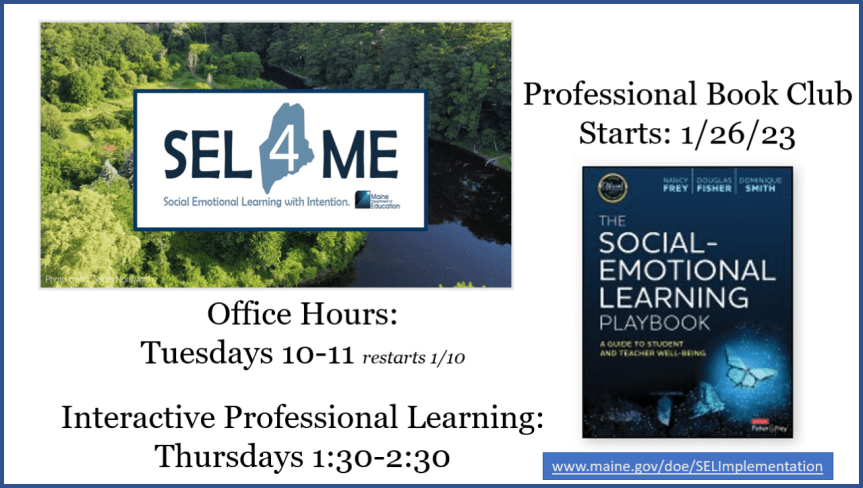
Please join Maine Department of Education (DOE) Social Emotional Learning (SEL) Specialist Sarah Norsworthy for the following SEL Implementation Professional Learning Opportunities being offered this winter and spring. Professional learning about SEL Implementation will occur in 4 strands, read & discuss, thinking routines, picture books and EdTech.

  • Weekly Open Office Hours: Tuesdays from 10:00-11:00 AM – Drop in with questions, comments, or for connection. Offered virtually – Pre-Register here Via Zoom Link
  • Weekly Interactive Professional Learning Opportunities: Thursdays from 1:30 – 2:30 PM – Offered Virtually – Pre-Register here Via Zoom Link. Each session will start with 20 minutes of focused learning followed by a conversation on classroom application. More info is available on the SEL Implementation Webpage. Upcoming sessions include:
    • 1/5/23 – Using Pear Deck To Build Belonging/Social Awareness
    • 1/12/23 – Picture Book Spotlight: Learning About Ourselves & Others. My Name Is An Address – A pronunciation guide is linked here. We will explore this book and talk about extending it within classrooms. Bring a copy – if you can.
    • 1/19/23 – Thinking Routine Spotlight: Developing Belonging, Social Awareness & Curiosity
    • 1/26/23 – Book Group: The Social Emotional Learning Playbook Module 1. Join ready to discuss module 1. Educators are encouraged to join with colleagues to continue the conversation within your schools.

Join the SEL Listserv for regular updates, and bookmark the SEL Implementation Webpage – resources and information are being regularly added.

For more information contact Sarah CB Norsworthy, Maine DOE SEL Implementation Specialist at sarah.norsworthy@maine.gov.

2023 Maine School Winter Wellness Summit: Prioritize Your S.E.L.F.

Prioritize Your S.E.L.F. – Sleep. Eat. Laugh. Fitness. “Be the best you, so you can be your best for your school.”

Join your colleagues from across the State to refill your wellness toolbox! This is a professional (and personal) learning event that will feature outstanding keynote speakers and engaging health promotion and wellness sessions. There will also be opportunities to learn about state programs and local school district wellness teams, successful wellness strategies, resources, and programs to can help build an action plan for healthier staff, students, school community, and learning environments.

When: Friday, January 27th from 8:00 a.m. – 3:30 p.m. (Snow date February 3rd)
Where: The Samoset Resort, Rockport, ME
Who: School and community individuals and teams of 2 or more interested in schoolsite health promotion and wellness
Cost: Early registration extended to January 6 from December 30 – $60/person. Regular registration after January 6 – $75/person. Late registration after January 20 – $90/person; Registration closes January 24. Morning Refreshments and lunch included in registration. Contact hours will be available. *If you will be paying by purchase order please contact susan.berry@maine.gov before you register. Now available: Scholarships to support access to the 2023 Winter Wellness Summit. Visit the website for details: Employee & Student Wellness Professional Learning

Our theme is focused on the importance of healthy habits and how they are interconnected. All areas of health will be addressed, (physical, mental, emotional, social, etc.) with knowledge and skills/strategies shared to enhance daily health practice. The content will support all within a school community promoting overall health and wellness.

Keynote Speakers:

Nancy H. Rothstein
Nancy H. Rothstein

The opening keynote speaker, Nancy H. Rothstein, aka The Sleep Ambassador®, is a globally known sleep expert on a quest to raise awareness, educate and provide strategies to optimize sleep for all. Sleep is integral to health, performance, productivity, safety, and well-being. This is a challenge for many so expanding our understanding of the impact of sleep, or not enough sleep, on our health is vital to our performance and well-being. Nancy’s goal is to empower people to enhance their sleep so they can live at their best.

Larry Weaver
Larry Weaver

The closing keynote, Larry Weaver, is a comedian and motivational speaker who delivers a one-of-a-kind, interactive, and uplifting message. He will illustrate keys to a positive attitude that are crucial to success and… simply having more fun at work! Larry will leave you laughing, learning, and better equipped to become more positive in your personal and professional life.

The goal of the Maine School Winter Wellness Summit is to inspire and empower participants to take care of one’s health and create healthier, more positive, and safer schools for all school personnel and students by engaging in health promotion and improving personal health and well-being and enhancing academic achievement.  In addition to the keynote presentations, this year’s agenda includes time to network with colleagues and professionals from across the state who value and practice health promotion and wellness, engaging and educational workshops on personal wellness practices and programs to support positive school environments, and support for worksite wellness program planning.

For more information visit the Maine DOE Employee and Student Wellness Website.  Contact susan.berry@maine.gov if you have any questions and please plan now to join us for the 2023 Winter Wellness Summit!