Student Career & Degree Exploration Event at Thomas College on 9/30 and 10/28  

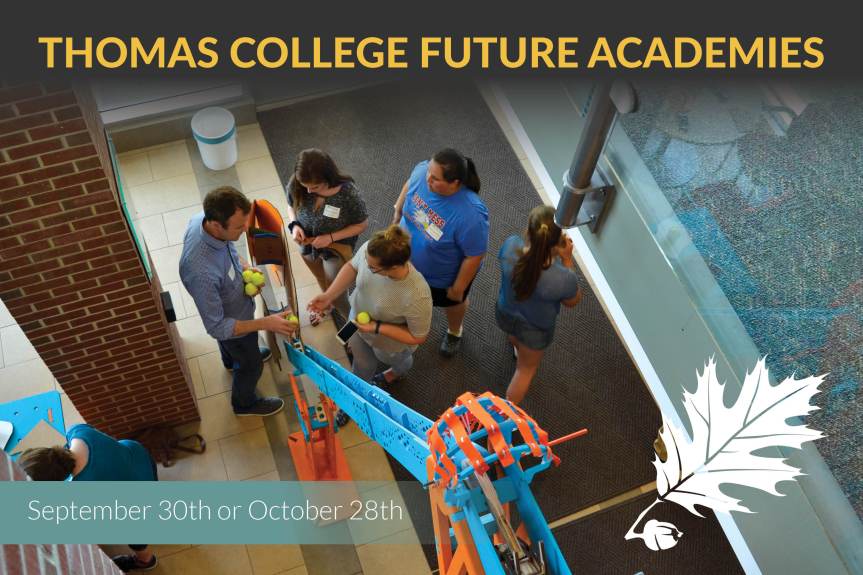
Thomas College, in partnership with the Maine Department of Education and the Maine Teacher of the Year Association, is hosting two hands-on, experiential career exploration days led by professional faculty and college students.

These career and degree exploration events are open to high school sophomores, juniors, and seniors who will have the opportunity to select a track and work with Thomas College professors and students to tackle real-world challenges.

The day also includes campus tours, lunch, and Thomas College swag.  Space is limited, so reserve your spot today!

Choose one day to attend:

September 30th
9am – 1:30pm
Thomas College
October 28th
9am – 1:30pm
Thomas College

Students attending can choose from the following tracks:

  • Future Teachers
  • Future Business Leaders
  • Future Tech Innovators
  • Future Crime Scene Analysts

Note: Thomas College does have some limited funding available to help support transportation to and from campus. Please reach out if you/your school would need this! For more information, please contact admiss@thomas.edu or 207-859-1101.

Register now!

Administrative Letter: Legal Requirements to Provide English Language Acquisition Services to Students who are English Learners (Revised 9.15.2021)

Administrative Letter: #27
Policy Code: IHBEA
TO: Public School Administrators
FROM: Pender Makin, Commissioner
DATE: August 22, 2019, Revised September 15, 2021

SUBJECT: The legal requirements for providing English for Speakers of Other Languages (ESOL) services to students who are English learners

Topics included in this letter:

  • Identification of students who are English learners
  • Exit criteria from ESOL services
  • Delivery of ESOL services
  • Administration of ACCESS for ELLs®
  • Enrollment of students who are immigrants and international students
  • Rights of students who are English learners to education
  • Students who are English learners and Special Education

Identification of Students Who are English Learners (EL)

Revision:

It is a federal requirement that all students who are English learners be identified within 30 days of enrollment from the beginning of the school year. For students enrolling at the start of the school year, parents/guardians must be notified of their child’s English learner status within the same 30-day period. After the start of the school year, SAUs must notify parents/guardians within two weeks of their child’s identification.

Each School Administrative Unit (SAU) must administer the Maine Department of Education’s Language Use Survey to the parent/guardian of every student, pre-kindergarten through 12th grade, enrolling in the SAU for the first time. The Language Use Survey must be included in the SAU’s enrollment packet or online enrollment system. If a student changes schools within a SAU, a new Language Use Survey is not required.

The Language Use Survey is available for download on the Maine Department of Education website   in English and 25 of Maine’s most commonly spoken languages. Parents/guardians are entitled to complete the Language Use Survey in their preferred language. SAUs must provide translation/interpretation services upon request.

The purpose of the Language Use Survey is to identify potential students who are English learners. The Language Use Survey decision tree provides guidance on its use. If any question is answered with a language other than English, the student should be administered an English language proficiency screener. (Note that Sign Language is not a qualifying language for English learner status. However, if a student uses Sign Language and an additional language other than English, the student may be eligible for English learner status.) See the resource and policy guide, Serving Maine’s Students who are English Learners, for information about the required screeners and identification thresholds, by grade level.

Students who were screened for EL status but did not initially qualify may be rescreened at any time if a potential need for ESOL support becomes apparent.

Exit Criteria from ESOL Services

In order to exit from ESOL services, a student must demonstrate English language proficiency. The Maine Department of Education defines English language proficiency as an overall composite proficiency level of 4.5 on ACCESS for ELLs®. No other measure qualifies a student who is an English learner for exit. While a district may choose to continue to provide language support services to students who have demonstrated English language proficiency, such students are no longer classified as English learners and are no longer administered ACCESS for ELLs® (or Alternate ACCESS, if applicable).

Students who are English learners with an IEP exemption from a domain or domains on ACCESS for ELLs/Alternate ACCESS are eligible to exit based on their performance on the non-exempt domains. The Maine Department of Education calculates an overall composite proficiency level for such students, utilizing a score of 4.5 on the exempt domain(s) and weighting domains according to WIDA’s overall composite score weighted formula.

Monitoring and Reentry into EL Status

Per federal guidance, SAUs are to monitor the performance of former students who are English learners for at least two years after exiting. If, during the two years of monitoring, or at any time thereafter, a former student who is an English learner shows a potential need for continued ESOL support, the student must be rescreened with the WIDA Screener Online to determine English learner status. If a student scores below the state-defined identification threshold, he/she must be reentered into English learner status, must receive ESOL services, and must take ACCESS for ELLs (or Alternate ACCESS, if applicable) until exiting.

Delivery of ESOL Services

An SAU is required to determine the components of an effective English language acquisition program tailored to the needs of each student, which may include, but is not limited to, tutoring, additional classroom support, materials, sheltered instruction, professional development for content area teachers, or other strategies (Office for Civil Rights December 1985 Title VI policy memorandum, Title VI Language Minority Compliance Procedures).

The Maine Department of Education requires the English language support program for a student who is an English learner to be provided or overseen by a 660 ESOL-endorsed teacher. (See 34 Code of Federal Regulations C.F.R. Section 100.3 (b)(ii)). All students who are English learners must be provided with English language support services that enable them to meaningfully access the curriculum in order to meet grade-level standards. English language development and content area knowledge are to be acquired simultaneously, rather than consecutively. In other words, English language proficiency is not a prerequisite to participate in mainstream classes. If students who are English learners receive services that remove them from content area classes (such as a newcomer program or pull-out services), any academic deficits that result must be remedied so the student remains on track with his/her non-EL peers academically.

English language support services are to be provided in a way that minimizes the isolation of students who are English learners from the general student population and encourages students who are English learners to participate in all aspects of the school program, including advanced coursework, career and technical education, gifted and talented programs, and extracurricular activities. Students who are English learners are entitled to ESOL services until exiting by demonstrating English language proficiency on ACCESS for ELLs® (or Alternate ACCESS, if applicable).

Administration of ACCESS for ELLs® or Alternate ACCESS

Federal and State laws require that the English language proficiency of all students who are English learners be measured annually as a component of accountability under the Elementary and Secondary Education Act (ESEA). If a student is identified as an English learner, that student must be administered ACCESS for ELLs (or Alternate ACCESS, if applicable) annually until the student demonstrates English language proficiency. The Maine Department of Education defines English language proficiency as a composite proficiency level of 4.5 on ACCESS for ELLs or level P2 on Alternate ACCESS. Failure of all students who are English learners to participate in the annual administration of ACCESS for ELLs/Alternate ACCESS may affect ESEA Title IA funding.

State law requires that ACCESS for ELLs/Alternate ACCESS be administered only by an individual trained it its administration. It is not required that this individual be an ESOL-endorsed teacher. However, only an ESOL-endorsed teacher is qualified to design, oversee, and implement an English language support program, which includes the interpretation of ACCESS for ELLs/Alternate ACCESS results.

If parents/guardians have questions about the purpose of ACCESS for ELLs/Alternate ACCESS, direct them to ACCESS for ELLs: FAQs for Parents/Guardians.

Enrollment of Immigrants and International Students

Title VI of the Civil Rights Act of 1964 prohibits discrimination based on race, color, or national origin, among other factors, by public schools. SAUs are required under federal law to enroll children regardless of citizenship or immigration status (Plyler vs. Doe). This applies  equally to students who are immigrants and international students attending a Maine public school as an exchange student or tuition-paying student. All students, including those who are immigrants and international students, must be screened for English learner status. Any student who is identified as an English learner, regardless of citizenship or immigration status, is entitled to ESOL services and must be administered ACCESS for ELLs (or Alternate ACCESS, if applicable) annually. International/exchange students are not exempt from Title I required state academic assessments. In Maine, recently arrived English learners who have been enrolled in a U.S. school for less than 12 months are exempt from one administration of the state’s English language arts assessment only. See the

SAUs are not permitted to discourage the enrollment of children who are undocumented immigrants by asking about their immigration status, denying enrollment to those with international birth certificates, or denying enrollment to children whose parents decline to provide their social security numbers or race and ethnicity information. Federal regulations allow schools to ask for children’s social security numbers to be used as student identifiers. However, they should inform parents of the purpose and that disclosure of such numbers is voluntary. Schools may not deny enrollment if parents refuse to provide a child’s social security number. SAUs may require proof that a child lives within SAU boundaries, which may include lease agreements, utility bills, or other documents. However, schools may not ask parents about a child’s immigration status to establish residency. SAUs may require proof of a child’s age, but they may not bar enrollment because a child has an international birth certificate or no birth certificate. See this fact sheet from the Departments of Justice and Education for more details about acceptable documentation requests.

Rights of Students who are English Learners to Education

The Civil Rights Act of 1964 remains the foundation of the legal rights of aa student who is an English learner. Lau v. Nichols confirms that all students who are English learners are entitled to meaningful access to the curriculum. If a parent refuses ESOL services this must be documented, but parental refusal does not release the school or SAU from its responsibility to provide meaningful education to students who are English learners. If a student who is an English learner cannot make academic progress without ESOL services, the student has a right to ESOL services, even if a parent refuses. Parental consent is not required to administer an English language proficiency screener or ACCESS for ELLs/Alternate ACCESS. Under State law SAUs are responsible for administering ACCESS for ELLs® to all students who are English learners, regardless of parental consent (20-A M.R.S. §6209(1-A)).

Students who are English Learners and Special Education

Students may qualify for, and have legal entitlement to, both ESOL and special education services. Appropriate screening is required to determine students’ eligibility for each type of service. Depending on a student’s learning disability and Individual Education Plan (IEP), universal testing tools or accommodations may be needed in order to measure English language proficiency. When evaluating a student who is an English learner for learning disabilities, screening must be linguistically and culturally appropriate. It is advisable to measure a student’s skills in the student’s primary language in order to clarify whether challenges are due to a learning disability or English language development.

Students who are English learners should not be placed in a special education program unless their exceptionality is well-documented, and appropriate procedures for special education services have been followed. English learner status is not a disability and is not covered by the Individuals with Disabilities Education Act (IDEA) or Maine Unified Special Education Regulations (MUSER).

For students who are English learners with IEP teams, the United States Department of Education has provided the following guidance:

“It is important that IEP Teams for ELs with disabilities include persons with expertise in second language acquisition and other professionals, such as speech-language pathologists, who understand how to differentiate between limited English proficiency and a disability. The participation of these individuals on the IEP Team is essential in order to develop appropriate academic and functional goals for the child and provide specially designed instruction and the necessary related services to meet these goals.”

Students who are English learners with learning disabilities are eligible for exit from ESOL services when they demonstrate English language proficiency by achieving an overall composite proficiency level of 4.5 on ACCESS for ELLs (or level P2 on Alternate ACCESS, if applicable).

If you have questions, or would like further information regarding serving students who are English learners, please contact April Perkins, ESOL/Bilingual Programs, at april.perkins@maine.gov or (207)624-6627.

Educational Resources to Help Honor National Hispanic Heritage Month

Today marks the first day of National Hispanic Heritage Month which is celebrated each year from September 15 to October 15 across the nation. The month is a time to honor Hispanic heritage by celebrating the histories, cultures, languages, and the remarkable contributions of Hispanic people to the fabric of the United States, whose ancestors came from Spain, Mexico, the Caribbean, and Central and South America. It is also a time to revisit ways to integrate diverse cultural material into education lessons all year long.

Here are some educational resources that can be used by schools to honor, recognize, and teach students about Hispanic heritage:

For further resources and information about integrating diverse backgrounds, cultures, and experiences into classroom lessons, please visit the Maine Department of Education’s Diversity, Equity, and Inclusion webpage.


REMINDER: How to use Sara Alert™ COVID-19 Monitoring System Safely and Effectively

The Maine Department of Education (DOE) contact tracing team uses Sara Alert (844) 957-2721 to monitor students and staff in PK-12 schools who have been in close contact to someone who has tested positive for COVID-19. Sara Alert is a public health system that supports the Maine Center for Disease Control and Prevention (CDC) to monitor for symptoms amongst the school population.

In an effort to ensure that Maine schools and their communities have all of the information they need to use Sara Alert™ safety and to ensure their personal information is safe while enrolled in Sara Alert™. Please disperse these helpful informational flyers to school communities statewide:

For more information email sarasupport@aimsplatform.com or visit www.saraalert.org.

RSU 54 Administrative Assistant Appointed Board Chair of National Association of Educational Office Professionals 

Vivian Champagne has been an Administrative Assistant in Skowhegan’s RSU #54/MSAD #54 School District. She has been working there since 2005, where she has been part of both high school athletics and adult education.

Vivian is a member of the National Association of Educational Office Professionals (NAEOP), a national association which aims to provide professional growth through leadership, education, achievement, recognition, and networking opportunities for educational office professionals.

As a dedicated member of NAEOP since 2012, and a past president of Maine’s state association, Maine Educational Office Professionals (MAEOP), Vivian recently completed NAEOP’s Professional Standards Program certification program and earned her Certified Educational Office Employee (CEOE) distinction.

“Professional Development is an important piece of my career,” said Vivian. “Searching for new things to learn took me from the state association to the national association which offered the CEOE distinction, which is the only nationally recognized certification program, credentialed for educational office professionals.”

Shortly after obtaining her CEOE, Vivian was appointed by the national president of the NAEOP to serve as Chairman of the 2021-2022 Administrative Council., an honor in which she was installed during this year’s NAEOP Annual Conference in July 2021.

The Administrative Council is comprised of education office professionals who work at the district or central office level, State Department of Education, School Boards Association, or any service unit that serves a number of school districts in a specified area in the state.

“I now represent any NAEOP member who is an administrative assistant that works in the office of education from K-12, college, and state level across the nation,” Vivian explained excitedly.

The one-year appointment will allow Vivian to be the connection between the administrative NAEOP members and the NAEOP board of directors, which she is energized to do through regular communication and workshops.  She is looking forward to elaborating and sharing more details during her term.

When not juggling her professional demands, Vivian is dedicated to her family. Happily married for 37 years, she has two adult children and two wonderful twin granddaughters.

To learn more about the NAEOP visit: https://www.naeop.org/

To learn more about the MAEOP visit: https://www.maine-association-educational-office-professional.com/

This article is part of the Maine Schools Sharing Success Campaign. To submit a story or a story idea, email Rachel at rachel.paling@maine.gov.

Apply for Federal Funds to Support Remote Learning – Application Window 9/28-10/13

The Emergency Connectivity Fund is a $7.17 billion program funded by the American Rescue Plan Act of 2021 to help schools and libraries support remote learning. The Program provides funding to schools and libraries for the reasonable costs of eligible equipment and services that can be provided to students, teachers, and library patrons who lack connected devices, such as laptop or tablet computers, and/or lack broadband access during the pandemic.

Who Is Eligible to Receive Funds Through the Emergency Connectivity Fund Program?

  • Schools, libraries, and consortia of schools and libraries that are eligible for support under the FCC’s E-Rate program, are eligible to request and receive support through the Emergency Connectivity Fund Program.
  • In addition, the Order clarifies that Tribal libraries, which are eligible for support under the Library Services and Technology Act, are also eligible for the Emergency Connectivity Fund.
  • Schools and libraries eligible for the Emergency Connectivity Fund Program do not need to be current E-Rate participants. Eligible entities that have not applied for E-Rate support should be prepared to demonstrate eligibility as a school or library under the Program rules during USAC’s application review.

What Equipment and Services Are Covered by the Emergency Connectivity Fund Program?

  • The following types of equipment purchased for off-campus use by students, school staff, and library patrons who would otherwise lack sufficient connectivity to engage in remote learning are eligible for support:
    • Laptop and tablet computers
    • Wi-Fi hotspots
    • Modems (including air cards)
    • Routers
    • Devices that combine a modem and router.
  • Schools and libraries can also receive funding for commercially available broadband internet service that provides a fixed or mobile broadband connection for off-campus use by students, school staff, or library patrons who would otherwise lack access to connectivity sufficient to engage in remote learning.
  • In limited circumstances where a school or library can demonstrate that there are no available service options sufficient to support remote learning for its students, school staff, or library patrons, the Emergency Connectivity Fund Program may support the construction of new networks and the equipment needed for datacasting services.
  • Review the Eligible Services List for additional guidance on the equipment and services eligible for funding under the Emergency Connectivity Fund Program.

How Can Schools or Libraries Apply?

  • second ECF application filing window will open on September 28, 2021 and close on October 13, 2021. During this second filing window, eligible schools, libraries, and consortia of eligible schools and libraries can submit requests for funding to purchase eligible equipment and services between July 1, 2021 and June 30, 2022.
  • The Universal Service Administrative Company (USAC) is the administrator of the ECF Program and will review applications.
  • Interested schools and libraries can find more information and apply at emergencyconnectivityfund.org
  • The initial ECF Program application filing window opened on June 29 and closed on August 13.

Apply Now


Resources and Information about Protecting Student Privacy

Federal and state laws regulate the privacy of student education records. These laws apply to all schools that receive funds under an applicable program of the U.S. Department of Education (DOE). With this in mind, the Maine DOE has put together a toolkit of links to information, resources, and training for district administrators and school employees to use as a quick reference for information and contacts related to student data privacy.

In addition to having links to information about the Family Educational Rights and Privacy Act (FERPA) and other federal and state laws that protect student privacy, there are also training videos, resources and guidance from U.S. DOE about understanding what student privacy is as well as other more in-depth tutorials about everything from virtual learning to integrated data systems.

The toolkit also features state level resources such as the Maine Student Privacy Alliance (MSPA), in addition to more student privacy resources from U.S. DOE, both specifically for district administrators but also for early childhood educators, education technology vendors, parents and students, postsecondary school officials, and researchers.

Access the Maine DOE Student Data Privacy Toolkit here.

For further questions about student data privacy, contact U.S. DOE Student Privacy Help Desk (Toll-Free): 1-855-249-3072

Working with Community Partners to Provide State-Funded Pre-K

Recently, members of the Early Learning Team at the Department of Education (DOE) partnered with the Maine State Head Start Collaboration Office and the Governor’s Office of Innovation and the Future to provide a three-part professional learning series aimed at supporting school administrative units (SAUs) in navigating formal partnerships with licensed community providers. The series examined common myths and facts about partnering, explored the benefits and barriers of forming partnerships, and reviewed a roadmap for beginning conversations between partners. Representatives from existing public Pre-K and community partnerships also joined for a one-hour panel highlighting their own unique experiences in providing high-quality public Pre-K programs through formal partnerships.

All three, one-hour sessions were recorded and are now available on the Maine DOE’s Early Childhood website on the Professional Learning & Resources page. Additionally, links to individual sessions are provided below.

As SAUs in Maine continue to start and expand their public Pre-K offerings, partnerships are highly recommended to support the growing number of children that would like to attend as well as the needs of families. The Early Learning Team is prepared to support these conversations as needed. Those interested in more resources should reach out to one of the following specialists:

Early Education Team Coordinator, Leeann.larsen@maine.gov

Early Childhood Specialist, Nicole.madore@maine.gov

Early Childhood Monitor, Marcy.r.whitcomb@maine.gov

State Head Start Collaboration Director, Nena.m.cunningham@maine.gov

Senior Policy Analyst & Children’s Cabinet Coordinator, Ana.hicks@maine.gov

WEBINAR SERIES: Deeper Learning Through The Arts

Join the Maine Department of Education (DOE) for for a free Professional Learning Series for educators of all content areas and grade levels!
Students are more likely to make meaning and gain understanding when they link new information to prior knowledge, relate facts to “big ideas,” explore essential questions, and apply their learning in new contexts. Where does arts integration fit in this process? By bringing the best practices of artists into the classroom as learning tools, students and teachers identify what quality work is and how to produce it in each subject area. Working together to craft meaning, teachers, artists and students become powerful partners in search of understanding.

This workshop series will provide strategies that empower teachers and artists to collaboratively design meaningful learning experiences for all students.
Teachers will explore how integrating arts into education can help students:

  • cultivate life-long habits of mind.
  • foster deep and personal understandings of standards-based math, science, social studies, language arts and fine arts.
  • develop powerfully articulate voices for expression.

Four Sessions – 2 hours each session:

  • Oct 13, 2021 03:30 PM
  • Oct 20, 2021 03:30 PM
  • Oct 27, 2021 03:30 PM
  • Nov 3, 2021 03:30 PM

Register here

Contact Jason Anderson, Maine DOE VPA Specialist, for more information: jason.anderson@maine.gov

Maine FrontLine WarmLine Available to Support School Staff

The Maine FrontLine WarmLine is a phone support service that provides Maine’s essential health care workers, first responders, and school staff with help in managing the stress of providing essential services during our fight against the COVID-19 pandemic.  The volunteers on the other end of the line are available to help callers address concerns with anxiety, irritability, poor sleep, grief or worry and, if needed, connect them with additional supports.

The FrontLine WarmLine is available from 8 AM to 8 PM, 7 days a week by calling (207) 221-8196 or Text the word “frontline” to 898-211 for support.

As Maine’s schools have faced multiple challenges during the COVID-19 pandemic, teachers and school staff are working tirelessly to provide education and support services to children across Maine.  The work of providing these services during the COVID-19 pandemic can take an emotional toll on those who are juggling their own families, the creation of multiple curricula, nutrition programming, providing social emotional support, cleaning and other facilities needs, and transportation to and from school, among the multiple other support services that students receive at school. It is equally imperative that these heroic education staff member are provided with support and resources to continue in their professions.

The FrontLine/WarmLine is staffed by volunteer professionals activated through Maine Responds, which includes licensed psychiatrists, psychologists, clinical counselors, social workers, and nurse practitioners. It launched in April 2020 as a joint effort of the Maine Department of Health and Human Services (DHHS), Maine Department of Public Safety’s Emergency Medical Services (EMS), Maine Association of Psychiatric Physicians, Opportunity Alliance, Maine Psychological Association, the Maine Chapter of the National Association of Social Workers, Maine Department of Education, the Maine Education Association (MEA), and MEA Retired.

The FrontLine WarmLine is a central component of the Maine DHHS Office of Behavioral Health’s StrengthenME program, which supports mental health and resiliency in response to the COVID-19 pandemic. For those who are not health care workers, first responders or school staff but are experiencing emotional distress, several other 24/7 resources are available:

  • Statewide Crisis Line: 888-568-1112
  • Intentional Peer Support Warmline to speak with staff who have lived experience with mental health conditions: 866-771-9276
  • Suicide Hotline: 800-273-TALK (800-273-8255)
  • 211 and 211maine.org can provide general COVID-19 information, including how to access behavioral health and social service resources
  • Maine DHHS Office of Behavioral Health resources guide