Free Inclusive Practices Training & Technical Assistance for Public Preschool Programs

Reminder, the deadline for applying is fast approaching!

School Administrative Units (SAUs) are asked to apply by June 4, 2021 to take advantage of this exciting professional development opportunity.  Notifications of acceptance will be provided by June 10, 2021.

This offering is available to any SAU in Maine with a public preschool program. The 2021 cohort will consist of 3 classrooms of 6 participants each. Teams must include the preschool teacher, ed tech, principal, special ed director, elementary special ed teacher and a regional CDS consultant or teacher. The purpose of team participation is to ensure consistent understanding and application of the course content so that high quality inclusive practices will be supported and sustained.

More detailed information about this opportunity can be accessed here.

The complete application is available at this link.

You may access this PDF version to preview the application prior to completing.

The project requirements include: Projected timeline:
Completion of the on-demand training: Inclusive Environments in Public Pre-K. By August 18, 2021
Participation in a half-day virtual orientation session. Mid-August 2021
Completion of an 18 hour online training: Creating Inclusive Preschool Settings Classrooms. September-November 2021
Participation in 2 PLCs scheduled as follow-up support during the online training. October 2021
Participation in consultation.

*It may be necessary to align class coverage on the days of consultation for some period of time.*

  • 2 (1-2 hour) classroom based consultations (onsite or technology-based).
  • 2 (1-2 hour) administrative consultation (onsite or technology based)
October-November 2021
Participation in a wrap up meeting hosted by the DOE to evaluate the project and short district team presentations to showcase your learning. December 2021

For more information, view the FAQ  or contact:

Nicole Madore at Nicole.madore@maine.gov or

Marcy Whitcomb at Marcy.r.whitcomb@maine.gov

MEDIA RELEASE: National Funding to Support Enhanced Access, Utilization of Wabanaki Resources

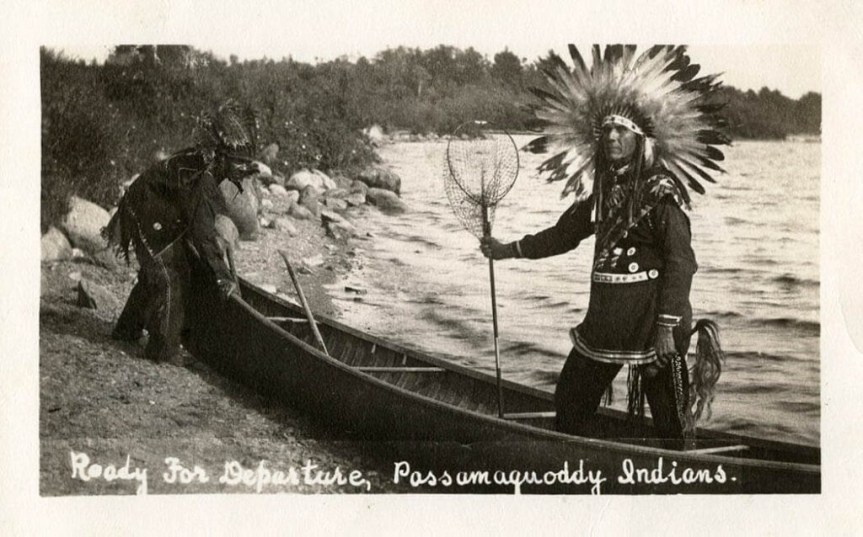
Image: Courtesy of the Hudson Museum HM7182.133

Collaborators on the project include partners from Raymond H. Fogler Library, the College of Education and Human Development and Native American Programs at UMaine, members of the Wabanaki Confederacy and the Wabanaki Studies Working Group, the Maine Department of Education, the Abbe Museum in Bar Harbor, Amherst College and the University of Massachusetts Amherst.

The National Endowment for the Humanities has awarded a grant of more than $59,000 to the University of Maine’s McGillicuddy Humanities Center to support development of a centralized digital portal that will improve access to Wabanaki historical and cultural resources and archival collections currently distributed across UMaine and, in the future, to incorporate collections curated by several external institutions.

“Teaching about the people whose land we inhabit today is crucial work and I am excited to be able to represent the Maine Department of Education (DOE) in support of this grant,” said Maine DOE Coordinator of Secondary Education and Social Studies Specialist Joe Schmidt. “During my time at the Department I have strived to make sure that we remove barriers for educators when it comes to teaching about Maine Native Americans and from the start of her time at the Department, Commissioner Makin has made this one of her top priorities as well. By working to develop a centralized portal of historic artifacts, educators will be better equipped to develop and deliver inclusive and accurate curriculum related to Wabanaki history and culture. Through this grant, we will take another step in making sure that all of our students can see themselves as important contributors to the past and present of all that Maine has to offer.”

UMaine professor of English Margo Lukens, a faculty adviser to the McGillicuddy Humanities Center, will lead the interdisciplinary Wabanaki Resources Portal project, which seeks to enhance utilization of existing resources to promote the study of Wabanaki history and culture at the elementary, high school and post-secondary levels in Maine and to facilitate interdisciplinary academic and arts scholarship.

UMaine’s archival holdings related to Wabanaki history and culture are extensive, and include the collection of Fannie Hardy Eckstorm, an early twentieth-century independent scholar of Wabanaki history and culture; the Molly Spotted Elk Collection, which provides a Penobscot view of the United States and Europe; the Linda Gilbert Collection of Penobscot Indian Music featuring original audio recordings about traditional song and dance; and the Maine Indian Collection, one of the largest institutional collections of Wabanaki baskets and basketmaking materials and tools, which is curated by the Hudson Museum. The museum also maintains a collection of significant primary resources, particularly images portraying traditional Wabanaki activities such as basketmaking and harvesting.

Other Wabanaki artifacts stewarded by UMaine include photographs of Passamaquoddy and Penobscot people including prominent tribal members Andrew Sockalexis and Lucy Nicolar Poolaw, who was also known as Princess Watawahso, characteristic objects from the 1880s through today, and the Senator William S. Cohen Papers related to the Maine Indian Land Claims Settlement Act of 1980. Fogler Library also maintains copies of recordings of Wabanaki speech and story now in the Library of Congress collection.

Much of the Wabanaki history and cultural material now housed in University of Maine collections is the intellectual and physical property of the Wabanaki tribes. A 2018 memorandum of understanding between UMaine and the Penobscot Nation delineates a process of artifact co-curation that includes tribal members to ensure culturally responsive care and use of archival material held by a nontribal organization. Maine’s Native American communities will be included in decision and policymaking related to the collections, including controlling access to culturally sensitive materials. UMaine is working to develop a similar memorandum of understanding with the Passamaquoddy Tribe.

Currently, access to UMaine’s resources is limited by siloed storage across multiple, unconnected locations and formats. Developing a centralized portal where digital copies of historic artifacts can be archived as searchable files will enhance interest in Wabanaki history and cultures while serving a diverse stakeholder base with interests in American history, literature, linguistics, law, art and natural sciences, as well as the study of colonization and decolonization in American society.

The Wabanaki Resource Portal project will center the ideas and perspectives of Wabanaki people in providing access to significant historical materials meant to educate the public, facilitate scholarship, preserve Wabanaki traditions and art, and support development of inclusive and accurate K–12 curricula that enhance the teaching of Wabanaki history and culture in Maine schools.

Collaborators on the portal project include partners from Raymond H. Fogler Library, the College of Education and Human Development and Native American Programs at UMaine, members of the Wabanaki Confederacy and the Wabanaki Studies Working Group, the Maine Department of Education, the Abbe Museum in Bar Harbor, Amherst College and the University of Massachusetts Amherst.

Lukens has co-authored “‘Still They Remember Me’: Penobscot Transformer Tales, Volume 1” with Penobscot language master Carol Dana and University of Southern Maine linguistics faculty Conor Quinn. The book recounts traditional tales of Gluskabe, the tribe’s culture hero, as told by Penobscot Newell Lyon to anthropologist Frank Speck. Speck published the stories in 1918 in an academic report titled “Penobscot Transformer Tales.” The 2021 bilingual edition of Transformer Tales, which was designed for language learning, presents the stories in contemporary Penobscot orthography with updated English translations and features artwork created by tribal members. The book will be available from the University of Massachusetts Press in June 2021.

For more information about this project contact Joan Perkins, joan.perkins@maine.edu

Wabanaki Seminar June 12, 2021 9am-12:15pm

The Maine Department of Education is delighted to invite educators statewide to our June 12 recognition of the 20th Anniversary of the signing of LD 291 which requires the teaching of Wabanaki History and Culture in Maine classrooms.

Please join us and a variety of educational leaders from 9-12:30 on Saturday, June 12. We will begin the morning with greetings from Governor Mills, Commissioner Makin and a keynote by legislation sponsor, Hon. Donna Loring.

Register here

For more information about the Wabinaki Seminar contact Joe Schmidt at joe.schmidt@maine.gov

Huge Increase in Independent Capstones at Portland High School During Unique School Year

This year, many Portland High School seniors took on unique independent projects as their senior capstone. Projects included building an artist’s shed, building a smoker, art work, career research, building a guitar, making electronic music, and researching topics such as Buddhism, reading and mental health, preparing for the Navy, lobstering and African clothing. 

Capstone requirements include student choice and research. Most students complete their capstone through a class, but some students design their own independent projects. In a typical year, there may be two or three students who take on an independent capstone, but this year over twenty students designed their own project. Independent capstones help students to explore a particular passion.

Skye Ferris, who made a series of portraits of friends and family reflects, “My advice for next year’s students is to choose a project that you are actually excited to complete, as I found my own process very enjoyable and it was something I had wanted to do for some time.”

Elias Parker who worked with two other students to help build an artist’s shed said, “ I am most proud of the seemingly far-fetched idea we had, and our ability to follow through and not sacrifice any magnificence nor quality in our project.”  When asked about advice he would give other students, Eli shared “GO BIG, you’ll be proud of yourself”

This large increase is likely due to the fact that the pandemic allowed for more independent learning, time to explore personal interests, and flexible time in which to do the projects. Hopefully this is a start to many meaningful independent projects in the future!

Information for this article was provided by Portland Public Schools as part of the Maine Schools Sharing Success Campaign. To submit a story or an idea, email it to Rachel at rachel.paling@maine.gov.

Students Against Destructive Decisions Offers Free Programming to Maine Schools

Students Against Destructive Decisions is expanding its reach throughout the state and offering all educational institutions free access to resources on mobility safety; substance use and prevention; mental health and wellness; and leadership and engagement. SADD offers students the chance to make big changes in their communities and improve the culture and climate of their schools through peer-to-peer education. SADD”s programming is evidence based, student led, and completely free.

For more information about how to start a SADD chapter at your school, please contact Christina Schechtman at cschechtman@SADD.org. For more information about SADD, visit www.SADD.org.

Belfast Teacher Named Alternative Educator of the Year

The Alternative Education Association (AEA) of Maine has announced that Lindsey Schortz of the Belfast Community Outreach Program in Education (BCOPE) has been named the 2021 Alternative Educator of the Year. Lindsey is the Lead Science and Math teacher in the program and has become integral to the success of the students while engaging them in their learning. The Maine Department of Education joins the AEA in recognizing the hard work and determination of Lindsey and all of alternative educators across Maine for everything they do to ensure that each and every student has the opportunity to learn.

“I love alternative education because it provides opportunities for students and teachers both,” said Lindsey Schortz. “For students who have not seen success in a traditional setting for whatever reason, it shows them that there is another way for them to learn.  For teachers and students, it is an opportunity to be creative, study topics in depth and perhaps most importantly form real relationships.  I feel fortunate to work at a school with such deep roots in the community and in a district that values alternative education and how it can transform a student’s educational experience.”

Colden Golann, Assistant Principal at Belfast High School, says “what separates Lindsey is her commitment to her students. She will stop at nothing to support kids and help them overcome the obstacles they are facing. Last year during school closures, Lindsey took it upon herself to visit any student who was not participating and often taught individualized lessons in driveways, porches or on breaks from student’s jobs.

Daisy Bradney, a student in the BCOPE program described Ms. Schortz as a, “kind, caring, and very passionate about what she does….she has always been my go to person whenever something exciting happens, she is always so thrilled for our achievements…no matter how big or small.

The AEA also recognized the other finalist for this award, Linda “Cookie” Dana of Bangor High School remarking that these great educators represent the level of excellence as determined by the National Alternative Education Standards.

The AEA will recognize both honorees and their achievements at their Annual Conference on May 28th.


PRIORITY NOTICE: Adopted English Language Development Standards; Process and Support

As a critical companion to the Maine Learning Results, Maine’s officially adopted K-12 English language development (ELD) standards are the WIDA ELD Standards, which are:

  • Language for Social and Instructional Purposes;
  • Language for Language Arts;
  • Language for Mathematics;
  • Language for Science; and
  • Language for Social Studies.

In March of 2021, WIDA released the refreshed ELD Standards Framework, 2020 Edition, which serves as a foundation for systems that foster engaged interactive student learning and collaborative educator practice. The Framework is centered on equity for all students and fosters the assets, contributions, and potential of culturally and linguistically diverse children and youth. It also provides a clear and coherent structure to guide the development of curriculum, instruction, and assessment of content-driven English language learning.

Over the course of the 2021-2022 school year, districts will need to engage in planning and preparation for full implementation of the new WIDA ELD Standards Framework beginning in the 2022-2023 school year. We suggest the following three steps for effective implementation.

Step 1: Professional Learning

The implementation process begins with professional learning about the new standards framework and dedicated time for collaborative learning/planning with educators, across grade levels and content areas, across the district and within individual schools. Administrators, curriculum coordinators, teacher leaders, and others who coordinate the professional learning calendar should plan accordingly for this important work to occur. (See the end of this article for opportunities for professional learning through the Maine Department Of Education (DOE).

Step 2: Plan the Collaboration Cycle

The Collaboration Cycle consists of 4 components.

  1. Co-Reflecting-Includes WIDA Can Do Philosophy and Guiding Principles of Language Development
  2. Co-Planning-Includes WIDA ELD Standards 2020 Edition
  3. Co-Teaching-Includes WIDA Focus Bulletins and WIDA Professional Learning
  4. Co-Assessment-Includes WIDA Assessments, WIDA Rubrics, and Proficiency Level Descriptors.

The Focus Bulletin outlining this Collaboration Cycle in detail can be found here. In order for collaboration to succeed, district and school leaders must develop a culture of shared responsibility and create both curricular and administrative structures that facilitate collaboration. “Regardless of the type of educational setting and programming, a coordinated effort among all district and school levels is necessary to provide multilingual learners with meaningful learning experiences and an equitable, high quality education” p. 236 WIDA ELD Standards Framework, 2020 Edition.

Step 3: Classroom/Content Area Teachers and ESOL Teachers Engage in the Collaboration Cycle

The components of the ELD Framework will be utilized to inform language development planning across units of study or curriculum maps. An important component of this planning is English learners’ Individual Language Acquisition Plans, which should include appropriate grade-level language expectations grounded in the five ELD standards.

The Maine Department of Education is pleased to provide support to School Administrative Units (SAUs) in their implementation of these required state standards. We invite all districts to participate in the following trainings:

  • A free, self-paced, six-module eWorkshop called The WIDA 2020 ELD Standards Framework: A Collaborative Approach is available to all Maine public school educators through the WIDA Secure Portal. If you do not yet have a WIDA Secure Portal account, contact WIDA Client Services to have one set up for you. (Note that you must have a Maine public school email address.)
  • A 45-minute overview of the WIDA ELD Standards Framework, 2020 Edition, was provided on May 7th at the Maine ESOL Meeting. A recording of this overview presentation is available here.
  • The Maine DOE is hosting a series of two eWorkshops, facilitated by WIDA, on Planning with 2020 WIDA ELD Standards. The eWorkshops will take place on June 9th and June 16th from 9:30am to 11:30am. Participants must attend both sessions. The workshops are free and limited to 40 participants. Registration closes June 1st. Register here.

Additionally, the Department invites educators to participate in a virtual professional learning community, which will guide them through the self-paced eWorkshop mentioned above. If you are interested in participating or serving as a teacher leader facilitator, contact Robin Fleck, ESOL Consultant, at robin.fleck@maine.gov. Contact hours will be provided.

Subscribe to the Maine DOE ESOL Educators Listserv to receive updates on additional professional learning opportunities related to the WIDA ELD Standards and other ESOL topics.

If you have any questions about the WIDA ELD Standards or the requirements for implementation, please contact April Perkins, World Languages & ESOL/Bilingual Programs Specialist at april.perkins@maine.gov.

Notice of Concussion Workgroup (LD 104)

As directed by L.D. 104, An Act to Protect the Health of Student Athletes by Requiring the Department of Education to Report on the Incidence of Concussions which was signed into law by Governor Mills on March 17, 2021, the Department of Education’s Concussion Workgroup is expanding its work. The law requires that the Department work with the Maine Principals’ Association to use existing or new collection methods in order to report on the incidence of concussion in Maine schools. The Department, together with the Maine Principals’ Association is pleased to continue working with the Maine Association of School Nurses and Maine Concussion Management Initiative (MCMI) as the Concussion Workgroup. The recent directive from the Maine Legislature instructs the Department to report to the Education and Cultural Affairs Legislative Committee annually, beginning in January 2022, on any available data on the incidence of concussions sustained by student athletes in the state using existing or new data collection systems. The report must include recommendations on best practices for the collection of such data.

The Head Injury Tracker (HIT) was developed by MCMI 2013 with the goal of providing schools with an ability to identify high-risk activities for brain injuries by tracking patterns of concussions within their school systems. The HIT platform, available at no cost, provides schools with an easy, confidential, and secure method of collecting concussion data for their students. The HIT website serves many purposes including protecting the propriety and confidentiality of the data collected, providing a platform for reporting concussion data to the State, and potentially a tool for schools to compare their risk analysis with other schools throughout the state.

The HIT website was developed with the importance of concussion reporting in mind and can be easily implemented and utilized at all institutions throughout the state. The website allows for multiple individuals, not just the athletic trainer or school nurse, at a school to enter the data allowing for easy tracking and communication surrounding a student’s recovery. Additionally, the data collected from the HIT website can be used to detail the impact a head injury has on a student’s academic, athletic, and personal experiences. In order for us to identify the impact of concussion on students, we must collect data. As we learn more, we will work together in this ongoing effort to improve academic and social emotional outcomes for all students with head injuries.

The Concussion Workgroup looks forward to working together on this initiative with the understanding that this is a long-term effort to improve outcomes for students who experience head injury. Over the next several months you can expect to see more educational opportunities for school personnel on recognizing a head injury, documentation, and tracking with the Head Injury Tracker (HIT).   We are working to develop a cadre of 25 schools that will work toward implementation in the fall of 2021, knowing that the larger goal is for all schools to participate.

For more information on concussion management in Maine schools please visit: https://www.maine.gov/doe/schools/safeschools/healthed/concussion

If you have questions about these efforts, please contact Emily.Poland@maine.gov .

Unpacking the Public Pre-K Guidebook

The Maine Department Of Education’s Early Learning Team is excited to offer a summer professional learning series focused around the newly released Pre-K Guidebook. This resource was designed to support expansion of high-quality and inclusive public Pre-K in Maine.

The Public Pre-K Guidebook describes high-quality pre-k programming, provides guidance for developing and implementing inclusive public pre-k programs that align with state requirements, and offers links to a wide variety of useful tools.  Beginning June 16th, this learning series will meet weekly from 9-10 am over the course of seven weeks. Each virtual meeting will focus on specific sections of the Guidebook and is designed for administrators and educators.

Topics to be covered include:

  • June 16- Program Structure
  • June 23- Inclusive Student Support
  • June 30- Collaborations and Partnerships
  • July 7- Preschool Budgets
  • July 14- Family Engagement
  • July 21- Transition to Preschool and Kindergarten
  • July 28- Technical Assistance

Participants are encouraged to pre-register for this series.

Any questions can be directed to Nicole.Madore@maine.gov,Early Childhood Specialist or Marcy.r.whitcomb@maine.gov, Early Childhood Monitor.

Get to Know the Maine DOE Team: Meet Regina Lewis

Maine DOE team member Regina Lewis is being highlighted this week as part of the Get to Know the Maine DOE Team Campaign. Learn a little more about Regina in this question and answer.

What are your roles with DOE?

I serve in the role of Coordinator of the NAEP and International Assessments for the Maine DOE as member of the Office of Learning Systems and the Assessment Team or “A-Team” as we frequently refer to ourselves.  In short, I am a liaison for the Maine Department of Education and the National Center for Education Statistics (NCES), which is part of the US Department of Education.  It’s my responsibility to coordinate the National Assessment of Educational Progress (NAEP) and international assessments such as, the Trends in Math and Science Study (TIMSS), Programme for International Student Assessment (PISA), and Progress in International Reading Literacy Study (PIRLS) as well as other special projects under the responsibility of NCES. My responsibilities include range from those that improve the collection of high quality data, to analyzing and reporting the data, and promoting the understanding about each assessment and its comparative relationship to NAEP and the respective state assessment. Participation in NAEP assessment is mandatory in order for districts to receive Title I funds according to ESSA.

What do you like best about your job?

I enjoy working with a network of colleagues across the country from my desk at home in Gardiner, Maine on one the most respected and highest quality assessments with a trendline that spans decades (Despite the belief of some, the assessment has changed over time).  I also enjoy the support of the members of the Assessment Team and others from the various teams within the department.  I love data collection and analysis for the purpose of improving the quality and equity of education for Maine’s students and students across the nation.  Through the support of the NAEP partnership organizations and the Maine Department of education, I continue to learn about high quality assessments and their advancements.  Pre-COVID, I enjoyed the occasional travel that provided networking and collaboration with those who share my passion for learning about assessments.  After all, where and how else can you become a fan of Andrew Ho (Go ahead and look him up. You will find him at Harvard), get a preview of the next step in assessment items and technology, and use assessment data to promote positive social change.  I believe that Assessment Systems are like military intelligence. Some assessments give you a satellite view and others provide more closely examined levels down to the formative assessments with the nitty gritty detail. We need them all to have the complete picture.

How or why did you decide on this career?

It was a long road of transitions, including multiple degrees and additional coursework from many of Maine’s universities that lead me to a career at Maine DOE. While teaching mathematics at RSU #4, I earned a Ph.D. in Curriculum, Instruction, and Assessment at Walden University.  Walden’s focus on using your talents and education to create positive social change led me to apply for this position.   While working my dissertation, I developed a great admiration for the NAEP and the International Assessments.  During my down time, I searched for a position that would provide a mechanism to use my knowledge and education for the purpose of improving education in Maine and the United States.  When I saw the vacancy at Maine DOE, I applied, was offered the position, and accepted.

What do you like to do outside of work for fun?

In my free time, enjoy hunting, fishing, wood working, sewing, gardening, and sailing with my husband. You might find me at the wheel of a two-seater convertible or a tractor. My husband and I are currently rehabbing a sailboat for future use. I love spending time with my grandchildren, supporting my husband in his duties as a Roman Catholic Deacon, and caring for our pets. I have 2 Labradors, laying hens, and meat birds including chickens and turkeys. As you just read, I love learning, but not just from books and/or educational organizations, the world is our lifelong classroom.

MEDIA RELEASE: Three Maine Schools Win a Brand New $100K DON’T QUIT!® Fitness Center

Today, Governor Janet Mills and fitness icon Jake (Body by Jake) Steinfeld, Chairman of the National Foundation for Governors’ Fitness Councils (NFGFC), announced three Maine schools have won a state-of-the-art $100,000 DON’T QUIT! Fitness Center. The multi-million dollar DON’T QUIT! Campaign has selected Deer Isle-Stonington Elementary School in Deer Isle, Gorham Middle School in Gorham and SeDoMoCha School in Dover-Foxcroft for new fitness centers in recognition of their commitment to the health of their students.

“The last year has proven just how important investing in the health of our students is to keeping our state strong,” said Governor Mills. “I congratulate these deserving schools on being selected to receive a state of the art fitness center and I thank them for their commitment to the health and well-being of Maine children. These centers would not be possible without the generosity of the National Foundation for Governors’ Fitness Councils and Mr. Steinfeld and I thank them for their investment in the children of Maine.”

“We had an overwhelming response from elementary and middle schools throughout the great state of Maine. None of this would have been possible without the incredible support of Governor Mills, who helped make this campaign a huge success by putting the health and well-being of children first,” said Mr. Steinfeld.  “Three schools really embodied our mission of building a nation of the fittest, healthiest kids in the world.  I’m thrilled to announce that Deer Isle-Stonington Elementary School, Gorham Middle School and SeDoMoCha School are all being awarded a brand new $100,000 DON’T QUIT! Fitness Center. Congratulations to all, we look forward to visiting these three schools during our ribbon cutting ceremonies this fall!”

Each fitness center is financed through public/private partnerships with companies like The Coca-Cola Company, Anthem Blue Cross and Blue Shield Foundation, Wheels Up and Nike, and does not rely on taxpayer dollars or state funding. Fitness in Motion provides all the fitness equipment, which is manufactured right here in the United States. The foundation’s goal is to build a nation of the fittest, healthiest kids in the world.

These state-of-the-art DON’T QUIT! Fitness Centers will be unveiled during ribbon cutting ceremonies this fall. This year, the NFGFC program will have completed 40 states and will make its way into all 50 states in the coming years.

For more information about the National Foundation, visit www.natgovfit.org.

###