The Rugged Road to Recovery: Voices of Hope Docuseries

In a 12-part video series SEED (Students Empowered to End Dependency) interviews young people who have struggled with Substance Abuse Disorder (SUD). Most are now participating in recovery programs that have enabled them to pursue a healthy lifestyle. The series also speaks with several medical experts to explore the science behind the disease model of chemical dependency and features many Maine people on the front lines helping those suffering from Substance Use Disorder as different recovery methods are explored.

The series premiered on on local TV stations in late April early May and is now available on the Voices of Hope and Recovery Website.

Learn more and watch the trailer, and watch the first three episodes here

SEED is a coalition of students and adults from 5 school systems and the Scarborough Police Department.  The five school systems participating in this project are Bath, Gorham, Scarborough, Windham, and Yarmouth.

Thank you to the sponsors: Pineland Farms Natural Meats, General Dynamics Bath Iron Works, and Jobs for Maine Graduates (JMG).

For questions, comments, or sponsorship inquiries, please contact David Packhem at voicesofhope.ep@gmail.com


Pre-K for ME and K for ME Program Overview Sessions and Training Opportunities

Since 2018, the Maine Department of Education has adapted and piloted open-source Pre-k and Kindergarten programs based on the Boston Public School’s evidence-based Focus on K1 and Focus on K2 curriculaPre-K for ME was launched in 2019.  K for ME will be launched in August of 2021.  These programs focus on the whole child and are interdisciplinary and developmentally appropriate.  They are also aligned to Maine’s learning standards.  While Maine schools are responsible for the purchase of the materials that support the programs, the programs can be accessed at no cost via the Maine DOE’s website.  Informational sessions for each of the programs are planned to provide an overview and opportunity for Q & A.  Dates, times, and registration for the overview sessions are:

Pre-K for ME Informational Session Registration (May 19, 3:00-4:00)

K for ME Informational Session Registration (May 25, 3:00-4:00)

Educators/schools/programs interested in utilizing Pre-K for ME and/or K for ME in the coming year may want to take advantage of 2-day initial trainings scheduled for this August.  These trainings are provided to promote understanding of program design and to support successful program implementation.  School administrators are strongly encouraged to attend the trainings with their Pre-K and/or Kindergarten teachers.

This year’s training opportunities will be held virtually from 8:30-3:30 on August 9 and 10 for Pre-K for ME and on August 11 and 12 for K for ME.  Registration for these trainings should be completed at the school/program level.  Principals and educators should complete one registration on behalf of their school/program.  Details about how to prepare for the trainings and the materials needed to support the programs will be provided at the overview sessions and via email as registrations are received. Registrations for the 2-day training should be received by June 30, 2021.

Registration Links:

Pre-K for ME 2-day Training Registration (August 9-10)

K for ME 2-day Training Registration (August 11-12)

For additional information about Pre-K for ME, contact Nicole.Madore@maine.gov, and for K for ME, contact Leeann.Larsen@maine.gov.

2021 STEM for All Video Showcase May 11- 18

2021 STEM for All Video Showcase: Learning from Research and Practice
May 11 – 18, 2021
Online event, https://stemforall2021.videohall.com,

Researchers, practitioners, policy makers, informal educators, and parents interested in enhancing STEM education are invited to take part in a free, interactive, 8-day video showcase event, showcasing federally funded projects to improve STEM and computer science education. All are welcome to view, discuss, and vote for favorites from May 11-18.

The online event, https://stemforall2021.videohall.com, provides an opportunity to hear how programs across the nation have addressed the challenges posed by COVID and related school closures, particularly in underserved communities. Over 1,100 presenters and co-presenters have come together to share 287 3-minute videos. More than half of the presentations address racial or gender inequities and provide strategies to broaden participation and quality experiences for students of all ages, from the youngest elementary students to those pursuing graduate degrees. Collectively they provide a comprehensive introduction to the creative work being done across the nation to improve STEM education in both formal and informal environments.

Visitors to the site can filter the presentations by grade level, organization, state, keywords, or audience type to find those of greatest interest. In addition to discussing the videos, all visitors can vote for their favorite presentations. At the end of the event, presentations that received the most votes will be identified as “Public Choice” winners.

While most of the projects presented are funded by the National Science Foundation, there are also presentations from projects funded by 8 other federal agencies, including ED, NASA, NIH, NOAA, IMLS, US Dept. of State, ONR, and USDA.

Last year’s STEM for All Video Showcase is still being accessed, and to date has had over 87,500 unique visitors from 181 countries.

The STEM for All Video Showcase is hosted by TERC, in partnership with: STEMTLnetCADRECAISECIRCLSSTELARCS for All TeachersNARSTNCTMNSTANSF INCLUDES, and QEM. The Showcase is funded by a grant from the National Science Foundation (#1922641).

To learn more about the Showcase and to watch the project videos, visit http://stemforall2021.videohall.com


MEDIA RELEASE: 2021 County Teachers of the Year Announced in Virtual Ceremony  

Teachers from all 16 of Maine’s counties were honored today in a virtual announcement that was broadcast live on the Maine Department of Education’s YouTube page.

As part of the Maine Teacher of the Year Program, hundreds of teachers across Maine are nominated by a member of their school community. Through a rigorous application process, one teacher from each county is selected as the County Teacher of the Year by a panel of teachers, principals, and business community members within the county.

During the ceremony, teachers were honored by Maine Department of Education Commissioner, Pender Makin; Educate Maine Executive Director, Jason Judd; State Board of Education member, Peter Geiger; 2021 Maine Teacher of the Year, Cindy Soule; Maine County, State Teachers of the Year Association Co-President Shana Goodall; and Maine’s 2021 Poetry Out Loud Champion, Emily Paruk, a senior from Gorham High School.

2021 County Teachers of the Year:

After being named, Maine County Teachers of the Year serve as ambassadors for teachers, students, and quality education state-wide throughout the year, and continue to participate in an intensive Maine State Teacher of the Year selection process.

The Maine County Teachers of the Year are available to make presentations to local and regional organizations.

The Maine Department of Education’s Teacher of the Year Program is administered through a collaborative partnership with Educate Maine. To learn more about the Teacher of the Year Program visit: https://www.mainetoy.org/

For more information about the 2021 Maine County Teachers of the year contact Rachel Paling (Maine DOE) at rachel.paling@maine.gov or Dolly Sullivan (Educate Maine) at dolly@educatemaine.org.

MEDIA RELEASE: All Maine School Nurses Named 2020/2021 School Nurses of the Year

Since 1972, National School Nurses Day has been set aside to celebrate this unique and specialized division of nursing.  This year Governor Janet Mills and the Maine Department of Education join the Maine Association of School Nurses (MASN) to celebrate and honor school nurses on May 12th, recognizing ALL Maine school nurses as the 2020-2021 “School Nurses of the Year.”

“This past year, unlike any other, school nurses in particular across the State of Maine have helped adapt with grace and grit to protect the health of our children,” said Governor Mills in her video message to Maine school nurses.

Traditionally, school nurses have been charged with ensuring students are safe, healthy, and ready to learn. They are responsible for bridging the gap between healthcare and education.  However, since last March, the COVID-19 pandemic has exhausted school district resources and launched school nurses into new and uncharted territory.  It has redefined the role both in school buildings and communities.   

School nurses serve as a critical health hub for students, ensuring that students are ready for learning by managing complex chronic conditions; identifying and addressing mental health issues; leveling the field on health disparities and promoting healthy behaviors; enrolling children in health insurance and connecting families to healthcare providers; handling medical emergencies and now, navigating through the COVID-19 pandemic by testing, tracking and educating students and school personnel. 

In a pandemic, nursing requires a focus on individual patient care, as well as a larger perspective of public health.  Nursing skill, knowledge, intuition, and practice does not stop at the four walls of a school, but must encompass the community at large.  There is a constant awareness of how decisions affect others inside and outside of school. Students’ lives don’t end when the last bell rings and they board the bus home. These same students go to work, volunteer, visit family, and play sports.  School nurses shoulder a responsibility to keep children healthy so that the community remains healthy. 

Generally (in a non-pandemic year) school nurses operate behind the scenes in “stealth mode”, providing care, comfort and pain relief. This year however, school nurses have navigated insurmountable pressure to explain and defend community health measures and promote health and safety for all school community members. This year, school nurses have been working especially hard to facilitate students’ return to in-person learning. This means putting all the recommended mitigation measures in place while supporting teaching staff as they meet educational needs of all students. 

And so, as we approach May 12th, please remember to thank your school nurse with an elbow bump and congratulate them on being named Maine School Nurse of the Year 2021 


Maine Association of School Libraries Announces Annual Awardees

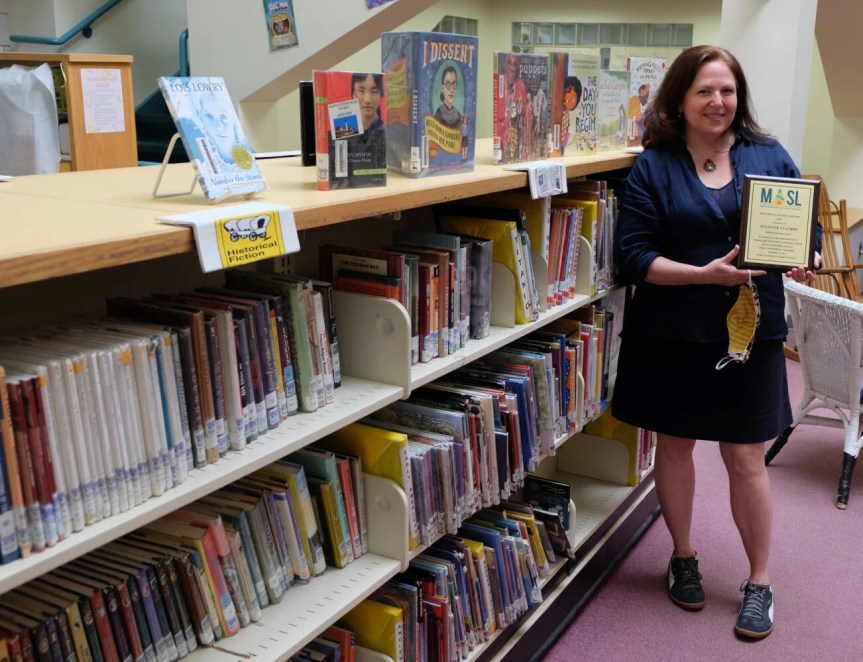
During School Library Month in April, the Maine Association of School Libraries (MASL) announced the recipients of the 2021 Awards. MASL’s annual awards recognize exemplary school library support staff, administrators, and library media specialists.

The 2021 Support Staff Award winner is Annette Thompson of Fort Fairfield Elementary School. Betsy York, MSAD20 School Library Consultant, described Ms. Thompson as a highly dedicated and “integral part of her school community.” 

The 2021 Administrator Award winner is Jay Dufour of Lewiston High School. Lewiston High School Librarian Marissa Deku nominated Mr. Dufour because he gives “200% of his heart to the advancement of his students and to making the school a better place.” 

The 2021 Walter J. Taranko School Librarian Award winner is Jennifer Stanbro of Skillin Elementary School in South Portland. Megan Welter, SPSD Director of Curriculum, Instruction, and Assessment, credited Ms. Stanbro’s vision and leadership for evolving the South Portland school libraries into “dynamic learning commons where students discover, think, and create.” 

Award winners were announced on April 15th at the virtual closing ceremony of MASL’s Spring Symposium. Each winner has been presented with a commemorative plaque and a $500 donation to their school library from MASL. Marking the 20th anniversary of Walter J. Taranko’s passing, his wife Donna Taranko-Moulton spoke about her late husband’s work advocating for Maine school libraries. Walter’s son Andrew Taranko was also in attendance.

The MASL Awards committee welcomes nominations from teachers, colleagues, and administrators by February 15th of each year. While Support Staff and School Librarian award nominees must be MASL members, non-members are encouraged to nominate their exemplary school library staff.

2021 Awards Committee Chair is Amanda Kozaka, and the 2021 Awards Committee Members are: Amy Denecker (Treasurer), Amy Roberson (PD Chair), Michelle Wyler (At-Large), Nancy Grant (Ex-Officio).

For more information about MASL Awards visit maslibraries.org/award_scholarships.


Join Dr. Habib Dagher to learn about UMaine’s leading research in floating offshore wind

Tesday, May 11th, 9:00-10:00 am

There is an international race to develop floating wind turbine technologies.  Educators and students are cordially invited to learn about these technologies and how they can help Maine mitigate climate change and keep more energy dollars in the state.  Dr. Habib Dagher, executive director of the Advanced Structures and Composites Center at the University of Maine, will be leading a webinar about the pioneering research in floating offshore wind being conducted at UMaine.

Dr. Dagher will give a presentation geared towards middle school and high school audiences that will cover the engineering of floating wind turbines.  How does one design floating turbines that can survive 500-year storms?  How is the power brought back to shore?  How are these turbines anchored to the seabed?  How many turbines does one need to power Maine?

Register for the webinar today!

The event is free but limited to 1,000 participants. Please register ASAP!

  • Did you know that harnessing just 3% of the Gulf of Maine offshore wind resource can provide enough electricity to heat every home and drive every car in Maine?
  • The Gulf of Maine’s offshore wind capacity is equivalent to that of 156 nuclear power plants.
  • Researchers at UMaine are working with NASA to optimize the design of floating offshore wind platforms.

Learn this and more during Dr. Dagher’s presentation.

For more information contact Advanced Structures & Composites Center.


Building from What You Have: A Process for Scaling up Tiered Supports in a MTSS

The Maine Department of Education, in partnership with the University of Southern Maine School of Education and Human Development are seeking school Multi-Tiered Systems of Support (MTSS) teams to engage in a summer learning institute titled Building from What You Have: A Process for Scaling-Up Tiered Supports in a MTSS. Continuous Improvement Teams from PK-12 are invited to submit an application.

The focus of the Institute is to assist school MTSS teams with engaging in a deep-dive into their current resources in order to scale-up tiered supports, particularly in Tier 1. School teams that wish to apply must be willing to commit to seven 3-hour sessions, held weekly, beginning on Tuesday, June 22 from 10:00 AM-2:00 PM with a 30-minute lunch break built in. The Institute spans 8 total weeks (please note we will not meet the week of July 5th).

This professional learning opportunity has been specifically designed for teams to engage in the work together. To that end, there is one application for the entire team. The team should consist of 4-5 individuals, including: a principal or asst. principal, two general education teachers, a special education teacher, and one team member of their choice (school psychologist, instructional strategist/coach, Title 1 teacher, school counselor or social worker, etc.).

We will be requiring two books as resources during the Institute. The first, Effective Universal Instruction: An Action-Oriented Approach to Improving Tier 1, will be provided as an eTextbook to each team member to support the summer work. The second, Supporting Successful Interventions in Schools: Tools to Plan, Evaluate, and Sustain Effective Implementation must be purchased by either the school or individually for each team member.

The session schedule is as follows:

  • June 22: MTSS Overview, Resources, and Q&A
  • June 29: MTSS resources session and workshop: Personnel
  • July 13: MTSS resources session and workshop: Curriculum and Instruction
  • July 20: MTSS resources session and workshop: Data and data-based decision making
  • July 27: MTSS resources session and workshop: Time
  • Aug 3: MTSS resources session and workshop: Facilities and physical space
  • Aug 10: Priorities Planning

Due to the highly interactive nature and the need to provide supports to teams, this Institute is being capped at 5 teams. Sessions will be molded and designed to meet participating teams’ needs to the greatest extent possible while covering all of the primary topics.

To apply for this professional learning institute, download and complete the application below. We will review applications on a first come-first serve basis. Only complete applications will be considered. You may submit your completed application beginning on Wednesday, May 19th, and you will be notified of your application status within two weeks of submission. Registration for the institute will remain open until all slots are filled.

Click here to download the application.

For more information or questions regarding the Institute, you may email Andrea Logan at andrea.logan@maine.gov or Rachel Brown-Chidsey at rachelb@maine.edu. You may submit your competed application to Andrea Logan at andrea.logan@maine.gov beginning Wednesday, May 19th 2021.

A Letter to America’s Teachers from Secretary Cardona

I never could predict what might happen in Mr. O’Neil’s art classes; I just knew I couldn’t wait for the next assignment.  Back then I didn’t realize all the ways this dynamic educator, a rare man of color leading our diverse classroom of second graders, was serving as a pioneer and role model for me and my peers in John Barry Elementary School.  But I’ll never forget how his teaching made me feel.  As a second grader, I remember looking up — watching him encourage, challenge and guide us – and thinking: “I want to be like him.”

In the years since embracing that calling and starting my career as a classroom teacher, I’ve kept that sense of purpose and wonder.  And my goal in all the administrative roles I’ve held is to facilitate great teaching and learning: to support and expand the transformative impact that skilled, caring classroom teachers have for students, schools, and communities.

Every day America’s teachers change lives, and every day those lives change the world.

Now, this truth can seem to recede as you rush to keep up with the day’s intense pace, and your students’ needs and opportunities.  Yet, from the first bell on the first day of the school year, you build a relationship with each of them.  You learn their strengths and struggles, laugh with them, cry with them, worry over them, cheer for them – and at the end of the school year, help them transition to their next grade level adventure.  You know all those experiences – both the academic and life lessons – have changed both you and them for the better.  You empower them to grow in skill and character — expand their understanding of the world and how to shape it — explore their interests and decide where to make their mark.

Teaching is not a job anyone just falls into.  It is mastery of a craft: in fact, the craft that enables all the others. In my experience, great teachers are also quintessential lifelong learners.  You use your command of learning science, your insights into your students’ unique needs and aptitudes, as well as the lessons of the past, the realities of the present and the inspiration, innovation and ingenuity of the future to help each new generation become leaders for today and tomorrow.  Throughout the year you support your fellow educators, add to your tools through professional development, provide feedback on assignments, sponsor sports, service learning, clubs and other extracurricular activities, collaborate with parents — in addition to everything you pour into your students during class.

Even in this unprecedented year, you rallied, finding new ways to engage with students.  In the face of tragedy, you learned new technologies and built virtual classroom communities, all while caring for yourselves and your own families.  As we heal, recover, and rebuild, this pandemic presents a chance to forge opportunity from crisis and reimagine education on every level.  We will use this time to address inequities in our education system, and your contributions will be invaluable.  The work won’t be easy, but the impact of your success will be profound, for students and communities.  I urge state, local, and elected officials to make sure classroom teachers have a voice in your plans and efforts to reimagine education; second to parents, they know our students best.

I look forward to learning and listening from you in the days ahead.  And, from all of us at the Department of Education: Happy Teacher Appreciation Week. There’s a reason teacher like Mr. O’Neil – and all of you – are memorable.  There’s a reason student in America’s classrooms watch you share your curiosity, energy and passion for ideas and think, “I want to be like them.”

You are embodiments of possibility, champions of your students’ potential and stewards of their success.

Dr. Miguel A. Cardona, U.S. Secretary of Education

Media Release: Mills Administration Updates COVID-19 School Health Advisory System  

Androscoggin County remains yellow; All other counties green.

AUGUSTA — The Mills Administration today released an update to its color-coded Health Advisory System that classifies counties’ relative risk of COVID-19 transmission to assist schools as they continue with their efforts to deliver instruction and support students safely.

Maine’s Department of Health and Human Services (DHHS) and Center for Disease Control and Prevention (Maine CDC) assessed COVID-19 data and trends for all counties and released the following designations:

  • YELLOW: Androscoggin County continues to have an elevated new case rate of 77 cases per 10,000 residents,  more than double the statewide average.
  • NOW GREEN: The new case rates in Kennebec, Oxford, and Somerset counties have fallen by at least 20 percent, and their positivity rates are below 5 percent.
  • All other counties remain green, including Franklin and York, which were closely monitored in the last update but have since shown improvements.

These designations are made out of an abundance of caution and for the consideration of school administrative units in their decisions to deliver instruction. DHHS and Maine CDC continue to review evidence that indicates lower transmission of COVID-19 in schools compared to the general population.

Over the last 30 days, the rate of new cases for school staff and students has remained steady at 46 per 10,000, about 40 percent lower than a new case rate of 78 per 10,000 for the general population.

This continues to demonstrate that in-person learning in schools that follow public health precautions can be conducted safely, without increased transmission of COVID-19, when schools use proven health and safety protocols and resources.

The Health Advisory System categorizations are defined as follows:

  • RED: Categorization as “red” suggests that the county has a high risk of COVID-19 spread and that in-person instruction is not advisable.
  • YELLOW: Categorization as “yellow” suggests that that the county has an elevated risk of COVID-19 spread and that schools may consider additional precautions and/or hybrid instructional models to reduce the number of people in schools and classrooms at any one time.
  • GREEN: Categorization as “green” suggests that the county has a relatively low risk of COVID-19 spread and that schools may consider in-person instruction, as long as they are able to implement the required health and safety measures.  Schools in a “green” county may need to use hybrid instruction models if there is insufficient capacity or other factors (facilities, staffing, geography/transportation, etc.) that may prevent full implementation of the health and safety requirements.

The county-level assessments are based on both quantitative and qualitative data, including but not limited to recent case rates, positivity rates, and syndromic data (e.g., symptoms of influenza or COVID-19). Those data are publicly posted every week on the Maine CDC website. DHHS and Maine CDC also consider qualitative factors, such as the presence of outbreaks that may potentially affect school-age children.

The Health Advisory System reflects ongoing analysis of evolving data, and serves as one piece of information that school and district leaders can use to make decisions about how to deliver education during the school year. The qualitative and quantitative considerations and data used by the CDC in determining community transmission risk levels for schools can be located here: How County Risk Levels for Maine Schools are Determined

The Health Advisory System can be found on the Maine DOE website in Part I of the Framework for Reopening Schools and Returning to In-Person Classroom Instructionhttps://www.maine.gov/doe/framework/part-I.

Maine schools have been safely open since the fall by adhering to the six requirements for returning to in-person instruction and by following the protocols for identifying close contacts that are found in the Standard Operating Procedure for a positive case in schools, regardless of their county color designation.

The next update will be provided on May 21, 2021. Updating this advisory on a two-week basis aligns with the incubation period for COVID-19 and allows for greater stability in the trend data for small counties.

###