The Portland Public Schools Is Grand Prize Winner for Equity Work

Portland Public Schools has been recognized for its commitment to equity as a Grand Prize winner in the National School Boards Association (NSBA) 2021 Magna Awards program. This is the first time in that program’s 27-year history that a Maine school district has been recognized with a Magna Award for its equity work.

The annual Magna Awards honor school districts across the country for programs that advance equity and break down barriers for underserved students. PPS, Maine’s largest and most diverse school district, won for one of our signature programs: Make It Happen! – a college readiness program that helps multilingual students build competitive academic profiles for college admission and financial aid.

An independent panel of school board members, administrators, and other educators selected the 15 winners – three Grand Prize winners and 12 first place winners. PPS is the Grand Prize winner in the category of districts with enrollment between 5,000 and 20,000 students. The other two Grand Prize winners were Massachusetts’s Mashpee Public Schools, which won in the under-5,000-enrollment category, and Michigan’s Detroit Public Schools, which was the winner for districts with more than 20,000 students.  This is the fourth year that the Magna Awards program has recognized school districts and their leaders for their efforts to bring educational equity to their students. It is believed that PPS is the first Maine school district ever to win a Magna Award.

“We are thrilled and honored to be chosen as a Grand Prize winner for our work to achieve equity for all our students, which is the central goal of our Portland Promise, the district’s strategic plan,” said PPS Superintendent Xavier Botana. “This recognition shines a national spotlight on the need to remove barriers to equity at a particularly important time, when the COVID-19 pandemic has increased the longstanding disparities that exist between different groups of students in our schools. Programs like Make It Happen! are vital to helping address these disparities, but there is much more we need to do. That is why my proposed FY22 school budget targets resources to the students to whom we owe the largest educational debt: those who are learning English, have disabilities or are alienated in our schools.”

Make It Happen!, founded 14 years ago, is a program of the district’s Multilingual & Multicultural Center. It’s a college-readiness and academic success program for language minority students in grades 9 through 12, and is designed to help students raise and realize their academic aspirations. The program provides students with personalized and structured academic support to ensure their success in school and help prepare them for college. Many graduates of the program are the first in their families to attend an institute of higher education.

Steve Bailey, Executive Director of the Maine School Management Association, said that Make It Happen! “is designed to meet students where they are and assist them in achieving their goal through personalized support.” Make It Happen! site coordinators and volunteer academic coaches, recruited from the community, help students take challenging classes, develop strong college applications, and engage in civic and leadership activities.

Diora Ndagano, a senior at Deering High School, said, “I joined Make It Happen! right after I arrived at Deering. I was an immigrant and I didn’t know anything about the education system in America, but with the help of the Make It Happen! program, I was able to adapt to school and apply to college. That’s how amazing that program was to me.”

In addition to bringing national attention to the district’s ongoing equity work, the Grand Prize includes a $5,000 grant that the district will use as a foundational investment to establish a college scholarship fund for students who participate in the Make It Happen! Program. The district plans to leverage this money to grow the fund. More details around the “Make it Happen Scholarship Fund” will be announced later this spring.

“2020 was a year like no other,” said NSBA Executive Director and CEO Anna Maria Chávez. “The 2021 Magna Award-winning districts represent the enormous efforts of school leaders during the pandemic to continue removing barriers to achievement for their underserved and vulnerable students.”

“The Portland Public Schools is very grateful to have our equity work recognized nationally,” said Portland Board of Public Education Chair Emily Figdor. “Achieving equity,  the centerpiece of our Portland Promise goals, is essential for us to fully realize our other strategic plan goals – achievement, whole student and people.”

The 27th annual Magna Awards program is sponsored by the National School Boards Association’s flagship magazine, American School Board Journal (ASBJ). PPS’ Grand Prize win is highlighted in the April issue of ASBJ. Read about the award-winning Make It Happen! program and the two other Grand Prize-winning districts at nsba.org/ASBJ/2021/april/grand-prize-magna-awards programs.

Information for this article was provided by Portland Public Schools as part of the Maine Schools Sharing Success Campaign. The Maine Schools Sharing Success Campaign is an avenue for Maine schools to celebrate successes and share innovative ideas, practices, and models that can be adapted and easily implemented by other Maine schools. Stories are not an endorsement of specific materials, services, or practices and are not intended to promote learning programs that are of cost to students, families, or schools. To submit a story or an idea, email it to Rachel at rachel.paling@maine.gov. 

Deering High School Senior Is Top Winner at Maine State Science Fair

Linh Nguyen, a senior at Deering High School, is the First Place Grand Award winner in the 2021 Maine State Science Fair. Nguyen came out on top among the nearly 160 students competing for prestigious state titles and more than $1 million in scholarships and awards. She won for her research on how carbon nanotubes could be used as an inexpensive remover of arsenic in drinking water systems.

In other news, Nguyen also was named on April 8 as a Cooke College Scholar, one of just 61 students nationwide to receive that prestigious honor – and the only one from Maine. The Cooke College Scholars receive up to $40,000 annually for up to four years to attend the college or university of their choice, in addition to comprehensive advising and other program support.

Celebrating its 75th year, the Maine State Science Fair (MSSF) is organized by The Jackson Laboratory and Maine Mathematics and Science Alliance (MMSA). This year’s event took place virtually on April 3, and 157 students representing 23 Maine schools tuned in to present virtual research or engineering projects to a panel of judges and attend events.

Dr. Nirav Shah, director of the Maine Center for Disease Control, was the keynote speaker. Dr. Shah encouraged the students to communicate their science clearly to non-scientific audiences. “Just as important as learning the tools of science are learning the tools of science communication,” Shah said. “The principle that I always keep in my mind [when answering a scientific question] is you shouldn’t tell them how to build a clock, you should tell them what time it is, because that’s what they are really interested in.”

Nguyen’s research project has a very practical application. She won for her work titled “Applications of Carbon Nanotube Based Sorbents for Removal of Arsenic from Polluted Water.” She studied how carbon nanotubes could be used as an inexpensive remover of arsenic in drinking water systems, including private wells where arsenic contamination is prevalent. A nanotube is a microscopic tube whose diameter is measured in nanometers.

Nguyen was one of three Grand Award winners – students whose MSSF projects were judged to be at the top overall.

The Second Place Grand Award winner was Vetri Vel, a Bangor High School senior, who won for improving his fall-detection software that uses a thermal-imaging detector of his own creation. His system could help elderly people living alone detect falls and send a call for help. Mateus Nascimento, a junior at Brunswick High School, won the Third Place Grand Award for his project titled: “Animals Talk: Understanding Silk Moth Communication through Detection of Pheromones with an Electronic Nose.”

The three MSSF Grand Award winners are invited to form the Maine delegation to the Regeneron International Science and Engineering Fair. This is a significant honor and speaks to the quality and significance of the student’s research or engineering project. This year, the Regeneron ISEF is virtual and will be held in May. Regeneron ISEF is a competition with significant financial and scholarship awards.

In addition to winning the MSSF First Place Grand Award, Nguyen placed first in the Environmental Engineering category award. Nguyen also was the recipient of the first Cary James Water Ride Scholarship, a $5,000 scholarship that she can apply to the college of her choice.

Also, Nguyen was notified April 8 by the Jack Kent Cooke Foundation that she is one of their  2021 Cooke College Scholars. This year’s 61 recipients were chosen from a pool of more than 5,800 applicants nationwide. The Cooke College Scholarship Program seeks to close the gaps in higher education access for driven students with financial need. Along with financial support, Cooke College Scholars will receive ongoing educational advising and opportunities for internships, study abroad, and access to graduate school funding.

“Linh is the kind of student who inspires everyone around her. She is driven by her curiosity and she is not afraid of putting in the hard work needed to accomplish any task,” said Deering science teacher Cyle Davenport. “As someone fortunate enough to have her in two of my classes, I can say that her success at the MSSF is completely deserved. Linh does not give up. All of her teachers are overwhelmed with pride for this young woman; and we are all eager to see what she does next.”

Deering school counselor Libby Heselton said, “Linh is highly conscientious and determined, with an outstanding work ethic. She seeks to understand concepts rather than just complete assignments, and adds to her classmates’ learning with probing questions that tie back to ‘why this matters.’ She is all about collaborative problem solving. Linh’s character outshines even her academics.  Accordingly, she has the very difficult decision of choosing among Stanford, MIT, Harvard, Princeton, and Yale.”

“The Portland Public Schools is extremely proud of this talented, hardworking student,” said Superintendent Xavier Botana. “One of the primary goals of our Portland Promise, the district’s strategic plan, is to empower and prepare our students for 21st century careers, and STEM learning is key to achieving that goal. Linh’s work stands out. Her STEM knowledge is impressive and she used it to solve an important problem. She is an all-around student  leader and excels in everything she does. The credit goes to her and also to her teachers and others who have supported her along the way. We look forward to seeing all the ways in which Linh will continue to achieve in the future.”

Learn more about other Maine State  Science Fair awards and scholarship winners.

“This year’s Maine State Science Fair was an inspiring showcase of the STEM talent being fostered in Maine high schools,” said Michael McKernan, Program Director for STEM and Undergraduate Education at The Jackson Laboratory and a co-director of the Science Fair. “Students presented projects that were both highly creative and also relevant to pervasive issues in Maine.”

“It has been awe-inspiring to see the achievements of Maine’s students as the Science Fair has grown to involve more schools and educators from across the state,” said Dr. Ruth Kermish-Allen, executive director of the Maine Mathematics and Science Alliance (MMSA). “Our young people are creating outstanding scientific research that truly can make a difference in the world, and we are able to recognize those efforts through increased scholarships to diverse higher education options available to MSSF students. The creativity and innovation we see in these complex scientific studies highlights the amazing talents of Maine’s next generation of leaders.”

Information for this article was provided by Portland Public Schools as part of the Maine Schools Sharing Success Campaign. The Maine Schools Sharing Success Campaign is an avenue for Maine schools to celebrate successes and share innovative ideas, practices, and models that can be adapted and easily implemented by other Maine schools. Stories are not an endorsement of specific materials, services, or practices and are not intended to promote learning programs that are of cost to students, families, or schools. To submit a story or an idea, email it to Rachel at rachel.paling@maine.gov. 

How “Time Flies” at Bangor High School’s Visual and Performing Arts Academy

As part of Bangor educator Eric Hutchins’ Graphic Design class, the students learn how art is used in everyday life, especially how it plays an such a big role in the commercial world today.

Serving as the second class for students focusing on a graphic art pathway that is frequently taken by students in the Visual and Performing Arts Academy (VPA) program at Bangor High School, the students focus on how to use computer software to create interesting works of art. As a start they learn about the importance of text in graphic art, how it can be used, and why just choosing any font is not the right thing to do.

“The images you see are examples of their first text project in the class where students chose statements that are considered ‘cliche’ and then they recreate them visually only using text,” explains Hutchins.

Over the course of the semester students recreate a package for a product. They measure the packaging, create a template, and then create the imagery and designs for the product. They also create business cards, book jackets, album covers, board game designs and movie posters over the course of the class.

“This is a unique class because it teaches students the importance of art in our society, and that a graphic designer’s artwork is everywhere,” added Hutchins.

Students that take the graphic arts pathway at Bangor High School’s VPA Academy traditionally take photography, digital art, graphic design and then their senior year take Advanced Placement 2D Design and submit a portfolio to be graded for college credit.

Information for this article was provided by the Bangor School Department as part of the Maine Schools Sharing Success Campaign. The Maine Schools Sharing Success Campaign is an avenue for Maine schools to celebrate successes and share innovative ideas, practices, and models that can be adapted and easily implemented by other Maine schools. Stories are not an endorsement of specific materials, services, or practices and are not intended to promote learning programs that are of cost to students, families, or schools. To submit a story or an idea, email it to Rachel at rachel.paling@maine.gov. 

Bangor Student Wins Sixth in the Nation in Science Talent Search

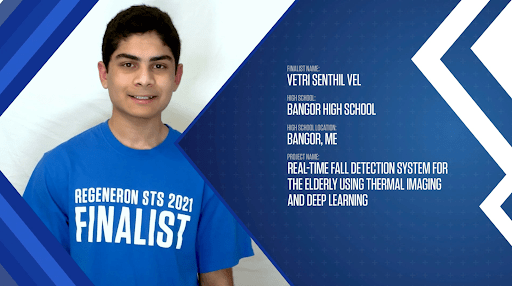
The Bangor School Department is proud to congratulate Vetri Vel ’21 for winning sixth place in the 2021 Regeneron Science Talent Search, the nation’s oldest and most prestigious science and math competition for high school seniors. Vetri received an $80,000 award for his project engineering a deep learning system that combines a small computer and thermal camera to detect heat signatures of a fallen person. Upon recognition of a fall, the system will immediately text for help. 

Historically held in person in Washington, D.C., this is the second year in its 80-year history that the competition took place virtually to keep the finalists and their families safe during the ongoing pandemic. Forty finalists were honored during a virtual ceremony March 17, and more than $1.8 million was awarded to the finalists, who were evaluated based on their projects’ scientific rigor, their exceptional problem-solving abilities, and their potential to become scientific leaders. 

Barbara Stewart, Chair of the BHS Science Department, has also been named a Teacher of Merit by Regeneron Science Talent Search 2021. Bangor High School will receive $2,000 to promote student research in STEM fields. 

“Congratulations to the Regeneron Science Talent Search 2021 winners,” said Maya Ajmera, President and CEO of Society for Science, Publisher of Science News and 1985 Science Talent Search alumna. “Throughout the COVID-19 pandemic, students have shown incredible resilience and perseverance in the face of new obstacles, conducting rigorous research, while navigating an uncertain world. These young people are the stewards of our future and I could not be more inspired by their hard work and pure grit.” 

The Regeneron Science Talent Search provides a national stage for future leaders in STEM – bringing together the best and brightest young minds to present their original research ideas to leading scientists. The competition celebrates the hard work, innovative thinking, leadership qualities and creativity of students who are bringing a fresh perspective to solving significant global challenges through rigorous research and cutting-edge discoveries. The judging panel also considers how these research efforts, innovative thinking and leadership qualities demonstrate the students’ potential to become future leaders in critical STEM fields. 

At BHS, Vetri is a varsity runner, a member of the science bowl team, and captain and top-ranked scorer on the varsity math team. He also volunteers as a virtual math tutor for his peers. He has also been accepted to MIT in the Fall of 2021. Vetri’s winning project is described below:

Project Title: Real-Time Fall Detection System for the Elderly Using Thermal Imaging and Deep Learning 

Vetri developed a wall mounted, real-time fall detection system for his Regeneron Science Talent Search engineering project. Distressed that an elderly neighbor had lain unassisted after a fall for nearly a day, Vetri engineered a hands-free solution that could immediately text for help after detecting a fall. He interfaced an inexpensive microcomputer with a thermal camera, collected room images that did or did not include a fallen person, and used them to train a neural network. At an average accuracy above 98 percent, his deep learning system distinguished between a fallen person and those sitting, standing, or sleeping, as well as nonhuman heat sources, such as pets. His approach also preserves privacy by relying solely on heat signatures for recognition. Vetri’s detection system may decrease future hospitalizations and deaths after a fall, which is a leading cause of fatalities among seniors.

Information for this article was provided by the Bangor School Department as part of the Maine Schools Sharing Success Campaign. The Maine Schools Sharing Success Campaign is an avenue for Maine schools to celebrate successes and share innovative ideas, practices, and models that can be adapted and easily implemented by other Maine schools. Stories are not an endorsement of specific materials, services, or practices and are not intended to promote learning programs that are of cost to students, families, or schools. To submit a story or an idea, email it to Rachel at rachel.paling@maine.gov. 

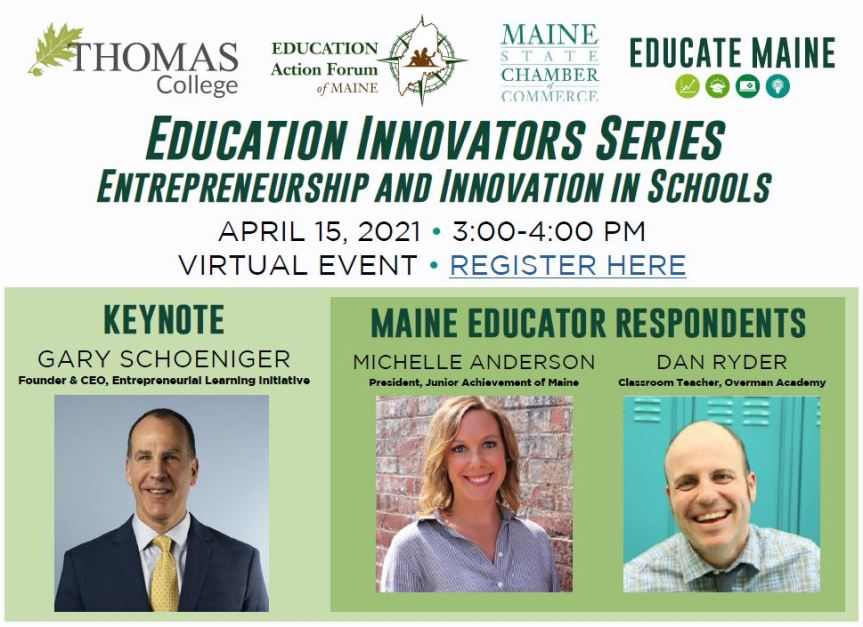
Education Innovators Speaker Series: Entrepreneurship and Innovation in Education

The Maine State Chamber of Commerce is hosting the next set of speakers for the Education Innovators Speaker Series. This month’s conversation is focused on entrepreneurship and innovation in education. They are pleased to welcome the following guests on April 15th from 3:00-4:00pm:

  • Gary Schoeniger, CEO of Entrepreneurial Learning Initiative
  • Michelle Anderson, President of Junior Achievement of Maine 
  • Dan Ryder, Classroom Teacher of Overman Academy

Anyone interested can register and learn more about this free event here.

Special thank you to the supporters of these events which include the Education Action Forum of Maine, the Center for Innovation in Education at Thomas College, Educate Maine, and the Maine State Chamber of Commerce Education Foundation. We hope to see you on the 15th!

Maine Students Present Research and Engineering Projects at 75th Annual Maine State Science Fair

Celebrating its 75th year, the Maine State Science Fair (MSSF), organized by The Jackson Laboratory (JAX) and Maine Mathematics and Science Alliance (MMSA), took place virtually on April 3, 2021. 157 students representing 23 schools in 8 Maine counties tuned in to present virtual research or engineering projects to a panel of judges and attend events. High school students from across the state competed for prestigious state titles and over $1 million in scholarships and awards.The winners were announced during a virtual award ceremony on April 3 at 3 pm ET. The event was headlined by keynote speaker Dr. Nirav Shah, director of the Maine Center for Disease Control.In his remarks, Dr. Shah encouraged the students to communicate their science clearly to non-scientific audiences. “Just as important as learning the tools of science are learning the tools of science communication,” Shah said. “The principal that I always keep in my mind [when answering a scientific question] is you shouldn’t tell them how to build a clock, you should tell them what time it is, because that’s what they are really interested in.”

“This year’s Maine State Science Fair was an inspiring showcase of the STEM talent being fostered in Maine high schools,” said Michael McKernan, Program Director for STEM and Undergraduate Education at The Jackson Laboratory and a co-Director of the Maine State Science Fair. “Students presented projects that were both highly creative and also relevant to pervasive issues in Maine.”

Linh Nguyen, a senior at Deering High School in Portland, studied how carbon nanotubes could be used as an inexpensive remover of arsenic in drinking water systems, including private wells where arsenic contamination is prevalent. Vetri Vel, a senior at Bangor High School, improved his fall-detection software which uses a thermal-imaging detector of his own creation. Vel’s system could be deployed in the homes of elderly people, living alone, to reliably and automatically detect falls and send a call for help. Ashton Caron, a senior at Nokomis High School in Newport, used GPS collars and chemical studies of pasture grass nutrition to study grazing patterns in cows. This could help Maine farmers better plan pasture rotations to sustain both the cows and their pasture resources.

The Grand Award winners were:

1.     First Award – Linh Nguyen, 12th grade, Deering High School. Applications of Carbon Nanotube Based Sorbents for Removal of Arsenic from Polluted Water.

2.     Second Award – Vetri Vel, 12th grade, Bangor High School. Readily Implementable Fall Detection System for the Elderly Using Thermal Image Segmentation and Convolutional Neural Networks.

3.     Third Award – Mateus Nascimento, 11th grade, Brunswick High School. How Animals Talk: Understanding Silk Moth Communication through Detection of Pheromones with an Electronic Nose.

“It has been awe-inspiring to see the achievements of Maine’s students as the Science Fair has grown to involve more schools and educators from across the state,” said Dr. Ruth Kermish-Allen, Executive Director of the Maine Mathematics and Science Alliance (MMSA). “Our young people are creating outstanding scientific research that truly can make a difference in the world, and we are able to recognize those efforts through increased scholarships to diverse higher education options available to MSSF students. The creativity and innovation we see in these complex scientific studies highlights the amazing talents of Maine’s next generation of leaders.”

In addition to the Grand Award prizes, more than $1 million in scholarships, including several full-tuition scholarships, from The University of Maine, College of the Atlantic, University of New England, University of Southern Maine, St. Joseph’s College of Maine, the University of Maine at Augusta, and Husson University were distributed to students who demonstrated creativity, innovation, aptitude and notable scientific potential.

For the first time, several Maine community colleges also offered and awarded scholarships. York County Community College, Central Maine Community College, and Southern Maine Community College each made one partial tuition scholarship. Additional students received awards for various achievements from JAX and MMSA.

The following students received full-tuition four-year Top Scholar awards from The University of Maine, including admission to the UMaine Honors College:

Emerson Harris, Boothbay Region High School

Zoe Stankevitz, Nokomis Regional High School

Ashton Caron, Nokomis Regional High School

Nora Goldberg-Courtney, Maine Coast Waldorf School

Nick Pease, Nokomis Regional High School

Matthew Gilbert, Greely High School

Ogechi Obi, Bangor High School

Grace Hall, Belfast Area High School

Ashly Nyman, Nokomis Regional High School

Carter Rice, Nokomis Regional High School

Quinn D’Alessio, Bangor High School

Maya Elkadi, Bangor High School

The following students received a $20,000 four-year scholarship from the College of the Atlantic, renewable for four years.

Nora Goldberg-Courtney, Maine Coast Waldorf School

Emerson Harris, Boothbay Region High School

The following students received a $5,000 four-year scholarship from the University of New England, renewable for four years:

Grace Hall, Belfast Area High School

Siobhan Duffy, Washington Academy

Emerson Harris, Boothbay Region High School

Maya Elkadi, Bangor High School

The following students received full-tuition four-year scholarships from the University of Southern Maine:

Quinn D’Alessio, Bangor High School

Emerson Harris, Boothbay Region High School

The following students received top merit scholarships from the University of Southern Maine, including a $5,000 award.

Tomas Cundick, Foster Technical Center

Grace Hall, Belfast Area High School

Nora Goldberg-Courtney, Maine Coast Waldorf School

Roland Ladd, Bangor High School

Virginia Weiss, Cape Elizabeth High School

Uyen Nguyen, John Bapst Memorial High School

Simon Socolow, Bangor High School

Siobhan Duffy, Washington Academy

The following students received a $2,500 four-year scholarship from St. Joseph’s College of Maine:

Grace Hall, Belfast Area High School

Uyen Nguyen, John Bapst Memorial High School

The following students received a $1,500 four-year scholarship from the University of Maine at Augusta, renewable for four years:

Nora Goldberg-Courtney, Maine Coast Waldorf School

Roland Ladd, Bangor High School

The following students received a $1,000 scholarship from Husson University:

Grace Hall, Belfast Area High School

Jordan Boyd, Nokomis Regional High School

Cassidy Hodges, Nokomis Regional High School

Ella Donaghy, Medomak Valley High School

Other awards included:

York County Community College awarded a $1,000 scholarship to Amber-Rae Pesek, Hancock County Technical Center.

Central Maine Community College awarded a one semester full-tuition scholarship to Lillian Philbrook, Hancock County Technical Center.

Southern Maine Community College awarded a one semester full-tuition scholarship to Virginia Weiss, Cape Elizabeth High School.

Linh Nguyen, Deering High School, was awarded the $5,000 Cary James Water Ride Scholarship.

The JAX Promising Scientist Award for outstanding research and engineering projects by 1st year students, was presented to:

Mary McPheeters, Falmouth High School

Alexander Benton, Maine Coast Waldorf School

Audrey Hufnagel, Lincoln Academy

Katie Nakai, Brunswick High School

Avery Matthews, Falmouth High School

The Reach Award for students from schools who are new to the Maine State Science Fair, given by the MMSA, was presented to:

The team of Anna Molloy, James Wheeler, Orono High School

The team of Esme Song, Penelope Haydar, Caroline Gentile, Cape Elizabeth High School

The full list of special awards is posted online at https://www.jax.org/mssf

Each category of research project includes three top prizes. The MSSF Category Winners are as follows:

Animal Sciences

1st – Patrick Wahlig, Falmouth High School

2nd – Runzhe Yao, Gould Academy

3rd – Ashton Caron, Nokomis Regional High School

Behavioral Sciences – Psychology

1st – Sciatzy Solis, Medomak Valley High School

2nd – Vy Do, Washington Academy

3rd – Olivia Whitten, Nokomis Regional High School

Biological Sciences

1st – Mateus Nascimento, Brunswick High School

2nd – Simon Socolow, Bangor High School

3rd – Ariel Larrabee, Hancock County Technical Center

Biomedical and Health Sciences

1st – Emerson Harris, Boothbay Region High School

2nd – Coco Xu, Falmouth High School

3rd – McHenna Martin, Hancock County Technical Center

Chemistry

1st – Auburn Putz-Burton, Gould Academy

2nd – Jiaqi Li, Gould Academy

3rd – Grace Leschey and Virginia Weiss, Cape Elizabeth High School

Computer Sciences

1st – Nick Pease, Nokomis Regional High School

2nd – Alex Hardy, Foster Technical Center

3rd – Cuthbert Steadman and Beckett Mundell-Wood, Bangor High School

Data Science

1st – Madyson Redding, Old Town High School

2nd – Maia Pietraho, Brunswick High School

3rd – Jack Nussbaum, Brunswick High School

Engineering

1st – Vetri Vel, Bangor High School

2nd – Brady McQuaid, Brunswick High School

3rd – Jordan Boyd, Nokomis Regional High School

Environmental Engineering

1st – Linh Nguyen, Deering High School

2nd – Maya Elkadi and McKayla Kendall, Bangor High School, Bangor High School

3rd – Frederick Oldenburg and Roland Ladd, Bangor High School, Bangor High School

Environmental Science

1st – Swetha Palaniappan, Cape Elizabeth High School

2nd – Paula Dauphinais and Nancy Dauphinais, Nokomis Regional High School

3rd – Ruth White, Orono High School

Environmental Science – Water

1st – Miranda LeClair, Old Town High School

2nd – Ginny Hunt, Bangor High School

3rd – Quinn D’Alessio, Bangor High School

Materials Science

1st – Ogechi Obi, Bangor High School

2nd – Jinkyu Kim, Gould Academy

3rd – MacKenna Carter, Machias Memorial High School

Physics and Energy

1st – Mia Smith Old Town, High School

2nd – Nuthi Ganesh, Bangor High School

3rd – Will Caron, Bangor High School

Plant Science

1st – Meaghan Caron, Bangor High School

2nd – Nora Goldberg-Courtney, Maine Coast Waldorf School

3rd – Bryce Carter, Hancock County Technical Center

Maine State Science Fair is further supported by Central Maine Power, AV Technik, Society for Science, Maine Technology Institute, Texas Instruments, Maine Space Grant Consortium, IEEE, Hancock Lumber, Fiber Materials, Inc., and Wipfli CPAs and Consultants.

Information for this article was provided by The Jackson Laboratory (JAX) and Maine Mathematics and Science Alliance (MMSA) as part of the Maine Schools Sharing Success Campaign. The Maine Schools Sharing Success Campaign is an avenue for Maine schools to celebrate successes and share innovative ideas, practices, and models that can be adapted and easily implemented by other Maine schools. Stories are not an endorsement of specific materials, services, or practices and are not intended to promote learning programs that are of cost to students, families, or schools. To submit a story or an idea, email it to Rachel at rachel.paling@maine.gov. 

Maine DOE Inviting Local Non-Profits to Discuss School-Community Partnerships for Supporting Students

The Maine Department of Education is eager to support school administrative districts (SAUs) as they plan for summer programming, especially in response to the pandemic. The engagement of community organizations that share our desire to support youth will be critical in creating meaningful and engaging summer opportunities for students.  Collectively, we recognize that students may have acute academic, social/emotional, and engagement needs in the coming months and into the next school year.  The Department is interested in a conversation to learn more about the possibilities for partnerships between SAUs and community organizations to support students. 

The Department invites local, non-profit organizations that have an interest in supporting SAUs in their planning, and possible programming, to join a conversation with Department representatives to: 

  • Understand the Department’s perspective on “learning recovery 
  • Share ideas of successful community partnerships to generate ideas going forward 
  • Understand how the American Recovery Plan Act – Elementary and Secondary School Emergency Relief Fund III resources can be utilized 

The meeting will be held on April 20, 2021 from 2:00-3:00.  To participate, please register to attend the Zoom meeting at https://mainestate.zoom.us/meeting/register/tZIvde-orj0qH9OgYH3MwMbeOA_GLlfYJ-Zj  

After registering, you will receive a confirmation email containing information about joining the meeting. 

We look forward to the conversation and the opportunity to learn and share information with each other. 

Maine Compass Career Collaborative Offers Comprehensive On-Demand College and Career Resources

The Maine Compass Career Collaborative virtual experience will open to all of Maine’s middle and high school students, free of charge, on April 26, 2021.

GEAR UP Maine and JMG are partnering to create the Maine Compass Career Collaborative, an on-demand career and post-secondary resource for Maine’s students in grades 7 through 12. The site will be universally accessible to all middle school and high school students in Maine.

“This is not a one-time event. The site will always be ‘open’ with on-demand resources to help students develop real-world skills and explore all of the post-secondary and career pathway opportunities that exist in Maine,” explains Debbie Gilmer, President of Syntiro, the non-profit organization that leads Maine’s GEAR UP grant. GEAR UP Maine is a statewide initiative, in collaboration with the University of Maine at Farmington, to support students on pathways to high school graduation and post-secondary education.

The site will include information about Maine’s public university and community college systems, private colleges such as Thomas College, and other programs that support post-secondary education such as the Bridge Academy and the Alfond Scholarship Foundation. It will also provide an on-going resource for students to learn the wide variety and increasing number of post-secondary credentials offered directly by Maine’s employers such as the E.J. Prescott UP training program.

“We wanted to include the word “Collaborative” in the title of the Maine Compass Career Collaborative because we are actively seeking partners to join us in this effort. It will launch as soon as students return from spring break, but we will continue to add content in the coming months and it will be free to students,” says Craig Larrabee, CEO and President of JMG. “In addition to being informational, it’s also going to be a lot of fun for students. We look forward to welcoming more partners as we continue to build this platform.”

The Maine Compass Career Collaborative will include a post-secondary exploration hall, an employer engagement experience, financial literacy education, information about how to write a resume and apply for college and jobs, digital literacy resources, including how students can be their own brand ambassadors, and additional support such as public speaking and professional dress guides.

Registration for the platform will open on April 26, 2021 and links to the Maine Career Compass Collaborative will be posted on the JMG web site (www.jmg.org) and the GEAR UP Maine web site (www.gearupme.org). The site is free of charge to all middle and high school students in Maine, and any educators who are supporting them.

Brunswick Special Ed Teacher Reflects on Making Relationships a Priority During COVID-19 

Carmon Parker, a special education teacher at Harriet Beecher Stowe (HBS) Elementary School in Brunswick has always wanted families to feel connected and supported through her Social Emotional Behavioral programWhen classroom-based learning was paused in March of 2019 at the onset of COVID-19, she really felt these values intensify 

Pre-pandemic photos from the HBS Social Emotional Behavioral program:

Not being able to see her students gave her a sense of helplessness because it meant that it would be that much harder to able to maintain those critically important connections with her studentsLike many teachers and school administrators, Ms. Parker quickly shifted gears to help take the pressure of “keeping up” off her students’ plates and the fear of regression off their family’s mindsShe focused on staying connected in creative ways since they couldn’t physically be together.  

She did this at first by scheduling zoom meetings where she worked with students on mindfulness practices, emotional regulation, and social skills. These meetings were also a time for students and families to ask questions, to help ease anxieties, and constantly reassure and remind students that one day we would all be together again,” said Ms. Parker.  

Along with classroom zoom meetings, they also made scheduled times to include other school community members that students had meaningful relationships with including teachers, administrators, and staff members that students saw on a regular basis around schoolShe even helped organize a birthday car parade for one of the students. I believe this helped us all feel that we were still together, even when apart, recalls Ms. Parker. 

As zooms became the norm and hybrid class schedules started to take shape in schools across Maine, Ms. Parker continued to adapt to the situation too, by making in-person time as productive and positive as possible while also taking advantage of time outside of the classroom to maintain relationships and add an extra layer of learning with her students. 

Thinking ahead during the initial building closures in the springMs. Parker wrote and received a Brunswick Community Education Foundation Grant that allowed her to order calming sensory items for her classrooms (humidifiers, essential oils, sound machines, etc.) which she has used to improve in-class experiences for students in her program. 

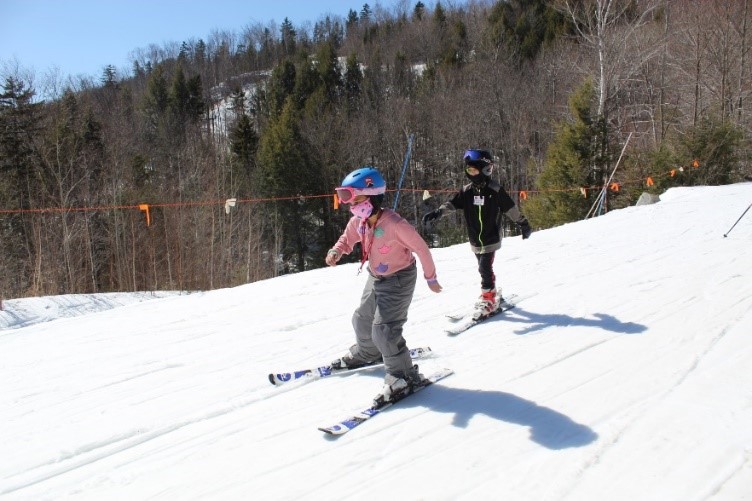
In addition, with the support and help from the families of her students, she was able to create safe outdoor learning experiences that helped bolster relationship building, among so many other positive learning and experiential opportunities for her students (and her). Ms. Parker spent many weekends connecting with her students and their families around activities that they could all enjoy together like surfing and skiing. “Her commitment and care for her students during an exceptionally challenging time has helped them to be resilient. They feel safe and supported and Ms. Parker has gone above and beyond to make sure they feel the love,” a parent said.   

In reflecting back on the many changes that came along with the COVID-19 pandemic, Ms. Parker writes that, “the silver linings that have come from this are having more time to connect and build relationships with families, further strengthening relationships with students, and channeling my energies into what and who brings me joy.  

Being apart from my students and team (my best friends) was the hardest thing I’ve ever gone through. It forced me to explore other passions such outdoor activities and photography. Our first day back at school, after 186 days of being apart, I shared pictures with my students of all the adventures I had. With the main message being, they would always be my greatest one. 

Family Engagement Activity – Capture Your Beauty: 

Information for this article was provided by Carmon Parker and a parent of one of her students as part of the Maine Schools Sharing Success Campaign. The Maine Schools Sharing Success Campaign is an avenue for Maine schools to celebrate successes and share innovative ideas, practices, and models that can be adapted and easily implemented by other Maine schools. Stories are not an endorsement of specific materials, services, or practices and are not intended to promote learning programs that are of cost to students, families, or schools. To submit a story or an idea, email it to Rachel at rachel.paling@maine.gov. 


Job Corps Hosting Virtual Info Sessions April 13th & 29th

Have you ever wondered what Job Corps was all about? Well, here’s your chance to find out!

Job Corps is a free Career Technical Training program that is federally funded  through the Department of Labor for 16-24 year-olds (the upper age limit may be waived for a student with a verifiable disability).  Some of the Career Technical Trainings available are welding, carpentry, culinary arts, CNA, and many more.  Eligible students can also earn their HS diploma and stay on center, free of charge, while they work towards completion of their trade.  The two centers in Maine are in Bangor (Penobscot Job Corps) and Limestone (Loring Job Corps).

Information sessions hosted by Maine’s Job Corps office will be held on April 13th at 1pm or April 29th at 3:00PM on Google Meets. Registration is required at which time link and logon information for the session will be sent via email.

For questions or to register email Ross Chicoine at Chicoine.Ross@jobcorps.org.