Seeking Public Comment to waive requirements related to assessment, chronic absenteeism, accountability identifications and accountability components within Maine’s Model of School Support

The Maine Department of Education (DOE) is seeking a one-year waiver pursuant to §8401(b) from requirements within the Elementary and Secondary Education Act (ESEA) as amended by the Every Student Succeeds Act (ESSA) of 2015) from the U.S. Department of Education (USDOE). The U.S. Department of Education requires state educational agencies, when seeking waivers from statutory or regulatory requirements, solicit and respond to public comment on the request and provide evidence of the available comment period. This 15-day public comment period from August 11, 2020 until August 26, 2020 waives requirements related to chronic absenteeism, accountability identifications and accountability components within Maine’s Model of School Support.

Maine’s Model of School Support contained within Maine’s ESSA state plan, focuses on supporting and assisting schools and educators experiencing challenges. The Maine DOE is working diligently to continue supporting Maine’s schools during this pandemic of COVID-19. Maine’s Model of School Support is immediately impacted by the Department’s waiver request.

Requirements from which Maine is seeking a waiver include:

  • Assessment requirements in section 1111(b)(2): the requirements to administer all required assessments in school year 2020-2021.
  • Accountability and school identification requirements in sections 1111(c)(4) and 1111(d)(2)(C)-(D): the requirements that a State annually meaningfully differentiate all public schools and the requirements to identify schools for comprehensive and targeted support and improvement and additional targeted support and improvement based on data from the 2020-2021 school year.
  • Report card provisions (ESSA Dashboard) related to certain assessments and accountability in section 1111(h) based on data from the 2020-2021 school year, namely:
    • Section 1111(h)(1)(C)(i) (accountability system description).
    • Section 1111(h)(1)(C)(ii) (assessment results).
    • Section 1111(h)(1)(C)(iii)(I) (other academic indicator results).
    • Section 1111(h)(1)(C)(iv) (English language proficiency assessment results).
    • Section 1111(h)(1)(C)(v) (school quality or student success indicator results).
    • Section 1111(h)(1)(C)(vi) (progress toward meeting long-terms goals and measurements of interim progress).
    • Section 1111(h)(1)(C)(vii) (percentage of students assessed and not assessed).
    • Section 1111(h)(1)(C)(xi) (number and percentage of students with the most significant cognitive disabilities taking an alternate assessment).
    • Section 1111(h)(2)(C) with respect to all waived requirements in section 1111(h)(1)(C) as well as 1111(h)(2)(C)(i)-(ii)(information showing how students in a local educational agency (LEA) and each school, respectively, achieved on the academic assessments compared to students in the State and LEA).

Federal program affected by the requested waiver

Maine’s Model of School Supports identifications will be impacted due to the following reasons:

  • Exclusion of the chronic absenteeism indicator

Governor Janet Mills declared a state of Civil Emergency on Sunday March 15, 2020. As a result, schools were recommended to cease traditional classroom-based instruction as soon as practical and for the duration of our state of Civil Emergency. Since that time, the state of Civil Emergency has been extended a further four (4) times with the current state of Civil Emergency due to expire on September 5, 2020.  Maine schools are accessing necessary health indicators, consulting federal and state CDC guidance to determine an appropriate and safe approach to starting the 2020-2021 school year.

  • Excluding the 95% participation rate within the academic achievement indicator

Given the varying modalities of instruction to be implemented within the state of Maine, the challenges posed related to equity for students, and the unavailability of in-person assessment at this time, the assessment platforms cannot be proctored to ensure the validity of assessment implementation.

  • Exclusion of additional school identifications and subsequent supports to schools

As a result of excluding the chronic absenteeism indicator and not utilizing the 95% participation rate for academic achievement, Maine’s Model of School Support will not have a complete data set and will be unable to identify additional schools eligible to receive supports.

Comments may be submitted to: ESSA.DOE@maine.gov

Impacts of COVID-19 on Education Leaders- a Resource

School and district leaders are facing untenable and unprecedented scrutiny and stress as this pandemic draws on. As you prepare to launch plans, reinvent education, and lead the effort to ensure the safety of your staff and students, all while providing for the education of all students, it is critically important that you also take time to provide care for yourself.

Maine Department of Education’s Mental Health Specialist, Bear Shea, has created a VERY helpful 30-minute video, designed for those who are leading in education, and filled with information and useable actions steps for ensuring that you are able to do your best.  Please consider giving yourself 30 minutes to watch, and then to give yourself the time and space for self-care going forward; your leadership is being counted on now more than ever. The video can be accessed on YouTube, A Conversation About the Impact of COVID-19 on School Leadership; please share with all for whom this may be helpful, and please reach out to health care providers if you or someone you know needs support.

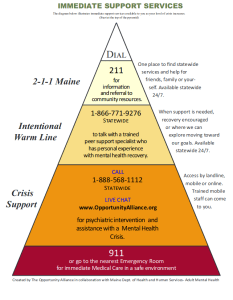
triangle with phone numbers for help. Call 211, or 911 for an emergency

School Librarians: Emergency Remote Learning Response

What were school librarians doing during the emergency remote learning last spring? Throughout remote learning, Maine Association of School Libraries (MASL) held eight pop-up webinars for school library staff and conducted a survey in June to gather information and share support throughout the school library community.
It was abundantly clear that school librarians kicked into high gear, supporting students, staff, and families with everything from tech support to research help, to what to read next. School librarians are key to reducing the digital divide and making education accessible to all students whether in a brick and mortar school or at home in a virtual classroom.
Check out this infographic summarizing the work of your Maine school librarians!

School Located Vaccine Clinic Toolkit Updated

Things have changed in the past several months. The return to school this fall is going to look very different. One thing has not changed; students need to be immunized. Immunizations remain the single most effective way to protect Mainers against many diseases and some cancers. August in National Immunization Awareness Month, and we need to work together to reinforce the importance with our staff, students, parents, and communities. The National Association of School Nurses has many resources on influenza vaccine that can be used by school nurses and other staff to promote immunization as a public health strategy for prevention.

One of the measures to assist us in getting children back to school right now is to prevent illness. With cold and flu season approaching, schools will find it even more difficult to differentiate symptoms of COVID-19 from other common illnesses. For this reason, it is even more important to encourage all our families and staff to be fully immunized against the diseases preventable by vaccine that are required for school entry, as well as seasonal influenza.

We are encouraging all Maine SAUs to host vaccine clinics to increase influenza vaccination rates for Maine. Schools can do this as a standalone entity or in partnership with local medical providers and the School Located Vaccine Clinic Toolkit can assist you in the process. The Maine Immunization Program in partnership with Public Health Nursing is hosting clinics right now to help kids get caught up on those routine vaccinations that might have been missed due to the pandemic. Information about these appointment-only clinics can be found here. Please feel free to share this with your families.

Maine Department of Education will be hosting a webinar that will thoroughly review each section of the School Located Vaccine Clinic Toolkit on August 18 from 11a-12p. Register Here.

For more information, contact the School Nurse Consultant at Emily.Poland@maine.gov.

Data, It’s Important!

Accurate and updated data are critically important to helping Maine Department of Education provide the support and information Maine schools need.

Synergy is now open for the 2020-2021 school year

Synergy, Maine Department of Education’s state student information system, is now open for entering 2020-2021 student information, including 2020-2021 enrollments. Information on manually entering and uploading 2020-2021 student data can be found here.

Please note: you will be unable to enter 2020-2021 student data if your organization has yet to complete the Maine Schools module for 2020-2021.  You may also encounter issues with entering staff data if Maine Schools is not completed.  All public, private, and charter schools, as well as regional programs need to complete the NEO Maine Schools module.  There are currently over 50 organizations who have not fully completed this task for 2020-2021.

Information on and instructions for Maine Schools can be found here.

Do we know how to contact you?  In order for the Maine Department of Education to be able to communicate effectively with schools and districts, staff contact information needs to be updated as quickly possible when there are changes in staffing.  At this point in time, this is particularly important for school and district administrators.  The Department is sending many communications via email regarding information and resources related to the pandemic and preparations for returning to instruction.  If staff contacts are not up to date, you may miss out on important information.  If you have questions about updating contacts, please contact the Helpdesk at 207-624-6896 or medms.helpdesk@maine.gov.

Please join us for a webinar on this topic, “Updating and Maintaining Contact Information”–Thursday, August 13, from 1 to 2 pm.  Please use  this link to register: https://attendee.gotowebinar.com/register/3350901731697602574

PRIORITY NOTICE: Update for Personal Protective Equipment Ordering

Personal Protective Equipment (PPE) and other materials have been ordered by the Maine Department of Education (DOE) for the purpose of supplementing the supplies of Maine’s public schools and certain other educational organizations that serve publicly funded students. This supplemental supply of materials includes items for the use of both staff in public schools and publicly funded students.

We STRONGLY encourage all eligible organizations to place their orders as soon as possible. In addition, it is important to note that the transport and delivery teams are working expeditiously to get supplies across the state, therefore it is critical that they are able to make contact and deliver at the established times.  Please confirm correct contact information and deploy your team to be ready to accept delivery as scheduled.

The table below shows what types of organizations can order PPE and other materials, and the users (student and/or staff) that are included. Please note that the approved amounts are necessarily based on imperfect estimates of need, and for that reason DOE intends to review the use of the materials early in the school year in order to adjust the calculations for potential, additional orders.

Type of Organization How the Organization Orders and Receives Materials from DOE Supported PPE Users
Regional School Unit, School Administrative District, Municipal School Unit, Maine Indian Education, Community School District, “Town Academy”, and Charter School Direct from the state warehouse to the school unit using the online ordering system. Staff and publicly funded students
Career and Technical Education Centers: materials should be ordered via the school unit which serves as the fiscal agent.

Regions: materials should be ordered directly via the online ordering system.


Staff and publicly funded students
Private Special Purpose and Non-Traditional Limited Purpose schools Direct from the state warehouse to the school using the online ordering system. Publicly funded students
Private Non-Sectarian Schools Direct from the state warehouse to the school using the online ordering system. Publicly funded students
Child Development Services CDS staff at DOE will place the order. CDS regional sites will receive the materials. Organizations serving students funded through Child Development Services (CDS) will need to contact CDS to determine amounts and methods of delivery. Staff and publicly funded students


In order to ensure that the inventory is not depleted before every organization has had a chance to submit an order, it has been necessary to set approved order amounts for the first order of materials. These amounts were based on a limited timeframe (45 school days) and upon student and staff numbers. Allocations can be found here.  A guide for when specific supplies should be used and by whom is available here. The use of materials will be monitored from the start of the school year so that the inventory and additional efforts for procurement can be adjusted in line with demonstrated need.

Seeking Innovative Educational Leaders to join Maine’s Leadership Development Program  

The Maine Department of Education (DOE) is pleased to announce the opportunity for Maine leaders to participate in the 2020-2021 Maine Leadership Development Program (LDP) cohort!  The Maine LDP is an initiative designed to build and strengthen instructional leadership skills among Maine’s educational leaders at the school, district, and state levels. In our ongoing efforts to support and foster the educational expertise in Maine, educators who aspire to do the same are invited to take advantage of this high impact opportunity!  

During the 2019-2020 school year, The Maine DOE partnered with the National Institute for School Leadership (NISL) to prepare the first cohort of candidates to become certified trainers and facilitators of future cohorts.  The 2020-2021 cohort will be led by Maine leaders committed to excellence in education.    

Maine’s LDP is delivered through a blended learning model including case studies, inquiry, and hands-on activities with practical applications that meet the rigorous expectations for today’s educational leaders.  Successful completion of the LDP may contribute to credit hours for participants pursuing an advanced degree or contact hours for re-certification purposes. 

Benefits for Maine Schools 

  • Prepares educational leaders to lead for excellence and equity 
  • Increases student achievement, and fosters a culture of high expectations 
  • Enhances teacher recruitment, retention, and quality 

Program Curriculum 

  • Nationally researched, evidenced-based, and locally delivered in a cohort model 
  • Improves the practice of leadership, transforms instruction and student achievement in schools 
  • Consists of 12 two-day units, delivered in 12 months 
  • Bridged with online coursework, readings, and job-embedded application of key concepts through action learning  

Characteristics of Ideal Candidates 

  • A belief in and commitment to improving instruction and increasing achievement for all students 
  • Experience in a leadership role at the school, district, and/or state level with background as a classroom teacher. Ideal candidates include, but are not limited to, teachers, principals, assistant principals, instructional coaches, deans, Title I directors, department leaders, ESEA coordinators, special education directors, English Learner directors, assistant superintendents, instruction and curriculum directors, CTE instructors, CTE directors, and superintendents. Priority will be given to educational leaders from schools identified to receive Tier III support throughout Maine. 
  • Excellent communications skills; able to effectively facilitate professional development for peers 
  • Demonstrated skills in mentoring and coaching 
  • Experience as a successful practitioner who is able to translate concepts to actions, theory to practice, and programs to craft 
  • Able to participate in the entire Maine LDP Program and deeply engage in action learning  
  • Likely to live and work in Maine for the next five years 

The Department encourages educational leaders to consider applying for this exciting opportunity by September 4, 2020.  

Please visit http://www.maine.gov/doe/educators/maineldp to hear from participants and for more information.

View the program schedule at https://www.maine.gov/doe/educators/maineldp/application and download the application by clicking here. 

For more information please email emily.doughty@maine.gov. 


Administrative Letter: Updated Remote Learning English Learner Identification Procedures

Administrative Letter: #28         
Policy Code: IHBEA
TO: Public School Administrators
FROM: Pender Makin, Commissioner
DATE: August 5,2020
SUBJECT: Updated Remote Learning English Learner Identification Procedures

The Maine Department of Education has developed a revised process for the identification of students as English learners during the COVID-19 pandemic. This revised process will remain in effect during any period when there is an interruption in face-to-face school operations as a result of the pandemic. Federal law requires that all English learners be identified within thirty days of enrolling at the beginning of the school year, or within two weeks for students who enroll mid-year (Sections 1112[e][3] and 3113[b][2] of Elementary and Secondary Education Act).

Please note that English learner identifications made in other states are not recognized in Maine, and all newly-enrolling students must undergo the identification process required by the Maine Department of Education.

Under the previous provisional identification process provided by the Department of Education in response to the challenges faced due to the COVID-19 pandemic, students were screened for approximate level of English proficiency using a set of informal rubrics. Provisional English learner status did not require official English learner identification. However, under the new revised process, students must be officially identified as English learners in the student data system by inputting an EL Start Date. Any student who was identified using the provisional identification process previously in place must now be officially identified by adding an EL Start Date, which must be the date on which the informal screening occurred. It is essential that all students who are English learners have an EL Start Date by October 1, 2020, to ensure that accurate enrollment counts are used in the state funding formula.

In order to accommodate the varying needs of SAUs across the state, the new, revised identification procedure allows for SAUs to exercise discretion in determining which of the following screening methods is most appropriate for the specific circumstances of their communities at any given time.

Prior to administering an English language proficiency screener (whether face-to-face or remotely), schools must provide the Language Use Survey to the parent/guardian of each student to complete. The Language Use Survey may be mailed, emailed, or completed in-person, as appropriate. Note that some families may require translation and/or interpretation by a qualified professional in order to complete the Language Use Survey and/or the enrollment process as a whole, and these services must be provided by the SAU at no cost to the family.
All Language Use Surveys and English language proficiency screener score reports must be kept in students’ cumulative files.

Screening Method 1: Face-to-Face
If a SAU determines through consultation with various stakeholders (including school board, staff, and families) that face-to-face screening can be conducted safely, SAUs may opt to administer an English language proficiency screener per the usual identification policy. According to current CDC requirements for health and safety in schools, face masks/face shields, hand sanitation stations, frequent sanitizing of computers and other items and surfaces involved in screening, physical distancing, and use of COVID-19 symptom screening questions must be used.

If a parent/guardian or screener administrator is not comfortable with face-to-face screening due to concerns about virus transmission, it is advisable to offer remote screening as an alternative.

Screening Method 2: Remote
For students in grades K-12, screening may be conducted remotely (via phone or video call) using the WIDA Remote Screener. (For students in pre-K, please see the final section of this document.) Training for screener administrators can be found within the WIDA Secure Portal, and screening materials are available in WIDA Assessment Management System (AMS). If you do not yet have login credentials, please contact WIDA Client Services at help@wida.us  or 1-866-276-7735.

Students who perform at the “developing” level or below will be officially identified as English learners in the student data system and must receive English language acquisition support services. Students identified as English learners must also participate in Maine’s annual English language proficiency assessment ACCESS for ELLs/Alternate ACCESS (when state-required assessment resumes as normal).

If a student performs at the “entering” or “emerging” level on the WIDA Remote Screener, no further validation of English learner status is required. However, when a student scores at the “developing” level, the student’s status must later be validated once face-to-face assessment is possible. There are two possible means of validation.

Validation Method 1: Face-to-Face Screening per Usual State Policy
When face-to-face screening can be safely conducted, a student must complete the regular screening assessment required by state policy. If the student performs below the identification threshold of 4.5, the student will remain in English learner status and no further steps are necessary. If the student performs above the identification threshold of 4.5, the SAU must submit a request for change in English learner identification to the Department. One request may be submitted for multiple students.

If requests for change in English learner identification are not received prior to the start of the ACCESS for ELLs/Alternate ACCESS assessment window (January 11, 2021), all identified English learners must participate in the ACCESS for ELLs/Alternate ACCESS, which will also serve as validation of the student’s English learner status.

Validation Method 2: ACCESS for ELLs/Alternate ACCESS
ACCESS for ELLs/Alternate ACCESS assessment window is scheduled to open January 11th and closes March 5th, 2021. If it is not possible to administer a face-to-face screening assessment prior the start of the assessment window, students’ English learner status will be validated via ACCESS for ELLs/Alternate ACCESS.

Assessment results will be available to SAUs in early May of 2021, so any student in English learner status must continue to receive English language acquisition support services until student performance reports are received and proficiency is confirmed. Students who receive an overall composite proficiency level of 4.5 or higher (or level P2 on Alternate ACCESS) will be automatically exited from English learner status by the Department.

In the event that state-required assessments are suspended for the 2020-21 school year, students will remain in English learner status until such time as either validation method can be utilized.

For assessment-related questions, please contact Jodi Bossio-Smith, WIDA Assessments Coordinator, at jodi.bossiosmith@maine.gov.

Identification of Students in Pre-Kindergarten
For students in pre-K, administering a remote screening assessment is not advised. Instead, as recent guidance from the US Department of Education permits, the Language Use Survey will be used to determine a student’s English learner status. If the Language Use Survey reflects a primary/home language other than English, the student will be temporarily identified as an English learner until validation is possible through an English language proficiency assessment (see validation methods 1 and 2 above). Educators must collaborate with parents/guardians in order to determine the type, frequency, and amount of English language acquisition support a student in pre-K will receive.

Re-entry of Former English Learners into English Learner Status
Students who have previously exited English learner status may experience a change in English proficiency level at any time. It is essential to monitor the performance of such students in order to ensure that any student who needs English language acquisition support services receives them.

Federal guidance recommends two years of intensive monitoring, but monitoring should continue throughout the rest of the student’s academic career. The federal guidance also includes recommendations on what the monitoring process should entail.

Given the unique and challenging learning conditions of the 2019-20 school year due to the pandemic, this fall it will be especially critical to monitor students’ performance and re-evaluate them for English learner status when appropriate, using the Maine Department of Education’s re-identification policy. It is recommended to allow a period of four to six weeks for students to re-acclimate to an English-speaking school environment before re-evaluating for English learner status.

If you have any questions about this notice, please contact April Perkins, Director of ESOL/Bilingual Programs & Title III, at april.perkins@maine.gov.

Free US ED Webinar: Vetting Apps and Education Technology

The Student Privacy Policy Office (SPPO) through the Privacy Technical Assistance Center (PTAC) is planning an event that addresses Vetting Apps and Education Technology.

As technology and online learning has become an ingrained part of education for students at all grade levels and subjects, education leaders have had to learn to interpret vendor claims, identify education technology needs, and communicate those to groups, ranging from parents to teachers to the vendors themselves. Integral to planning is the need to protect students’ privacy.

This webinar will examine strategies educators can use to vet the claims of education technology vendors, with a specific focus on privacy issues around FERPA and PPRA. We will highlight existing PTAC resources on the topic, as well as delve into security best practices in order to facilitate schools’ and agencies’ own analysis of security protections within these new applications.

This event will have limited capacity, and further details will be sent after your registration request has been approved. For those unable to attend, the event will be recorded and made available on the studentprivacy.ed.gov website.

Event: Vetting Apps and Education Technology
When: Wednesday 12 August 2020, 12:00 PM – 04:00 PM
Time Zone: (GMT-05:00) Eastern Time (US and Canada) (Please note that Daylight Saving Time (+01:00 hr) is in effect during this time)
To register now, please visit the following link: https://aemcorp.adobeconnect.com/ecm7k5n0thql/event/registration.html
To know more about the event, please visit our website: https://aemcorp.adobeconnect.com/ecm7k5n0thql/event/event_info.html

FREE Technical Support to Collaborative Planning Teams and Emergency Operations Planning

Beginning Monday, August 10 and Wednesday, August 12, Department of Education’s Maine School Safety Center will begin offering twice weekly office hours to answer any questions schools may have concerning their emergency operations plans (EOPs).  This is a general effort to offer support and guidance for schools and their collaborative planning teams(CPTs) for all issues regarding their EOPs.

Office Hours will be available from 9:00 to 11:00 every Monday and Wednesday through September 9, 2020, and can be scheduled in advance by contacting MSSC’s Emergency Operations Planning Officer, Melissa Condon at 207-446-0862 or Melissa.A.Condon@Maine.gov. The MSSC team will provide a zoom meeting or phone consultation, as requested.