Prek teachers Melissa Brown, Jessie Carlson, Morgan Gallagher and Sarah Smith from RSU 57 provided training recently for new teachers ready to implement the PreK for ME program in the coming school year.
Prek for ME is a curriculum program based on the Boston Public School’s open source curriculum. Last year, 14 prek classroom teachers, including the 4 from RSU 57, were part of the pilot program that was successfully conducted last year assisting participants in improving their prek classroom instruction. RSU 57 saw great results in this research-based, whole child/multi-domain program.
Excited and eager to help bring their experience and expertise to others, the four RSU 57 teachers co-trained with some assistance from Sue Reed, Early Childhood Specialist from Maine DOE who is leading the efforts to adapt the Prek for ME curriculum for Maine.
The evaluations from the program help to illustrate its success:
“This was a super training! I appreciated the balance between presentation and hands on with the teachers.”
“Teachers who have used the program are very helpful!”
The prek teachers from RSU 57 invited participants to visit their classrooms and to contact them with any questions. The Prek for ME program will be available on the Maine DOE website by the end of August.
Phase II of graduation will allow schools the opportunity to review and make necessary changes to correct or update exit codes from the 2018/19 school year for their 4th, 5th and 6th year students. The only exits changes allowed during this phase are to the exit of ‘Graduated with diploma’ or ‘Not enrolled, eligible to return’. This phase will focus on ensuring accuracy of exit statuses for students who are part of the 2019, 2018 and 2017 cohorts.
Graduation Reporting Phase II
Opens: August 1st
Due: August 30th
Graduation Phase II Webinar
The Department will be holding an online webinar for Phase II of graduation reporting. The webinar is designed for any school staff who may be asked to complete Graduation Reporting Phase II for their school or district. During this webinar we will review the process, as well as give a detailed walk through on how to complete Phase II of reporting. Registration is free, but necessary prior to the webinar. This ensures that connection details can be shared with participants.
Webinar Date/Time: Thursday, August 22nd 11:00am-12:30pm
If you have any questions regarding reporting or NEO access, feel free to contact: Access: MEDMS Helpdesk – (207) 624-6896 Reporting: Trevor Burns (Student Data Coordinator) – (207) 624-6678
The 2nd annual Powered by Maine Teach to Lead® conference is taking place as a chance for educators and school administrators to network with other leaders throughout the state and to provide participants with the unique opportunity to collaborate with fellow teachers and school administrators on an action plan to accomplish common goals and solve identified issues for the coming school year.
Teach to Lead® is a collaborative statewide effort that unites educators, policy-makers, and the greater community around the common vision that every Maine student will benefit from the purposeful involvement of teacher leaders who collaborate in guiding the continuous improvement of schools and the teaching profession.
Teacher leadership systems can also help state, district, and school leaders capitalize on the talents and insights of teachers currently working in local schools. Over time, infusing teacher leadership roles and opportunities throughout educational systems may help to develop, recruit, and retain a greater and even more effective educator workforce.
Who:
Teacher leaders, principals, superintendents, and other school administrators from around the state, educators from Maine’s Teacher of the Year program, and representatives from Maine Principals Association (MPA), Maine Education Association (MEA), University of Maine at Farmington, and the Maine Department of Education, including Deputy Commissioner Daniel Chuhta.
When:
Friday, August 16th
8:30am to 3:30pm – Remarks from Maine DOE Deputy Commissioner Dan Chuhta will take place just before the lunch break.
Where:
University of Maine at Farmington, North Dining Hall
For more information contact Kelli Deveaux, Maine DOE Director of Communications at kelli.deveaux@maine.gov or (207) 624-6747.
The Maine Department of Education (DOE) has finalized a contract with Teaching Strategies to support the use of their Gold® assessment tool in elementary grade (Pk-3) classrooms.
Teaching Strategies Gold® is an authentic formative assessment tool that aligns to Maine’s Early Learning and Development Standards for PreK and Maine’s College and Career Ready Standards for kindergarten through 3rd grade. Teachers observe and document evidence of student skills as part of authentic instruction. Data collected through this assessment is captured in an online platform.
Public schools will be able to access a reduced per student rate of $15.95 for the 2019-20 school year. Schools may apply for this reduced rate here. Use of Teaching Strategies Gold® is an option for use as part of a school or district’s local assessment system. It is not a state required assessment.
In addition to the reduced rate, the Maine DOE is hosting a two-day training on August 19th and 20th for teachers and administrators who are new to using this assessment. The training will be held at the Maine State Library located at 230 State St. Augusta, Maine. Training will cover the research behind Gold® and how to access the online platform. Educators will also have time to navigate the tool and practice observation skills of individual student development. Administrators new to the tool are encouraged to attend day one (8/19/2019). Training is limited to 30 participants and will be offered on a first come, first served basis. Registration will automatically close once it has reached 30 participants.
Students who are English learners (ELs) are considered former ELs when they reach an overall composite proficiency score of 4.5 on ACCESS for ELLs or level P2 on Alternate ACCESS. Former ELs are fully mainstreamed, no longer receive English for Speakers of Other Languages (ESOL) services, and are no longer administered ACCESS for ELLs/Alternate ACCESS each year.
In the past, districts were required to closely monitor the performance of former ELs for a minimum of two years, per federal guidance, in order to ensure that they were able to succeed academically without ESOL services. If a former EL demonstrated a continued need for ESOL services, districts were required under civil rights law to provide such services, but students did not officially re–enter EL status in the state student data system.
Starting in school year 2019-2020, students who were formerly ELs may be eligible to officially re-enter EL status if they demonstrate a need for continued English language learning support. To determine if a former EL needs to be re–entered into EL status, districts must have a clear protocol for monitoring during the two-year intensive monitoring period and beyond. To effectively monitor, all general education teachers must have an awareness of how language learning needs may manifest in the classroom, as well as an understanding of how non-linguistic factors may affect student performance. To assist districts in developing a strong monitoring protocol, the US Department of Education’s Office of English Language Acquisition has produced Chapter 8 of the EL Tool Kit: Tools and Resources for Monitoring and Exiting English Learners from EL Programs and Services. It includes sample monitoring forms, information about digital monitoring systems, and a self-assessment.
When a continued need for ESOL services is suspected, teachers should refer the student to the ESOL teacher/coordinator for re–screening. The student should be administered the WIDA Screener Online. When a former EL scores below an overall proficiency level of 4.5, the district must submit an online request to officially re–enter the student into EL status in the state student data system. Note that students who were screened for EL status upon enrollment, but did not qualify at that time, may be re–screened at any time if a potential need for ESOL services becomes apparent.
Essential Provisions and Services (EPS) funding for the next school year is based on the previous school year’s October 1 enrollment counts. Students who are re–entered into EL status are eligible for an additional weighted EPS funding amount, like all other students who are ELs.
If you have any questions about this notice or would like any assistance, please contact April Perkins at april.perkins@maine.gov or (207)624-6627.
Grants Officer Jamie McFaul from the Maine Commission for Community Service (MCCS) is being highlighted this week as the part of a Get to know the DOE Team campaign! Learn a little more about Jamie in the brief question and answer below.
What are your roles with DOE?
I work for the Maine Commission for Community Service, a partner agency to the Maine Department of Education. The Commission builds capacity and sustainability in Maine’s volunteer and service communities by funding programs, developing managers of volunteers, raising awareness of sector issues, and promoting service as a strategy. Learn more on our website (MCCS)
My role with the Commission is as the Grants Officer. In this role I administer AmeriCorps grants in the State. I am responsible for monitoring financial and program performance, identifying noncompliance and corrective actions, and all other oversight tasks associated with grant program management including federal performance and compliance reporting.
What do you like best about your job?
I really love working with all of the programs that we have throughout the State, their AmeriCorps staff & members are doing great work and I am proud of what they are able to accomplish. Plus, every day at MCCS, I learn something new – the staff I work with is very dedicated to lifelong learning and professional/personal development, and that means a lot to me.
How or why did you decide on this career?
I wanted to work in the field of public service with a focus on community development & planning and, with my current position at MCCS, I am able to do just that.
What do you like to do outside of work for fun?
I like to work on the garden, play a variety of musical instruments, read non-fiction, and go for hikes with my puppy, Zebadee.
The Maine Charter School Commission has received applications from two entities proposing a new public charter school opening in the fall of 2020. There are 9 public charter schools operating in the state of Maine. Current law allows for a maximum of 10.
Applications were received for:
Ecology Learning Center, located in Montville. will serve grades 9-12 with a target population of high school-aged youth seeking experiential, community-based learning. The catchment area of the school will be Waldo County.
Sheffwood Academy, located in Topsham, will serve grades 6-12 with a target population of students with a passion for the arts and/or technology. The catchment area of the school will be a 20-mile radius around Topsham.
At its August 6, 2019 Business Meeting, the Maine Charter School Commission determined whether the application(s) appear to demonstrate the applicant’s competence in each element of the Commission’s published approval criteria and appears to demonstrate that the applicant is likely to open and operate a successful public charter school in the state of Maine. The Maine Charter School Commission denied the application for Sheffwood Academy, with no further action recommended. The Maine Charter School Commission has moved the Ecology Learning Center application forward, and a public hearing will be held on August 7th for the Ecology Learning Center from 4:00pm-6:00pm in the Washington/York Room of the Augusta Civic Center. The purpose of the hearing is to elicit public comment on the expected impact of the proposed charter school on students, parents, the community to be served by the school, and public education in the State. It’s important to note that if a school is approved for a charter, all students in the state of Maine are welcome to enroll.
If you are unable to attend a public hearing in person, written comments will be accepted through 5:00pm on Friday, August 23rd. Written comments can be mailed to the Maine Charter School Commission at 182 State House Station, Augusta, ME 04333 or emailed to mcsc@maine.gov.
This spring, Augusta School Department’s Lincoln Elementary School recorded videos of each of their teachers and staff members reading a book out loud and then posted it to their school Facebook page for students, parents, and families to enjoy. This effort was part of a read-a-thon initiative to keep kids engaged with reading and literacy activities over their week-long vacation in April.
With 25 videos posted over April break and hundreds of views by students and their families, they decided to expand the effort into the summer months and include community members as guest readers. “We have made an effort to post at least one video every day this summer,” said Lincoln Elementary School Principal Heather Gauthier. “Between June 14th and August 28th when school is back in session, we will have done over 75 videos, many of them with 200+ views on Facebook and YouTube, and positive engagement from parents and community members.”
Their guest readers include everyone from teachers, school administrators, staff, and education technicians to police officers, school board members, local authors, former students, local government officials, and even Maine DOE’s very own Lee Anne Larson, Early Learning Team Coordinator.
“We have received a lot of great feedback from community members who have been engaged and parents who have benefited from the videos,” said Heather. “One parent told us that she puts the videos on while she cooks dinner so that the kids can watch and listen to books while she is busy cooking.”
What started as an effort to keep students reading over the summer months has turned into a summer reading activity that has been successful in engaging students, parents, and community members alike.
This article was written by Rachel Paling, Maine DOE Communications and Outreach Manager in collaboration with Lincoln Elementary School Principal, Heather Gauthier. If you have story ideas for the Maine DOE’s Maine Schools Sharing Success campaign, contact Rachel at rachel.paling@maine.gov.
Maine is proud to be one of 20 other states in the nation to meet federal requirements for serving the needs of children with disabilities. This rigorous effort was led by the Maine Department of Education (DOE) Office of Special Services.
Under the Individuals with Disabilities Education Act (IDEA), states are required to report each year to the US Department of Education regarding their progress in meeting “measurable and rigorous targets” to serve students with disabilities. This determination is based on how well schools address the needs of children with disabilities. As part of the review process, Maine and other states were evaluated based on several factors, including student performance and fulfilling IDEA’s procedural requirements.
Members of the Special Services Team at the DOE have been hard at work to partner with and support schools to ensure the quality of education for disabled students in Maine continues to improve. Their strategy has been to identify areas where the state has struggled and use targeted professional development and collaboration with district administrators and teachers to improve those areas. Child Development Services has also been utilized to enhance support for children with disabilities from birth to the age of five. As part of a broader Department-wide effort, this strategy has helped to further emphasize student support and achievement.
One, among many other, contributing factors for the 2019 review, was the increased amount of Maine students with disabilities who participated in standardized testing compared to the previous year. The state receives full points from the federal government if at least 90% of students with disabilities participate in standardized testing.
“We’ve been working really hard to make sure the Department is providing the support needed to help schools improve their practices with children with disabilities,” said Jan Breton, Acting Director of the Office of Special Services. “It takes a strong team of people, both here at the Department and in the field, to make sure that our State is meeting these requirements,” she added.
The commitment and collaboration of students, families, educators, and the Maine DOE has enabled Maine to meet requirements by several percentage points. Additionally, the support and guidance that enables students with disabilities to make smooth transitions from secondary school to post-graduation living has also improved, and the dropout rate for students with disabilities has decreased. With more Maine students receiving their diplomas, these young people can expect improved employability and a wider spread of higher education options after high school.
This milestone gives the Department the opportunity to refocus efforts on collaborative and student-focused growth, as well as areas in which Maine has not yet scored full points as part of the requirements. One example is around the team’s efforts to improve the state’s federal ratings for math scores through the Math4ME program. This program is grounded in hands-on activities and interactive professional learning experiences that allow participants to gain a deeper understanding of core concepts of mathematics and strategies. The program focuses on students with disabilities in grades 3-8.
Maine’s special education professionals are passionate and dedicated in their daily work to improve the lives and outcomes of children with disabilities. With our strong team of professionals here at the Maine DOE and our valuable partnerships with educators, administrators, families, and stakeholders statewide, we hope to continue our important work toward ongoing growth, improvement, and alignment in special education in our state.
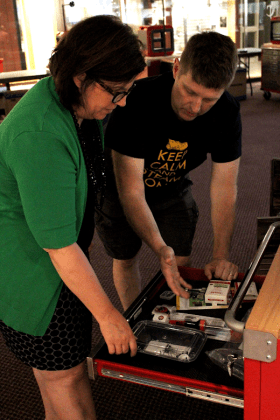
Course Instructor Keith Kelley and EMMC President Lisa Larson looking through a STEAMRoller cart that is included with the course.
In a four-day educator training that took place last month at the United Technology Center (UTC) in Bangor, 14 educators from across Maine gathered for a unique professional development opportunity offered through a partnership between two educators from RSU 19, Eastern Maine Community College (EMCC), and UTC that aims to help educators integrate advanced technology and experiential learning into every lesson plan, and to help fill the workforce gap in Maine.
Utilizing a $50,000 grant that EMCC President Lisa Larson obtained through the Maine Community College System, the 3 credit Introduction to Experiential Teaching through Technology course was offered as an opportunity for educators to “learn practical learning experiences to integrate traditional and newly advanced technologies into project biased lesions,” similar to the teaching methods found in career and technical education (CTE) settings throughout the state. The idea is to bring the experiential teaching philosophy to classrooms long before the high school CTE experience. The earlier integration of experiential learning gives students a taste for possible career paths but just as importantly, learning experiences that allow them to utilize and understand the advanced technological tools of their future and to utilize and exercise their own problem-solving and management skills.
The course was led by RSU 19 educators, Keith Kelley and Kern Kelley who are brothers, partners, and advocates for integrated experiential student learning. It provides classroom teachers, at any grade level and of any subject matter expertise, with not only the tools but also the mindset and methods to teach project based and integrated lessons to their students. This type of learning environment provides students with real-world, problem solving experiences with technology, bringing full circle the content areas that make up the very well-known acronym STEAM (science, technology, engineering, art, and math).
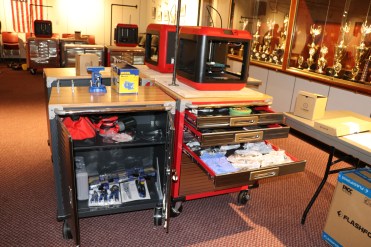
The STEAMRoller Cart includes: Seville Classics UltraHD 2-Door Rolling Cabinet and a 6-drawer Rolling Storage Cabinet, Vise, Portable Vise Table, Power Strips, Cordless Orbital Hand Sander, Corded Orbital Hand Sander, Power Drill, Impact Power Drill, Rotary Dremel Tool, Irwin Clamps, Kobalt 100-Piece Household Tool Set with Hard Case, Hand Tool Bag, Hammer, Locking Pliers, Tape Measure, Speed Square, Spade Bits, Flash Forge 3D Printer, 3D Printer Tool Set, Frog Tape, Duct Tape, Rocketbook, FriXion Pens, iPod Touch & Case, Tripod, Raspberry Pi, Soldering Iron, Scrappy Circuits, Safety Goggles, Disposable Gloves, Breakout of the Box DRAWER, and a Breakout EDU Kit.
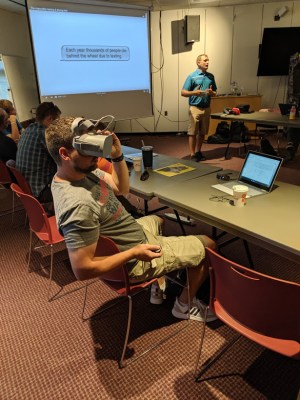
Each educator’s school paid $381 total for the four-day hybrid course that includes the four in-person sessions, bi-weekly reading and reflection assignments and online discussions and provides educators with contact hours plus 3 college credits, in addition to a “STEAMRoller” cart of hardware and equipment valued at over $2,000 each. They will also each have the opportunity to host a STEAMRoller bus for a day at their school, which includes an experiential student conference provided by course instructors and their partners. At the student conference, educators and students will be able to participate in a day filled with breakout sessions on various topics such as 3D printing, drones, and virtual reality to name a few.
Hermon High School Principal Brian Walsh is excited that one of his 9th grade science teachers is attending the course this summer so that he can share his knowledge and the tool kit with the other 9th grade science teacher so that they can integrate hands-on project-biased learning experiences, not just to 9th graders but throughout the high school as well. Walsh has felt a void where they were unable to fill an industrial arts position in prior years and hopes this will help bring new STEAM learning experiences, career pathways, and experiential opportunities to the students at Hermon High School.
Tonya Therrien, Benton Elementary 5th Grade teacher decided to take the course with the hopes of bringing back to her classroom, “a way to utilize technology more with the kiddos, beyond just using it for research.” She wants her students to know how to use technology as a tool. When asked what she thought of the training so far, she said, “this is probably the most worthwhile class I’ve ever taken, and I’ve taken a lot of classes.” She then added that she has two master’s degrees which both required a fair amount of coursework.
Aaron Pody, a high school Life Sciences teacher from RSU 18 came to the class to learn about ways to teach the content with more relevance to his students. He has been pleased to find that there are ways to bring technology into the classroom that are not cost prohibitive.
RSU 26 educator Karen Frye from Orono was excited to bring back what she has learned at the course to provide her gifted and talented students with the rare opportunity to do some hands-on problem solving, which will further enrich their learning experience and give them some problem-solving skills.
The 3-credit course and the STEAMRoller bus events are intended to give participating educators and schools a taste of experiential learning methods, along with emerging technologies, tools and resources. The course is expected to be followed up by an Experiential Education certificate program that EMCC is expected to launch in January of 2020. The new program aims to provide the state with educators that can help fill the growing workforce gap in technologically skilled workers.
The launch of the experiential training was deemed a success by organizers and participants alike. The innovative approach to an obvious need has the potential to further help Maine schools lead their students toward successful career choices, experience with problem-solving, and the ability to successfully navigate the technology of our future.
This article was written by Rachel Paling in collaboration with course instructors Keith and Kern Kelley, and staff at both UTC and EMMC. If you have story ideas for Maine DOE’s Maine School’s Sharing Success campaign, please contact Rachel Paling at rachel.paling@maine.gov.



 Tonya Therrien, Benton Elementary 5th Grade teacher decided to take the course with the hopes of bringing back to her classroom, “a way to utilize technology more with the kiddos, beyond just using it for research.” She wants her students to know how to use technology as a tool. When asked what she thought of the training so far, she said, “this is probably the most worthwhile class I’ve ever taken, and I’ve taken a lot of classes.” She then added that she has two master’s degrees which both required a fair amount of coursework.
 RSU 26 educator Karen Frye from Orono was excited to bring back what she has learned at the course to provide her gifted and talented students with the rare opportunity to do some hands-on problem solving, which will further enrich their learning experience and give them some problem-solving skills.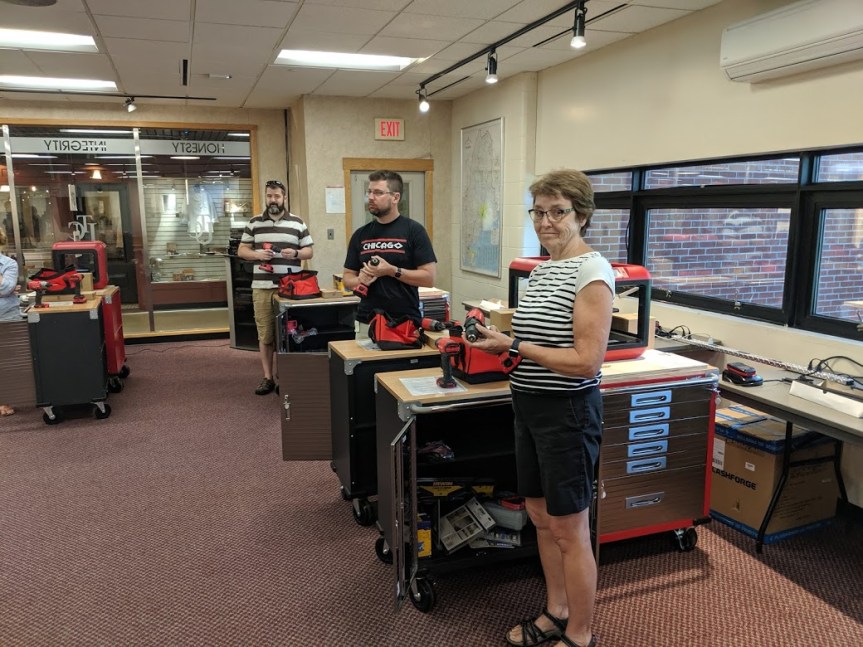
 Maine DOE Newsroom