Meet Bertha Caler, Retired Teacher, Volunteer Extraordinaire, and Downeast Gem.

Submitted by Sarah Woog, Executive Director of the Washington County Consortium.
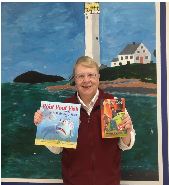
Bertha graciously welcomed me into her home in Cherryfield so I could learn about her work at D.W. Merritt School in Addison. Thank you, Bertha, for your time, and for all you do to enrich children’s lives.

In the January Washington County Consortium Newsletter, I encouraged Washington County educators to reach out if they knew someone who should be profiled for future newsletters. I soon received an email from Suzanne Plaisted, a teacher at D.W. Merritt School, who recommended I reach out to Bertha Caler. Bertha, she shared, “is a retired teacher who has not only been subbing for years but established a free library at D.W. Merritt School in Addison.” Bertha seemed like a great person to profile. She is doing replicable work that truly enhances the lives of many students.

Bertha’s work is replicable, but she is not. She has the energy of my seven-year old, the passion of a crusader, and the generosity of the heart we see in every great educator. As soon as I was seated in her living room, Bertha pulled out her overflowing 3-inch binder where she logs every book donation with donors’ names. When students take out a book, that’s logged too, but they are not required to return it. They are welcome, encouraged, to keep books. Bertha explained, “We’ve had over 2500 donations. Hundreds haven’t come back and that’s the goal.”

Here’s how the free library works: Bertha collects book donations. She started collecting from public libraries and local donors and now, thanks to her Facebook page, she regularly gets books shipped to her from all over the country, from Minnesota all the way down to Florida, and from throughout New England. Last year, she received a package every day and would even get calls from the Post Office asking her to come pick up the overflow.

Bertha logs the donations, takes a picture, gives a shout-out on Facebook, and stores the books by grade level in her garage. She brings rotations of books from the garage into D.W. Merritt School to give them away. She has two book carts she carts around the school, one for the littles and one for the big kids. “I’ll take the books down and get surrounded,” Bertha shared. From there, little hands grab books and consume them with a happy fury. Some books are returned, some get a new home.

Bertha runs the free library “because I don’t see kids reading anymore… We need to get the world opened up to them and this is the way to do it.” Not only does the free library open the world to kids through reading, but it also opens lines of communication between D.W. Merritt students and the world outside of Washington County. Every donor receives a hand-made (not just hand-written, but hand-made with illustrations) thank-you note from students at D.W. Merritt. The free library teaches students how to express appreciation, how to write thank-you notes,  and even how to address envelopes.

The free library’s impact is constantly expanding. Last year, the Stephen and Tabitha King foundation donated $5000 to buy books and supplies for the free library. D.W. Merritt has re-instituted school-wide sustained silent reading because of a growing enthusiasm for books at the school. Bertha believes the free library “can happen at any school. You just have to have someone willing to put in the time.” If you’re interested in setting one up at your school, find Bertha on Facebook and reach out to her. Or just reach out to her, because she’s worth getting to know.
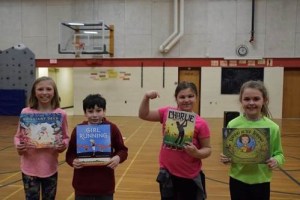


Highlights from the Williams Elementary School in Oakland

Submitted by Melanie Smith, Principal of Williams Elementary School in RSU 18.

March Madness

It’s the fourth year of Williams Elementary School’s annual school-wide reading tournament.  Williams elementary staff, Valerie Glueck and Shelly Moody, started Nonfiction March Madness four years ago to celebrate our school community’s of reading and capture our excitement in a school-wide event.  Every year 16 outstanding nonfiction books are selected that we hope will foster our students’ curiosity while building background knowledge about a variety of engaging topics. On February 27, Williams kicked off the reading event by having a student representative from each classroom run into the gymnasium when each book was announced.

This year we have a book bracket with the 16 outstanding nonfiction books included in this year’s tournament. Alternative Ed teacher, Ryan Sucy created the PDF bracket for us so that students could predict the winner and monitor their favorite books throughout the rounds of our tournament.  The bracket will be sent home with students to encourage them to chat with their parents about their favorite books.
Jason Pellerin, JMG teacher at MHS, is our incredible master of ceremonies for our March Madness events.  He really knows how to hype the crowd and get kids excited about reading! Amanda Levesque, 4th grade teacher at Williams, organizes the music, lights and sound for our events, too!  We have many other staff who have helped this year and in the past to make this tradition exciting for our students. It takes a village!

Our big assembly to announce the winning title will be on Wednesday, April 3rd.

Bedtime Math’s Crazy 8’s Club

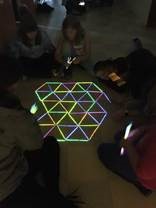
Valerie Glueck, Williams Elementary’s title 1 math teacher, organized the first Williams Elementary School Bedtime Math’s Crazy 8’s After School Club. The club started on February 27 with an activity titled Glow-In-The-Dark Geometry.  Glueck, three teachers from WES (Alexandra Cotter, Kinsey Hilton and Karen Mayo) and Messalonskee High School students Ben Hellen, Cameron Croft and Tieran Croft have volunteered their time to provide our students with fun and engaging math activities after school.

“The goal of Crazy 8s is to show that math is fun and recreational, not compulsory, in order to change our culture and get kids to think of math as play.  We offer mischief-making activities that kids love, like Bouncy Dice Explosion and Toilet Paper Olympics. We start with the fun, then roll in the math,”  (https://crazy8s.bedtimemath.org/home/what).

Breakfast with the Best 

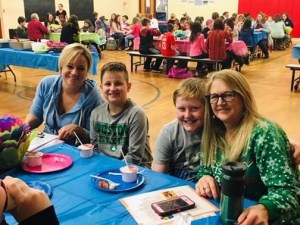
Williams Elementary School put their Gratitude Grant into action yesterday morning as they welcomed some special guests who joined them for breakfast. As part of the RSU 18 Lifestyle Team’s focus on Being Thankful, Gracious, and Giving our schools submitted proposals for gratitude grants to support a particular project. WES set its sights on hosting a Breakfast with the Best.
The proposal written by Principal Melanie Smith read, “It is important that we help our students develop strong character traits by creating activities that allow them to be compassionate, respectful and responsible citizens. At Williams Elementary School, we would like to provide our students with the opportunity to express their gratitude to a person in their life that they are thankful for and/or that has made a difference in their life.”

Each student selected a person and wrote an essay explaining how that person was important in their lives. They worked on their essays over the course of several writing blocks.  They drafted and redrafted, working on standards, receiving feedback and support as they developed a thoughtful, polished essay detailing why they are thankful for the person they invited.  They also wrote formal invitations for the breakfasts for their guests to RSVP to.

On the day of the breakfast, students came downstairs to greet their guests with a laminated copy of their essay to give to them as a keepsake. They then escorted their guest into the beautifully decorated gymnasium to share a breakfast and celebrate the difference that these special people had made in their lives.
Guests included many parents, grandparents, siblings, aunts, and uncles, but also coaches, teachers or formers teachers, and other staff members or mentors. Students opened each breakfast with a speech of welcome and the reading of a special poem.  After everyone had the chance to enjoy some snacks, each student took a moment to share their essay with their person, leaving few dry eyes around the room.

“It was really a team effort to get this morning together,” said Principal Melanie Smith. “The kitchen staff organized and prepared the breakfasts, the custodial staff had the gym set up and ready to go for Wednesday morning’s events, many staff attended multiple breakfasts to help out, and several students volunteered to stay in during recess one day to make paper flowers to decorate the tables. They also helped set up for the event, and clean up after the event took place.”

Thanks to everyone’s efforts the breakfast was a huge success. Guests were very moved by the students’ thoughtful pieces, the beautiful handmade decorations, the food and its presentation, and the event as a whole.

“This is a day that will be remembered by many for a long, long time,” said Principal Melanie Smith


Strong Community Bonds Benefit Cushing Community School in RSU 13

Submitted by Dawn Jones, Teaching Principal at Cushing Community School in RSU 13

A new after school math program for Cushing Community School students begins this week, thanks to our partnership with Cushing Public Library. This is the latest example of how community organizations and volunteers in our small, rural town partner with our school to support students.

Bedtime Math®’s Crazy 8s Club provides high-energy standards-aligned math activities to build motivation and confidence. Starting out as a once-a-week program for students in grades K-2, the library has plans to possibly expand for grades 3-5 in the fall. The school provides bus transportation and helps support communications with families, while the library provides planning, healthy snacks, and staff and supplies to implement the activities. Not only is Crazy 8s Club helping fill a community need for after school programming, but the school anticipates benefits will come back to the classrooms as students bring increased confidence and enthusiasm to their math learning each day.

In addition to Crazy 8s Club, the Langlais Sculpture Preserve in Cushing also provides after-school nature-based arts enrichment to Cushing students in grades 1-5. Growing out of a partnership between Cushing Community School and The Georges River Land Trust, this program is approaching the end of its second year. Among their many projects this spring, students will work with a local woodworker to create a sculpture for the school garden area, modeled after the work of well-known Cushing Artist, Bernard Langlais, whose homestead-studio is the site and inspiration for this after
school program.

Community organizations also help support reading and science enrichment. Students take monthly walking trips to the town library for stories and activities with library volunteers. A community “Green Team” — composed of retired community members with a passion for nature and gardening — helps maintain the school garden area and supports teachers in using our garden and school nature trail to take learning outside and help students learn about and care for our local resources.

This past fall the Green Team worked with school administration and staff to organize the school’s first ever “Outdoor Science Day.” Students spent the day rotating through outdoor activities led by community volunteers and experts from environmental education organizations to learn about seeds, soil, pollinators and beekeeping, ecosystems and apple-pressing. Teachers were able to connect activities with specific expectations in the Next Generation Science Standards so they could continue to build on the learning back in their classrooms. The centerpiece of the day was students enjoying apple cider they pressed themselves, thanks to a local community member who brings his cider press to our school each year. This year they had a better idea of all the natural resources and ecosystem
connections needed to produce a delicious cup of cider.

These are a few examples of how community volunteers and organizations are helping provide unique activities for Cushing students. In combination with the support of the CCS Friends & Family parent group — whose active support could easily fill another article — our growing network of community connections helps make Cushing Community School a special place. You can follow school news and events on our Facebook page.

Recent Highlights from Noble Middle School in RSU 60

Civil Rights Team Hosts Annual “Theme Week” with Success

Submitted by Terese Hodgdon, Secretary at Noble Middle School

In Berwick, Maine, Noble Middle School Guidance Counselors, Amy Malette and Sarah Burcalow, have been co-advisors of our Civil Rights Team for many years. They typically have 15-20 students on the Civil Rights Team. Meeting once a week, the students work on projects that fulfill the Maine Civil Rights Team Project mission statement:  We help schools think and talk about issues related to race and skin color, national origin and ancestry, religion, disabilities, gender (including gender identity and expression), and sexual orientation.

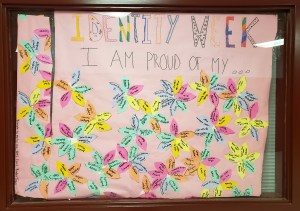
Recently, the Civil Rights Team hosted the annual “theme week.” This year, it was called “Identity Week.” Students and staff wore different clothing each day to show support for the different areas covered under the Maine Civil Rights Law. Students were invited to the office each morning to read a quote that pertained to the daily category. This year’s clothing options were as follows:

  • Monday: Wear Black and White clothing to show your support of all races and skin colors
  • Tuesday: Wear the colors of the flag of your national origin or ancestry.
  • Wednesday:  Wear all the colors of the rainbow to show your support of all genders and sexual orientations.
  • Thursday: Wear comfy clothing to show that people of all religions should feel comfortable in school.
  • Friday: Wear a hat to ‘put a lid’ on discrimination against disabilities.

During lunch periods, a table was set up in the cafeteria where there was a banner of flowers. Students could pick a petal and write on it what they were proud to identify with.

Fitness for Life and Teacher Good Enrich the Lives at Noble Middle School

Submitted by Elyse Galeucia, Literacy Coach at Noble Middle School

Over the years Noble Middle School (NMS), in Berwick, Maine, has been lucky enough to have wonderful teachers. Many do not compare to that of Physical Education teacher Rebecca Good. Ms. Good not only embraces her physical education curriculum, but is stellar in building relationships with students by investing and modeling the lifestyle she thinks everyone should have both physically and emotionally.

Every child Ms. Good has taught, both past and present, would all agree that she is a powerful, impactful, and unforgettable teacher. She has always had such finesse when working with students within their middle school years, an extremely delicate period of their lives.

Although there are many notable moments in Ms. Good’s 35+ year career, one of her many successes has been her Fitness for Life program at NMS. This program has allowed Ms. Good to invite many different community members, such as firefighters, police officers, Navy personnel, and parents, into the school to lead fitness classes in order to model how they are “fit for life.” Furthermore, she not only has brought this program to the classroom, on multiple occasions, she has scheduled times during the morning for the whole school (all 532 students) to work out together, staff and administrators included!

Ms. Good strives for excellence and is never satisfied with “good enough.” Within her daily physical education curriculum she is always finding ways to imbed literacy and technology in order to engage and bind her message of truly living a balanced life.


School Safety and Security Bulletin: Fire Alarm Changes and Codes

Throughout the 2018- 2019 school year, the Maine Department of Education, State Fire Marshal’s Office, Department of Health and Human Services, Maine State Police, Maine Sheriffs Association, Maine Chiefs of Police Association, and the Maine Emergency Management Agency will provide tips and resource information to Maine schools to help provide some guidance for identifying signs and preventing school violence.

School Safety and Security Bulletin  – March 2019

Further questions and inquiries can be send to Pat Hinckley, Maine DOE Transportation and Facilities Administrator at pat.hinckley@maine.gov.

FY2018/2019 Tribal Clean Diesel Funding Request for Applications (RFA) Changes; Deadline is April 3

The U.S. Environmental Protection Agency has combined fiscal year 2018 and 2019 Clean Diesel Grant funding into one Request for Applications (RFA). An additional $2.0 million in grant funding has been added to the already open FY18 Tribal RFA for a total of $4.0 million available. Under this amended grant competition, each applicant may request up to $800,000 in federal funding, and EPA is expecting to award between 5 and 12 grants. The deadline for applications is Wednesday, April 3, 2019.

Please visit the Clean Diesel Tribal Grants Website for the RFA and Supporting Documents (www.epa.gov/cleandiesel/clean-diesel-tribal-grants)

Tribal Applicants Click Here If Interested in Learning More About the VW Mitigation Trust DERA Option.

Priority – Priority is given to projects that achieve significant reduction in diesel emissions and exposure in areas designated as having poor air quality, and in areas receiving a disproportionate quantity of air pollution from diesel fleets.

Eligibility – Tribal governments (or intertribal consortiums) and Alaskan Native Villages, which have jurisdiction over transportation or air quality, are eligible to apply for Tribal Clean Diesel grants.

Use of Funding – Eligible diesel vehicles, engines and equipment may include:

  •  School buses
  •  Class 5 – Class 8 heavy-duty highway vehicles
  •  Locomotive engines
  •  Marine engines
  •  Nonroad engines, equipment or vehicles used in construction, handling of cargo (including at ports or airports), agriculture, mining or energy production (including stationary generators and pumps).

Further questions can be send to Pat Hinckley, Maine DOE Transportation and Facilities Administrator at pat.hinckley@maine.gov.

Release of FY2018 Title IA Basic Disadvantaged and Program Improvement Funds for General Title IA Reallocation-Title IA FY2019 Summer School

The Maine Department of Education’s ESEA Federal Programs Title IA Office is announcing the availability of approximately $700,000 of FY18 Title IA Disadvantaged and Program Improvement funds for Title IA reallocation purposes.

The Application for FY2018 Title IA Funds Reallocation (Title IA FY19 Summer School Application) and Title IA Reallocation Procedures are available on ESEA Federal Programs website by clicking on the Title I Icon.  The Application or FY2018 Title IA Funds Reallocation (including how the funds will be used to improve the performance of Title IA identified students along with a detailed budget) must be mailed/postmarked by April 12, 2019 at 5:00 p.m. and mailed to:

Department of Education
ESEA Clearinghouse
23 State House Station
Augusta, ME 04333-0023

For more information regarding Title IA programs, please contact monique.sullivan@maine.gov. or jackie.godbout@maine.gov.

Administrative Letter: Clarification on Requirement to Ensure Parents’ Meaningful Access to IEP Information

Administrative Letter: #23
Policy Code:  BGE
To: Public School Administrators, Special Ed. Directors, EL Coordinators/Directors, and ESOL Teachers
From: Pender Makin, Commissioner
Date:  March 12, 2019
Subject: Clarification on Requirement to Ensure Parents’ Meaningful Access to IEP Information

Title VI of the Civil Rights Act of 1964 guarantees parents’ right to receive communication from their children’s schools in a language they can understand. The US Department of Education has provided guidance (PDF) clarifying that, “State Education Agencies (SEAs) and Local Education Agencies (LEAs) have flexibility in determining what mix of oral and written translation services may be necessary and reasonable for communicating the required information to parents with limited English proficiency.”

For parents of students with Individualized Education Plans (IEPs), LEAs must ensure that parents are able to understand the proceedings of the IEP meeting and access the IEP document as needed.

In a 2007 letter (PDF) to Conway Public Schools in Arkansas, the Office of Special Education (OSEP) indicated that, “while providing written translations of IEP documents is not required under IDEA, we believe in some circumstances it may help to show that a parent has been fully informed of the services his or her child will be receiving.”

A 2016 Dear Colleague Letter (PDF) from OSEP states that, “Under Title VI, all vital documents, including a student’s IEP, must be accessible to Limited English Proficient (LEP) parents, but that does not necessarily mean that all vital documents must be translated for every language in the district. For example, a timely and complete oral interpretation or translated summary of a vital document might suffice in some circumstances. A district must, however, be prepared to provide timely and complete translated IEPs to provide meaningful access to the IEP and the parental rights that attach to it. This is because a parent needs meaningful access to the IEP not just during the IEP meeting, but also across school years to monitor the child’s progress and ensure that IEP services are provided.”

This notice does not serve as legal advice, and LEAs should consult legal staff and/or the Office for Civil Rights for guidance pertaining to their specific contexts.

The Maine Department of Education would like to acknowledge and thank Maine’s special education directors, administrators, and educators for ensuring federal and state regulations for educating students with special needs are met, and for their ongoing dedication to the students and families that these processes serve.

For further information about translation/interpretation please contact April Perkins, Director of ESOL/Bilingual Programs & Title III at (207) 624-6627 or april.perkins@maine.gov. For further information about supporting students with an IEP, please contact Maine DOE’s Office of Special Services at (207) 624-6713.

PRIORITY NOTICE: Information Regarding ESEA Dashboard and Implementation of the Federal Accountability Model Under ESSA

Dear District and School Leaders,

I am writing to provide you with an update regarding School Year (SY) 2018-19 data correction requests, the timeline for the release of the ESEA Dashboard, and implementation of the federal accountability model under ESSA.

Data requests submitted to the Maine DOE by the February 8, 2019 deadline will be completed by Friday, March 15, 2019. The updated data sets will be uploaded to the ESEA Dashboard and provided to Superintendents for review on Monday, April 15, 2019. The review period will end on Monday, April 29, 2019. After April 29, 2019, no further data corrections will be possible. The ESEA Dashboard will be publicly  available later in SY 2018-19.

Maine DOE leadership had a phone conversation with the US Department of Education (USDE) on December 12, 2018 to discuss Maine’s ESSA amendment. During this conversation Maine DOE staff members outlined Maine’s proposed amendment. USDE did not indicate required revisions to Maine DOE during the call or provide written follow-up. The Maine DOE submitted the amendment on December 14, 2018.

The Maine DOE leadership emailed USDE leaders several times over the past three months to inquire about the ESSA amendment status. To meet USDE’s required timeline for implementation, the previous administration instructed Maine DOE leaders to move forward with the implementation of the ESEA Dashboard and federal accountability system, without regard to the status of Maine’s amended ESSA Plan.

Under my leadership, Maine DOE leaders expressed concern regarding the implementation of the federal accountability model without federal approval of Maine’s amended model. After gaining a deeper understanding of the concerns expressed by Maine DOE leaders, I called Frank Brogan, Assistant Secretary of Elementary and Secondary Education, to inquire about the status of Maine’s amendment. As a result of that call, a meeting was scheduled with USDE staffers and Maine DOE leadership for Friday, March 8, 2019.  During the call, Maine DOE leadership connected with USDE to discuss Maine’s amended ESSA plan, which had been submitted to them on December 14, 2018. Given the USDE’s recent feedback provided during the March 8, 2019 call, the Maine DOE suspects current anticipated school identifications will likely remain unchanged. However, Maine DOE believes USDE’s proposed revisions will require Maine to identify additional schools. The Maine DOE expects to receive written feedback from USDE by Friday, March 15, 2019.

In light of these developments, Maine DOE will request an extension to make school identifications during SY 2019-20. Please know that the Maine DOE is doing everything conceivable to ensure Maine has an equitable federal accountability model that honors stakeholder feedback and Maine’s small, rural context.

Pender Makin
Commissioner
Maine Department of Education

Cornville Regional Charter School: Community Centered and Uncompromisingly Learner Centered

Submitted by Ashlee Savage, Administrative Assistant for Cornville Regional Charter School

The Cornville Regional Charter School is doing some amazing things district wide. As a district, we are community-center and uncompromisingly learner-centered. We have 3 schools that serve a variety of age ranges from Prek to Grade 10.

Our Early Childhood Campus serves learners ages 4-6 and are working very hard to pull in community members and businesses into the classrooms. This happens in a variety of ways from having those people come directly into the classrooms to run learning opportunities to setting up different centers in the room to represent different businesses. This campus also does a great job with scheduling and hosting parent involvement nights.

Our Cornville Campus offers a variety of opportunities for learners, facilitators, and families. Each learner participates in special interest groups 3 days a week. These special, unique offerings include, but are not limited, to knitting, rhythmic gymnastics, snowshoeing, robotics, gym games, felt art, painting, etc. Our schedule also allows learners to move from room to room as needed throughout the day to ensure that everyone’s education is customized to their needs. For facilitators, they receive a numerous amount of professional development. Every Friday our district has an early release day which allows staff to partake in meaningful PD for the last 3 hours of each week. Lastly, the Cornville Campus has great parent involvement. We offer multiple celebration of learning nights, book fairs, grandparents luncheon, and numerous PTF events.

Our Downtown Campus has 1/3 of the sophomore class currently enrolled in a college course, 2 of the learners are part of the Maine Meals (a local business) team participating in the Maine Center for Entrepreneurship Top Gun program at Thomas College, 1 of the learners is a member of the Somerset Public Health’s board, several of the learners are involved in building a wooden boat with a local community member, and several of the learners have volunteered at a local retirement home and at the local humane society. As a school, they are also putting together a full fabrication lab that is accessible to not only all of the learners but also to community partners. Community involvement is super important and with the downtown campus being right in the heart of Skowhegan, it is the perfect opportunity to get our learners working and learning beside community members.