PRIORITY NOTICE: Update Regarding the Release if the ED 279 Subsidy Printouts

The Maine Department of Education has been working as quickly and efficiently as possible to calculate and prepare the ED 279 Subsidy Printouts as we know that school districts rely on this information to set their local budget.

The Department is pleased to report that the technology issues that were identified earlier on in the process have been completely cleared up. The only remaining element needed to complete the printouts is the General Purpose Aid (GPA) amount. That amount will come from the Governor’s budget which is scheduled for release on February 8th.

Once we receive this amount, we will be able to load it into the formula to complete the process. The anticipated release of the ED 279 Subsidy Printouts is February 15, 2019 at the very latest. We sincerely hope to complete them even sooner.

Further information will be available as soon as possible. Thank you for your patience.

MEDIA RELEASE: Maine DOE Seeks Community Partners to Help Feed Hungry Children This Summer

With the assistance of the U.S. Department of Agriculture, Maine public schools have long offered a nutritious breakfast and lunch meal program to thousands of income eligible children in Maine during the school year. To extend this program, Maine Department of Education Child Nutrition (Maine DOE) is seeking organizations who would like to participate in the federally funded Summer Food Service Program (SFSP), which provides children healthy meals when school is not in session.

“Hunger doesn’t take a summer vacation. More than 46% of Maine’s public school students qualify for free and reduced price meals,” said Maine Department of Education Acting Commissioner A. Pender Makin. “The Maine DOE is pleased to once again partner with community organizations to provide meals for kids this summer.”

In 2018, 123 sponsors participated in the program, serving meals at 450 sites throughout the state. Although the number of sponsors continues to grow in Maine, there is still a long way to go towards feeding all eligible children during the summer. Community partners are working to maximize the number of sponsors utilizing the availability of funds under the SFSP.

SFSP may be offered statewide in areas or at sites where more than 50 percent of the children are eligible for free or reduced meal benefits under the National School Lunch Program or census track data supports the need. Organizations that provide services in rural communities or near migrant farm workers and tribal populations are urged to participate. Eligible sponsoring organizations include schools, nonprofit residential summer camps, government agencies, and tax-exempt organizations including faith-based organizations.

Maine DOE encourages any eligible organization to consider providing this much-needed service to Maine children. The agency will begin accepting applications to participate in February. Approved sponsors will be reimbursed for eligible meals served to children during the long summer break.

Interested organizations should begin planning now for a successful summer. Potential sponsors are required to attend training sessions. For a complete schedule of trainings, please visit https://www.maine.gov/doe/schools/nutrition/resources/calendar. Maine DOE is available to attend meetings or consult by phone and email to answer questions regarding summer meals.

For more information about the Maine DOE’s Summer Food Service Program, contact adriane.ackroyd@maine.gov, call 624-6726 or visit https://www.maine.gov/doe/schools/nutrition/programs/sfsp.

###

In accordance with Federal civil rights law and U.S. Department of Agriculture (USDA) civil rights regulations and policies, the USDA, its Agencies, offices, and employees, and institutions participating in or administering USDA programs are prohibited from discriminating based on race, color, national origin, sex, disability, age, or reprisal or retaliation for prior civil rights activity, in any program or activity conducted or funded by USDA.

Persons with disabilities who require alternative means of communication for program information (e.g., Braille, large print, audiotape, American Sign Language, etc.) should contact the Agency ere they applied for benefits. Individuals who are deaf, heard of hearing, or have speech disabilities may contact USDA through the Federal Relay Service at (800) 877-8339. Additionally, program information may be made available in languages other than English.

To file a program discrimination complaint, complete the USDA Program Discrimination Complaint Form, AD-3027, found online at How to File a Program Discrimination Complaint and at any USDA office or write a letter addressed to USDA and provide in the letter all of the information requested in the form. To request a copy of the complaint form, call (866) 632-9992. Submit your completed form or letter to USDA by:

(1) mail: U.S. Department of Agriculture, Office of the Assistant Secretary for Civil Rights, 1400 Independence Avenue, SW, Washington, D.C. 20250-9410;

(2) fax: (202) 690-7442; or

(3) email: program.intake@usda.gov.

USDA is an equal opportunity provider, employer, and lender.

The Maine Human Rights Act prohibits discrimination because of race, color, sex, sexual orientation, age, physical or mental disability, genetic information, religion, ancestry or national origin.

To file a complaint of discrimination, write Maine Human Rights Commission, 51 State House Station, Augusta, Maine 04333-0051. Maine is an equal opportunity provider and employer.

 

Maine DOE Awards McKinney-Vento Sub-grants for the Education of Homeless Students

Maine DOE is pleased to announce that the following school districts will be receiving 2019 grants to support the needs of homeless children and youth: Augusta SD, Bangor SD, Biddeford SD, Lewiston SD, Portland PS, RSU 57, RSU 60, and Westbrook SD.  These funds augment other local and federal funds that districts have allocated for homeless education and can be used for activities that include instructional services, transportation, parent and staff training,  support and referral services, and emergency assistance.

Grants are for a one year period, and the DOE will issue a new call for proposals in 2020 for funding that may be renewable for up to three years.  If you have questions about homeless education or the McKinney Vento Sub-grant program, contact Gayle Erdheim, gayle.erdheim@maine.gov or (207) 624-6637.

Maine FFA Helps Good Shepherd Food Bank to Address Hunger Issues in Maine

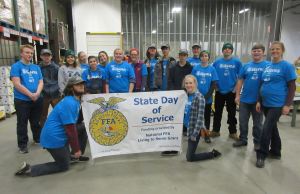
Group photo of Region 4’s afternoon class students and Narraguagus students with Maine FFA student State Officers in Hampden.

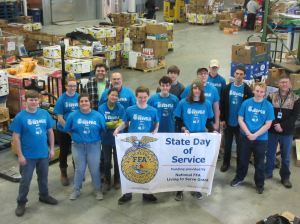
On January 16-17, 2019, high school student State FFA Officers of FFA (formerly known as “Future Farmers of America”), worked with nearly 30 FFA student volunteers and their teachers from Sanford Regional Technical Center, Region 4 United Technologies Center (Bangor) and Narraguagus High School to assist at Good Shepherd Food Bank facilities in Auburn and Hampden.

Good Shepherd, the largest distributor of food assistance in the state, addresses food insecurity in Maine, which affects 1 in 5 children.  FFA has traditionally been involved in food, landscaping and agricultural literacy community service activities at the local and state levels, and Good Shepherd Food Bank depends on the assistance of volunteers such as those from the FFA.  Membership in the FFA consists of middle and high school students who are enrolled in courses related to agriculture and natural resources.  Sanford Regional Technical Center FFA students are enrolled in environmental landscaping and horticulture programs taught by Katie Hoagland.  At Region 4, Bangor-area FFA student members are enrolled in the horticulture program with teacher Jeff Beswick, while Narraguagus High School FFA students, accompanied by teacher David Rinkle, come from both the marine trades “Skippers” program, as well as those working with the Food Justice League.

Group photo of Region 4’s morning class students and Narraguagus students with Maine FFA student State Officers in Hampden.

The Maine FFA Association is supported by the Career & Technical Education division of the Maine Department of Education and the Maine Department of Agriculture, Conservation & Forestry, as well as by additional sponsors, and travel and other costs associated with assisting Good Shepherd were supported by a “State Day of Service” grant from the National FFA Organization.  Through this grant, an additional supported event included conducting a service/leadership workshop in Presque Isle for nearly 100 Aroostook County FFA members.  The National FFA grant is also supporting the donation of two industrial grade scales and ramps for the Hampden and Auburn Good Shepherd facilities that will facilitate processing food donations and shipments transported by tractor trailers,

At the Good Shepherd Food Bank in Auburn, Sanford FFA students were involved in inspecting, sorting and boxing over 7,000 pounds of fresh produce and nearly 6,000 pounds of packaged foods.  One Sanford student said “I can’t believe we made so many meals in such a short amount of time!”  Student State FFA President, Graham Berry, noted “It’s great to be able to volunteer at Good Shepherd Food Bank.  Anything that we can do to help feed those who go without makes the world that much better of a place than it was before.”

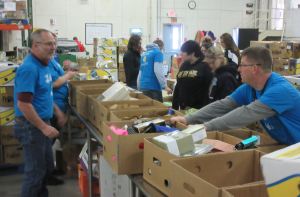
Narraguagus High School teacher David Rinkle (left) and Region 4 Horticulture teacher Jeff Beswick (right) help their students to inspect, sort and box donated food at Good Shepherd in Hampden.

In Hampden, FFA students from Region 4 and from Narraguagus helped Good Shepherd move into their newly renovated 40,000 square foot Hampden warehouse, now nearing completion.  Students finished the day by helping to inspect, sort, and box donated food items.  Maine FFA Vice President James Hotham commented that the Region 4 and Narraguagus helpers were a “really great group of students.”  Narraguagus teacher David Rinkle noted that his students were not only happy to help out, but also found the information on Good Shepherd and food needs in Maine very educational.  He commented “The food bank was enlightening for everyone and they really had a good time.”

According to Auburn Volunteer Coordinator, Bethany Tatro, Good Shepherd Food Bank “distributes 28 million pounds of food a year, or 25 million meals, to Mainers in need.”  Despite the size of the Hampd

en and Auburn facilities,  Good Shepherd Food Bank relies heavily on volunteer labor, such as that by the FFA group, to process food donations, and depends on private food donations and those by food retailers throughout the state.

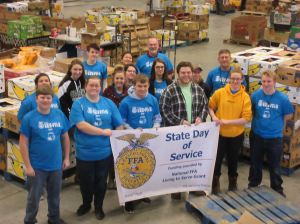
Maine FFA State President, Graham Berry (second from right), Vice President James Hotham (left) with Sanford FFA teacher Katie Hoagland (right) and her FFA landscaping/horticulture classes.

The FFA Organization is one of the largest student leadership organizations in the United States, providing recognition, awards, travel opportunities, competitions and scholarships for over 650,000 high school and middle school students enrolled in courses related to agriculture and natural resources.  Schools with green houses and school gardens for students grades 7-12 are among those eligible for membership.  Not all FFA members are “farmers,” though many do come from agricultural families who recognize the many benefits and connections FFA membership bestows.  In addition to providing organizational and leadership skills valuable to any profession, active involvement in FFA is often one of the first things looked for by agricultural organizations across the country when hiring new employees.

For more information, please contact State FFA Advisor, Doug Robertson, doug.robertson@maine.gov


Maine Students Selected for United States Senate Youth Program

Students Headed to Washington, D. C. and to Receive $10,000 College Scholarship

The United States Senate Youth Program (USSYP) announced that high school students Mr. Joseph Eugene Bergeon and Mr. Jay Raj Philbrick will join Senator Susan Collins and Senator Angus King in representing Maine in the nation’s capital during the 57th annual USSYP Washington Week, to be held March 2 — 9, 2019. Joseph Bergeon of Kennebunk and Jay Philbrick of Limestone were selected from among the state’s top student leaders to be part of the 104 national student delegation who will also each receive a $10,000 college scholarship for undergraduate study.

The USSYP was created by Senate Resolution 324 in 1962 and has been sponsored by the Senate and fully funded by The Hearst Foundations since inception. Originally proposed by Senators Kuchel, Mansfield, Dirksen and Humphrey, the impetus for the program as stated in Senate testimony is “to increase young Americans’ understanding of the interrelationships of the three branches of government, learn the caliber and responsibilities of federally elected and appointed officials, and emphasize the vital importance of democratic decision making not only for America but for people around the world.”

Each year this extremely competitive merit-based program brings the most outstanding high school students – two from each state, the District of Columbia and the Department of Defense Education Activity – to Washington, D.C. for an intensive week-long study of the federal government and the people who lead it. The overall mission of the program is to help instill within each class of USSYP student delegates more profound knowledge of the American political process and a lifelong commitment to public service. In addition to the program week, The Hearst Foundations provide each student with a $10,000 undergraduate college scholarship with encouragement to continue coursework in government, history and public affairs. Transportation and all expenses for Washington Week are also provided by The Hearst Foundations; as stipulated in S.Res.324, no government funds are utilized.

Joe Bergeon, a senior at Kennebunk High School, serves as a student representative on the Maine R.S.U. 21 Board of School Directors, and is a member of the Class of 2019 Executive Council. He was also the 77th youth governor of the Maine YMCA Youth in Government program. During the summer of 2018, he was sponsored by Senator Susan Collins and served as a United States Senate page. Joe is active in his school’s debate team and is a member of the varsity swim team. He hopes to pursue a degree related to international studies and business.

Jay Philbrick, a junior at the Maine School of Science and Mathematics, serves as the treasurer of the Student Senate, and leads by serving as head tutor in his school’s Learning Center and president and founder of his school’s High School Quiz Show Maine team. Jay has been recognized for his academic talents as well through his selection as a Michael P. Fabio grant winner and as a finalist for the Lemelson-MIT grant award. He believes that a degree in economics can help shape a better understanding of public policy and may serve him in a future in public office.

Chosen as alternates to the 2019 program were Ms. Lauren Cooper, a resident of Dover-Foxcroft, who attends Foxcroft Academy and Mr. Logan Holt, a resident of Brunswick, who attends Brunswick High School.

Delegates and alternates are selected by the state departments of education nationwide and the District of Columbia and Department of Defense Education Activity, after being nominated by teachers and principals. For more questions about the process please visit: www.ussenateyouth.org.

For questions about Maine’s delegates, alternates, or state selection process contact Joe Schmidt at joe.schmidt@maine.gov or (207) 624-6828.

For general information about the United States Senate Youth Program, contact Program Director, Ms. Rayne Guilford at rguilford@hearstfdn.org or (800) 425-3632.


Call for Student and Educator Team Proposals: MLTI Student Conference

The MLTI Student Conference Committee is issuing the call for student and educator team proposals for the 16th Annual MLTI Student Conference, to be held on Thursday, May 23, 2019 at the University of Maine in Orono.

Two important notes:

  1. Proposals are due much earlier this year! This will allow us to have a session list finalized by the time conference registration opens.
  2. Ideally, all proposals will have some form of student leadership incorporated. This could mean students will lead the whole session (with some adult support), students will serve as guides/coaches during the activity portion, or something in between. Students can co-present with teachers or other educators (including from community or business organizations).

Sessions will be one-hour long, must involve some form of creating, making, and doing, and should leave participants excited about what they learned and eager to share their experiences with others.

Here’s the information you need to submit a proposal:

Conference Theme:  Create for ME

Possible Topics:  Proposals are not limited to the conference theme, and might include topics such as music, spoken word recording, coding, video production, graphic design, or writing and publishing your collection of short stories.

Device Requirements:  The student conference supports all MLTI devices, regardless of platform and encourages “platform-agnostic” sessions.

A Proposal Submission must include:

  1. The name of your school
  2. The title of your session
  3. List of all presenters ($15 registration cost will be waived for up to two presenters per session)
  4. A description of your session:
    • What skill will participants learn? How will you teach this?
    • What activity will participants engage in – what will they create?
    • What can participants expect to walk away knowing and being able to do?
  5. Materials to share in the conference registration form:
    • Short video advertisement of the session (less than a minute)
    • Short description of the session (less than 200 words)
  6. Student leadership information:
    • How will student leaders be incorporated into the session?
    • How will they be empowered to succeed during preparation and during the day of the conference?
  7. Session requirements:
    • Level of expertise needed to participate fully (beginner, intermediate, expert)
    • The maximum number of participants you can accommodate (room sizes vary from 30-100)
    • Space set up requests (auditorium, tables/chairs, projector, speakers, etc.)
  8. Technology requirements:
    • A list of which platforms can be used in the session: (MacBook, iPad, ProBook, ElitePad, Chromebook, other)
    • Software and materials participants must have to participate (be specific)
  9. The name of the educator to be contacted about this proposal, and their email and phone number

Submit Proposals by 5 pm, Friday, March 15, 2019 to this online form or copy and paste this URL into your browser: http://bit.ly/MLTI-student-conference-proposals-2019. It is recommended that you type your answers in a separate document and then copy them into the form, so you can be sure to save your work.

General Timeline:

  • Proposals due: 3/15
  • Proposals selected: 3/22
  • Registration open: 4/1
  • Last day to register: 4/23

Spread the word – if you know of someone doing fantastic work involving technology with making, doing, or storytelling please encourage them to submit a proposal or send an email with suggestions to Amanda.Nguyen@maine.gov!

For more information or answers to questions, please visit the MLTI Student Conference page or contact Amanda Nguyen, Digital Learning Specialist at Amanda.Nguyen@maine.gov.


School Health Annual Report Summary for 2017-18

The Department of Education is pleased to announce the release of the School Health Annual Report summary for 2017-18. This report is a combination of the required reporting for Maine and optional data that is being collected as part of the national initiative with the National Association of School Nurses, Every Student Counts™. Collecting school health data informs local, state, and national student health policy and helps to promote best practices in school health services. Creating data driven polices to advocate for the needs of students, we can increase evidence-based school nursing practice and improve youth health outcomes.

To highlight a few points of interest in the report, students seen by a registered nurse in the health office returned back to class 91% of the time, compared to only 85% when seen by a health aide or unlicensed person in the school. There were 41 reports of epinephrine being administered in Maine schools for suspected anaphylaxis. 29% of those were for a peanut allergy and 25% were to people with a previously undiagnosed life threatening allergy.

As a reminder, there will be a change in the way this report is collected starting with the report for 2018-19. In the past, this report has been done by each school. The reporting link will be sent to the superintendent listed in NEO for each district, who will need to select and forward it to one point person to be responsible for compiling and submitting the data from all schools within the SAU.

The following is a list of the data points that are being collected:

  • Number of students screened for distance acuity, near acuity, and hearing in the required grades and the number of students referred/number of students with completed referral (required reporting per Chapter 45)
  • Summary of epinephrine administration (required reporting per Chapter 40)
  • Staffing levels for health services (direct services, supplemental staff, special assignments, supervisory position provided by RN, LPN, and health aides)
  • Number of students with a diagnosis (from a health care provider) of asthma, type 1 diabetes, type 2 diabetes, seizure disorder, life threatening allergy
  • Health office visits & disposition (number of students seen face to face by RN, LPN, health aide and resulting disposition: return to class, sent home, or 911 call)


If you have questions about the School Health Annual Report or Every Student Counts™, please contact the School Nurse Consultant, Emily.Poland@Maine.gov or 207-624-6688, or visit the Every Student Counts™ Website.

Read to ME Challenge to Kick-off February 4th at Young School in Saco

Year 4 of the Read to ME Challenge is scheduled to begin on February 4, 2019.  Maine Department of Education Acting Commissioner Pender Makin will launch the campaign by reading to children at Young School in Saco.  She will follow up her reading by issuing a challenge to participate in the 2019 campaign.  This simple but powerful campaign challenges adults to read to children for 15 minutes, to capture that reading episode via a photo and then post it on social media to challenge others to do the same.  The Read to ME Challenge will run for the month leading up to Read Across America Day on March 2, 2019. The Department will be live streaming this event on their official Facebook Page.

If your organization is willing and able to promote the Read to ME Challenge, please follow this link to provide us with your contact information: Read to ME Challenge Partner 2019. Read to ME Challenge resources, including a guidance document, public service announcements in a variety of languages, fliers and a list of engaging ways to incorporate the challenge are available on the Read to ME webpage.

Reading aloud to children is one of the most cost effective and highly beneficial methods of building children’s literate abilities. The simple act of reading aloud to a child 15 minutes a day for five years results in 27,375 minutes of language exposure which can put children on the path to high literacy achievement.  Reading aloud exposes children to the world around them, helps them see reading as an enjoyable and valuable activity and often strengthens bonds with trusted adults.

Schools and organizations are invited to join the challenge and to encourage community members to do the same. The collective voice of many key partners, leaders and those in respected positions will send a clear message about the vital importance reading to children plays in the social and economic well-being of Maine.   Maine DOE also encourages partners to be creative and to use this opportunity to enhance ongoing literacy education outreach efforts.

Thanks for your consideration of this opportunity, and don’t hesitate to contact danielle.m.saucier@maine.gov  (624-6702) with any questions.

MEDIA RELEASE: Maine DOE Awards Third Round of EMBRACE Grants for Regional Efforts

Augusta – The Maine Department of Education today announced that four new EMBRACE grants have been conditionally awarded to school districts and other education agencies. Made available as part of the statewide regionalization initiative, the round-three EMBRACE grants prioritize Enabling Maine students to Benefit from Regional and Coordinated approaches to Education. The awardees are partnering on a regional level to improve educational opportunities for students.

A total of 17 applications were received by the Department for the second competitive grant opportunity funded through the Fund for the Efficient Delivery of Educational Services (FEDES), which was made available to districts last summer. Of those 17 applications, four have been conditionally awarded. Based on the funding requests, totaling $4.2 million, the four awardees have projected savings of over $7 million in a 5-year period.

The first two rounds of EMBRACE grant funding in 2017 and the spring of 2018, had 19 grantees being awarded over $7.5 million in funds for regionalization efforts.

Round three EMBRACE (FEDES) grant project descriptions:

Down East Maine Career and Technical Education (CTE) Collaborative

This project will support the expansion of career and technical education programming opportunities to western Washington County. The project aims to increase student enrollment in CTE programs at the high school level and provide introductory and exploratory sessions for middle school students.

Participants:

  • Lead SAU – RSU 37/MSAD 37 (Addison, Columbia, Columbia Falls, Harrington, Milbridge)
  • Cherryfield Public Schools
  • Machias Public Schools
  • Moosabec CSD #17/School Union 103 (Beals Public Schools, Jonesport Public Schools)
  • Washington Academy

Kennebec Valley Multiple Pathways Academy II

This project will support a high school alternative education program that aims to reduce dropout and truancy rates by providing new and improved opportunities for at-risk students with multiple pathways for achievement.

Participants:

  • Lead SAU – RSU 83/MSAD 13 (Bingham, Moscow)
  • RSU 59/MSAD 59 (Madison)
  • RSU 74/MSAD 74 (Anson, Embden, New Portland, Solon)

Maine Center for Leadership and Innovation (MCLI)

This project will support the creation of a Leadership Academy that aims to provide a high-quality, research-based system of professional learning experiences and support for school- and district-level leaders.

Participants:

  • Lead SAU – RSU 6/MSAD 6 (Buxton, Frye Island, Hollis, Limington, Standish)
  • Brunswick Public Schools
  • Cape Elizabeth Public Schools
  • Gorham Public Schools
  • Portland Public Schools
  • RSU 14 (Raymond, Windham)
  • RSU 15/MSAD 15 (Gray, New Gloucester)
  • Scarborough Public Schools
  • South Portland Public Schools
  • Westbrook Public Schools

Valley Unified Learning Transformed

This project will support three components for the Valley Unified Integrated, Consolidated 9-16 Educational Facility: the merger of software systems that feed into the common student information and payroll/accounting systems; a comprehensive enrollment study, educational visioning, concept approval, and site approval; and develop programming options that link regional workforce needs to the regional education goals.

Participants:

  • Lead SAU – Madawaska Public Schools
  • MSAD 27 (Ft. Kent, New Canada, Saint Francis, Saint John Plantation, Wallagrass)
  • RSU 33/MSAD 33 (Frenchville, Saint Agatha)

OHills Reads – A Community Reads Initiative Targeting the Opiod Addiction

OHills Reads is a community-led group in collaboration with Healthy Oxford Hills and MSAD 17 that aspires to build a stronger, healthier, and more empathetic community by uniting schools, businesses, local organizations, and families with a community-wide reading and discussion of a common book. This month, in an effort to raise awareness and reduce stigma around substance use and misuse, the community read will be The Seventh Wish by Kate Messner.

According to the educator’s guide, written by Melissa Guerrette, a teacher in MSAD 17 and partner in this project, “This story is both honest and heart-felt, weaving themes of wishes, fierce love for family and acceptance of circumstances beyond our control from a younger siblings perspective. With respectful, age appropriate writing, Kate Messner has given middle grade readers a lens into the realistic ache and struggle of Charlie Brennan and her family, who—like too many families in our country —are facing the tragedy of a loved one with opioid addiction. ”

Plans are underway to bring educational programs to intermediate classrooms in MSAD #17, and to host community events including panel presentations, book discussions, an event with Kate Messner, the author, and a fishing derby. The events will take place throughout the month of January and early February. If you are interested in learning more about or participating in the OHills Reads events, please check the Facebook Page (OHills Reads), or contact Emily Eastman (emilye@healthyoxfordhills.org), Melissa Guerrette (m.guerrette@msad17.org ) or Heather Manchester (h.manchester@msad17.org).