ESSA and Maine Integrated Youth Health Survey (MIYHS) Data

The MIYHS provides valuable data to school administrators and communities in assessing the health of their youth. With this data, action can be taken to further address specific needs and/or problems that Maine students are facing.

Middle and high schools who participated in the 2017 MIYHS have school level student data related to school climate, bullying, alcohol, marijuana and prescription pain medication. A one page snapshot of school level data is now available by contacting Reid.Plimpton@maine.gov

New Fact Sheets for 2017

  • Youth Safety on Maine’s Roads
  • Tobacco’s Use by Youth in Maine
  • Lifetime Substance Use Among High School Students in Maine
  • Connections at School and Home among Maine High School Students

These new fact sheets can be found on the MIYHS webpage, See here

Additionally, the Updated 2017 MIYHS Middle School and High School Data Dashboard is now live.  The interactive data tool presents multiple years of MIYHS data on Maine middle school and high school students. Data is available by the State, County and Public Health District levels and includes maps, graphs and tables that are available for export.

Contact jean.zimmerman@maine.gov or reid.plimpton@maine.gov for  more information

Maine DOE provides supplemental funding for facilitation and legal costs for regional service centers

This notification was shared Jan. 25, 2018 with regional service center Part II Applicants.

To: Regional Service Center Part II Applicants

From: Robert G. Hasson, Jr. Ed.D., Commissioner

Subject: Supplemental funding for facilitation and legal costs for Part II and interlocal agreement

The Department is committed to supporting Regional Service Center (RSC) applicants who have chosen to pursue the development of a durable and flexible partnership and interlocal agreement. Recognizing the investment of time and resources this undertaking requires, we are providing additional funding for facilitation and legal costs of up to $20,000 per RSC membership group. You may access this additional funding by contacting Jennifer Pooler, Regionalization Project Manager.

PRIORITY NOTICE: Guidance for Changes to Career and Technical Education Funding

Beginning with fiscal year (FY) 2018/2019 state funding for education, the State allocation for Career and Technical Education (CTE) will be based on a program-driven cost model, which bases the calculation of state subsidy on the following components: direct instruction, central administration, supplies, operation and maintenance of plant, other student and staff support, and student enrollment.

State subsidy payments will be made directly to Career and Technical Education Centers and Regions. In this model, State subsidy will replace both state and local share for the costs included in the model, which should provide relief to assessment payments that sending schools would have previously received. Going forward, local assessments will only be necessary for costs outside/above the model, such as new equipment or costs not covered by the model.

When the FY 2018/2019 ED279 subsidy printouts are released, SAUs and school board members should consider these changes as they review their state allocation and move toward setting a 2018/2019 budget.

As a reminder, the ED279s are on track for release by the February 1 statutory deadline.

Further details about the new model can be found in the CTE Model Executive Summary. Further questions about funding can be directed to Tyler Backus at Tyler.Backus@maine.gov and questions about CTE operations can be directed to Paul Hambleton at Paul.Hambleton@maine.gov.

2017-2018 ESEA Report Cards

The 2017-2018 Elementary and Secondary Education Act (ESEA) Report Cards are now publicly available in the Maine Assessment and Accountability Reporting System (MAARS).  The 2017-2018 ESEA Report Cards present results from the 2016-2017 school year.

The ESEA Report Cards are designed to meet federal requirements for data reporting as outlined in the Elementary and Secondary Education Act (ESEA) as amended by the Every Student Succeeds Act (ESSA).  States are required to provide an annual report card to inform stakeholders about the progress of students and schools on indicators of student achievement, graduation rates, status of ESEA accountability and information on fully certified teachers.

The 2017-18 ESEA report card is for informational purposes only and does not impact school accountability status. Title I Accountability status for 2017-2018 remains as determined by school performance reported for the 2013-2014 school year. A new school and district accountability system will be implemented at the beginning of school year 2018-2019 as part of Maine’s approved ESSA plan with the U.S. Department of Education.

MAARS can be accessed through the following link, which is also located in the Maine Department of Education website.  Report Cards can be accessed in MAARS from the “Quick Reports” page by clicking on the “School,” “District,” or “State” button for school year 2016-2017, which downloads an excel sheet with links to each Report Card.

Further questions regarding the purpose of the 2017-2018 ESEA Report Cards should be directed to ESEA Federal Programs and Title I Director Chelsey Fortin-Trimble at Chelsey.A.Fortin@maine.gov or call 624-6815.  Questions regarding assessment and data reporting should be directed to Assessment Director Andrew Hudacs at Andrew.Hudacs@maine.gov or call 624-6827.


PRIORITY NOTICE: Additional training dates for Comprehensive Needs Assessment and SAU Consolidated Plan

As a result of the substantial response to technical assistance sessions for support regarding the development and completion of a Comprehensive Needs Assessment and SAU Consolidated Plan, as required under the recently reauthorized Elementary and Secondary Education Act (ESEA), the Maine Department of Education has expanded the training schedule.

Completed SAU Consolidated Plans must be submitted to the Maine Department of Education on or before July 1, 2018. The utilization of the CNA and SAU Consolidated Plan template will ensure all required elements are included.

The Department has expanded upon the following training schedule to support SAU Data Coordinators, SAU and school staff as they complete the Comprehensive Needs Assessment and SAU Consolidated Plan. Registration can be completed through the session title hyperlinks below.

Data Collection – Remains unchanged
The target audience for this session is SAU Data Coordinators and will provide an overall view of the template document. Please ensure participant has log-in credentials to NEO for all applicable modules. Tandberg is available.
Tuesday February 13, 2018
9 AM – 12 Noon
Augusta, Cross State Office Building, Room 103

Work session – Extended timeframe & change in location
The target audience for this session is SAU and school staff completing the CNA/SAU Consolidated Plan. Morning timeframe will focus on sections 3-6, afternoon timeframe to focus on sections 7-10. You may attend one or both sessions.
Tuesday February 6, 2018
9 am – 3 pm
Capital Area Technical Center, 7 Pierce Dive, Augusta, ME 04330
(1 pm – 4 PM Augusta, Cross State Office Building, Room 541)

Work session – Remains unchanged
The target audience for this session is SAU and school staff completing the CNA/SAU Consolidated Plan. Session to focus on sections 3-6 only. Tandberg is available.
Tuesday March 6, 2018
8:30 AM – 12 Noon
Augusta, Cross State Office Building, Room 541

Work session – Additional date added
The target audience for this session is SAU and school staff completing the CNA/SAU Consolidated Plan. Morning timeframe will focus on sections 3-6, afternoon timeframe to focus on sections 7-10.
Friday March 9, 2018
9 am – 3 pm
Capital Area Technical Center, 7 Pierce Drive, Augusta, ME 04330

Data Dive and Evaluation – Remains unchanged The target audience will be central office and plan development team members who will examine the data to determine root cause and next steps. The group will be divided into two groups for a work session: Group 1 – NWEA data, Group 2 – STAR data.
Monday March 19, 2018
9:00 AM – 1:00 PM
Augusta, Cross State Office Building, Room 103

Available resources to assist SAUs to complete the SAU Consolidated Plan include:

  • Guidance Document –  – This document provides guiding questions for SAUs to ponder and respond to when completing the CNA. The SAU Consolidated Plan will be developed after the CNA is completed.
  • Question and Answers – This document contains a summary of all questions posed during technical assistance sessions.

In order to register for the upcoming professional development sessions, please click on the hyperlinks included below. By clicking on the appropriate link, you will be brought to a registration form.

For further information please contact Janette Kirk, Deputy Director, Office of Learning Systems at (207) 624-6707 or Janette.Kirk@maine.gov

Powered By Maine Teach to Lead Summit

Maine Teach to Lead is pleased to announce Powered By Maine Teach to Lead Summit, Monday, April 9th, 8:30-3:30pm at Husson University, in Bangor.

Do you have a vision for your school or district? Do you need time and support to make your vision a reality? Then the Powered By Maine Teach to Lead Summit is for YOU!

This is a FREE event for teachers where you will be able to network with other teachers from across Maine, collaborate with teaching peers to cultivate an idea, and develop an action plan to accomplish your goals.

Join us and make your idea a reality!

Apply today (Applications are due by February 8th at 5pm.)


PRIORITY NOTICE: Preliminary Guidance for release of ED 279s

The FY 2018/2019 education subsidy printouts (ED279s) are projected to be distributed to SAUs by the February 1 statutory deadline. With the many changes that went into effect in the 2018/2019 biennial budget and because of the uncertainty and regular questioning that often arises prior to and during this process, the Department is releasing guidance so that SAUs, school boards and local taxpayers can review their own unique circumstances as a unit and the factors with the largest impact on 2018/2019 education funding subsidy levels.

The following is a list of key factors that are greatly impacting calculations for state allocation and required local share for FY 2018/2019 education funding:

  • Student enrollment – A dramatic increase or decrease in student enrollment. Whether it is because of a change in population or because of a withdrawal from or formation to a unit, the EPS funding formula’s major driver is student population.
  • Changes in debt service payments – SAUs that have either paid off or begun to pay principal or interest payments for equipment (new school, new bus, etc.), that the State has allocated funds to pay those payments could see dramatic changes in calculations if either payments no longer need to be made or if payments have begun.
  • Town valuation –Each town’s valuation is provided by the Maine Revenue Service each year and determines the town’s ability to pay local share. Previously the amounts used were determined based on the average valuation of the previous 3 years for each town. This coming FY they will be based on an average of the previous 2 years, per changes created in the biennial budget. As property values tend to increase year after year, this change has created an increased “ability to pay” for some towns resulting in a higher required local share.

Valuation change, Pupil change, and Per Pupil Valuation calculation and change for each SAU

A full list of detailed changes to the EPS funding formula will be provided with the ED279s.

For more information about the EPS formula and state funding for education visit the School Funding webpage on the Maine DOE webpage or contact Tyler Backus at tyler.backus@maine.gov.

SAT 3rd Year High School Student Enrollment Confirmation

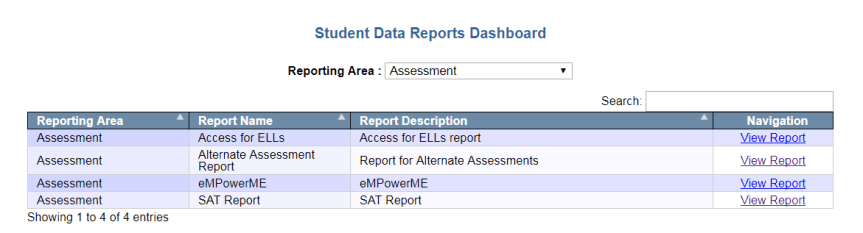
As previously announced, the 3rd year high school student enrollment (bulk registration) file for spring 2018 SAT assessment will be sent to Measured Progress/College Board on Friday, February 2, 2018. Any students changing enrollment after 2/2/18 will need to complete paper registrations on the day of SAT testing (4/10/18 or the makeup date on 4/24/18). SAT enrollments can now be checked in NEO.

Confirm your enrollment in NEO/Student Data (for SAT bulk registration) Dashboard https://neo.maine.gov login:

1.) Click “Student Data” module

student data

2.) Click “Student Reports” module

student reports

3.) Choose Reporting Area “Assessment” – SAT Report
assessment

4.) Click View Report

If there are discrepancies in your 3rd year high school enrollment, please recheck your enrollment system and/or contact the DOE Data HelpDesk at MEDMS.helpdesk@maine.gov or 624-6896.

Reach Higher Maine Webinar: The New CTE Pathway to Maine’s Proficiency Diploma

Reach Higher Maine has developed a series of free webinars designed to provide school counselors & those working with student’s tools to use in their college and career readiness programs.

Live Webinar Date:  January 31st 2018, 1:30 PM

The webinar will be recorded and available on the Reach Higher Maine Google Classroom

Description: Presenters will dispel the myths surrounding the CTE Pathway by showcasing the talent, ambition and resilience of CTE students. Through video, we will share the stories of students who have walked the CTE pathway and turned struggle and uncertainty in to self-confidence and future promise.  We will take the time to clarify the new CTE diploma pathway and discuss how CTE schools statewide can act as a resource and academic partner for students working toward achieving proficiency in an evidence based system

The webinar is free and will provide a certificate of completion upon request as well as access to the Discussion Board where you can ask questions of the presenters or the rest of the attendees.  We are hoping this will encourage attendees to share best practices.

Register for this course 

Presenters:

  • Danielle Despins, MOA/CSR Coordinator – Special Populations and Gender Equity Coordinator from the Maine Department of Education’s Career and Technical Education team
  • Dave Boardman, Ed.D. Mass Media Communications instructor at the Mid-Maine Technical Center

Handouts include:

  • Maine Proficiency Diploma Pathway Requirements
  • Maine Proficiency Diploma Requirements

Resources:

  • Reach Higher Maine Google Classroom A Google email (@Gmail.com) account is needed to access to the Google Classroom

  • To access this webinar after January 31st or to access past webinars, log into the Reach Higher Maine Google Classroom. Once you are logged into your email, click the + in the upper right hand corner to “Create or join your first class!,” then select “Join class.” The class code is 1bs991n.
  • Welcome and Orientation to Education SeriesShort video to help you access and navigate the Google Classroom so that you can get the most out of this experience 


For more information please contact Reach Higher Maine at ReachHigherMaine@gmail.com

Reach Higher Maine is a coalition of Maine education & workforce professionals with the goal of helping to expose Maine students to education and career opportunities by helping to support school counselors in their work.

Professional Learning Program for teaching Code.org computer science courses

Educate Maine and the Maine Mathematics and Science Alliance have announced that applications are now open for Code.org’s computer science Professional Learning Program.

Code.org’s Professional Learning Program is an intensive, year-long professional learning program for middle and high school educators who are interested in teaching Code.org’s CS Discoveries (middle school) or CS Principles (high school) courses. These programs are designed to prepare educators to provide high quality computer science instruction based on the curriculum, tools and approach to students in their classrooms.

Applications opened on January 16 and close on March 30, and will be reviewed on a rolling basis. For more information and to apply, visit the Professional Learning page for CS Discoveries or CS Principles.

For more information about this opportunity visit the MMSA website or Code.org. Send specific questions to Angela Oechslie at Educate Maine angela@educatemaine.org or Renee Charette at MMSA rcharette@mmsa.org.