2017 County Teachers of the Year honored

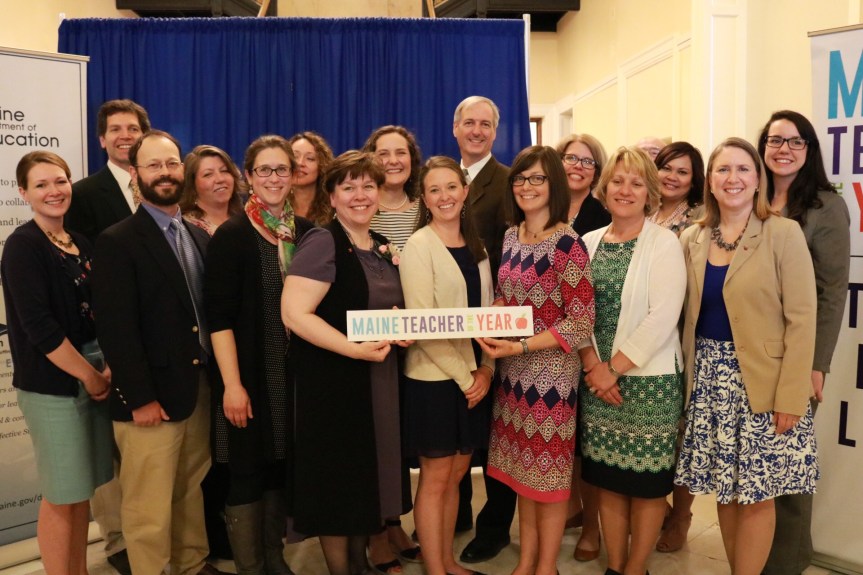
Teachers from each of Maine’s 16 counties were today honored in Augusta’s State Capitol at an annual event in the Hall of Flags announcing the 2017 Maine County Teachers of the Year. The group is the county finalists for Maine Teacher of the Year, an honor awarded each year to one teacher in Maine.

The educators were each nominated by a member of their community for their exemplary service in education, and dedication to their students. They were selected by a distinguished panel of teachers, principals and business community members from a pool of hundreds of other nominated teachers in their communities.
CTOY2

2017 County Teachers of the Year:

  • Androscoggin: Nesrene Griffin, Governor James Longley School
  • Aroostook: Leslie Marquis, Fort Kent Community School
  • Cumberland: Brooke Teller, Casco Bay High School
  • Franklin: Allison Warman, Rangeley Lakes School
  • Hancock: Marielle Edgecomb, The Peninsula School
  • Kennebec: Lisette Bordes, Messalonskee High School
  • Knox: Iris Eichenlaub, Camden Hills Regional High School
  • Lincoln: Christopher Coleman, Great Salt Bay Community School
  • Oxford: Janet Harriman, Sacopee Valley High School
  • Penobscot: Kasie Giallombardo, Nokomis High School
  • Piscataquis: Kaitlin Young, SeDoMoCha Elementary School
  • Sagadahoc: John Dever, Mt. Ararat High School
  • Somerset: Eric Brown, Lawrence High School
  • Waldo: Christi Goosman, Searsport District High School
  • Washington: Rhonda Stevens, Beatrice Rafferty School
  • York: Jen England, Noble High School

Ambassadors for teachers, students, and quality education in Maine, these teachers will continue to participate in the intensive State Teacher of the Year selection process, including the submission of a video showcasing their classroom instructional practices.

The field will be narrowed to eight semi-finalists who will begin working on their professional portfolio, a component of the National Teacher of the Year process. After the portfolio review and presentations to a select panel, the field is narrowed to three finalists. In October, the 2018 Maine Teacher of the Year will be selected after a school site visit and final interview.

The Maine Teacher of the Year is a program of the Maine Department of Education, administered by Educate Maine, a business-led organization working to ensure Maine’s students and workers are the best educated and highly skilled in the world.

For more information, visit www.maine.gov/doe/toy/.

###
 

PRIORITY NOTICE: Maine DOE announces change in English learner reclassifications

Maine DOE has changed English learner reclassifications to Overall Composite Proficiency Level Score of 5 or greater on ACCESS 2.0.

Maine recently received its 2016-17 ACCESS 2.0 for ELLs scores and many of our English learners scored at proficiency levels lower than expected. This is because of a process that established new expectations for what scale score students must achieve in order to reach each proficiency level.

WIDA explains as follows: “The changes to students’ ACCESS for ELLs 2.0 proficiency level scores reflect the increased language demands of college and career readiness standards. WIDA raised the bar for language proficiency and students needed to showcase higher language skills in 2016–2017 to achieve the same proficiency level scores (1.0–6.0) in previous years. This is the result of a process to determine the student performance required for each proficiency level through a series of decisions made for each grade level by expert panels of teachers as well as district and state English language learner administrators.”

The following bullets are intended to clarify what has changed and what has not:

  • The ACCESS for ELLs 2.0 test questions did not get more difficult.
  • The scoring of the ACCESS for ELLs 2.0 domains did not change.
  • The same performance on the ACCESS for ELLs 2.0 in 2015-16 and in 2016-17 would also result in the same scale score.
  • The only change is in the scale score required to achieve each proficiency level (1-6).
  • At each level, in 2016-17, the student needed to achieve a higher scale score to reach a given proficiency level.
  • In other words, the same performance in 2015-16 and in 2016-17 would result in the same scale score, but the proficiency level score would be higher in 2015-16 than in 2016-17.
  • If parents or teachers want to know if a child’s English language proficiency improved from 2015-16 to 2016-17, they should compare the scale scores across the two years, but not the proficiency level scores.

The exit criterion in Maine has always been rigorous. We are currently the only state that requires a 6.0 proficiency score on the overall composite. After looking at our 2016-17 data, it is apparent that the 6.0 exit criterion is too high given the new cutscores for proficiency levels. We have therefore changed Maine’s exit criteria to a 5.0 proficiency level score. The 5.0 proficiency level in 2016-17 is similar to the 6.0 proficiency level in earlier years.

You may find the following materials helpful:

Direct questions about ACCESS for ELLs 2.0 and the educational or English language acquisition services for English learners to Nancy Mullins, Maine DOE ESL/Bilingual Programs, at nancy.mullins@maine.gov (207) 624-6788.

Maine DOE recommendations for dyslexia screening

In accordance with 20-A M.R.S. §4710-B, the Maine Department of Education recommends universal screening for all K-2 children.  The law pertains to screening children K-2 for traits indicating that the child may be at-risk for difficulty learning to read, it is not a diagnostic assessment.  The intent is to identify at-risk children so that they may receive early evidence-based intervention known to help children with SLD/dyslexia.

 There is a list of suggested screening tools available on the Maine DOE website, along with other useful information about dyslexia, resources and frequently asked questions.

Maine Unified Special Education Regulations (MUSER) has long recognized dyslexia as a Specific Learning Disability [MUSER VII (2) (L)], consistent with the Individuals with Disabilities Education Act (IDEA) (20 U.S.C. 1401) and the Federal Regulations (34 CFR 300.8) which implement the IDEA Law. However, there has been confusion regarding the use of the term, dyslexia.  Consequently, in 2015 Michael Yudin, Assistant Secretary, Office of Special Education and Rehabilitation Services (OSERS) issued a, “Dear Colleague” letter specifying that nothing in IDEA or the implementing regulations prohibits the inclusion of the condition that forms the basis for the child’s disability determination in the child’s IEP. https://www2.ed.gov/policy/speced/guid/idea/memosdcltrs/guidance-on-dyslexia-10-2015.pdf.

If you have further questions regarding dyslexia or 20-A M.R.S. §4710-B, please contact Lisa Whitis, MEd, JD, Maine DOE Dyslexia Coordinator at Lisa.Whitis@maine.gov or 624-6643.


MEDIA ADVISORY: 2017 Maine County Teachers of the Year to be announced 5/11 at 2pm

FOR IMMEDIATE RELEASE
CONTACT: Rachel Paling (207) 624-6747 or rachel.paling@maine.gov

What: 16 Maine teachers will be announced and honored as part of the Maine Department of Education’s annual Maine County Teachers of the Year awards. The teachers were nominated by a member of their community and chosen by a panel of teachers, principals and business community members.

The educators serve as ambassadors for teachers, students, and quality education and are available to make presentations to local and regional organizations. Into the summer, they will continue to participate in an intensive State Teacher of the Year selection process.

Who: 16 Maine teachers (one from each county), Department of Education Commissioner, Robert Hasson, Executive Director of Educate Maine, Ed Cervone, State Board of Education, Martha Harris, and 2017 Teacher of the Year, Tammy Ranger.

Where: Hall of Flags, Maine State Capital

When: Thursday, May 11, 2017 from 2:00pm – 4:00pm

For more information contact Maine DOE Director of Communications, Rachel Paling at rachel.paling@maine.gov or call 624-6747.

###

Registration open for Maine School Wellness Summit

The goal of the 2017 Wellness Summit, Awaken Your Inner Superhero, is to prepare and empower participants to create and sustain healthy, positive and safe school environments for all school personnel and students. Participants will gain knowledge and skills related to establishing a school culture and climate that is committed to wellness. They will gather tools, tips and resources for implementing programs and strategies that can improve personal health and well-being; assist in establishing and promoting policies and environmental practices to build a culture of wellness; and enhance academic achievement. This summit is a component of the Maine Schoolsite Health Promotion Program (MSHPP) and is hosted by the Maine Department of Education.

This year’s summit will feature two keynote speakers from Maine. Opening the summit is Barbara Anne Cookson, a certified holistic health coach, fitness instructor, licensed massage therapist, author, and speaker. She will offer an interactive and fun presentation which will teach participants principles and practices for being better leaders, to be happier and healthier, and to reach their full potential. Her passion is motivating others to be the superheroes they were born to be.

Wrapping up the summit will be Retired United States Army Staff Sergeant Travis Mills, a recalibrated warrior, motivational speaker, actor, author and an advocate for veterans and amputees. Travis lives an inspiring life as a quadruple amputee following his motto, “Never give up. Never quit.”  A genuine American hero, Travis with his larger-than-life personality, sense of humor and incredible spirit for life will teach and inspire participants to overcome obstacles or circumstances.

Also coming to engage the audience in how to activate a wellness program is plenary speaker, Stacey Vannah, a certified health and wellness coach who works with adults to support their wellness visions. Before becoming a full-time coach, Stacey spent over 20 years in the classroom, advocating for change and participating on school site wellness teams here in Maine. Stacey will take summit attendees on a journey of visualizing, planning and delivering wellness ideas. Required for her session are minds open to possibility, a willingness to think a bit differently, and the courage to unleash one’s inner super wellness power.

In additional to these fabulous presentations participants will engage in multiple workshops, an idea galleria, leadership skills development, networking, and planning that supports health promotion and wellness for one’s school, district employees and students. The agenda is designed to serve new participants to the summit and returning participants. All school districts will want to have representatives attend this event, Tuesday, June 27 and Wednesday, June 28 at Bates College in Lewiston, to bring back resources and tools for developing and sustaining a successful worksite wellness program.

The Wellness Summit is open to individuals or teams; anyone interested in learning about and supporting school site wellness. It is $125/person for both days or $75/person for one day. For more information or to register, please click the following links:  Maine School Wellness Summit highlights, the agenda and registration. Up to 13 contact hours can be earned.


PRIORITY NOTICE: One year extension granted for certificates expiring on July 1, 2017

Maine Department of Education (DOE) Commissioner Robert Hasson has approved a one year extension for all certificates with an expiration date of July 1, 2017. All teachers, educational specialists and administrators with certificates expiring on July 1, 2017 will be issued a one year certificate that will be mailed to your home address on file with the Maine DOE.

As many of you are aware, the Maine DOE is in the midst of transitioning to a new online certification system. This one year extension is being granted to ensure that folks who are up for renewal on July 1, 2017 will not be affected by the launch of the new online system.

This is the first time the Department has issued a one year extension and there is much work going on behind the scenes to get the renewals mailed to you in a timely manner. We appreciate your patience as we work through the steps necessary to make it happen.

As soon as all of the pieces are in place to bring the new online system up, applicants will be able to access it and renew their certificates with the assurance that their current certificates will remain valid until that is possible. Any renewal credits or professional development training hours that have been accrued for this year’s renewal will still be valid for the renewal of certificates with an expiration date of July 1, 2018.

The new system is expected to be fully functional by the fall of 2017. This is a first time endeavor for the Department. We are diligently working through the development of many new processes necessary to make it happen, as well as the unexpected delays that are often times inevitable when taking on such an extensive system change.

If you have questions please look over our Frequently Asked Questions sheet. For further questions, contact the Maine Department of Education’s Certification office at 207-624-6603 or cert.doe@maine.gov.

This message was sent directly to all Maine administrators, in addition to teachers, educational specialists and administrators with certificates expiring on July 1, 2017.

Changes to school grade configurations

School administrative units that plan to make significant school grade configuration changes must notify the Maine Department of Education of these changes by the June 15 prior to the start of the school year in which they will take effect. For example, school grade configuration changes that will take effect for the 2017-18 school year must be communicated to the Department by June 15, 2017 using the Maine Schools module of NEO. Users must have a NEO login and access to the Maine Schools module to fill out this information.

https://neo.maine.gov/doe/neo/maineschools

The reason for this notice is to ensure that the Department has the necessary lead time to analyze the grade changes and to make the determination as to whether the school population changes are significant enough to warrant the creation of a new school ID for reporting purposes. If deemed necessary, the new school ID will need to be communicated to vendors and the USDOE by the start of the school year on July 1.

If local school boards have not approved school grade configuration changes by the June 15 deadline, please contact Shannon Bartash directly to discuss the proposed changes at 207.624.6799 or Shannon.Bartash@maine.gov.

Maine DOE Takes Our Sons and Daughters to Work

KetnerQuoteOn April 27, Maine Department of Education (DOE) hosted 18 students who came to work with DOE staff as part of Take our Sons and Daughters to Work day. Ranging in age from 8 to 17, the students spent the day learning about working in public service at the Capitol and participated in activities throughout the day including interviews with DOE staff, up-close experience seeing some of the work at DOE, and a special tour of the State House with a behind-the-scenes look at how the legislature functions.
Maine DOE’s structure for the day was aligned to the State’s Career and Education Development Standards, part of the system of student outcomes in the Maine Learning Results.  The day began by communicating self-knowledge and practicing interpersonal skills, followed by learning about the work done in a government agency, understanding the knowledge and skills necessary to do the work, and exploring the various education and work backgrounds that support the development of these skills.

wordle
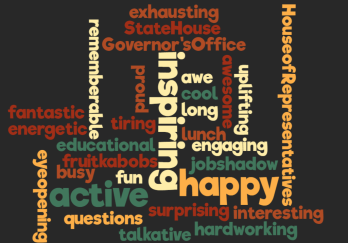
A word cloud created from words the students used to describe their day.

At the beginning of the day, students were asked to introduce themselves with an acrostic that included words which represent their strengths, character traits, and interests.

One student described himself as joyful, outgoing, skateboarding, helpful, unpredictable, and adventurous.  Throughout the day, participants learned about the traits needed to do the work they observed and about the people doing the various jobs.  At the end of the day, they were able to reflect on their own interests and skills to determine how they matched with those they observed.   This particular student reflected that an attitude of helpfulness was apparent in all the work he observed and being outgoing is an important strength.

Another student who was particularly interested in working with refugees who have been the victims of violence interviewed Jay Ketner, World Languages Specialist, about the role of language development relative to her career aspirations.

StudentQuoteKetner found that like most of us leaving high school, the student had ideas about college majors and future career possibilities without being definitively decided and fixed. However, she clearly conveyed how much it meant to her to be working with immigrant and refugee groups, and wanted to learn more about how language and cultural study could equip her for such work.
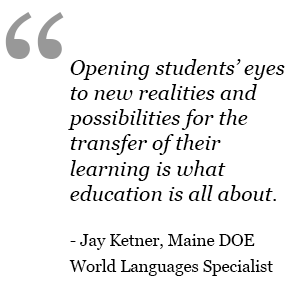
“As a former interpreter for refugees and immigrants seeking asylum, I was able to show her a whole world of language applications in school, study abroad, the workplace, and our changing communities. Opening students’ eyes to new realities and possibilities for the transfer of their learning is what education is all about,” Ketner stated after spending some time with the student.

Another student interviewed Jennifer Tarr, Maine DOE Director of Special Projects and Senator Shenna Bellows, representative to District 14: Chelsea, Farmingdale, Gardiner, Hallowell, Manchester, Monmouth, Pittston, Randolph, Readfield, West Gardiner, and Winthrop.

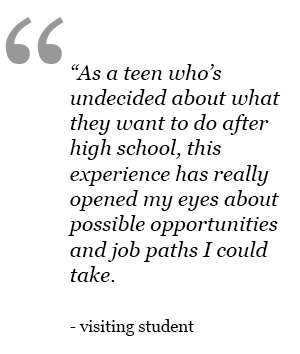
Of the experience, the student said, “As a teen who’s undecided about what they want to do after high school, this experience has really opened my eyes about possible opportunities and job paths I could take.”

Students also had the opportunity to sit down with Maine Department of Education Commissioner Robert Hasson and Deputy Commissioner Suzan Beaudoin to ask questions about their jobs and the Department.

Eager to find out more, students asked various questions: What is the hardest part of your job? What is the easiest part of your job? Do you love your job? How long have you worked here?

IMG_0302
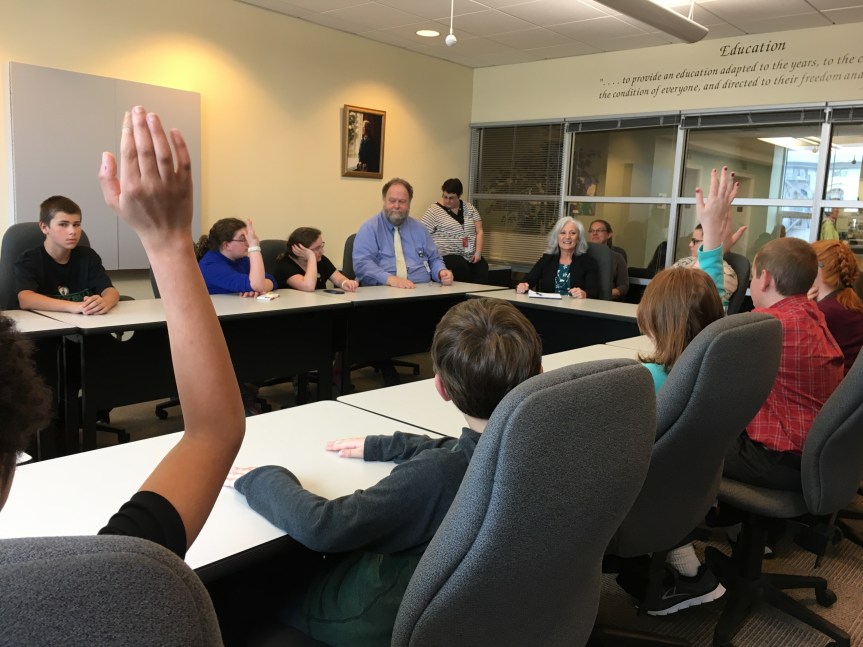
Students interviewing Commissioner Hasson and Deputy Commissioner Beaudoin

One of the biggest highlights of the day was an “insider’s” tour of the State House led by Aaron Chadbourne, Senior Policy Advisor to the Governor. The group sat in legislative seats, learned about all the work that goes on behind the scenes including what is done in the Reviser’s Office, by the legislative office and by the Secretary of the Senate. What was clear at the end of the tour was that it takes many people in supportive roles to make it all work.

20170427_141329
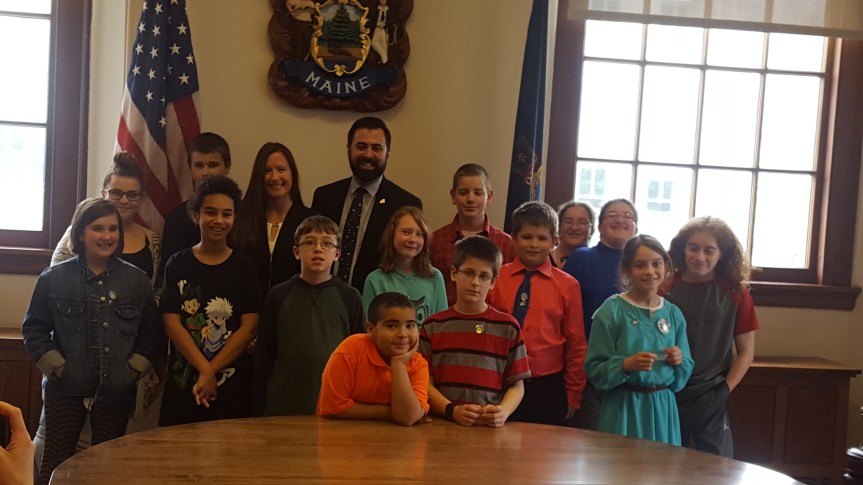
The students in the Governor’s Cabinet Room with Adrienne Bennett, Press Secretary and Aaron Chadbourne, Senior Policy Advisor

Reflecting on the day, many were pleasantly surprised and inspired by how excited and passionate people were about what they do as they explained the importance of their jobs and expressed a deep concern for and commitment to Maine’s youth.

Maine DOE seeking presentation proposals for Early Childhood Education Conference

The Maine DOE’s Early Childhood Education (ECE) conference team is seeking presentation proposals from PreK and Kindergarten teachers for the 2nd annual ECE Conference scheduled for August 14 at the Augusta Civic Center.

This year’s conference focus is “STEAM Starts Early”. The morning keynote address will be given by national speaker Doug Clements and the teacher presentations will run concurrently during the afternoon session.

Presentations will be 90-120 minutes and will present a unit or lesson plan created by the teacher team and grounded in core STEAM concepts. The audience for the sessions will be PreK, K teachers and instructional staff and administrators. Proposals are due by May 30 and should be inquiry, experiential and exploration based. The request for presentations is for a team of teachers consisting of:

  • PreK or K teacher and;
  • Art teacher and/or technology integrationist.

The ECE conference team will select three proposals, each of which will receive an XYZ da Vinci Mini 3D Printer with filament as an appreciation for their time.

For more information and to obtain a copy of the detail requirements for the presentation proposal, please contact one of the Maine DOE’s ECE conference team members listed below:

Deb Lajoie, Deborah.j.lajoie@maine.gov or 624-6613 or;

Shari Templeton, Shari.Templeton@maine.gov or 624-6880 or;

Beth Lambert, Beth.Lambert@maine.gov or 624-6642

Greater Technology Grant Flexibility Proposed

The Department announced on March 15th that many of the schools ending their 2013 MLTI participation in June would be eligible for grants to continue providing 1:1 mobile computer devices to their students and staff.

The grants are available for:

  • Students and staff in 7th and 8th grades, where the school did not refresh its devices in 2016 students;
  • High school staff in schools where students are provided 1:1 mobile devices at local expense, provided their MLTI participation ends in June; and
  • High school staff in schools that have not participated in MLTI before, if they provide 1:1 mobile devices for their students at local expense.

The prior announcement focused on grants to continue 1:1 device programs, which is the intent of the program. In response to inquiries from technology directors and schools that wish to pursue more innovative approaches to achieving the same objectives as a 1:1 program, the Department is refining our guidance.

With this announcement, the Department is expanding the types of educational technology that can be funded by the grants.

The Department is seeking a statutory change that will allow more flexible use of these grant funds. Pending that change, the Department will fund 1:1 programs as well as programs that do not provide devices on a 1:1 basis. The focus of the programs must be on integrating technology into the classroom, for the purpose of enhancing student outcomes, and may include hardware, software, educational materials and support for educators in the use of technology in teaching.  Schools will be asked to explain how student learning will be enhanced by the program, and how they will measure that enhancement.

Eligible schools may apply for the 1:1 program or the alternate program (not limited to 1:1). If the statutory change needed to authorize use of funds for the alternate program is not approved, those schools may re-apply for a grant for a 1:1 program.

Application materials are posted on the MLTI Website. For additional information; contact Deb Friedman, MLTI Project Manager at 624-6834 or deborah.friedman@maine.gov.