Washington County Educator Profile: Mitch Look

The Washington County Educator Profile is submitted by Sarah Woog, Executive Director of the Washington County Consortium.

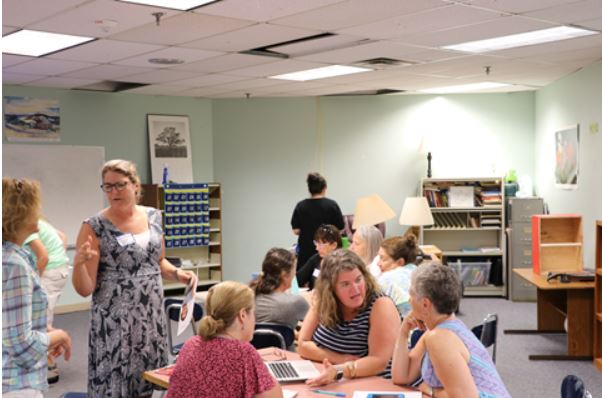
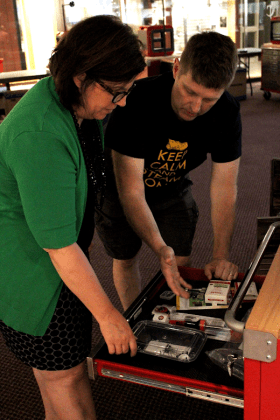
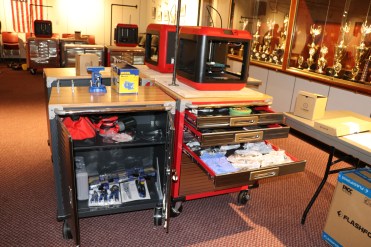
I have known Mitch Look for some years now. He’s been a member of the Washington County Leadership Team (WCLT) since before I began working with the team four years ago. I have always been struck by Mitch’s passion for education in Washington County, and by his skills as a leader. I appreciate his ability to act as a kind and supportive team member but also advocate and dissent when he is called to do so. Honestly, I admire Mitch and wanted to learn about what makes him tick. I also thought his story could provide some lessons for all of us. I met Mitch in his office last week, in the midst of back-to-school prep and PD that’s a familiar ritual to us all.

Mitch has been teaching “ever since I could.” He studied education at the University of Maine at Machias and coached basketball at Machias Memorial High School while still an undergraduate student. After working in the classroom for some years, as a middle school teacher and coach, he “wanted to have a bigger voice in decision-making” and went back to school to get his Master’s Degree and become a certified administrator. He engaged in the years long trek familiar to many of us, teaching full time while traveling back and forth in the evening for his studies in Orono. He earned his credentials, and was first a teaching principal at Fort O’brien Elementary, then principal at D.W. Merritt School, after which he served as principal at Rose M. Gaffney School for seventeen years. In 2009 he added a Certificate in Advanced Studies (CAS) to his resume.

Mitch became the ESEA/Curriculum Coordinator for AOS 96 five years ago. He is happy in his position, happy to “make it my own.” He had been apprehensive about assuming leadership positions outside of schools because he cannot stand the idea of his work getting further from the educators and students, which creates a tension with his desire to increase his impact. He told me he takes every opportunity to get into the schools of AOS 96, to feel the pulse of the school and learn from those he serves. His idea of staying current, in addition to being informed by current research and best practices, is also keeping an ear to the ground and finding innovative ways to problem-solve based on what’s working and what’s not working in schools. Mitch’s perspective expresses the duality we all experience in our work- the eternal quest for improvement fed by learning, not only from the “experts” but also, and especially, from the folks right in our schools and communities.

And Mitch loves those schools and communities. He has a keen eye for equity. When I asked what he hoped for education in Washington County, he said “the same opportunities and resources for our kids and educators that others get. Always been a dream of mine to see our kids and teachers have the resources that others have. With the talent we have down here, can you imagine what could be.” I hear you, Mitch. And I agree with your not-so-veiled critique of the inequities we all experience. However, I’d argue we can do what Mitch does in the meantime, and harness our greatest resource- our people- to realize the visions of our collective imagination.
Franklin County Adult Education Educator Recognized as Outstanding District Educator

Information submitted by Michael Burd, Franklin County Adult Education Technology Instructor/Integrator.

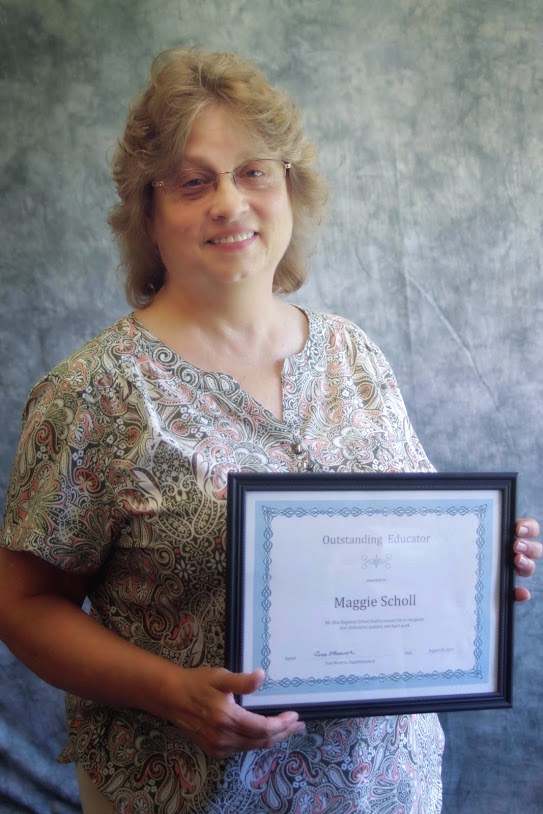
Long-time Adult Education Educator Maggie Scholl was recognized recently at an event that took place within her district.

Maggie is described as patient with a calm demeanor and the tenacity to make sure that each and every one of her students learns. She is known for maintaining positive communication with students, has a caring approach to education and a genuine interest in students.

Pleasant and collaborative with her colleagues, she contributes to the team both professionally and personally. One of her former students and a current colleague had this to say about Maggie, “I am the teacher that I am today because of great role models and this educator is definitely one of the larger role models of education for me.”

Maggie is a graduate of the University of Maine at Farmington where she later worked as a tutor in a program that helped veterans obtain a G.E.D. and improve their skills to go on to college. After a short stint working locally as a teacher, she left teaching to raise her children. Years later, she returned to the classroom when she accepted a position working for the Franklin County Adult Education Program in RSU 9 doing the same work she had enjoyed so much in the past. She has been teaching adult education there for more than 20 years.

MSSM STEM Summer Camp Success Story

Submitted by Ryan McDonald, Summer Programs Director and Public Relations Coordinator at Maine School of Science and Mathematics.

The STEM Summer Camp at Maine School of Science & Mathematics ended the 2019 season on August 3rd. Over 550 middle school campers came to the small town of Limestone in beautiful Aroostook County to learn about science, technology, engineering, and math. The campers had three hands-on classes daily and then a non-STEM class called “Instructor’s Passion”. After that, they participated in traditional summer camp activities such as rock climbing, creating tie dye shirts, baking, capture the flag, swimming, and of course our special 100-foot mega slip-n-slide.

The camp started in 1997 as a camp for girls to get them interested in the STEM fields, but expanded to six weeks total with three for boys and three for girls. In 2018, the camp changed to five weeks with a co-ed week in the middle. We have found the new model to be very effective and plan to continue.

The classes are designed to keep kids academically stimulated through the summer and have no homework nor prerequisites. The only requirement is curiosity for how things work. Some of the classes this year and past years have included Real Life CSI, Model Rocketry, 3D Printing, You Can Do the Cube (Rubik’s Cube), The Science of Clay, Intro to Programming, LEGO Robotics, Catapults and Trebuchets, and many more. This year brought a new idea, Instructor’s Passion for the 4th class. It was a shorter class where each instructor taught a hobby or interest such as origami, Japanese language, drawing, creating your own game, appreciating Beethoven’s music, team building, etc.

The MSSM STEM Summer Camp brings educators, staff, and campers from all 16 counties, a few other states, and even a few foreign countries. Each year we strive to improve the camp based on feedback from the campers. We don’t make anyone an expert in each week of camp, but we do love when campers learn something and say, “Wow! This exists.”

For more information about the MSSM STEM Summer Camp and Maine School of Science and Mathematics, go to:  www.mssm.org.

Class in a Canoe: Early College at Bryant Pond

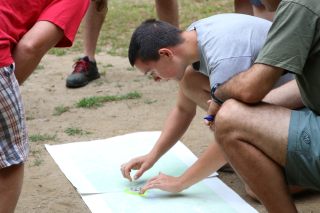
A student shows the class how to locate their position on the map

This article was written by Maine DOE Intern Emmeline Willey in collaboration with instructors from the 4H program at Bryant Pond and the UMaine Early College program.

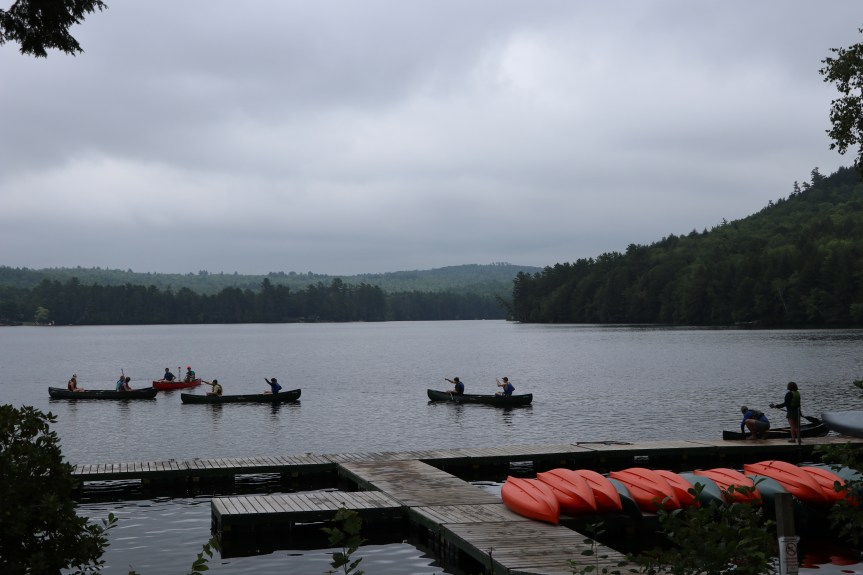
It’s the type of overcast morning that settles in a dewy film over lakeside Maine, where the air hangs thick and heavy and silent canoes prickle with fishing rods. At the end of a dirt road sprawls the University of Maine 4-H Center at Bryant Pond. The rustic campus was built in 1956 and became part of UMaine Cooperative Extension in 2008. Today, it is home to the Outdoor Leadership Early College Program and the students who are pioneering it. 

Students retrieve compasses to be used in orienteering.

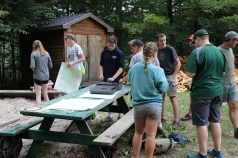
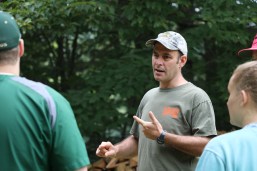
Upon my arrival, I catch a man as he’s sprinting out of the woods. He invites me to follow him back to the rest of the group after he retrieves a black case from a barn. I’m led up a steep hill on a rough draft of a path that opens on a dozen teenagers crouching over contour maps. Statewide Director Ryder Scott greets me in this clearing and explains that the students are finding their exact location using points of reference and geographic landmarks. Their knees are rooted in the ground and their sneakers are dirty; they tolerate the bugs with the nonchalance of camp kids on their second week of wilderness. 

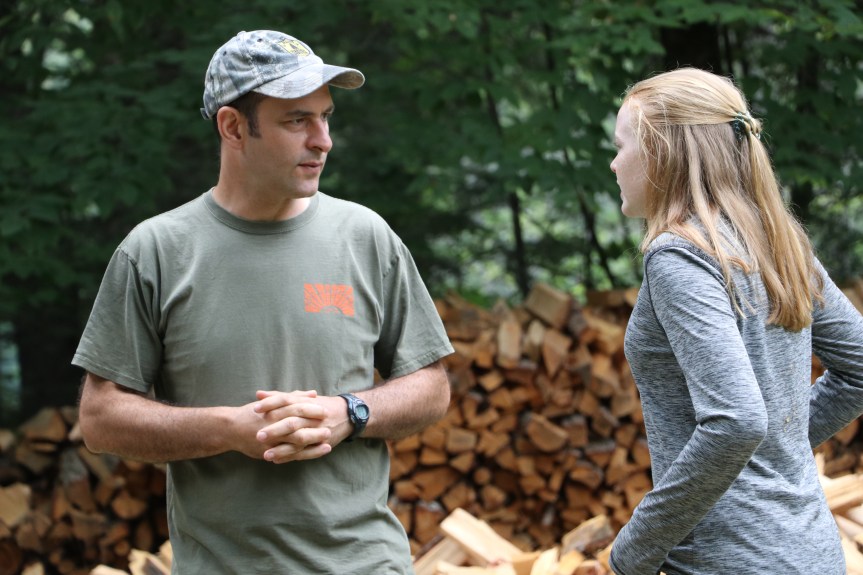
 Scott in discussion with a student.
Scott in discussion with a student.

Minutes later, the group breaks, and the contents of the mysterious black case are revealed: compasses. The students retrieve them in pairs and trail off into the woods. 

This is the sport of orienteering, one of many activities offered through the Outdoor Leadership Early College Program. In this competitive game, players are armed with a map and compass and sent into the wilderness to navigate their ways to checkpoints. Like many races, the goal is to finish in the shortest amount of time. 

IMG_1709
Tara Pocock, UMaine staff member with a background in outdoor education.

“Ryder! I have a question about trees!” yells a student, sprinting back out of the woods with a leaf in hand. They circle around the Ash leaf to take photos like scientists in an outdoor, worldwide laboratory. Shortly after, the rest of the class comes bounding out to regroup before they head to the lake. 

“They’re learning to appreciate the natural world, to be a part of nature and recognize their impact on the environment,” says Tara Pocock, a UMaine staff member and instructor at the 4-H Center, explaining that this understanding of the outdoors is important to help teenagers grow into responsible world citizens. 

Ryder Scott, UMaine staff member with backgrounds in outdoor education.

The three-week college course is offered to Maine high school students through the UMaine Early College Program. By the end of the course, students will earn three credits in Outdoor and Adventure Activities (KPE 265). Scott expressed UMaine’s goal to grow this program into a 12 credit outdoor leadership pathway that could lead to a four-year degree from the University of Maine, and support workforce development throughout the state of Maine. 

“It’s experience with real-world consequences,” Ryder Scott tells me, describing the three-day canoe trip the students will be taking next week. “If they misread the compass, if they burn the oatmeal, it’s going to be a bad time.” 

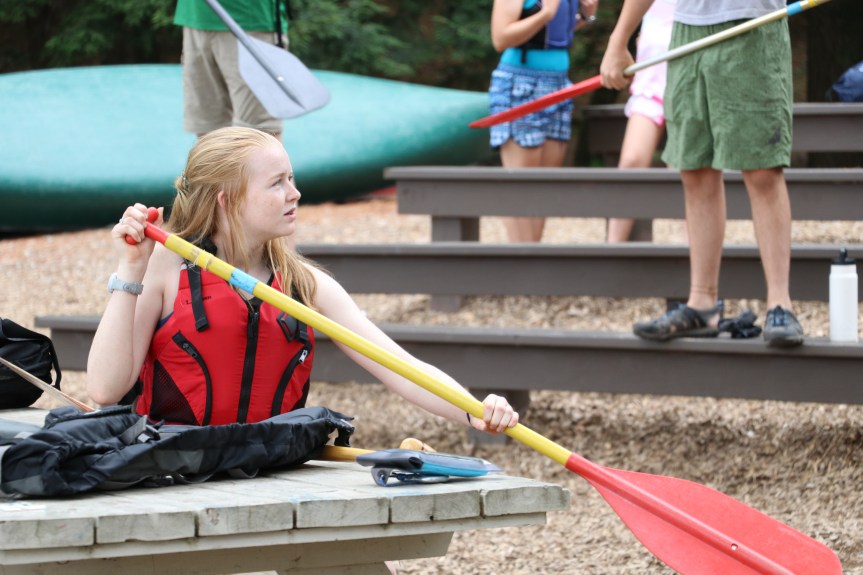
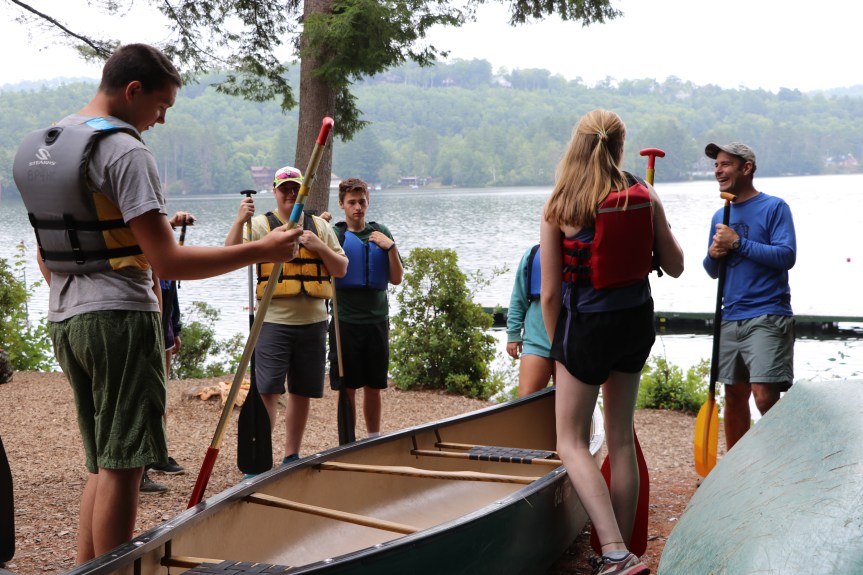
As the students make their way down to the water, discussion can be heard over the importance of wearing synthetic materials during aquatic activities. At the lakeside, the class gathers and student Laura Howe volunteers to give a lesson on proper paddling technique. 

Laura Howe demonstrates proper paddle technique to the class
IMG_1705
The class reviews the three points of contact necessary to canoe.

Halfway through the lesson, Scott interrupts to point out that the students are all holding their paddles correctly by balancing them on the tops of their shoes. Outdoor environments are conducive to this kind of rapid habit-building and learning via osmosis, as failure to remember instructions will have direct consequences on either expeditions or, in this case, expensive equipment. 

IMG_1730
Liz Dunn (right) says she met Ryder Scott through Oxford Hills’ science program, and became interested in outdoor career paths after participating in a Junior Maine Guide program. She hopes that Bryant Pond and similar programs will help her narrow down her career choices in the future.

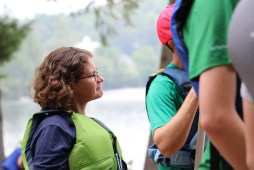
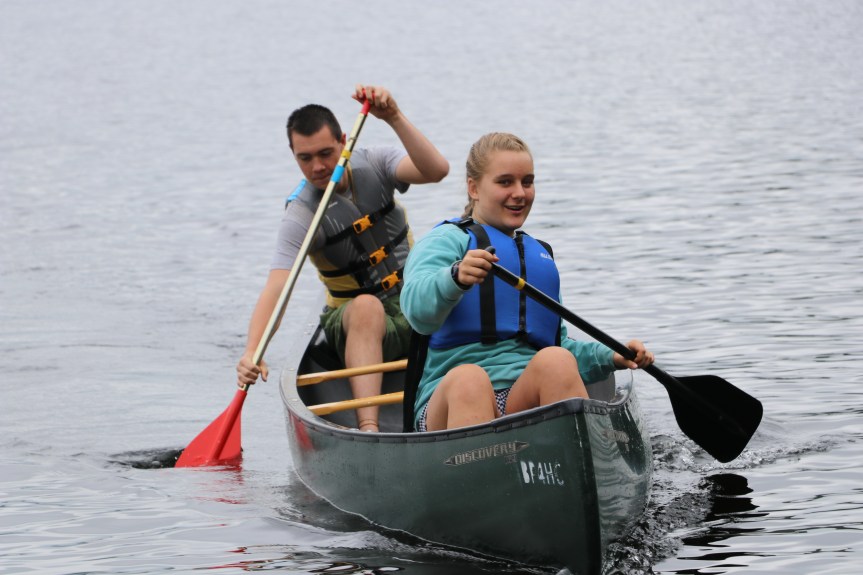
The class piles into canoes two at a time. They joke around with one another and hover nearby, waiting for their classmates. Students at experiential outdoors learning centers like this benefit from being a part of Maine and immersed in its enchanting wilderness. High school students can learn and adapt to the environment of the natural world, without missing out on the curriculum of the classroom. The UMaine Early College Program allows students to enjoy an outdoor summer, while still making critical progress toward their future careers and education. 

This fall, UMaine Bryant Pond will be offering another course (KPE 209-Wilderness First Responder) as part of the Early College Outdoor Leadership program. For more information, contact Ryder Scott, Statewide Director of UMaine 4-H Centers at ryder.scott@maine.edu or 207-665-2935. 

The University of Maine will be offering over 40 online courses in a wide range of academic disciplines to high school students this fall. Students across the state will benefit from the flexibility and variety of Academe online college courses. Through a partnership between the Maine Department of Education and the University of Maine, tuition is waived for students of Maine public and home schools for up to six college credits per semester and 12 college credits per year. Fall classes start Sept. 3. Registration is open at umaine.edu/earlycollege. 

Interested students and parents are encouraged to contact Allison Small, Early College Programs Coordinator, 581.8004; um.earlycollege@maine.edu. 


Maine Teachers Learn About the Benefits of Technology in Elementary School Classrooms

This article was written by Simon Handelman, a Maine DOE Intern from the Margaret Chase Smith Policy Institute.

Imagine how surprising it was seeing my own mother sitting in a classroom at Casco Bay High School, on a Friday morning in August. Allow me to clarify, I was not surprised to see her attending the professional learning class there; she is an extremely dedicated teacher. All I mean is it was serendipitous to see her on a day I might have otherwise stayed in Augusta at the Department of Education. My mother, Ellen Handelman, is the art teacher at Harrison Lyseth Elementary School in Portland. She, like so many other enthusiastic Maine teachers, is spending her last weeks of  summer vacation attending professional learning classes, one after another. I do not believe she has had so much homework since college. 

We were at Casco Bay High School that day for the same reasons. A session was being taught by former Cushing Community School teacher Beth Heidemann, and philanthropist David Perloff. They were underscoring the benefits of technology in elementary school classrooms. For my mother, the highlight of that day was a winning a 3D printer for her very own classroom. When I asked her to express her excitement about the printer, she said “my students can witness (in real time) how science, technology, engineering, and math combine with art to create usable objects which pair form and function.” 

Casco Bay PL Session1
Teachers at Casco Bay PL Session use downtime to network and catch up with friends.

My mother is constantly developing methods to display for her students the foundational importance of art education. She firmly believes “everyone is an artist,” and I agree. In fact, that same mantra of was repeated again and again at Casco Bay that day. Heidemann’s company Go2Science, which she founded with scientist Curtis Bentley, allows kindergarten through second grade students to travel virtually around the world, investigating hypotheses for a representative group of scientists. Heidemann’s message: “everyone is a scientist.”  

Casco Bay PL Session2
Teachers at Casco Bay PL Session Listening to a Presenter

Perloff’s Perloff Family Foundation, which donated the printer my mother won, believes all young students are equipped to learn about complicated technology, if given the chance. His foundation provided three hundred fifty 3D printers to Maine public schools, and the Maine Medical Center Children’s Hospital. Perloff believes “everyone is an engineer.” 

Other elementary school teachers in attendance raved about occasions in their own classrooms when young students expressed high level critical thinking. In one case a teacher told the group that her kindergarten class was able to fix the internet for a substitute teacher, using only verbal directions (for safety reasons).  

As the summer months come to a close, teachers across the state are eager to return to their students. There are many fantastic professional learning opportunities available in Maine, and many more dedicated teachers prepared to become the best they can possibly be.   

Brunswick Community Support Group is Working Hard to Welcome Refugee Families

This article was written by Maine DOE Intern Simon Handelman in collaboration with community members from the Emergency Action Network (TEAN) in Brunswick.

When Sarah Singer, Teresa Gillis, and other community leaders founded The Emergency Action Network (TEAN), they were responding to the rising poverty and homelessness afflicting students at Brunswick Schools. TEAN worked with teachers and administrators in Brunswick schools to identify the needs of struggling students and families. Once a specific need was clear to TEAN, they utilized the Yard Sale feature on Facebook to collect donations or, members of TEAN purchased the necessary item outright and delivered it to the Superintendent’s office.

Each fall TEAN members visit faculty in all four Brunswick schools. They connect with educators and identify needs the taskforce is equipped to address. When a child needed running shoes to participate in gym class, TEAN got those shoes to the student. Singer expressed how happy the recipient was once he was able to participate in activities with the rest of his class. When mobile home park Bay Bridge Estates experienced well failures, TEAN delivered a U-Hall filled with Poland Springs bottled water to the residents. These examples of TEAN’s excellent work explain Singer’s classification of the organization as a “catch-all safety net” and a “crisis response group.”

In recent weeks, the organization has committed itself to assisting families of asylum seekers in Brunswick. Erin Mangalam and Singer, both on the board of directors for TEAN, use their own multi-lingual skills to connect families to the resources they need. Maggy Jansson, another director, is using her background as a home visiting pediatric nurse to help families access healthcare services. However, TEAN understands they do not have the necessary background to provide optimal assistance, for this reason the taskforce pushed the town of Brunswick to hire a Cultural Broker. Nsiona Nguizani has been working in the Maine immigrant community for several years. His job is to break down linguistic and cultural barriers so support groups like TEAN or Mid Coast Hunger Prevention Program (MCHPP) can more efficiently meet the needs of these new Brunswick community members.

Support groups in Brunswick learned from Musalo Chitam at the Maine Immigrant Rights Coalition that newcomer families often travel thousands of miles over the course of several months. These families know how to be independent–they just need to become oriented in their new home. In response to this message, Mangalam and Dana Bateman (another TEAN volunteer) collected bikes for the families. TEAN does not have the resources to buy every family a car, but they can mobilize the community to get a significant number of bikes for families. Once the bikes were collected, Bruno Inacio translated Kris Haralson’s bike safety training from English to Portuguese so as many people as possible could understand the information.

TEAN is working on many projects, and more information can be found on their website and Facebook page. Moreover, TEAN is just one of many support groups working hard to help their neighbors, new and old. Similar efforts are being undertaken in Topsham by Mt. Ararat TEAN, and in Freeport by Freeport Friends. Singer says the goal was to build a “totally replicable model.” She says that it is necessary to understand that needs are different in each community. In some towns like Brunswick, the role of support groups is changing rapidly. However, dedicated people with open minds can alleviate some of the burdens for families, students, and teachers by building networks like TEAN in their own communities.

RSU 57 Prek Teachers Train Fellow Educators on Research-based Prek Practice

Prek teachers Melissa Brown, Jessie Carlson, Morgan Gallagher and Sarah Smith from RSU 57 provided training recently for new teachers ready to implement the PreK for ME program in the coming school year.

Prek for ME is a curriculum program based on the Boston Public School’s open source curriculum. Last year, 14 prek classroom teachers, including the 4 from RSU 57, were part of the pilot program that was successfully conducted last year assisting participants in improving their prek classroom instruction. RSU 57 saw great results in this research-based, whole child/multi-domain program.

Excited and eager to help bring their experience and expertise to others, the four RSU 57 teachers co-trained with some assistance from Sue Reed, Early Childhood Specialist from Maine DOE who is leading the efforts to adapt the Prek for ME curriculum for Maine.

The evaluations from the program help to illustrate its success:

“This was a super training!  I appreciated the balance between presentation and hands on with the teachers.” 

“Teachers who have used the program are very helpful!” 

The prek teachers from RSU 57 invited participants to visit their classrooms and to contact them with any questions.  The Prek for ME program will be available on the Maine DOE website by the end of August.

Lincoln Elementary School Goes Above and Beyond to Keep Students Engaged in Reading During the Summer

This spring, Augusta School Department’s Lincoln Elementary School recorded videos of each of their teachers and staff members reading a book out loud and then posted it to their school Facebook page for students, parents, and families to enjoy. This effort was part of a read-a-thon initiative to keep kids engaged with reading and literacy activities over their week-long vacation in April.

With 25 videos posted over April break and hundreds of views by students and their families, they decided to expand the effort into the summer months and include community members as guest readers. “We have made an effort to post at least one video every day this summer,” said Lincoln Elementary School Principal Heather Gauthier. “Between June 14th and August 28th when school is back in session, we will have done over 75 videos, many of them with 200+ views on Facebook and YouTube, and positive engagement from parents and community members.”

Their guest readers include everyone from teachers, school administrators, staff, and education technicians to police officers, school board members, local authors, former students, local government officials, and even Maine DOE’s very own Lee Anne Larson, Early Learning Team Coordinator.

“We have received a lot of great feedback from community members who have been engaged and parents who have benefited from the videos,” said Heather. “One parent told us that she puts the videos on while she cooks dinner so that the kids can watch and listen to books while she is busy cooking.”

What started as an effort to keep students reading over the summer months has turned into a summer reading activity that has been successful in engaging students, parents, and community members alike.

Heather says that they plan to keep the guest reading videos going for as long as they can and hopes that people keep enjoying and watching them. Check out the Lincoln Elementary School Department’s videos on YouTube. Find Lincoln Elementary School Department on Facebook.

This article was written by Rachel Paling, Maine DOE Communications and Outreach Manager in collaboration with Lincoln Elementary School Principal, Heather Gauthier. If you have story ideas for the Maine DOE’s Maine Schools Sharing Success campaign, contact Rachel at rachel.paling@maine.gov.

Maine Reaches Federal Milestone in Special Education

Maine is proud to be one of 20 other states in the nation to meet federal requirements for serving the needs of children with disabilities. This rigorous effort was led by the Maine Department of Education (DOE) Office of Special Services.

Under the Individuals with Disabilities Education Act (IDEA), states are required to report each year to the US Department of Education regarding their progress in meeting “measurable and rigorous targets” to serve students with disabilities. This determination is based on how well schools address the needs of children with disabilities. As part of the review process, Maine and other states were evaluated based on several factors, including student performance and fulfilling IDEA’s procedural requirements.

Members of the Special Services Team at the DOE have been hard at work to partner with and support schools to ensure the quality of education for disabled students in Maine continues to improve. Their strategy has been to identify areas where the state has struggled and use targeted professional development and collaboration with district administrators and teachers to improve those areas. Child Development Services has also been utilized to enhance support for children with disabilities from birth to the age of five. As part of a broader Department-wide effort, this strategy has helped to further emphasize student support and achievement.

One, among many other, contributing factors for the 2019 review, was the increased amount of Maine students with disabilities who participated in standardized testing compared to the previous year. The state receives full points from the federal government if at least 90% of students with disabilities participate in standardized testing.

“We’ve been working really hard to make sure the Department is providing the support needed to help schools improve their practices with children with disabilities,” said Jan Breton, Acting Director of the Office of Special Services. “It takes a strong team of people, both here at the Department and in the field, to make sure that our State is meeting these requirements,” she added.

The commitment and collaboration of students, families, educators, and the Maine DOE has enabled Maine to meet requirements by several percentage points. Additionally, the support and guidance that enables students with disabilities to make smooth transitions from secondary school to post-graduation living has also improved, and the dropout rate for students with disabilities has decreased. With more Maine students receiving their diplomas, these young people can expect improved employability and a wider spread of higher education options after high school.

This milestone gives the Department the opportunity to refocus efforts on collaborative and student-focused growth, as well as areas in which Maine has not yet scored full points as part of the requirements. One example is around the team’s efforts to improve the state’s federal ratings for math scores through the Math4ME program. This program is grounded in hands-on activities and interactive professional learning experiences that allow participants to gain a deeper understanding of core concepts of mathematics and strategies. The program focuses on students with disabilities in grades 3-8.

Maine’s special education professionals are passionate and dedicated in their daily work to improve the lives and outcomes of children with disabilities. With our strong team of professionals here at the Maine DOE and our valuable partnerships with educators, administrators, families, and stakeholders statewide, we hope to continue our important work toward ongoing growth, improvement, and alignment in special education in our state.

Innovative New “Experiential” Educator Training Takes Center Stage

Course Instructor Keith Kelley and EMMC President Lisa Larson looking through a STEAMRoller cart included with the course.
Course Instructor Keith Kelley and EMMC President Lisa Larson looking through a STEAMRoller cart that is included with the course.

In a four-day educator training that took place last month at the United Technology Center (UTC) in Bangor, 14 educators from across Maine gathered for a unique professional development opportunity offered through a partnership between two educators from RSU 19, Eastern Maine Community College (EMCC), and UTC that aims to help educators integrate advanced technology and experiential learning into every lesson plan, and to help fill the workforce gap in Maine.

Utilizing a $50,000 grant that EMCC President Lisa Larson obtained through the Maine Community College System, the 3 credit Introduction to Experiential Teaching through Technology course was offered as an opportunity for educators to “learn practical learning experiences to integrate traditional and newly advanced technologies into project biased lesions,” similar to the teaching methods found in career and technical education (CTE) settings throughout the state. The idea is to bring the experiential teaching philosophy to classrooms long before the high school CTE experience. The earlier integration of experiential learning gives students a taste for possible career paths but just as importantly, learning experiences that allow them to utilize and understand the advanced technological tools of their future and to utilize and exercise their own problem-solving and management skills.

The course was led by RSU 19 educators, Keith Kelley and Kern Kelley who are brothers, partners, and advocates for integrated experiential student learning. It provides classroom teachers, at any grade level and of any subject matter expertise, with not only the tools but also the mindset and methods to teach project based and integrated lessons to their students. This type of learning environment provides students with real-world, problem solving experiences with technology, bringing full circle the content areas that make up the very well-known acronym STEAM (science, technology, engineering, art, and math).

The STEAMRoller Cart includes: Seville Classics UltraHD 2-Door Rolling Cabinet and a 6-drawer Rolling Storage Cabinet, Vise, Portable Vise Table, Power Strips, Cordless Orbital Hand Sander, Corded Orbital Hand Sander, Power Drill, Impact Power Drill, Rotary Dremel Tool, Irwin Clamps, Kobalt 100-Piece Household Tool Set with Hard Case, Hand Tool Bag, Hammer, Locking Pliers, Tape Measure, Speed Square, Spade Bits, Flash Forge 3D Printer, 3D Printer Tool Set, Frog Tape, Duct Tape, Rocketbook, FriXion Pens, iPod Touch & Case, Tripod, Raspberry Pi, Soldering Iron, Scrappy Circuits, Safety Goggles, Disposable Gloves, Breakout of the Box DRAWER, and a Breakout EDU Kit.

Each educator’s school paid $381 total for the four-day hybrid course that includes the four in-person sessions, bi-weekly reading and reflection assignments and online discussions and provides educators with contact hours plus 3 college credits, in addition to a “STEAMRoller” cart of hardware and equipment valued at over $2,000 each. They will also each have the opportunity to host a STEAMRoller bus for a day at their school, which includes an experiential student conference provided by course instructors and their partners. At the student conference, educators and students will be able to participate in a day filled with breakout sessions on various topics such as 3D printing, drones, and virtual reality to name a few.

Hermon High School Principal Brian Walsh is excited that one of his 9th grade science teachers is attending the course this summer so that he can share his knowledge and the tool kit with the other 9th grade science teacher so that they can integrate hands-on project-biased learning experiences, not just to 9th graders but throughout the high school as well. Walsh has felt a void where they were unable to fill an industrial arts position in prior years and hopes this will help bring new STEAM learning experiences, career pathways, and experiential opportunities to the students at Hermon High School.

educators looking at a computer screen togetherTonya Therrien, Benton Elementary 5th Grade teacher decided to take the course with the hopes of bringing back to her classroom, “a way to utilize technology more with the kiddos, beyond just using it for research.” She wants her students to know how to use technology as a tool. When asked what she thought of the training so far, she said, “this is probably the most worthwhile class I’ve ever taken, and I’ve taken a lot of classes.” She then added that she has two master’s degrees which both required a fair amount of coursework.
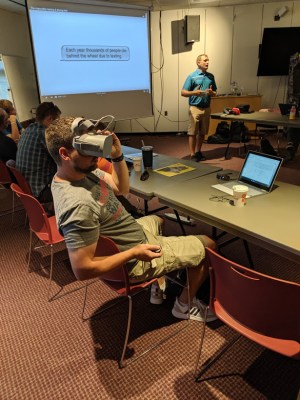
Aaron Pody, a high school Life Sciences teacher from RSU 18 came to the class to learn about ways to teach the content with more relevance to his students. He has been pleased to find that there are ways to bring technology into the classroom that are not cost prohibitive.

educator wearing VR gogglesRSU 26 educator Karen Frye from Orono was excited to bring back what she has learned at the course to provide her gifted and talented students with the rare opportunity to do some hands-on problem solving, which will further enrich their learning experience and give them some problem-solving skills.
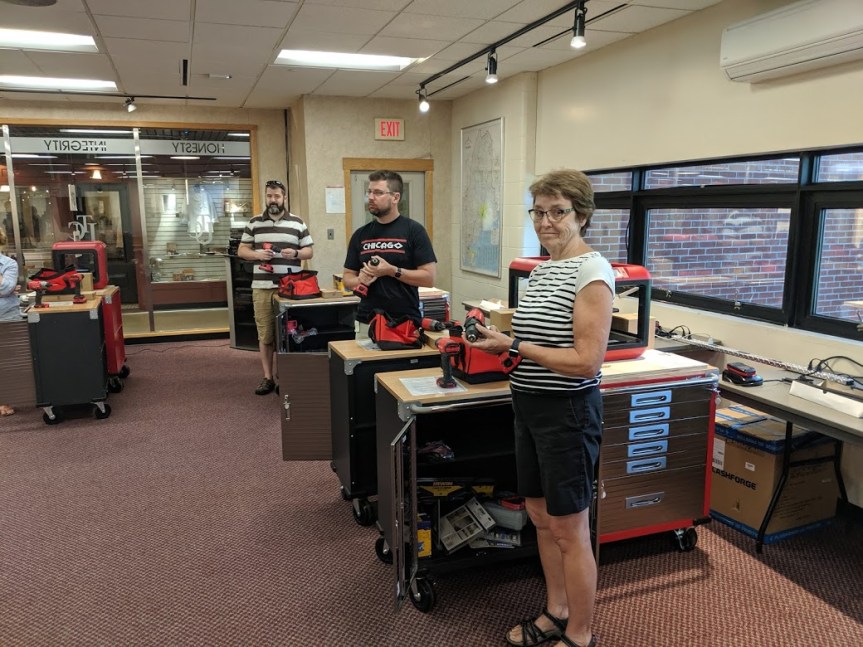
The 3-credit course and the STEAMRoller bus events are intended to give participating educators and schools a taste of experiential learning methods, along with emerging technologies, tools and resources. The course is expected to be followed up by an Experiential Education certificate program that EMCC is expected to launch in January of 2020. The new program aims to provide the state with educators that can help fill the growing workforce gap in technologically skilled workers.

The launch of the experiential training was deemed a success by organizers and participants alike. The innovative approach to an obvious need has the potential to further help Maine schools lead their students toward successful career choices, experience with problem-solving, and the ability to successfully navigate the technology of our future.

Educators standing with STEAMRoller Carts

This article was written by Rachel Paling in collaboration with course instructors Keith and Kern Kelley, and staff at both UTC and EMMC. If you have story ideas for Maine DOE’s Maine School’s Sharing Success campaign, please contact Rachel Paling at rachel.paling@maine.gov.