NEW Online Course: Cybersecurity Considerations for K-12 Schools and School Districts

The following opportunity comes from the U.S. Department of Education’s Readiness and Emergency Management for Schools (REMS) Technical Assistance (TA) Center.

Does your emergency operations team know the types of threats facing their networks and systems? Is your team prepared to handle cyber threats before, during, and after one occurs? Is cybersecurity included in your emergency operations plan (EOP)? These important questions for your planning team to consider will be answered by taking this NEW online course, Cybersecurity Considerations for K-12 Schools and School Districts.

This 30 to 45 minute free online course aims to help K-12 school personnel, school district administrators and staff, and state/regional education agency personnel include cybersecurity in EOPs and obtain critical data needed to prepare for network breaches and insider threats. This online course uses an engaging visual format and interactive features such as learning activities and quizzes that help you:

  • Recognize the connection between school safety and cybersecurity;
  • Identify the evolving threats facing school and school district networks and systems;
  • Prepare for possible cyber threats before, during, and after; and
  • Integrate cybersecurity with EOP development and planning.

Take Another REMS TA Center Online Course
The REMS TA Center offers a diverse set of self-paced, online courses as asynchronous training and professional development opportunities on school safety, security, emergency management, and preparedness topics. If you are a first-time user, create a profile for easy access to all our online courses.

Fundamentals of EOP Development

Annexes and Related Topics

School EOPs In-Depth: Planning for Large Events

Climate Data-Art Workshop for Educators

Join the Maine Department of Education and Friends of Maine Coastal Islands National Wildlife Refuge as they cohost an afternoon with Jill Pelto, an accomplished climate change artist with a passion for constructing new ways to communicate science through art.

March 31, 2022
3:00 – 6:00 p.m.
virtual event

This 3-hour workshop is designed for middle and high school teachers that would like to learn how to braid climate science, data, and visual art as a means of communicating both the data and the urgency of climate impacts in a novel way. Jill’s data-art approach has been utilized in classrooms internationally.

During the workshop, teachers will demo the activity as “students” and create an original artwork that integrates scientific data collected by researchers from Friends of Maine Coastal Islands, including Tern (Arctic, Common, Roseate) recovery and Atlantic Puffin fledgling rates in Maine. This activity can be adapted for the classroom using the same datasets, or other datasets that teachers (or upper-level students) identify.

Instructional objectives of this workshop include:

  1. Understand the meaning of the data
  2. Relate to the data personally
  3. Create an original artwork that illustrates a story

Register here for this workshop. An agenda, list of simple materials to have at hand during the workshop, and the Zoom link will be sent to all participants after successful registration. Space is limited.

If you have any questions about this event, please contact Shari Templeton at shari.templeton@maine.gov or 207-530-6407.

MEDIA RELEASE: Maine Department of Education Announces $1.2 Million in Rethinking Responsive Education Ventures (RREV) Funding to Support Education Innovation

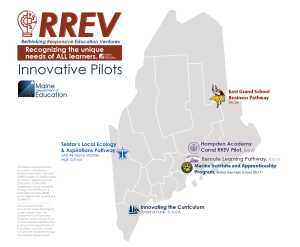
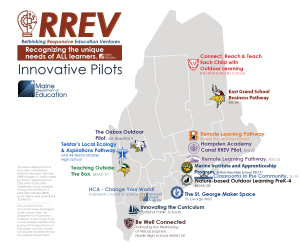
The Maine Department of Education (DOE) today awarded $1.2 million in Rethinking Responsive Education Ventures (RREV) funding to support education innovation in six School Administrative Units across Maine. These funds will be used to support projects focused on workforce development, environmental stewardship, outdoor education, a marine institute, and internship opportunities as well as supporting unique approaches to remote learning.

Awardees for this second round of RREV funding include East Grand School in Danforth, Belfast Area High School, Portland School Department, Telstar High School in Bethel, RSU 22 in Hampden, and RSU 25 in Bucksport.

“Education is changing in so many new and exciting ways, and we should be at the forefront, introducing our children to the great outdoors and offering them hands-on experiences outside the classroom that will spark new perspectives, engender new friendships, and deliver new skills,” said Governor Janet Mills. “Using these federal enrichment funds, creative Maine educators can get children outdoors this summer, exposing them to lived experiences that will get them ready for life and new careers.”

“Educators in Maine are constantly paving the way with their innovation and creativity, and RREV offers a way to supercharge these efforts,” said Education Commissioner Pender Makin. “We’re excited to invest in these educator-led projects to rethink teaching and learning in ways that deepen student engagement, expand beyond the traditional classroom, connect students with Maine’s bounty of natural resources, and allow them to explore career paths that fuel their passions.”

The Maine DOE was awarded $16.9 million from the U.S. Department of Education’s Rethink K-12 Education Models Funding. As one of 11 States to receive funding, Maine created RREV to support the work of visionary educators to develop innovative pilot programs around remote and outside of the classroom learning. RREV is flooding Maine with innovative practices, professional development, and pilot design classes. Courses in innovative design process are available through several of Maine’s public and private universities at no cost to Maine educators who wish to participate. In addition to the innovative pilot development classes, the Department is also offering asynchronous, innovative principles webinars which are available to all educators in self-paced, independent modules.

The first round of nine RREV pilots were announced last fall with an initial investment of more than $2 million to support projects including expanded outdoor learning, a makerspace, hiring an Outdoor Learning Coordinator, expanded internships, service learning, and work/study opportunities, and engaging remote learning pathways. MSAD 17, Brewer School Department, MSAD #28, RSU 89 Katahdin Schools, Mt Blue HS/ Foster Technology School, Harpswell Coastal Academy, Noble High School, MSAD 60, St. George Municipal School Unit, and School Union #76 were all part of the first round of pilots.

“At St. George School, we dare to dream big. For over 5 years, our school community has been working to bring the trades, technology, and innovation back to the heart of public education and allow all students, grades K-8, to engage in hands-on/minds-on projects,” said St. George MSU Superintendent Mike Felton, part of the first round of RREV pilots. “The RREV Program believes in the power of local schools and communities to shape their future and isn’t afraid when a small school dreams big. RREV’s support, assistance, and encouragement will help make our dream of a St. George K-8 Career Technical Education/Makerspace Building a reality and, in the process, stretch people’s imaginations as to what’s possible in rural education and economic development.”

For more information on how to get involved in RREV and to learn more about the pilots, visit https://www.maine.gov/doe/rrev. 

New Pilots:


All RREV Pilots:

Register Now for Public Pre-K Technical Assistance Sessions Available April – July 2022

Members of the Early Learning Team will be providing an opportunity for new and expanding Pre-K programs to come together to learn and discuss the components of high-quality programming.

These sessions will be offered virtually on the 2nd and 4th Monday of each month, April through July 2022, from 3:30-4:30pm. You may register once and have access to all sessions. Each session will be recorded and links to the recordings will be shared.

Once your registration is confirmed, you will receive an email with a link to a document that highlights resources related to each session topic. This should be used as a guide during the sessions.

Please feel free to share the registration link with others in your school system who may be interested.

The sessions are scheduled as follows:

  • April 11, 2022: Pre-K Application in Accordance with Ch. 124 and the Pre-K Guidebook Review & Reflect
  • April 25, 2022: Community Needs/Recruitment/Enrollment/Transitions
  • May 9, 2022: Partnering with Community Providers Exploring MOUs & Child Care Licensing
  • May 23, 2022: CDS Relationships/Coordination/Screening
  • June 13, 2022: Curriculum and Assessment Choices
  • June 27, 2022: High-Quality Classroom Environments & Materials
  • July 11, 2022: Early Childhood Development Teacher Training and MELDS
  • July 25, 2022: Family Engagement Strategies

Register here. For questions and clarifications, please contact Early Childhood Specialist Nicole Madore at nicole.madore@maine.gov.

Spring Training Begins TODAY 3/7 with an All-Star Lineup of Professional Learning Offerings

Active learning, student engagement, technology integration, digital instructional design, digital citizenship, and online safety are the main topics for an ongoing professional learning series offered by the MLTI Ambassadors starting on March 7. These daily offerings are offered live and open to all interested educators. The sessions will also be available in asynchronous versions on our website.

To attend one of the live sessions via zoom, be sure to register through this March Calendar or through the Maine DOE PD Calendar.  Please note that the times of these offerings vary from day to day.  Asynchronous versions of these sessions will be available through MLTI Professional Learning as well as the MLTI Youtube channel.
MondayMonday – Technology Integration with Rob Dominick 

The first series of workshops will focus on effectively integrating technology into the classroom. We will look at surveyed data on technology integration and learn about the common flaws and beliefs with the integration. Then, we will explore a variety of strategies for integrating technology so we can find commonalities and synthesize them towards your own needs. Finally, there will be a chance to evaluate sample lessons and create your own to implement.

The second series will dig into digital portfolios for students. We will cover exactly what they are, their intended purpose and the process of preparing and designing them.

Available every Monday in March! Check here for times and dates.

TuesdayTuesday Tech – Student Engagement with Erik Wade

Every week, we will discuss a broad technology integration idea that could be used to increase student engagement. These workshops will look at the big idea, break it down into easy-to-understand pieces, look at examples, and talk about potential starting points for integration into the classroom.

Available every Tuesday in March! Check here for times and dates.
WednesdayWednesdays with Werner – Digital Citizenship & Online Safety with Jonathan R. Werner

This six-part series on Digital Citizenship and Online Safety will draw on the incredible resources Common Sense Education (CSE) has curated to provide educators with a framework for and tools to teach students about Digital Citizenship.  CSE divides these resources into six areas. After an introductory session about CSE and the role of educators in teaching Digital Citizenship, the next five sessions will follow CSE’s framework:

  • Media Balance and Well-Being (Week 2)
  • Privacy and Security (Week 3)
  • Digital Footprints and Identity (Week 4)
  • Relationships and Communication (Week 5)
  • Cyberbullying, Digital Drama, and Hate Speech (Week 6)

Please note, educators can choose any or all of these sessions and do not need to be able to attend all six.  After April Break, we will tackle the sixth CSE focus area, News and Media Literacy, in a multi-week series focusing on issues such as Finding Credible News, the Four Factors of Fair Use, and Creator’s Rights and Responsibilities.

Available every Wednesday in March! Check here for times and dates.

ThursdayThursday – Digital Instructional Design with Kate Meyer

This series of workshops will explore the creation and implementation of high-quality, engaging, interactive digital learning experiences for your students. Each week we will explore a new digital strategy that you can implement into any unit of study. The workshops in this series will have time built in to try out the strategies we’re exploring, so come ready to dig in!

Available every Thursday in March! Check here for times and dates.
FridayFriday – Active Learning with Holly Graffam

The first series of workshops will focus on integrating Problem-Based Learning in the classroom. It will include an overview of Problem-Based Learning as well as delve into applications across a variety of content areas from literacy to science. Included will be how technology can support this integration.

Computer Science across the curriculum will be the subject of the second series of workshops. Sessions will discuss the critical need for computer science in our classrooms and examine engaging, creative ways to integrate computer science into your existing curriculums.

Available every Friday in March! Check here for times and dates.


Maine Education Matters Podcast on COVID Fatigue

The Maine Department of Education teamed up with Maine Education Matters podcast and a few other rock stars in Maine’s education system recently for a podcast to talk about COVID-19 fatigue in Maine schools.

Matt & Courtney host a panel of education rock stars to discuss the elephant that’s in the education room: COVID fatigue. We talk with Kelsey Stoyanova (2022 Maine Teacher of the Year), Chris Howell (2022 Maine Superintendent of the Year), Carrie Woodcock (Executive Director of the Maine Parent Federation), and Bear Shea (MDOE Mental Health Specialist and Licensed Clinical Social Worker) about how COVID is impacting the social, mental, emotional, and physical lives of everyone in education, from administrators to teachers to parents…everyone…and the different ways in which COVID is fatiguing everyone. It’s an empathy-fueled conversation, and one that needs to be had across the state and beyond.

For more information on Maine Education Matters podcast visit their website.

MEDIA RELEASE: Maine Department of Education Resources on Helping Young People Safely Navigate the Internet

During his State of the Union address this week, President Biden called for increased measures to ensure young people are protected on the internet and while using social media. The Maine Department of Education offers parents, educators, and students a number of free resources, by grade level, to help young people safely navigate the internet and avoid dangers that can impact their physical and mental health.

The Maine Department of Education’s comprehensive web-based social emotional learning resource SEL4ME embeds specific lessons in interest safety at every grade level. For example, the second grade module Be Fine Online helps students learn ways to stay safe when online, including the importance of never revealing their personal information; sixth graders have lesson like Be Aware What You Share in which they gain a deeper understanding of internet safety and social media and on cyberbullying; the eighth grade lesson User Beware: The Scary Side of the Internet helps students understand that not everything on the internet is safe, including how to spot online predators and the dangers of sexting; and in 11th grade, students have access to Cyber Bullying and Digital Citizenship which goes into the effects of online bullying and the virtual footprint that can follow them into the work place.

SEL4ME is free to all Maine schools, families, and community partners and offers more than 450 PreK-12th grade learning modules. Each grade level hosts lessons within the five key elements of social emotional learning (SEL): self-awareness, self-management, social awareness, relationships, and responsible decision making. Educators, families, and students can learn more and sign up here.

The Maine Department of Education’s Digital Learning Specialists, in partnership with the MLTI Ambassadors, also provide professional learning, resources, and support for digital citizenship, social media use, online safety, and cyber security. MLTI also partners with Common Sense Education to share digital citizenship and online safety resources with educators. Educators can also reach out to specialists directly to explore ways to integrate these skillsets into their instruction to help students stay safe online.

“The internet is a tremendous resource for students to explore and activate their passions, develop skills and knowledge, build connections, and expand their digital literacy, and Maine educators and schools are constantly integrating technology into teaching and learning in innovative ways,” said Education Commissioner Pender Makin. “We’re also committed to making sure students have the tools and resources they need to navigate the internet safely and avoid the very real dangers that President Biden outlined in his State of the Union speech that pose a threat to the physical and mental health of our young people. We encourage educators and families to take advantage of our free resources.”

Paid Professional Learning Opportunity Provided by Maine DOE

The Maine Department of Education (DOE) is accepting applications from individuals interested in learning more about the competitive grant process. Selected applicants will be trained to serve as peer reviewers who assist the DOE in reviewing, assessing, and scoring competitive grant proposals for the 21st Century Community Learning Centers (21st CCLC) Program. The 21st CCLC program is a federally funded education program that helps schools and communities develop before-school, after-school, and summer educational programs that support students and their families.

This year’s Request for Proposals (RFP) for the 21st CCLC program was released to the public on January 5, 2022 and is available online at https://www.maine.gov/dafs/bbm/procurementservices/vendors/rfps. The DOE anticipates receiving proposals from local education agencies, community-based organizations, and other eligible entities seeking awards under this RFP.

Qualifications:
Peer Review applicants will be selected based on their experience in providing effective academic support, enrichment, youth development, and related support services for children and youth. The most qualified candidates will be individuals who have experience in the administration of high-quality youth development programs within schools and communities. Examples of the experienced individuals sought include, but are not limited to:

  • 21st CCLC program directors and site coordinators
  • Teachers and principals
  • College and university staff
  • Youth development workers
  • Community resource providers

Required Tasks:
Selected applicants must be able to participate in an online training and review grant proposals through a web-based system. Applicants will work individually to read each assigned proposal and create detailed, objective, constructive, and well-written comments on approximately 10 proposals based on the criteria established in the RFP.  These comments will be submitted to the DOE prior to participating in the scheduled consensus scoring sessions. It is anticipated that peer reviewers will have a three week window in which to complete their individual review of assigned proposals. Following the individual review of proposals, each successful applicant will be required to participate in a series of two online/virtual consensus scoring sessions hosted by the DOE. It is during these consensus scoring sessions that the peer review team will score each application.

Selected applicants must complete the following tasks during the following date(s):

Task Date(s) Time(s)
Participate in an online training webinar March 31, 2022 1:00 PM – 2:30 PM
Review grant applications through a web-based system and provide individual, written comments on each application (which must be submitted to the DOE) April 18, 2022 – May 6, 2022 Any Time
Participate in online/virtual consensus scoring sessions with other members of the peer review team (applicants MUST be available on all four scoring days, but will only be selected to participate for two days) May 10, 2022 – May 11, 2022; or
May 12, 2022 – May 13, 2022
9:00 AM – 4:00 PM

Compensation for Services:
Selected reviewers who complete the required tasks will be provided an honorarium of $85 per assigned application.

Previous participants have also found that serving as a member of the peer review team is an excellent opportunity for professional development and growth. It is likely that, if selected, applicants will be exposed to new program models, strategies, and practices. These new concepts may provide ideas and support for ongoing work as well as future grant writing efforts. Most importantly, the time given to this effort will help ensure the funding of quality education programs for the children and families of Maine.

How to Apply:
Interested parties should contact Travis Doughty at travis.w.doughty@maine.gov to obtain a copy of the 2022 peer reviewer application and then return the completed application along with a current resume or CV.

Pursuant to Title IV, Part B of the Elementary and Secondary Education Act, as amended by the Every Student Succeeds Act of 2015, peer reviewers may not include any applicant, or representative of an applicant, who has or will submit a proposal in response to the current grant competition.

Deadline:
The Maine Department of Education will continue accepting peer reviewer applications through March 17, 2022, or until the needed positions are filled. Interested parties are encouraged to apply as soon as possible.

Contact:
For more information, contact State Coordinator Travis Doughty at travis.w.doughty@maine.gov or 624-6709.

Webinar: Understanding the Role of Families and Parents in Supporting School Safety Before, During, and After an Emergency

The U.S. Department of Education’s Readiness and Emergency Management for Schools (REMS) Technical Assistance (TA) Center will host a webinar on Monday, February 28, 2022, from 10:00 a.m. to 11:00 a.m. EST. This webinar will highlight the role of parents and families in supporting school safety efforts at the local and state levels.

The 60 minute webinar will:

  • Highlight the role of parents and families in supporting school safety efforts at the local and state levels.
  • Demonstrate the importance of developing a collaborative planning team to support emergency operations plan development, as outlined in Step 1 of the six-step planning process detailed in the Guide for Developing High-Quality School Emergency Operations Plans.
  • Discuss the role that parents, parent engagement specialists, and parent advocacy groups play in supporting the National Preparedness System mission areas — prevention, protection, mitigation, response, and recovery — as well as their role in the before, during, and after phases of a potential emergency.
  • Share resources to assist parents, families, parent engagement specialists, and parent advocacy groups in collaborating and supporting school safety efforts at the local and state levels.

Register on the REMS TA Center Website to participate in the Webinar

Presenters:

U.S. Department of Education, Office of Elementary and Secondary Education

  • Beth Yeh, Education Program Specialist

REMS TA Center

  • Janelle Hughes, Project Director

Questions About the Event?

Contact the REMS TA Center Help Desk at 1-855-781-REMS [7367] or info@remstacenter.org from 9:00 a.m. to 5:00 p.m. ET, Monday through Friday.

Can’t make the live event? This Webinar will be archived on the REMS TA Center’s website within 7 business days.

Webinar: Online Safety Guidance and Resources for K-12 Schools (February 24)

Please join the Federal School Safety Clearinghouse on February 24 at 3:00 PM EST for an informational webinar on online safety featuring guidance and resources for kindergarten through grade 12 schools.

The session will feature guest speakers from the Homeland Security Investigations Cyber Crimes Center (C3) and the National Center for Missing & Exploited Children (NCMEC). Presenters will provide an overview of how to make the internet a safer place for students and protect children from crimes of victimization.

Schools, educators, and parents can help build resilience against online violence, as well as foster digital ecosystems that are safe and secure for students. Through promoting online safety practices and improving digital literacy and critical thinking skills, the K-12 community can help reduce certain risk factors among youth.

The discussion will feature additional school safety-related resources available through SchoolSafety.gov, as well as a Q&A session.

  • When: February 24, 2022, 3:00 PM to 4:00 PM EST
  • Where: Adobe Connect (access link to be provided one day in advance of the event)
  • For: K-12 School Superintendents and Principals; School and District Administrators; Teachers and School Staff; School Counselors and School Psychologists; Emergency Management; School Resource Officers; Parents
  • Registration: https://schoolonlinesafetywebinar.eventbrite.com

If you have any questions, please contact the School Safety team at SchoolSafety@hq.dhs.gov.