ECET2 in Maine: Celebrating Effective Teachers and Teaching!

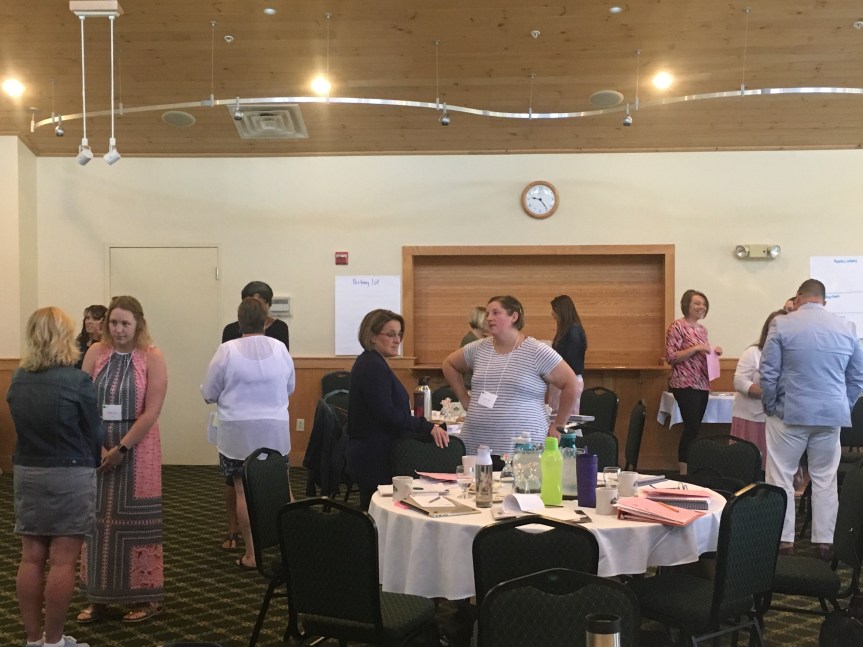
In her opening remarks to the York and Downeast convenings of Elevating and Celebrating Effective Teachers and Teaching (ECET2), Maine Education Association (MEA) president Grace Leavitt told those assembled, “teaching is not a profession you leave at the door when the bell rings, it is always on your mind.” For the teachers packed into the Pratt & Whitney Building at York County Community College on August 7, and the Science Building at the University of Maine at Machias on August 15, summertime professional learning was certainly alive and well!

This summer marked the fifth anniversary of ECET2 in Maine and the first summer of regional Maine ECET2 convenings. Karen MacDonald and Jennifer Dorman (2014 & 2015 Maine Teachers of the Year) hosted the first ECET2 for 150 teachers at Colby College in August of 2015.

two educators posing together smiling
Karen MacDonald and Jennifer Dorman

MacDonald and Dorman wrote grants, sought sponsors, and spent countless hours (!!) handling the numerous logistics involved in planning and hosting a free, overnight conference for 150 Maine teachers. Why? They wanted to share the professional learning, leadership, and respect they experienced during their national Teacher of the Year travels with teachers here in Maine. They also wanted to highlight the role teacher leaders can play in our state. Dorman and MacDonald’s efforts were enthusiastically embraced by Maine teachers not only during that first summer, but in each subsequent year.  As rave reviews of ECET2 spread, more teachers joined the planning process, including Diana Allen (Sanford Schools) as another co-chair, and the conference became so popular there was not only a waitlist for attendees, but the number of presentation proposals exceeded the available session slots! These factors led to ECET2 branching out to the regional convenings that took place this summer.

Why is ECET2 so popular?  Let’s start with the title—this conference is all about celebrating effective teaching and teachers—and it is, from start to finish, put on by teachers for teachers.  It was born out of a desire to provide a forum for exceptional teachers to learn from one another and to celebrate the teaching profession, and seeks to realize a teacher’s potential by ensuring each convening includes these six elements:

  • Nurtures trust among teachers
  • Focuses on each teacher’s potential for growth
  • Inspires both the intellect and the passion that drives teachers in their work
  • Provides time for collaboration and learning
  • Puts teachers in the lead
  • Recognizes teachers as talented professionals

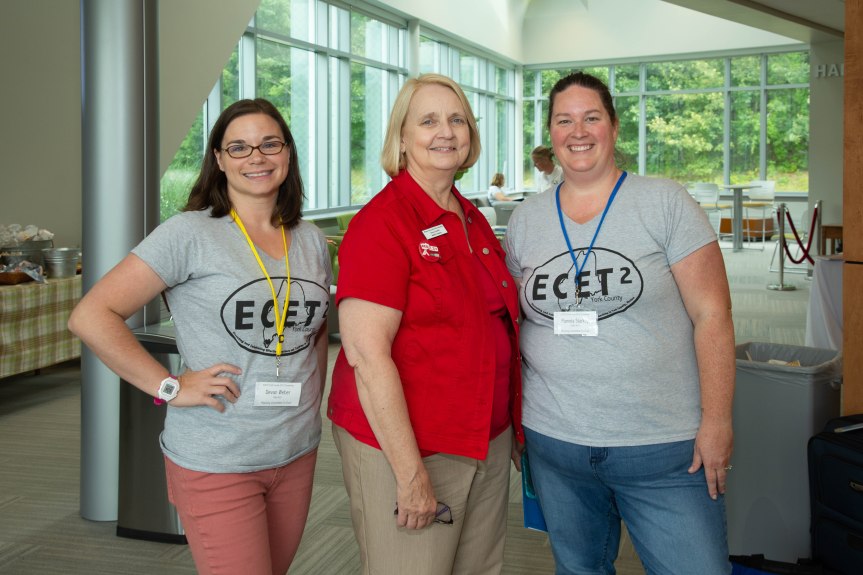
Inspired from their own experiences at ECET2, Pamela Starkey (Marshwood Great Works School, 2016 Oxford County Teacher of the Year), and Devan Weber (Eliot Elementary School) co-chaired ECET2 York, and Marielle Edgecomb (Peninsula School, 2017 Hancock County Teacher of the Year) chaired ECET2 Downeast. Both convenings featured breakout sessions on best teaching practices in content areas, as well as sessions on social-emotional learning and mindfulness in the classroom. Teacher leadership and innovation were embedded throughout the gatherings. Keeping in mind the importance of collaboration, inspiration, and celebration, the convenings also included these components:

Cultivating the Calling:

These inspirational talks are given by teachers on why they chose to teach, or what inspires them to continue teaching. In York, Katie Toothaker, 2018 Androscoggin Teacher of the Year, told the audience, “each school year is a new beginning for you and your students.” Toothaker shared how her teachers demonstrated the ability of public educators to nurture self-worth in their students and the difference that made for her and how she pays that forward with her own students. Teresa Gaetjens, National Board Certified Teacher, shared the importance of growth mindset, contextualizing her topic around the passing of her young daughter. This heart-wrenching story underscored the importance of perseverance both in and out of the classroom. At ECET2 Downeast, Marielle Edgecomb shared the importance of professional learning –teacher to teacher—being brave enough to open our classroom doors and teaching practices for others to see, learn from, and celebrate. Marielle challenged educators to see their students and colleagues through “eyes of appreciation.”

Colleague Circles:

This is a dedicated time for teachers to collaborate on “problems of practice” and generate possible solutions. Topics this year included: teacher shortages, school improvement, mental and physical wellness, school safety, diversity, and culturally responsive teaching. In York, teachers recorded goals or action steps on a post card and gave them to the ECET2 organizers, with the understanding that they will receive them in the mail sometime this fall as a reminder/check-in on their summer work and goals.

Educator Shark Tank—a fabulous idea that was shared from another state’s ECET2!

Just like on TV—except the prize money, $1000 generously donated by the Maine Education Association, was awarded to two innovative education projects that will positively impact student learning. Educators at ECET2 Downeast submitted many compelling proposals to the Sharks, four of which made the final round. The four finalists had three minutes each to present their best “pitch” to the Sharks. After a lively round of presentations and lots of laugher, followed by clarifying questions from the Sharks, the two $500 cash awards went to the Rose Gaffney School for their proposal to use technology to increase community and collaboration, and the Brooklin School for their work on diversity and literacy. Congratulations to all who submitted proposals—the Sharks had a tough task choosing just two!

The verdict is in on the first summer of regional ECET2 convenings: resounding success! As with their central Maine ECET2 predecessors, the regional convenings provided a platform for optimistic and personal professional learning—and a true celebration of teachers and the teaching profession! As teachers were preparing to leave, many of their comments echoed Paula Bourque’s (Instructional Coach, NBCT, Augusta Schools) reflection of her ECET2 experience:

“Each of us left the conference feeling inspired, empowered, and connected.  We are charged with going out and sharing what we experienced and learned with our colleagues and cultivating the calling of teacher leadership. We left with a stronger network to lean on and collaborate with as we navigate the challenges of teaching. We are dedicated to promoting teacher leadership, positive school culture, and the advocacy for what is best for our students.”

ECET2: A perfect way for educators to recharge in preparation for a new school year!

ECET2 origin and resources: https://www.teacher2teacher.education/ecet2/


Growth Celebrated and Knowledge Shared as MoMEntum Literacy Pilot Wraps Up

Kindergarten through 3rd grade teachers from across the state gathered this month for a final event that served as the culmination of two and a half years of work by 1500 students, 100 teachers, 9 schools, and 6 literacy coaches. Momentum, a K-3 literacy pilot program designed to improve the literacy achievement of students, came to a close with a professional learning event and an opportunity to reflect on the knowledge and growth experienced by its participants.

Deployed in January 2018, the MoMEntum pilot program provided 9 schools with iPad devices from Apple, Inc. and research-based curriculum resources along with targeted professional learning and coaching to help them improve not only the reading levels of their young students, but also to engage them in a meaningful integration of literacy across other content areas using technology. Additionally, and somewhat uniquely, the pilot also provided schools with the tools to measure how well students were responding to the new learning style.

Teachers received intensive professional learning on specific software applications that individualized student learning, and provided a platform to share student progress with their parents or guardians. Trained literacy coaches worked within each school along with locally grown professional learning communities (PLC) that met monthly (or more) to share practices, evaluate their work and progress, and seek ways to improve.

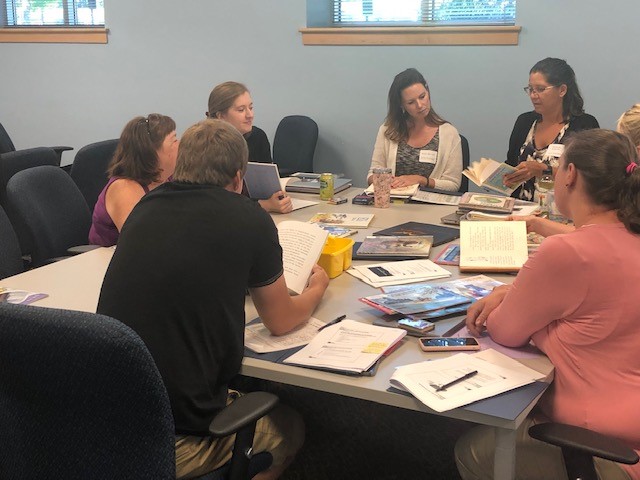
room of educators sitting at tables listening to speakerAt the closing event were an array of teacher-lead professional learning sessions about classroom management and curriculum practice. For example, Lindsey Davis, a 1st Grade Teacher from Leroy H. Smith School in RSU 22, lead a session about how to engage students in Close Reading lessons that utilize integrated and relevant content. Heather Gray and Danielle Afari, teachers from Dirigo Elementary School in RSU 56, lead an informative and entertaining session about ways to glean student progress based on data and assessment in the classroom.
Teachers and administrators also had the opportunity to work on sustainability plans to keep their work from the MoMEntum pilot going in their schools by establishing school level and individual goals to help continue their integrated literacy work.

Kathy Jacobs, a 1st grade teacher who is moving into a special education role at China Primary School, a participating school from the pilot, said that she has definitely, “seen growth in the students” during the pilot program and that no matter what happens now that the program has come to a close, she will apply some of the things she has learned into her teaching practices going forward.

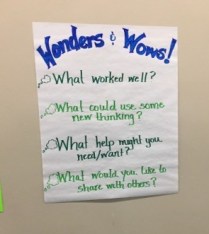
Wonders & wows posterThere was also an opportunity for teachers and administrators to share their “Wonders & Wows” as a way to evaluate the work and progress and highlight areas for future collaborative work.
“I learned as much from the teachers as I hope they learned from me,” said Literacy Coach Heidi Goodwin, a Distinguished Educator on loan from MSAD 54 who worked directly with the Maine DOE on the pilot program. “They [teachers] were great thinking partners,” she reflected. There were 6 educators total that served as coaches for the program. Along with Heidi were, Kayanne Nadeau, on loan from MSAD 27; Liz Wakem, on loan from RSU 71; Lisa Sleight, a retired Maine educator; Li Gowell, a retired Maine educator; and Dee Saucier, a Maine DOE staff member.

“This was not just a great learning opportunity for the schools involved but for the Department as well,” said Lee Anne Larsen, Maine DOE Early Learning Team Coordinator who has been involved in the administration of the MoMEntum pilot from its inception.  Reflecting on the valuable lessons learned during the pilot, Lee Anne remarked that the most notable were about ways to effectively use technology in the classroom, and methods of meaningfully integrating literacy into other content areas. “It will definitely inform our future work at the Department,” she added.

While the full pilot program and everything that came along with it was only deployed in 9 schools initially, the professional learning resources are available, completely free, to all schools on the Maine DOE Website, along with help and support from Maine DOE staff members Lee Anne Larson and Dee Saucier who both helped administer the pilot program. For further information please reach out to them at Leeann.Larsen@maine.gov and/or Danielle.M.Saucier@maine.gov.


The Transformational Leaders’ Network (TLN): Learn More!

THERE IS STILL ROOM TO JOIN, Read All About It!

Twenty-four Maine administrators came together this summer for the first 3-day Transformational Leaders’ Network (TLN) retreat held at the Senator Inn in Augusta.  Fully sponsored by the Maine Department of Education, districts made a meaningful commitment to support their leaders in building their capacity. Led by several facilitators with expertise in designing and coordinating educational leadership graduate programs at the University of Maine, as well as school coaching and mentoring, the retreat was structured to help these leaders further their skills to realize the goals of their school improvement plans.

During a conversation about the growing demands on school leaders, Marie Robinson, PreK-12 principal of Katahdin’s Schools and superintendent of Medway, said, “At what point do you say ‘Stop–I need to come up with a better way’.”  Marie had been a participant in a previous TLN cohort. During the retreat, participants had the opportunity to hear from other school leaders who, like Marie, had been part of that TLN cohort.

“I didn’t think of the [TLN] meetings as another thing I was going to have to do.  I looked forward to my meetings, knowing that I would come out refreshed and ready to problem solve,” Marie shared as she sat in a roundtable discussion with other principals from around the state. She went on to explain that the TLN didn’t tell her what to do about any one specific issue she was experiencing, but rather that her TLN experience gave her the resources and know-how to approach a situation with a new perspective and a toolbox of ideas.

Ainslee Riley, principal of Thomaston Grammar School, a first-time participant in the program, commented on her experience at the retreat, “I wasn’t sure what to expect from the conference, it sounded interesting on paper,” she said in an email following the conference. “I am so happy that I decided to attend.  It was an excellent opportunity for me to focus on my school goals and my personal goals as an educational leader.

“It is not often that administrators have an opportunity to get together outside of their own district for the purpose of helping one another to grow,” she added. “I would recommend this experience to any administrator, whether they are brand new to the profession or a veteran.”

At the beginning of the retreat, participants went around the room introducing themselves, including information about where they were a school leader, and for how many years. There was a range of expertise in the room, everywhere from,  “I just finished my first year as a principal and before that I was a teacher,” a response met with knowing smiles and head nods from around the room, to others with 15 to 25 years of experience in school leadership. All participants brought to the table a unique set of experiences, circumstances, and challenges to share and reflect upon.

In addition to providing school leaders an opportunity to connect with one another, celebrate successes, and address challenges, the retreat goal was for them to develop two action plans for the coming year: one to include continued and on-going professional learning and growth for their schools as a whole, and one for transformational leadership, professional self-growth, and self-care as leaders.

The range in growth plans was broad, focusing on RTI and data, visioning and collaboration, addressing difficult issues, and providing meaningful leadership to staff in order to raise students’ success.

The TLN is not a new program of the Department of Education.  It was originally designed over six years ago to support school leaders of struggling schools.  However, the TLN for 2019-2020 kicks off an opportunity for any and all Maine principals, assistant principals and curriculum coordinators to join the network. The yearlong TLN experience will bring school leaders together to support leadership growth and to improve schools. The program will include regional meetings, leadership training, coaching, networking, and professional development for school level leaders who are interested in joining.

To learn more information and register to join the TLN, please visit the TLN webpage (https://www.maine.gov/doe/Testing_Accountability/model/turnaround ).

For further questions or information about the Transformational Leaders’ Network (TLN), contact Chelsey Fortin-Trimble, ESEA Federal Programs and School Turnaround Director at Chelsey.A.Fortin@maine.gov.

Maine DOE Summer Literacy Conference Provides Professional Learning on Small Group Strategies

Maine DOE’s Elementary Literacy Specialist Dee Saucier and School Turnaround Literacy Coach Darlene Bassett led a two-day summer professional learning event earlier this week in Augusta for Maine educators.

Conference Participants had the opportunity to learn how to implement the Assess-Decide-Guide framework in balanced literacylearn the elements of text complexity and how it impacts instructional decisions, understand the foundations of guided reading as a small group, learn the components and purposes for today’s guided reading, and learn how to take elements of the Assess-Decide-Guide framework and apply them to other forms of small group instruction.

The conference enabled educators to walk away with a plan of action to begin implementing small groups. 

Maine Teachers Engage in “K for ME” Curriculum Pilot Training

In Augusta, kindergarten teachers and their administrators from five Maine school districts participated in three days of training for the K for ME pilot, a research-based, discipline integrated, whole child curriculum for kindergarten.

Principals and teachers volunteered to implement this curriculum, based on the Boston Public Schools kindergarten program, to help tailor it for Maine’s children and school communities. Melissa Luc, consultant from the Boston Public Schools, facilitated the training and is working with participants from schools and Department to oversee the revisions.

During the 2018-19 school year, the Maine DOE piloted the PreK for ME curriculum in 14 preschool classrooms – the curriculum will soon be posted as an open source on the DOE website. K for ME expands upon this work by creating a vertical alignment for students building on concepts and content they learned in prek. K for ME will also be an open-source curriculum available on the Maine DOE website as a resource for districts after the pilot year.

For more information ,contact Lee Anne Larsen at leeann.larsen@maine.gov or 624-6628.

RSU 57 Prek Teachers Train Fellow Educators on Research-based Prek Practice

Prek teachers Melissa Brown, Jessie Carlson, Morgan Gallagher and Sarah Smith from RSU 57 provided training recently for new teachers ready to implement the PreK for ME program in the coming school year.

Prek for ME is a curriculum program based on the Boston Public School’s open source curriculum. Last year, 14 prek classroom teachers, including the 4 from RSU 57, were part of the pilot program that was successfully conducted last year assisting participants in improving their prek classroom instruction. RSU 57 saw great results in this research-based, whole child/multi-domain program.

Excited and eager to help bring their experience and expertise to others, the four RSU 57 teachers co-trained with some assistance from Sue Reed, Early Childhood Specialist from Maine DOE who is leading the efforts to adapt the Prek for ME curriculum for Maine.

The evaluations from the program help to illustrate its success:

“This was a super training!  I appreciated the balance between presentation and hands on with the teachers.” 

“Teachers who have used the program are very helpful!” 

The prek teachers from RSU 57 invited participants to visit their classrooms and to contact them with any questions.  The Prek for ME program will be available on the Maine DOE website by the end of August.

Innovative New “Experiential” Educator Training Takes Center Stage

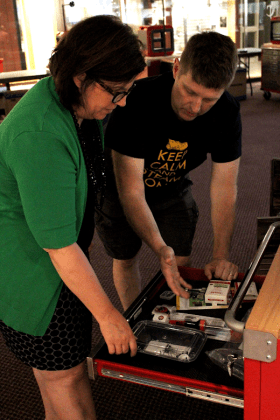
Course Instructor Keith Kelley and EMMC President Lisa Larson looking through a STEAMRoller cart included with the course.
Course Instructor Keith Kelley and EMMC President Lisa Larson looking through a STEAMRoller cart that is included with the course.

In a four-day educator training that took place last month at the United Technology Center (UTC) in Bangor, 14 educators from across Maine gathered for a unique professional development opportunity offered through a partnership between two educators from RSU 19, Eastern Maine Community College (EMCC), and UTC that aims to help educators integrate advanced technology and experiential learning into every lesson plan, and to help fill the workforce gap in Maine.

Utilizing a $50,000 grant that EMCC President Lisa Larson obtained through the Maine Community College System, the 3 credit Introduction to Experiential Teaching through Technology course was offered as an opportunity for educators to “learn practical learning experiences to integrate traditional and newly advanced technologies into project biased lesions,” similar to the teaching methods found in career and technical education (CTE) settings throughout the state. The idea is to bring the experiential teaching philosophy to classrooms long before the high school CTE experience. The earlier integration of experiential learning gives students a taste for possible career paths but just as importantly, learning experiences that allow them to utilize and understand the advanced technological tools of their future and to utilize and exercise their own problem-solving and management skills.

The course was led by RSU 19 educators, Keith Kelley and Kern Kelley who are brothers, partners, and advocates for integrated experiential student learning. It provides classroom teachers, at any grade level and of any subject matter expertise, with not only the tools but also the mindset and methods to teach project based and integrated lessons to their students. This type of learning environment provides students with real-world, problem solving experiences with technology, bringing full circle the content areas that make up the very well-known acronym STEAM (science, technology, engineering, art, and math).

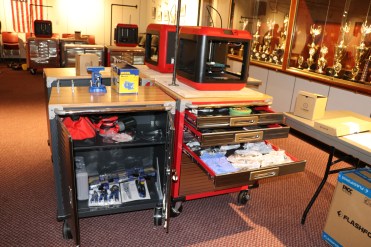
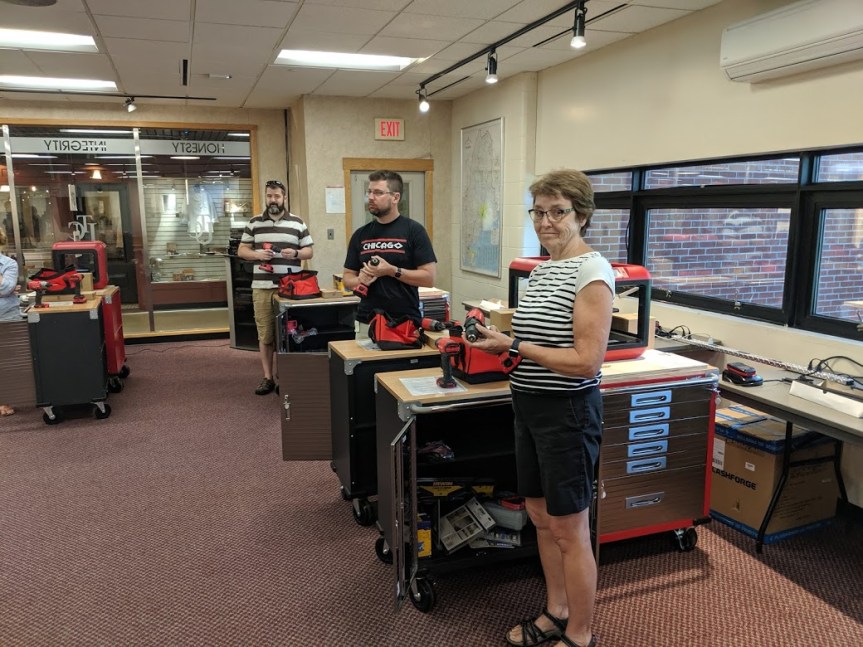
The STEAMRoller Cart includes: Seville Classics UltraHD 2-Door Rolling Cabinet and a 6-drawer Rolling Storage Cabinet, Vise, Portable Vise Table, Power Strips, Cordless Orbital Hand Sander, Corded Orbital Hand Sander, Power Drill, Impact Power Drill, Rotary Dremel Tool, Irwin Clamps, Kobalt 100-Piece Household Tool Set with Hard Case, Hand Tool Bag, Hammer, Locking Pliers, Tape Measure, Speed Square, Spade Bits, Flash Forge 3D Printer, 3D Printer Tool Set, Frog Tape, Duct Tape, Rocketbook, FriXion Pens, iPod Touch & Case, Tripod, Raspberry Pi, Soldering Iron, Scrappy Circuits, Safety Goggles, Disposable Gloves, Breakout of the Box DRAWER, and a Breakout EDU Kit.

Each educator’s school paid $381 total for the four-day hybrid course that includes the four in-person sessions, bi-weekly reading and reflection assignments and online discussions and provides educators with contact hours plus 3 college credits, in addition to a “STEAMRoller” cart of hardware and equipment valued at over $2,000 each. They will also each have the opportunity to host a STEAMRoller bus for a day at their school, which includes an experiential student conference provided by course instructors and their partners. At the student conference, educators and students will be able to participate in a day filled with breakout sessions on various topics such as 3D printing, drones, and virtual reality to name a few.

Hermon High School Principal Brian Walsh is excited that one of his 9th grade science teachers is attending the course this summer so that he can share his knowledge and the tool kit with the other 9th grade science teacher so that they can integrate hands-on project-biased learning experiences, not just to 9th graders but throughout the high school as well. Walsh has felt a void where they were unable to fill an industrial arts position in prior years and hopes this will help bring new STEAM learning experiences, career pathways, and experiential opportunities to the students at Hermon High School.

educators looking at a computer screen togetherTonya Therrien, Benton Elementary 5th Grade teacher decided to take the course with the hopes of bringing back to her classroom, “a way to utilize technology more with the kiddos, beyond just using it for research.” She wants her students to know how to use technology as a tool. When asked what she thought of the training so far, she said, “this is probably the most worthwhile class I’ve ever taken, and I’ve taken a lot of classes.” She then added that she has two master’s degrees which both required a fair amount of coursework.
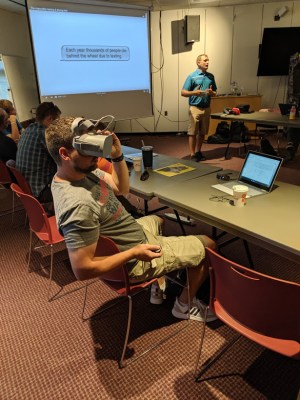
Aaron Pody, a high school Life Sciences teacher from RSU 18 came to the class to learn about ways to teach the content with more relevance to his students. He has been pleased to find that there are ways to bring technology into the classroom that are not cost prohibitive.

educator wearing VR gogglesRSU 26 educator Karen Frye from Orono was excited to bring back what she has learned at the course to provide her gifted and talented students with the rare opportunity to do some hands-on problem solving, which will further enrich their learning experience and give them some problem-solving skills.
The 3-credit course and the STEAMRoller bus events are intended to give participating educators and schools a taste of experiential learning methods, along with emerging technologies, tools and resources. The course is expected to be followed up by an Experiential Education certificate program that EMCC is expected to launch in January of 2020. The new program aims to provide the state with educators that can help fill the growing workforce gap in technologically skilled workers.

The launch of the experiential training was deemed a success by organizers and participants alike. The innovative approach to an obvious need has the potential to further help Maine schools lead their students toward successful career choices, experience with problem-solving, and the ability to successfully navigate the technology of our future.

Educators standing with STEAMRoller Carts

This article was written by Rachel Paling in collaboration with course instructors Keith and Kern Kelley, and staff at both UTC and EMMC. If you have story ideas for Maine DOE’s Maine School’s Sharing Success campaign, please contact Rachel Paling at rachel.paling@maine.gov.

Conference: Collaborating to Address the Complex Mental and Behavioral Health Needs of Maine Youth

The Maine American Academy of Pediatrics (AAP), Maine Department of Education (DOE) and Maine Association of School Nurses (MASN) are collaborating to bring you best practices and current research on a variety of critical mental and physical health related topics facing adolescents. Recognizing that we are all supporting the needs of Maine children in different locations and ways we are bringing experts together to receive collaborative professional learning.

Hosted by: The Maine AAP, Department of Education and Maine Association of School Nurses

Intended audience: Those interested in the mental health of students (school nurses, medical providers, school counselors, social workers, and administrators)

Some topics covered: 

  • Identification and treatment of anxiety and depression in children and adults: How can we do better?
  • Addressing the Complex Mental and Behavioral Health Needs of Maine Youth: The Key Role of Adverse Childhood Experiences and Trauma Informed Care
  • Creating an Inclusive Environment for LGBTQ Youth
  • Tools for Screening and Safety for Youth at Risk of Suicide
  • Substance Use Disorder:  Impact on Youth and Families

Date: August 16, 2019

Time: 8:00 AM – 3:15 PM

Location: The program is being held in the Talbot Hall/Bonney Auditorium at the University of Southern Maine, located at 92 Bedford Street in Portland.

Cost: $50.00

Register here.

For questions or additional information, please contact Emily Poland at emily.poland@maine.gov.

Next Think Tank Scheduled for September 30!

In the ongoing effort to engage with all stakeholders, the Department of Education will hold its next Think Tank at the Schoodic Institute in Winter Harbor on September 30.  Participants can choose  from four topics, and can attend morning or afternoon sessions only on one topic, or attend both sessions and discuss two topics! Topics include special education, defining school success, educator excellence (recruiting and retaining) and MLTI.  Lunch will be provided, and the think tank is FREE, however we do ask for participants to register, for planning purposes.  Please see the Registration Link for more information and to register. We look forward to hearing from you!

Seeking Innovative Educational Leaders to Join Maine’s Leadership Development Program

The Maine Department of Education is thrilled to announce that the facilitator candidates for Maine’s Leadership Development Program (Maine LDP) have been selected. The selected facilitator candidates represent the following regions of the state: Washington, Kennebec, Penobscot, Cumberland, Androscoggin, and York counties.  The Department is looking forward to highlighting the selected facilitator candidates in August.  Maine’s LDP is an initiative designed to build and strengthen instructional leadership skills among Maine’s educational leaders at the school, district, and state levels. In our ongoing efforts to support and foster the educational expertise in Maine, educators who aspire to do the same are invited to take advantage of this high impact opportunity!

In recent weeks, the Department has been contacted by educational leaders interested in participating in the Maine LDP, but not able to commit to serving as future facilitators. In response to this feedback, the Department has made available  a limited number of seats for Maine leaders join the cohort. If you are interested in participating in Maine’s LDP and are able to make the one-year commitment, this is your chance to join this exciting professional learning opportunity. Maine’s LDP brings together the Maine DOE’s successful Transformational Leaders’ Network with NISL’s nationally recognized Executive Development Program (EDP).

Maine’s LDP is delivered through a blended learning model and includes study, inquiry, and hands-on activities with practical applications that meet the rigorous expectations for today’s educational leaders. Completion of the program can contribute to credit hours for participants pursuing an advanced degree, or contact hours for re-certification purposes.

Benefits for Maine Schools

  • Prepares educational leaders to lead for excellence and equity
  • Increases student achievement, fosters a culture of high expectations
  • Enhances teacher recruitment, retention, and quality

Program Curriculum

  • Nationally researched, evidenced-based, and locally delivered in a cohort model
  • Improves the practice of leadership, transforms instruction and student achievement in schools
  • Consists of 12 two-day units, delivered in 12 to 15 months
  • Bridged with online coursework, readings and job-embedded application of key concepts

Characteristics of Ideal Candidates

  • A belief in and commitment to improving instruction and increasing student achievement
  • Experience (five years) in a leadership role at the school, district, and/or state level and background as a classroom teacher. Ideal candidates include, but are not limited to, principals, assistant principals, instructional coaches, deans, Title I directors, department leaders, ESEA coordinators, special education directors, English Learner directors, assistant superintendents, instruction and curriculum directors, and superintendents.
  • Excellent communications skills; able to effectively facilitate professional development for peers
  • Demonstrated skills in mentoring and coaching
  • Experience as a successful practitioner—able to translate concepts to actions, theory to practice, and programs to craft
  • Able to participate in the entire NISL program and attend all required sessions
  • Likely to live and work in Maine for the next five years

The Department encourages experienced educational leaders to consider applying to join the initial cohort of participants for Maine’s LDP. The deadline for participant candidates is August 5, 2019. Please visit http://www.maine.gov/doe/educators/maineldp for more information and email nisledp.doe@maine.gov  with any questions. Interviews will be scheduled upon review of submitted applications.