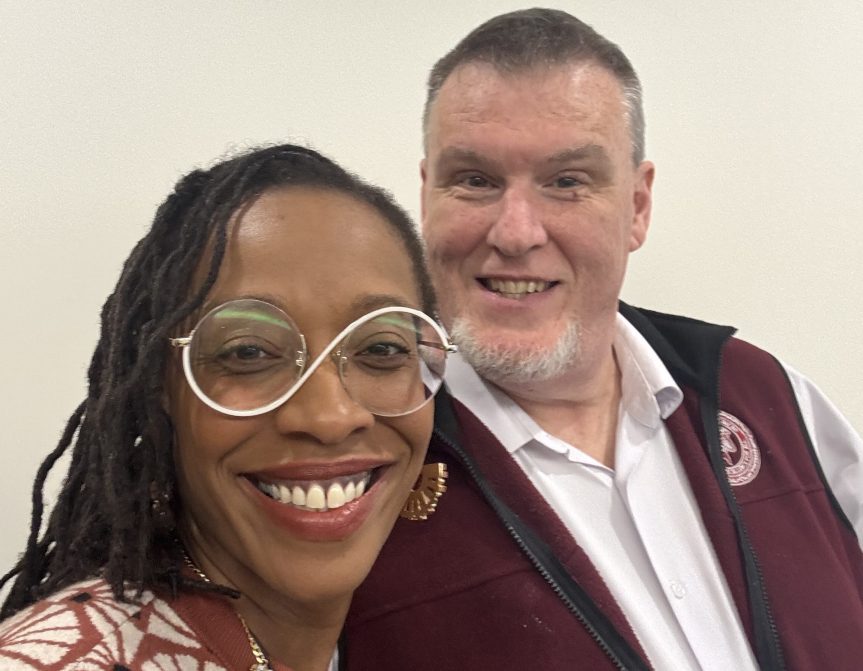
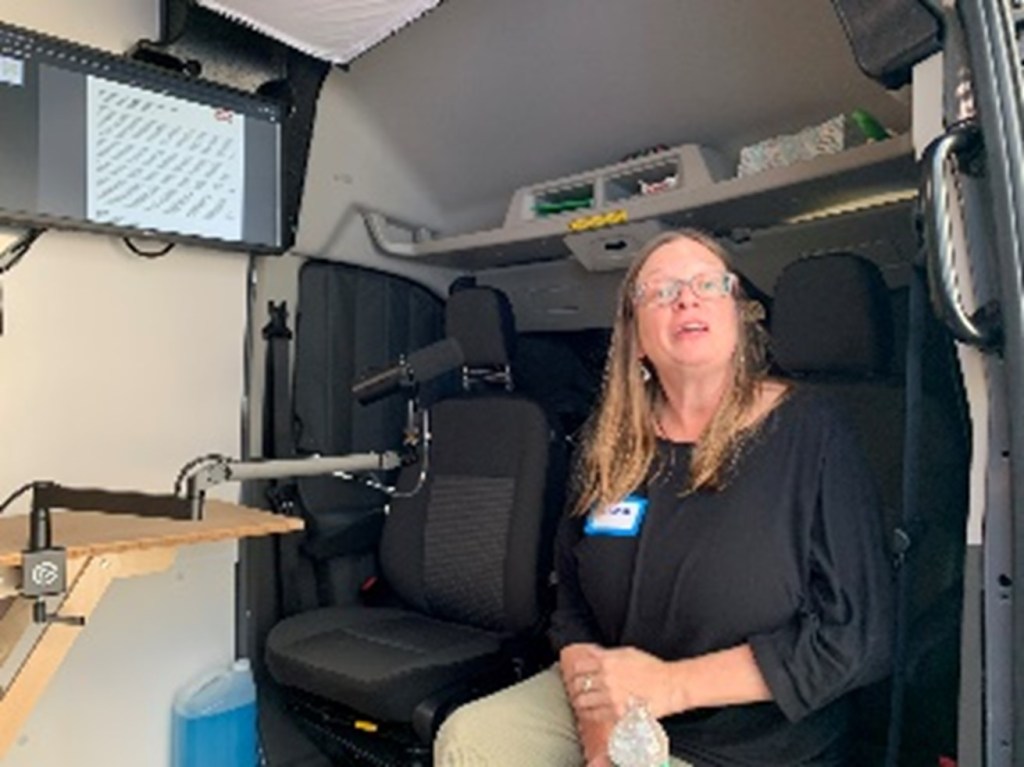
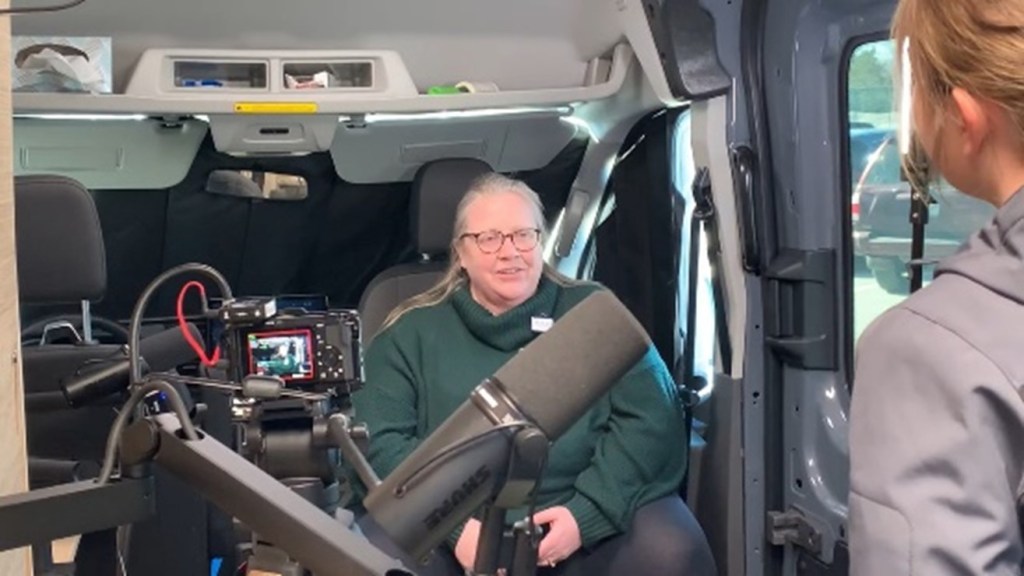
(Pictured: Ayesha Hall, Maine DOE Director of Strategic Partnerships, with Fred Ravan, President of Educators for a Multilingual Maine [EMME].)
The Maine Department of Education (DOE) is proud to have successfully concluded its Multilingual/Multicultural Connections Webinar Series, a five-part virtual professional learning experience designed to expand access to language learning, cultural inclusion, and international collaboration in Maine schools.
This work reflects an ongoing commitment by the Maine DOE to promote multilingual and multicultural learning as critical components of student success. Through this series, the Maine DOE provided a platform for educators, school leaders, and international partners to come together, share strategies, and build community around a shared vision for more inclusive, globally-connected classrooms.
Each session explored timely and essential topics—including how to integrate Indigenous and critical languages, how to make the most of international Memoranda of Understanding (MOUs), and how to use tools like the Seal of Biliteracy and the Multilingual Learner Dashboard to expand language learning pathways.
“This wasn’t just a webinar series—it was an invitation to join an important conversation about inclusion in Maine schools,” Ayesha Hall, Maine DOE Director of Strategic Partnerships, said. “Educators are already doing the work. Our job is to make sure they’re supported with access to partnerships, resources, and opportunities that reflect the needs of learners in our state today.”
As the series wrapped up on May 5, 2025, educators heard directly from district teams that have already begun integrating global partnerships and multilingual learning into their school communities—affirming all that is possible when language and culture are viewed as assets.
To continue supporting this work, the Maine DOE has updated its Global Partners Network webpage, where educators, district leaders, and partners can:
Revisit the webinar series and explore featured programs.
Connect with Maine DOE-supported international partnerships.
You may explore the Global Partners Network here. For more information or for inquiries regarding partnerships with the Maine DOE, please contact Ayesha Hall, Maine DOE Director of Strategic Partnerships, at Ayesha.Hall@maine.gov.
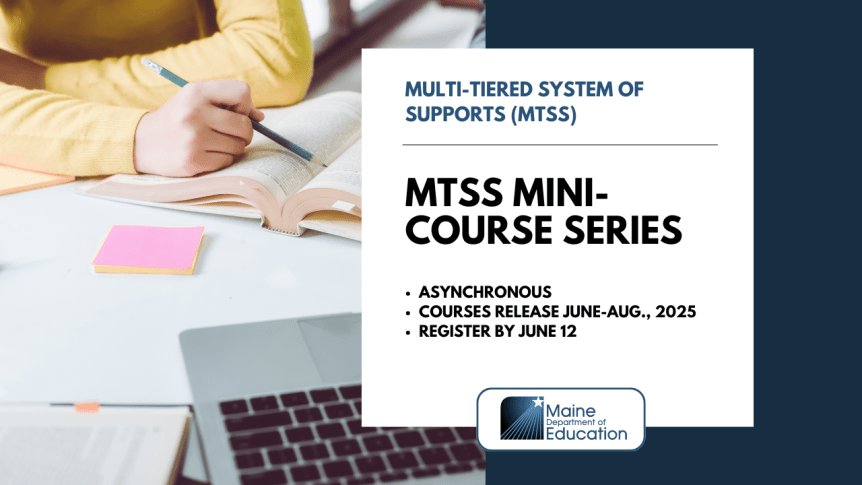
Are you ready to grow your Multi-Tiered System of Supports (MTSS) knowledge and practice? This summer, the Maine Department of Education (DOE) Office of Teaching and Learning is excited to offer a three-part, fully asynchronous MTSS Mini-Course Series. Each 28-day course builds on the last—complete Course 1 to unlock Course 2, and finish Course 2 to gain access to Course 3.
MTSS Mini-Course Series Overview
Course
Release Date
Close Date
Prerequisite
Focus
Course 1: MTSS Foundations
June 15
July 13
None
Core MTSS principles and Maine policy context
Course 2: MTSS Leadership Practices and Teaming Structures
July 15
August 12
Course 1
Leadership roles and teaming practices
Course 3: MTSS and Special Education – A Crosswalk Course
August 15
September 12
Course 2
Connections between MTSS and special education
How It Works
Register for Course 1 by June 12 at midnight using this link.
Course 1 opens on June 15. Complete all modules and the final activity by July 13.
Course 2 unlocks for those who completed Course 1 on July 15. Complete by August 12.
Course 3 unlocks for those who completed Course 2 on August 15. Complete by September 12.
All courses close exactly 28 days after opening. No late enrollments or extensions will be available.
Why Participate?
Stackable Learning: Master each MTSS component before moving to the next.
Flexible and Asynchronous: Engage with readings, videos, and discussions at your own pace.
Maine-Focused: Learn practical strategies aligned with Maine DOE guidance and equity goals.
Professional Recognition: Earn a digital badge for each course. Complete all three to receive a Summer MTSS Series certificate.
Earn Contact Hours
Receive one contact hour per module (up to four per course; 12 total).
Earn up to 10 additional hours for attending the optional weekly course office hours.
Stay Connected
Join Office Hours: Drop in every Thursday at 9 a.m. for collaborative MTSS discussion and support.
Plan Ahead: Block out 30 minutes twice a week to stay on track.
Let’s make this summer the season that you transform your MTSS knowledge and practice. For questions, please contact Andrea Logan, Maine DOE MTSS Specialist, at andrea.logan@maine.gov.
Mark your calendars! Registration for the Maine Department of Education (DOE) Summer Data Training is now open.
Trainings are scheduled at various locations throughout the state in July and August. This year’s training will focus on reporting system updates. The workshop-style structure of this training will allow staff members from school administrative units (SAUs) the opportunity to work within the Connect system alongside the Maine DOE Data Team.
Dates and Locations:
July 29 – Caribou
July 30 – Orono
July 31 – Machias
August 12 – Augusta
August 13 – Biddeford
Please use this link to register, andbe sure to select a location to receive updates about your specific training. The Maine DOE is looking forward to this opportunity to meet with SAUs. If you have any questions about this year’s Summer Data Training, please contact Alexandra Cookson at Alexandra.Cookson@maine.gov or call 207-446-3897.
In an effort to better support Maine educators, the Maine Department of Education (DOE) Office of Teaching and Learning and Office of Innovation are launching a new statewide professional learning structure for the 2025-2026 school year. By coordinating statewide learning days and offering support where it’s most needed, the Maine DOE hopes to empower school administrative units (SAUs), lighten local workloads, and help all Maine educators to feel more connected, supported, and equipped to meet the needs of their students.
As part of this offering, there will be three full days of free professional development workshops across the 2025-2026 school year. These sessions are intentionally aligned with the professional learning days already built into many school calendars, providing an easy way for SAUs and schools to incorporate these opportunities into their existing plans.
All workshops will be held in-person at three University of Maine System campuses—the University of Maine at Orono, the University of Maine at Farmington, and the University of Southern Maine—and will also be offered live online through a hybrid format. To ensure maximum flexibility, sessions will be recorded and available asynchronously. Contact hours will be awarded for participation in sessions.
Key benefits of this structure include:
Equity of Access: Educators across all regions and school types can access consistent, high-quality professional development, regardless of geography or resources.
Improved Efficiency: The Maine DOE-developed sessions reduce planning burdens on individual SAUs, while providing timely, relevant content aligned with statewide priorities.
Coherence and Quality: Topics are directly connected to Maine Learning Results and shaped by feedback from Maine educators.
Workshop offerings span a wide range of educator needs, including Wabanaki Studies, STEAM (Science, Technology, Engineering, Arts, and Mathematics), literacy, Universal Design for Learning, Multi-Tiered Systems of Support (MTSS), numeracy, inclusive family engagement, and more. All sessions are grounded in research and designed to deliver practical, classroom-ready tools for educators, from pre-K through grade 12.
The full schedule and session descriptionsare now available here. Registration details will be released soon. For more information, please contact Beth Lambert, Maine DOE Chief Teaching and Learning Officer, at beth.lambert@maine.gov.
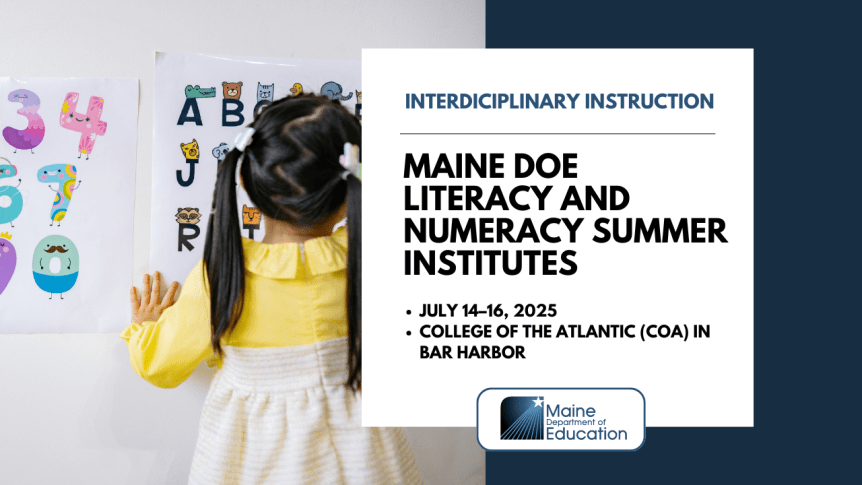
The Maine Department of Education (DOE) Office of Teaching and Learning invites educators across Maine to apply for the 2025 Literacy and Numeracy Summer Institutes. These three-day, in-person professional learning experiences will occur from July 14–16, 2025, at the College of the Atlantic (COA) in Bar Harbor. Applications will close on May 27.
Designed for public school teachers, instructional coaches, administrators, and specialists across all grade levels and content areas, these immersive and hands-on institutes will bring together educators committed to strengthening interdisciplinary approaches to literacy or numeracy. Each participant will engage in deep content learning, hands-on collaboration, and the design of practical, real-world instructional experiences.
Participants will engage with local learning environments, including community gardens, the iconic Beatrix Farrand Gardens, the Dorr Museum of Natural History, Allied Whale, COA’s greenhouses and learning labs, the intertidal zone, and the vibrant community of Bar Harbor. They will explore high-impact instructional practices, investigate ways to connect content to students’ lives and communities, and help advance a statewide effort to promote meaningful, integrated learning across Maine classrooms.
Expectations of Participants Educators selected to participate in the institute will:
Attend the full three-day in-person experience.
Collaborate with fellow educators to deepen their understanding of evidence-informed interdisciplinary literacy or numeracy practices.
Create a high-quality learning task that reflects real-world application of literacy or numeracy concepts and meets the criteria to be made available on MOOSE (Maine Online Opportunities for Sustained Education).
Have the opportunity to pilot the task during the 2025–2026 school year, providing feedback and contributing to shared statewide resources.
Participants will receive a stipend of $400 for successfully completing and posting the learning task, with an additional stipend available for those who choose to pilot the task and submit classroom feedback and instructional resources.
Logistics and Support The Maine DOE will provide lodging and meals for all participants, and mileage reimbursement is available for attendees traveling more than 50 miles one way.
Apply Now Applications are open now and will close on Monday, May 27, at 5 p.m. All applicants will be notified by Monday, June 2. Space is limited, and the Maine DOE will work to ensure that selected participants represent a diverse range of grade levels, geographic regions, and content areas from across the state.
The 2025 Literacy and Numeracy Summer Institutes are funded through Title II/Title IV state reservation funds. For more information or with questions, please contact Maine DOE Chief of Teaching and Learning Officer Beth Lambert at beth.lambert@maine.gov.
The Maine Department of Education (DOE) Interdisciplinary Instruction Team invites educators to join a new series of weekly virtual office hours, focused on exploring numeracy across content areas. Sessions will take place every Wednesday from 3:30 to 4:30 p.m., beginning April 16, 2025, and running through June 4, 2025.
Each session will highlight a different topic that illustrates how numeracy and mathematical thinking can deepen learning across the curriculum (full schedule below). Whether you’re a classroom teacher, instructional coach, or curriculum leader, these office hours are designed to offer practical insights and spark interdisciplinary connections.
Session Topics:
April 16 – Data Visualization
April 30 – Climate Change
May 7 – Fast Fashion
May 14 – Food Waste
May 21 – Plastic Pollution
May 28 – Water Quality
June 4 – Numeracy Resources
To participate in these office hours, please register here.
The Interdisciplinary Instruction Team is part of the Maine DOE Office of Teaching and Learning. For further questions, please contact Maine DOE Interdisciplinary Instruction Specialist Michele Mailhot at Michele.R.Mailhot@maine.gov.
Maine Youth Thriving is hosting a series of free, virtual (via Zoom) and in-person professional development sessions throughout the next several months in partnership with the Maine Department of Education (DOE) and Maine’s Office of Child and Family Services.
These sessions will focus on:
Ways in which adverse and positive childhood experiences impact children’s development,
Ideas for supporting a stronger focus on positive experiences and for building resilience for young children, and
Strategies for how educators can address compassion fatigue and build their own resilience.
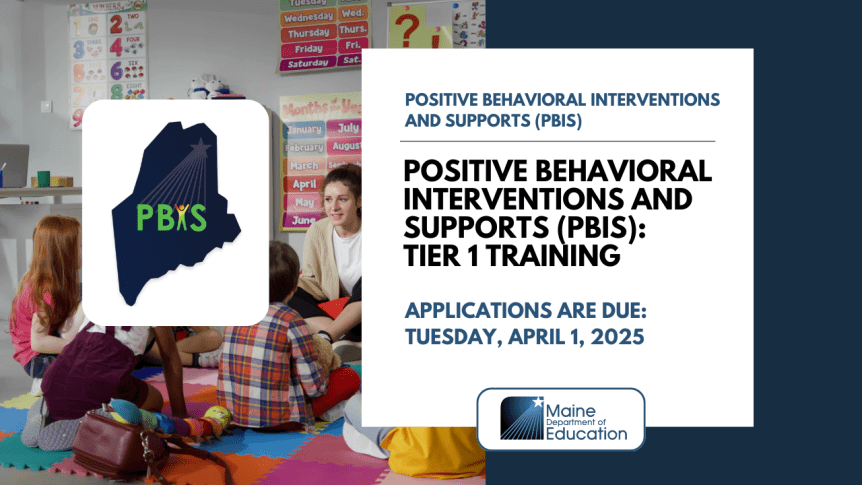
Maine Positive Behavioral Interventions and Supports (PBIS) is a partnership between the Maine Department of Education (DOE) and the University of Maine System. Maine PBIS offers a three-year intensive training and coaching model to support districts and schools in implementing Tier 1 PBIS with fidelity. Maine PBIS is accepting applications for a new PBIS Cohort Training. Applications are due by Tuesday, April 1, 2025.
PBIS is “an evidence-based, tiered framework for supporting students’ behavioral, academic, social, emotional, and mental health that creates safe, positive, equitable schools, where every student can feel valued, connected to the school community, and supported by caring adults.” (Center on PBIS, 2025).
What is PBIS Cohort Training?
Cohort Training: Involves a group of schools or districts working together through a structured training and coaching process.
Focus: To implement PBIS effectively and sustainably, highlighting:
Data-driven decision-making, using data to monitor implementation and guide interventions.
Systems and practices, establishing clear expectations, consistent procedures, and effective interventions.
Training and coaching, providing ongoing support and professional development to school staff.
Fidelity, ensuring that PBIS is implemented as intended.
Benefits:
Key Features of PBIS Cohort Training
Multi-year approach: Often spans several years to allow for sustained implementation and support.
Team-based: School teams participate in the training and coaching process.
Tiered approach: PBIS is a tiered framework, with Tier 1 being universal supports for all students; Tier 2 being for students at risk; and Tier 3 being for students with intensive needs.
Data-driven: PBIS relies on data to monitor implementation and make decisions.
Focus on prevention: PBIS emphasizes preventing problems before they occur.
Emphasis on positive behaviors: PBIS focuses on teaching and reinforcing positive behaviors.
Collaboration: PBIS training often involves collaboration among schools, districts, and regional or state-level organizations.
You can learn more about Maine PBIS and the training model by exploring the following resources:
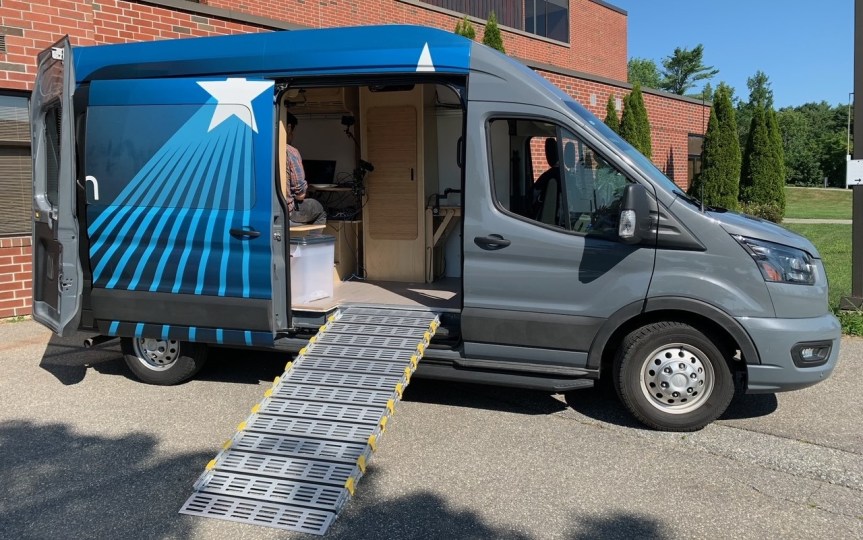
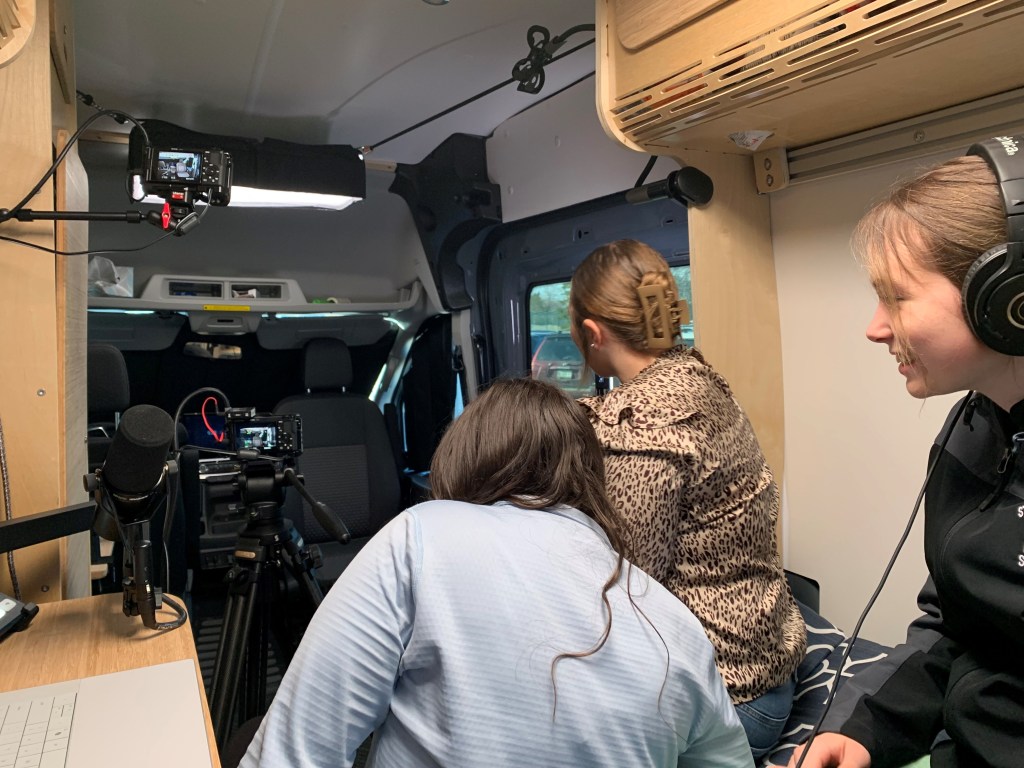
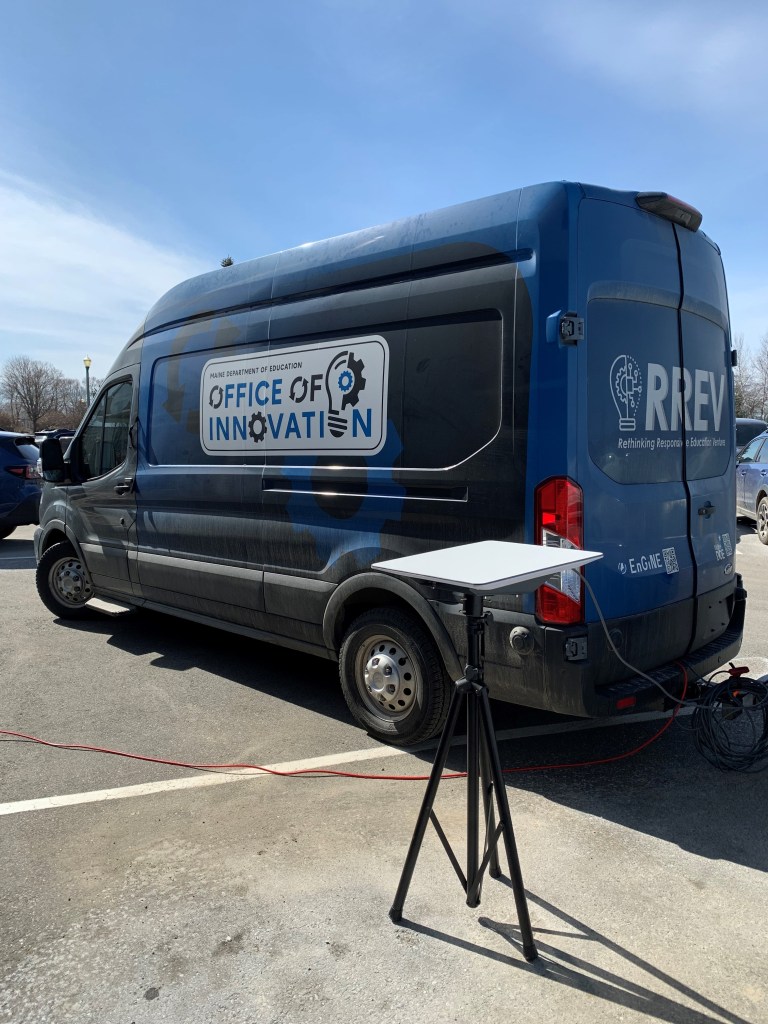
With the help of federal grant funds and some crafty educators and students in RSU 19, the Maine Department of Education (DOE) is proud to present the Maine DOE Mobile Learning Van, designed to bring new and innovative peer-to-peer learning opportunities to schools and their communities across the state.
The vision for this van came out of the Rethinking Responsive Education Ventures (RREV) initiative, funded by the Education Stabilization Fund through the U.S. Department of Education’s Rethink K-12 Education Models grant. The grant’s purpose was to bolster Maine educators’ innovative efforts to support their students with agile, effective, and resilient learning experiences that improve learning outcomes for all students.
With large-scale, ongoing professional learning an important component of the RREV grant, the Maine DOE introduced the idea of using a mobile unit, rather than hosting conferences and events. This unit would travel throughout the state, supporting schools and educators—especially those that experience travel and financial barriers, which can prevent access to high-quality professional learning. Additionally, this field-based, peer-to-peer learning would create opportunities for educators statewide to connect with one another.
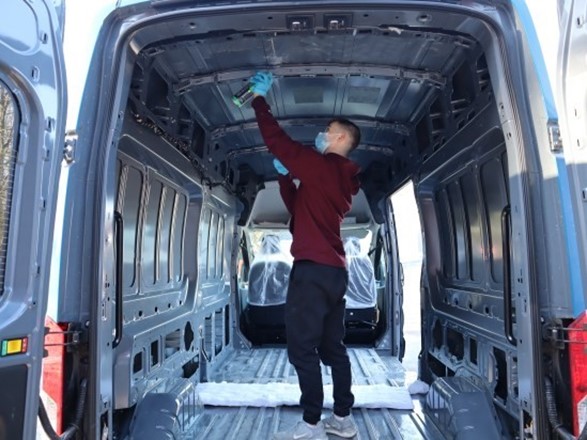
Initially, that mobile unit—a van—arrived as an empty Ford Transit van that didn’t look much like a mobile learning office. In the true spirit of innovation—and a strong belief in public education—the Maine DOE partnered with RSU 19 to tackle the challenge of turning this vision into a reality.
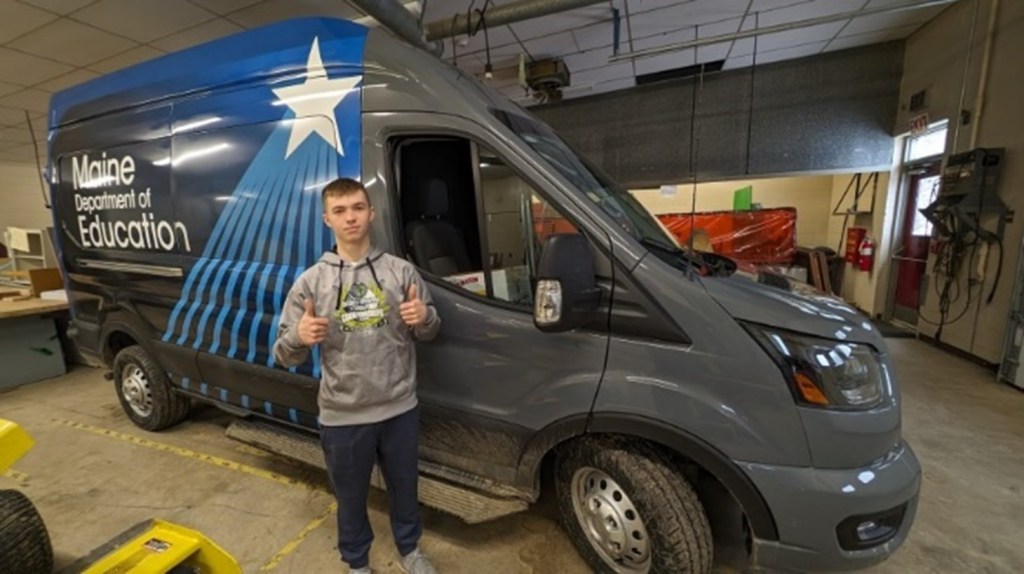
RSU 19’s Director of Technology Integration Kern Kelley headed that project alongside the Maine DOE’s Office of Innovation. Kelley is an award-winning educator, passionate about authentic learning and student-led projects. He has a reputation for preparing his students for a strong post-graduation future by providing them with opportunities in school to learn about 3-D design, computer programming, robotics, and other advanced technological skills.
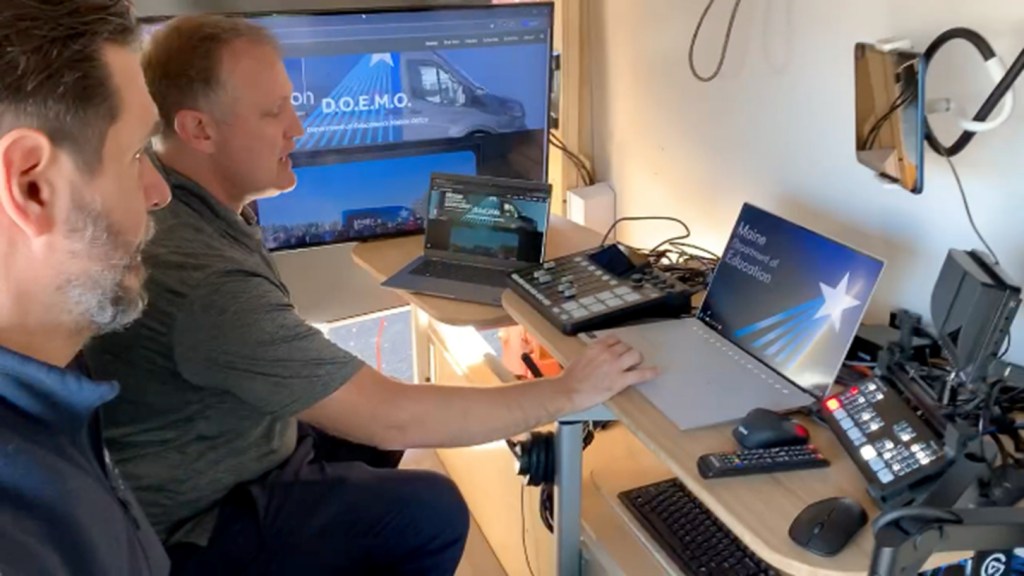
Kelley got to work on this van with his Nokomis High School students, who were divided into two teams. One group of student builders worked on the van’s interior build-out, installing equipment like laptops, iPads, and Chromebooks (in line with the Maine Learning Technology Initiative), as well as cameras, microphones, an audio/video mixing device, a drone, a satellite link, two monitors for presentation in or behind the van, an internal interviewing station, a ramp for accessibility, and a tent and bag chairs for small outdoor presentation possibilities.
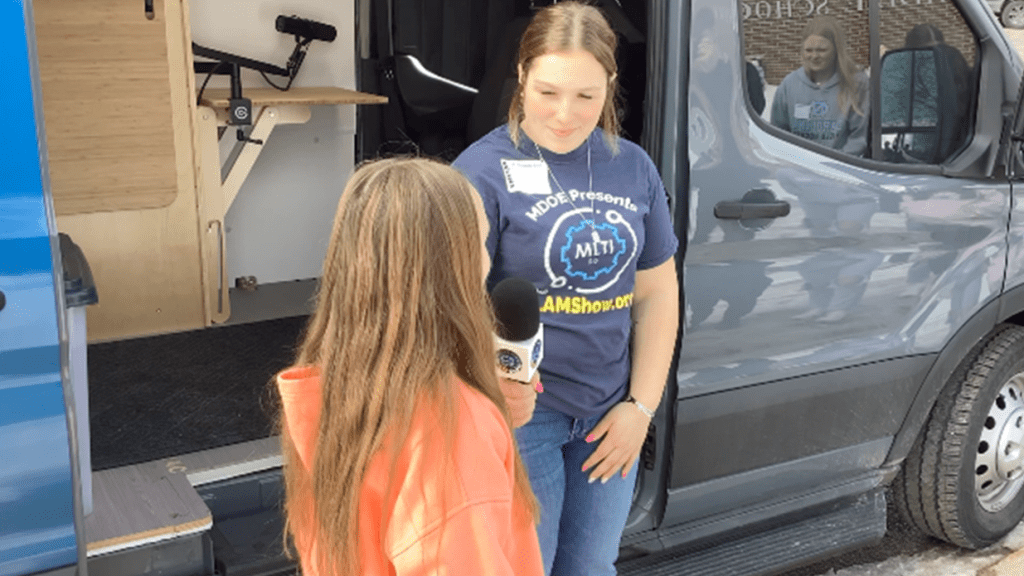
A second group of students—a documentary team—captured the van’s transformation through a website, YouTube videos, and interviews.
Using their creativity, inventive thinking, and construction skills, these students created the final product—the Maine DOE Mobile Learning Van, affectionately known as the “Marty Mobile”, named after the original RREV Director who died suddenly in April of 2022.
Once the van was nearly complete in the spring of 2024, the Maine DOE’s RREV team traveled to 25 of the participating RREV schools to celebrate the learning that had been made possible because of RREV award funding and the educators committed to making those innovative opportunities a reality. Video footage and audio interviews from those trips are posted on the RREV webpage.
After the spring RREV tours, the RREV team returned the van to RSU 19 for a final transformation over the summer. By the start of the 2024-2025 school year, most of the finishing touches—including equipment and technology—were in place.
Since then, the Maine DOE has conducted some test outings with the van during a few RREV Learning Tours (in MSAD 28, St. George Municipal School Unit, Wayfinder Schools, MSAD 59, and the Maine Academy of Natural Sciences), as well as a SLAM (Student Leadership Ambassadors of Maine) showcase in MSAD 60.
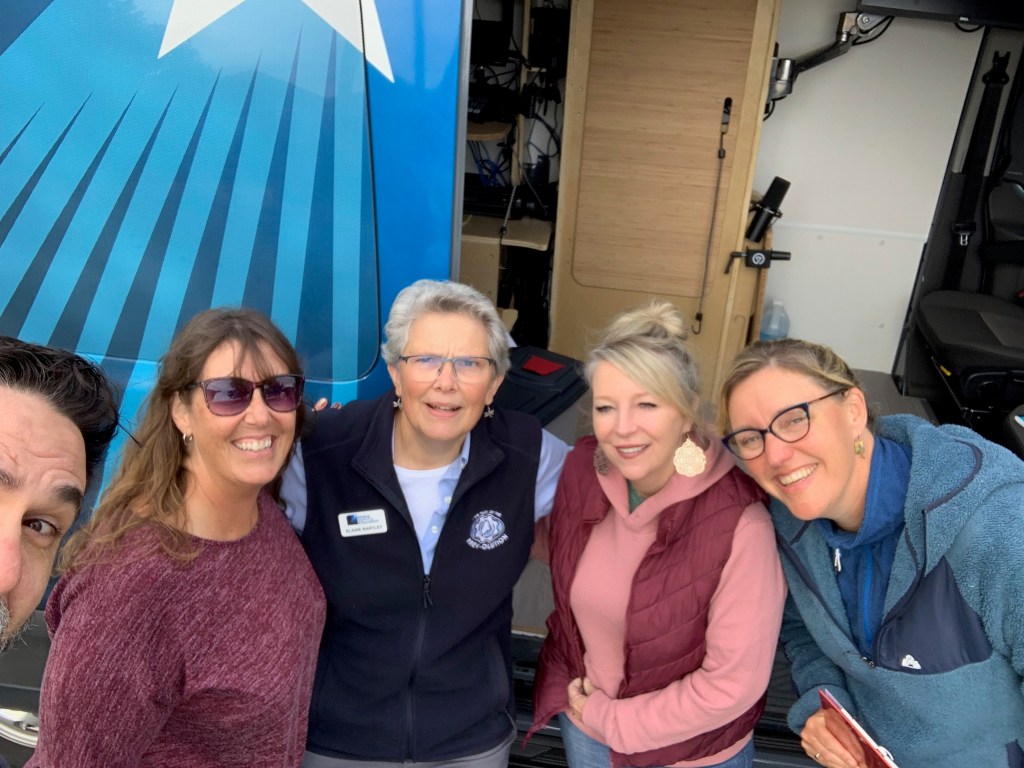
On March 12, 2025, the van visited the Maine School Safety and Transportation Conference at the Samoset Resort in Rockport. At the event, Kelley and his students accompanied members of the Maine DOE’s Office of Innovation to showcase how the van could be used to conduct interviews and capture footage from the field.
Keep an eye out for upcoming Maine DOE Mobile Learning Van stops, scheduled at locations across the state! Up next: In Aroostook County, the van will stop at Limestone Community School for a Learning Tour. Then, it will be at Fort Kent Middle School for the SLAM Showcase.
You can stay up to date on future professional learning and collaboration opportunities by checking out the Maine DOE Newsroom and Event Calendar.
In April, the Maine Department of Education (DOE) is hosting McKinney-Vento Spring 2025 Regional Meetings to provide updates on federal, state, and local policies and discuss resources available to students and families experiencing homelessness or housing instability.
During these meetings, participants will learn about strategies for increasing local capacity to support McKinney-Vento-eligible students. Participants will have an opportunity to brainstorm solution-oriented approaches for affected youth in their schools and communities—and to network with colleagues from other schools and organizations.
The scheduled meetings are as follows:
Penobscot and Piscataquis Counties Wings for Children and Families, 900 Hammond St. #915, Bangor Thursday, April 3 8:05-10:30 a.m.
Washington and Hancock Counties Maine DHHS Regional Office, 38 Prescott Dr., Machias Thursday, April 3 1-3:30 p.m.
Aroostook County Maine Department of Labor, 66 Spruce St., Presque Isle Friday, April 4 9-11:30 a.m.
Mid-Coast, Kennebec, and Somerset Counties Burton M. Cross Office Building Room 103 A and B, 111 Sewall St., Augusta Tuesday, April 8 9-11:30 a.m.
Androscoggin, Franklin, and Oxford Counties Edward Little High School, 77 Harris Street, Auburn Tuesday, April 15 9-11:30 a.m.
York and Cumberland Counties People’s Choice Credit Union, 23 Industrial Park Rd., Saco Tuesday, April 15 9:30 -noon
Registration for the McKinney-Vento Spring 2025 Regional Meetings is required. Participation is free. This event is appropriate for school staff or community-based organizations that support families and students experiencing housing instability. It is intended to be a space for connection and collaboration.
If you have questions, please contact Susan Lieberman, consulting McKinney-Vento Liaison Support Specialist, at susan.lieberman88@gmail.com or Signe Lynch, Maine DOE McKinney-Vento Homeless Education Specialist, at signe.lynch@maine.gov.






 Maine DOE Newsroom