Maine Association for Health, Physical Education, Recreation, and Dance Announces 2025 Awardees

The Maine Association for Health, Physical Education, Recreation, and Dance (Maine AHPERD) has announced the recipients of its 2025 Teacher of the Year awards, as well as recognition awards for Individual and Community Partner Organizations and Outstanding Future Professionals in the areas of Health Education and Physical Education.

These awards recognize exemplary health education, physical education, and adapted physical education teachers, professionals, and students who have demonstrated outstanding dedication to their students and/or the profession. Find more information about the awards here.

The 2025 Maine AHPERD award recipients are as follows:

Adapted Physical Education
Teacher of the Year
Rose Prest-Morrison
Sacopee Valley Elementary School


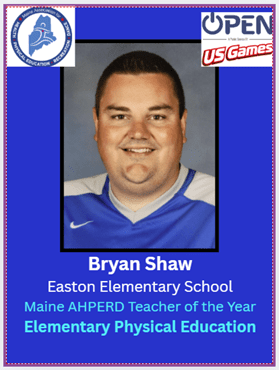
Elementary Physical Education
Teacher of the Year
Bryan Shaw
Easton Elementary School


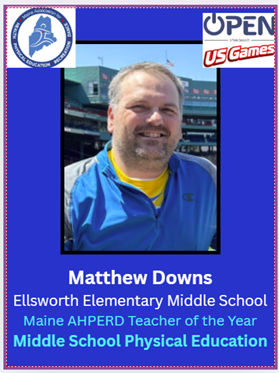
Middle School Physical Education
Teacher of the Year
Matthew Downs
Ellsworth Elementary/Middle School


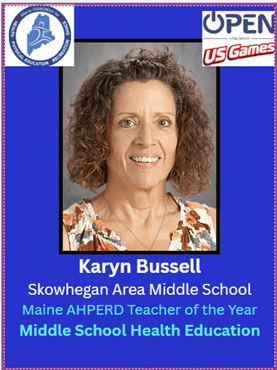
Middle School Health Education
Teacher of the Year
Karyn Bussell
Skowhegan Area Middle School


High School Health Education
Teacher of the Year
Sarah Rose
Poland Regional High School


In addition to providing Teacher of the Year awards, Maine AHPERD also recognizes individuals and community partner organizations who serve as strong supporters of the Maine AHPERD mission.

The 2025 honorees include:

Recreation Professional Award
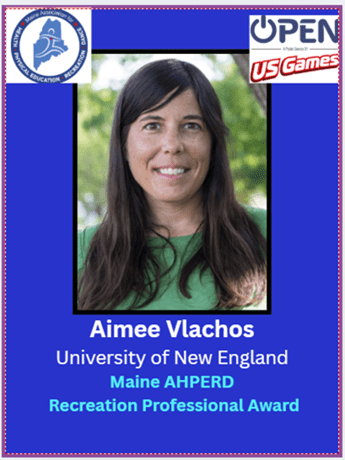
Aimee Vlachos
University of New England


Dance Professional Award
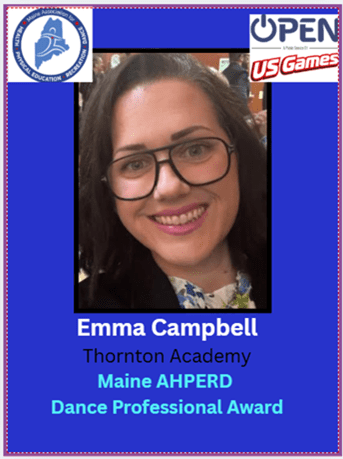
Emma Campbell
Thornton Academy


Community Award
Lee Anne Dodge
Drug-Free Community Coalition: SoPo Unite


This year, Maine AHPERD also honored twelve distinguished students hailing from five Maine institutions of higher learning as 2025 Outstanding Future Professionals in health education and physical education:

  • Jacob Chovinard, Saint Joseph’s College of Maine
  • Brandon Sadowski, Saint Joseph’s College of Maine
  • Logan Welch, Saint Joseph’s College of Maine
  • Joelle Daigneault, University of Maine at Farmington
  • Brynn Dzengelewski, University of Maine Orono
  • Brianna Harriman, University of Maine Orono
  • Allie Hull, University of Maine Orono
  • Jeremy Miller, University of Maine Orono
  • Kennen Bean, University of Maine at Presque Isle
  • Jackman Daigle, University of Maine at Presque Isle
  • Aidan Curran, University of New England
  • Fritz Van Winkle, University of New England

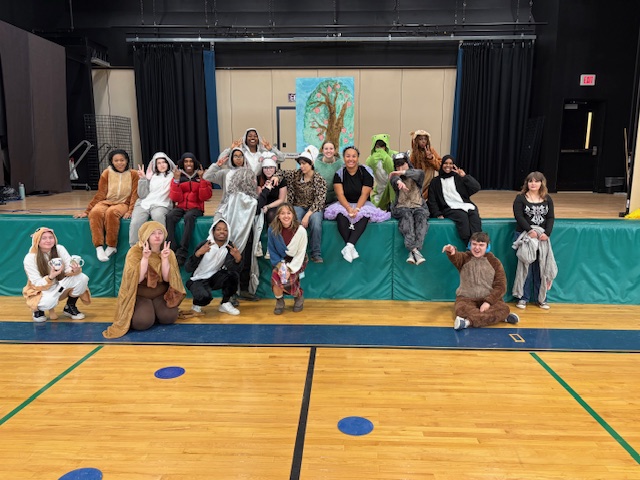
Photo Caption: Left to right in the front row: Brandon Sadowski, Allie Hull, Joelle Daigneault, and Kennan Bean. Left to right in the back row: Logan Welch, Jackman Daigle, Jacob Chovinard, Jeremy Miller, Brianna Harriman, and Aidan Curran.

Please note that Brynn Dzengelewski and Fritz Van Winkle are not present in this photo.

Visit the Maine AHPERD website for highlights and resources from the Maine AHPERD 80th Annual Conference that was held from November 2-4, 2025.  

Youth Leaders from Maine and New Hampshire Gather for ‘Can We? Connect’ at Augusta Civic Center

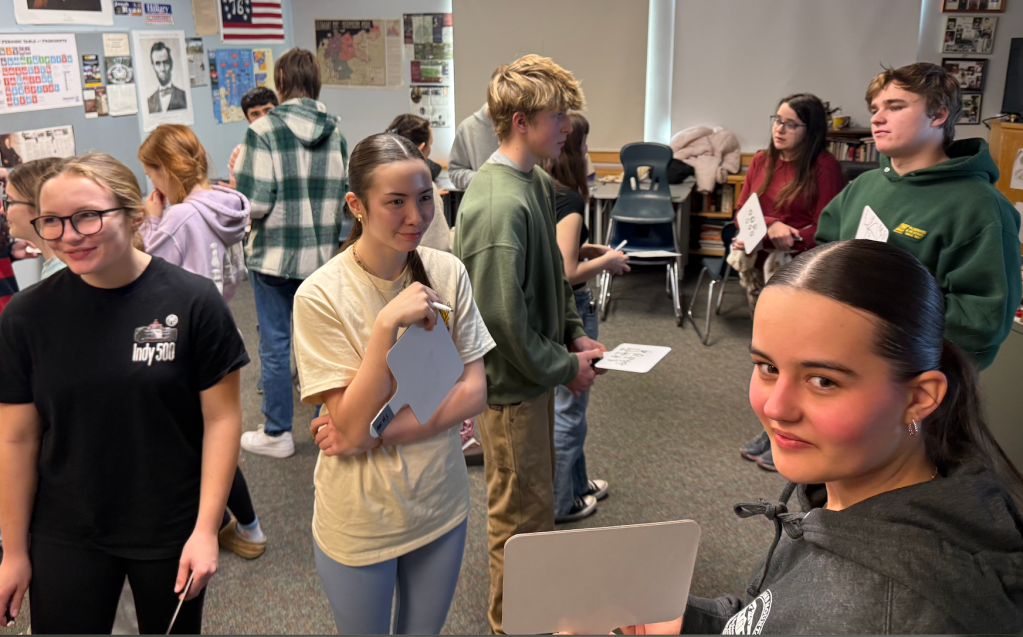
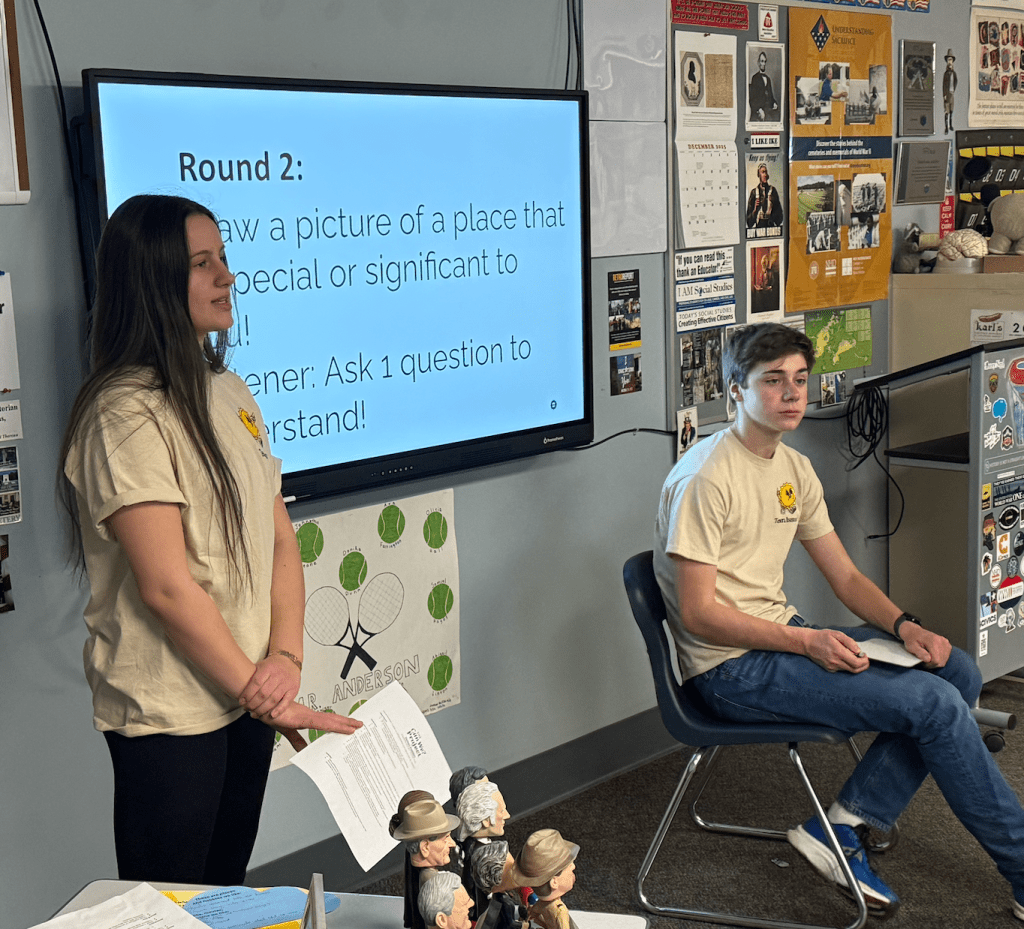
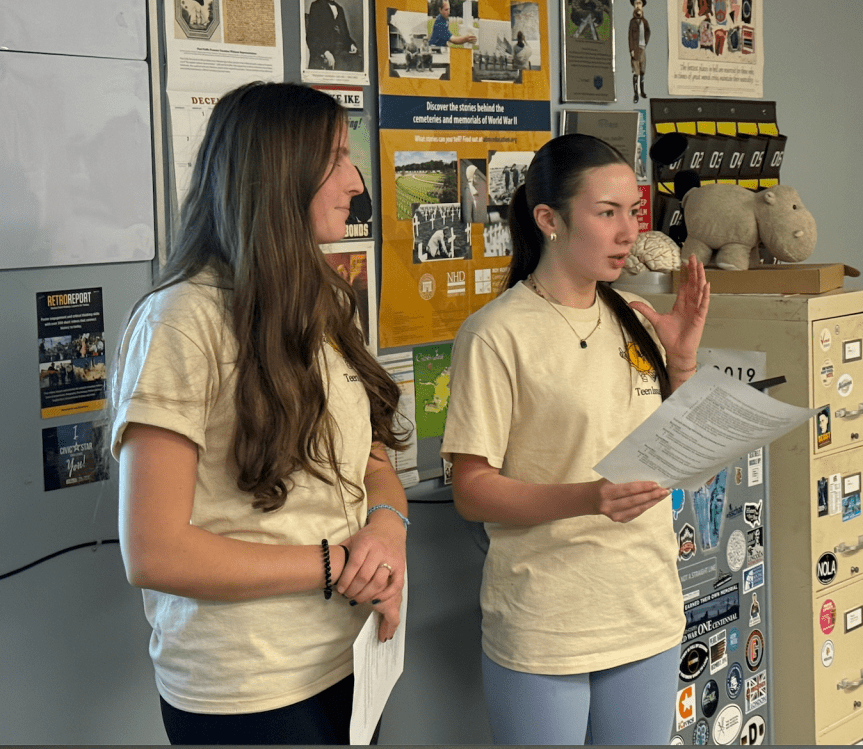
Maranacook High School student leaders lead a “Teen Issues” event at their school following The “Can We? Connect” event.

An early December snowstorm didn’t stop nearly 300 students and educators from 17 high schools across Maine and New Hampshire from coming together on December 11, 2025, at the Augusta Civic Center for Can We? Connect, a day of youth-led dialogue and educator professional learning produced by The Can We? Project.

Can We? Connect is the second of three full-day retreats held throughout the school year for cohorts of student leaders from partner schools. While the first and third retreats take place locally, Can We? Connect offers a unique opportunity for students to gather regionally for a shared experience centered on constructive dialogue across real and perceived differences. One student participant described the experience as “the anti-debate league,” highlighting its focus on understanding rather than argument.

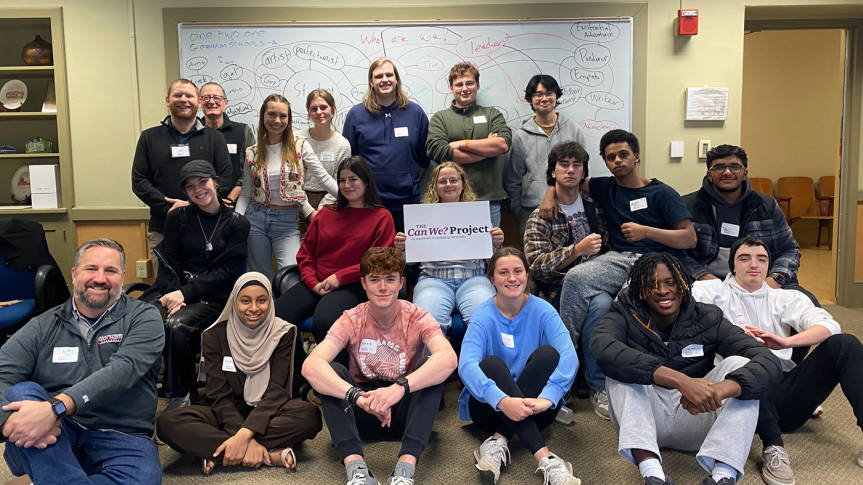
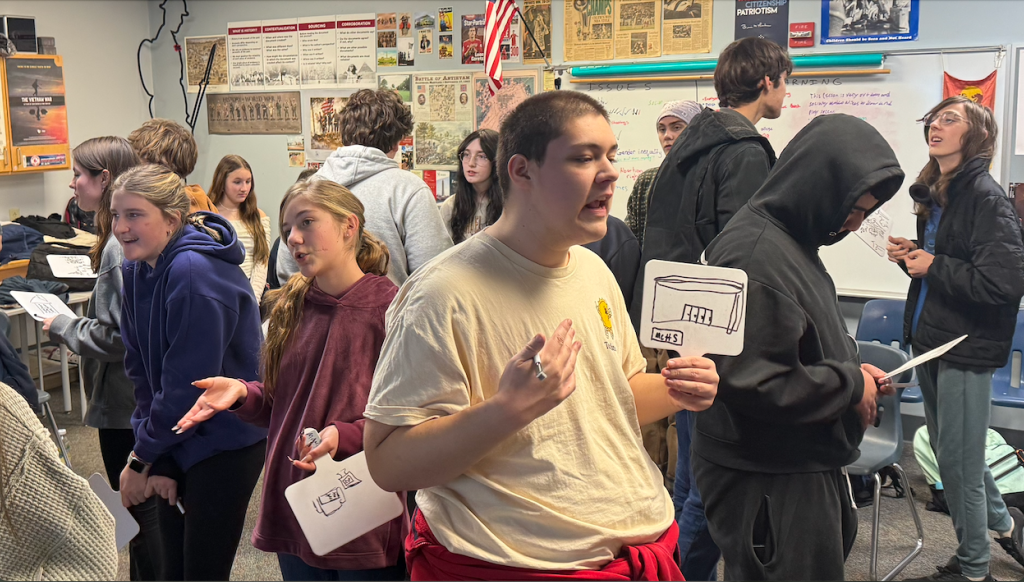
This photograph, taken at Gorham High School, is courtesy of The Can We? Project.

Throughout the day, students practiced inquiry and active listening skills as they explored their own identities, learned about the communities their peers come from, and shared hopes for the future. Students also engaged in structured conversations where they shared personal beliefs and responded to thoughtful questions from peers about the values and moral foundations behind those beliefs.

While students participated in youth-led dialogue sessions, accompanying teachers and educators took part in a concurrent professional learning experience led by Julia Enriquez, a Can We? Project Liaison and history teacher at Yarmouth High School. The session focused on tools to foster constructive dialogue in classrooms, including a deck of conversation cards that Enriquez is developing to support meaningful discussion across any topic or theme.

Maranacook Community High School has been an active participant in The Can We? Project, with approximately 18 student leaders taking part in two retreats this school year. About a week after Can We? Connect, these students put their learning into action by hosting a “Teen Issues” event for the Maranacook school community. Student leaders organized a series of sessions that allowed participants to choose topics related to mental health awareness, personal interests and hobbies, or other issues important to them—many of which are not typically addressed within the regular curriculum.

This student-led event introduced The Can We? Project to the broader school community and engaged approximately 70 students across four sessions. Along with facilitating a “Picture Paddles” activity designed to build empathy and active listening skills, student leaders guided thoughtful, civil dialogue around issues that each participant identified as important.

“These were completely student led, with The Can We? Project student leaders facilitating,” Shane Gower, Maranacook Community High School Social Studies Teacher, said. “It was truly amazing to see, and we received so much positive feedback from participating students. It was very clear that our students really need opportunities like this for meaningful discourse.”


Other students continue to share their positive experiences with The Can We? Project, too. During the Can We? Connect event, facilitators gathered student feedback reflecting on the powerful impact of this experience:

  • “I am more hopeful towards the future, and I am honestly surprised that so many people I met are so similarly motivated. I think it was truly amazing to have this experience where I got to go out and communicate effectively about opinion and belief without stereotype or judgment.”
  • “Just like belonging in the greater world, I was really moved by everyone’s sense of kindness and support. There was no aggressive language or hate speech, and it was really nice to have that experience.”
  • “I am thinking that this will shape my ability to debate in the future. I often have a hard time thinking about other people’s perspectives, and this helped a lot.”
  • “I hope that this form of civil conversation can be something that becomes pursued by the general public. If things are discussed, sides become less polar.”
  • “Everyone believes in a future where they’re given a fair chance to be who they are. I felt much more seen than I ever have in my entire life.”

Educators at the December 11 event also echoed the positive impact on students:

  • “Can We? Connect is an amazing opportunity for all of our students to connect with peers from across the state.”
  • “They were interested in doing more and learning more about the others they had just met. They want to do something to replicate the experience at our school.”
  • “They were all full of happy and excited chatter on the ride home. I hope you all know just how much this type of experience means to teenagers.” 

The Can We? Project continues to seek new partner schools and welcomes interest from students and educators who want to bring youth-led dialogue to their communities.

This story was submitted by The Can We? Project. For more information or to begin a conversation about participation, please contact John Holdridge, Can We? Project Director, at jholdridge@waynflete.org. To submit a good news story to the Maine DOE, please fill out the good news submission form.

A map of this year’s participating schools is included below.

Jordan-Small Middle School Pilots Innovative Outdoor Education Program Through Science Curriculum

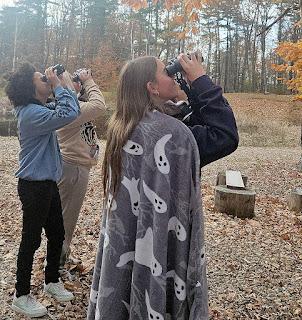
Students in Jordan-Small Middle School’s outdoor education pilot program bird-watch as one of their recent activities. 

At Jordan-Small Middle School (JSMS) in RSU 14, teacher Jed Bloom’s science classes no longer stop at the classroom door. This past fall, sixth-, seventh-, and eighth-grade students stepped into the woods on district property as part of a pilot outdoor education program that blends science instruction with nature-based exploration, hands-on projects, and plenty of fresh air.

Bloom said this new outdoor education approach reflects a growing body of research showing that outdoor learning increases academic achievement, strengthens critical thinking, and supports students’ personal development. According to the North American Association for Environmental Education, outdoor, hands-on learning allows “personal growth and life-building skills, including confidence, autonomy, and leadership,” to become essential parts of students’ lives. Additionally, outdoor education naturally encourages the core practices of science: asking questions, making observations, forming hypotheses, and testing ideas.

Bloom said these findings inspired him to bring his science classes outdoors in a meaningful way.

“You can certainly do that inside a lab, in a classroom surrounded by four brick walls,” Bloom said. “But outside, there’s so much more to observe. You see it; you hear it; you smell it. It activates all the senses. That sensory experience leads to more questions, deeper thinking, and better science.”

Sixth-grader Jack Sawyer’s curiosity was sparked during a routine visit to the Frog Pond across the street on Raymond Elementary School’s campus. What began as a simple observation quickly evolved into a more profound question about the natural world.

“The first day when we went to the Frog Pond, all the grass and cattails were standing up, but throughout the year, they started to fall down,” Sawyer said. “I wondered why they did that.”

Part of the pilot’s design, Bloom emphasized, is that both he and his students are learning together and working to determine what does and doesn’t work for the program.

“The students get to see that learning is a collaborative process,” Bloom said. “We’re exploring, experimenting, and improving the program for next year.” 

In addition to meeting science standards, the JSMS outdoor education program meets the Maine Learning Results standards—skills that Maine students are expected to have gained upon graduating high school. These include the Maine Learning Results guiding principles of becoming:

  • A Self-Directed and Lifelong Learner
  • A Creative and Practical Problem Solver
  • A Responsible and Involved Citizen
  • An Integrative and Informed Thinker
  • A Clear and Effective Communicator

For many students, this program goes beyond the state’s standards and the school’s curriculum. As they observe the natural world—birds, trees, wind, frogs hopping and singing at the Frog Pond, etc—Being outdoors, and the lessons it teaches, are beginning to take hold for these sudents.

Seventh-grader Carly Herman said she finds that the hands-on, outdoor activities make learning more engaging.

“The best part is going out and having fun,” Herman said. “Right now, we’re making a fire pit and building forts. When it gets really cold, the fire pit will help keep us warm, and the forts will keep us dry during rain and snow while we do our observations and journaling.”

Classmate Jamar Banton agreed, adding that the outdoor journals the students keep while on their exploratory adventures have helped him to notice things he never paid attention to before.

“When we sit and listen, we take notes on everything happening around us,” Banton said. “One time, I heard a buzzing noise, and it turned out to be a bee nearby. I even heard cars in the distance—sounds you don’t think about being in nature, but they’re there.”

While JSMS academics are the heart of this pilot program, Bloom said there is another component that is just as essential to the lives of JSMS students, and that is the art of playing.

“12- and 13-year-olds need to move their bodies and play together,” Bloom said. “They’re learning social skills as much as science skills. Many kids today have packed schedules filled with school, sports, and evening activities. Add in the pull of cellphones, and there’s not much unstructured time outdoors.”

Outdoor education, Bloom said, gives students space to breathe, move, collaborate, and reset.

As the pilot program continues, Bloom said he hopes this new initiative will become a model for future outdoor learning at JSMS and hopefully the entire district. For now, though, his students seem more than happy trading fluorescent lights for sunshine, textbooks for field journals, and worksheets for the rustle of leaves and snow beneath their feet.

This article was submitted by RSU 14. To submit a good news story to the Maine DOE, please fill out the good news submission form.
A Look Back: Maine FFA Celebrates the Year of Youth in Agriculture

From left to right: Sierra Hemond; Julia Deitrick; Jillian McLaughlin; Lane Carmichael; Hannah Shaw; Maine Commissioner of Agriculture, Conservation, and Forestry Amanda Beal; Julia Pierce; Hayley Mane; and Mia Arcott.

This article was written by Jillian McLaughlin, Maine FFA State Reporter.

Nearly a year ago, on January 14, 2025, Governor Janet Mills signed a proclamation officially designating 2025 as the Maine Year of Youth in Agriculture. This action launched a series of statewide initiatives designed to engage and support young agriculturalists through enhanced access to resources, mentorship opportunities, and networking experiences.


The first initiative took place that month during the 2025 State of Maine Agricultural Tradeshow with a student-led panel held at the Commissioner’s Luncheon. Hosted by Governor Mills and Maine Department of Agriculture, Conservation, and Forestry Commissioner Amanda Beal, this panel elevated the voices of young leaders in agriculture as attendees heard firsthand accounts of their experiences and aspirations. Panelists included Maine FFA State President Lane Carmichael and representatives from the Maine 4-H Foundation.


In March 2025, Governor Mills invited youth leaders to attend Maine Agriculture Day at the Maine Legislature. A select group of students met with state senators and representatives to discuss the current state of agriculture in Maine. Throughout the day, participants were formally recognized by both the Maine House of Representatives and Senate for their dedication to the future of agriculture. Students also had the opportunity to meet personally with Governor Mills to discuss her continued commitment to engaging Maine’s agricultural youth.


The Maine Association of Agricultural Fairs declared the 2025 fair season the Year of Youth in Agriculture, which presented students with the opportunity to actively engage in events across the state. This included animal clinics, showing events, youth agriculture auctions, youth in agriculture displays, and much more.


In September 2025, the Eastern States Exposition took place in West Springfield, Massachusetts. Known as “The Big E,” this exposition is the largest fair on the East Coast, bringing together hundreds of FFA members for competitions, American Star Awards, and livestock shows. 2025 marked the 100th anniversary of the Maine Building on the fairgrounds. To commemorate the occasion, Commissioner Beal invited Maine FFA state officers and 4-H leaders to participate in a ribbon-cutting ceremony. Prior to the event, state officers Jillian McLaughlin and Hannah Shaw conducted a one-on-one interview with Commissioner Beal, reflecting on key takeaways from the Maine Year of Youth in Agriculture. This celebration concluded with remarks from 4-H leaders, government officials, and Maine FFA State President Carmichael.

Maine FFA members also did their part to continue the momentum of the Maine Year of Youth in Agriculture throughout 2025. In the summer, the Maine FFA State Officer Team inspired and engaged young members statewide, as they facilitated youth outreach events at agricultural fairs across the state following training with the National FFA. These events provided FFA and 4-H members with opportunities to network, build connections, and strengthen their leadership skills through workshops.

2025 provided young members of Maine’s agricultural community with a once-in-a-lifetime opportunity to connect directly with state leaders and have their voices heard. As Maine looks to the future, its youth are now better equipped with the knowledge, skills, and relationships needed to lead and advance the state’s agricultural industry. Although the Maine Year of Youth in Agriculture has officially come to a close, its impact will extend far beyond 2025.

To learn more about the Year of Youth in Agriculture, please visit: Maine Department of Agriculture, Conservation, and Forestry | Maine’s Year of Youth in Agriculture.

To submit a good news story to the Maine DOE, please fill out the good news submission form.
Princeton Elementary Showcases Hands-On STEAM Learning Through Maine DOE Learning Tour

On December 9, 2025, Princeton Elementary School teacher Donna Netzer opened her classroom to educators from across Maine, as she demonstrated ways to incorporate numerous Science, Technology, Engineering, the Arts, and Mathematics (STEAM) technologies into the typical educational environment. This presentation was part of the Maine Department of Education (DOE) Office of Innovation’s latest Learning Tour, an opportunity for educators to participate in peer-to-peer learning.

During the Learning Tour, Netzer and her tech-savvy students demonstrated how each STEAM technology in her classroom (e.g., indi robots, Bee-Bots, Cubelets, 3D pens, etc.) is easily connected to the required grade-level Maine Learning Results. Netzer prepared demonstrations with students from pre-K through grade 8, illustrating how her students are “tech-sperts” for their peers and teachers at their small, rural school.


Experiential learning opportunities can be extremely powerful for many students, as they bring contextual meaning to the concepts being taught in the classroom, turning cerebral ideas into authentic life experiences. For some students, experiences in an outdoor environment may resonate, while for others, STEAM experiences may help to establish those learning connections.

The evening before Princeton’s Learning Tour, Netzer also arranged a STEAM night, where students, families, and community members could visit the school and explore some of these STEAM technologies for themselves.


It was a well-attended event, and many community members expressed excitement about trying things out for themselves. One of the unique applications was a Makey-Makey project that showcased conduction principles and programmable circuit boards in the form of a banana piano!

Check out this video highlighting the Princeton Elementary School Learning Tour:

The Maine DOE Office of Innovation is committed to providing Learning Tours that showcase these innovative learning experiences across the state. If you are interested in learning more, please contact Elaine Bartley, Maine DOE Rethinking Responsive Education Ventures (RREV) Research and Design Director, at elaine.bartley@maine.gov.

Maine Adult Education Educator Julie Berube Honored with National Barbara Bush Fund for Family Literacy Grant

The Maine Department of Education (DOE) is proud to recognize Julie Berube, Coordinator of the First Teachers Family Literacy Program at Biddeford Adult Education, as a recipient of a $10,000 national grant from the newly established Barbara Bush Fund for Family Literacy, an initiative of the George and Barbara Bush Foundation.

Berube’s program was selected as one of only three grant recipients nationwide in the Fund’s inaugural year, alongside organizations in Washington, D.C., and Florida. Announced in November 2025, the Barbara Bush Fund for Family Literacy builds on First Lady Barbara Bush’s decades-long commitment to literacy by supporting proven, community-based family literacy programs and elevating effective practices across the country.

For Berube, the recognition was both unexpected and deeply meaningful.

“When I initially found out my program was selected for the $10,000 grant, I was shocked,” Berube shared. “Pam Cote, Senior Director for the Barbara Bush Fund for Family Literacy, called me one evening in October. I was working late and happened to be the one answering the phone. I truly thought she had been gathering information for a national directory.”

Berube noted that after nearly six months of conversations with the Foundation, she never imagined her program would be among the first funded.

“I am profoundly grateful and humbled to be among the first recipients recognized by the newly launched George and Barbara Bush Foundation. After 26 years coordinating the First Teachers Family Literacy Program, this recognition serves as a powerful affirmation of my enduring commitment to family literacy.”

Berube’s connection to Barbara Bush’s literacy legacy runs deep. Berube joined Biddeford Adult Education in 1999 as a Child Care Coordinator and was soon encouraged by then-Director Anita Kramer to step into the role of Family Literacy Coordinator.

“I was hesitant at first—it was a big endeavor,” Berube recalled. “But Anita believed in me, and that made all the difference.”

With Kramer’s support, Biddeford Adult Education applied for and received a Maine Family Literacy Initiative (MEFLI) grant—funded through the original Barbara Bush Foundation. The program was named First Teachers, reflecting Barbara Bush’s belief that parents are a child’s first and best teachers.

Biddeford became the only program in Maine at the time to receive two consecutive MEFLI grants, and Berube noted that Barbara Bush herself had a strong personal connection to the region, spending summers in nearby Kennebunkport.

When MEFLI funding ended, Berube was determined to keep the program alive.

“I ran a penny auction fundraiser for four years to keep First Teachers going,” she said. “I wrote letters to local businesses six months in advance, and we were fortunate to have interns from the University of New England. It took a lot of time and energy, but I wasn’t willing to let the program end.”

In 2009, family literacy funding was formalized and became a permanent part of the local school budget—a testament to the program’s impact, longevity, and strong outcomes.

“Receiving funding now from the George and Barbara Bush Foundation feels like a full-circle moment,” Berube shared. “I started this program with a Barbara Bush Foundation grant, and more than two decades later, I’ve received a grant from the newly launched Barbara Bush Fund for Family Literacy.”

The First Teachers Family Literacy Program empowers parents and caregivers to build their own literacy skills while learning alongside their children. By engaging families together, the program strengthens early literacy, builds confidence, and helps break cycles of low literacy across generations.

Families in Berube’s Creative Play Class are participating in an Intergenerational Literacy Activity (ILA).

David Durkee, Program Director at Biddeford Adult Education, emphasized the program’s importance within the broader adult education mission.

“Julie has strengthened our adult education program by engaging parents and children together, building foundational reading and language skills, and fostering lifelong learning,” Durkee said. “Her work benefits individual families and the broader community.”

Durkee described Biddeford Adult Education as a leader in accessible, high-quality adult education, offering flexible programming, workforce development, and strong community partnerships.

“Julie has expanded family literacy significantly through partnerships with organizations like Head Start and continually offers new learning opportunities for students and families,” Durkee added.

The new grant will allow Biddeford Adult Education to further its family literacy efforts.

“This funding will enable us to expand parent-child literacy events, increase early childhood reading activities, offer more parent education workshops, and strengthen partnerships,” Durkee said. “These funds will broaden the program’s reach and provide more families with the resources they need to build strong literacy foundations.”

The Barbara Bush Fund for Family Literacy aims not only to provide funding but also to serve as a national thought leader, amplifying effective programs that address one of the country’s most pressing educational challenges. By awarding this grant, the George and Barbara Bush Foundation is honoring Berube’s decades of dedication, while investing in a vision that spans generations.

The Maine DOE congratulates Julie Berube and Biddeford Adult Education on this well-deserved national recognition and applauds their leadership in adult education and family literacy in Maine.

This story was a collaboration between the Maine DOE and Biddeford Adult Education Program. To submit a good news story to the Maine DOE, please fill out the good news submission form.
Gorham Superintendent Heather Perry Named Finalist for AASA National Superintendent of the Year Award

Gorham School District Superintendent Heather Perry has been named one of four finalists for the AASA National Superintendent of the Year® Award, a prestigious honor administered by The School Superintendents Association (AASA), which recognizes exceptional leadership, professionalism, communication, and community engagement among school leaders nationwide.

“I am deeply honored to be named a finalist for National Superintendent of the Year,” Perry said. “This recognition reflects the extraordinary work of our students, staff, families, and community in Gorham. Public education is truly a team effort, and I am proud to serve alongside educators and leaders who are so deeply committed to creating meaningful opportunities for every child.”

In October, the Maine School Superintendents Association (MSSA) named Perry the 2026 Maine Superintendent of the Year, citing her work to improve student achievement, address Maine’s educator shortage, and partner with local businesses to expand students’ career aspirations. On Monday, December 15, 2025, Perry was announced as a finalist for the national award—marking the first time a Maine superintendent has reached finalist status since the award’s inception in 1988.

“We are beyond thrilled that Heather Perry has been named a finalist for National Superintendent of the Year,” Eileen King, Executive Director of MSSA, said. “Heather is a true beacon of educational leadership, and I am so pleased that she is being recognized on the national level for her extraordinary commitment to students and families in Gorham and across our state. She is a role model, a problem-solver, a collaborator, and a steadfast advocate for public education.”

Perry has served as superintendent of the Gorham School District for the past decade. Under her leadership, the district has focused on reaching every student—particularly those who have been historically underserved. Through partnerships with businesses and community organizations, Gorham has expanded career pathways and aspirations, resulting in significant growth in student participation in internships, career mentorships, and career and technical education (CTE) programs. The district now reports a graduation rate exceeding 96 percent.

Perry has also played a key role in addressing Maine’s educator workforce shortage. In 2022, Gorham piloted an innovative educator apprenticeship program designed to recruit and retain school staff while supporting career advancement through a combination of coursework and on-the-job training. The program has since expanded to dozens of school districts across Maine.

Prior to her tenure in Gorham, Perry worked as a teacher and administrator in the Machias area and served as superintendent in RSU 3 and the Greenville School Department. She currently serves on the Executive Committee of MSSA and previously served on AASA’s executive committee. Perry is also a nationally respected voice on school leadership, with published work regularly featured by AASA.

The National Superintendent of the Year® Award will be announced live during AASA’s National Conference on Education, held February 12-14, 2026, in Nashville, Tennessee.

This story was submitted by the Maine School Management Association (MSMA). To submit a good news story to the Maine DOE, please fill out the good news submission form.
Saco Celebrates Groundbreaking for New Pre-K–Grade 5 School Campus After 20-Year Wait

Pictured: Saco School Department’s New Elementary School Assistant Principal (Grades 1-5) Tom Partridge, Fairfield School student Caroline Libby, Fairfield School student Maris Posey, Young School student Nathan Smith, Young School student Olivea Desmarais, New Elementary School Principal (Grades 1-5) April Noble, Young School student Anna Broaddus, Fairfield School student Alex Hadiaris, New Primary School Principal (PreK-K) Wendy LeBlanc, Young School student Cameron Blunt, Fairfield School student Nathan Kupresanin, New Primary School Assistant Principal (pre-K–kindergarten) J’Aime Walker, and New Elementary School Assistant Principal (Grades 1-5) Jeff Mears. Photo Credit: Maureen Grandmaison Photography

The Saco School Department and City of Saco marked a historic milestone on December 4, 2025, as families, city officials, students, educators, and construction partners gathered for the official groundbreaking of the district’s transformative new pre-K–grade 5 school campus, representing the long-awaited transformation of the district’s elementary learning environments.

Following more than two decades of planning, the community-backed bond and state funding—covering approximately 72% of the total $140 million project—have paved the way for this exciting initiative to move from vision to reality. The campus will consist of two new elementary schools on a shared site to serve all pre-K through grade 5 students in a unified and equitable setting.

“This project has been years in the making, and today’s groundbreaking represents far more than bricks and mortar; it’s about creating opportunity, equity, and excellence for every child in Saco,” Jeremy Ray, Saco Superintendent of Schools, said. “Our students will learn in spaces designed to spark curiosity, collaboration, and creativity. They will thrive together in facilities built for their success.”

The new campus will feature two climate-controlled buildings: a primary building for pre-K through kindergarten students and an elementary building for grades 1-5 students—with flexible classroom spaces to adapt to evolving teaching methods, enhanced safety and security systems, a dedicated unified arts wing, and expanded outdoor learning opportunities, ensuring that every elementary student has access to the same high-quality facilities. The two buildings being located on one campus will allow the district’s youngest learners to have fewer transitions, providing for more stability—and educators will have access to the resources and environment necessary to inspire students.


A project of this scale requires strong leadership. At the December 4 event, Superintendent Ray highlighted the administrators who will lead the new schools forward. The new grades 1-5 Saco Elementary School will be led by current C.K. Burns School Principal April Noble, supported by Assistant Principals Jeff Mears and Tom Partridge. The new pre-K through Kindergarten Saco Primary School will be led by current Fairfield School Principal Wendy LeBlanc, supported by Assistant Principal J’Aime Walker. These individuals provide strong instructional leadership, a collaborative spirit, and a dedication to student success that will help define the culture and identity of the schools. By naming these leaders early, the administration can engage deeply in the design and preparation of the buildings, help shape the educational programs, collaborate with staff, and begin establishing a vision for each school. 

City of Saco Mayor Jodi MacPhail added, “This major investment reflects the values of Saco’s families in our shared future when they supported the bond and the state’s strong commitment when it covered more than $100 million of the cost. For 20 years, Saco has waited for this opportunity—and together, we are building a brighter future for every student who calls this city home.”

Assistant Superintendent Meg Parkhurst thanked the community for their support, the students and staff for providing feedback on the design, and the project architect for their work. Rob Tillotson, president and owner of Oak Point Associates, also spoke, sharing insight into the design process and expressing excitement about the project’s positive impact on the community and its students.

“As we build these schools for the future, we are also entering a transformative new era for the Saco School Department,” added Ray. “The construction of this pre-K–grade 5 campus will consolidate our current elementary schools—Young, Fairfield, C.K. Burns, and our dedicated pre-K program—into one unified system. We honor the proud history of these schools, and we recognize the deep memories they hold for generations of families. But we also know that what we are creating here today will offer even greater opportunities, designed for the way students learn now and the way they will learn tomorrow.”

Following the ceremony, attendees gathered at Saco Public Works for light refreshments and a community conversation about the construction timeline, projected opening dates, and the long-term vision for the campus. Construction is expected to be completed by Fall 2028, at which time a community-wide open house will be scheduled.

This story was submitted by Saco School Department. To submit a good news story to the Maine DOE, please fill out the good news submission form.
Maine DOE Announces 2026 United States Senate Youth Program State Delegates

The Maine Department of Education (DOE) is pleased to announce that Katarina Ousback of Scarborough High School and WanTing Huo of the Maine School of Science and Mathematics (MSSM) have been selected as Maine’s delegates to the 2026 United States Senate Youth Program (USSYP). They will join 102 exceptional student leaders from across the nation for Washington Week this spring, where they will engage directly with U.S. Senators, Supreme Court Justices, Cabinet officials, and other national leaders. Each delegate will also receive a $10,000 college scholarship from the William Randolph Hearst Foundation.
The USSYP, founded in 1962 and supported annually by the U.S. Senate, recognizes high school students who demonstrate a strong commitment to leadership, public service, and civic engagement. More than 6,000 students nationwide have participated in the program, including Maine’s own U.S. Senator Susan Collins, who often credits her USSYP experience and meeting Senator Margaret Chase Smith as a defining moment in her decision to pursue public service.

About Maine’s 2026 USSYP Delegates

Katarina Ousback, a senior at Scarborough High School, is a student leader with a deep passion for government and service. She serves as Student Council President and has held numerous leadership roles, including District Governor for the New England and Bermuda District of Key Club International and a U.S. Senate Page for Senator Susan Collins. Katarina has testified on legislation, participated in National History Day at both the state and national levels, and completed more than 350 hours of community service. Her teachers and school leaders describe her as mature, thoughtful, and deeply committed to strengthening her community through civic action.

Left to Right: Halsey Frank, a representative from Susan Collins' office; Katarina Ousback, Karen Fox, a representative from Senator Angus King's Office; and Dan Chuhta, Deputy Commissioner of the Maine Department of Education.
Left to right: Halsey Frank, a representative from Senator Susan Collins’ office; Katarina Ousback; Karen Fox, a representative from Senator Angus King’s Office; and Dan Chuhta, Deputy Commissioner of the Maine Department of Education.

WanTing Huo, a junior at MSSM, currently serves as the Youth Council Representative for the League of Women Voters of Maine. She is an active advocate for youth civic engagement and a leader across several statewide and community organizations. WanTing has served as a Lieutenant Governor for Key Club International, a 4-H Agriculture Ambassador, and a member of the Maine Youth Action Network’s Youth Grantmaking Council. She is also the co-founder of SpeechSphere, a nonprofit that provides free language education to underserved youth in multiple countries. Her nominators describe her as curious, dedicated, and a natural connector of people and ideas.

Left to right: Rob Constantine, MSSM Principal; Trisha House, a representative from Susan Collins' office; WanTing Huo, Beth Lambert, Maine DOE Chief Teaching and Learning Officer; and Jordyn Madore, a representative from Senator Angus King's Office.
Left to right: Rob Constantine, MSSM Principal; Trisha House, a representative from Susan Collins’ office; WanTing Huo; Beth Lambert, Maine DOE Chief Teaching and Learning Officer; and Jordyn Madore, a representative from Senator Angus King’s Office.

A Strong Cohort of Maine Finalists

This year’s applicant pool was among the strongest the state has seen, with students demonstrating exceptional academic achievement, leadership experience, and commitment to public service. Ten finalists were invited to participate in the state interview process, representing high schools from across Maine.

“Each one of these students reflects the best of Maine. They are thoughtful, engaged, community-minded young leaders,” said Beth Lambert, Chief Teaching and Learning Officer at the Maine DOE “Katarina and WanTing bring a remarkable combination of talent, service, and purpose, and we are proud to have them represent our state on the national stage.”

About the United States Senate Youth Program

During Washington Week, delegates will participate in policy discussions, attend briefings with key federal agencies, and hear directly from Senators, congressional staff members, and national policymakers. The program aims to encourage students to pursue careers in public service and to deepen their understanding of the democratic process. The $10,000 scholarship awarded to each delegate supports undergraduate studies and is intended to help prepare the next generation of civic leaders.

The Maine DOE congratulates Katarina Ousback and WanTing Huo on this extraordinary achievement and looks forward to celebrating their continued leadership at the state and national levels.

To learn more about the USSYP, visit https://ussenateyouth.org/.

From Maine to the Main Stage: Maine FFA Members Receive National Recognition in Indianapolis

Pictured from left to right: Maine State FFA Officers Jillian McLaughlin (L)and Callie Cullins (R) , with Poland FFA Members Sierra Hemond, Lea Marchesseault, Lachlan Newell, and Nolan Davis.

In October, the Maine FFA was proudly represented by five amazing chapters at the 98th National FFA Convention and Expo, held in Indianapolis, Indiana. The National FFA Convention brings in thousands of FFA members from across the country, as well as Puerto Rico and the U.S. Virgin Islands. While at the convention, members and advisors have an opportunity to attend outstanding workshops facilitated by national staff, visit the ever-growing career expo, and network with agribusiness professionals from all industry sectors.


At the National FFA Convention, a select group of members also participates in the National FFA Career Development Events (CDEs) and Leadership Development Events (LDEs). To participate, students must win their respective competitions at the state level. This year, following months of hard work and dedication, Maine was proudly represented in seven different CDEs and LDEs by members of various chapters:

  • Peyton Hallet of the Easton FFA Chapter competed in the National FFA Creed Speaking LDE. This event challenges first-year members to memorize and recite the five paragraphs of the FFA Creed, as well as to answer questions from a panel of judges about their interpretation of the piece. Hallet received a bronze placement in this year’s national competition.
     
  • Members of the Caribou FFA Chapter traveled to Indianapolis to represent Maine in both the National FFA Nursery and Landscape CDE and Farm Business Management LDE. Both teams, supported by advisor Scott Moir, worked diligently to prepare over the summer months. The Nursery and Landscape CDE challenges team members to correctly identify plants, aid in plant propagation, and correctly estimate mock landscaping inquiries by customers. The Farm Business Management LDE challenges students by simulating a real management scenario for an agricultural business. Competitors learn how to properly manage a company, read business reports, and establish consumer relations. Desirae Oullette, Simon Disy, Tait Margeson, and Ian Russel received bronze recognition as a team in the national Nursery and Landscape CDE. George Solomon, Lexus Botting, Megan Martin, and Kayden Guerrette received bronze placement in the national Farm Business Management LDE. Individually, Solomon placed silver.
     
  • Julia Deitrick of the Lincoln Academy FFA Chapter proudly represented Maine in the National FFA Prepared Public Speaking LDE. This LDE required competitors to write and memorize a speech about an agricultural topic of their choice. For this year’s competition, Deitrick wrote and delivered her speech about farm income instability on the coast of Maine. Deitrick received bronze placement at the 98th National FFA Convention and Expo.
     
  • Members of the newly established Poland FFA Chapter made the journey to Indianapolis to compete in the National FFA Livestock Evaluation CDE. This event tasks teams with evaluating a variety of different livestock breeds and ranking them accordingly, from most desirable to least desirable. Team members must be knowledgeable about livestock anatomy and able to easily identify desirable traits amongst breeds. Members of Poland’s team included Sierra Hemond, Lachlan Newell, Lea Marchessault, and Nolan Davis. Newell, Marchessault, and Davis placed bronze individually, and Hemond placed silver.
     
  • Students from the Tri-County Technical Center FFA Chapter competed in this year’s National FFA Environment and Natural Resources CDE. This CDE fosters student engagement with natural resource concepts and helps students understand how agriculture and the Earth’s environment intersect. Members of the Tri-County team included Burleigh Rowe, Lily Geary, Christopher McGuinness, and Autumn Picard. Rowe and McGuinness earned bronze individually, and Picard and Geary placed silver.
     
  • The final member who represented Maine at the 98th National FFA Convention and Expo was Maine FFA state officer Jillian McLaughlin from the Lincoln Academy FFA Chapter. This year, McLaughlin competed in the National FFA Employability Skills LDE, having won first place in the state preliminary competition back in May of 2025. This event requires competitors to create a job for which they currently feel qualified and complete all necessary paperwork for applying to the position. After completing the paperwork—including a job description, resume, and cover letter—the competitors undergo an initial virtual interview prior to arriving in Indianapolis. Once the convention begins, competitors participate in a single face-to-face interview with a panel of judges. The group of 50 students is then cut down to the top 12 for the semifinal round. For the first time in Maine FFA history, McLaughlin represented Maine not only as a top 12 semifinalist but as a top eight finalist. McLaughlin received gold placement in the national competition, finishing seventh in the nation.

The Maine FFA is proud of all members who challenged themselves by competing at the national level. Each one of them demonstrated hard work, determination, and a willingness to learn as they carried the state to incredible recognition. Congratulations to all individuals and teams!

This article was written by Jillian McLaughlin, Maine FFA State Reporter. To submit a good news story to the Maine DOE, please fill out the good news submission form.