A Day with Maine Teacher of the Year Finalist Lacey Todd and Her Mountain Valley Middle School Community

Eat…or be eaten!

That was the activity listed on the whiteboard in Mrs. Lacey Todd’s fifth-grade science classroom at Mountain Valley Middle School in Mexico. It was time to explore food chains, and the excitement among the students was electric.

The activity? Students were given packets of cards with different animals or edible items on them. Working in groups, they had to arrange the cards into mini food chains. What does an ant eat? Who would eat this log? What happens when the hawk and the eagle eat the same thing? Once their food chains were arranged, they were asked to explain their reasoning and the class got to go around and look at the other food chains. They were then asked to draw connections between their different food chains. What was similar about all the things at the top of their chains? What was similar about everything at the bottom of the food chain? What was different?

While the students energetically created their food chains, they were surrounded in their classroom by many animals appearing on the cards they were using. Mrs. Todd’s room is filled with tanks of fish, ocean creatures, lizards, and a bearded dragon named Pumpkin. At some point in the school year, there will be a chicken and they’ll all closely watch as chicks hatch out of eggs.

Last year, she brought her students on a trip to the ocean where they were able to explore the beauty and bounty of Maine’s coast. She came back from that trip with an idea to add a saltwater tank to her classroom so that she could bring the ocean to her students every day.

Mrs. Todd’s room is the perfect place to be a young scientist, and that’s exactly what she calls them. There’s even a bulletin board filled with diverse images of people exclaiming that they are scientists, underscoring that science is for everyone and Mrs. Todd’s class is a place where everyone belongs.

That sense of belonging comes up again and again during the visit to Mountain Valley. A parent said Mrs. Todd made school feel like home for her kids. A student said that once you are her student, you are family for life. A former student said that Mrs. Todd’s classroom felt like a second home. Another said that Mrs. Todd is the reason she feels proud of herself.

Lacey Todd is the 2023 Oxford County Teacher of the Year and a 2024 Maine Teacher of the Year finalist. Her colleagues, students, and community members make clear that she is the heart and soul of Mountain Valley Middle School.

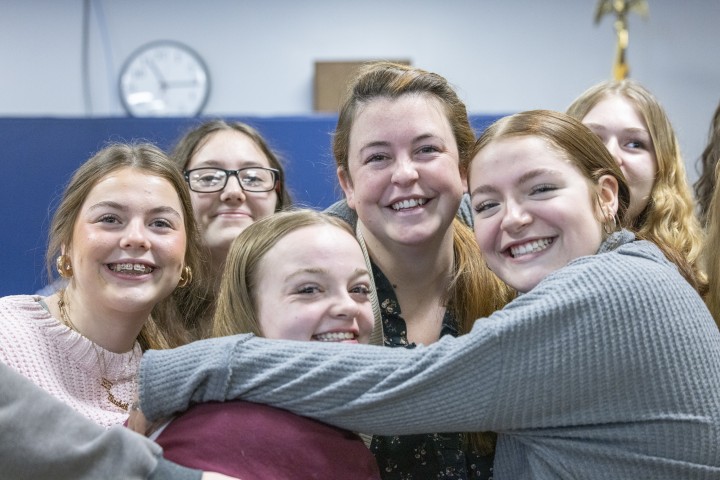
Often the first to arrive and the last to leave, a colleague said that Mrs. Todd has an enthusiasm for every day of life, for the kids, and for the staff, that she makes connections with every student, and that students come to school because they know Mrs. Todd is there. She can be found greeting everyone as they arrive at school, and if you need it you can stop by “hug alley” for a loving embrace from Mrs. Todd to get you through the school day. She’ll even make sure you won’t miss your bus in the afternoon.

She also supports her colleagues and is a leader at the school. Staff come to her when they need help solving problems. One colleague said she changed them as an educator. Another said she teaches all of us. Someone else said that if you want to be an educator or stay in the profession, go see Lacey. Mrs. Todd has an incredible passion for teaching, for teaching science, and for always learning and growing.

That passion extends beyond the school walls, as Mrs. Todd strives to strengthen the connection between the school and community, engage parents, and champion Mountain Valley everywhere she goes.

When asked for a word to describe Mrs. Todd, some of the responses from her school community included inspiring, special, invested, nurturing, helpful, amazing, home, innovative, and dedicated.

All it takes is a day at Mountain Valley, and you too will feel like you are part Mrs. Todd’s family.

A Day with Maine Teacher of the Year Finalist Edith Berger and the Miller School Community

Miller School in Waldoboro greets people with joy from the instant you walk in. Colorful murals cover almost every hallway. Created by classes stretching back decades, these murals tell a story about generations of students and create a connection with students and educators walking the halls today on their way to lunch, recess, or the next class. Everyone greets you with a warm smile and there’s a feeling that this is a great place to learn.

If you arrive early enough, the sound of music may draw you into Mrs. Edith Berger’s classroom. She often plays music in the morning to set a good tone for the day and share the sounds with students and staff. Her classroom is just as colorful and joyful as the rest of the school, and it’s the room everyone goes to when they have a question, need help, want to bounce an idea off someone, want a snack, or just need someone to talk to. Students and other educators know Mrs. Berger’s class is a safe, supportive, and welcoming place for all. She makes every feel seen, heard, and appreciated.

Mrs. Berger is a sixth-grade writing and social studies teacher at Miller School, the 2023 Lincoln County Teacher of the Year, and a 2024 Maine Teacher of the Year Finalist. Her colleagues, students, and community members describe her as a role model, a quiet leader, inspiring, compassionate, dedicated, creative, and professional.

In today’s writing class, where everyone is referred to as a writer, students are given various mentor texts to examine what expression and reflection look like in essays, stories, and poems. The students analyze the texts and find the spots that show why the author wrote the piece. They share their thoughts in groups and then as a class, discussing what certain passages of the writing say about the author’s purpose and making connections to their own lives. Mrs. Berger engages with the different groups and poses questions to get them to engage more deeply with the texts and make connections.

If you close your eyes, you’d think you were in a high school class.

With the school year still so fresh, the students have just started to look at personal narratives from the perspective of purpose. They’ve examined why people write and explored ways that writers get in the zone to write. These writers are blossoming.

Later in the day comes social studies, and Mrs. Berger teaches a civics lesson connected to Constitution Day. Students are provided the preamble of the Constitution, which they read together last week and identified the portions that illustrate the functions of government as viewed by the framers of the Constitution. In this class, students are given examples of American civil life, such as a federal agency providing food for children or having marshals on planes, and are asked to connect those examples to the different functions of government. The students share their reasoning in groups and then as a class. Through this, Mrs. Berger gives the Constitution life and connects it to modern examples the students can identify with.

Mrs. Berger’s colleagues say that she honors everyone’s voice, and that practice becomes a model for students. They say that she meets kids where they are while having high expectations—and that those high expectations come with a high level of support. They say she doesn’t give up on any kid—she finds a way to reach them no matter what. That’s clear with any visit to her classroom.

Her colleagues also describe her as not just a teacher of children, but also of adults, saying “I would not be the principal I am without Edie, I became a better teacher by working with Edie, she’s the room I go to if I have questions or need help, and everyone is part of her classroom.”

There are stories of Mrs. Berger responding late at night to help another teacher struggling with a lesson plan, making handmade journals for students to use to help them cope with anxiety, coming back from a conference or event full of new ideas for her class and the school, always being on the cusp of what’s new, and always finding ways to grow.

What’s also evident is just how much Mrs. Berger is a fixture of the community. Whether it’s speaking at the library about civics, bringing in guest speakers for her class, going to community events, or promoting her school, she is constantly building bridges between Miller School and the rest of the community.

Edith Berger doesn’t just teach civics; she is a true citizen. She’s also Miller School’s guiding light and helps everyone in her school community shine.

Meet Flint – A Furry Companion Offering Comfort and Purpose to Molly Ockett 2nd Graders

Flint is a trained, skilled 4-year-old Labrador retriever, Facility Dog from a local nonprofit organization called Assistance Canine Training Services (ACTS). Nationally certified through the Alliance of Therapy Dogs, Flint works at Molly Ockett School 5 days a week with 2nd-grade classroom teacher, Kelley Brown who is also his handler.

“A few years ago we had service dogs in training at Molly Ockett and we saw the magic and benefits of having a dog in the classroom,” said Brown. “Now we have our own full-time Facility Dog working at Molly Ockett School, building connections with students year after year.”

Flint spent 2 years training to be of service to people and has been on staff at Molly Ockett for the past 2 school years in Brown’s 2nd-grade classroom. Flint is trained to listen to readers, support writers, roll dice for math games, and offer fist bumps, Brown explains. He will rest a chin on a lap, pick up items, be a companion, and offer comfort and purpose in the classroom. He is able to provide a calm, supportive, comforting presence to all students and staff that he is able to work with and at this point, most of the students at Molly Ockett have seen and or met him.

Brown explains that Facility dogs are placed with professionals who work in fields that benefit from animal-assisted intervention (AAI). Within the field of education, animal-assisted education (AAE) is becoming more and more recognized by teachers, counselors, and others in the field of education as a successful way to work with and connect with students in their daily lessons and with social and emotional learning.

“Those of us fortunate enough to work with Facility dogs are better at our jobs because of these dogs, said Brown. “I have a greater capacity to help others because of him. He opens doors and changes people’s experiences for the better in a way that I as a human just can’t do.”

Brown adds, “It has been a privilege having Facility Dog Flint in the school community. I am grateful for and amazed by the connections he has built.”

Information for this story was provided by Molly Ockett School Grade 2 teacher Kelley Brown. To submit a good news story or an idea for the Maine DOE Newsroom, please email Rachel Paling at rachel.paling@maine.gov.

A Day With Maine Teacher of the Year Finalist Joshua Chard’s Class

“We take care of everybody”

“Everyone is valued”

“People are kind”

Those are some of the things that Mr. Joshua Chard’s third-grade students want people to know about their school.

The Chardlings, as they’re affectionately called, go to school at East End Community School in Portland. East End is a diverse and welcoming school that sits on a hill overlooking the city and the water. Beyond extraordinary teachers, the school has its own garden with an outdoor classroom, a closet where students can get free clothes and other supplies, and a deep connection to the neighborhood and families as a community school.

Mr. Chard is one of four finalists for 2024 Maine Teacher of the Year and the 2023 Cumberland County Teacher of the Year. He was nominated by his principal and assistant principal. Colleagues say he builds relationships with every student, meets every student where they’re at, and finds joy in the uniqueness of each human.

It’s easy to see why people say that about him. On a recent morning visiting Mr. Chard’s class, he and his Chardlings were happily seated on a colorful carpet, passing around a stuffed bear and telling their visitors what’s great about their school.

Next, it was math time. With the learning target written on the board, Mr. Chard asked the class who could tell him the math learning target for the day. He called on people one by one until the entire class said in unison, “Let’s choose a scale for our bar graph!” The students were given a scenario to measure the different shapes found on a piece of paper in bar graph form. Instead of working alone, they joined groups to discuss the problem and give their reasoning for what scale they should use to measure the shapes. Today was not about getting the right answer but working through the problem together and defending their reasoning.


Later in the day, and after a snack, it was time for science. Mr. Chard and the students returned to their carpet to learn about Wabanaki history and rivers, using the Columbia River to compare to Maine’s Presumpscot River. Mr. Chard asked what the students had learned the day before, with almost every hand going up with excitement. The students talked about what they knew about the Wabanaki, the immigrants who arrived, and 20 million years since the Columbia River was first formed. But if we know the Columbia is 20 million years old, then how old would that make the Presumpscot? After lots of class discussion, the class collectively inferred that the Presumpscot must have been around the same age.

Then it was time for another of Mr. Chard’s “juicy” words—flora. Using cards with images of flora, Mr. Chard asked the class if they could tell us what flora meant. But why just talk about flora when you can experience flora? So, everyone took a card with an image of flora, and outside they all went to roam the perimeter of the school in search of flora that is often found near the banks of the Presumpscot River.

“That’s my flora!”

“I found it!”

“I think this is it!”

The Chardlings were enthusiastically committed to their mission to find their flora.

That’s just a bit of a glimpse into the engaging, project-based, immersive, and rigorous learning on display in Mr. Chard’s class.

When asked why he teaches, Mr. Chard said, “I teach because I stand tall on the shoulders of the teachers who lifted me up and saw my potential even when I couldn’t see it myself. I strive to be the teacher who lifts his students up in the same way, so that those students look back and say, ‘I stand tall on Mr. Chard’s shoulders.’ I can think of no better legacy than that.”

One of Mr. Chard’s fellow teachers talked about his magical formula that combines joy and fun with high expectations and his ability to meet the unique needs of every student. That was on full display on our wonderful day with the Chardlings.

Spruce Mountain High School Envirothon Team Finishes 16th at the Envirothon World Championships

This story and photos were provided by Spruce Mountain High School Teacher Rob Taylor (2019 Franklin County Teacher of the Year).

Do you know what a frogsickle is? Can you find the perimeter of a circular 1/250th hectare plot of forest land? Can you interpret LIDAR images to identify landforms? Do you know that manmade salt marshes work more effectively than dykes to protect shorelines from rising sea levels? These are just a few things that Spruce Mountain High School students learned as they competed in the 2023 National Conservation Foundation Envirothon in Tantramar New Brunswick, Canada from July 23rd to the 29th. The team represented Maine well, taking 16th place out of 49 teams at the competition held at Mount Allison University.

Envirothon is the world’s largest environmental science competition and students compete on field tests on Forestry, Aquatic Ecology, Wildlife Biology, Soil Science, and a Current Issue, which for 2023 was adapting to a changing climate.

The Spruce Mountain High School Team won the Maine Envirothon on June 7th at the Viles Arboretum in Augusta, earning the right to represent Maine at the National Conservation Foundation International Envirothon, which included championship teams from most US States, Canadian Provinces, China, and for the first time, Singapore. The team includes graduated seniors Abrahm Geissinger, Owen Schwab, and Dan Wilson, as well as rising seniors Leah Burgess and Brenden Veilleux. The students spent a great deal of time this summer studying, learning from natural resource professionals, solving practice problem scenarios, and working on oral presentation skills.

Brenden Veilleux plans to major in Biology in college and said, “The hours we spent learning the 700 pages of resource materials for the competition really paid off and will help me in the future.”

For graduates Geissinger, Schwab, and Wilson, this was their third consecutive trip to the world championships and Schwab said, “This was a wonderful finale to my Envirothon career.”

Geissinger added, “Envirothon has helped me both as a public speaker and as a student.”

Wilson said, “I have been able to figure out what I want to do in life from Envirothon. This program has allowed me to make lifetime connections and meet some really interesting people.” Both Wilson and Schwab will attend the University of Maine in the fall and will major in Environmental Science.

According to Team co-advisor Ken Baker, “It has been a pleasure to work with the team preparing them to compete and it was rewarding to see them get to meet other students from around the world. The level of completion was intense and the students certainly rose to the challenge.”

The team finished 16th overall with a score of 537 out of a possible 700 points. The team was 21st in Aquatics with a score of 78%, 12th in Forestry with a score of 79%, 19th in Soils with a score of 69%, 17th in Wildlife with a score of 85%, 34th in Current Issue Test with a score of 75%, and 16th in Current Issue Oral presentation with a score of 151/200.

Baker said, “The team’s 16th place finish in the Oral Presentation is particularly noteworthy. The team was able to work with a number of experts in the field of climate change prior to the completion. This really helped them with their ability to solve the problems with adapting to climate change in New Brunswick.”

The students prepared prior to the competition by meeting with Senior Climate Resilience Coordinator Brian Ambrede and Community Resilience Partnership Program Manager Ashley Krulik, both of whom work for the Governor’s Office of Policy Innovation and the Future. They also met with Jordan Daigle, a Spruce Mountain High School Envirothon and Harvard Alumnus who serves as an Air and Greenhouse Gas Specialist at Chevron Corporation and they were provided resources by Environmental and Resiliency Planner Zach Gosselin of the Androscoggin Valley Council of Governments. Brenden Veilleux said, “Working with these professionals gave us a real-world perspective on how to deal with climate change.”

The team also learned about a number of technologies including LIDAR, which makes 3-dimensional images of land forms. They also met with Senior Geo Engineer Scott Dixon at Main-land Development in Livermore Falls, who taught team members how to use special 3D stereoscopic glasses to interpret aerial photographs, in addition to reviewing information on interpreting soils. Joel Gilbert of Berry Fruit Farm and the Jay Livermore Falls Chamber of Commerce met with the team to help them understand the business aspects of running a farm and farmstand, helping team members understand that sustainability requires analyzing social, environmental, and economic factors. Owen Schwab said, “It was awesome that local businesses and experts are willing to help us!”

Team member Leah Burgess said, “For me, this week of completion was a chance for our team to put our hard work to use. We managed to improve on last year’s 20th place finish, one of our major goals. The host committee from New Brunswick put on an amazing event not only for us to learn new things, but also for us to have so much fun!”

The team entered New Brunswick by ferry, visiting Campobello and Deer Islands, and saw porpoises and seals along the way. They visited places like Hopewell Rocks Provincial Park, Fundy National Park, the City of St. John New Brunswick, Irving Ecocenter: La Dune de Boutouche, and Irving Nature Park as part of the competition.

Spruce Mountain High School Envirothon Team

In the Current Issue Oral Presentation Competition, the team was provided information about the Isthmus of Tantramar in New Brunswick, which is especially vulnerable to the effects of climate change and they were sequestered together in a room for 6 hours with limited resources, where they developed a plan to make the area more resilient. The team’s solution featured using salt marshes as an effective strategy to help with coastal flooding instead of building expensive dykes. Salt marshes rise with increasing sea levels, while dykes require costly regular maintenance. The plan also identified stakeholders and described how to involve local residents by listening to their concerns and helping them identify and implement resilience strategies. You can view their presentation here:

Advisor Rob Taylor said, “I am really proud of this team. Our community has had 12 teams compete in the International Envirothon program over the years and this team had the second highest finish in school history. It is great to work and live in a community that supports our young people in programs like Envirothon. It is also a pleasure to work with all the Envirothon students at Spruce Mountain High School.”

The team from Massachusetts won the competition with an amazing score of 644/700 and swept the top scores in the five subject area tests. Pennsylvania took second and won the Current Issue Oral Presentation Competition with a score of 174.67/200. The remaining teams recognized with awards for overall top ten finishes were Ontario, Florida, New Mexico, North Carolina, California, New York, Tennessee, and Maryland (in order 3rd-10th). The Maine team’s 16th place score of 537/700 overall was only 21 points shy of earning a spot in the top ten.

By the way, if you are still wondering what a frogsickle is, it is not a cold treat on a summer’s day. It refers to the hibernating strategies of wood frogs that live in forests and breed in vernal pools that dry up in late summer. The frogs survive winter by lowering their body temperatures and freezing solid. One impact of climate change may be winters in the future where stretches of warm weather cause thaws followed by refreezing. This may be a problem for hibernators like wood frogs.

The team would like to thank the many local and Maine professionals, businesses, and community members who supported our trip to New Brunswick. It would not have been possible without their support.

Technical Support:

Scott Dixon – Senior Geo Engineer – Main-land Development, Livermore Falls ME

Brian Ambrette – Senior Climate Resilience Coordinator – Governor’s Office of Policy InnovaEon and the Future

Ashley Krulik – Community Resilience Partnership Program Manager – Governor’s Office of Policy InnovaEon and the Future

Jordan Daigle – Greenhouse Gas Specialist at Chevron CorporaEon

Joel Gilbert – CEO Berry Fruit Farm LLC, Chairman Jay Livermore Falls Chamber of Commerce

Dale Finseth – Kennebec County Soil and Water District

Frank Lopez, Merle Ring, and Ken Lausten – Our Fearless Forestry experts!

Justin Trinqet and Nikki Leroux – JustNiks Mycosilva, LLC

Steve Gettle – Woodland Investment Services

Robin Beck – Rockin Sheep Farm

Sponsors:

Maine Association of Conservation Districts – Maine Envirothon

Androscoggin Bank Linda Burgess
Ameriprise Financial – Michelle Maki Main-land Development
AMVETS North Star Lodge
Belinda Poland OEs Federal Credit Union
Counter Point Farm Pallet One of Maine
Debi Gagnon Ray and Audrey Henderson
Debra Hardy Timberlake Rockin Sheep Farm
Dr. William Beaker Sandy and Wynn Muller
Ellen Shaw Sappi Paper
Eloise Poland Spruce Mountain Pharmacy
Fitch Company Engineers T & L Automotive
Friends of Wilson Lake Wilton Masonic Lodge
Jay Livermore Falls Lions Club Dianne Maurais (great whoopie pies for the swap!)


Maine DOE’s Second Annual Computer Science Showcase Features Innovative Student and Educator Projects

Students and educators from 40 school administrative units (SAUs) across Maine recently participated in the Maine Department of Education’s (DOE) Second Annual Computer Science Education Showcase at the Collins Center at the University of Maine. The Showcase highlighted innovative computer science education programs and projects in schools across Maine, with hands on, interactive exhibits.

Exhibits featured a variety of computer science education projects, including robotics, artificial intelligence (AI), 3D design, coding, augmented reality/virtual reality (AR/VR), data science, cybersecurity, and more. Robotics students participated in a live demonstration on stage where they had to work together to move objects and overcome structural barriers, requiring teamwork and problem solving.

The Showcase also included a panel discussion with educators, a student, industry representatives, and experts highlighting the importance of computer science education, opportunities for students and educators, and where the field is headed.

“If you can just simply show them and introduce students to these [computer science] concepts, then it opens up a whole world to them. You can be a kid from Maine and do really amazing things in the computer science field,” said Allison Braley, a teacher from RSU 25.

“These are foundational skills we are talking about, and they are across every sector. These are critical 21st century skills that everyone needs regardless of what pathway you choose in life. Kids can stay in Maine, they don’t have to go to Boston or California for these jobs. Employers are here. It doesn’t matter what background you’re from or what zipcode you’re from, this is for every student,” said Angela Oechslie from Project Login.

“If computing is an elective and only for some, you mostly get those students who set out to do that because they see themselves as who society says should do it. The beauty of looking at computer science from pre-k through 12 is that it can be universal, and you can make those opportunities for anybody to stumble across them—it’s young women, it’s those who are the first generation in their family to go to college, it’s kids in rural areas, it’s kids from underrepresented groups. We can diversify the field and we can make the field richer by giving everyone a chance to say that’s the thing I love,” said Penny Rheingans from UMaine.

“Most of the really difficult problems we need to solve over the next 30 years are going to be solved using computer science,” said Judson McIntosh, an Engineering Manager at Tyler Technologies.

Maine continues to lead on computer science education and is the only state to provide interdisciplinary computer science education to all pre-K through grade 12 students in the state. Earlier this year, more than a thousand students from across the state participated in the Maine DOE’s Maine Learning Technology Initiative (MLTI) Student Conference. Students had access to more than 40 sessions that engaged them in essential computer science skills and knowledge, including animation, AI/machine learning, AR/VR, audio editing, CAD/3D Design, robotics, coding, and video game design. More than a dozen of the sessions were led or co-led by students.

Nearly 100 educators from across the state attended a multi-day institute in July, focused around computer science education. Educators spent two and a half days engaging in sessions and collaborating to integrate computer science into their classrooms and upcoming school year activities. Topics included Robotics & Programming, Coding & Hardware, Augmented & Virtual Reality, and much more. The more than 600 participants at this year’s Maine Educator Summit also had access to multiple workshops and sessions related to computer science and technology skills and integration.

Last year, the Mills administration launched a new Maine DOE initiative to provide every Maine school with a free mobile computer science lab. Schools were able to order one of three mobile lab options: Robotics and Programming, Augmented and Virtual Reality, and Coding and Hardware. Each lab contains computer science equipment valued at $5,000 and is designed to be integrated into any content area and skill level. Additionally, the initiative made available professional learning opportunities for educators tailored to each computer science topic area.

Join the #LoveMaineSchools Movement!

The 2023 County Teachers of the Year cohort (CTOYs) want to share your amazing stories! During the 2023-2024 academic school year, the 2023 CTOYs will collect and share positive stories from Maine educators to elevate the teaching profession and connect with a variety of audiences. The group of teachers plan to showcase and distribute stories, images, and videos that capture the exceptional efforts of our magnificent Maine educators as they engage students in dynamic learning opportunities.

The group is trying to reach people across Maine,  any and everyone invested in Maine schools including teachers, parents, business partners, policymakers, and community members.

#LoveMaineSchools is the platform for educators to share their passion and spark conversations celebrating positive stories. A new monthly theme, intentionally broad and open to interpretation, will invite participation from all grade levels and content areas.  For instance, when the theme is “Making Connections,” submissions can effortlessly explore various aspects of creating links with individuals, families, communities, subject matter, content, and curriculum, among other possibilities. This flexible approach promotes active participation and allows diverse and imaginative interpretations of monthly themes. They want to hear from you and your school community!

As the hashtag #LoveMaineSchools gains momentum and reaches more people, they expect more teachers to share voices and stories.

Submit your stories at bit.ly/lovemaineschoolssubmit

You can see the positive messaging and stories the group has already begun sharing by following their Facebook and Instagram pages.

As part of their year of service in the Teacher of the Year Program, Maine’s State and County Teachers of the Year serve as advocates for teachers, students, and public education in Maine. They also receive ongoing professional learning and participate in many state and county leadership opportunities. For more information about the Maine Teacher of the Year program, visit the Maine Teacher of the Year website


Brunswick ELO Program Expanding Career Exploration Opportunities for Students

As an Extended Learning Opportunities (ELO) Ed Tech, Molly Myers supports “the expansion of career exploration experiences and career planning” at Brunswick High School. From career fairs to internships, Myers helps students prepare for their post-high school pursuits.

The program has been incredibly successful among Brunswick students with about 20 students participating directly in ELOs and another 200 taking part in other career-related activities. These related activities included virtual job shadows, career fairs, guest speakers and panels, and more. Myers created course-specific career exploration for teachers to use in their classrooms to help students broaden their horizon of what might be possible through what they are learning in the present.

Students directly involved in the ELO program have completed paid work experiences, such as internships, in several lines of work including healthcare, culinary, veterinary medicine, and education. Through these experiences, students gained confidence in trying new things, asking for help, solving problems, and, in the end, articulating their learning to the larger community.

Myers says the best part of her job is “meeting with students and hearing the stories of their interests, passions, and amazing accomplishments both within and beyond school!”

Myers would like to thank Cory King for being a huge help and supporter of Brunswick’s ELO program.

Extended Learning Opportunities (ELOs) are hands-on, credit-bearing courses outside of the traditional classroom with an emphasis on community-based career exploration. These opportunities are personalized for students and help them explore options for their professional lives. They help students engage in learning through instruction, assignments, and experiential learning. The Maine Department of Education (DOE), along with state-wide partner Jobs for Maine Graduates (JMG), have made a concerted effort to provide working models, support, and funding opportunities for Maine schools to set up ELO programs within their school communities. To learn more about Maine’s initiatives with extended learning opportunities, visit: https://www.maine.gov/doe/index.php/learning/elo or reach out to Maine DOE ELO Coordinator Rick Wilson at rick.wilson@maine.gov.

Celebrating Summer Food Service Programs Providing Free, Healthy Meals for Students Across Maine

(Pictured: part of the lunch spread provided at an MSAD 33 Summer Food Service Program (SFSP) meal site this summer.)

Portland’s Munjoy South playground filled with people as meals were distributed to students through the USDA Summer Food Service Program (SFSP) recently. The Munjoy South playground site, which is one of 12 summer meal sites throughout the city and over 400 across the state, is operated through Portland Public Schools. The site serves 20 to 30 students a day on average and on this particular day, was serving sandwiches, chicken drumsticks, cornbread, fruits, vegetables, milk, and more.

The SFSP is a federally funded and state-administered program that provides free, healthy meals and snacks to children, youth, and adolescents in low-income communities. Local sponsors, like Portland Public Schools, operate the meal program throughout Maine.

At the Munjoy South summer meal site were volunteers from the Maine Celtics and the Locker Project. The Maine Celtics volunteers help run summer day camps Mon-Fri for students and also enjoy playing quick games of soccer and basketball with anyone who wants to join in. Also present was The Locker Project, which helps fight food insecurity in Cumberland County by providing students and families with surplus local produce and other foods, in addition, the Book Fairy Pantry Project was there with a free book stand with ample children’s books for the taking.

On this day, also visiting the meal site were representatives from Maine Equal Justice, Good Shepherd Food Bank, the Islamic Food and Nutrition Council, AmeriCorps VISTA, Preble Street, Full Plates Full Potential, and the offices of Governor Mills, Senator Collins, Senator King, and Representative Pingree. These organizations were brought together by Anna Korsen, Full Plates Full Potential, Policy and Program Coordinator to showcase all that Portland Public Schools (PPS) has done to provide food for local youth and to witness the success and joy of so many community partners coming together to benefit the community.

Maine has good reason to celebrate all that has been accomplished this summer and recently in the way of providing nutritious food to youth both during the summer and the school year.

Maine is one of the first states to provide meals at no charge to public school students during the school year. Starting with the pandemic-related waiver that allotted funds for schools across the United States to provide free meals for students in the 2021/2022 school year, this past year a new Maine-specific law went into effect that provides funds to Maine schools through its annual budget, specifically to provide school meals to all students, regardless of their family’s income. Maine is one of less than 10 states to continue with free meals for all students beyond the pandemic.

Maine is incredibly proud of its many partnerships between both federal and state-level partners, Maine school nutrition programs, and countless community partners across our state who have worked tirelessly to feed Maine’s youth through school-administered programming all year long.

We want to celebrate school nutrition champions like Dawn Hilton the Director of Food Services for PPS and Jim Hanna, Executive Director, Cumberland County Food Security Council for their ongoing work to organize local partners within their community at sites like the Munjoy South playground. In addition to Hilton, there are 106 other districts across Maine with countless school nutrition champions that partner with organizations within their communities to offer summer meal sites at 400 sites throughout Maine.

Special thanks to Kittery School Department, MSAD 33/27, RSU 54, and Belfast Soup Kitchen for providing pictures from some of their summer meal sites this summer:

For Portland’s efforts, Hilton would like to thank her Summer Meal Team for their continued help in fighting food insecurity along with the Maine Celtics, Cumberland County Food Security Council, Full Plates Full Potential, and the Locker Project for their endless support in their work during the summer. It is because of community partnerships like these, that exist in every corner of Maine, Maine DOE can leverage federal programs like Maine’s Summer Food Service Program to direct funding to communities across our state to help fight food insecurity throughout the summer.

To learn more about the Summer Food Service Program (SFSP) in Maine and how to get involved, visit the Maine Department of Education’s website.

South Portland ELO Coordinator Making Career Exploration Opportunities More Accessible for Students  

As South Portland High School’s Extended Learning Coordinator, Sheree Inman hopes to open career exploration opportunities to as many students as possible. When South Portland received the Extended Learning Opportunities (ELO) grant, Inman was tasked with uniting the school’s existing internship and co-op programs and expanding these offerings to more students. Inman has been immensely successful in implementing the school’s ELO Program with many students participating in internships, job shadows, and other career-related opportunities.  


Through the program, South Portland students have been able to pursue ELOs in a wide variety of career fields including banking, real estate, media, firefighting, veterinary care, and more. One of Inman’s students was interested in finance and accounting and went on to intern for Saco Biddeford Savings Bank for her ELO. Through this internship, she gained hands-on experience in bank telling, accounting, and marketing and was able to spend time in their corporate office. This is just one of the program’s many success stories in which students have been able to gain professional experience and a head start on their career path.  


Another career exploration opportunity available to students through the program is the annual career fair. “This is where students can talk to employers about occupations and opportunities beyond high school,” said Inman. Several local businesses at the career fair also offer job shadows and internships for students.  


“The best part of my job is when I can make a connection with a student into a field that they really want to learn more about,” said Inman. Seeing students get excited about these opportunities gives her a great sense of pride in her work.  

“Without this type of programming in schools, students don’t always get to see what actually happens in various career fields,” said Inman. In the future, she hopes to continue to provide individual ELO opportunities while expanding offerings for group ELO experiences. She is also working with special education teachers to help bring ELO opportunities to their students.  


Inman and the South Portland ELO Program are very thankful to their community business partners and to South Portland’s Economic Development Director William Mann.  

Extended Learning Opportunities (ELOs) are hands-on, credit-bearing courses outside of the traditional classroom with an emphasis on community-based career exploration. These opportunities are personalized for students and help them explore options for their professional lives. They help students engage in learning through instruction, assignments, and experiential learning. The Maine Department of Education (DOE), along with state-wide partner Jobs for Maine Graduates (JMG), have made a concerted effort to provide working models, support, and funding opportunities for Maine schools to set up ELO programs within their school communities. To learn more about Maine’s initiatives with extended learning opportunities, visit: https://www.maine.gov/doe/index.php/learning/elo or reach out to Maine DOE ELO Coordinator Rick Wilson at rick.wilson@maine.gov.