Collaborating Across Districts to Integrate Computer Science into K-8

Submitted by Josh Young, Educational Technology Coordinator, Mount Desert Island Regional School System – AOS 91

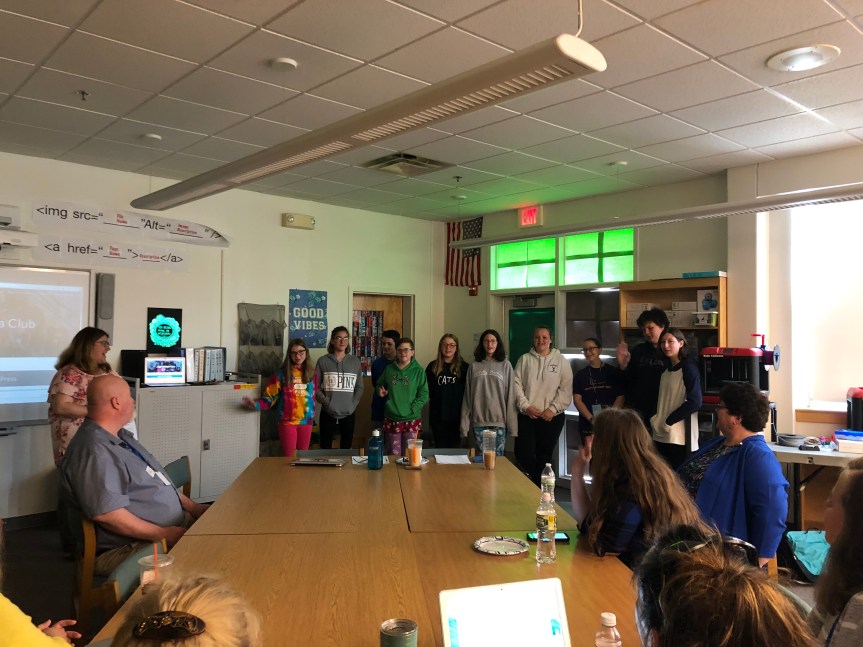
This past week the Mount Desert Island School district (AOS 91) hosted teams from Dexter (AOS 94) and Bethel (SAD44) to continue conversations about what the integration of computer science could look like in rural Maine districts.  This initiative, Integrate-2-Innovate (i2i), is facilitated by the Maine Math and Science Alliance (MMSA) and the Education Development Center (EDC) and funded by the National Science Foundation’s Computer Science for All program.

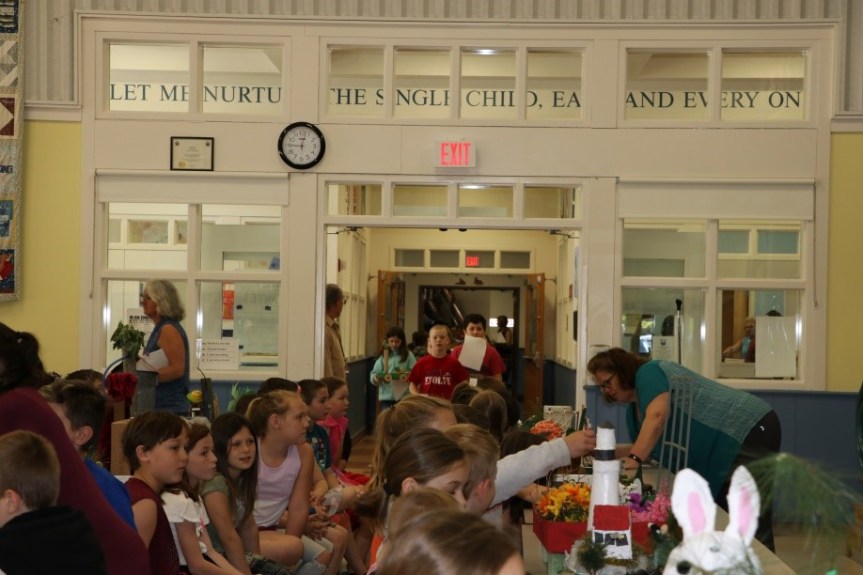
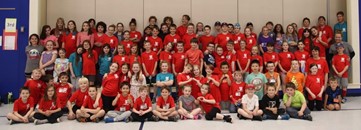
The 30 educators included Kindergarten, 4th grade teachers, middle school science and math teachers, principals, and curriculum coordinators.  They started the day exploring the practices of computer science, math, and science and commonalities between them.  To try and understand how these practices already exist in classrooms, we spent the afternoon observing seven classrooms throughout the MDI district.  MDI - Computer ScienceIn visiting our colleague’s classrooms, we wanted to understand the dynamics and context of this district/classroom; understand how math and science are generally taught in this district/classroom; envision how computer science might integrate into an activity like the one we are observing; and, of course, build the capacity, trust, and relationships between our districts as we learn together.

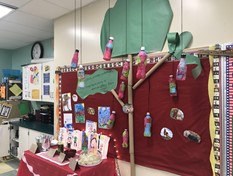
We observed 7th and 8th graders working on engineering a design challenge for building a bridge, a number taught in a 4th grade classroom where kids were trying to solve a problem using modelling, algorithmic and procedural thinking, and much more.

As we all gathered back together after the classroom observations, we heard from local businesses about how computer science is used in their organizations, which gave us some real-world, relatable examples of computer science to share with our students and communities.  Educate Maine and MMSA worked with the MDI school district to arrange for presentations from the MDI - Computer Science2Jackson Lab and Acadia National Park about how Computer Science fits into their work, the kinds of CS jobs available locally at all levels from right out of high school to PhDs, and what these professionals think students  need to be successful in Maine’s workforce.  These employers were very clear that learning how to work as a team to problem solve and deconstruct problems is extremely important. When current coding experts were asked what to teach kids they said, Don’t teach them to code in specific languages too early, instead support them in how to think about data – how data are structured, classified, categorized – introduce basic statistical concepts early. The coding languages we have now could be totally different than what we will have 10 years from now.

As we begin to unpack what computer science can really look like at the K-8 level and how it can fit into our existing learning standards, we are building on our shared experience and the expertise we all have as teacher leaders in rural districts.  We are excited about the recent advances the Maine Department of Education and the legislature have recently taken to advance computer science and we hope that this is just the beginning of a concerted statewide reform to provide equitable access to computer science learning opportunities to all students K-12.


Maine FFA Convention Attracts 200 Members and Guests

Pictured: Awards Banquet Head Table:  National FFA VP Ridge Hughbanks, Convention Sentinel Ava Cameron, Reporter Olivia Tardie, Treasurer Alli Kenney, Secretary Camryn Curtis, State Vice President James Hotham, State President Graham Berry.

This year’s Maine FFA (formerly known as “Future Farmers of America”) annual Convention included 200 middle and high school FFA members, assisting judges, helpers and guests from the education and private sectors.  Participating schools included:  Region 4 United Technologies Center (Bangor), Ashland Middle/High Schools, Caribou Technology Center, Central Aroostook Junior & Senior High Schools, Easton Junior/Senior High Schools, Hodgdon Middle/High School, and Presque Isle Regional Career & Technical Center.   Maine FFA chapters include nearly 500 students across the state from Sanford to Caribou, enrolled in courses related to agriculture and natural resources in such areas as agriculture, forestry, horticulture, agricultural mechanics, nursery and landscapes, integrated sciences and others.  The two-day event featured recognition for past year accomplishments, competitions, scholarships and educational tours, with over $10,000 in awards and scholarships presented.

During the Convention Awards Banquet, guest speakers included Dan Chuhta, Deputy Commissioner for the Maine Department of Education, Chandler Vaughan, National FFA Alumni Council Representative, and Ridge Hughbanks, National FFA Organization Central Region Vice President.  Speakers addressed areas related to providing FFA opportunities to as many students as possible, taking advantage of one’s education, and participating in community related endeavors, an important activity of the FFA.  Students were excited to receive awards for their work of the past year, distinguishing themselves in independent projects (“Supervised Agricultural Experiences”), as well as advancing in areas related to technical and community development achievements through “State FFA Degrees” and the “State FFA Stars” program.

Students were excited to participate in events such as Agricultural Sales, Horse Evaluation and Veterinary Science, which allowed them to showcase and further develop their leadership abilities, as well as learning more about a topic of interest.  Educational tours to areas such as UMaine’s Pulp and Paper Process Development Center further enhanced the opportunities available to students.  Leadership and sportsmanship abilities, important to FFA, were evident in bestowing awards such as the Best FFA Chapter Spirit award, this year won by Region 4 United Technologies Center students, Bangor.

The FFA is one of the largest student leadership organizations in the United States, with over 600,000 members, and the Maine FFA Convention was directed by its State FFA Officer team under the leadership of President Graham Berry and Vice President James Hotham, with support from Doug Robertson, State Advisor in the Maine Department of Education and Faith McLaughlin, Maine DOE staff support specialist, as well as volunteering students and numerous other partners working on a volunteer basis.  Events were hosted at the University of Maine, Orono’s campus, as well as at Eastern Maine Community College.

For more information on technical and science programs eligible for FFA chapter membership for grades 7-12, please contact Maine FFA State Advisor, Doug Robertson in the Maine Department of Education:  doug.robertson@maine.gov  (207) 624-6744  and refer to the Maine FFA Association website:  https://www.maine.gov/doe/learning/ffa

Maine Students Bring a Slice of the Future to our State House

Pictured: Team Northern Force from Gorham/Falmouth, with their robot Geffrey

Eight middle and high school teams from across the state assembled at the Capitol building on Wednesday morning to receive praise from their community leaders. The students were congratulated for their exceptional performances at FIRST competitions across the state and nation. FIRST (For Inspiration and Recognition of Science and Technology) is a non-profit organization that allows students to compete in science, technology, and engineering-based challenges. The high school teams at the Capitol competed in the FIRST Robotics Competitions in Maine. A few teams even represented the state at the World Championship in Detroit, Michigan earlier this spring, where there were over 3,000 teams present from countries all across the world. The World Championship can be viewed here: https://www.youtube.com/watch?v=sLmn5CbNr3Y

IMG_0881
Pictured: Team Radical Impact from Cheverus with their robot

These precocious high schoolers were asked to design robots that could compete in a game requiring multiple complicated maneuvers. Robots must be piloted blind for several minutes at the beginning of each competition. Each team chose a different way to overcome this challenge, many opting for robot-mounted cameras. Next, each team had to pickup and carefully drop large dodgeballs in holes cut into a model rocket and space station, for points. In the course of the competition robots had to move up and down over physical obstacles, and place Velcro covers over the holes.

IMG_0887
Team Blue Crew of Farmington, with robot R2D2
IMG_0892
Team Iron Tigers from Gardiner with robot Christa

Students were excited to share their experiences at the FIRST meets. Tasked with building and programming the robots, the students learned valuable skills like digital modeling, 3D printing, coding, wiring, and engineering. Because they were asked to design the robots themselves, students also worked on interpersonal, leadership, and problem solving skills. One student, a freshman at Cheverus, is already reaping the rewards of coding know-how. Members of his school’s coding club saw him working on Java Script in the library, they were so impressed he was invited to join.

IMG_0886
Student from the Maine School of Science and Mathematics with robot Dozer
IMG_0873
Team B.E.R.T. 133 of Bonny Eagle, Standish, with their robot WALL-E

However, many of the teams were comprised of more than their building team, one student explained that although there were ten students involved in the construction of the robot, their total headcount was around twenty-five students, with the rest heavily involved in fundraising, advertising, and outreach. Students involved in this process not only picked up important communication skills and experience, but learned how to market their club and raise money for competitions. Students also have the opportunity to meet and interact with peers who have similar interests from across the country, with one young engineer commenting that they had made and kept friends from Tennessee and Australia.

IMG_0877
Student from The Outliers from Portland
IMG_0885
Team from Cape Elizabeth with robot Wacky Boi

FIRST strives to promote STEAM engagement among young students as well, inspiring growth of the field for the future. They include Robotics Competitions such as the ones in which these students competed, as well as a separate LEGO League for ages 9 to 14, from which some students were also in attendance. The organization prioritizes the involvement of underrepresented, underserved, and vulnerable youths. Of all students involved in FIRST, 43% are female; 72% are from economically disadvantaged families; over half of all students are from ethnic minorities. 87% of participants in the program go on to take more advanced math and science courses; students who competed were also more than twice as likely as others to show increased interest in pursuing STEAM fields.

IMG_0883
Pictured: Team SmartFun Engineers from Farmington and their LEGO robot, Stanley
IMG_0890
Pictured: Steve Martin, Senior Member and organizer of the event, showing a map of FIRST involvement in the State of Maine

Students shared overwhelmingly positive remarks about their experiences, and showed great passion for their robots and the competitions. Many were only Freshmen, and all expressed that they intend to continue participating in competitions and to pursue STEAM fields in their future. FIRST competitions provide a great opportunity to middle and high school students who are looking to get hands-on experience with a wide array of skills before they even graduate. Interested readers can visit www.firstinspires.org to get involved and learn how to help aspiring scientists and engineers pursue their passions, by investing in our future.

This story was written by Maine DOE Interns Emmeline Willey and Simon Handleman in collaboration. If you have a story idea or would like to submit a written story for the Maine DOE Newsroom, email Rachel Paling at rachel.paling@maine.gov.
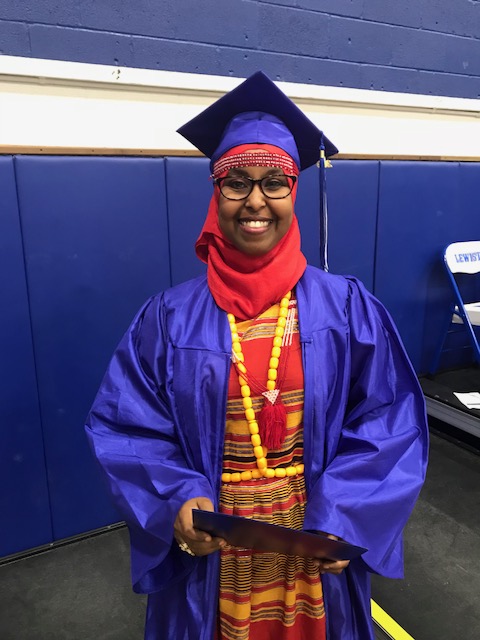
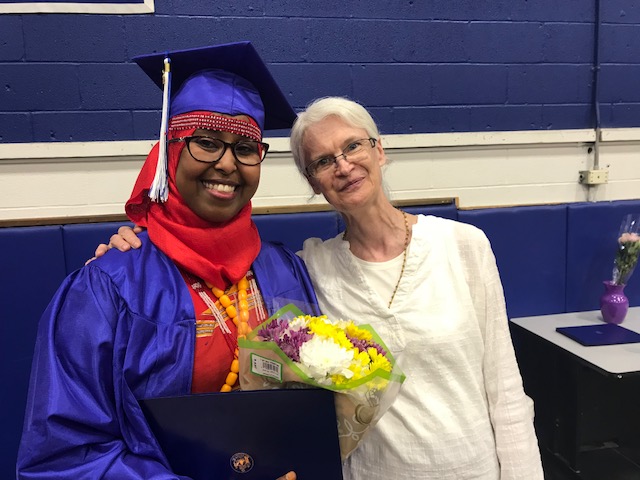
Augusta Teacher’s Commitment to Inclusion Recognized Internationally

Students in the EL (English Learner) program at Augusta’s Cony Middle and High School have a lot to look forward to: Their teacher Karina Escajeda’s visionary grant applications secured her funding with which to attend two international schools where she will gain valuable insights for her classroom and community. Karina will attend Egypt’s Dahab School of Arabic Language and will be in residence at Aristotle University in Thessaloniki, Greece. All through the month of April, praise flowed into Karina’s inbox. These prestigious grant programs pledged thousands to make possible her language and cultural studies abroad.

Following her time in Egypt, Karina plans on bringing her knowledge of the Arabic language back to Cony (her alma mater) where she will foster stronger relationships with EL students, many of whom come from refugee backgrounds. When she is not studying in Dahab, Karina plans to visit additional cultural and historical sites across the country such as Cairo, Luxor, and Aswan. Karina is rightly committed to the belief that students from Iraq and Syria add valuable elements to school culture.

For this initiative and foresight the Fund for Teachers emailed Karina on April, 4 to commend her for “bold vision” which “stands out.” This $5,000 grant was not the only source of praise and money for Karina: NEA’s Learning & Leadership Grant pledged $2,000 to Karina on April, 22. They thanked her for “hard work and commitment to the importance of high quality public education.”

In addition to her upcoming time in Egypt, Karina will study refugee integration efforts in Greece through the Fulbright Distinguished Award in Teaching. She will be part sponsored by, and lecture in, Aristotle University’s Applied Linguistics Program from January to June of next year (2020). This University’s teacher training program provides Greek teachers with the necessary skills to create inclusive communities for growing populations of refugee students. Karina has identified many similarities between the ways in which Maine and Greece welcome their refugee populations: “In both places, new residents are struggling to adapt to new homes that are almost entirely monolingual.”

The prestigious Fulbright Commission sent out a press release on April, 23 in which the U.S. Department of State (a major grant contributor) awarded Karina five months of independent study in Greece. The goal of the Fulbright Distinguished Awards in Teaching Semester Research Program is to build international relationships that work to solve global challenges. Karina will join an alumnus among whom there are over 50 Nobel Laureates, over 80 Pulitzer Prize winners, and over 30 former heads of government or state.

Suffice it to say the Augusta public school system is more than proud. We can all appreciate Karina’s “commitment to push the boundaries of [her] own learning,” as put by the Fund for Teachers. She will bring these new and enlightening experiences from Egypt and Greece back to her own community, and the students for whom she worked so hard to secure these grants. Congratulations Karina, and Cony Middle and High School.

This story was written by Maine DOE Intern Simon Handleman in collaboration with Karina Escajeda. If you have a story idea or would like to submit a written story for the Maine DOE Newsroom, email Rachel Paling at rachel.paling@maine.gov.

Maine Schools Selected for Peer to Peer Jazz Education Program

The Herbie Hancock Institute of Jazz brought its Peer-to-Peer jazz education program Maine this week as part of a weeklong tour to New England public schools. The “informances” are a combination of performance with educational information will be presented by five of the country’s most gifted high school music students along with internationally acclaimed trumpet recording artist Sean Jones, Kansas City jazz and blues vocalist and a former winner of the Institute’s International Jazz Vocals Competition Lisa Henry, and renowned jazz educator Dr. JB Dyas.

Each school visit included an assembly program featuring a musical performance for all students, followed by workshops for each school’s jazz band and choir with the visiting student performers playing alongside and sharing ideas with their New England counterparts. The program took place at Portland High School on May 23rd, Deering High School on May 24th.

Immediately following the informances jazz workshops were held for each host school’s jazz band and choir in which the visiting students played side-by-side with Maine students, providing tutelage peer to peer.

The week-long tour will conclude with two performances open to the public on May 25 at Portland’s premier jazz club, Blue (650A Congress St.), where Portland residents and visitors are invited to enjoy an evening of music with Jones and Henry alongside jazz’s future “young lions.” The septet will perform standards, jazz classics, and contemporary jazz, including compositions from Jones’ and Henry’s latest recordings. The shows begin at 6:00 pm and 8:00 pm. For further information call 207-774-4111 or visit https://portcityblue.com.

Saco Middle School Hosts “Sebago Speaks” Event to Showcase Student Work

Saco Middle School co-teachers Andrew Fersch and Kaitlyn Leeman hosted an innovative student event recently called, Sebago Speaks. The event featured a series of talks given by students and community members on various issues, each about having a positive impact on the world and their community.

The Sebago Speaks student presenters were selected by their peers and teachers among the entire 7th grade class who all completed a class assignment which challenged them to conduct interviews, research, reading, and writing to create an inspiring presentation on a topic of their choice.

The event featured topics such as, plastic use, income inequality, drug abuse, technology addiction, football, melting ice caps, obesity, animal shelters, recess, music, survival, and kindness, among others.

Check out some of the videos from the event:

Melting Ice Caps – Rory

Girls Playing Football – Madalyn

Music – Lily

Animal Shelters – Laura

Money – Troy


Maine Educators Honored for Excellence in Mathematics and Science

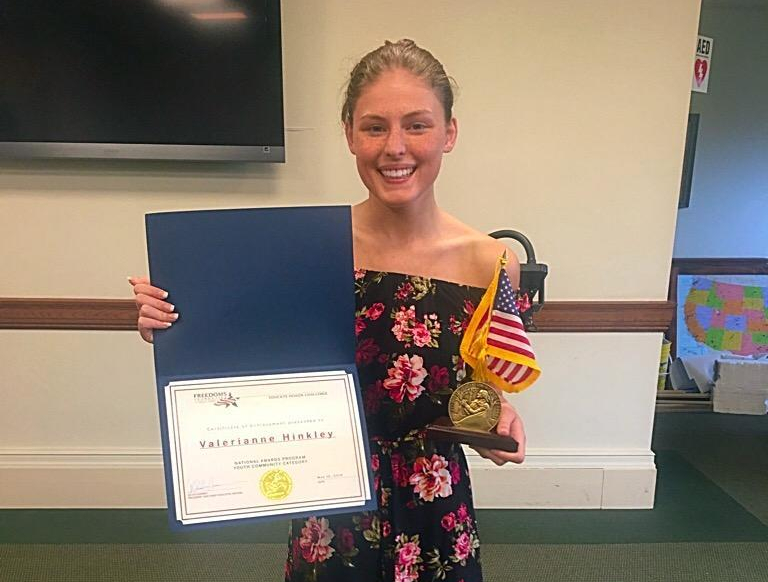
The Maine Department of Education honored two educators at an annual dinner event held at the Maple Hill Farm Inn, located in Hallowell, earlier this month. Kirsten Gould, the District Assessment for Learning Coach at Buxton Center Elementary School (MSAD 6), and Heather Dorr, a 5th Grade Teacher at Ella Lewis School in Steuben (RSU 24) were both named state finalists for the 2018 Presidential Award for Excellence in Mathematics and Science Teaching (PAEMST).

The Presidential Awards for Excellence in Mathematics and Science Teaching are the nation’s highest honors for teachers of mathematics and science. Awardees serve as models for their colleagues, inspiration to their communities, and leaders in the improvement of mathematics and science education.

The evening event included social networking with past awardees, dinner, and official congratulations from Wilson Hess, Chair of the Maine State Board of Education and Beth Lambert, Maine DOE Coordinator of Secondary Education and Integrated Instruction.  The keynote address was delivered by Leigh Peake, Chief Education Officer at the Gulf of Maine Research Institute, whose message to the audience was to “embrace messy,” when it comes to quantifying often-times messy data and taking on the inevitable challenges of an ever changing and anarchic fields of math, science, and beyond.

Kirsten Gould
District Assessment for Learning Coach
Buxton Center Elementary School in MSAD 6

Kirsten has a passion for effective STEM education at the elementary level. Her support of professional development for her colleagues has made her a committed and powerful teacher-leader in her community and beyond. In addition to her leadership with the Maine Elementary Sciences Partnership, Kirsten collaborates as part of her district’s vertical science team, provides school and district-level professional development around teaching and assessing at the elementary level, and this year, does Assessment for Learning work for her district colleagues.

Heather Dorr
5th Grade Teacher
Ella Lewis School in Steuben (RSU 24)

A tireless advocate for students, Heather is skilled at meeting all her students where they are and advancing their learning. She is fluent with the curriculum standards and has an impressive management system imbedded with standards-based learning. A highly sought out mentor teacher to countless beginning teachers and student teachers, she is always eager and willing to share her knowledge and expertise with others. More recently, Heather has served as a leader in her work to develop a Collaborative Response Model (CRM) alongside her colleagues at RSU 24. Heather Door was unable to make it to the event but is expected to be honored at a special ceremony next month.

The state finalists were presented with certificates from the PAEMST program and will be in the running for a trip to Washington, DC, which will include professional development experiences and networking with other math and science educators from around the nation.

For more information about the PAEMST Program, contact the PAEMST State Coordinator for mathematics, Michele Mailhot, at michele.mailhot@maine.gov, or for science, Shari Templeton, at shari.templeton@maine.gov.


Washington County Educator Profile: Charity Williams

Submitted by Sarah Woog from the The Washington County Consortium. 

Meet Charity Williams, Principal at Princeton Elementary School

As I explored ways to best support Washington County educators this year, Charity’s name kept on coming up. “Charity has done some great work implementing practices that celebrate teaching at Princeton Elementary School,” one colleague told me. As I reflect on teaching and how to best support it, I’ve come to believe celebrations are key. I wanted to learn more.

Charity welcomed me to her school a couple weeks ago. I showed up an hour early (long story) and offered to wait until our scheduled time and catch up on some other work. Charity told me to come on over instead. So I showed up at 8:00 AM on a Wednesday morning, somewhat unannounced.

Have you ever walked into a school and felt immediately at peace? Did it ever happen at 8:00 AM? I think we can all admit this can be a bit of an anomaly. (If it’s not for you, please reach out so I may profile you and your school next!) Well, it happens at Princeton Elementary School. And I wanted to know why.

There are many fantastic things that go on at Princeton Elementary. Here are three that stuck out to me: 1) student voice is encouraged and heard; 2) teaching is celebrated; and 3) the surrounding community serves as a partner and resource.

Charity and her staff use restorative practices to support students in making good decisions and learn and move forward when they do not. When a student comes to Charity because of an infraction, she asks three questions: “What happened? Who was affected? How can we fix it?” They even plan an logical consequence together. Teachers are encouraged to engage with students in this manner as well. Charity shared that when she first started as principal, an offending student would say “I’m just a bad kid.” Now they say “I made a bad choice and I can fix it.” I think that’s a lesson in acceptance and reconciliation we could all learn from, even (or especially?) as adults.

It seems folks at Princeton Elementary are constantly learning, and they especially value learning from each other. Twice a month, one educator hosts “open classroom” after the students have left for the day. The entire staff goes to the open classroom and is welcomed with snacks. The host teacher shares what’s worth celebrating in their classroom. Open classroom allows educators to join in celebration while fostering a vibrant learning community.

Community doesn’t stop at the school doors. Charity partners with organizations in her area to bring resources to the school and students that may otherwise have been unavailable. A local church hosts a celebratory turkey dinner for the staff each year as a gesture of appreciation. A health center donates a social worker regularly to help support the implementation of trauma-informed practices. Charity is given a small “slush fund” annually so families may get help with heating expenses when a child is cold at home. The school partners with the local grocery store to have fresh and healthy snacks for the students.

I could write more about what goes on at Princeton Elementary and the work of Charity and her staff. There are many lessons to share. I recently remarked to Charity how I would love to intern under her one day if time and opportunity allowed. She replied she is happy to do this with any current or future administrator. Please, if you feel inclined, reach out to Charity and take her up on this offer (williamsc@su107.org). Not only would such an experience equip you with concrete strategies for supporting educators, students and communities of Washington County, but it would make you proud to be a member of our educational community as well. Princeton Elementary is a model of strength-based problem solving and a true testament to the Downeast way of loving thy neighbor.

Portland High School Students Present About Their Internships

Image caption: Tyler Karu (right) of Tyler Karu Interior Design looks on as interns pose for a photo after their presentations to a freshman seminar class. From left to right are: Tahj Hebert (City of Portland IT Intern), Gloria Sanchez (Tyler Karu Interior Designs Intern), Will Gordon (Garrand Marketing Intern)

Submitted by Andrea Levinsky, Extended Learning Opportunities Coordinator, Portland High School

About thirty Portland High School students presented about their community-based internships that they have had this year. Students spent at least 45 hours on their internships learning about a career field of high interest to them and earned an elective credit for completing the experience.

Internships allow students to learn career-specific skills. Tahj Hebert, an intern with the City of Portland’s Information Technology department enjoyed using computer science to help people in the community. Tahj’s project was to use arcGIS mapping software to analyze the connection between weather and car crashes. Tahj said that “by the end I was able to create maps using the data available to the city of Portland, use in-software tools to analyze the data presented in the maps, and make my own tools by writing my own python scripts and running them in the application.”

DSCN3739
Interns and mentors pose for a photo after presentations to a Jobs for Maine’s Graduates class. From left to right are: Anne Fisher (Painting for a Purpose Staff), Robby Sheils (Painting for a Purpose Intern), Nate Thorne (Portland Players Intern), Diane Mutoni (Maine Youth Court Intern), Mike Freysinger (Maine Youth Court Staff)

Students are able to learn more about a potential career path through an internship. Will Gordon was able to experience the role of an art director at Garrand Marketing and now better understands what that career path entails. He said that the internship “was an awesome experience, I was able to get in front of other professional artists and learn what that type of job is like.”

Internship are a direct link to future jobs and mentorship. In her internship, Gloria Sanchez was able to solidify her passion for her chosen career path of interior design by interning with Tyler Karu Interior Designs. She gained experience in creating designs and working with clients. Gloria was even hired by the company for a summer job following her internship!

Internships allow students to practice college and career readiness skills. Diane Mutoni, an intern with Maine Youth Court said that in her internship she “Learned how to communicate with people despite the situation and [learned about] listening and understanding without judging.” She also said she learned time-management skills and work better in groups.

Thank you so much to the companies that hosted interns this year including: The Dehler Animal Clinic, Forest Avenue Veterinary Hospital, Portland Parks and Recreation, VIA Marketing Agency, Garrand Marketing, The Maine Audubon, The Maine Jewish Film Festival, Casco Bay Artisans, The Cedars, Maine Youth Court, Painting for a Purpose, Portland Players, Planned Parenthood, Kingspoke, 75 State Street, Systems Engineering, Lee Auto, Signature Soul, City of Portland IT, Nat Warren-White Drama Therapist, The Barron Center, Toni’s Touch Hair Salon, Ryan Lucas Athletic Trainer, Tyler Karu Interior Designs, and Lyseth Elementary School.  

Portland High School is always looking for more internship partners. If your business or organization is interested in hosting an internship next year, please contact Andrea Levinsky, Extended Learning Opportunities Coordinator at levina@portlandschools.org.

Atwood Primary School Principal Jennifer McGee Reflects on “Core Skills”

This submission is from the May 2019 RSU 18 Administrative Report, submitted by RSU 18 Assistant Superintendent Keith Morin.

The Principal’s Pen by Jennifer McGee, Principal of Atwood Primary School 

I was struggling for what I would write about this month.  After all, I have been writing Principal’s Pens for 20 years now.  As I was staring at my blank computer screen, a man, who had been working in the building installing toilet paper dispensers, appeared at the door of my office.

“Are you the principal,” he asked peering around the corner.

“I am,” I said, rising from my seat.  

“Good, I want to talk to you,” he said extending his hand to shake mine.  I’m always a bit nervous, never knowing what I’m about to hear. And then he continued, “Ma’am,  I have been working in school buildings for 38 years, and I have NEVER done this before…but I want to tell you, you have the nicest bunch of children I have ever seen.  They are so polite, so nice. I want to make a donation to your school.”

He went on to tell about the thousands of schools he had been in for the past 38 years, and could not believe how delightful and well behaved our children are…and so young!  

That visit, prompted this month’s Principal’s Pen.  

This entire school year, I have been taking a course called The Educational Leadership Experience.  Each month, a group of Maine educator’s tour businesses in Maine that are on the rise and hiring! It’s been a wonderful experience, and one of my take-aways is this:  soft skills have become core skills.

In the past, employers used to refer to traits like manners, punctuality, interpersonal skills, and work ethic as “soft skills”. No longer. Now they are called “core skills”.   The reason for this change is simple. If people don’t possess these essential skills, they will not keep their job. Workplaces are demanding their work force arrive with these core skills in tact.  And I happen to agree.

Manners matter.  And manners in all shapes and forms make a difference.  When I was a child, we sat at the table and had dinner as a family. My elbows were not allowed on the table, my napkin was placed in my lap, we were expected to chew with our mouths closed and not talk with our mouths full.  We also said “please” and “thank you” when we passed food to one another.

My Mom was a stay-at-home-mother, so family dinners were a regular thing.  When I was raising my children, we had more than a few dinners in the car…and admittedly, family dinners around the table were rare…but…manners were expected. Always.

At the beginning of the school year, here at Atwood, during our very first town meeting, we begin talking about the importance of manners.  And our duty teachers are wonderful about reminding the children to say “please” and “thank you” as they go through the breakfast and lunch lines.  And you all are certainly doing your part, because today a complete stranger noticed how very polite your children are!  So there: core skills…check!

I think it was kind of symbolic that this repairman also said he wanted to donate to our school because of the kindness and politeness of our students. It serves to show us that unexpected and surprisingly wonderful results can come from positive interpersonal skills.   

Children can learn this too.  I know, when my children were small, I didn’t want rude friends over to our house to play. I wanted the polite, well-behaved, nice children!  So there are rewards for manners.

And it feels good to be polite and kind.  A first grader skipped into her classroom on her way in from recess, “I held the door for my friends,” she said!  She felt good inside. As adults we like that feeling too. That’s why sometimes people pay it forward in the Dunkin Donuts drive thru line, that’s why we have “secret pals” at work….to leave each other random surprises, and that’s why it feels good to bring a bouquet of flowers to someone who does not expect them!  Giving really is a selfish act…because it feels so great!

So ultimately my message for this month’s Principal’s Pen is to say: Keep it up parents!  You are doing a great job raising polite children who want to do the right thing. A random stranger working in our building watched and listened to your children, and he said they were the BEST children he had ever encountered in his 38 year career, and that’s pretty great.   

Keep at it!  Manners are core skills that will serve your children well their whole lives.  You may feel like you are the “nag police” when you insist your children say “please” and “thank you” and “excuse me” and “I’m sorry” and “chew with your mouth closed”, but you are setting them up for a lifetime of exercising solid core skills that will serve them well every single place they go!  People notice.

This story was also featured in the OC NJ Daily Newspaper.