The Maine School Bus Purchasing Program for fiscal year (FY) 2027 will open on Monday, November 3, and close on Tuesday, November 25. An informational session to review the application process is scheduled for Wednesday, November 5 at 1 p.m.
This program supports school administrative units (SAUs) by providing subsidies to offset part of the cost of new school buses used to transport students to and from school, home, and school events. It also serves as a valuable resource for SAUs seeking to replace aging buses or respond to emergencies and special transportation needs. The goal of this program is to ensure the most equitable distribution of limited funds, while maintaining a modern and safe fleet of school buses across the state.
There are three different ways to apply for a new school bus:
Addition to Fleet—includes:
Buses equipped with a wheelchair lift.
Buses to accommodate increased enrollment.
Buses to transport students with disabilities.
Buses to replace contracted services (emergency).
Buses to replace contracted services (planned).
Emergency Request—applies when a bus is damaged beyond economic repair due to:
Accidents.
Fire.
Vandalism.
Other (total) losses.
If an emergency request is completed in Neo, the school must contact the Transportation Coordinator with the information for the request.
Replacement Request—minimum qualifications for replacement are:
Passenger vans shall have a minimum of seven (7) years of useful life and accumulate 100,000 miles. End-of-life passenger vans shall be replaced by Type A or Type C school buses. A van cannot be replaced with a van.
Type A school buses shall have a minimum of ten (10) years of useful life and have accumulated 125,000 miles. Type A school buses shall be replaced by Type A, Type C, or Type D school buses.
Type C (conventional) school buses shall have a minimum of ten (10) years of useful life and have accumulated 125,000 miles. Type C school buses shall be replaced by Type A, Type C, or Type D school buses.
Type D (transit-style) school buses shall have a minimum of fourteen (14) years of useful life and have accumulated 245,000 miles. Type D school buses shall be replaced by Type A, Type C, or Type D school buses.
The existing end-of-life bus shall be decommissioned and removed from fleet service within one year of the SAU taking possession of the new approved school bus.
There will be an informational session on Wednesday, November 5, at 1 p.m., where Maine DOE Transportation Coordinator Cheryl Brackett will review the application process with participants, provide guidance regarding where to find information for their request, and address any questions that may arise.
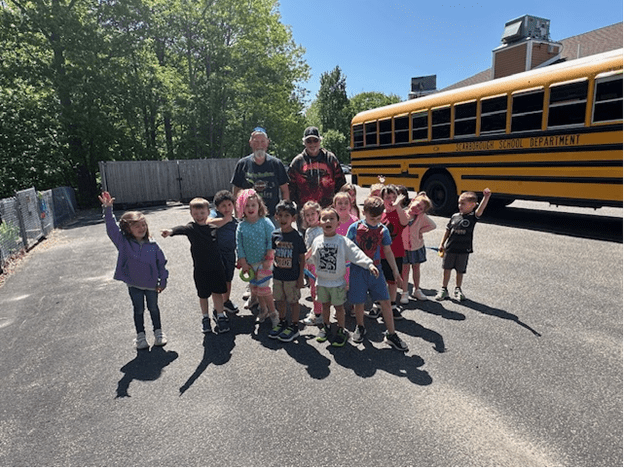
At the Shooting Stars Program for pre-K students in Scarborough, lunchtime is about a lot more than food—it is about smiles, laughter, and two beloved visitors who the children affectionately call, “The Pizza Men.”
Dave Gardner and Rick Harden, school bus drivers for Scarborough Public Schools, delivered meals every day last year to the public pre-K partnership classroom at the Shooting Stars Program. Over time, what began as a daily delivery turned into something far more meaningful: a joyful connection that bridged the classroom and the community.
“We might have a tough day, but the kids would never know it,” Gardner said. “We come in all smiles. It’s impossible not to when you see how happy [the children] are.”
The nickname “The Pizza Men” took shape after one Friday pizza delivery last year, and it stuck. Since then, the children have greeted the duo with excitement and giggles, hoping that the day’s lunch might include pizza.
Gardner, who has been driving a school bus for nine years, and Harden, who has been behind the wheel for seven, have made positivity their trademark.
“We go out of our way to greet every child,” Harden said. “We crack jokes. We make them laugh. It starts their day off right—and ours, too.”
That genuine connection has not gone unnoticed. The class regularly shows their appreciation by creating holiday ornaments, Valentine’s Day candy bags, and colorful thank-you cards for Gardner and Harden.
“It’s those little things that remind you why this job matters,” Gardner said.
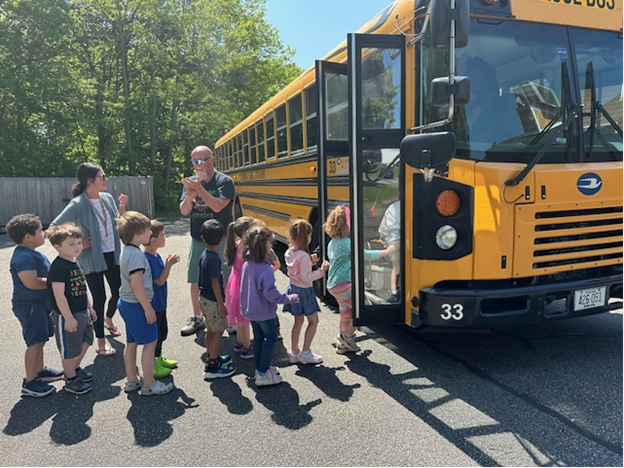
Last spring, the pair went above and beyond once again. They brought a full-size school bus to the Shooting Stars Program, so that the preschoolers could explore, learn about bus safety, and get comfortable with the sounds and excitement of the bus before starting kindergarten.
“The kids were thrilled,” a teacher shared. “It was even more exciting than when the fire department brought the fire truck!”
For Gardner and Harden, the visit wasn’t just for fun, either.
“We wanted to show them that the bus isn’t scary,” Gardner explained. “All of the children got to try things independently. That was a big moment for them and for us.”
“To me, these kids are like my grandkids,” Harden added. “I want every interaction to be positive. If they trust us, they’ll speak up when something’s wrong—and that’s what keeps them safe.”
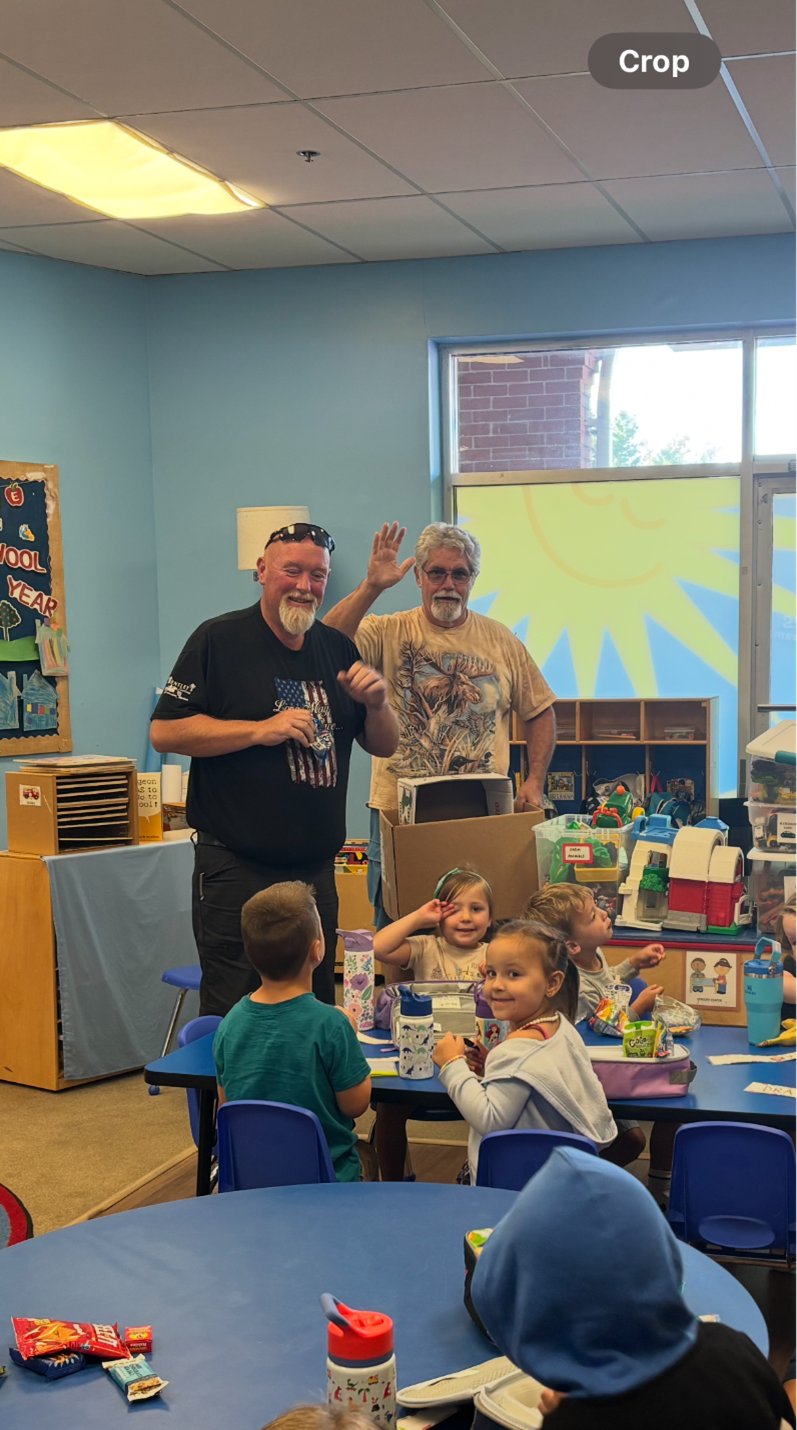
That sense of care shines through in every visit. One day during snack time, Gardner couldn’t resist joining the children at their tiny table.
“They were having snacks, so I sat down with them,” Gardner laughed. “The chairs were a little small for me, but the kids thought it was the funniest thing ever.”
Now, some of those same pre-K students ride Gardner and Harden’s buses as kindergarteners. They still wave, giggle, and shout, “Hey, Pizza Men!” when they see them.
As Maine celebrates National School Bus Safety Week, the staff at the Shooting Stars Program say it best: that Gardner and Harden aren’t just delivering meals—they’re delivering joy, confidence, and care to the next generation.
For more information, please contact Michelle Belanger, Maine DOE Pre-K Partnership Specialist, at Michelle.Belanger@maine.gov.
From October 20-24, 2025, the Maine Department of Education (DOE) is recognizing National School Bus Safety Week, an annual observance dedicated to promoting the safety and well-being of the millions of students who depend on school transportation safety.
Eighty percent of Maine students ride school buses to school every school day. This important week serves as a powerful reminder of the shared responsibility among drivers, students, parents, caregivers, educators, and communities to ensure that every child’s journey to and from school is safe. Schoolbus safety should be everyone’s priority, every day.
This year, we unite under the theme: “Safe Stops. Stronger Communities.” Every stop is a chance to protect lives. When we choose safety, we’re not just preventing crashes; we’re strengthening the very communities we love. Together, we can protect every journey, ensuring safety at every stop!
Every school day, millions of children take their seats on a yellow school bus—the safest way to and from school. Yet, safety doesn’t stop at the bus doors. It requires every driver, every lawmaker, every community member to take responsibility. When red lights flash and the stop-arm is extended, we all have one simple choice: Stop.
NASDPTS reports that drivers illegally pass stopped school buses more than 39 million times each year. Each violation represents more than a statistic—it is a moment when a child’s life is in danger. While we’ve seen progress with a 13% reduction in violations this past year, far too many risks remain on our roadways.
Please find a NASDPTS – National School Bus Safety Week PSA for sharing purposes here.
The Maine School Bus Purchasing Program provides subsidies to school administrative units (SAUs) to help offset the cost of purchasing new school buses used to transport students to and from school, home, and school-sponsored events. This program is designed to support SAUs in acquiring new buses, retiring end-of-life vehicles, and meeting emergency or special transportation needs.
The Maine School Bus Purchasing Program will open on November 1, 2025, and close on November 25, 2025. Before then, please consider joining Cheryl Brackett, Maine Department of Education (DOE) Transportation Coordinator; Donna Tiner, Maine DOE School Finance Coordinator; and Kimberly Hall, Maine DOE Education Data Systems Manager, for a Maine School Bus Purchasing Program informational session on October 15, 2025, from 1-2 p.m. via Zoom:
Cheryl will demonstrate how to access NEO and complete the bus purchase request. She will also review the steps in the program.
Donna will share details about funding.
Kimberly will provide information surrounding the role of the Maine Education Data Management Systems (MEDMS).
This hour-long session will conclude with a question-and-answer period. Please find the Zoom information below:
The first round of approvals for the Maine School Bus Purchasing Program will occur between December 30, 2025, and January 15, 2026. With questions, please contact Cheryl Brackett at cheryl.brackett@maine.gov or 207-446-3019.
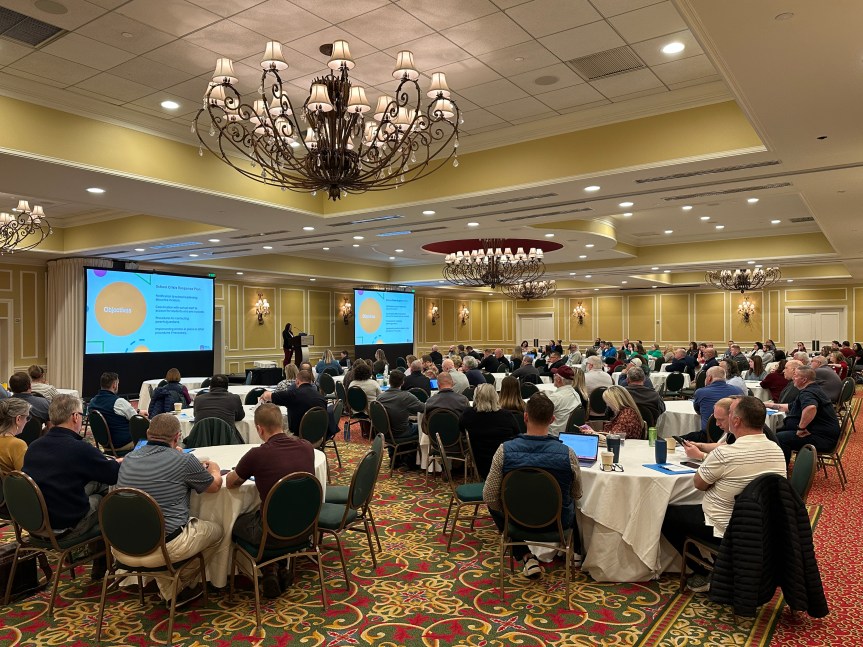
From March 10-12, 2025, the Maine Department of Education (DOE) Maine School Safety Center (MSSC) hosted the first annual Maine School Safety & Transportation Conference at the Samoset Resort in Rockport. This three-day event brought together transportation administrators, district and building administrators, law enforcement, school health teams, and safety experts to explore effective strategies for maintaining safe and supportive learning environments.
The conference began with an evening networking event, fostering connections among participants from across the state. The following morning, a general session led by the MSSC team set the stage for an in-depth exploration of school safety and transportation topics.
MSSC Assistant Director Jeffery Upton welcomed attendees, emphasizing the significance of hosting a conference tailored to Maine’s unique demographics and geography. Upton highlighted the need for comprehensive, localized strategies that address the state’s distinct challenges.
Following Upton, Bridgette Gilbert, the Maine DOE School Emergency Management Coordinator, stressed the value of tabletop exercises—discussion-based activities that simulate emergency scenarios in a low-stress environment. She provided participants with materials and scenarios to bring back to their schools, helping to refine emergency response plans and identify areas for improvement.
Michelle Legare, Maine DOE School Safety and Security Coordinator, highlighted the importance of law enforcement involvement and discussed considerations before, during, and after an incident.
Maine DOE Transportation Training Coordinator Cheryl Brackett then addressed the critical role of transportation safety, noting the impact of natural and human-made disasters on school transportation systems. She underscored the importance of equipping all school staff with emergency preparedness training.
Maine DOE Restorative Practices Coordinator Stacey Barlow also provided a brief presentation to discuss the importance of using restorative practices following emergencies, focusing on building and maintaining relationships among students and staff.
Audience members contributed valuable insights during the general session, such as the benefit of conducting unscheduled fire or lockdown drills to ensure genuine preparedness. Additionally, the complexities of student cell phone use during emergencies and the need for accurate, timely communication with parents were discussed.
Throughout the remainder of the conference, participants engaged in breakout sessions hosted by partners across Maine and the nation on topics like Behavioral Threat Assessment Management (BTAM), exploitation prevention for students, restorative practices, bomb threat assessment, drug identification and trends, FERPA compliance, bus evacuation procedures, dangerous student behavior prevention and intervention law, Security At First Entry (SAFE) Assessment, emotional intelligence, specialized sessions for school nurses, Transportation Director 101, CDL information session, vaping awareness, and wheelchair securement.
Participants also had the opportunity to attend a Drug and Alcohol Supervisor Certification course held by the Maine Motor Transport Association, enabling them to leave the conference certified to identify the physical, behavioral, speech, and performance indicators of probable alcohol misuse and use of controlled substances.
One standout session highlighted a year-long initiative by the transportation team at MSAD 6, Bonny Eagle. That team has partnered with Maine DOE Social Emotional Intelligence Consultant Kellie D. Bailey to train staff and bus drivers in emotional intelligence, mindfulness practices, and understanding brain science to better address challenging youth behavior.
The initiative aims to cultivate self-awareness and self-regulation and to develop an understanding of these concepts to help with student relationships and student behavior.
“Safety on the bus begins with the person behind the wheel. Having drivers who are best equipped to manage their own responses to the multiple environmental, behavioral, and emotional factors that they encounter daily is essential, as we strive to continue to elevate our [team] and our industry as a whole,” said MSAD 6 Assistant Director Mitzii Smith. “We are excited to be blazing a new trail with this work, as we are the only Transportation Department in the State of Maine to have initiated this collaboration.”
Right to left: Sherri Zulick, MSAD 6 Transportation Trainer; Kellie D. Bailey Maine DOE Consultant; Mitzii Smith, MSAD 6 Transportation Assistant Director; Sarah Marean, MSAD 6 Transportation Director
Check out a video clip of MSAD 6 bus drivers talking about the project.
Attendees left the conference equipped with new tools, strategies, and connections to strengthen school safety and transportation practices statewide. The Maine School Safety & Transportation Conference reaffirmed the collective commitment to creating secure and supportive environments for Maine’s students.
Here is a video of transportation directors and bus drivers being interviewed by Nokomis High School students during the conference, using the Maine DOE Mobile Learning Van.
MSSC plans to host a School Safety & Transportation Conference annually in the late winter/spring.
Anyone working with school safety is encouraged to check out MSSC’s eight-week School Safety Specialist Program. Provided at no cost to Maine schools, the courses are available asynchronously through Eastern Maine Community College and the Federal Emergency Management Agency.
Please join the Maine Department of Education (DOE) Maine School Safety Center for the first School Safety & Transportation Conference from March 10-12, 2025 at the Samoset Resort in Rockport, Maine.
This event will bring together educators, transportation professionals, safety experts, and policymakers to discuss and explore innovative strategies, best practices, and emerging technologies to improve school safety and transportation systems.
Why Attend?
Learn from leaders: Gain insights from keynote speakers, panel discussions, and breakout sessions led by experts in school safety and transportation.
Network with peers: Connect with professionals and stakeholders from across Maine to share challenges, solutions, and success stories.
Who Should Attend?
This conference is designed for:
School and district administrators
School board members
Facility directors
Transportation directors and staff
School support staff (e.g., counselors, social workers, nurses, office staff, etc.)
Staff and team leadership
Safety and security personnel, including school safety specialists
Law enforcement and administrators
School resource officers
Juvenile community corrections officers
First responders and local/county EMAs
Please be on the lookout for upcoming communication regarding registration, which opens in mid-January. The first 150 attendees to register will receive a scholarship for registration, meals, and lodging. More information, including a full agenda, speaker lineup, and travel information, is also coming soon.
Let’s work together to create a culture of care and safety in our schools, as well as more efficient transportation systems for our students. We look forward to seeing you in March of 2025!
State employees, including the Maine Department of Education (DOE), recently participated in the annual Take ME to Work Day by hosting their children and/or children they know for the day at the Maine Capitol Complex and at state-operated locations across Maine.
The day offered a chance for state employees to give their kids the opportunity to learn more about what they do for the people of Maine and see first-hand the inner workings and importance of our government.
Take ME to Work Day started with tours of the Maine State House, followed by a visit from Governor Janet Mills in the Hall of Flags. She greeted the kids and employees and delivered a message about the meaningful and fulfilling work of state government and its many employees.
Maine DOE’s Laura Cyr providing a tour.
Students in the Capitol dome.
Governor Mills addressing students and employees in the Hall of Flags.
While the state had many other activities for kids participating in Take ME to Work Day, the Maine DOE once again took the opportunity to provide a jam-packed day full of fun experiences and learning opportunities for Maine DOE employees and their kids.
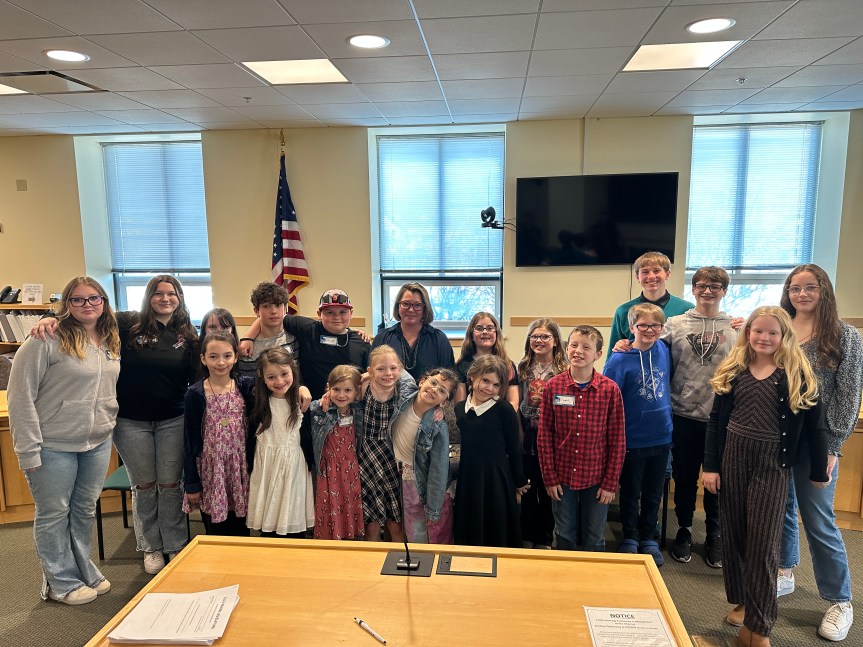
Following the State House tour, a mock legislative hearing was held with the help of Laura Cyr, a member of Maine DOE’s Legislative Team. Cyr explained to students about the Legislative Committee on Education and Cultural Affairs and the types of bills they oversee. Then, students volunteered to pretend to be senators and representatives on the committee and hear about a mock bill: An Act to Improve Education by Lowering the Driving Age (to 10 years old). After introducing the hypothetical bill, each student got the chance to speak about the bill, either in favor, against, or neither for nor against the bill.
Laura Cyr leading students in a mock legislative hearing.
Students in the Education and Cultural Affairs Committee room at Maine’s Capitol Complex.
Students brought up many important points, including that it would be convenient to be able to drive themselves to school if they missed the bus, that anyone young or old who has a driver’s license should have to take driving classes, and that kids are probably not ready to be driving at age ten. They also discussed the potential parking kerfuffle that would take place at school if, suddenly, everyone younger than ten years old was driving to school. Ultimately, the kids decided that the bill would need many changes if it were to proceed.
Following the mock hearing, students and adults got the opportunity to ride a Thomas Electric Bus from C.W. Cressy & Son. On the ride, which took everyone across Augusta’s Memorial Bridge to more State of Maine office buildings, students enjoyed the quiet bus ride and talked about the fact that there is no traditional engine when you open the hood. The group also learned that charging an electric bus takes about 3 hours and will ride for 150 miles on that charge.
posing in front of the Thomas Electric Bus.
Riding on the Thomas Electric Bus.
Over across the bridge, the group’s destination was a visit with Maine DOE’s Child Nutrition Team to see the culinary classroom and participate in a make-your-own-pizza lunch. Led by Chef Michele Bisbee and her daughter, students learned about the different learning opportunities afforded to school nutrition staff across Maine, both in-person and remote, through the culinary classroom. They also washed up and made their own pizzas. While the group waited for lunch to cook, Chef Bisbee quizzed them on the different food groups and discussed the intricacies of serving nutritional food in Maine schools. Bisbee ended the discussion by asking kids to thank the school nutrition staff at their school next week when school is back in session.
Chef Bisbee helping students with a make-your-own-pizza lunch.
After lunch, the group rode the electric bus back to the Capitol Complex and joined the Maine DOE Learning Through Technology Team’s Jon Graham to learn about and have hands-on fun with computer devices as part of Maine DOE’s Maine Teaches Computer Science (CS) initiative.
Following a brief overview and history of the Maine Learning Through Technology Initiative (MLTI), Graham showed kids all of the older and newer MLTI devices and showcased some of the computer science tools available to Maine schools through Maine DOE-administered grants and opportunities, such as Sphero BOLTs, Sphero Indi Cars, and a Dash robot. These tools allowed students to play around with and try computer coding in real time. Maine leads the nation in offering universal computer science education.
The day was full of fun opportunities, laughs, learning, new friends, and possibly some budding future Maine State employees.
Maine’s Take ME to Work Day occurs annually in the spring; for more information about the program, visit Maine’s Bureau of Human Resources Page.
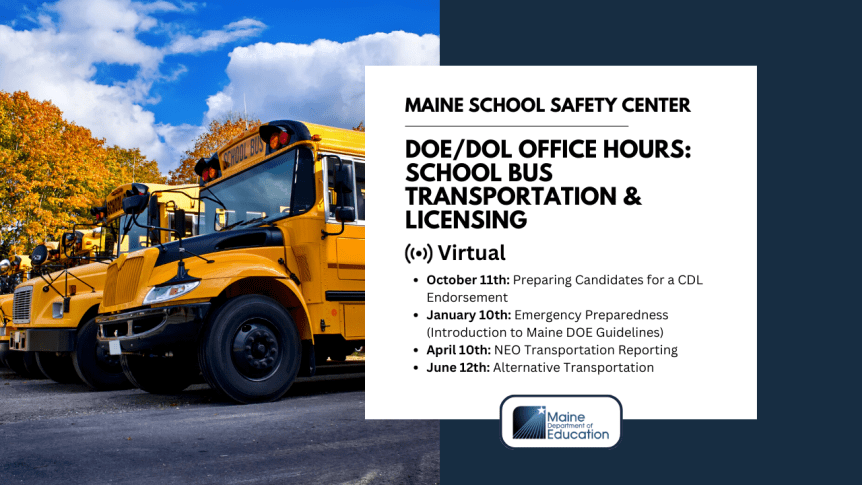
The Maine Department of Education (DOE) and Maine Bureau of Motor Vehicles (BMV) are pleased to offer joint Open Office Hours focused on school bus transportation and licensing. Information on how a school administrative unit (SAU) can train new bus drivers will be reviewed. The shortage of school bus drivers is at a critical point. Being able to train in-house is an advantage in recruiting candidates.
The first Office Hours on October 11 will feature Cheryl Brackett, Maine DOE Transportation Coordinator, as well as Christopher Ireland, Maine BMV Director of License Services. Sessions are meant to be a time for transportation directors to come together to ask questions, work together to problem solve, share best practices, and network.
Office hours are offered as part of the Maine DOE’s School Safety Center and are intended to meaningfully support addressing questions and needs. Participants can join for the full hour, for just a part, or only to obtain an answer to a question.
Transportation Office Hour Sessions will be held the second Wednesday quarterly, from 12:00 to 1:00 p.m., on the following schedule:
Month
Day
Topic
October
11th
Preparing Candidates for a CDL Endorsement
January
10th
Emergency Preparedness – Introduction to Maine DOE Guidelines
April
10th
NEO Transportation Reporting
June
12th
Alternative Transportation
Please use the following Microsoft Teams link to join the meeting on October 11:
Rural school transportation is often more challenging to electrify compared to urban or suburban service. Longer distances, a higher percentage of students requiring busing, harsher winters, and higher operating speeds all put greater strain on buses, budgets, and maintenance staff. Despite these challenges, electric school buses can provide the same or better performance as diesel buses while reducing operational cost. Different approaches need to be taken to overcome the unique operating challenges of rural routes when implementing electric school buses.
To document these different approaches — and the benefits of rural school bus electrification — the Maine Clean School Bus Program has gathered information from the first rural deployment of an electric school bus in Maine, on Mount Desert Island. Check out the case study here!
There will be a webinar and Q&A to go in-depth on rural electric school bus deployment. The webinar will take a deep dive into challenges specific to rural Maine, cover the big takeaways of the MDI case study, and address questions. See below for registration information:
Rural School Bus Electrification
Tuesday, November 29
10AM-11AM Register here to receive a zoom link
The Maine Department of Education is announcing that the 2022 Annual Year-End Transportation Reports, EFT-21 Safety and Training and EFT-24 Vehicle Mileage and Operations, are open.
School entities may access the reports through the Maine DOE Transportation data system. Both annual reports are located under Annual Data. Instructions to complete transportation reports are located on the Maine DOE Neo Dashboard. Please note that the final step to complete your report submittals is Superintendent authorization. Both transportation reports are due by October 15, 2022.
Timely annual transportation reports provide critical data to support our Maine transportation mission that transportation provided shall conserve the comfort, safety, and welfare of the students conveyed.
If you have questions about access to the transportation reports and technical questions, please contact the Maine DOE Help Desk MEDMS MEDMS.Helpdesk@maine.gov.