Applications Open for MOOSE Instructional Designers

Do you want the space to create innovative curriculum? Are you looking for a community of educators who are passionate about meaningful, interdisciplinary education? Do you want to expand your impact outside your classroom/school? If this sounds like you, the Maine Department of Education (DOE) is currently looking for dynamic, creative, and collaborative educators to join the MOOSE Team!

Now in its third year, Maine’s Online Opportunities for Sustained Education (MOOSE) platform continues to grow. Last year, we added PreK-12 Learning Progressions to our already robust bank of MOOSE modules – created by Maine teachers for Maine students. These modules center on interdisciplinary, project-based learning experiences that are accessible, inclusive, and available for free online.

This year, MOOSE continues with new Learning Progression topics as well as an Iteration & Improvement Team that will cycle back through existing content, augmenting existing functionality and ensuring even greater accessibility.

Learning Progression Teams will be set up in a single creation session with two phases (Designers are committing to the year-long process due to the connected nature of the phases).

  • Phase 1 (Sept 19 – Jan 13): Training and orientation begins the week of September 19th with full learning progressions created by January 13th.
  • Phase 2 (Jan 17 – May 19): Creation of teacher materials begins the week of January 17th and completes by May 19th. During this time, Designers will create teacher materials for the modules they just created AND for two additional existing modules from the MOOSE library.

The Iteration & Improvement Team will similarly have two stipend phases but these Designers will work from an individual matrix with a set of modules they must successfully address within each phase (Sept-Jan and Jan-May).

We are looking for Maine educators including, but not limited to, teachers, curriculum leaders, and representatives from Maine educational community organizations (e.g., museums, libraries, educational centers, etc.) interested in creating content for learning progressions in Applied Ethics, Data Science, and Cyber Security. Additional learning progressions will support topics outlined in LD 1664: African-American History & Culture and Wabanaki History & Culture. These learning progressions will be developed in conjunction with members of each of those communities and will require educators to be committed to a deeply collaborative process. The final team will be made up of individuals who are willing to work on the Iteration & Improvement of existing MOOSE modules (must have prior experience working on a MOOSE team in Year 1 or 2).

You do not need to have expertise in the topic area you are interested in or a strong background in technology, just a commitment to learning. Our work benefits from having a diverse range of perspectives and experiences (e.g., grades, disciplines, training, etc.) represented on each team. We value your years of experience as Maine educators and your willingness to embrace creativity and innovation. Each topic will be supported by a full-time Team Leader and dedicated Module Coach to help Designers through the process. You can learn more about MOOSE and our plans for Year 3 on the MOOSE website.

When you are ready to apply you can access the application here. Applications close August 26th.

If you are interested in applying but still have questions, the MOOSE team will be holding a Q&A session via Zoom on Thursday, August 18th from 3-4pm.

For more information about MOOSE please contact Project Manager Jenn Page, jennifer.page@maine.gov.
Funding to Promote School Nursing Workforce Development in Maine

The increased workload for school nurses due to the COVID-19 pandemic has put an immeasurable strain on our workforce over the past two years. The Maine Department of Education (DOE) will spend the next year providing opportunities to the current workforce of school nurses to build upon their expertise and to promote evidence-based practice in all Maine schools.

As part of funding from the U.S. CDC for COVID-19 Emergency Response, Public Health Crisis Response, Maine Department of Health and Human Services (DHHS) was awarded $8,861,778 for a two-year period, starting July 1, 2021 through June 30, 2023. This grant requires at least 25% of the award to support school-based health programs, including nurses or other personnel.  Maine DHHS in partnership with Maine DOE has partnered to provide opportunities to promote continued development of the current school nurse workforce. Emphasis on school nursing workforce development strengthens quality of health services within schools. This, in turn, allows for improved equity in care, and further supports the CDC Whole School, Whole Community, Whole Child model, allowing students to reach their highest health potential.

The Maine DOE’s school health workforce development efforts began with securing four School Nurse Regional Liaisons working within the Coordinated School Health Team of the Office of School and Student Supports. They will be ensuring that school nurses across the state have equal access to the opportunities for development.  The following opportunities will be rolled out in the next school year. To ensure all school nurses receive communications, please be sure that staff information is updated in Neo. The following activities from the Maine DOE will be forthcoming.

  • With the goal of increasing the number of nationally certified school nurses in Maine (up to 50), the Maine DOE will provide scholarships to qualified school nurses for the exam fee and review course, if needed. In addition, a facilitated study group will be created and available to those approved to participate. Once the application form is created, communications will be sent to school nurses through the DOE Maine School Nurse announcement listserv.
  • With the goal of increasing the number of school nurses seeking advanced degrees (up to 25), the Maine DOE will provide scholarships to qualified school nurses to enroll in graduate-level courses (increasing the number of nurses with advanced degrees), to be paid as tuition reimbursement to the individual with successful completion of a graduate-level nursing, public health, or education-focused course. Once the application form is created, communications will be sent to school nurses through the DOE Maine School Nurse announcement listserv.
  • With the goal of increasing the number of school nurses who hold certification in Pediatric Emergency Assessment, Recognition, and Stabilization (PEARS) the Maine DOE will provide an in-person course for school nurses in at least four locations across the State of Maine at no cost (up to 100 school nurses). Once the dates are secured, qualified school nurses may register through the DOE Professional Development

To be eligible for these opportunities, school nurses must meet the eligibility requirements for each individual activity, be employed full-time in a Maine school for at least one year and hold a current 524 professional endorsement from the Maine Department of Education.

For more information contact DOESchoolandStudentSupports@Maine.gov.


Maine DOE Hosts Early Elementary Educators for Summer Instructional Program Training

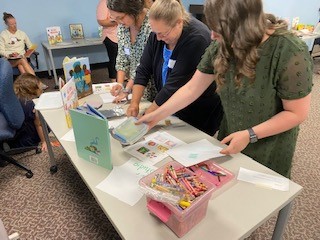
Over a four day period from August 1-4, the Maine Department of Education’s (DOE) Early Learning Team, in collaboration with seven Maine teacher leaders and a consultant from the Boston Public Schools, hosted over 130 Maine educators in two day trainings on the Maine DOE’s interdisciplinary instructional programs:  Pre-K for ME, K for ME, and 1st Grade for ME.  During the trainings, teachers learned about and explored the program components through hands-on simulations and interactive activities.

Over the past 5 years, the Maine DOE has worked with a consultant from the Boston Public Schools and Maine educators to pilot Boston’s Focus Curriculum–an interdisciplinary, developmentally appropriate, whole child focused instructional program.  The pilot process has enabled the Maine DOE to align the programs with Maine’s Early Learning and Development Standards (MELDS) and Learning Results and to make enhancements to the programs that support Maine’s context.  Pre-K for ME and K for ME are open-source and available on the Maine DOE’s website.  1st Grade for ME is being piloted in 5 schools during the 2022-23 school year during which time 14 first grade teachers will be implementing the program and providing feedback to guide adaptions.  Additionally, 2 Maine educators are writing the science portions of 1st Grade for ME.  1st Grade for ME should be available as an open-source resource in August of 2023.

For more information about Pre-K for ME, K for ME, and/or 1st Grade for ME, please reach out to Nicole Madore, Early Childhood Specialist (Nicole.Madore@maine.gov) or Lee Anne Larsen, Director of Early Learning (leeann.larsen@maine.gov).

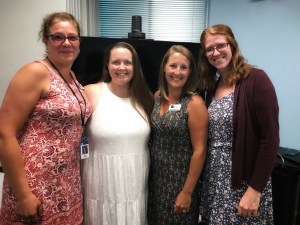
Maine DOE Consultants and Teacher Leaders at the Pre-K for ME training

WEBINAR: The Role of School Administrators in Supporting School Safety Efforts

The U.S. Department of Education, Office of Elementary and Secondary Education, Office of Safe and Supportive Schools and its Readiness and Emergency Management for Schools (REMS) Technical Assistance (TA) Center will host a Webinar on Friday, August 26, 2022, from 12:00 p.m. to 1:00 p.m. ET. This Webinar will highlight the role of school administrators in supporting school safety efforts at the local level.

The objectives of this 60-minute Webinar are to

  • Demonstrate the importance of developing a collaborative planning team to support emergency operations plan (EOP) development, as outlined in Step 1 of the six-step planning process detailed in the Guide for Developing High-Quality School Emergency Operations Plans.
  • Discuss the role that school administrators — including principals, vice principals, and other school leaders — play in implementing the National Preparedness System mission areas before, during, and after a potential emergency.
  • Share resources to strengthen efforts around overall plan development.

Register on the REMS TA Center Website to participate in the Webinar!

Presenters:

  • Ocali Charter High School – Elizabeth Brown, Principal
  • Hudson City School District – Michael Sedlak, Unit Principal
  • REMS TA Center – Janelle Hughes, Project Director

Questions About the Event?

Contact the REMS TA Center Help Desk at 1-855-781-REMS [7367] or info@remstacenter.org from 9:00 a.m. to 5:00 p.m. ET, Monday through Friday.

Can’t make the live event? This Webinar will be archived on the REMS TA Center Website within 7 business days.

Reminder: Upcoming Public Pre-K Expansion RFA Informational Meeting  

For SAUs interested in applying for the second round Public Pre-K Expansion RFA, the Maine DOE will be holding an informational meeting on Tuesday, August 23 from 10 am-12 pm. Those wishing to learn more about the Pre-K Expansion RFA opportunity and/or who want to ask questions may attend through this link. This meeting will be recorded and made available on the DOE’s Early Learning Professional Learning and Resources page.  

In the meantime, information about the RFA and RFA Application can be found on the Grant RFPs and RFAs webpage. 

Additional questions regarding the RFA should be directed to Pre-K RFA Coordinator jane.kirsling@maine.gov. 


2022 Maine Educator Summit Draws 400 Educators to Augusta

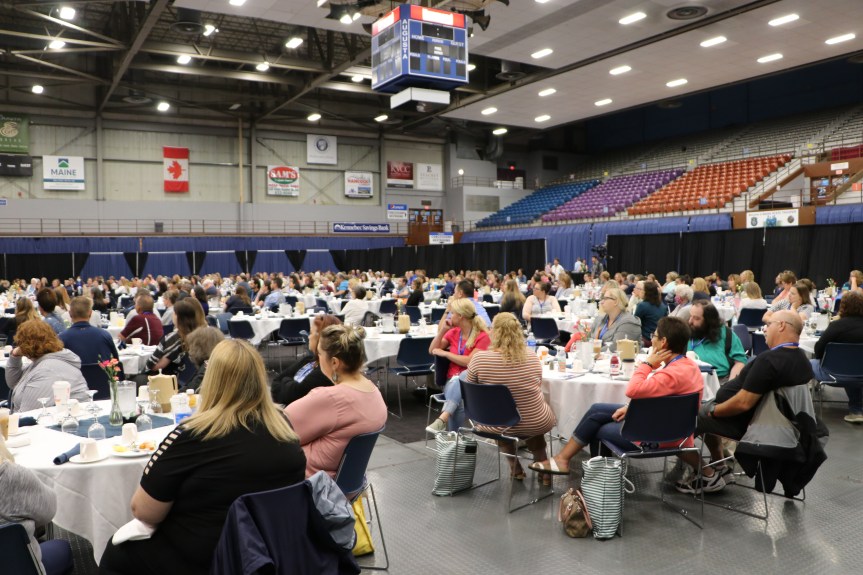
More than 400 educators from across Maine gathered at the Augusta Civic Center for the first annual Maine Educator Summit. The theme for the Summit was Supporting Resilience, Responsiveness, and a Renewed Approach to Education with more than 58 professional learning presentations on a range of topics including interdisciplinary instruction, student wellbeing, school safety, engaging with community, “grow your own” solutions to build the educator workforce, extended learning opportunities, and more.

The Summit also provided an opportunity for educators to connect, build community, and learn from and with one another.

Maine Education Commissioner Pender Makin and inspirational speaker Randy Judkins delivered keynote addresses to the educators.

“It’s extremely important for educators and school leaders to be able to have a space to come together, to network and share ideas, to learn new strategies, and to strengthen their professionalism and resilience as they are about to enter a new school year,” said Makin on the importance of the Summit.

One educator shared that they left feeling as though their enthusiasm for teaching was renewed and they held a greater sense of community and comradery while another shared that they were grateful to have connected with people who can help them implement the practices they learned about at the summit in their classrooms, schools, and districts.

Check out some of the media coverage from the event featuring teaching interviews:

While this is the first official Educator Summit, the Maine DOE looks forward to planning and hosting a summit each year moving forward.

Maine DOE Update – August 12, 2022

From the Maine Department of Education


Reporting Items

| Visit the DC&R Reporting Calendar |


News & Updates

Maine DOE Hosts First ‘Teachers of Adult Multilingual Summer Institute’ Drawing in Rural Districts Eager to Support New Learners

As the housing crisis felt across Maine has driven some of Maine’s newest multilingual residents out of urban areas and into rural parts of our State, the Maine Department of Education (DOE) and Maine’s adult education multilingual learning programs are right there to provide the support they need. |  More

Gifted and Talented Program Update Form is Now Live

The 2023 Gifted and Talented (GT) program update form is now live on the Multitiered Systems of Development – Gifted and Talented (MTSS-GT) website. Rather than a full application, we will be collecting district GT program information through a short survey. This survey allows the Maine Department of Education (DOE) an opportunity to take a “pulse check” of GT programming happening around the state. The survey is titled, “Gifted and Talented District Update Survey 2023” and is located under the MTSS banner. |  More

Nominations and Applications are Now Open for the Presidential Awards for Excellence in Mathematics and Science Teaching (PAEMST)

The National Science Foundation (NSF) is currently accepting nominations and applications for the Presidential Awards for Excellence in Mathematics and Science Teaching (PAEMST). PAEMST is the highest recognition that a Kindergarten through 12th grade science, technology, engineering, mathematics, and/or computer science educator may receive for outstanding teaching in the United States. Since 1983, more than 5,100 teachers have been recognized for their contributions to mathematics and science education. Up to 108 awardees may be recognized each year. Maine is proud to have honored over 80 exceptional educators for their contributions! |  More


Maine Schools Sharing Success Stories

| Submit your Maine School Success Story |


Professional Development & Training Opportunities

| Visit the Professional Development Calendar |


Latest DOE Career/Project Opportunities: View current Maine Department of Education employment opportunities here


The Power of Puppets: Sharing Summer Success in the 21stCCLC Program

Lights, Camera, Action! Campers at Dirigo Elementary School, a 21st Century Community Learning Centers CCLC program site, have been perfecting their puppeteer skills through music. James Hamalainen, music teacher at Dirigo Middle School, worked with each group to create their own music, write lyrics and produce the final show.  Improvising, writing songs, practicing lines, character development and dancing are some of the areas students explored while building their self esteem in a fun, supportive environment.

Puppets are a powerful educational tool that can help students overcome anxiety, and foster self confidence. When combined with music it can help improve language skills, as well as social and emotional development. Research shows that the isolation over the last few years has caused a significant number of elementary students to fall far behind in language, communication and social development. Learning experiences like this can begin to address these concerns to help students progress academically.

RSU 56, in partnership with Oxford County Mental Health Services (OCMHS), is a 21st Century Community Learning Center (21stCCLC) program based at Dirigo Elementary School in Peru, Maine.

Funded through the U.S. Department of Education’s Nita M. Lowey 21st Century Community Learning Centers (CCLC) program, Maine currently has 35 CCLC grants and 61 CCLC sites across Maine that provide academic enrichment opportunities during non-school hours for children, particularly for students who face economic and/or academic challenges. With strong community partnerships at the core of every one of its programs, Maine’s 21st Century Learning Centers help students meet academic goals and offer a broad array of enrichment activities, in addition to other educational and engagement opportunities for communities and families. Learn more about Maine’s CCLC grant opportunities at https://www.maine.gov/doe/learning/esea or reach out to Travis Doughty at travis.w.doughty@maine.gov.

Maine DOE Hosts First ‘Teachers of Adult Multilingual Summer Institute’ Drawing in Rural Districts Eager to Support New Learners

As the housing crisis felt across Maine has driven some of Maine’s newest multilingual residents out of urban areas and into rural parts of our State, the Maine Department of Education (DOE) and Maine’s adult education multilingual learning programs are right there to provide the support they need. 

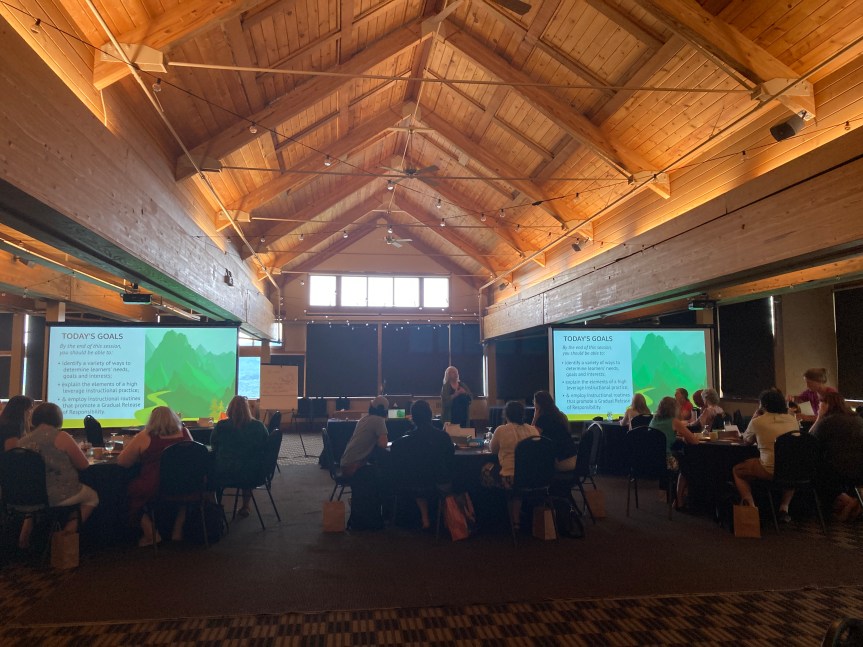
The first-ever, “Teachers of Adult Multilingual Summer Institute” was held in Sugarloaf and virtually recently. Hosted by Maine DOE’s Adult Education Team and endearingly referred to as, “Camp Sugarloaf,” the gathering featured nationally renowned educator and speaker Jayme Adelson-Goldstein who led a workshop, which took place over the course of the three-day institute, on implementing high-leverage practices and differentiation in virtual and  in-person multilingual classrooms with interactive activities that enabled participants to get to know each other and dig into valuable content and best practices for educating adult learners who are multilingual. 

In addition to Adelson-Goldstein’s full group sessions, the institute also offered various breakout sessions led by educators working in some of Maine’s more urban adult education programs.  

While Rochelle Yanike Hale from Portland Adult Education led a session on “How to Increase Student Writing in a Remote Class,” Virginie Akimana from Portland Adult Education hosted a session on, “Considerations for Working with Adult Multilingual Learners,” and Tekia Cox from Augusta Adult & Community Education hosted participants for a Roundtable Discussion on Orientation for Multilingual Learners. Also offering sessions were Kelli Park from University of Southern Maine (USM)/Merrymeeting Adult Education, Elizabeth Cuccinello DiLalla from RSU 13 Adult & Community Education, Moira Taylor from Portland Adult Education, Lisa Parisio from Immigrant Legal Advocacy Project, Amy Hatch from Lewiston Adult Education, and Anya Enright from EnGen. 

Members of Maine DOE’s Adult Education Team also hosted various other sessions on everything from CASAS (assessments) to community resources, and the Teaching the Skills That Matter (TSTM) Toolkit. In addition, the institute also provided participants with ample opportunities for networking, relaxing, and communicating and collaborating with each other across the three-day event.    

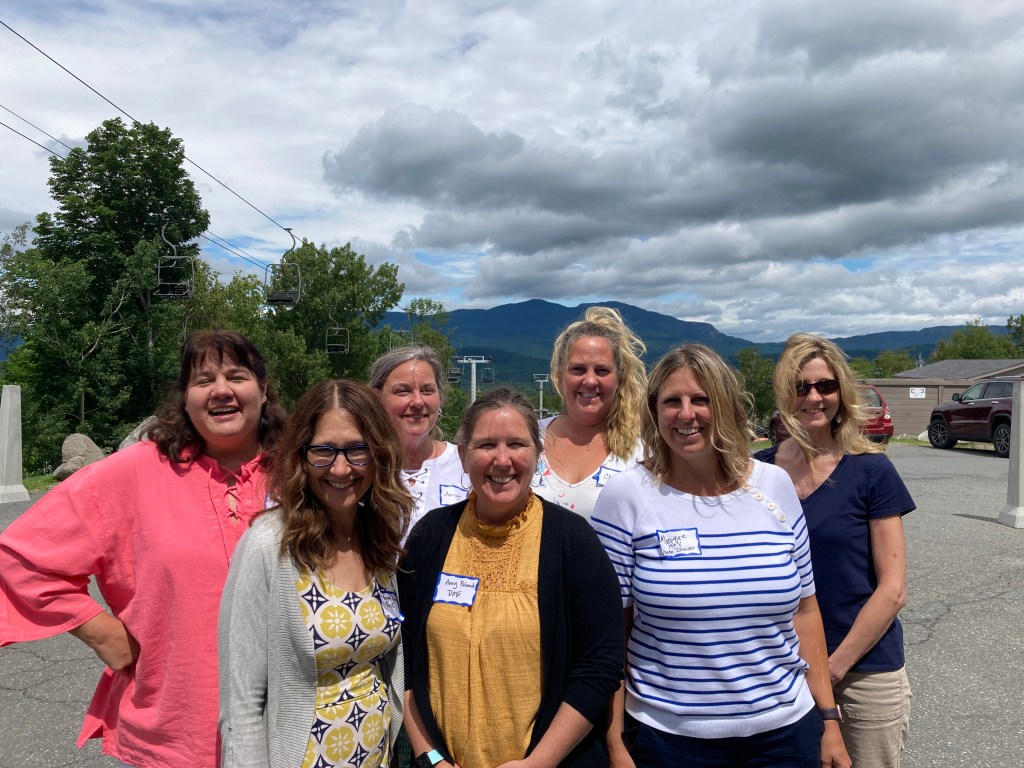
Meet the Adult Education Team: 

Back row: Kelley Heath- Adult Ed Data/High School Education Coordinator, Amy Hatch-Adult Ed MaineStars Data Entry, Christy Le-Adult Ed Micro-credential Assistant, Tammy Ranger- Director, Workforce Development & Innovative Pathways 

Front row: Megan Dichter- Adult Ed Workforce Development/ESL Coordinator, Amy Poland- Adult Ed Prof Dev/ME College Transition Coordinator, Monique Roy-Director Adult Education 

While this is the first official Summer Institute hosted for Maine’s adult educators, the Maine DOE’s Adult Education Team hopes to plan a summer institute annually each year going forward. 

Gifted and Talented Program Update Form is Now Live

The 2023 Gifted and Talented (GT) program update form is now live on the Multitiered Systems of Development – Gifted and Talented (MTSS-GT) website. Rather than a full application, we will be collecting district GT program information through a short survey.  This survey allows the Maine Department of Education (DOE) an opportunity to take a “pulse check” of GT programming happening around the state.  The survey is titled, “Gifted and Talented District Update Survey 2023” and is located under the MTSS banner.

All Maine districts are asked to complete the survey regardless of whether they have current GT programming, waiver status, etc. The purpose of the survey is to collect current programming information of Gifted and Talented services and is not a full program application.  The survey is currently live, and will be open through September 30th, 2022.

Got Questions?

If you have any questions about this year’s process, consider joining a MTSS-GT office hour!  The MTSS-GT office hour happens every Tuesday from 12:00 PM – 1:00 PM throughout the summer.  September office hours will be Tuesday’s from 3:30-4:30 PM each week.  You can obtain the link for the office hours is here.