WEBINAR: Resources to Address the Mental Health Impact on Students, Families, and Staff

Please join the Federal School Safety Clearinghouse on January 20 at 3:00 PM EST for an informational webinar on the latest resources to address the mental health impact on students, parents, teachers, and school personnel during the COVID-19 pandemic.

The session will feature guest speakers from the U.S. Centers for Disease Control and Prevention and the Mental Health Technology Transfer Center Network, which is funded by the Department of Health and Human Services Substance Abuse and Mental Health Services Administration. Presenters will provide an overview of national COVID-19 guidance for K-12 schools and share resources to address the mental health impact on students, parents, teachers, and school personnel.

The discussion will feature additional school safety-related resources available through SchoolSafety.gov, as well as a Q&A session.

  • When: January 20, 2022, 3:00 PM to 4:00 PM EST
  • Where: Adobe Connect (access link to be provided one day in advance of the event)
  • For: K-12 School Superintendents and Principals; School and District Administrators; Teachers and School Staff; School Counselors and School Psychologists; Emergency Management; Parents and Guardians; and Students
  • Registration: https://schoolsafetycovidandmentalhealthwebinar.eventbrite.com

If you have any questions, please contact the Federal School Safety Clearinghouse School Safety team at SchoolSafety@hq.dhs.gov.

Regional School Calendars Due June 1, 2022

This is a reminder that Regional School Calendars are due by June 1, 2022 for school administrative units (SAU) and private schools approved for tuition purposes, in coordination with their local secondary career and technical education (CTE) school. This requirement is part of Public Law 2011, Chapter 686 to promote collaboration among local school administrative units that may benefit from inter-administrative unit collaboration beyond CTE.

For school year 2022-23, both regional school calendars and individual calendars for each school administrative unit must be submitted by the director of the local CTE Center/Region to the Department of Education (DOE) no later than June 1, 2021 for a decision on approval by July 12, 2022. Guidance and templates can be accessed electronically at www.maine.gov/doe/regionalcalendar/.

Given the coordination required for fulfillment of this law, the Maine DOE recommends that SAUs initiate discussions as soon as feasible, including representatives from all affected secondary schools and their associated career and technical education center or region.

For more information, including guidance, instructions, templates, a waiver process, and a link to the complete law, please visit www.maine.gov/doe/regionalcalendar/ Further questions should be directed to Doug Robertson doug.robertson@maine.gov / 624-6744 or Dwight Littlefield dwight.a.littlefield@maine.gov / 624-6721.

Bath Middle School Takes Hands-on Approach to Learning About Ocean Sustainability

Inspired by the Expeditionary Learning model, Bath Middle School has taken a hands-on approach to examining the issue of ocean sustainability.  As part of this project, as citizen scientists, the 7th-grade students took to the local waterfront to collect data on the invasive green crab species and graphed their results.

Students also visited the Maine Maritime Museum in downtown Bath to learn about the history of Maine’s fishing and shipping industry.  Working with Museum educators, they generated timelines through the examination of the museum’s artifacts.

The culminating activity was for students to design and build a product that would address an issue that threatens the sustainability of our oceans such as pollution, climate change, or invasive species.  On Thursday, December 16th, parents, and the community were invited to attend an event that displayed the students’ work.

parents at event

In a “Shark Tank” format, the top five projects were pitched to a panel of judges to determine a winning product.  Students created videos, websites, and prototypes to convince the judges of their product’s ability to impact and help solve an issue that puts the sustainability of our oceans at risk.

After much deliberation, the judges determined that the winning product was Compostable Condiments designed by Sadie C. and Laura K.  This product proposed using an invasive seaweed to make a biodegradable substitute for the plastic used in takeout packets like ketchup.

Congratulations to all the 7th graders for their innovative ideas that could help to preserve one of Maine’s most essential natural resources.

This story was written and coordinated by MLTI Ambassador Holly Graffam as part of the Maine Schools Sharing the Success Campaign. To learn more, or to submit a story or an idea for a story, email rachel.paling@maine.gov. 

Integrating Podcasting at Caribou Community School 

Creation and innovation are core elements to middle school learning, thanks to Kim Barnes and Heather Anderson, who both teach 8th grade English language arts (ELA) and social studies at Caribou Community School. In a recent unit of study about resiliency, Mrs. Barnes and Mrs. Anderson had the creative idea that podcasting would be a great way for students to demonstrate their knowledge on the topic. 

Mrs. Barnes said the idea was conceptualized from the work she did with the revised ELA Standards and thought that podcasting was a truly “authentic way to braid [the] standards into the work [they] were already doing.” 

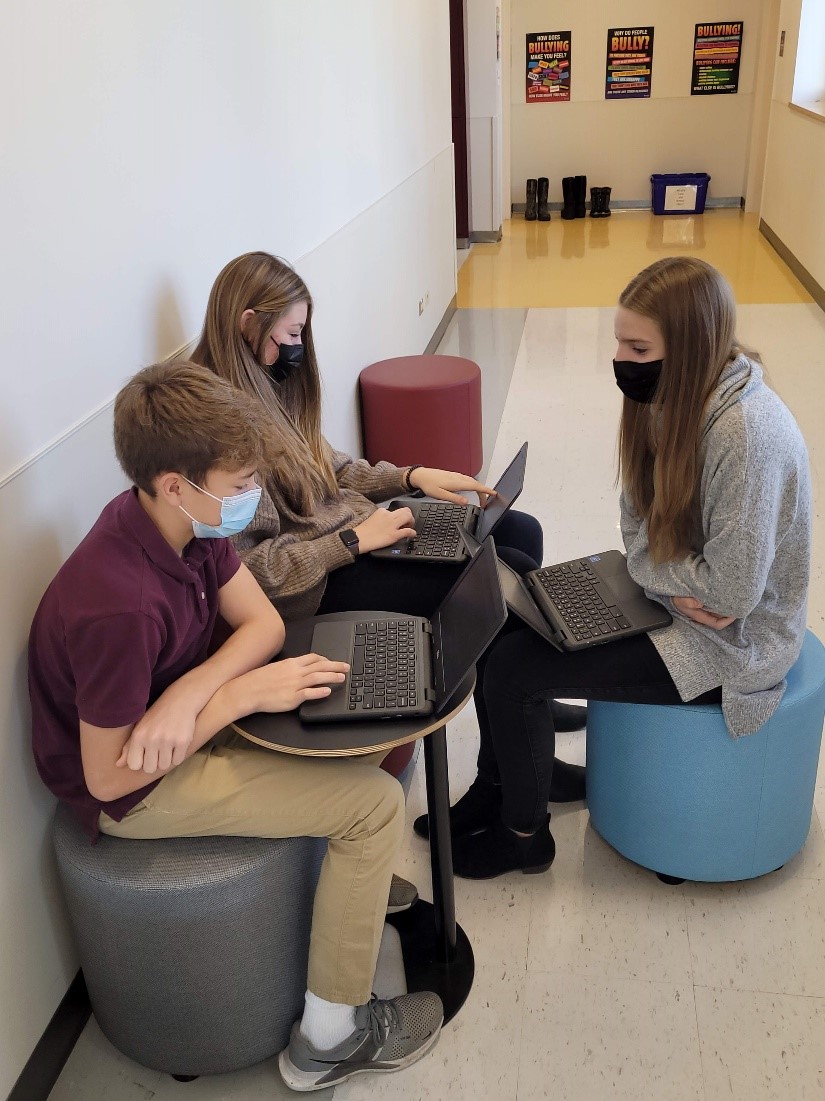
Though they knew they wanted to use podcasting in their unit, Mrs. Barnes and Mrs. Anderson also felt they needed some support with teaching their students the more technical aspects. They reached out to the Department of Education’s Maine Learning Technology Initiative (MLTI) Ambassadors who were able to create and present lessons to the Caribou 8th grade students. This all-day event focused on supporting the work Mrs. Barnes and Mrs. Anderson were doing in the classroom, as well as leading the students through the process of podcasting on their Chromebooks. The Ambassadors explained the value and possibilities of podcasting and then demonstrated how to create and edit podcasts using WeVideo. Students then practiced the process of podcasting in pairs or small groups by choosing a topic of their own, or just discussing a predetermined prompt. One group took the opportunity to begin a sports podcast, where they discussed recent events in sports and even planned out how often they should record the podcast in order to continue with it. 

From this experience, Mrs. Barnes noticed that the engagement of the students skyrocketed. Students reported that they really enjoyed the creative part of making podcasts and, immediately, many of them began listening to other podcasts outside of class for fun. Some students were also motivated to begin a school podcast.  

The busy day proved to be quite fruitful. Mrs. Anderson and Mrs. Barnes felt that the event not only helped the students, but it also really energized them, as teachers. One student shared that the work with podcasting “is changing [his] perspective about reading and writing to a more positive one as ELA has always been a struggle for [him].” 

This story was written and coordinated by MLTI Ambassador Rob Dominick as part of the Maine Schools Sharing the Success Campaign. To learn more, or to submit a story or an idea for a story, email rachel.paling@maine.gov. 

Maine School Safety Center to Offer School Emergency Planning Virtual Office Hours

Melissa Condon, the Emergency Operations Planning Officer for the Maine Department of Education’s Maine School Safety Center will be offering virtual office hours for anyone working in Maine’s education workforce who is interested in talking about School Emergency Planning.

Sessions will be offered Weekly on Mondays & Wednesdays from 8:00am – 10:00am starting on Monday, January 19th and ending on Monday, February 28th

If you are interested in registering to attend any of the Office Hours, email Melissa.A.Condon@maine.gov for a link to join the virtual meeting.

Description: 

Available for personalized discussions for School Administrative Units (SAUs) related to various areas of emergency management and planning to include mitigating against, preparing for, responding to, and recovering from various threats and hazards that exist both to the school and surrounding community.

This is an opportunity to ask questions and/or seek technical assistance for topics such as:

  • The development of a Comprehensive Health and Safety and Emergency Management Plan
  • Identifying and planning for all hazards and potential hazards that could reasonably be expected to affect a SAU
  • Forming a collaborative, multi-disciplinary planning team
  • Developing and enhancing MOUs/MOAs with community partners
  • Physical site assessments
  • Emergency management training and education opportunities
  • Emergency exercises/drills
  • Continuity of Operations

For further information or questions, contact Melissa Condon at Melissa.A.Condon@maine.gov.

MEDIA RELEASE: Maine CDC and Maine Department of Education Revise COVID-19 Guidance for Schools to Support In-Person Learning During Omicron Surge

AUGUSTA – The Maine Center for Disease Control and Prevention (Maine CDC) and the Maine Department of Education (DOE) announced today further revisions to the Maine CDC’s Standard Operating Procedure (SOP) for responding to COVID-19 in schools.

Following discussions with school superintendents, the Maine CDC has revised the SOP to state that schools enforcing a universal masking policy may choose to suspend contract tracing in light of the transmissibility of the Omicron variant and its impact on the effectiveness of contact tracing.

The Maine CDC has determined that, because the Omicron variant is far more contagious than prior variants, has a shorter incubation period, and tends to spread in the early part of an infection, it is contributing to higher levels of community transmission, making community exposures more frequent and, consequently, reducing the effectiveness of contact tracing in schools. While the goal of contact tracing is to provide a timely notification to all individuals who may have been exposed to COVID-19, school superintendents have reported that conducting contact tracing in a timely and thorough manner is becoming increasingly difficult, if not impossible, for school personnel given the fast spread of the Omicron variant.

The revised SOP permits schools with universal masking policies to suspend contact tracing if they are not able to conduct it effectively, in order to rededicate limited and tired staff to focus on other COVID-19 mitigation strategies, like detecting and preventing infected people from being in schools via pooled testing, to help keep kids in the classroom. Schools that have the resources to contact trace effectively are encouraged to continue doing so.

“Keeping kids safely in the classroom is crucial to their education and minimizes disruption to the lives of their parents, who often have to stay home from work or are put in a child care crunch when their kids can’t be in school,” said Governor Mills. “Of course, the best way to protect the health of students and to keep them in the classroom is to get vaccinated, which will help slow the spread of COVID.”

“The rapid spread of the Omicron variant has further burdened Maine’s schools during an already challenging school year in the midst of the COVID-19 pandemic,” said Education Commissioner Pender Makin and Maine CDC Director Nirav D. Shah. “These recommendations allow teachers and school staff to focus their limited resources on educating students in the classroom as safely as possible. Getting vaccinated remains the most important step to protecting our school communities.”

“We are grateful for the ongoing efforts of Maine CDC as they continue to provide schools with the guidance and protocols that will protect the physical and emotional health of staff and students, and preserve the critically important opportunity for in-person learning,” said Maine School Board Association Executive Director Steve Bailey.  “As the governance team of their local education systems, including the safety, time and resources of their schools, our school boards have the responsibility to ensure they have a universal masking policy in place that will both keep students and staff safe and permit school staff to suspend contact tracing for cases of COVID-19 in schools. We stand ready to help them in these efforts.”

“On behalf of school and district leaders across Maine, we welcome today’s guidance, which provides some relief to school staff, especially our nurses, who have continued to exceed safety protocols with extensive and labor intensive contract tracing and notification efforts,” said Maine School Superintendents Association Executive Director Eileen King.  “Schools with universal masking policies in place for all indoor school sponsored activities will be able to shift their time and attention to other strategies that ensure the physical and emotional health and safety of staff and students. We thank Dr. Shah and his team for engaging superintendents in discussions about the implementation logistics and implications of Maine’s school prevention and response strategies for COVID-19, and for providing insight and balance to the science that informs community health decisions.”

The change is consistent with those adopted recently by other New England states and builds on other revisions from the Maine CDC that, among other updates, reflect recently updated guidance from the U.S. CDC on quarantine and isolation periods. All of these revisions are designed to support in-person learning, thereby promoting the health and well-being of school students, staff, and their communities.

The change is also specifically targeted to schools that have implemented a universal masking policy. U.S. and Maine CDCs recommend universal indoor masking by all students, faculty, staff, and visitors in K–12 schools, regardless of vaccination status, across all school-based and school-sponsored activities. Wearing a mask has been proven to mitigate the spread of COVID-19. Local school boards are charged with the responsibility of implementing masking requirements for their school systems. Schools that do not have a universal masking policy should continue contact tracing.

Since the fall of 2020, all Maine pre-K-12 schools have been providing in-person instruction to students. Throughout the pandemic, the Mills Administration has promoted safe, in-person learning, dedicating $329 million in Coronavirus Relief Funding (CRF) to Maine schools to help them educate Maine students. The Administration has also provided 10,859,586 face coverings, gloves, and other types of personal protective equipment to Maine schools and has supported COVID-19 testing in schools, including launching a pooled testing program. The pooled testing guidance has also been streamlined in light of Omicron, and schools have received 242,500 rapid antigen BinaxNOW tests from the Maine Department of Health and Human Services. The Administration has helped organize vaccine clinics for school staff across Maine and supported more than 500 vaccine clinics for schools and students this past fall.

According to Maine’s Vaccination Dashboard, as of January 12, 2022, 51.5 percent of children ages 5 to 19 were fully vaccinated for COVID-19. Data from the U.S. CDC show that Maine ranks fourth best in the nation in the percent of 5 to 17 year olds fully vaccinated. As of the end of October, 83 percent of school staff were fully vaccinated.

The updated public health guidance for responding to a positive case of COVID-19 in schools can be viewed HERE.


###


Indirect Cost Rate Approval Process

The Maine Department of Education would like to share updated information concerning our indirect cost rate approval process.

The Department issues an indirect cost rate for a specific fiscal year that is valid from July 1 to June 30 of the applicable fiscal year. The indirect cost rate is applied to the direct cost amount expended, not to the grant award. Indirect costs are recovered only to the extent of direct costs incurred.

To recover indirect costs, the LEA applies the indirect cost rate in affect for a given fiscal year or the term of the grant award to the direct expenditures less capital outlay during that fiscal year or the term of the grant award.

In order for districts to receive approval of their indirect cost rate, the audit reconciliation with MEFS must be completed. The Department also recommends completing the following training to all districts that apply: Indirect Cost Training Course FY 21 (ed.gov).

Development of Indirect Cost Rates:

  • The Department sources information from the LEA’s official annual upload to MEFS and the detail accounts that make up that report.
  • The Department will prepare a “preliminary indirect cost rate” for LEAs requesting an indirect cost rate and may be requested for certification.
  • Once preliminary indirect cost rates are provided to the LEA, the LEA shall provide information for subawards and subcontracts so to calculate an adjustment to the indirect cost rate prior to final certification.
  • Predetermined rates that are certified and the certifications will be published to: https://www.maine.gov/doe/funding/fiscalreview/compliance/indirectcostrate
  • Restricted indirect cost rates will be limited to 8%. Unrestricted indirect cost rates are limited to 15%. All preliminary calculated rates outside of the statistical norm are subject to review to ensure the proper classification of costs.

The following information has been added to the Indirect Cost Rate Agreement:

  • Distribution Base: MTDC Modified Total Direct Cost – Total direct costs excluding equipment, capital expenditures, participant support costs, pass-through funds, and the portion of each subaward (subcontract or subgrant) above $25,000 (each award; each year).
  • Applicable To: Restricted- Restricted rates apply to programs that require a restricted rate per 34 CFR 75.563 and 34 CFR 76.563.
  • Treatment of Fringe Benefits: Fringe benefits applicable to direct salaries and wages are treated as direct costs. Pursuant to 2 CFR 200.431, (b), (3), Paragraph (i), unused leave costs for all employees are allowable in the year of payment. The treatment of unused leave costs should be allocated as an indirect cost except for those employee salaries designated as a direct cost for the restricted rate calculation.
  • Capitalization Policy: Items of equipment are capitalized and depreciated if the initial acquisition cost is equal to or greater than $5,000.

If you have any questions as you review these printouts, please contact our School Finance Team member Mary Randall, mary.randall@maine.gov, for assistance.

Maine DOE Update – January 7, 2021


From the Maine Department of Education


Reporting Items

| Visit the DC&R Reporting Calendar |


News & Updates

Maine DOE and MCCS Partner to Offer Free College Courses for Adult Education Students

Maine adults seeking to pursue college have a new option to jumpstart their education, with support from their local Maine adult education program. A new partnership between the Maine Community College System (MCCS) and the Maine Department of Education (DOE) will offer tuition-free college courses to Maine’s adult education students. | More

Seeking Collaborative Educators to Join the MOOSE Team

Are you a Maine educator who wants the space to play and create innovative curriculum? Are you looking for a community of educators who are passionate about meaningful, interdisciplinary education? Do you want to expand your impact outside your classroom/school? If this sounds like you, the Maine Department of Education (DOE) is currently looking for dynamic, creative, and collaborative educators to join the MOOSE Team! | More

Information Regarding Federal Requirements for Entry-Level Driver Training (ELDT)

The Federal Requirement for Commercial Driver’s License (CDL) applicants to complete Entry Level Driver Training (ELDT) before taking a road or skills exam takes effect on February 7, 2022.  The good news is drivers who have successfully completed a written exam and hold a CDL permit before February 7, 2022 are exempted from having to complete ELDT prior to a skills or road test. | More

Public Meeting Notice for LD 313 Work Force Group on Career and Technical Education

On Wednesday, January 12, 2022 from 8:00-10:00 am the LD 313 Work Force Group will hold its fourth meeting, hosted by the Maine Department of Education. | More

U.S. DOE Announces Joint Temporary Action with U.S. DOT to Help Address School Bus Driver Labor Shortage

The U.S. Department of Transportation in coordination with the U.S. Department of Education has announced that the Federal Motor Carrier Safety Administration (FMCSA) is giving states the option of waiving the portion of the commercial driver’s license (CDL) skills test that requires applicants to identify the “under the hood” engine components. All other components of the written and road test will remain. | More

PRIORITY NOTICE: Seeking Proposals for Afterschool and Summer Learning Programs

The Maine Department of Education is pleased to announce the release of a request for proposals (RFP) seeking bids from interested parties to implement comprehensive 21st Century Community Learning Centers (21st CCLC) programming in 2022-2023.  It is anticipated that roughly $2M will be available to issue grant awards later this year. | More

Maine School Nutrition Teams Invited to Register for Farm to School Cook-off by Jan 14

Registration is open for the annual Maine Department of Education (DOE), Child Nutrition Farm to School Cook-off!  Held in the Spring of 2022, the cook-off is a statewide culinary competition for teams of school nutrition professionals and students to promote local foods in school meals. This voluntary competition is made available to all school districts in Maine.  The cook-off involves three regional competitions that take place in locations across the state (including Career and Technical Education [CTE] culinary arts centers), and a finals competition in the Maine DOE Child Nutrition Culinary Classroom located in its Augusta offices. All necessary precautions will be taken due to COVID-19, including face coverings and social distancing of teams. | More

Maine’s Teacher of the Year Journey Starts with Your Nomination

Nominations are now open for the 2022 County Teachers of the Year and 2023 Teacher of the Year. Members of the public are encouraged to nominate educators who demonstrate a commitment to excellence and who inspire the achievement of all students. | More

2022 Mitchell Scholarship Online Application Open Until April 1

The 2022 Mitchell Scholarship online application is now open until April 1. You can find the application link, requirements, and a few additional college and scholarship resources on the Mitchell Institute’s Website.  | More

Printable Infographic:  Tips to Improve How Your Mask Protects You

As we all work together to fight the Omicron variant of COVID-19, effective mask wearing continues to be one of the best strategies.  Find important information, graphics, and translated resources on the U.S. Centers for Disease Control and Prevention (CDC) website to share with your school community about how individuals can improve how their mask protects them: | More


Maine Schools Sharing Success Stories

| Submit your Maine School Success Story |


Professional Development & Training Opportunities

SAVE THE DATE: Maine Collaborative Child Abuse Prevention Conference February 2-4

Save the date for an 3-day free online conference for Social Workers, Law Enforcement, Educators & Prosecutors. Trainings are designed to provide cross disciplinary education, advocacy for systemic legal change, guidance for survivor support and leadership on emerging technologies, education and training around how to recognize and address the intersecting forms of child maltreatment in connection with child sexual abuse is the focus of all. | More

| Visit the Professional Development Calendar |


Latest DOE Career/Project Opportunities

View current Maine Department of Education employment opportunities here


Riverside Adult Education Recognized for its Innovative Day Reporting Program

Riverside Adult Education serves the communities of Regional School Units (RSUs) 26, 22, and 34 in Penobscot County. Like all of Maine’s high-quality adult education programs, Riverside works with adults in their region looking for personal, professional, and academic growth.

Riverside was recognized recently by the Maine Sheriff’s Association and the Penobscot County Jail for their unique PACE Day Reporting Program. PACE stands for Purpose, Awareness, Connection, and Education, and invites a niche audience of participants to go at their own pace, or to simply enjoy a change of pace when it comes to personal and professional betterment.

Intended for individuals in Penobscot County who have been sentenced to two days in jail for a minor offense, the PACE Day Reporting program gives folks the opportunity to spend that time doing something a bit different.

PACE program coordinator Rebecca Cross, who helped get the program up and running, recalls her initial conversations about the creation of PACE with Penobscot County Sheriff Troy Morton: “He wanted me to create something where the people would leave enriched in some way, instead of sitting in the cellblock for two days.”  Their shared vision helped create PACE – a program that provides the opportunity for participants to get involved in educational programs they never knew how to access.

“The Penobscot County Sheriff’s Office is blessed to have a tremendous partnership with Rebecca Cross and Riverside Adult Education,” said Sheriff Morton. “This community-based correctional program focuses on a therapeutic approach to incarceration through an educational experience.” 

People who opt to participate in PACE spend each day of their jail sentence embarking on a tailored educational experience. While some may choose to practice for the High School Equivalency Test (HiSET) or take the Comprehensive Adult Student Assessment System (CASAS) math and reading assessment for adults, others choose to get help in filling out the Free Application for Federal Student Aid (FAFSA®) form and learning about possible higher education options available to them. 

Another option of PACE presents a whole other set of professional learning opportunities. These learning options are one of the things about PACE that really sets it apart – by the way it draws participants, who may be feeling turned out by their own community, back into society through investing in them valuable time, knowledge, and training. The program offers classes like, “How to Stretch Your Food Dollar,” and “Trauma Informed Yoga,” as well as, “How to Breathe Your Way Through Mental Health Struggles,” among other topics. 

“It’s a balance between profoundly sobering conversations around addiction and light hearted remembering of the joys of life,” said Cross.

In addition, a new option in the PACE program called, “Life Ready” includes reflective workshops using podcasts. These workshops are linked to mic-credentialing, a system developed by Eastern Maine Community College. The micro-credentialing curriculum through Life Ready encourages students to consider their own story and how it affects their life choices. The podcasts include useful topics like, business startup, home buying, credit scores, budgeting with very little income, and financial literacy, which according to Cross, is a very popular one.

“People who do not have very much, or no money at all, often think that financial literacy doesn’t apply to them,” she explained. By making budgeting and financial literacy accessible and easy to use for anyone, it has become one of the most well utilized options in the program.

PACE classes and workshops are offered on a Friday and a Saturday to make them more convenient and accessible for people who are working or already taking classes during the week. This means that the community organizations who partner with PACE are willing to send instructors to volunteer on a Saturday, which sends a very positive message to participants, says Cross.

“They [PACE program participants] are astounded at the fact that people from the community want to come in and spend time with them, even on the weekend,” said Cross. “The fact that people are willing to do that means a lot.”

Cross also explains that their community partnerships are one of the most impactful aspects of the program. These partnering organizations, such as Health Equity Alliance and the BARN (Bangor Area Recovery Network), send people to conduct the classes or workshops. One recent workshop was hosted by Eastern Maine Development Corporation (EMDC) on “How to Develop an Elevator Speech,” and “How to Interview for a Job.” They have also hosted faculty from University of Maine at Orono who have provided reflective writing workshops. In addition, they have hosted local artists who offer their time teaching classes on how to paint.

“It’s so profound for people,” said Cross. “It can be healing, to just sit down and tap into your creativity and just laugh with people, and at themselves.”

So far, PACE has served 139 people in Penobscot County since its creation in January of 2020. Cross says that although it does cost participants money to enter into PACE, they have worked hard to keep that cost as low as possible, which ends up being a small fraction of what other, similar programs charge in other states. 

Encouraged at the fact that all 139 of the people who have participated in PACE have not been charged with another sentence, they are eager to keep working on making the program accessible to even more people and bring in more community partnerships to match the need.

“Rebecca’s passion for education and wonderful ability to bring in supporting resources makes this program a success” said Sheriff Morton. “This educational approach allows individuals the opportunity to connect with resources available throughout our state.” 

“It’s a great community effort and I just get to put the pieces together,” said Cross, adding that they are always so happy to see people who have participated in the program go on to continue their education, opening up a world of possibilities for what their next step might be.

For more information about PACE, contact Rebecca Cross at rcross@rsu26.org.

Seeking Collaborative Educators to Join the MOOSE Team

Are you a Maine educator who wants the space to play and create innovative curriculum? Are you looking for a community of educators who are passionate about meaningful, interdisciplinary education? Do you want to expand your impact outside your classroom/school? If this sounds like you, the Maine Department of Education (DOE) is currently looking for dynamic, creative, and collaborative educators to join the MOOSE Team! 

After a successful first year, Maine’s Online Opportunities for Sustained Education (MOOSE) platform continues to grow. Last year, nearly 300 modules were created on the MOOSE platform by Maine teachers for Maine students. These modules are student-driven and center on interdisciplinary, project-based learning experiences that are accessible, inclusive, and available for free online.  

This year, MOOSE content is being created with greater connections between modules to build PreK-12 learning progressions for specific topics. The year is broken into two creation sessions with the first session currently underway and will be completed in March.  

  • The training and orientation for new creators in the second round begins February 7th with full learning progressions created by July 2nd 
  • Content creators will earn a stipend of $3000 for successful completion of the work and receive related synchronous and asynchronous professional development. 

We are looking for Maine educators including, but not limited to, teachers, curriculum leaders, and representatives from Maine educational community organizations (e.g., museums, libraries, educational centers, etc.) interested in creating content for learning progressions in STEAM, Career Readiness, Computer Science, and Climate Education 

You do not need to have expertise in the topic area you choose or a strong background in technology, just an interest in both. We value your years of experience as a Maine educator and your willingness to embrace creativity and innovation. Each topic will be supported by a full-time team leader and will include returning team members from the first round of creation in addition to some new educators. The modules are stronger when we have a diverse range of perspectives and experiences (e.g., grades, disciplines, training, etc.) represented on each team.  

You can access the application here 

If you are interested in applying but still have questions, the MOOSE team will be holding Q&A sessions via zoom on Thursday, January 20th and Tuesday, January 25th, from 3-4pm. Please select the date you are interested in attending to register.  

To learn about the work completed in MOOSE’s first year, view our video here 

For more information about MOOSE please contact Beth Lambert, beth.lambert@maine.gov or Page Nichols, page.nichols@maine.gov.