Special Education Forms Update 08.01.2020

Based on the periodic review and feedback from a stakeholder group of practitioners in the field, the Maine Department of Education’s Office of Special Services has revised two of the required forms for Special Education. Specifically, the IEP form and the Optional Referral form have been revised; all vendors have been notified of these changes. Below are links to the updated forms:

A complete list of all forms is available on our website. All changes in the revised forms go into effect on August 1, 2020. Below are the detailed changes to the IEP form and the Optional Referral Form:

  • Section 3. Considerations C. and Ci. on page 1 were updated to include current language related to English Learners.
  • Section 7. Related Services on page 4, Behavioral Health Day Treatment was removed from the related services grid. Please see guidance about documenting behavioral services in section 6. Supplementary Aids, services, Modifications and/or Supports of the IEP. The guidance was jointly issued, in March of 2020, by the Maine Department of Education (MDOE) and the Maine Department of Health and Human Services’ (DHHS) Office of MaineCare Services (OMS).
  • Section 5. The Academic Performance description was updated to include all children in Part B, ages 3-20.
  • Section 5. The Functional/Development performance descriptions were updated to include all children in Part B, ages 3-20.
  • The Optional Referral Form, section J, Recent Academic Achievements was revised to include the grade level benchmarks for the assessments that are considered during a referral.

The updated Procedural Manual is posted on the Office of Special Services website. For more information or assistance, please call Roberta Lucas, Federal Programs Coordinator at 624-6621 or roberta.lucas@maine.gov
DOE Commissioner to Provide Briefing to Legislature

Maine Department of Education Commissioner Pender Makin will host a briefing with the legislature, on Friday, August 21, 2020 from 11 am – 12pm. 

Recognizing that Maine schools are preparing for, and that some have already begun, their 2020-2021 school year, Commissioner Makin will provide an update on the innovative initiatives that the department has undertaken as part of their continued provision of resources and support for Maine schools, and answer questions.

The update will occur for one hour via Zoom.  The link will be provided by respective leadership.

Others who wish to attend may reach out to Karen Kusiak, DOE Director of Legislative Affairs, at karen.kusiak@maine.gov.

Announcing Launch of MOOSE Learning Module Library!

The Maine Department of Education is excited to announce that the MOOSE (Maine Opportunity for Online Sustained Education) Learning Module Library will launch on Tuesday, September 8th, 2020.

MOOSE will provide free access to a-synchronous, interdisciplinary, project-based learning modules aligned to the Maine Learning Results for all grades, PK-12. Maine educators, curriculum leaders, and educational community organizations have worked all summer to produce these engaging and innovative learning opportunities for Maine’s students. While the platform won’t be available until September 8th, you can preview the module topics on our website.  

We will continue to develop more modules throughout the year and we need Maine educators to join us! Phase II of the module creation work will begin September 8th and last until November 20th. Each participant will be trained in a-synchronous instructional design by Maine DOE digital learning specialists, as well as supported in their content by Maine DOE content specialists. Stipends of $1000 will be provided for successful completion of the project. 

Participants must be Maine educators, including but not limited to curriculum leaders and Maine educational community organizations such as museums, libraries, and educational centers. 

To register, click here. 

For more information please contact Beth Lambert,  beth.lambert@maine.gov or Page Nichols, page.nichols@maine.gov. 

Maine DOE Update – August 14, 2020


From the Maine Department of Education


Reporting Items

| Visit the DC&R Reporting Calendar |


News & Updates

Department of Education Fall 2020 Survey Data Released

Maine Department of Education released the data received from over 40,000 parents, educators, and education leaders from across Maine. | More

Mills Administration Updates COVID-19 School Health Advisory System

The Mills Administration today released  an updated color coded Health Advisory System that classifies counties’ relative risk of COVID-19 transmission by color for schools as they continue with their plans to deliver instruction and support students  safely this fall.  The updated assessment released today showed that Maine’s 16 counties continue to be designated “green,” with no changes from the initial launch of the system two weeks ago. | More

Maine DOE Student Cabinet, Governor Mills Release COVID-19 PSAs for Maine Youth

The Maine Department of Education (DOE) and the Children’s Cabinet teamed up with the Maine DOE Student Cabinet to create and launch a series of COVID-19 public service announcements (PSAs) created by Maine students for Maine students. | More

School Librarians: Emergency Remote Learning Response

What were school librarians doing during the emergency remote learning last spring? Throughout remote learning, Maine Association of School Libraries (MASL) held eight pop-up webinars for school library staff and conducted a survey in June to gather information and share support throughout the school library community. | More

Seeking Public Comment to waive requirements related to assessment, chronic absenteeism, accountability identifications and accountability components within Maine’s Model of School Support

The Maine Department of Education (DOE) is seeking a one-year waiver pursuant to §8401(b) from requirements within the Elementary and Secondary Education Act (ESEA) as amended by the Every Student Succeeds Act (ESSA) of 2015) from the U.S. Department of Education (USDOE). The U.S. Department of Education requires state educational agencies, when seeking waivers from statutory or regulatory requirements, solicit and respond to public comment on the request and provide evidence of the available comment period. This 15-day public comment period from August 11, 2020 until August 26, 2020 waives requirements related to chronic absenteeism, accountability identifications and accountability components within Maine’s Model of School Support. | More

Coordinating SAU Re-opening Plans with Child Care

As School Administrative Units continue their efforts in constructing re-opening plans that keep the safety and well-being of students, families, and staff at the center of their decision making, one of the many critical considerations will be child care options for families, especially when schools are operating hybrid and distance-learning only models. | More

Impacts of COVID-19 on Education Leaders- a Resource

School and district leaders are facing untenable and unprecedented scrutiny and stress as this pandemic draws on. As you prepare to launch plans, reinvent education, and lead the effort to ensure the safety of your staff and students, all while providing for the education of all students, it is critically important that you also take time to provide care for yourself. | More


Maine Schools Sharing Success Stories

| Submit your Maine School Success Story |


Professional Development & Training Opportunities

| Visit the Professional Development Calendar |


Latest DOE Career/Project Opportunities

View current Maine Department of Education employment opportunities here


Mills Administration Updates COVID-19 School Health Advisory System  

FOR IMMEDIATE RELEASE  

All counties remain green i second release of color designations that  reflect relative COVID-19 risk by county to assist district leaders with school planning

AUGUSTA — The Mills Administration today released  an updated color coded Health Advisory System that classifies counties’ relative risk of COVID-19 transmission by color for schools as they continue with their plans to deliver instruction and support students  safely this fall.  

The updated assessment released today showed that Maine’s 16 counties continue to be designated “green,” with no changes from  the initial launch of the system two weeks ago.  

The Health Advisory System is a collaboration among the Maine Department of Education (DOE), the Maine Department of Health and Human Services (DHHS), and the Maine Center for Disease Control and Prevention (Maine CDC). The classifications were developed to categorize counties based on quantitative and qualitative data about COVID-19 including, but not limited to, recent data on case rates, positivity rates, and syndromic data (e.g., symptoms of influenza or COVID-19). This system categorizes counties by three-color based designations: red, yellow, and green. 

The Health Advisory System categorizations are defined as follows: 

  • RED: Categorization as “red” suggests that the county has a high risk of COVID-19 spread and that in-person instruction is not advisable. 
  • YELLOW: Categorization as “yellow” suggests that that the county has an elevated risk of COVID-19 spread and that schools may consider additional precautions and/or hybrid instructional models as a way to reduce the number of people in schools and classrooms at any one time. 
  • GREEN: Categorization as “green” suggests that the county has a relatively low risk of COVID-19 spread and that schools may consider in-person instruction, as long as they are able to implement the required health and safety measures.  Schools in a “green” county may need to use hybrid instruction models if there is insufficient capacity or other factors (facilities, staffing, geography/transportation, etc.) that may prevent full implementation of the health and safety requirements. 

Regardless of their county’s red, yellow, or green designation, districts must also meet the Requirements for Safely Opening Schools to protect the safety and well-being of staff, students, and families. They fall into six categories: 

  1. Symptom Screenings Before Coming to School 
  2. Physical distancing and school facilities 
  3. Masks/Face Coverings 
  4. Hand Hygiene 
  5. Personal Protective Equipment 
  6. Return to School After Illness 

The Health Advisory System reflects ongoing analysis of evolving data and serves as one piece of information that school and district leaders can use to make decisions about how to deliver education this fall. It will be updated at 12:00 pm every other Friday, and can be found on the Maine DOE website in Part I of the Framework for Returning to Classroom Instruction: https://www.maine.gov/doe/framework/part-I
 

### 

MEDIA RELEASE: Department of Education Fall 2020 Survey Data Released

Contact: Kelli Deveaux
August 12, 2020

Today, Maine Department of Education released the data received from over 40,000 parents, educators, and education leaders from across Maine.

On July 6, 2020 the Maine DOE released a series of surveys about the 2020 school year during COVID-19 as part of an ongoing effort to gather input from families, communities, educators, leaders, and educational stakeholders across Maine. This information was aggregated by an independent research group and reported to the DOE for consideration.

The DOE staff continue to have ongoing conversations with educational leaders, state leaders, and health experts to develop health markers and corresponding guidance to ensure the safe return to in-classroom instruction. It will also inform the technical assistance and supports that the DOE will provide to our school community members, including educators, families and students.

Recognizing that the greatest value is in the feedback gathered locally, Collaborative Planning Teams for each school unit across the state have also facilitated the critically important local conversations as to the unique variables, resources and needs within each school community; the state and county data compiled from the DOE survey will be one of many resources that will guide the processes and decision making regarding instructional models for the 2020-2021 school year.

“I am extremely grateful to the tens of thousands of individuals across Maine who took the time to fill out these surveys,” said Commissioner Pender Makin. “Their input is not only deeply appreciated, but it is critical as we further develop our guidance to schools amid the COVID-19 pandemic, and continue to have conversations with leaders across the state about education in Maine. We remain committed to providing support and leadership during these uncertain and unprecedented times.”

Survey information by group, county and question, along with initial considerations and actions, can be found on the Department of Education webpage: https://www.maine.gov/doe/fall2020survey

Coordinating SAU Re-opening Plans with Child Care

As School Administrative Units continue their efforts in constructing re-opening plans that keep the safety and well-being of students, families, and staff at the center of their decision making, one of the many critical considerations will be child care options for families, especially when schools are operating hybrid and distance-learning only models.

Availability of child care, particularly for students in PK-Grade 5, will be essential, as will coordination between SAUs and child care settings.  As SAUs continue to gather input from families and shape plans, ascertaining which families have child care needs as a result of the varied school re-opening models will be particularly helpful to both schools and child care facilities.

SAUs are strongly encouraged to coordinate planning with local child care providers.  Determining if adequate child care options exist for families within the SAU, as well as building contingency plans to address identified and/or anticipated need, will enable smoother transitions, especially between the various risk-status designs.  Additionally, child care providers will be better able to collaborate with schools to support distance learning designs if they can be partners in the planning process (see contacts for local child care providers below).

The Maine Department of Education and Office of Child and Family Services in the Department of Health and Human Services are positioned to support SAUs in exploring child care considerations and in addressing identified child care needs.  Funding provided through the ESSER funds and CRF funds may be expended to support needs related to child care and maintaining continuity of instruction as a result of COVID-19 precautions.  Additionally, the Office of Child and Family Services (OCFS) can provide technical assistance to help SAUs connect with licensed child cares in their school systems, problem solve child care related issues, and explore expansion of child care availability for families.  Contacts for OCFS staff who can provide assistance are listed below. Contacts from the Maine DOE’s Early Learning Team, who may also be equipped to answer related questions, are also listed.   Finally, OCFS is willing to schedule a technical assistance session for Superintendents to answer questions and gather needs.  If interested in this type of session, please complete this poll by August 16, 2020.

Contacts:

Office of Child and Family Services

Maine DOE

Child Care Providers:  Child Care Choices website

MEDIA RELEASE: Maine DOE Student Cabinet, Governor Mills Release COVID-19 PSAs for Maine Youth

The Maine Department of Education (DOE) and the Children’s Cabinet teamed up with the Maine DOE Student Cabinet to create and launch a series of COVID-19 public service announcements (PSAs) created by Maine students for Maine students.

The youth PSAs feature members of the Maine DOE Student Cabinet in a series of videos that talk about staying healthy during the COVID-19 pandemic. The PSAs will be posted on social media throughout the remainder of the summer and into the 2020/2021 school year to help remind Maine’s youth to stay physically active and mentally healthy even while social distancing and wearing face coverings to help stop the spread of COVID-19. The PSAs can be viewed at the following links:

Governor Janet Mills has also created a special video for Maine’s youth acknowledging how much they have sacrificed during the COVID-19 pandemic in addition to thanking them for their efforts and emphasizing the importance of their resilience moving forward.

“I want to thank you for the role you are playing in keeping our state safe and healthy,” said Governor Mills in the video. “This is a challenging time for everyone all across the country, but especially for you.” View Governor Mills’ full video message below.


###

Seeking Public Comment to waive requirements related to assessment, chronic absenteeism, accountability identifications and accountability components within Maine’s Model of School Support

The Maine Department of Education (DOE) is seeking a one-year waiver pursuant to §8401(b) from requirements within the Elementary and Secondary Education Act (ESEA) as amended by the Every Student Succeeds Act (ESSA) of 2015) from the U.S. Department of Education (USDOE). The U.S. Department of Education requires state educational agencies, when seeking waivers from statutory or regulatory requirements, solicit and respond to public comment on the request and provide evidence of the available comment period. This 15-day public comment period from August 11, 2020 until August 26, 2020 waives requirements related to chronic absenteeism, accountability identifications and accountability components within Maine’s Model of School Support.

Maine’s Model of School Support contained within Maine’s ESSA state plan, focuses on supporting and assisting schools and educators experiencing challenges. The Maine DOE is working diligently to continue supporting Maine’s schools during this pandemic of COVID-19. Maine’s Model of School Support is immediately impacted by the Department’s waiver request.

Requirements from which Maine is seeking a waiver include:

  • Assessment requirements in section 1111(b)(2): the requirements to administer all required assessments in school year 2020-2021.
  • Accountability and school identification requirements in sections 1111(c)(4) and 1111(d)(2)(C)-(D): the requirements that a State annually meaningfully differentiate all public schools and the requirements to identify schools for comprehensive and targeted support and improvement and additional targeted support and improvement based on data from the 2020-2021 school year.
  • Report card provisions (ESSA Dashboard) related to certain assessments and accountability in section 1111(h) based on data from the 2020-2021 school year, namely:
    • Section 1111(h)(1)(C)(i) (accountability system description).
    • Section 1111(h)(1)(C)(ii) (assessment results).
    • Section 1111(h)(1)(C)(iii)(I) (other academic indicator results).
    • Section 1111(h)(1)(C)(iv) (English language proficiency assessment results).
    • Section 1111(h)(1)(C)(v) (school quality or student success indicator results).
    • Section 1111(h)(1)(C)(vi) (progress toward meeting long-terms goals and measurements of interim progress).
    • Section 1111(h)(1)(C)(vii) (percentage of students assessed and not assessed).
    • Section 1111(h)(1)(C)(xi) (number and percentage of students with the most significant cognitive disabilities taking an alternate assessment).
    • Section 1111(h)(2)(C) with respect to all waived requirements in section 1111(h)(1)(C) as well as 1111(h)(2)(C)(i)-(ii)(information showing how students in a local educational agency (LEA) and each school, respectively, achieved on the academic assessments compared to students in the State and LEA).

Federal program affected by the requested waiver

Maine’s Model of School Supports identifications will be impacted due to the following reasons:

  • Exclusion of the chronic absenteeism indicator

Governor Janet Mills declared a state of Civil Emergency on Sunday March 15, 2020. As a result, schools were recommended to cease traditional classroom-based instruction as soon as practical and for the duration of our state of Civil Emergency. Since that time, the state of Civil Emergency has been extended a further four (4) times with the current state of Civil Emergency due to expire on September 5, 2020.  Maine schools are accessing necessary health indicators, consulting federal and state CDC guidance to determine an appropriate and safe approach to starting the 2020-2021 school year.

  • Excluding the 95% participation rate within the academic achievement indicator

Given the varying modalities of instruction to be implemented within the state of Maine, the challenges posed related to equity for students, and the unavailability of in-person assessment at this time, the assessment platforms cannot be proctored to ensure the validity of assessment implementation.

  • Exclusion of additional school identifications and subsequent supports to schools

As a result of excluding the chronic absenteeism indicator and not utilizing the 95% participation rate for academic achievement, Maine’s Model of School Support will not have a complete data set and will be unable to identify additional schools eligible to receive supports.

Comments may be submitted to: ESSA.DOE@maine.gov

Impacts of COVID-19 on Education Leaders- a Resource

School and district leaders are facing untenable and unprecedented scrutiny and stress as this pandemic draws on. As you prepare to launch plans, reinvent education, and lead the effort to ensure the safety of your staff and students, all while providing for the education of all students, it is critically important that you also take time to provide care for yourself.

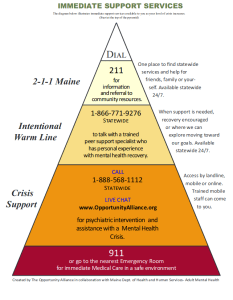
Maine Department of Education’s Mental Health Specialist, Bear Shea, has created a VERY helpful 30-minute video, designed for those who are leading in education, and filled with information and useable actions steps for ensuring that you are able to do your best.  Please consider giving yourself 30 minutes to watch, and then to give yourself the time and space for self-care going forward; your leadership is being counted on now more than ever. The video can be accessed on YouTube, A Conversation About the Impact of COVID-19 on School Leadership; please share with all for whom this may be helpful, and please reach out to health care providers if you or someone you know needs support.

triangle with phone numbers for help. Call 211, or 911 for an emergency