
Washington County Educator Profile: Charity Williams

Submitted by Sarah Woog from the The Washington County Consortium. 

Meet Charity Williams, Principal at Princeton Elementary School

As I explored ways to best support Washington County educators this year, Charity’s name kept on coming up. “Charity has done some great work implementing practices that celebrate teaching at Princeton Elementary School,” one colleague told me. As I reflect on teaching and how to best support it, I’ve come to believe celebrations are key. I wanted to learn more.

Charity welcomed me to her school a couple weeks ago. I showed up an hour early (long story) and offered to wait until our scheduled time and catch up on some other work. Charity told me to come on over instead. So I showed up at 8:00 AM on a Wednesday morning, somewhat unannounced.

Have you ever walked into a school and felt immediately at peace? Did it ever happen at 8:00 AM? I think we can all admit this can be a bit of an anomaly. (If it’s not for you, please reach out so I may profile you and your school next!) Well, it happens at Princeton Elementary School. And I wanted to know why.

There are many fantastic things that go on at Princeton Elementary. Here are three that stuck out to me: 1) student voice is encouraged and heard; 2) teaching is celebrated; and 3) the surrounding community serves as a partner and resource.

Charity and her staff use restorative practices to support students in making good decisions and learn and move forward when they do not. When a student comes to Charity because of an infraction, she asks three questions: “What happened? Who was affected? How can we fix it?” They even plan an logical consequence together. Teachers are encouraged to engage with students in this manner as well. Charity shared that when she first started as principal, an offending student would say “I’m just a bad kid.” Now they say “I made a bad choice and I can fix it.” I think that’s a lesson in acceptance and reconciliation we could all learn from, even (or especially?) as adults.

It seems folks at Princeton Elementary are constantly learning, and they especially value learning from each other. Twice a month, one educator hosts “open classroom” after the students have left for the day. The entire staff goes to the open classroom and is welcomed with snacks. The host teacher shares what’s worth celebrating in their classroom. Open classroom allows educators to join in celebration while fostering a vibrant learning community.

Community doesn’t stop at the school doors. Charity partners with organizations in her area to bring resources to the school and students that may otherwise have been unavailable. A local church hosts a celebratory turkey dinner for the staff each year as a gesture of appreciation. A health center donates a social worker regularly to help support the implementation of trauma-informed practices. Charity is given a small “slush fund” annually so families may get help with heating expenses when a child is cold at home. The school partners with the local grocery store to have fresh and healthy snacks for the students.

I could write more about what goes on at Princeton Elementary and the work of Charity and her staff. There are many lessons to share. I recently remarked to Charity how I would love to intern under her one day if time and opportunity allowed. She replied she is happy to do this with any current or future administrator. Please, if you feel inclined, reach out to Charity and take her up on this offer (williamsc@su107.org). Not only would such an experience equip you with concrete strategies for supporting educators, students and communities of Washington County, but it would make you proud to be a member of our educational community as well. Princeton Elementary is a model of strength-based problem solving and a true testament to the Downeast way of loving thy neighbor.
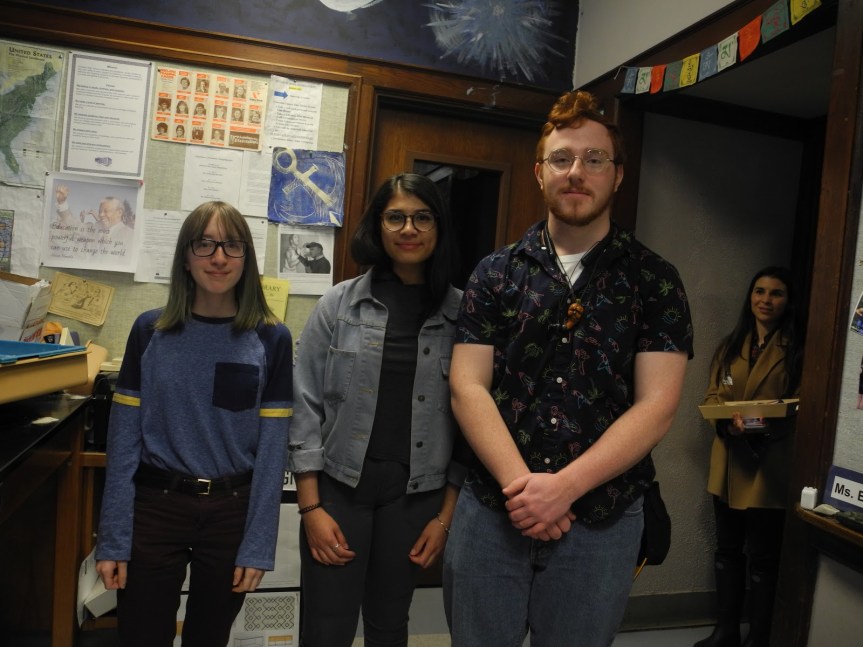
Portland High School Students Present About Their Internships

Image caption: Tyler Karu (right) of Tyler Karu Interior Design looks on as interns pose for a photo after their presentations to a freshman seminar class. From left to right are: Tahj Hebert (City of Portland IT Intern), Gloria Sanchez (Tyler Karu Interior Designs Intern), Will Gordon (Garrand Marketing Intern)

Submitted by Andrea Levinsky, Extended Learning Opportunities Coordinator, Portland High School

About thirty Portland High School students presented about their community-based internships that they have had this year. Students spent at least 45 hours on their internships learning about a career field of high interest to them and earned an elective credit for completing the experience.

Internships allow students to learn career-specific skills. Tahj Hebert, an intern with the City of Portland’s Information Technology department enjoyed using computer science to help people in the community. Tahj’s project was to use arcGIS mapping software to analyze the connection between weather and car crashes. Tahj said that “by the end I was able to create maps using the data available to the city of Portland, use in-software tools to analyze the data presented in the maps, and make my own tools by writing my own python scripts and running them in the application.”

DSCN3739
Interns and mentors pose for a photo after presentations to a Jobs for Maine’s Graduates class. From left to right are: Anne Fisher (Painting for a Purpose Staff), Robby Sheils (Painting for a Purpose Intern), Nate Thorne (Portland Players Intern), Diane Mutoni (Maine Youth Court Intern), Mike Freysinger (Maine Youth Court Staff)

Students are able to learn more about a potential career path through an internship. Will Gordon was able to experience the role of an art director at Garrand Marketing and now better understands what that career path entails. He said that the internship “was an awesome experience, I was able to get in front of other professional artists and learn what that type of job is like.”

Internship are a direct link to future jobs and mentorship. In her internship, Gloria Sanchez was able to solidify her passion for her chosen career path of interior design by interning with Tyler Karu Interior Designs. She gained experience in creating designs and working with clients. Gloria was even hired by the company for a summer job following her internship!

Internships allow students to practice college and career readiness skills. Diane Mutoni, an intern with Maine Youth Court said that in her internship she “Learned how to communicate with people despite the situation and [learned about] listening and understanding without judging.” She also said she learned time-management skills and work better in groups.

Thank you so much to the companies that hosted interns this year including: The Dehler Animal Clinic, Forest Avenue Veterinary Hospital, Portland Parks and Recreation, VIA Marketing Agency, Garrand Marketing, The Maine Audubon, The Maine Jewish Film Festival, Casco Bay Artisans, The Cedars, Maine Youth Court, Painting for a Purpose, Portland Players, Planned Parenthood, Kingspoke, 75 State Street, Systems Engineering, Lee Auto, Signature Soul, City of Portland IT, Nat Warren-White Drama Therapist, The Barron Center, Toni’s Touch Hair Salon, Ryan Lucas Athletic Trainer, Tyler Karu Interior Designs, and Lyseth Elementary School.  

Portland High School is always looking for more internship partners. If your business or organization is interested in hosting an internship next year, please contact Andrea Levinsky, Extended Learning Opportunities Coordinator at levina@portlandschools.org.

Atwood Primary School Principal Jennifer McGee Reflects on “Core Skills”

This submission is from the May 2019 RSU 18 Administrative Report, submitted by RSU 18 Assistant Superintendent Keith Morin.

The Principal’s Pen by Jennifer McGee, Principal of Atwood Primary School 

I was struggling for what I would write about this month.  After all, I have been writing Principal’s Pens for 20 years now.  As I was staring at my blank computer screen, a man, who had been working in the building installing toilet paper dispensers, appeared at the door of my office.

“Are you the principal,” he asked peering around the corner.

“I am,” I said, rising from my seat.  

“Good, I want to talk to you,” he said extending his hand to shake mine.  I’m always a bit nervous, never knowing what I’m about to hear. And then he continued, “Ma’am,  I have been working in school buildings for 38 years, and I have NEVER done this before…but I want to tell you, you have the nicest bunch of children I have ever seen.  They are so polite, so nice. I want to make a donation to your school.”

He went on to tell about the thousands of schools he had been in for the past 38 years, and could not believe how delightful and well behaved our children are…and so young!  

That visit, prompted this month’s Principal’s Pen.  

This entire school year, I have been taking a course called The Educational Leadership Experience.  Each month, a group of Maine educator’s tour businesses in Maine that are on the rise and hiring! It’s been a wonderful experience, and one of my take-aways is this:  soft skills have become core skills.

In the past, employers used to refer to traits like manners, punctuality, interpersonal skills, and work ethic as “soft skills”. No longer. Now they are called “core skills”.   The reason for this change is simple. If people don’t possess these essential skills, they will not keep their job. Workplaces are demanding their work force arrive with these core skills in tact.  And I happen to agree.

Manners matter.  And manners in all shapes and forms make a difference.  When I was a child, we sat at the table and had dinner as a family. My elbows were not allowed on the table, my napkin was placed in my lap, we were expected to chew with our mouths closed and not talk with our mouths full.  We also said “please” and “thank you” when we passed food to one another.

My Mom was a stay-at-home-mother, so family dinners were a regular thing.  When I was raising my children, we had more than a few dinners in the car…and admittedly, family dinners around the table were rare…but…manners were expected. Always.

At the beginning of the school year, here at Atwood, during our very first town meeting, we begin talking about the importance of manners.  And our duty teachers are wonderful about reminding the children to say “please” and “thank you” as they go through the breakfast and lunch lines.  And you all are certainly doing your part, because today a complete stranger noticed how very polite your children are!  So there: core skills…check!

I think it was kind of symbolic that this repairman also said he wanted to donate to our school because of the kindness and politeness of our students. It serves to show us that unexpected and surprisingly wonderful results can come from positive interpersonal skills.   

Children can learn this too.  I know, when my children were small, I didn’t want rude friends over to our house to play. I wanted the polite, well-behaved, nice children!  So there are rewards for manners.

And it feels good to be polite and kind.  A first grader skipped into her classroom on her way in from recess, “I held the door for my friends,” she said!  She felt good inside. As adults we like that feeling too. That’s why sometimes people pay it forward in the Dunkin Donuts drive thru line, that’s why we have “secret pals” at work….to leave each other random surprises, and that’s why it feels good to bring a bouquet of flowers to someone who does not expect them!  Giving really is a selfish act…because it feels so great!

So ultimately my message for this month’s Principal’s Pen is to say: Keep it up parents!  You are doing a great job raising polite children who want to do the right thing. A random stranger working in our building watched and listened to your children, and he said they were the BEST children he had ever encountered in his 38 year career, and that’s pretty great.   

Keep at it!  Manners are core skills that will serve your children well their whole lives.  You may feel like you are the “nag police” when you insist your children say “please” and “thank you” and “excuse me” and “I’m sorry” and “chew with your mouth closed”, but you are setting them up for a lifetime of exercising solid core skills that will serve them well every single place they go!  People notice.

This story was also featured in the OC NJ Daily Newspaper.

CDC Notifies Public of Confirmed Measles in Maine

Maine Department of Education is sharing the notice provided by the Maine Center for Disease Control regarding a school aged student with a confirmed case of Measles. Schools that were directly involved/at risk have been contacted and have received guidance from the CDC epidemiologist.

If schools who are not affected are contemplating notification beyond what has already been provided to the media by the CDC, the following questions should be considered when making the decision:

    1. What message do you want to send that isn’t already in the news/social media?
    2. What are you telling families to do in response to the information?
    3. Who is going to be handling the parent response?

If school personnel have further questions, we encourage local conversations with the school nursing staff, who are in contact with Emily Poland, School Nurse Consultant at the Maine Department of Education.


PRIORITY NOTICE: Seeking Public Comment for a Tydings Amendment Waiver

The Maine Department of Education (DOE) is seeking 30 days of public comment from May 22 – June 20, 2019, on a Tydings amendment waiver application (waiver from §421(b) of the General Provisions Act) to the U.S. Department of Education (USDOE). The Tydings amendment waiver seeks an extension to the availability of Elementary and Secondary Education Act (ESEA) §1003(a) funds awarded during Federal fiscal year (FY) 2017.

Maine DOE Leadership participated in a call with USDOE program staff on Friday, May 10, 2019. During this call, the USDOE outlined next steps regarding Maine’s submission of an amendment to the Maine ESSA State Plan. The Maine DOE is working to provide the necessary information as expeditiously as possible. During this time of pause, the Maine DOE is unable to utilize 1003(a) funds. USDOE approval of the Tydings amendment waiver would allow the Maine DOE to make available 1003(a) funds to Maine schools identified for tiered supports, once the pause is lifted.

The U.S. Department of Education requires state educational agencies, when seeking waivers from statutory or regulatory requirements, solicit public comment on the application, respond to public comments, and provide evidence of the available comment period. The Maine Department is requesting the period of availability for $2,578,500.00 of 1003(a) funds be extended from September 30, 2019 to September 30, 2020.

A copy of the letter seeking waiver from §421(b) of the General Provisions Act can be downloaded with key elements of the request included below.

Federal program affected by the requested waiver

Maine’s Model of Support for eligible Tier III (Comprehensive Supports and Intervention or CSI) and Tier I (Additional Targeted Supports and Intervention or ATSI) support under section 1003(a) of ESEA, as amended by the ESSA of 2015, is immediately impacted by the Department’s waiver request. This request is seeking to extend the availability of $2,578,500.00 to support eligible Maine schools.  The funding will assist schools in engaging in whole-school reform by meeting school and student needs.

Impact to Student Achievement

Waiving §421(b) of the General Provisions Act (Tydings waiver) will directly impact student achievement by allowing the Maine Department of Education to provide increased support for school and classroom leaders during the 2019-2020 school year. Maine is committed to providing a differentiated method of support to struggling schools. Maine’s Model of Support includes coaching and mentoring for school leaders, evidence-based professional learning for educators, and content-specific instructional coaching in classrooms. This process requires all eligible Tier III schools to annually partner with educators, families, and community members to complete a comprehensive needs assessment (CNA). During this process each school team analyzes local academic and non-academic data, identifies promising practices and concerning trends, determines root cause,and creates meaningful goals and a plan for continuous improvement.

Monitoring

The Department will continue to work with schools eligible to receive Tier III (CSI) and Tier I (ATSI) support to ensure funds are utilized in a manner that is reasonable, necessary and allowable under the ESEA, as amended by the ESSA of 2015. The Maine Department of Education will continue to ensure proposed uses of funds align with the school’s completed CNA.  Schools eligible to receive Tier III (CSI) supports will continue to document all school improvement related work within DirigoStar (Indistar), the Department’s online project management tool. Each school is also supported and monitored by an assigned school leadership coach. Maine DOE leadership and instructional coaches visit each Tier III eligible school several times throughout the school year.

Continuity of Services to Students

Schools will continue to utilize their completed CNAs to direct and implement the work without negative impact to specific student populations. The extension to the period of availability of funds will ensure schools will have an increased opportunity to access funds to further target supports and meet the needs and goals of the schools, students, and educators as determined in the CNA. Schools will continue to share and engage with communities and families in ways they have found beneficial, and which meet the needs of schools and their communities.

Comments may be submitted to: ESSA.DOE@maine.gov

Free Training, Technical Assistance, Equipment and Materials for Public Preschool Programs

The Maine Department of Education (DOE) has received a grant from the US Department of Education to support public preschool teachers, special educators, principals and special education directors in providing high quality classroom environments and inclusion practices for 4-year-olds.

The program is being offered through Maine Roads to Quality Professional Development Network (MRTQ PDN), a University of Maine System partnership between University of Southern Maine (USM) and University of Maine (UMaine), that includes the University of Maine Center for Community Inclusion and Disability Studies (CCIDS) which has expertise in providing training and technical assistance around inclusionary practices.

MRTQ PDN will contract with Maine DOE and partner with Child Development Services to provide online training and technical assistance to 3 classrooms of 6 participants each. Teams must include the preschool teacher, ed tech, principal, special education director, elementary special education teacher, and a CDS consultant or teacher. The purpose of team participation is to ensure consistent understanding and application of the course content so that high quality inclusive practices will be supported and sustained.  All team members will receive certificates of contact hours which support certification renewal and/or local professional development requirements.

This project will serve as a pilot to help Maine DOE gather information on what schools need to best support all preschool age children, including those with special needs and disabilities.

Upon completion of training and technical assistance, each public preschool classroom teacher who has participated will receive $1500 in mini-grants for materials and supplies to support high quality preschool inclusionary environments.

For more information, or FAQ view the application or contact Nicole Madore at Nicole.madore@maine.gov


End of School Year 18’-19’Checklist for Completing Reports

The following checklist is designed to assist districts with publicly funded students in completing required end of year reports.  The dates listed after each report are when the report is open for entry and due for certification, if required.

Synergy:  The following items are available in the Synergy Student Information System. Please visit the Synergy Instructions Helpdesk Page for Synergy codes to be used for the items below.

   Update Attendance – All students with an enrollment must have attendance entered.

   Update Truancy – All students who have met the threshold for truancy must have a truancy incident entered.

  Special Education – exit any students who have left special education: Special Education will not need to be ended unless the student is exiting the special education program. Special Education services will need to be          uploaded each year.

   Update Behavior – Note: all enrollments exited with an expulsion must have an expulsion incident in the Behavior module.

   Update/End ALL Enrollments (done last):

  • DOE will NOT be automatically ending enrollments
  • Concurrent enrollment MUST be ended before the primary enrollment can be ended
  • All students will need to be exited on their actual last day of school. This may be verified using “Attending Student Report”
  • June 30 should not be automatically populated for the last day of school.
  • Future exit dates that are more than 7 days out are not permitted in the system.
  • Ending a student’s enrollment will end Economic Status and Truancy – to avoid this, update Truancy records prior to ending enrollments
  • Ending enrollments will prevent you from manually updating Attendance Data. Once an enrollment has been ended, attendance data can only be modified by uploading the data.
  • New enrollments will need to be uploaded/entered as well as special education information each school year.

Annual End of Year Reports and Certifications:

The following items are Annual Reports for the 2018/2019 school year. Instructions for these reports can be found here:

https://www.maine.gov/doe/data-reporting/collection/helpdesk/resources/data-reporting-instructions

The report listed below is linked directly to its corresponding certification report in NEO

Graduation Phase I : April 1 – May 15

Graduation Phase 1 Instructions

Maine Schools and School Approval – Verified and certified by Superintendent by May 3 – June 14th

Instructions for Maine Schools

Accountability– Verified and certified by Superintendent. May 13 – June 21

Accountability Report Instructions

Attendance – Verified and certified by Superintendent. June 4 – June 29

Attendance Reporting Instructions

Behavior – Verified and certified by Superintendent. June 4 – June 29

Behavior Reporting Instructions

Special Education Exit Report – Verified and certified by Special Ed Director or Superintendent. June 3 – June 30.

Special Education Exit Reporting Instructions

Truancy – Verified and certified by Superintendent. June 4 – June 29

Truancy Reporting Instructions

Bullying reporting –  Verified and certified by Superintendent. June 15 -June 29.

Bullying Reporting Instructions

Report of Adult Education for Subsidy Purposes–  June 1-July 15.

EF-M-39 Report of Adult Education Instructions

School Health Annual Report.  May 25 – July 31.

School Health Annual Report Instructions

Restraint and Seclusion Report – Verified and certified by Superintendent. June 15 – August 1.

Restraint and Seclusion Reporting Instructions

Graduation Phase II: July 1 – August 30

Graduation Phase II Instructions

Q4 Actual Balance Sheet July 1 – August 23

Actual Balance Sheet Instructions

Q4 Actual Expenditure July 1 – August 23

Actual Expenditure Instructions

Q4 Actual Revenue July 1 – August 23

Actual Revenue Instructions

Q1 Budget Expenditure – Due by 8/2/2019 or 30 days after the budget passes, whichever is later

Budget Expenditure Instructions

Q1 Budget Revenue (coming soon) – Due by 8/2/2019 or 30 days after the budget passes, whichever is later.

Budget Revenue Instructions

Contacts and Questions:  If you have questions about these reports, (i.e. what should be entered) please contact the specialist listed below:

Attendance: Trevor Burns 624-6678 Trevor.R.Burns@Maine.gov

Maine Schools: Katherine Warren 624-6716 Katherine.Warren@Maine.gov

Special Education: Brandi Giguere 624-6648 Brandi.A.Giguere@Maine.gov

Financial Reports: Tyler Backus 624-6635 Tyler.Backus@Maine.gov

Truancy: Gayle Erdheim 624-6637 Gayle.Erdheim@Maine.gov

School Approvals: Pam Ford-Taylor 624-6617 Pamela.Ford-Taylor@Maine.gov

Behavior/Bullying/Restraint and Seclusion: Sarah Adkins 624-6685 Sarah.Adkins@Maine.gov

Accountability: Katherine Warren 624-6855 Katherine.Warren@Maine.gov

School Nurse Report: Emily Poland 624-6688 Emily.Poland@Maine.gov

If you have questions about accessing the reports, please call or email the helpdesk, 624-6896 or MEDMS.helpdesk@maine.gov

If you do not have credentials for Synergy or NEO, the district superintendent may grant access using the appropriate webform on the Helpdesk Page:

Synergy Access Request

NEO Access Request

Transformational Leader’s Network Summer Conference

School principals, this is all about YOU! Join us for a great professional development opportunity that allows you to focus on goals that matter to you. Therefore, please come with two goals for your school and two goals for your personal professional development!

Hosted by: Maine Department of Education

Special Presenter: Gordon Donaldson, Fran Farr, Stephen MacDougall

Cost: DOE will cover the costs for the conference registration, hotel lodging, daily breakfast and lunch (dinners will be on your own), and required texts. Contact hours for the conference and for TLN sessions throughout the year may be used for recertification

Dates:  June 23, 2019 to June 26, 2019. No activities planned for Sunday, and dismissed by 2 p.m. on Wednesday.

Location:  Senator Inn

The Maine Department of Education invites you, as the leader of a Maine school, to take advantage of a great opportunity to join the Transformational Leaders’ Network (TLN) for a yearlong experience. The Network brings principals together to support school improvement and, most importantly, to promote leadership growth.  The TLN is part of DOE’s commitment to support schools trying to improve.

DOE will cover the costs for the conference registration, hotel lodging, daily breakfast and lunch (dinners will be on your own), and required texts. Contact hours for the conference and for TLN sessions throughout the year may be used for recertification.

Principals will bring their own school improvement goals to the conference and, in a variety of formats, draw up plans for their leadership work in the coming school year.

What are the objectives of the TLN?    

  • Establish a supportive learning network
  • Develop knowledge of the resources available to you and your staff to assist in successfully transforming teaching and learning
  • Reduce the isolation that you may often feel by connecting you with other leaders engaged in improving their schools
  • Provide a forum for celebrating successes and addressing challenges with your colleagues


Maine DOE Data Management Systems Summer Training

The Maine Department of Education Data Team is holding their annual summer training during the first two weeks of August.  The focus of the training this year will be on tips and resources to assist districts with their data reporting, and viewing/certifying their reports. The sessions will be focused on sharing resources to assist districts with the data tasks required.

Training Dates and Locations

August 6, Caribou High School, 308 Sweden St Caribou, ME 04736

August 7, Brewer High School, 79 Parkway south Brewer, ME 04412

August 8, Ellsworth Elementary/Middle School, 20 Forrest Avenue Ellsworth, ME 04605

August 12, Cony High School, 60 Pierce Drive Augusta, ME 04330

August 13, Mt. Blue High School, 129 Seamon Rd Farmington, ME 04938

August 14, Mt. Ararat Middle School, 66 Republic Avenue Topsham, ME 04086

August 15, Buxton Center Elementary School, 912 Long Plains Road Buxton, ME 04093

All sessions will begin with registration at 8:30, with presentations beginning at 9.  We will serve a light lunch and will finish no later than 4:00.  Coffee and water will also be provided throughout the day.

Topics for each session:

  • How student and staff data is used for EPS and Accountability
  • What’s new for 2019-2020
  • Accurate, Complete and Timely Data Submissions
  • Data Security
  • Our Website and Where to find helpful resources
  • Data Collection and Reporting Calendar
  • Maine Schools and School Approval changes
  • NEO Staff – Entering Staff information
  • MEIS – Maine Educator Information System
  • Synergy – Manual and Uploads
  • Graduation (NEO) requirements and reporting
  • Student Reports (NEO) – where to find them and how to utilize them
  • Behavior, Truancy and Attendance (NEO) – importance of these reports and important resources

To register for the training, please visit Summer 2019 Training Registration.

If you have any questions, comments. or concerns regardin these training sessions, please contact Ryan Cunningham Maine DOE Data Systems Helpdesk Manager at (207) 624-6809 or Ryan.L.Cunningham@maine.gov.

Reinvigorate Your Science Classroom

Teachers of science, do you find yourself asking these questions?

  • Now that the Next Generation Science Standards (NGSS) have been adopted as Maine’s revised Science and Engineering Standards, how do I align my lessons?
  • What are the shifts discussed in the Framework and NGSS?
  • What is three-dimensional (3D) learning and what are some of the tools available to help me teach 3D?
  • How can I maximize student learning in my classes?

These questions and more will be part of the PK-12 summer science lesson study. This professional learning opportunity comes in two phases:

  1. A book study on Visible Learning in Science via Zoom
  2. Two days of face-to-face training in Augusta with Peter McLaren, national expert and member of the NGSS writing team, and Shari Templeton, DOE Science Specialist, on August 6th & 7th. Participants will utilize A Vision and Plan for Science Teaching and Learning as they learn how to re-purpose and plan lessons that align to the new standards.

This training is limited to 25 participants, in order to maximize individual interaction. Priority will be given to ensure geographic diversity from the various regions of the state. The cost for the professional learning is $75, which includes resources and meals. Upon completion of both phases, teachers will receive a $300 stipend, reimbursement for mileage, and overnight lodging.

To apply, go to http://bit.ly/SciApp19

FMI: contact Shari Templeton, Science & Technology Specialist, at shari.templeton@maine.gov