Maine youth have shown they want to take action on things that matter in their community. That is why Volunteer Maine, the state service commission, is offering $1,500 mini-grants to support youth-led projects through its Semester of Service grant program. Applications are due on or before November 2, 2023.
Youth groups in schools, faith communities, service organizations, and nonprofits are eligible to apply and participate. The Semester of Service begins on Martin Luther King Day of Service in January 2024 and ends with National Youth Service Day in April 2024. Proposals that tackle issues related to climate, mental or physical health, and housing are encouraged.“Youth-led” means individuals 17 or younger take the lead in all aspects of the initiative (research, decision-making, design, implementation). Advisors over 18 years old are resources and process facilitators. Youth-leadership is critical because it develops young people’s knowledge, skills and confidence to be catalysts for positive change within their communities.Participating youth groups are asked to learn what Dr. King meant by the “Beloved Community” and reflect on what their actions can contribute to making it a reality in their locale. “The Beloved Community” is a term first coined in the early 20th Century by the philosopher-theologian Josiah Royce, b1855 – d1916. For Dr. King, the Beloved Community was not an altruistic goal but rather a realistic, achievable goal. It could be attained by people working together to end poverty, hunger, homelessness, racism, prejudice, violence, bullying, and other conditions that divide or weaken a community.
Proposals for youth-led projects will be accepted from organizations with youth programs or youth constituents, 17 years old or younger, that are Maine public or private nonprofits, state/county/local units of government, higher ed institutions, faith-based organizations, Indigenous communities, and local schools.
Regardless of the type of youth group, the legal applicant must have an employer identification number (EIN) or taxpayer identification number (TIN) and, if selected, accept responsibility for signing the grant agreement, accounting for grant funds, and submitting a report on the outcomes of the project. Awards will not be made to individuals.
For more information contact Maryalice Crofton, Executive Director of Volunteer Maine at (207) 624-7792 or maryalice.crofton@maine.gov.
About Volunteer Maine
Volunteer Maine, the Maine Commission for Community Service, builds capacity and sustainability in Maine’s volunteer sector by funding service programs, developing volunteer managers and service-learning practitioners, raising awareness of the scope and the impact of the volunteer sector, and encouraging an ethic of service.
The Maine Department of Education (DOE) launched a new podcast today hosted by Commissioner Pender Makin featuring conversations with educators, school staff, and students. The monthly podcast, What Holds Us Together, highlights the great things happening in public schools across Maine and how public education connects us. | More
School leaders, teachers, and staff are often tasked with helping our students and their families grapple with what’s happening in the news. The Maine Department of Education (DOE) has compiled the following list of resources to assist educators in helping students process the violence, terror, and news coming from the Middle East. | More
If your School Administrative Unit (SAU) is opening or expanding a Pre-K program in the 2024-2025 school year, you are eligible to receive funding on your FY25 ED279 for children you enroll in these new or expanded Pre-K programs in 2024. This means you will receive the funding for enrollment in the same year that you enroll the Pre-K children, without a year delay. | More
Public Law 2023, Chapter 450 amends 20-A MRSA §7001, 7002, 7258, and 8305 to amend the upper age limit to under 22 years of age, changes hearing impairment to deafness, including hearing loss, changes serious emotional disturbance to emotional disability, and changes deafness and blindness to deaf-blindness. Public Law 2023, Chapter 450 also amends outdated language by changing the term pupil evaluation to individualized education program. These changes are now reflected in the revised MUSER. | More
As a result of the First Special Session of the 131st Maine Legislature, Resolves 2023, Chapter 44, “Resolve, Directing the Department of Education and the Maine Municipal Bond Bank to Amend Their Rules Regarding the Maine School Facilities Finance Program and the School Revolving Renovation Fund” effective October 25, 2023 directs the Maine Department of Education (DOE) and the Maine Municipal Bond Bank to amend their rules to require: (1) that the maximum total loans from the fund for repair, renovation, and improvement projects for Priority One, Priority Two, Priority Three, Priority Four and Priority Five be increased from $4,000,000 to $8,000,000, and (2) that the maximum loan amount from the fund to address each priority level in a school building be increased from $1,000,000 to $2,000,000 within any 5-year period. | More
As a result of the First Special Session of the 131st Maine Legislature, Public Law 2023, Chapter 460 was signed by Governor Mills on July 27, 2023. This law, An Act to Require Public Schools to Offer Training for Secondary Students on the Administration of Naloxone Hydrochloride requires all Maine public schools to offer training to secondary students in the administration of naloxone hydrochloride in nasal spray form. | More
The Maine Department of Education (DOE) invites students, friends, families, community members, educational organizations or associations, co-workers, and supervisors to nominate school employees for the Recognizing Inspirational School Employees (RISE) Award. | More
At the beginning of the 23/24 school year, Limestone Community School was facing a need for an ESOL (English for Speakers of Other Languages) educator to meet the federal requirements of newly enrolled students. As the language use survey indicated a need for assessments, Principal Ben Lothrop recognized that while a 660-certified teacher wasn’t necessary on-site in the past, now it was. He first posted a position for a 660-certified educator with no success. In rural communities in Maine, finding a certified multilingual learner educator is often difficult, as it does fall in the US Department of Education’s teacher shortage. | More
Project G.R.O.W. (Garden Roots & Outdoor Wellness) at Mt. Ararat High School has taken off! The program is led by Darcy Baggett and Becca Norklun. Throughout the 2022/2023 school year, they had garden involvement in a variety of ways, all of which contributed to meeting their impact goal of 1870 student hours. | More
Starting in December, the Maine Department of Education (DOE) is hosting an asynchronous book study on student engagement based on two books: Reimagining Student Engagement and Teaching Students to Drive Their Learning. Educators will receive a free copy of each book. | More
(Pictured: Educator Amy Trombley, with students Sustada Ma, El-Shammah Nsadha, and Ammala Ma)
At the beginning of the 23/24 school year, Limestone Community School was facing a need for an ESOL (English for Speakers of Other Languages) educator to meet the federal requirements of newly enrolled students. As the language use survey indicated a need for assessments, Principal Ben Lothrop recognized that while a 660-certified teacher wasn’t necessary on-site in the past, now it was. He first posted a position for a 660-certified educator with no success. In rural communities in Maine, finding a certified multilingual learner educator is often difficult, as it does fall in the US Department of Education’s teacher shortage.
“In rural areas across the state of Maine like Limestone and Aroostook County, we struggle to find qualified regular education teachers, much less anything more specialized like an ESOL teacher. In the past, I’ve had to ‘grow my own,’ and this is no different. It’s a great opportunity for the teacher, our students, and the local area as more and more people with various cultural and language backgrounds are moving into our area.”
The next step was for Lothrop to identify an educator who may want to pursue the emergency certification for 660. Title I teacher, Amy Trombley, jumped at the opportunity. “ESOL is a very rare certification, especially in this rural area of Maine, but it is still very much needed. I have a history of working with multilingual learners before my teaching career and loved the experiences that it brought with it. It is a very rewarding job! My main goal in teaching is to make sure the needs of every single student is met. With this certification, I can ensure needs are met for all demographics and make the education experience for multilingual students is that much more equitable.” Trombley applied for and received emergency 660 certification and then enrolled in the University of Southern Maine in the Teaching English to Students of Other Languages (TESOL) program with the District’s support. She has also taken advantage of free professional learning offered by the Maine Department of Education (DOE): WIDA webinar series, “Scaffolding Learning through Language.”
At the Maine DOE, we recognize an increased demand for 660 certification specialists in Maine. We are offering a collaborative webinar with Maine DOE ESOL Specialist Jane Armstrong, Certification Coordinator Erin Reinhard, Family Engagement Specialist Melanie Junkins, and the University of Southern Maine TESOL program instructors Dr. Andrea Stairs-Davenport, Dr. Alec Lapidus, and Dr. Melinda Butler. This one hour webinar is designed for administrators and educators in the state who want to learn more about obtaining a 660 certification, the differences in emergency, conditional, and full certification, and a pathway to earn this certification at the University of Southern Maine.
Questions regarding the webinar can be directed to Melanie Junkins (melanie.junkins@maine.gov), Maine DOE Family Engagement and Culturally Responsive Specialist.
Starting in December, the Maine Department of Education (DOE) is hosting an asynchronous book study on student engagement based on two books: Reimagining Student Engagement and Teaching Students to Drive Their Learning. Educators will receive a free copy of each book. In this 8-week online book study, educators will:
Examine what research says about student engagement
Reflect on their students’ engagement and classroom management
Design strategies to increase engagement that works for them and their students
Collect data on how the changes have impacted their students’ engagement
Opportunity to collaborate with teachers statewide
During this book study, educators will be assigned weekly readings, post a response, and comment on other teachers’ responses. Teachers will also need to implement one or more engagement strategies and share their resources and/or reflections. Educators completing the book study will receive 10 contact hours. The book study is perfect for individual teachers, as well as teams of teachers, who want to examine research-based practices that can increase and improve student engagement.
Books: Teachers participating in the book study will receive copies of:
Reimagining Student Engagement by Amy Berry
Teaching Students to Drive Their Learning: A Playbook on Engagement & Self-Regulation, K-12 by Fisher, Frey, Ortega & Hattie
Intended Audience: PK-12 Teachers & Administrators When: December 1-February 2 Where: Maine DOE EnGiNE Platform (There will be optional Zoom sessions to further our discussions and collaboration.) Contact Hours: 10 contact hours available upon completion How:Register here
For more information on this book study, please contact Jaime Beal, Interdisciplinary Instruction Specialist at jaime.beal@maine.gov
The Maine DOE encourages all schools and districts across the State of Maine to learn more about interdisciplinary instruction on our website or by contacting the Interdisciplinary Instruction Team Coordinator at Kathy.bertini@maine.gov
Project G.R.O.W. (Garden Roots & Outdoor Wellness) at Mt. Ararat High School has taken off! The program is led by Darcy Baggett and Becca Norklun.
Throughout the 2022/2023 school year, they had garden involvement in a variety of ways, all of which contributed to meeting their impact goal of 1870 student hours.
In the Fall, the team was able to partner with both the Interact Club and the Brunswick Area Rotary Club to build a tool shed. Two adults and five students built it together over a weekend using the MAITC (Maine Agriculture in the Classroom) grant-funded shed kit. This now enables them to house all of their new tools and equipment, also purchased with the funding, out of harm, and in a locked space.
Perhaps the most exciting project of the year was the collaborative sculpture project, organized by the school’s Art Department, their Community Pathways Program, and Project GROW. They invited internationally known environmental sculptor, Patrick Dougherty and his son, Sam Dougherty to work with roughly 200 students over the course of two full days to make large garden sculptures out of local saplings. It was featured on local news and in local papers – a huge success that students are still talking about!
Project GROW Garden Group met weekly, even throughout the winter, to plan the garden’s development, write area businesses and collaborators, harvest and sow Maine native seeds from their own school property, and more. The Leadership group is led by two Garden Coordinators, and eight students of varying high school ages. In the Spring, this group continued their work in the physical garden space, planting, harvesting, and planning new sections of the project’s “campus.”
Science teachers brought their students out to the garden during class time to teach them about the environment, plant and animal biology, and conduct soil science. An estimated number of students who were involved in the program through science classes is 100; some classes did this one time, others used the garden several times throughout the year for their research and outdoor exploration.
The health classes also used the garden to explore healthy living options, such as growing one’s own food, and discussing garden work as an opportunity for physical exercise. More specifically, t
he teacher of the “Fit for Life” course brought her students to the garden each semester, creating short-term visits with long-term impact for approximately 50 students.The Functional Life Skills class, Alternative Education Program, and the Community Pathways programs each used the garden this spring as a place for healthy, hands-on, outdoor learning. Collectively, these programs serve approximately thirty students and do a variety of things appropriate for their students’ needs.
This year, the district’s extended school year program for students with special needs was offered at Mt. Ararat High School, which means that 95 elementary and middle school students had access to Project GROW, as well. Every rain-free day of the 4-week program, these young students could be seen walking the gardens, sampling green beans, exploring our stick sculptures, and playing games.
“As a garden coordinator, it was an incredibly rewarding and unexpected scene this summer,” said one of the Project GROW organizers.
While their goal for student use has been met this year, they still hope to increase garden access even further. The Project organizers believe all academic disciplines at MTA can benefit from the use of Project GROW.
Follow along on their new Instagram account: @MTA_ProjectGROW
This story originated in the Maine Agriculture in the Classroom Newsletter where you can find more good news, grants, resources and more. To submit a story or an idea to showcase the great things happening in Maine schools email Rachel Paling at rachel.paling@maine.gov.
Public Law 2023, Chapter 450 amends 20-A MRSA §7001, 7002, 7258, and 8305 to amend the upper age limit to under 22 years of age, changes hearing impairment to deafness, including hearing loss, changes serious emotional disturbance to emotional disability, and changes deafness and blindness to deaf-blindness. Public Law 2023, Chapter 450 also amends outdated language by changing the term pupil evaluation to individualized education program. These changes are now reflected in the revised MUSER.
With respect to the change initially made by emergency rule, the Maine Department of Education (DOE) determined that the funding structure previously outlined in Section XVIII.3.C(2) of MUSER for private schools that serve exclusively students with disabilities (“special purpose private schools”) was causing those schools to limit or cease operations, leaving some of Maine’s most significantly impacted children without the educational placements they are entitled to by law. Further breakdown of this critical component of the continuum of educational placements would leave the State unable to maintain compliance with IDEA and MUSER. This problem was initially resolved with the emergency rule filing of July 7, 2023. The Department seeks to make the change permanent in this rulemaking process.
This amendment makes those changes and no others.
As required by law, a period of public comment opens October 25, 2023 through November 27, 2023. Written comments may be submitted to Maine DOE Rulemaking Liaison Laura Cyr, State House Station #23, Augusta, Maine 04333; 207-446-8791 or laura.cyr@maine.gov until 5:00 pm November 27, 2023. For documentation purposes, written comments are preferred.
In addition, a public hearing for the revised Rule Chapter 101 will be held in person and virtually on November 17, 2023, from 3:00-5:00 pm at the Burton Cross Office Building, located at 111 Sewall Street, Augusta, Maine 04333, Room 103. As space will be limited, participants are encouraged to attend virtually through Zoom, using this link:
Topic: Rule Chapter 101 Public Hearing Time: November 17, 2023, 3:00 pm Eastern Time (US and Canada) Join Zoom Meeting
Meeting ID: 823 5264 8387
Passcode: 56401141
Timeline for Rulemaking for Rule Chapter 101 – Major Substantive
If your School Administrative Unit (SAU) is opening or expanding a Pre-K program in the 2024-2025 school year, you are eligible to receive funding on your FY25 ED279 for children you enroll in these new or expanded Pre-K programs in 2024. This means you will receive the funding for enrollment in the same year that you enroll the Pre-K children, without a year delay.
If you are planning to start and/or expand public Pre-K in the 2024-25 school year and would like to receive an FY25 estimate Pre-K allocation, please notify the Maine DOE by completing the FY25 Estimate Pre-K Count Data Form before November 8, 2023. There are 3 questions to be answered on the funding survey:
What is your SAU? Choose your SAU from a drop-down list.
Do you have an existing Pre-K program (FY24)? – Yes/No
What is your SAU’s Pre-K Estimated Increase Count (new slots available in new or expanding program)?
SAUs completing the form must also complete the Pre-K Program Application with DOE’s Early Learning Team by April 30, 2024 and obtain program approval.
The FY25 Estimate Pre-K Count Data Collection form is meant to capture the FY25 estimate for new and expanding Pre-K program enrollment. The estimated student count data, in addition to the current (FY24) enrollment in an existing Pre-K program, will be used to provide funding on the FY25 ED279. An SAU’s Pre-K total enrollment number, as reported and verified October 1, 2024, should match the combined existing and estimated increase total that was used to calculate funds in the ED279. After October 1, 2024, an audit adjustment, based on actual enrollment reported in NEO on October 1, 2024, will be made to the Pre-K allocation assigned on the FY25 ED279. Please note that this may increase or decrease funding.
As a result of the First Special Session of the 131st Maine Legislature, Resolves 2023, Chapter 44, “Resolve, Directing the Department of Education and the Maine Municipal Bond Bank to Amend Their Rules Regarding the Maine School Facilities Finance Program and the School Revolving Renovation Fund” effective October 25, 2023 directs the Maine Department of Education (DOE) and the Maine Municipal Bond Bank to amend their rules to require: (1) that the maximum total loans from the fund for repair, renovation, and improvement projects for Priority One, Priority Two, Priority Three, Priority Four and Priority Five be increased from $4,000,000 to $8,000,000, and (2) that the maximum loan amount from the fund to address each priority level in a school building be increased from $1,000,000 to $2,000,000 within any 5-year period.
This amendment makes those two changes and no others.
As required by law, a period of public comment opens October 25, 2023 through November 27, 2023. Written comments may be submitted to Maine DOE Rulemaking Liaison Laura Cyr, State House Station #23, Augusta, Maine 04333; 207-446-8791 or laura.cyr@maine.gov until 5:00 pm November 27, 2023. For documentation purposes, written comments are preferred.
In addition, a public hearing for the revised Rule Chapter 64 will be held in person and virtually on November 17, 2023, from 9:00-11:00 am at the Burton Cross Office Building, located at 111 Sewall Street, Augusta, Maine 04333, Room 103. As space will be limited, participants are encouraged to attend virtually through Zoom, using this link:
Topic: Rule Chapter 64 Public Hearing Time: November 17, 2023 9:00 am Eastern Time (US and Canada) Join Zoom Meeting
Meeting ID: 833 2442 4683
Passcode: 25140325
Timeline for Rulemaking for Rule Chapter 64 – Revised, Major Substantive
As a result of the First Special Session of the 131st Maine Legislature, Public Law 2023, Chapter 460 was signed by Governor Mills on July 27, 2023. This law, An Act to Require Public Schools to Offer Training for Secondary Students on the Administration of Naloxone Hydrochloride requires all Maine public schools to offer training to secondary students in the administration of naloxone hydrochloride in nasal spray form. The law further requires the Maine Department of Education (DOE) to adopt rules on how to train secondary students to administer naloxone hydrochloride in nasal spray form. The training may be provided as extracurricular instruction, is to be delivered by a qualified individual, and that the standards for instruction are based on those of a nationally recognized program, organization, or agency.
Other revisions to the rule account for updates to terminology and practice in CPR and AED administration.
As required by law, a period of public comment opens October 25, 2023, through November 27, 2023. Written comments may be submitted to Maine DOE Rulemaking Liaison Laura Cyr, State House Station #23, Augusta, Maine 04333; 207-446-8791 or laura.cyr@maine.gov until 5:00 pm November 27, 2023. For documentation purposes, written comments are preferred.
In addition, a public hearing for the revised Rule Chapter 41 will be held in person and virtually on November 17, 2023, from 12:00-2:00 pm at the Burton Cross Office Building, located at 111 Sewall Street, Augusta, Maine 04333, Room 103. As space will be limited, participants are encouraged to attend virtually through Zoom, using this link:
Topic: Rule Chapter 41 Public Hearing Time: November 17, 2023, 12:00 PM Eastern Time (US and Canada) Join Zoom Meeting
Meeting ID: 838 7690 8723
Timeline for Rulemaking for Rule Chapter 41 – Revised, Routine Technical
Commissioner Pender Makin Hosts What Holds Us Together, First Episode Features Maine Teachers of the Year Matt Bernstein and Joshua Chard
The Maine Department of Education (DOE) launched a new podcast today hosted by Commissioner Pender Makin featuring conversations with educators, school staff, and students. The monthly podcast, What Holds Us Together, highlights the great things happening in public schools across Maine and how public education connects us.
The podcast launched with a conversation between Makin, 2023 Maine Teacher of the Year Matt Bernstein, and the newly named 2024 Maine Teacher of the Year Joshua Chard. The three discuss what they love about teaching and schools in Maine, the importance of public education, student voice, elevating the education profession, their message to aspiring teachers, and so much more.
“Public education is the most precious common good that we share. Every month, I’ll highlight the inspiring and amazing things happening in Maine schools through conversations with educators, school staff, and students across our state,” said Maine Education Commissioner Pender Makin in the podcast’s trailer.
What Holds Us Together can be listened to and subscribed to on all major podcast platforms, including Apple and Spotify. New episodes to be released on the third Thursday of every month.




 In the Fall, the team was able to partner with both the Interact Club and the Brunswick Area Rotary Club to build a tool shed. Two adults and five students built it together over a weekend using the MAITC (Maine Agriculture in the Classroom) grant-funded shed kit. This now enables them to house all of their new tools and equipment, also purchased with the funding, out of harm, and in a locked space.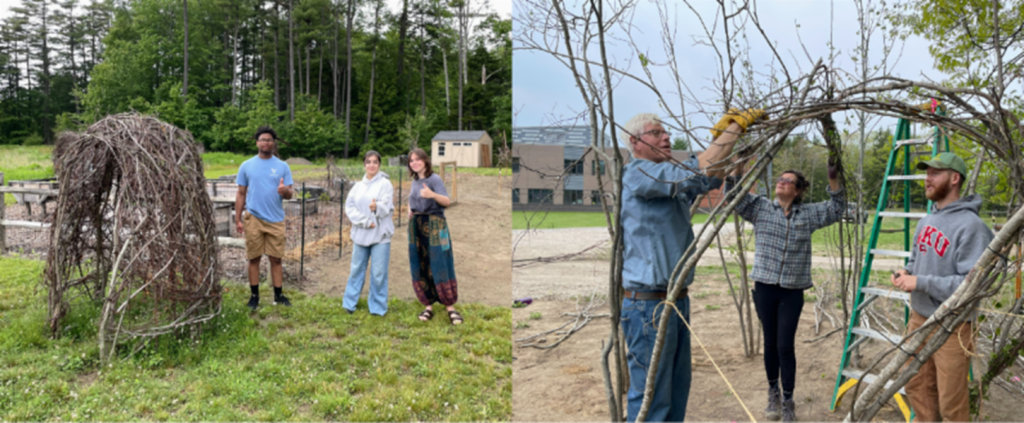

 Maine DOE Newsroom