Maine DOE Offers Two Opportunities to Participate in a 1% Alternate Assessment Support Webinar

Letters were sent out Friday, December 21st to all districts that have identified more than 1% of their students as alternate assessment students.  Three levels of support are offered to all districts.  Districts assigned to a level of support in Tier 2 and Tier 3 are required to attend one of the 1% Support Webinars listed below.  All other districts are welcome to attend.

The webinar will include an overview of the 1% ESSA regulation – Section §1111(b)(2)(D)(I) for providing alternate assessments, including: the definition of significant cognitive disabilities, meeting the criteria within the Participation Guidelines, how to identify students in Synergy, and how to complete the Action Plan for districts over the 1% participation threshold. Concentration on the Action Plan will look at three levels of support and what that means to districts, how to provide justifications, and a look at disproportionality.

Please contact Sue Nay at sue.nay@maine.gov or Ann Belanger at ann.belanger@maine.gov  with questions.

MEA Released Item Workshop Webinars

In November 2018, Maine DOE content specialists provided workshops to help Maine educators utilize the released items associated with Maine’s eMPower English language arts and math assessments and MEA science assessment. For those who were unable to attend, recordings of these sessions are now available.  The recordings can be accessed at the following links:

Educators will find documents related to these sessions in the file boxes included as part of the recordings or via links provided to Padlets incorporated within the recordings. Additionally, educators viewing the recordings will be encouraged to access released item data in the MAARS system.  Access to the released item data requires a user name and password which educators can obtain from their District Assessment Coordinator (DAC).

Please share the recording links with classroom teachers and instructional coaches who might not have been able to attend.

For questions or additional assistance, please contact the appropriate content specialist:

Recording & Materials from Presentation About ESSA & Report Cards

The Maine Department of Education held a presentation on Monday, December 10 about the details of Maine’s Model of School Support under the Every Student Succeeds Act (ESSA) which includes the release of the new, user-friendly, public Report Cards in early January. Below is a link to a recording of the session and links to the PowerPoint Presentation, in addition to all of the handouts from the presentation.

Further questions about Maine’s ESSA Plan, Maine’s Model of School Support, and the Report Cards should be directed to Acting Director of Learning Systems, Janette Kirk Janette.Kirk@maine.gov or ESEA Federal Programs & School Turnaround Director Chelsey Fortin-Trimble Chelsey.A.Fortin@maine.gov.

Maine Education Assessments Released Items Now Available

The Maine Department of Education is excited to announce the availability of released items from Maine’s 2017/18 state assessment. As educators begin to explore the released items for MEA spring 2018, we want to clarify a few inconsistencies within English Language Arts(ELA)/Literacy and Mathematics and provide some information about released items moving forward.

ELA/Literacy:

In grade 3 eMPowerME reading, the passage students read while completing the assessment is not available for reference. Unfortunately, the assessment vendor, Measured Progress, was unable to obtain the necessary permissions to release the passage for public use. Fortunately, the passage used is a commonly known text, Corduroy, (Freeman, D. (1987). Corduroy. Harmondsworth: Puffin Books.). Educators should pay close attention to the information contained within the released item to guide use of the materials. Moving forward, the Maine DOE has taken steps to ensure that all passages utilized in any future released items will have the necessary permissions obtained for both confidential and public release.

Additionally, when the released items first became available on 11/12/18, there was a misalignment in the numbering of the ELA/Literacy released items in the Confidential MAARS portal versus the Released Item Documents found in the Measured Progress’ WordPress site. In the MAARS released item chart, the Essay item, indicated by “Item Type” WP (writing prompt), was originally reported as Released Item #01 in all grades, followed by Reading, then Writing & Language released items.

This is an example of the way ELA/Literacy Grade 3 released items chart first appeared in the confidential MAARS portal:

releasedItems1

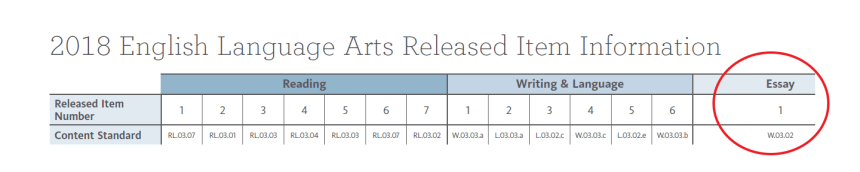
In the Educator Support Materials for the eMPowerME Released Item Documents (pdf), the last 2 pages are Math and ELA/Literacy released item information charts. In the ELA/Literacy chart (Grade 3 example below), the Essay is presented last, and the numbers for Reading and Writing & Language correspond to the item numbers in the released item booklets, but not to the released item numbering in the MAARS chart above.releaseditems2
The placement of the Essay score (Writing Prompt/WP) has been corrected in MAARS Confidential to appear as the last item in ELA, as shown below in the sample snapshot for Grade 3:

releaseditems3

The new, correct placement of the WP/Essay score for each grade is as follows: Grade 3=#14, Grade 4=#17, Grade 5=#14, Grades 6, 7, and 8=#16.

Mathematics:

When the released items became available on 11/12/18, there was a constructed response (CR) item in math omitted from the MAARS confidential reports in every grade 3-8. eMPowerME math released items include multiple choice items (MC), multi-select items (MS), and one (1) constructed response item (CR) per grade level. The math CR items have now been added to MAARS Confidential and are slotted in the tables according to the placement of the CR in the released items. The Math CRs are scored in 2 parts: Concepts & Procedures Standard (CPS) and Mathematical Process Standard (MPS) as shown below in the sample snapshot for Grade 3:
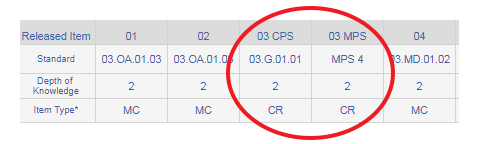
releaseditems4

NOTE: ELA/Literacy & Mathematics – The best way to align the released item numbering from the charts in MAARS to the released item PDFs is to follow the Tables on the last 2 pages of each grade level’s pdf titled “2018 Mathematics Released Item Information” and “2018 English Language Arts Released Item Information”.

Future eMPowerME Released Items:

The Maine DOE is committed to providing as many resources as possible to support instructional practice. One such support is the availability of released items. Unfortunately, the frequency in which the Maine DOE is able to release items is currently limited to 2017/2018 and 2019/2020. We will be unable to release items from the 2018/2019 test administration. There are many factors that have impacted this decision and the Maine DOE is exploring how to increase the frequency of releasing items while not increasing the amount of testing time for students. It should be noted that although released items will not be provided from the 2018/19 test administration, educators will still have access to the released items from the 2017/18 test administration in addition to the already available sample items.

Further questions can be directed to Lee Anne Larsen, Acting Deputy Director, Office of Learning Systems at 624-6628 or Leeann.Larsen@maine.gov

MEA Alternate Science – PAAP Opens First Week of December

The PAAP Task Bank is now open. All teachers assessing students using the MEA Alternate assessment for science in grades 5, 8, and third year high school may now log in.

Measured Progress Log In

Teachers must go to the registration page tab to create a new password.  Please refer to the User Guide for assistance.

Please contact Sue Nay at sue.nay@maine.gov or telephone 624-6774 for assistance.


Using Assessment to Strengthen Instruction in English Language Arts, Mathematics, and Science, K-8

As part of its 2018-19 Assessment Literacy series, the Maine Department of Education will present full-day workshops to continue supporting educators in examining eMPower ELA and math, and MEA science assessment data, connecting that data with locally generated assessment information, and identifying high impact instructional strategies that foster student engagement and achievement of learning standards.

State level assessment provides school systems with a useful lens through which educators can evaluate the effectiveness of curricula and instructional practices. This information can help educators improve programming to increase the number of students meeting expectations for learning standards in English language arts (ELA), mathematics, and science. The availability of released item data and sample state assessment items, coupled with local level assessment information, enables educators to dig more deeply into what instructional practices are benefiting student learning as well as where adjustments could be made to result in greater positive impact.

Join Maine DOE ELA, Math, and Science specialists as they provide professional learning and resources that:

  • Connect state eMPower and science assessment to instructional practices
  • Delve into the roles cognitive demand and stamina play in instruction and assessment
  • Explore protocols for linking state level data analysis with local level data analysis

Participants will select one of 3 content areas in which to focus their learning during the day: English language arts, mathematics or science.  Schools are strongly encouraged to register teams of 3 so that they will have representation in each of the 3 featured content areas. An alternate option is for educators to come as a team representing one content area (e.g. science teachers from a middle school).  Time will be provided during the day for teams to share their learning across content areas and to collaboratively plan for how to disseminate the day’s content back in their respective schools. Lunch will be provided during each full day session which will run 8:30 am – 3:30 pm. Contact hours will be provided.

Cost is $40 per individual or $100 per 3-person team. Registration requires a credit card.  

Workshop Locations/Registration Links Workshop Dates
Keeley’s Banquet Center, Portland January 15, 2019
Snow Date: February 1, 2019
Jeff’s Catering, Brewer January 24, 2019
Snow Date: January 31, 2019
University of Maine at Presque Isle January 29, 2019
Snow Date: January 30, 2019

For further information, please contact Lee Anne Larsen, Acting Deputy Director of the Office of Learning Systems at 207-624-6628 or leeann.larsen@maine.gov.

What Is Progress in English Language Proficiency? #success4ME

Maine defines English language proficiency (ELP) as sufficient skill in English necessary to meaningfully access the curriculum. As part of Maine’s Model of School Support, part of Maine’s rollout of the Every Student Succeeds Act (ESSA), this indicator of school success focuses on English learners and measures the progress they make toward English language proficiency each school year. ESSA requires that each state include an indicator that gauges, “progress in achieving English language proficiency as defined by the State and measured by the assessments within a State-determined timeline for all English learners.”

What does this look like in Maine?

English learners are students who have a primary or home language other than English and are in the process of learning English. Around 3% of Maine’s students are English learners and their schools support them in learning English to succeed academically. They may receive English language support services inside or outside of their regular classes, through programs specifically for English language development, or through a variety of other supports. It usually takes 4-7 years for an English learner to become proficient in English, but this can vary depending on many factors.

Each year, English learners are administered ACCESS for ELLs, an assessment that measures a student’s ability to listen, speak, read, and write in English. A student’s overall score ranges from 1.0-6.0. In Maine, English language proficiency is defined as level 4.5, so the progress in English language proficiency indicator measures how much progress a student makes each year toward reaching level 4.5. A school’s score for progress in English language proficiency is based on the average percentage made towards the annual target for each student, where there are at least ten (10) English learners.

School level descriptors for progress in ELP is as follows:

Emerging Developing Meeting Excelling
The average progress towards the students’ annual target is less than 65% The average progress towards the students’ annual target is between 65% and 80% The average progress towards the students’ annual target is between 80% and 95% The average progress towards the students’ annual target is greater than 95%

How progress in ELP will be presented on the report card:

ELPreportcard1.png

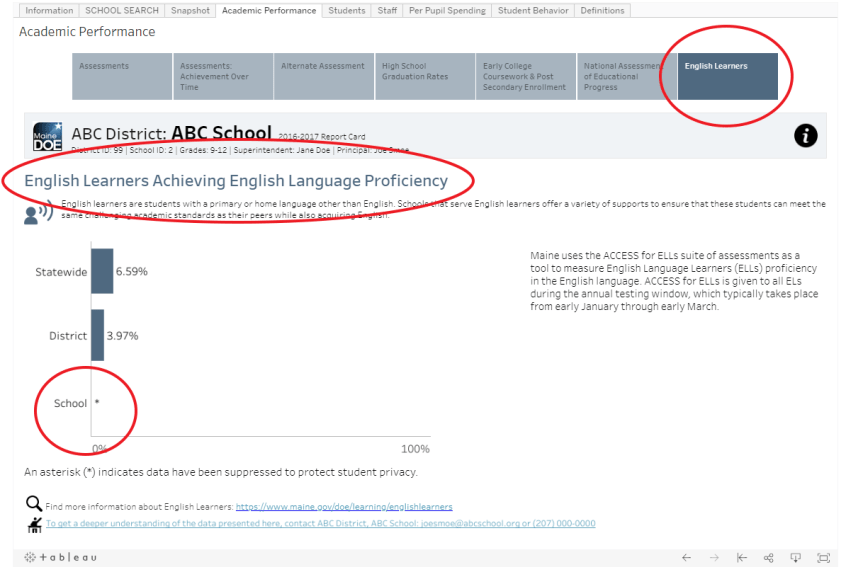
In the example provided below, there are less than 5 students who are English learners and therefore the data has been suppressed (notated by a *).

ELPreportcard2

ELPreportcard3


National Assessment Governing Board Makes Small Changes to NAEP Achievement Level Descriptors

In an effort to reduce the confusion regarding the National Assessment of Educational Progress (NAEP) achievement levels and the misuse of NAEP data, the National Assessment Governing Board (NAGB) slightly modified the names of the performance levels. In the November 18, 2018 posting on the “Curriculum Matters” blog on Education Week’s, there is an update on the small changes made to the achievement levels for the NAEP.

From this point forward, the NAEP achievement levels will contain the NAEP acronym such as “NAEP basic” and “NAEP proficient”.  With the current emphasis on the reporting of student performance in the form of achievement levels, NAGB made this change to reduce the direct comparison of the NAEP levels of proficiency with those used by the individual states.

After each state-level NAEP assessment report is completed, a mapping study is conducted that provides a guide for the examination of state proficiency standards in relation to the NAEP scales.  The publication of the “Mapping State Proficiency Standards Onto NAEP Scales” reports are released much later than the Nations Report Card report and the State Snapshot reports since the data and analyses from these reports is required to conduct the mapping study.

For further information about NAEP, contact Regina Lewis, Maine DOE Coordinator of NAEP & International Assessments at Regina.Lewis@maine.gov.


What Is Academic Achievement? #success4ME

aa ela (blue)
Academic Achievement – English Language Arts (ELA)

Within Maine’s Model of School Support as part of the Every Student Succeeds Act (ESSA), Maine uses data from Maine’s Education Assessments to define the academic achievement indicator as the number of students scoring at a performance level of 3 (meeting state expectations) or 4 (exceeding state expectations).  ESSA requires that each state’s accountability system, in Maine we call it Maine’s Model of School Support, includes academic achievement as measured by performance on the annual state assessments.

Why academic achievement?

Academic Achievement - Mathematics
Academic Achievement – Mathematics

Maine’s strategic plan aims for students to graduate from high school workplace ready; academic achievement is a cornerstone of the Maine’s Model of School Support. Maine administers the Maine Educational Assessments (MEAs) annually to measure student performance in English Language Arts (ELA) and math.

What does this look like in Maine?

Using the cut-scores that have been established for each of the performance levels of the state assessment, students earn a performance level ranging from 1 to 4.

1 – Well Below State Expectation
2 – Below State Expectations
3 – Meets State Expectations
4 – Exceeds State Expectations

The state has established the ambitious goals for each school to improve academic achievement in ELA and math by 20% for each individual eligible student group using the 2016 assessment as the baseline year. This equates to a 1.4% increase in academic achievement for each student group, in each subject area, on an annual basis.

The school level descriptors for academic achievement are as follows:

Academic Achievement – English Language Arts (ELA)

Emerging Developing Meeting Excelling
No eligible student group made their annual target At least one eligible student group made their annual target All eligible student groups made their annual target All eligible student groups exceeded their annual target by at least 10%

Academic Achievement – Mathematics

Emerging Developing Meeting Excelling
No eligible student group made their annual target At least one eligible student group made their annual target All eligible student groups made their annual target All eligible student groups exceeded their annual target by at least 10%

Where eligible student groups (with an “n” size of 10) include: Asian, Black, Hispanic/Latino, Two or More Races, White, Students with Disabilities, Economically Disadvantaged; migrant students, and English Learners.

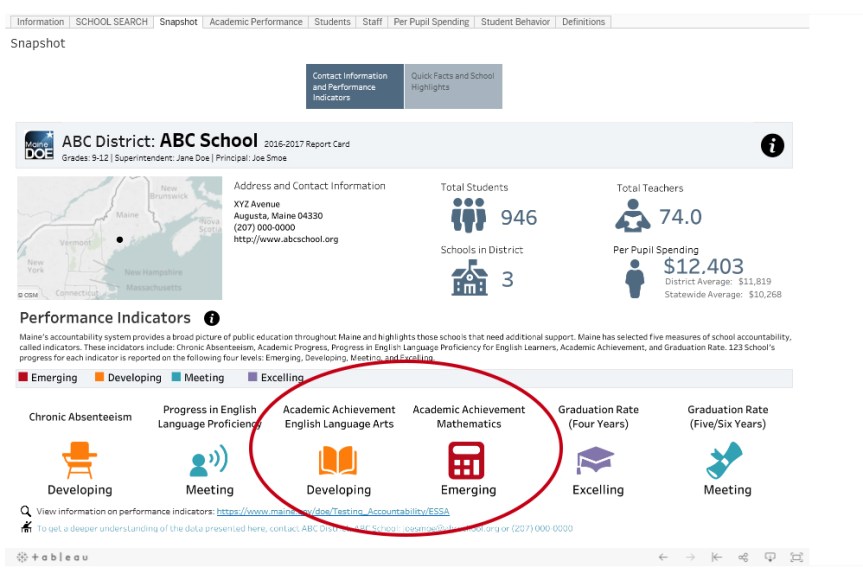
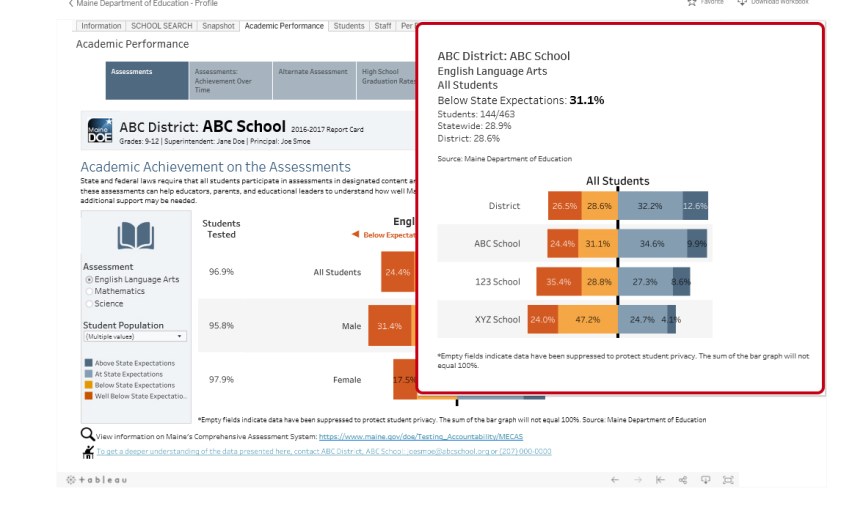
Academic achievement will be presented on the school report card in the following way:

reportcard1aa

The following are examples of elements the user may select to view:

  • Performance of specific student populations
  • National Assessment of Educational Progress
  • English Leaner performance
  • Student performance on the Alternate Assessment

reportcard2aa.jpg

reportcard3aa

Further questions can be directed to Janette Kirk, Acting Director, Office of Learning Systems at Janette.Kirk@maine.gov.

PRIORITY NOTICE: MEA Released Items and Individual Student Reports Available

The Maine Department of Education in collaboration with school districts and schools have verified their 2018 Maine Educational Assessments (MEA) results data within the Maine Assessment and Accountability Reporting System (MAARS). All data in the confidential (login credentials needed), and public sites is now available. Individual Student Reports (ISRs) are also available to districts to download.

This year to support Maine educators, the Department is excited to be able to release items from the math, English language arts (ELA) and science assessments at each grade level in which students in grades 3 – 8 take state assessments. School and district users will also be able to incorporate the released item data in their analysis of student performance. Data regarding district, school and individual student responses to released items are available the confidential MAARS site within Interactive Reports. The actual pdf versions of the released items are available on the maine.onlinehelp.measuredprogress.org/released-items site.

Elements for release include:

  1. The student versions consist of one item booklet per grade, 3-8, that contains each assessed content area (Math, Reading, Writing/Language, Essay).
  2. The associated teacher versions consist of one document per grade, 3-8, that contains each assessed content area and which include:
  • Items as seen on student version
  • Standard alignment notation
  • Answer key
  • Scoring rubrics where applicable
  • Scorer training notes and annotations
  • Exemplary responses where applicable
  • Sample student responses
  • Table of released item information

As a reminder to those who registered, the Department will be using these materials during the scheduled workshops to assist educators in navigating MAARS, examining their data, and linking it to instructional practice.

Further questions can be directed to Janette Kirk, Acting Director, Office of Learning Systems at janette.kirk@maine.gov.