MEDIA RELEASE: Maine DOE Releases 2017/2018 Education Assessment Results

The Maine Department of Education has released the 2017-2018 Maine Education Assessment (MEA) results in the content areas of mathematics, English language arts/literacy, and science.

The Department would like to thank schools, districts, and community members for their continued patience while an additional validation was completed after the initial delay in releasing the 2017/2018 results.

“This year the Department has three years of data from the same assessments which will allow for measurement across multiple years,” said Maine Department of Education Commissioner Robert G. Hasson, Jr. “The new trend lines will assist the Department in determining where support is needed to help increase student achievement across the state.”

The public results can be viewed by school or district and by student group, including grade level groups, in the Maine Assessment and Accountability Reporting System (MAARS).

PRIORITY NOTICE: Delayed Public Release of Maine Education Assessment (MEA) Results

The public release of the Maine Education Assessment (MEA) data scheduled for today, November 5, 2018, has been delayed.

The validation process is taking longer than anticipated and extra time is needed to allow the Department to work with our vendor, Focal Point K-12, to ensure that the data is accurate prior to its release.

The Department is making a concerted effort to complete the validation process so that we can release the results as soon as possible.

Thank you for your patience and understanding as we work through this unanticipated delay.

What is Academic Progress? #success4ME

academic progress ela (blue)
Academic Progress – English Language Arts (ELA)

The Academic Progress indicator, is one of four (4) indicators utilized in Maine’s Model of School Supports and is used for grades 3-8. Academic Progress is defined as the comparison of individual student assessment performance scores from one year to the next, aggregated to the school level.

At the state, district, school, and classroom levels, Maine educators are committed to creating a culture of support and encouragement for families with children experiencing challenges. In the past, Maine has focused solely on achievement and in particular, achievement gaps between student groups. Academic achievement records the number of students on average, who are performing at state expectations. Although this is beneficial to track, when conducting a more detailed analysis of data, academic achievement does not take into account the individual growth of a student.

academic progress math (blue)
Academic Progress – Mathematics

What does this look like in Maine?

Each year students in grades three through eight are administered statewide assessments in both English language arts (ELA) and mathematics. Student performance on the state assessment is scored on a scale of 1 to 4.  A performance level of 3 or above indicates that a student is meeting grade-level expectations. Every student grades 3 -8 who has been in the same school for two consecutive years will receive a progress score by looking at his or her assessment results from the previous year in comparison to the current year. Individual students are assigned scores of 0 to 450 according to academic achievement scores from one year to the next. A score of 100 indicates expected growth. An individual score of less than 100 indicates that a student has not yet made adequate growth. The progress scores of all eligible students are added together and then divided by the number of eligible students.  The resulting number is the school indicator scores for ELA and math.

The above is repeated to determine a progress indicator score for mathematics and a progress indicator score for ELA.

How will academic progress data be presented on the school report card?

The school as a whole will receive a performance measure related to the percentage of students who are making academic progress. Academic progress rates will never be reported at the student level.

The school level descriptors for academic progress are as follows:

Academic Progress – English Language Arts (ELA)

Emerging Developing Meeting Excelling
A score of less than 100 for all eligible student groups A score of at least 100 for at least one eligible student group A score of at least 100 for all eligible student groups A score of at least 150 for all eligible student groups

Academic Progress – Mathematics

Emerging Developing Meeting Excelling
A score of less than 100 for all eligible student groups A score of at least 100 for at least one eligible student group A score of at least 100 for all eligible student groups A score of at least 150 for all eligible student groups

Eligible student groups include: Asian, Black, Hispanic/Latino, Two or More Races, White, Students with Disabilities, Economically Disadvantaged, Migrant students, and English Learners.

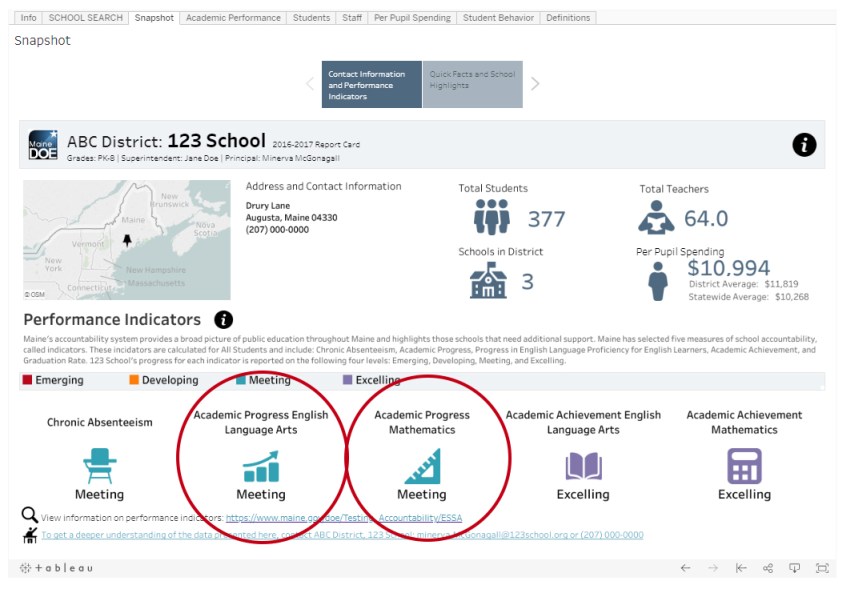
Academic progress data will be presented on the initial page of the report card in the following way:

reportcard1_AP

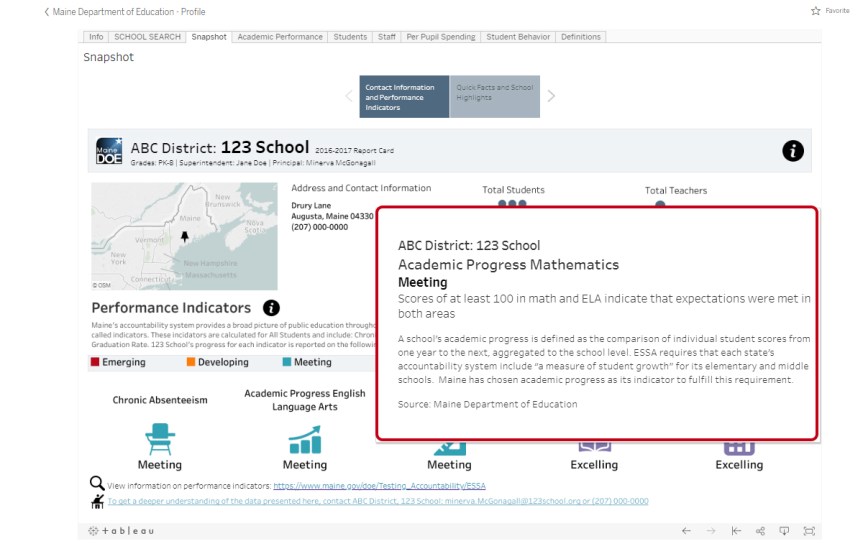
To assist parents and community members in understanding academic progress, the report card provides “hover over” features that explain the definition of the performance level.

reportcard2_AP

Further questions can be directed to Janette Kirk, Acting Director, Office of Learning Systems at janette.kirk@maine.gov

Administrative Letter: Change in English Learner Identification and Exit Criteria

Administrative Letter: 20
Policy Code: IHBEA
To: Public School Administrators
From: Robert G. Hasson, Jr., Ed. D. Commissioner
Date:  October 29, 2018
Subject: Change in English Learner Identification and Exit Criteria

Under the Every Student Succeeds Act, states are required to develop uniform statewide policies for identifying and exiting English learners (ELs). In light of this requirement, the Maine Department of Education has sought to review and refine its policies in order to best meet the needs of its students. Over the past year and a half, the Department has collected stakeholder input from around the state regarding its definition of English language proficiency. Additionally, the Department has conducted extensive analysis of assessment data to determine the level of English language proficiency needed in order to succeed academically on par with non-EL peers.

Following the completion of the review and analysis, Maine’s definition of English language proficiency is now a composite proficiency level (CPL) of 4.5, as measured by WIDA ACCESS for ELLs and WIDA Screener Online. All ELs who attain a composite proficiency level of 4.5 or higher on ACCESS for ELLs will be exited from English learner status. Students who achieved a CPL of 4.5-4.9 in 2017 or 2018 will be retroactively exited as of November 1, 2018. Districts will not need to take any action to exit these students, as the Department will do so automatically.

However, districts must take action to exit recently identified students who are no longer eligible for EL services based on the change in identification criteria. Any student who was identified as an English learner with a WIDA Screener Online CPL of 4.5 must be removed from EL status. To change a student’s status in the state student data system, the student’s district superintendent must submit a request for change in English learner identification, including the student’s Language Use Survey and WIDA Screener Online score report. All requests for change in English learner identification must be submitted by November 9, 2018 to ensure accuracy of 2018-19 ACCESS testing rosters. Please note that if a student identified as an EL has already been administered ACCESS for ELLs, he/she must achieve a CPL of 4.5 or higher on ACCESS for ELLs in order to exit.

ELs with significant cognitive disabilities who qualify for the state alternate academic assessment are administered Alternate ACCESS for ELLs. Please note that the exit threshold for Alternate ACCESS for ELLs has not changed and remains a CPL of P2.

After an EL demonstrates English language proficiency by attaining a CPL of 4.5 or higher on ACCESS for ELLs, federal and state regulations require that schools monitor the student’s academic progress for two years. If during that two-year period a continued need for English language acquisition services becomes apparent, the student must be provided services. Note that in such cases the student will not be designated as an EL in the state student data system and will not be administered ACCESS for ELs.

This Administrative Letter is a supplemental update to Administrative Letter 11, which provides more extensive information about the requirements for serving ELs, including more details on Maine’s EL identification policy.

To assist districts in communicating with students and families about Maine’s new definition of English language proficiency, the Department has developed a student and family guide, translated into the state’s top ten languages.

If you have questions or would like further information regarding serving ELs, please contact April Perkins, ESOL/Bilingual Programs, at april.perkins@maine.gov, (207)624-6627.

Alternate Assessment Workshops – December 2018 Registration Now Open

Teachers administering alternate assessments may register for Personalized Alternate Assessment Portfolio (PAAP – MEA Alternate Science) and Multi-State Alternate Assessment (MSAA- MEA Alternate Mathematics and ELA/Literacy) assessment administration training. All registrations must be received by November 27th.

Teachers administering the MSSA & PAAP assessments should register here.

Training locations include:

Location Date Meeting Venue Address
Presque Isle 12/4/18 Hampton Inn 768 Main Street  Presque Isle, ME 04769
Orono 12/5/18 Black Bear Inn 4 Godfrey Drive  Orono, ME 04473
Augusta 12/6/18 Governor Hill Mansion 136 State Street   Augusta, ME  04330
Saco 12/7/18 Ramada Inn 352 North Street   Saco, ME  04072

For more information please contact Gina Troisi at Troisi.Gina@measuredprogress.org, or contact Sue Nay, Alternate Assessment Coordinator at sue.nay@maine.gov / 624-6774.

Upcoming Maine Assessment Literacy Professional Development Opportunities

As part of the Maine DOE Assessment Literacy Professional Development series, a MAARS webinar and three in-person sessions focused on the eMPowerME assessment (grades 3-8) and science assessment (K-12) have been scheduled.

State Assessment & Released Items Professional Development

As part of the Maine DOE Assessment Literacy Professional Development series the Maine DOE will be hosting three regional sessions in Presque Isle, Bangor and Portland on November 13, 14 and 15, 2018 respectively. Where applicable, the DOE encourages that a team representative across grade spans be in attendance at the session. An opportunity for team time will be incorporated into the days agenda.

Each of the three (3) sessions will focus on the eMPowerME assessment (grades 3-8) and science assessment (K-12) and will include:

  • AM session will primarily focus on Confidential Reports in MAARS
    • Navigation within MAARS* to access data
    • Overview of the state assessment data
  • PM session will primarily focus on the utilization of released items
    • Review of released item data
    • An advanced session for data analysis
      • How this analysis can impact curriculum development and instructional practices

* DACs should ensure that staff attending have necessary permissions and log-in information to access MAARS.

The audience for this session is District Assessment Coordinators (DACs), teachers, principals, and central office staff. Registration begins at 8:30 am with the session beginning promptly at 9 am (until 3:30pm). Lunch will be provided.

Presque Isle – November 13, 2018

University of Maine at Presque Isle
Campus Center – Multipurpose Room
Parking map

Bangor – Orono – November 14, 2018

University of Maine
Wells Conference Center, Orono

Portland – November 15, 2018

Keeley’s Banquet Center
178 Warren Ave
Portland, ME 04103

To register for any of the regional MAARS Review and Released Item sessions please click here.

MAARS Webinar

October 31, 2018
10:00 – 11:00 am

The audience for this session is returning and new District Assessment Coordinators (DACs) and Career and Technical Education (CTE) Directors. The content of the webinar will include:

  • Role of DACs
  • MAARS Public Reports Overview
  • MAARS Confidential Reports Overview
  • How to add/delete/change MAARS roles and permissions (‘districtadmin’, ‘districtuser’ ‘schooluser’ ‘rosteruser’)

The updated above listed roles within MAARS will be a critical element to prepare for the upcoming November MAARS Workshops.

To access the October 31, webinar please use this link.

For questions contact Maine DOE’s Assessment Team at (207) 624-6770 or eric.buckhalter@maine.gov

Balanced Assessment System Webinar Recording Now Available

The first session of an assessment literacy series was conducted via webinar on September 26, 2018 and focused on a Balanced Assessment System. The session included an overview of the planned professional learning opportunities and implementation timeline in addition to reviewing the key components of a Balanced Assessment System. The webinar can now be accessed here:

Balanced Assessment System Webinar (YouTube)

Further professional development opportunities can be found on the Department’s Professional Development & Training Calendar.

ESSA & Accountability: Why does accountability matter? #success4ME

Every element of our education system, including our expectations for students, how we understand if students are meeting those expectations, and how we are working with and supporting teachers and leaders, work toward the goal of ensuring all students are prepared for success after high school. Accountability is one piece of that system.

Accountability systems are intended to help us focus on what matters most, give us a better understanding of what is working well, and determine where we need to make improvements so we can help all students succeed. Just as state standards and assessments set expectations for what students should know and be able to do, state accountability systems set expectations for school performance helping schools determine next steps in accessing available supports from the state.

Statewide accountability systems set goals for achievement and growth for all schools regardless of race, income and zip code, and provide an opportunity for all stakeholders to understand school and district profile, and performance information.

Maine’s accountability system is now known as Maine’s Model of School Support. Through the implementation of the model,  Maine will identify schools eligible to receive additional supports in January 2019.

What is Maine’s Model of School Support?

Maine has moved towards a more purposeful approach to supporting Maine Schools. Maine’s Model of School Supports utilizes the following indicators:

Elementary/Middle Schools High Schools
Chronic Absenteeism Chronic Absenteeism
Academic Progress English Language Proficiency
English Language Proficiency Academic Achievement
Academic Achievement Graduation Rate

As you can see, the indicators remain a constant across grade spans with the exception of academic progress and graduation rate. Graduation rate only applies to high schools and as such is a high school model indicator. Progress can only be calculated when there are multiple years of data and this is currently only possible between grades 3-8 or Elementary/Middle level, therefore, progress is utilized in Elementary/Middle schools.

Data related to these indicators will be utilized to determine performance levels for each student population. Student populations include: white, Asian, black, two or more races, Hispanic, Native American, Native Hawaiian or Other Pacific Islander, economically disadvantaged, English language learners, migrant, homeless, foster care and students with disabilities (data for bolded student groups is included in the model. Data for non-bolded student groups is used for reporting purposes only).

In order for a school to receive a performance level within the above indicators, there must be a minimum count of 10 students. If there are less than 10 students in a student group, the data is not utilized, is suppressed, and the indicator will not be applicable for that specific student group.

The method by which 2018/2019 determinations are made is a new process to Maine containing many new indicators (listed above). The Department in collaboration with stakeholders, believe the inclusion of a wide variety of indicators will provide a more comprehensive view of school success. Maine uses performance on these indicators to determine schools who would benefit from the provision of school supports. Schools determined eligible to receive supports will receive additional assistance from the state and their districts. Additional assistance and support through the Maine Department of Education will include professional development and learning, regional leadership coaching, and other supports as determined by the tier of support.

Comprehensive Supports and Interventions (CSI) or Tier III supports are determined as a result of all student populations within Title I schools experiencing challenges across all indicators within Maine’s Model of School Supports. This comprehensive support assists in accelerating  improvement schoolwide. Schools will receive supports for a period of three (3) years. These are schools similar to those identified as priority schools in Maine’s previous accountability model.

Targeted Supports and Interventions (TSI) or Tier II Supports – are determined as a result of specific student populations experiencing challenges in a specific indicator consistently for three(3) years.  These schools are similar to schools that were previously identified as Focus schools; however, under ESSA, Maine  now must identify any school with a consistently underperforming subgroup of students. Maine will not be making determinations for schools eligible for Tier II supports until the 2019/20 school year and then annually thereafter as four (4) years of data is required in order to determine three (3) years of consistently underperforming.

Additional Targeted Supports and Interventions (ATSI) or Tier I Supports – are determined as a result of a single student population(s) experiencing challenges across all indicators. These determinations will be made on an annual basis. Support is provided to schools due to a need based on the performance of at least one student group.

Upcoming articles in the DOE Newsroom will focus specifically on each of the five (5) indicators.

Questions regarding the above information can be sent to ESSA.DOE@maine.gov or Janette Kirk via email at janette.kirk@maine.gov or 624-6707.


 

Assessment Professional Development and Learning Opportunities

As a follow-up to the September 6, 2018 notice in the Maine DOE Newsroom regarding scheduled opportunities for professional development and learning around assessment, the Department is providing additional information and registration details for upcoming sessions.

Lexile Framework for Reading

On October 9- 11, 2018, the Department in conjunction with MetaMetrics® will be conducting three (3) regional ½ day repeated sessions in Presque Isle, Bangor/Brewer and Portland areas. Each ½ day /3-hour session will provide attendees an overview of the Lexile Framework for Reading and the utilization of Lexile levels to support and impact instructional practice. This session will discuss and review student Lexile levels as determined by student performance on the Spring 2018 ELA eMPowerME state assessment and as reported on 2018 Individual Student Reports (ISRs) to parents.

The intended audience for this session is Special Educators, Librarians, English Language Teachers, English Language Arts (ELA) teaching staff, and elementary school teaching staff.

To register for the Lexile professional development session please click here.

Date Location Session times Registration
October 9, 2018 Elks Lodge

508 Main Street,

Presque Isle, 04769

PM – 12:30 -3:30 pm To register for Oct. 9 sessions, click here.
October 10, 2018 Jeff’s Catering

15 Littlefield Road,

Brewer, 04401

AM – 8:30 -11:30 am

PM – 12:30 -3:30 pm

To register for Oct. 10 sessions, click here.
October 11, 2018 Elks Lodge

1945 Congress Street,

Portland, 04102

AM – 8:30 -11:30 am

PM – 12:30 -3:30 pm

To register for Oct. 11 sessions, click here.

Maine’s Assessment & Accountability Reporting System (MAARS) Review & Released Items

On November 13-15, 2018, the Department in conjunction with FocalPointK-12 will be conducting three, one day sessions in Presque Isle, Bangor/Brewer and Portland areas.

During each morning session, attendees will be provided an overview of MAARS with a focus on confidential reporting elements. Please note, in order for participants to engage fully in this session, participants should ensure necessary permissions to access MAARS have been granted and provided from the District Assessment Coordinator (DAC).

Afternoon sessions will focus on English Language Arts (ELA), Mathematics eMPowerME and Science released items and specifically the impact on curriculum and development review to instructional practice.

To register for the MAARS Review and Released Item session please click here.

The intended audience for this session is Superintendents, Assistant Superintendents, curriculum coordinators, and ELA, Math and Science teaching staff.

Date Location Time Registration
November 13, 2018 Presque Isle Registration 8:30 am

Session 9 am – 3:30 PM

To register for Nov.13 sessions, click here.
November 14, 2018 Bangor/Brewer Registration 8:30 am

Session 9 am – 3:30 PM

To register for Nov. 14 sessions, click here.
November 15, 2018 Portland Registration 8:30 am

Session 9 am – 3:30 PM

To register for Nov. 15 sessions, click here.

For further information or additional questions please contact Janette Kirk, Deputy Director, Office of Learning Systems at janette.kirk@maine.gov or 624-6707.

Reminder to Superintendents: Updating of District Assessment Coordinators (DAC) in NEO

As a reminder to superintendents, Maine DOE is currently in the process of releasing and reviewing assessment results from the 2017-2018 MEA test administration.  We will soon transition into sharing information about the upcoming 2018-19 test administration.

All critical communication regarding the Maine Educational Assessments (MEA) is sent to the individual listed as the District Assessment Coordinator (DAC) within District Roles in NEO.  Please verify the correct individual is listed in NEO. A current listing of DACs can be accessed by downloading the most current version here. (Attached excel of DACs as of today 9/10/18).

If the DAC listed is not accurate, please update DAC information within the District Roles Section on the certification page of the Staff Module of NEO.

  1. Log into NEO
  2. Go to Staff Module
  3. Click on certButton2 and choose Certification Report
  4. Scroll down to the bottom of the screen to the District Roles section
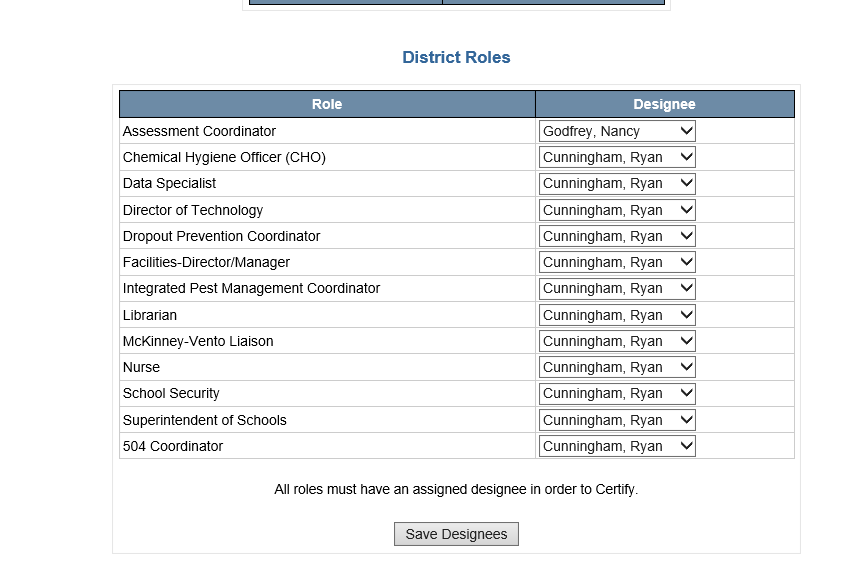
  5. Under Designee – click on the dropdown arrow and select the correct person that will be the District Assessment Coordinator (DAC). The person must already have another position for your district in NEO staff or the person will not show on the list.
    district roles.png
  6. Once the person is selected, Click the Save Designees button to save the information to the database.
  7. If you have issues with the NEO staff module, please send an email describing the problem to MEDMS.Helpdesk@maine.gov
  8. Any other questions can be directed to Eric Buckhalter, Management Analyst eric.buckhalter@maine.gov or 207-624-6770.