K-12 101 Train-the-Educator & SITE ASSESS Trainings

Morning Session – Developing EOPs K-12 101 Training

The REMS TA Center, on behalf of the U.S. Department of Education’s Office of Safe and Healthy Students, is pleased to offer this on-site, 4-hour training that presents important Federal guidance on school emergency management planning. Each school day, our nation’s schools are entrusted to provide a safe and healthy learning environment for approximately 55 million elementary and secondary school students in public and nonpublic schools. In June 2013, the White House released the Guide for Developing High-Quality School Emergency Operations Plans (School Guide), which provides an overview of Federal guidance on school emergency management planning. The School Guide, produced by the U.S. Departments of Education; Justice, led by the Federal Bureau of Investigation; Homeland Security, led by the Federal Emergency Management Agency; and Health and Human Services, incorporates lessons learned from events, like the school shooting in Newtown and the tornadoes in Oklahoma, as well as years of emergency planning work by the Federal government, to present a recommended process, important content elements, and key considerations for school EOP development. In collaboration with their local government and community partners, schools can take steps to plan for these potential emergencies through the creation of a high-quality school EOP. With this K-12 101 training, an expert team will provide an overview of a recommended six-step planning process to create a high-quality school EOP, which includes:

Step 1: Forming a Collaborative Planning Team
Step 2: Understanding the Situation
Step 3: Determining Goals and Objectives
Step 4: Plan Development
Step 5: Plan Preparation, Review, and Approval
Step 6: Plan Implementation and Maintenance

Afternoon Session – SITE ASSESS Mobile App Training

Participants will learn about SITE ASSESS, the REMS TA Center’s first-ever mobile application designed to support education agencies with examining the safety, security,
accessibility, and emergency preparedness of a school building and grounds. This 2-hour training provides information on the importance of site assessments as a school emergency preparedness activity, an overview of the secure mobile app and its features, and shared strategies for using the app to conduct K-12 site assessments collaboratively.

TRAINING DETAILS

When: Friday, September 27, 2019
Time: 8:00 am – 3:00 pm (Registration begins at 7:30 am)
Where: Senator Inn, 284 Western Ave, Augusta, ME 04330
Cost: NO CHARGE

Register for these training sessions online here.   Registration for this event closes on Tuesday, September 24, 2019 at 5:00 pm Eastern Standard Time.

If you have questions or need additional assistance, please contact the REMS TA Center at (855) 781-REMS (7367) or info@remstacenter.org.

Developing Emergency Operations Plans (EOPs) K-12 101 Train-the-Trainer (TtT) Training

The Readiness and Emergency Management for Schools (REMS) Technical Assistance (TA) Center, on behalf of the U.S. Department of Education’s Office of Safe and Healthy Students, is pleased to offer the “Developing Emergency Operations Plans (EOPs) K-12 101 Train-the-Trainer (TtT) Training.” This on-site, 8-hour training presents important Federal guidance on school emergency management planning.

TRAINING DESCRIPTION
Each school day, our nation’s schools are entrusted to provide a safe and healthy learning environment for approximately 55 million elementary and secondary school students in public and nonpublic schools. In June 2013, the Obama Administration released the Guide for Developing High-Quality School Emergency Operations Plans (School Guide) which provides an overview of Federal guidance on school emergency management planning.

The School Guide, produced by the U.S. Departments of Education; Justice, led by the Federal Bureau of Investigation; Homeland Security, led by the Federal Emergency Management Agency; and Health and Human Services, incorporates lessons learned from recent events, like the school shooting in Newtown and the tornadoes in Oklahoma, as well as years of emergency planning work by the Federal government, to present a recommended process, important content elements, and key considerations for school emergency operations plan (EOP) development.

In collaboration with their local government and community partners, schools can take steps to plan for these potential emergencies through the creation of a high-quality school EOP. With this K-12 101 TtT TBR, an expert team will train potential master trainers on the recommended six-step planning process to create a high-quality school EOP, which includes the following:
Step 1: Forming a Collaborative Planning Team
Step 2: Understanding the Situation
Step 3: Determining Goals and Objectives
Step 4: Plan Development
Step 5: Plan Preparation, Review, and Approval
Step 6: Plan Implementation and Maintenance

WHO SHOULD ATTEND?
Potential master trainers from participating schools and districts responsible for training site-based planning teams interested in creating, revising, or enhancing school EOPs; school staff who serve, or will serve, on their school or school district’s EOP planning team; and other interested community stakeholders, including first responders, emergency medical services personnel, law enforcement, and others.

TRAINING DETAILS
When: Thursday, September 26, 2019
Time: 8:00 am – 4:00 pm (Registration begins at 7:30 am)
Where: Senator Inn, 284 Western Ave, Augusta, ME 04330
Cost: NO CHARGE

Register for this training session online here. Registration for this event closes Tuesday, September 24, 2019 at 5:00 pm Eastern Standard Time.

If you have questions or need additional assistance, please contact the REMS TA Center at (855) 781-REMS (7367) or info@remstacenter.org.
HEALTH UPDATE: Mosquito-Borne Illnesses and Schools

TO:        Superintendents, Heads of Private Schools, School Nurses, Principals, Athletic Directors and Coaches
FROM:  Maine Department of Education and Maine Center for Disease Control and Prevention
RE:        Mosquito-Borne Illnesses and Schools
DATE:   September 2019

Maine Department of Education (Maine DOE), in collaboration with Maine Center for Disease Control and Prevention (Maine CDC), is sharing this important guidance, developed by Maine CDC, with schools regarding mosquito-borne illnesses.

Three mosquito-borne illnesses are a local risk in Maine: Eastern Equine Encephalitis (EEE), Jamestown Canyon virus (JCV), and West Nile virus (WNV).  These are potentially serious viral infections, spread by the bite of an infected mosquito.  These diseases are especially severe in children (as well as adults over 50).  About one in every three people with EEE die, and many of those who recover have lasting health problems. It is important to practice prevention, since there is no vaccine or treatment for humans.

Maine saw the first human case of WNV in 2012, the first human case of EEE in 2014, and the first human case of JCV in 2017. Maine had two human cases of WNV and one human case of JCV in 2018. Maine also had one case of WNV in a horse and four WNV positive mosquito pools in 2018. Mosquito testing in Maine does not include JCV, and laboratory testing for JCV in humans is done out of state.

Maine identified an EEE positive horse in York County on August 30, 2019. To date in 2019, Maine has not identified any positive human or mosquito pools. Other northeastern states are reporting a very active season for EEE. Massachusetts is reporting one human death and four animal deaths from EEE. Hundreds of mosquito pools in Massachusetts have come back positive for EEE. New Hampshire also reports EEE positive mosquito pools and an EEE positive horse. Massachusetts also reports WNV positive mosquito pools.

The risk for getting a mosquito-borne disease is highest from dusk to dawn and when temperatures are above 50 degrees (and especially above 60 degrees), since these are the conditions when mosquitoes are most actively biting.

Schools play an important role in preventing mosquito-borne illnesses.  Maine CDC and its partners recommend:

  • Cover up outdoors. Children and others on outdoor field trips and participating in outdoor activities for a significant amount of time, when the temperature is above 50 degrees, should cover up with long sleeve shirts, long pants, and long socks.
  • Use repellent.   Use an EPA approved repellent containing DEET, picaridin, IR3535, or oil of lemon eucalyptus on skin. The repellent permethrin can be used on clothing and can be remain effective through several washes. Always follow the package directions.  See here for details on recommended repellents.  Schools that schedule practices or games at dusk or evening with temperatures above 50 degrees should encourage the use of repellent for all participants, including coaches and observers.  Please note:  School employees and volunteers must have authorization from parents/guardians before applying repellents to minor children (CMR 01-026, Chapter 10, Section 2.I.4.iii).
  • Implement Integrated Pest Management strategies. Since we anticipate the risk from mosquito-borne illnesses to continue, schools should consult with their IPM Coordinator to review their IPM policy.  Review information on Maine’s School IPM Program. 
  • Monitor Maine CDC’s arboviral website for the most up to date information on confirmed detection in the state. If mosquito-borne disease activity increases in your area, the following strategies should be implemented:
    1. Strongly encourage the use of EPA approved repellents.
    2. Talk with your school IPM coordinator and implement a plan to reduce the number of mosquitoes and mosquito breeding sites on school grounds.
    3. Limit and/or reschedule evening outdoor activities. Unless the dusk temperature is forecast to be less than 50 degrees, limit or reschedule outdoor evening activities such as school athletic events so people are able to go indoors by one hour before sunset.

All these recommendations are especially true in those areas with previously-identified mosquito-borne illnesses.  However, the lack of identified virus in an area of the state does not mean there is no risk.

Resources to learn more about mosquito-borne illness and mosquito control:

Maine DOE and Maine CDC continue to work very closely together and are greatly appreciative of your assistance in keeping Maine’s children and school communities healthy.

Hampden Academy Recognized for their Dedication to Creating a Climate of Inclusion

Submitted by Cindy Carlisle, Student Data Specialist for Regional School Unit  22.

Hampden Academy in RSU 22 was named on ESPN Honor Roll for 2019 — a list of top 34 schools from across the country — as part of its Special Olympics Unified Champion Schools National Recognition Program.

A “Unified Champion School” is one that has demonstrated commitment to inclusion by meeting 10 national standards of excellence developed by a panel of leaders from Special Olympics and the education community.

The aim of Unified Champion Schools is to incorporate Special Olympics sports, leadership and related activities that empower the youth to be the agents of change in their communities. shifting the focus from the events to that of a whole school movement for inclusion. Special education and general education students — along with educators and administrators — are encouraged to work together to create supportive classrooms, schoolwide activities and opportunities for growth and success for all.

See the full list here

Maine Partners Help Tackle Opioid Addiction with Mobile Bedroom Trailer

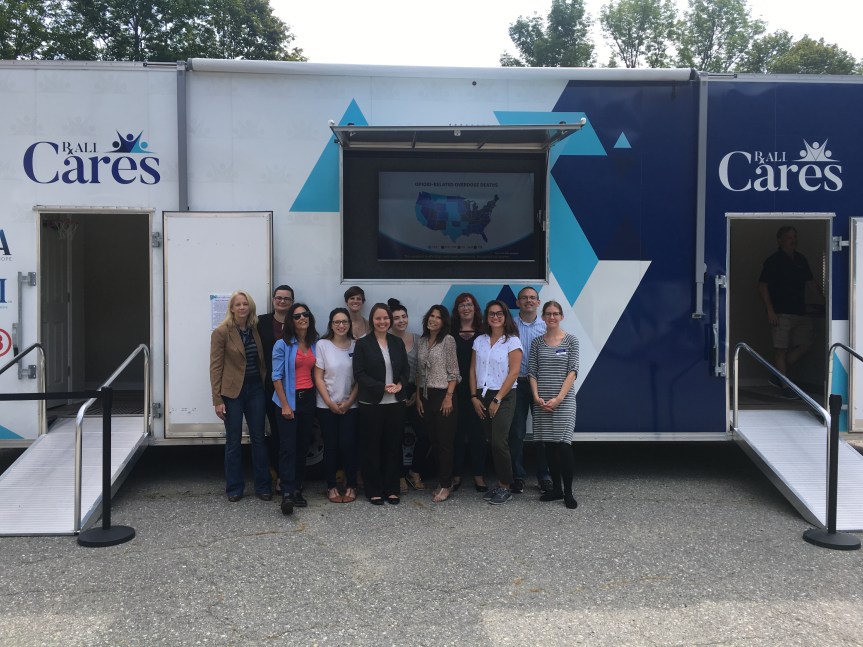
The Rx Abuse Leadership Initiative (RALI) of Maine hosted tours of a youth bedroom trailer in the parking lot at NAMI Maine (National Alliance on Metal Illness) today in Hallowell in an effort to raise awareness about the warning signs of opioid misuse in youths.

The youth bedroom trailer, created by Code 3 as a mobile awareness campaign, is staged as a typical teenager’s bedroom with tell-tale warning signs of opioid use arranged throughout the room. Tours of the trailer take participants through the bedroom pointing out a number of signs that the youth is misusing substances. The warning signs are often identifiable to veteran law enforcement but may not be as obvious to parents, guardians, or other adults.


Today’s tours hosted local law enforcement officers in addition to state government officials, members of the legislature, and local community members. The Trailer is scheduled to make another appearance today, details below, and plans for an appearance in Bangor are in the works:

Monday, September 9
3:00 pm-6:30 pm
Kennebunk Elementary School
177 Alewive Road
Kennebunk

RALI Maine is an alliance of organizations elevating programs that have a real impact on our state’s opioid crisis. They support a broad range of programs, including prevention, treatment and recovery services, facilitating the safe disposal of unused prescription medicines, and raising awareness of the warning signs of opioid misuse. For more information, including a list of local partners visit: https://www.rali-me.org/


Free Adverse Childhood Experiences and Resilience Building Training for Childcare and PreK Teachers

The Preschool Development Grant (PDG), B-5, a collaboration between the Departments of Education and Health and Human Services, will be providing free trainings on Adverse Childhood Experiences (ACES) and resilience building. The PDG is a one-year planning grant to study and improve the birth-5 early care, education and service system in our state, and has 5 goals:

  1. Conduct a statewide needs assessment plan
  2. Develop statewide Birth to 5 Strategic Plan
  3. Maximize parental knowledge and choice
  4. Share best practices
  5. Improve overall quality of programming for children birth-age five.

To address goal 4, the PDG is providing funds to team up with Maine Resilience Building Network (MRBN) and offer a free training around Adverse Childhood Experiences (ACES) and resilience building. Strong Kids, Strong Families, Strong Communities: The Impact of ACES and Resilience Building will cover Adverse Childhood Experiences research, early brain development science, and protective factors such as positive relationships. Strategies to promote resilience building in classrooms and to support families and their children, birth-5, will be offered.

This training is intended for child care and preschool/prek staff, and will be offered in 12 sites throughout the state from 6:00-8:30 PM on the following days:

Tuesday, 9/24/19, Brunswick

Tuesday, 10/1/19, Caribou

Wednesday, 10/2/19, Houlton

Tuesday, 10/8/19, Owls Head

Tuesday, 10/15/19, Mexico

Wednesday, 10/16/19, Westbrook

Thursday, 10/17/19, Belfast

Monday, 10/21/19, Bangor

Wednesday, 10/23/19, Auburn

Tuesday, 10/29/19, Calais

Monday, 11/4/19, Augusta

Tuesday, 11/5/19, York

To find out more and to register, visit the “Upcoming MRBN Events” at  https://maineresilience.org/ or contact Karen.J.Bergeron@maine.gov


Conference: Collaborating to Address the Complex Mental and Behavioral Health Needs of Maine Youth

The Maine American Academy of Pediatrics (AAP), Maine Department of Education (DOE) and Maine Association of School Nurses (MASN) are collaborating to bring you best practices and current research on a variety of critical mental and physical health related topics facing adolescents. Recognizing that we are all supporting the needs of Maine children in different locations and ways we are bringing experts together to receive collaborative professional learning.

Hosted by: The Maine AAP, Department of Education and Maine Association of School Nurses

Intended audience: Those interested in the mental health of students (school nurses, medical providers, school counselors, social workers, and administrators)

Some topics covered: 

  • Identification and treatment of anxiety and depression in children and adults: How can we do better?
  • Addressing the Complex Mental and Behavioral Health Needs of Maine Youth: The Key Role of Adverse Childhood Experiences and Trauma Informed Care
  • Creating an Inclusive Environment for LGBTQ Youth
  • Tools for Screening and Safety for Youth at Risk of Suicide
  • Substance Use Disorder:  Impact on Youth and Families

Date: August 16, 2019

Time: 8:00 AM – 3:15 PM

Location: The program is being held in the Talbot Hall/Bonney Auditorium at the University of Southern Maine, located at 92 Bedford Street in Portland.

Cost: $50.00

Register here.

For questions or additional information, please contact Emily Poland at emily.poland@maine.gov.

Cultivating Safe, Equitable, Strengths Focused School Communities- A Collaborative Opportunity

What:

The goal of this convening is to build capacity, communication, and collaboration among youth serving practitioners based in schools, law enforcement, community corrections, and community programs to cultivate safe, equitable, strengths focused school communities where all youth experience positive outcomes. The meeting will advance effective and ongoing multidisciplinary partnerships to increase communication, expand training and resources, align strategies, and measure progress across youth serving systems.

When:

Tuesday, July 30, 2019
8am-4pm

Where:

Cony High School
60 Pierce Dr.
Augusta, ME 04330

More Details:

Registration and breakfast open at 8 am, the program will begin at 9 am. The full agenda, featuring Judge Steven Teske presenting the School Justice Partnership Model, will be published in July.

Contact:

Contact Jay Pennell with questions:
jay.h.pennell@maine.gov

A Hopeful Path Forward at Maine’s Opiate Crisis Summit

In her opening remarks at the Opiate Response Summit, Governor Janet Mills expressed her appreciation for Gordon Smith. One of the Governor’s first actions, post-inauguration, was to found the Opiate Response and Prevention Taskforce directed by Smith. Mills’ founding of this taskforce underscores what a large priority the Opiate Epidemic represents for Mainers. Turning the Tide: Maine’s Path Forward in the Opiate Crisis, a summit which packed the Augusta Civic Center with over 1,000 people on the 15th, represented an overwhelmingly hopeful attitude towards harm reduction and prevention. Several days prior to the event, Smith commented that the need to cap registration at 1,050 people was a good problem to have. Many are invested in solving this Crisis.

The Governor opened the event with a grave message stressing the urgent need for awareness, and what is at stake for Maine families. In the past five years, 1,700 Mainers have died of drug overdose. If 1,700 baby seals washed up dead on the beach, said Mills, there would be a massive public response. “These are not ‘druggies’,” said Mills, “they are neighbors.” The Governor stressed in her speech that people affected by substance use disorders are family members: they are sons and daughters and parents, employees and employers, neighbors and friends.

Commissioners from many government Departments such as Health and Human Services, Public Safety, and Law Enforcement were present. Department of Education Commissioner Pender Makin was also in attendance. Following the Governor’s remarks, attendees heard from Sam Quiones, author of Dreamland, a book which outlines the evolution of an American Opioid Crisis.

Afterward, the nine morning breakout sessions began. These were hosted by a variety of experts. The diverse topics from both morning and afternoon sessions included the following critical subjects:

· Addressing Stigma: Using Researched-Based Evidence

· Building Public Health Infrastructure

· Needle Exchanges and Naloxone Distributions

· Challenges in Recovery Centers and Housing

· Community Prevention Services at Work

· Data to Action: Harnessing Information to Tackle the Opioid Crisis

· Emerging Threats: Current and Predictive Trends

· Harm Reduction with Neonatal Focus

· How to Best Navigate Jobs and Transportation During Recovery

· Improving Access to Medications for OUD: Considerations for Special Populations

· Improving Access to Medications for OUD: Engaging More Clinicians to Offer Treatment

· Law Enforcement and its Role of Bringing Hope to Recovery

· MaineWorks: Offering Dignity, Trust, and a Path Forward

· OD Mapping and Overdose Response Through Community Partnerships

· Responsible Prescribing and Pain Control Debate: Has the Pendulum Swung Too Far?

· State Prevention Services: Opioid Task Force Update

· The Importance of Law Enforcement in Community Based Recovery

· The Power of Community Coalitions

· Voices of Recovery: Panel of Individuals in Recovery

Summit2
Peter Michaud, Debate Moderator addressed the audience at the Responsible Prescribing and Pain Control Debate breakout session.

At lunch, the parents of two young men who lost their lives to substance abuse disorders spoke and shared their story before the assembled audience. Former White House Director of National Drug Control Policy, Michael Botticelli, then spoke on the importance of community support in the recovery process. Speaking on his own experience with the disorder, he highlighted the stigma which only perpetuates the issue. “Epidemics don’t happen in a vacuum,” he said. Botticelli stressed the ways in which the epidemic is exacerbated by poor data, over-prescription, and lack of information and resources. He closed his remarks by pointing out the number of options that Maine should employ moving forward, saying “We cannot dictate other people’s paths to recovery.”

The panel of speakers who following the afternoon breakout session demonstrated a deluge of support from state government bodies all over New England and the North East. The Senior Advisor to the Governor of Rhode Island Tom Coderre, Senior Advisor to the Governor of New Hampshire David Mara, and the Commissioner of Health in Vermont Dr. Mark Levine sat on the panel, as well as the President of the American Medical Association Dr. Patrice Harris. Coderre succinctly represented the mentality of support shared by those in attendance when he encouraged Maine to “flatter Rhode Island by mimicking any of their ideas.” The goal of the Summit was to build on existing positive information so New England can better tackle this unprecedented Crisis.

Turning the Tide: Maine’s Path Forward in the Opiate Crisis served as a lightning rod for activists who wish to generate a reason for hope. And there are reasons to be hopeful. The Summit alone demonstrates an effort by the administration and the public to address an Opiate

Crisis sweeping Maine and America. Those in the recovery process are being given a larger voice at the table. Maine Law Enforcement is now prepared to administer Naloxone to those experiencing an overdose. In fact, 2017 was Maine’s high water mark for overdoses. We are turning the tide, and this Summit was among the first steps of many more to come.

Free School Safety Presentation

I Love You Guys Foundation School Safety Presentation Coming to Maine

What:                 Standard Response Protocols and Standard Reunification Method for schools and districts, and an After Action Review of the Marjory Stoneman Douglas High School Shooting.

When:                 31 July 2019- William Cohen Middle School, Bangor.  8:00-12:00

2 August 2019- Windham High School, Windham.  8:00-12:00

Audience:          Maine school superintendents, principals and staff; local first responders; county emergency management agency staff.

Presenter:          Scott Parker, Scott Parker, “I Love You Guys” Certified Trainer for the Standard Response Protocols and Standard Reunification Method; National school safety subject matter expert; supported the development of the Maine Model plan in 2007; certified SRP and SRM Train the Trainer in 2013; has worked with over 20 school districts and academies in Maine; currently working with 8 school districts in Maine.

Cost:                    Free, supported by National School Safety Organization, “I Love You Guys Foundation”

Registration:     Advance registration will be required. Contact: ScottParker.preparedness@gmail.com

Technical Assistance:  A new Update Standard Response Protocol and Standard Reunification Method will be available for attendees after this training.

Save the date!