Media Release: Maine School Safety Summit Brings Together More than 300 Educators, School Leaders, and Law Enforcement Personnel to Collaborate on School Safety Issues

The Maine Department of Education’s Maine School Safety Center held its annual Maine School Safety Summit this week at Windham High School, with a focus on how educators, school leaders, law enforcement, and communities can increase collaboration and communication around school safety strategies. The three-day summit attracted more than 300 participants from across the state with roles ranging from school principals, social workers, and nurses to school resource officers, first responders, and emergency preparedness professionals.

Nearly 50 workshops were offered on a wide range of school safety topics, including trauma awareness; supporting the safety and well-being of young people; brain science; restorative practices; social media use; emergency operations planning; food security linked to school security; behavioral threat assessment; bus safety; and more. Staff from the Maine Department of Education’s Office of School and Student Supports and Office of School Facilities and Transportation also helped lead several workshops.

The Maine School Safety Center (MSSC) was created two years ago, and codified into law this year, with the mission of developing a safe school infrastructure that will deliver high quality, up-to-date best practices, procedures, training, and technical assistance and support to Maine schools. MSSC offers school supports and services on school emergency management, threat assessment and mental health, restorative practices, training, and school safety and security. MSSC has provided hundreds of trainings, courses, and professional learning experiences to support school staff and school leaders throughout Maine.

MSSC’s approach to school safety is comprehensive and is guided by the beliefs that supporting the well-being of students and a healthy school environment is essential to the reduction of behaviors that threaten the safety of the school community; everyone who comes in contact with students and a school system has a responsibility to help create and sustain a healthy school environment and ensure a student’s well-being; the school environment, culture, approaches to discipline, and interface with the community are crucial to the well-being of all students, and particularly to those students who are alienated from the school program and those with behavioral and/or mental health issues; and schools and communities need to collaborate to create a systematic approach to school safety.

“This summit was planned long before the tragedy in a Texas elementary school last month, but that event, and so many others, certainly underscore the fact that school safety and security, emergency prevention, and emergency response preparedness remain top concerns for students, staff, families, and communities nationwide and here in Maine,” said Education Commissioner Pender Makin in her keynote address. “This three-day event offers a wide variety of professional learning opportunities and technical assistance to help schools and their community partners enhance all aspects of school safety, ranging from culture and climate to hazard planning to crisis response and recovery planning. What is clear throughout all of the sessions, and reinforced by who is here attending the summit, is the overarching message that partnerships, relationships, communication, and collaboration are the keys to this work.”

“We all know that when we put our minds and our hearts together, we can be brilliant. Throughout the last 27 months, we have all worked together to stay safe, to keep our schools open and to make sure that we took care of our students and each other–both professionally and personally,” said Eileen King, Executive Director of the Maine School Superintendents Association. “Keeping our students and staff safe is the priority, change is the reality, and collaboration must be the strategy.”

“School boards across the state engage in and support sound school safety practices for students and staff,” said Steve Bailey, Executive Director of the Maine School Board Association. “Through the leadership of the DOE’s Maine School Safety Center, and the collaboration with other partner agencies and associations, this identified effort to expand and promote safety practices and important inter-agency relationships will be an important next step to helping keep our schools safe, while also knowing what to do and who to turn to should additional resources be needed.”

“Safety is a top priority for students and for school staff, and with safety encompassing so many things, physical and emotional/mental health, security, cyber, food security, and more, we need to do what we can to work collaboratively to address these issues and provide the public education our students deserve,” said Grace Leavitt, President of the Maine Education Association.

“It’s imperative that law enforcement and educators have an open line of communication and a collaborative working relationship,” said Chief Kevin Schofield, Maine Chiefs of Police, Windham Police Department. “It’s incumbent upon all of us to take this issue seriously and work together to make sure our students and schools are as safe as possible.”

The Maine School Safety Summit was sponsored by the Maine Department of Education, Maine Juvenile Justice Advisory Group, Maine School Superintendents Association, Maine Chiefs of Police Association, Maine Sheriff’s Association, Maine Principals Association, Maine Department of Corrections, Maine School Resource Officers Association, Strategies for Youth, and Maine School Board Association.
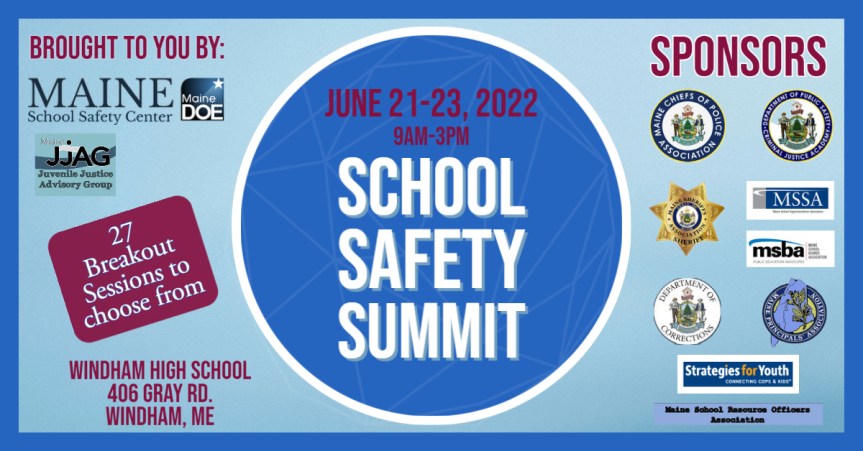
 

Register Today for the Maine School Safety Summit June 21-23

Please join the Maine Department of Education’s (DOE) Maine School Safety Center for the first annual Maine School Safety Summit.  Along with state-level partners from across Maine, the Maine School Safety Center and Maine Juvenile Justice Advisory Group (JJAG) are proud to invite you to this high level, diverse training opportunity catered specifically for school and district administrators, school resources officers, juvenile community corrections officers, and law enforcement that work directly with schools, in addition to school support staff such as school counselors, social workers, school nurses, and emergency planning and facilities school/district staff members.
LOCATION
Windham High School
406 Gray Road Windham, ME
DATE & TIME
June 21-23, 2022
9:00 AM – 3:00 PMHighlights include:

  • Day one and two there will be a two-day course specifically designed for school/district administrators such as principals and superintendents as well as law enforcement administrators on how to work best together as a team for more effective interactions with youth.  This specialized training presented by Strategies for Youth will be the first of its kind here in Maine.
  • Simultaneously, on days one and two, over 16 different presentations will be available for assistant principals, social workers, school counselors, facilities directors, school safety personnel, SROs, JCCOs, law enforcement who respond to schools, school office staff, educational technicians, and any other school staff who work to make their schools a safer place.
  • Day three will have two tracks. Track one will provide a special session for Transportation Directors and Bus inspectors. Track two will bring all other attendees together to discuss an exciting new way of dealing with youth in crisis entitled, Juvenile Justice Jeopardy, and in the afternoon will be a session entitled Communication in a Diverse World.

Our goal is to create safer schools by offering wraparound total services for Maine students.

For further questions, contact Wendy Robichaud, School Safety Training Coordinator, Maine School Safety Center (MSSC) at wendy.robichaud@maine.gov.
School Safety Summit Save the date

2021-2022 School Health Annual Reporting Window is Open

The Maine Department of Education (DOE) is announcing that the School Health Annual Report is now available through the Reporting Calendar. The reporting link is available through the DC&R Calendar and the superintendent will determine who will compile and submit the data from all schools within the SAU. The data does not need to be submitted by your health staff; it can be entered by whomever the Superintendent determines is appropriate. Please remember that these reports once submitted, are manually verified so it may take several weeks for your report to show up in DC&R as completed. This report is due by July 30, 2022.

You may download the reporting worksheet in order to aid data collection among your schools.

Now more than ever, being able to quantify the workload of your school health staff is of utmost importance as we continue in this unprecedented time. Advocating for the multiple needs of your students helps to inform evidence-based school nursing practice and improve overall youth health outcomes. Healthy students are better learners.  If you have questions about the School Health Annual Report, please contact the MDOE School Nurse Consultant, Emily.Poland@Maine.gov.

2022 Annual School Health Survey: https://mainedoe.co1.qualtrics.com/jfe/form/SV_8DhfRs2YjzA86I6

Maine Nurses Attend New England School Nurse Conference

Over 25 Maine nurses (not all are pictured here) joined school nurses from across New England for their first in-person professional development event in two years.

The New England School Nurse Conference is an annual event, hosted by one of six New England School Nurse Associations (Connecticut, Maine, Massachusetts, New Hampshire, Rhode Island, Vermont).

Hosted by New Hampshire School Nurse Association, the conference was held in Portsmouth, NH with a theme of, “Schools Nurses: The Link to Student Success.”

For more information about the New England School Nurses Association visit: https://nesnconference.nursingnetwork.com/

Virtual Training: Emergency Evacuations- Planning for the Whole School Community

The following opportunity is being provided by the Maine Department of Education’s Maine School Safety Center (MSSC) through the REMS TA Center, a partner of the U.S. Department of Education, Office of Safe and Supportive Schools.

Emergency Evacuations: Planning for the Whole School Community – Learn how schools and school districts can better prepare for an evacuation after an emergency. During this training session, an overview is provided on issues related to identifying on- and off-site assembly areas, transportation considerations, such as the use of mutual aid agreements, meeting the needs of students with disabilities or access and functional needs, and shared lessons at the local.

Tuesday May 17th

10:30-1:00

Register here: https://forms.gle/xEponZj8Mn4JWyGk6

Virtual Training: REMS Exercises and Drills

The following opportunity is being provided by the Maine Department of Education’s Maine School Safety Center (MSSC) through the REMS TA Center, a partner of the U.S. Department of Education, Office of Safe and Supportive Schools.

Exercises and Drills – Learn about strategies that K-12 education agencies can use in collaboration with their team of multidisciplinary community partners to enhance efforts to practice school emergency operations plans (EOPs).

During this training session, the REMS TA Center will share recommendations from Federal partners specific to developing, practicing, and enhancing high-quality school EOPs through a variety of exercise types, including drills, tabletop exercises, virtual simulations, and more. Additionally, the REMS TA Center will explore new considerations about exercises and drills and efforts education agencies can take to protect the whole school community.

Tuesday May 10th

10:30-1:00

Register here: https://forms.gle/3xW6prCYMrdmtRKh8

Planning for Family Reunification Before, During, and After an Emergency Train-the-Educator (TtE)

The following opportunity is being provided by the REMS TA Center, a partner of the U.S. Department of Education, Office of Safe and Supportive Schools.

The Readiness and Emergency Management for Schools (REMS) Technical Assistance (TA) Center is excited to offer the Planning for Family Reunification Before, During, and After an Emergency Train-the-Educator (TtE) Virtual Training by Request (VTBR). This dynamic and interactive 2.5-hour training is designed to provide educators and school staff with a better understanding of family reunification before, during, and after an emergency and how to develop a Family Reunification Annex for the school emergency operations plan (EOP) that meets the needs of the local school and community.

TRAINING DESCRIPTION
This training is intended to provide participants with an introduction to family reunification and how it is used to reunite children with verified and authorized family members after a critical and often highly stressful incident (e.g., a fire, a natural disaster, a school bus accident, a situation involving weapons or violence at school, etc.) that prevents a normal school dismissal. The Family Reunification Annex is recognized in Guide for Developing High-Quality.

School Emergency Operations Plans and The Role of Districts in Developing High-Quality School Emergency Operations Plans as a critical element of the overall EOP.
Participants will be equipped to review and update their Family Reunification Annex on a regular basis to ensure the most successful outcome, while applying training principles for including a step-by-step plan to reunify children with their families before, during, and after an emergency across the five mission areas.

WHO SHOULD ATTEND?
The intended audiences for this training are school and school district administrators, educators, staff, and members of an EOP planning team. This training is also applicable for fire officials, emergency medical services personnel, law enforcement and school resource officers, local public health officials, local mental/behavioral health practitioners, and other community partners.

TRAINING DETAILS
When: Tuesday, May 3, 2022 Time: 10:30 a.m. to 1:00 p.m. ET Cost: NO CHARGE
Register here (Registration for this event closes on Friday, April 29, 2022 at 5:00 p.m.)

If you have any questions or need additional assistance, please contact the REMS TA CENTER at 1-855-781-REMS [7367] or via email at info@remstacenter.org or contact the Maine School Safety Center.

NEW Online Course: Assessing Your School Site

The following opportunity is being provided by the REMS TA Center, a partner of the U.S. Department of Education, Office of Safe and Supportive Schools.

Is your school or school district looking to examine the safety, security, accessibility, and emergency preparedness of its building and grounds? Do your ongoing assessments include a site assessment? To support K-12 school safety teams in conducting site assessments, the U.S. Department of Education, Office of Safe and Supportive Schools and its REMS TA Center are pleased to provide a NEW online course: Assessing Your School Site.

This 30- to 45-minute free online course aims to help K-12 school (public and nonpublic) personnel, school district administrators and staff, state/regional education agency personnel, and their partners develop a greater understanding of site assessments and how to examine the safety, security, emergency management, and preparedness of K-12 buildings and grounds. This online course uses an engaging visual format and interactive features, such as learning activities and quizzes, to help you learn about

  • Site assessments, including their purpose and their role in the planning process, how frequently they should be conducted, by whom they should be conducted, and the process for conducting them.
  • Building design principles that guide site assessments, such as Crime Prevention Through Environmental Design and Universal Design.
  • Data from site assessments and how they can be used to inform your school emergency operations plan and safety, security, emergency management, and preparedness programs.
  • Tools that are available to support you with this important work.

Get more information and take the course here.

If you have any questions or need additional assistance, please contact the REMS TA CENTER at 1-855-781-REMS [7367] or via email at info@remstacenter.org or contact the Maine School Safety Center.

Developing Emergency Operations Plans (EOPs) K-12

Don’t miss your chance to register for next week’s emergency operations plan (EOP) development training brought to you by the Maine School Safety Center and the Readiness and Emergency Management for Schools (REMS) Technical Assistance (TA) Center.

Download the detailed flyer here (PDF)

When: Tuesday, April 12, 2022 Time: 10:30 a.m. to 1:00 p.m. ET
Cost: NO CHARGE
Register here (Registration for this event closes on Friday, April 8, 2022, at 5:00 p.m.)

With this training, an expert team will provide an overview of the recommended six-step planning process to create a high-quality school EOP, which includes the following:

Step 1: Forming a Collaborative Planning Team
Step 2: Understanding the Situation
Step 3: Determining Goals and Objectives
Step 4: Plan Development
Step 5: Plan Preparation, Review, and Approval
Step 6: Plan Implementation and Maintenance

WEBINAR: Resilience Strategies for Educators: Techniques for Self-Care and Peer Support

Resilience Strategies for Educators (RSE): Techniques for Self-Care and Peer Support Train-the-Educator (TtE) Virtual Training by Request (VTBR) is a virtual learning opportunity coming up for caregivers in schools and school districts to better understand, and teach others, resilience strategies following emergency events.

The REMS TA Center is excited to offer the NEW Resilience Strategies for Educators: Techniques for Self-Care and Peer Support (RSE) Train-the-Educator (TtE) Virtual Training by Request (VTBR) created in partnership with the U.S. Department of Education’s Office of Safe and Supportive Schools (OSSS). This dynamic and interactive half-day-long training is designed to assist caregivers in schools and school districts to better understand resilience and self-care strategies following natural disasters and other emergency events.

Participants will gain the knowledge and hands-on skills needed to implement the five components of Psychological First Aid — listen, protect, connect, model, and teach, as well as awareness about compassion fatigue, and how to build a self-care plan.

Pre- and -post training activities will provide guidance on how this training is relevant to emergency operations planning and assist with the implementation of what is learned.

TRAINING DETAILS
When: Tuesday, April 26, 2022
Time: 10:30 a.m. to 2:30 p.m. ET
Cost: NO CHARGE
Register here. (Registration for this event closes on Friday, April 22, 2022 at 5:00 p.m.)

TRAINING DESCRIPTION
As part of a comprehensive school emergency operations plan, it is important for schools and school districts to understand how to prevent, protect against, mitigate, respond to, and recover from critical incidents, including social, emotional, and behavioral recovery. The training is designed to provide educators and school staff with a better understanding of resilience strategies that can be used to increase their ability to work more effectively with individuals impacted by stress, loss, and trauma brought on by community or family violence, natural and man-made disasters and economic hardship.

WHO SHOULD ATTEND?
The training is applicable in areas that have been impacted by traumatic events and/or natural disasters, as well as those that have not recently experienced a traumatic event(s). The intended audiences for this training include, but are not limited to:

• School counselors and psychologists
• School social workers and nurses
• Administrators, educators, and support staff
• School Resource Officers
• Community partners such as local mental/behavioral health practitioners

For more information and questions reach out to REMS directly at info@remstacenter.org or contact Maine School Safety Center (MSSC) staff Melissa Condon at melissa.a.condon@maine.gov.