What is Graduation Rate? #success4ME

The graduation rate indicator is one of four indicators used in Maine’s Model of School Support. It will be used as an indicator of success for high schools only. Graduation is defined as graduating within four years after entering ninth grade. In Maine, the graduation rate indicator reflects the number of students graduating “on-time”, as well as the graduating students who progressed at a different rate and graduated in either five or six years.

In the past, graduation rate was never utilized when making determinations of schools eligible to receive support. Under Maine’s Model of School Support, the graduation rate for students meeting graduation requirements in four years in addition to the graduation rate of students meeting graduation requirements in five or six years will be utilized.

graduation rate 4 yr (blue)
4 Year Graduation Rate

What does this look like in Maine?

Achieving a diploma is a major accomplishment and marks a significant milestone in a student’s life. It is important to highlight the number of students achieving a diploma, whether it takes some students four years or longer to do so. As it relates to Maine’s Model of School Support, the Graduation Rate indicator is split into two rates of graduation:

  • graduation 5_6 yr (blue)
    5 and 6 Year Graduation Rate

    The 4-year rate is the number of students who graduate in four years with a high school diploma, divided by the number of students who form the adjusted cohort for the graduating class.

  • The 5 and 6 year rates reflect the number of graduating students who took 5 and 6 years, respectively to graduate from high school.

How will graduation rate data be presented on the school report card?

The school as a whole will receive a performance measure related to individual student groups meeting the annual graduation target.

Graduation Performance Descriptors:

Graduation – 4 Year

Emerging Developing Meeting Excelling
No eligible student group made their annual graduation target At least one eligible student group made their annual graduation target All eligible student groups made their annual graduation target All eligible student groups have met or exceeded the long-term goal of 90%

Graduation – Combined 5/6 Year

Emerging Developing Meeting Excelling
No eligible student group made their annual graduation target At least one eligible student group made their annual graduation target All eligible student groups made their annual graduation target All eligible student groups have met or exceeded the long-term goal of 92%

Eligible student groups include: Asian, Black, Hispanic/Latino, Two or More Races, White, Students with Disabilities, Economically Disadvantaged, Migrant Students, and English Learners.

Goals for four year adjusted cohort graduation rate:

Subgroup Baseline (Data and Year) Long-term Goal (Data and Year) 2030
All students 86.83% 2016 90% or maintain current 2016, whichever is greater, graduation percentages by 2030
Economically disadvantaged students 77.77% 2016
Children with disabilities 72.19% 2016
English learners 78.14% 2016
Race – Hispanic/Latino 83.46% 2016
Race – American Indian 84.91% 2016
Race – Asian 90.68 % 2016
Race – Black or African American 76.77% 2016
Race – Native Hawaiian or Other Pacific Islander 88.24% 2016
Race – White 87.29% 2016

The measurements of progress are based on increases in the percentage of all students in Maine who make progress toward the long-term goals on a three-year basis. Long-term goals were developed to reduce the percentage of non-graduating students to result in student groups all meeting the goal of 90% by 2030. The calculation process, for example, is as follows:

Subgroup: All Students

  • Step 1: 2016 Graduation Rate = 86.83%
  • Step 2: 90% (goal) – 86.83% (baseline) = 3.17%
  • Step 3: Differential for each 3-year step is 3.17 divided by 5 = .61%
  • Step 4: Add to the baseline .61 % and add the .61% to each subsequent step to reach the goal of 90% by 2030.

Goals for extended- year cohort graduation rate

Subgroup Baseline (Data and Year) Long-term Goal (Data and Year) 2030
All students 88.61% 2016 92% or maintain current 2016, whichever is greater, graduation percentages by 2030
Economically disadvantaged students 80.82% 2016
Children with disabilities 77.27% 2016
English learners 86.12% 2016
Asian 94.27% 2016
American Indian 83.49% 2016
Black 83.47% 2016
Hispanic 84.13% 2016
Native Hawaiian 93.33% 2016
White 88.84% 2016
Multiple Races 86.62% 2016

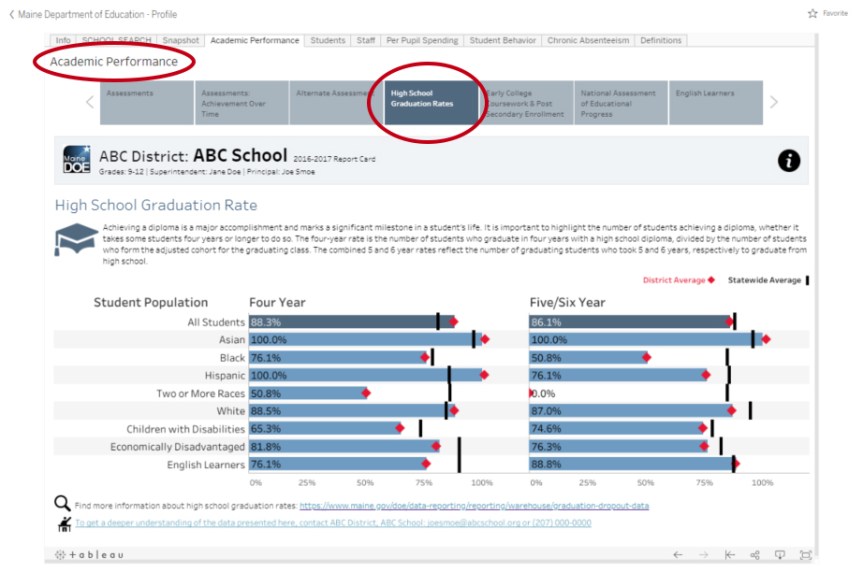
Graduation rate will be presented on the initial page of the report card in the following way:

reportcard1

reportcard2

reportcard3

reportcard4

For further information please contact Janette Kirk, Acting Director, Office of Learning Systems at Janette.Kirk@maine.gov.

Love to Code: STEAM Professional Learning Workshop – Register by 11/16

Maine educators are invited to participate in a professional learning workshop that supports the integration of technology across multiple content areas with a focus on STEAM (Science, Technology, Engineering, Art, and Math) as well as computer science, coding, and computational thinking. By using arts and craft techniques to teach circuits and programming, the workshop will introduce ways to engage learners of diverse backgrounds and interests in designing and building their own technologies and getting excited about STEAM!

During the workshop, educators will:

  • Engage in activities that can be used in classrooms with students who are learning STEAM, coding, and computational thinking concepts
  • Explore techniques that blend craft and code: students can use skills they have (crafting) to learn new skills (coding), offering new pathways to coding for students who find traditional pathways to learning code less accessible
  • Learn how to develop integrated learning opportunities, where the technology is used in service of the learning (instead of as the focus of the learning).
  • Understand how to create and foster a sense of wonder (instead of fear) when students try something new and somewhat challenging

The workshop will be led by a team from Chibitronics that has created Love to Code, an electronics and coding toolkit that gets students building circuits and coding in an art-friendly, hands-on way.  Students will learn to build and program functioning circuitry within the pages of a picture book and then take these skills to design their own paper circuits (sample paper circuit projects). Students can then program a “Chibi Chip” to control their art work, making interactive artwork that comes to life with code!

Love to Code’s innovative features include a:

  • Picture book format, which teaches complex coding concepts by embedding them in metaphor and story;
  • Blend of craft and code, which allows learners to use skills they already have (crafting) as they learn new skills (coding).

Learn more about the presenters and see some of their projects, Jie Qi and Natalie Freed.

Event Information:

  • Date: Saturday, December 1st, 2018
  • Time: 8:30am – 3:30pm
  • Location: RiSE Center, University of Maine, Orono
  • Contact Hours: 8 hours can be earned
  • Cost: $15 (includes light breakfast, lunch, and Love To Code Kit)
  • Register here

Please bring a laptop or tablet with you to the event. In order to program the Chibi Chips, devices need to have a headphone port available. This might require you to bring an adapter/dongle depending on your device.

Draft Agenda:

  • 8:00am: Registration and light breakfast
  • 8:30am: Welcome, Introductions, and Connections
  • 9:00am: Jie Qi and Natalie Freed– “From Make Believe to Making Tech: Paper Circuits and Programming”
  • 10:00am: Break
  • 10:15am: Learning with the Love to Code Kits
  • 11:45am: Lunch – includes a networking activity
  • 12:45pm: Expectations and goals for afternoon design and creation time
  • 1:15pm: Design and Create: Make what you’ll take back to your school – workshop for colleagues, unit or lesson with students, etc
  • 3:00pm: Wrap up, reflections, connecting forward

For answers to questions or more information, please contact Amanda Nguyen, Digital Learning Specialist for the Maine Department of Education at Amanda.Nguyen@maine.gov.

Live Broadcast Available for Nov. 7th Public Hearings for English Language Arts, Mathematics, and Career and Education Development Standards Review

As a reminder, the Maine Department of Education has scheduled public hearings this week as part of the scheduled periodic review of the Maine Learning Results. The Department is seeking public comments regarding the current English language arts, mathematics, and career and education development standards.

Public hearings for each standard have been scheduled back to back in room 103 of the Burton Cross Building in Augusta. Anyone may speak at the public hearings which will be live-streamed. People wishing to speak will be asked to sign in and it will be helpful, but not mandatory, to provide a written copy of comments.

Below is a list of relevant links, as well as hearing times including live broadcast links for each event:

Career and Education Development Standards:

Mathematics Standards:

English Language Arts Standards:

Anyone unable to attend the public hearing may send written comments by 5pm on December 1, 2018. Written comments may be emailed to sis.doe@maine.gov with the subject “CED Standards Review,” “Mathematics Standards Review,” or “English Language Arts Standards Review,” or mailed to Maine Department of Education, attn: Beth Lambert, 23 State House Station, Augusta, ME 04333.

For further information about the standards review process contact Beth Lambert at Beth.Lambert@maine.gov.

WIDA Early Years Online Learning Modules (to Support Multilingual Children) Now Available at No Cost to Teachers and Administrators

The Maine Department of Education is excited to announce that Maine’s early care and education community is now able to access to the WIDA Early Years online learning modules. These modules focus on supporting young multilingual children, ages 2.5 to 5.5 years and are available at no cost to teachers and administrators. Multilingual children, commonly referred to as dual language learners, are children who are developing more than one language.

Each self-paced, interactive module provides opportunities for reflection and offers suggestions for applying content to local practice. The following modules are available:

  • Dual Language Learners and their Families
  • WIDA Early English Language Development Standards Framework
  • Dual Language Learners with Disabilities
  • Scaffolding Language Learning
  • Promising Practices

A description of each module, frequently asked questions, and instructions for creating a user account and registering for the modules can be found in the documents listed below:

Access the modules: WIDA Early Years online modules (visit and create your user account)

If you are a program leader, administrator, trainer, or coach, we hope you will utilize these modules as a resource to support the professional learning needs of those serving multilingual children. The modules can be used in staff development sessions and/or shared with individual educators or teams of educators, such as professional learning communities.

Contact hours are available upon completion of a module. To receive a contact hours certificate, please download the certificate of completion generated by the WIDA Early Years online system and email it to april.perkins@maine.gov.

Additionally, the Department has purchased a set of WIDA Early Years Promising Practices Implementation Kits to assist districts in refining their programs for young multilingual children. These kits serve as a program self-evaluation tool, highlighting several evidence-based, highly effective strategies for supporting children’s development of multiple languages. Several districts with a significant number of dual language learners will receive these kits. A district that does not receive its own kit may request to borrow one from the Maine Department of Education.

WIDA Early Years resources have been provided to Maine educators through Title III, CDS, Head Start and public pre-k funds.

If you have any questions about these resources, or to request to borrow a WIDA Early Years Promising Practices Implementation Kit, please contact Maine DOE Director of ESOL/Bilingual Programs & Title III April Perkins at april.perkins@maine.gov or (207)624-6627.

PRIORITY NOTICE: Proposed Revisions to Rule Chapter 132 (Social Studies and Science and Technology Standards); Public Hearing on November 15, 2018

This notice is one of four priority notices being sent to district and school administrators on 10/24/18 regarding proposed major substantive rules that have been filed with the Secretary of the State of Maine on this day (Rule Chapters: 101, 115, 122 and 132). Please share this notice with all interested parties.

As part of the scheduled periodic review of the Maine Learning Results, the Maine Department of Education is seeking public comments regarding proposed revisions to the social studies and science and technology standards found in Rule Chapter 132 Learning Results: Parameters for Essential Instruction. Please note that the Department of Education is only seeking comments on the Science and Technology Standards and Social Studies Standards sections of Rule Chapter 132 at this time.

The standards review process for the science and technology and social studies standards began in 2017 with a public comment period and a public hearing on the current science and technology and social studies standards. After the public comment period, steering committees were convened who were charged with reviewing all submitted comments and with developing blueprints for the revision of the state standards in their assigned content area. Once the blueprints were created, writing teams, consisting of pk-12 teachers who represent Maine’s cultural and geographical diversity, assembled to draft the standards revisions. Now, as part of this review process, the Maine Department of Education has submitted the revisions as part of a proposed rule change to Chapter 132.

Find the details for proposed changes for Rule Chapter 132 on the Maine DOE Proposed Rule & Rule Changes webpage (proposed rules are listed in order by rule number).

Public Hearing Information for Rule Chapter 132:
November 15th from 1-4pm
room 103 at the Cross Building, 111 Sewell Street, Augusta
Anyone may speak at the public hearing which will be live-streamed (A link to the livestream will be available prior to the public hearing). People wishing to speak will be the asked to sign in and, preferably, provide two written copies of comments, as well as an electronic copy. Anyone unable to attend the public hearing may send written comments

Comment Period Deadline: 5 pm on December 3rd, 2018

Written comments may be sent to Standards Review at sis.doe@maine.gov, or mailed to Beth Lambert, 23 SHS Station, Augusta, ME 04333.

What is Chronic Absenteeism? #success4ME

Maine’s student success indicator, chronic absenteeism is one of four (4) indicators utilized in Maine’s Model of School Supports and is used for all grades, K-12. Chronic absenteeism in Maine is defined as missing ten percent (10%) of enrolled school days where the student has been enrolled in the school for at least ten (10) days.

Is chronic absenteeism new?

At the state, district, school, and classroom levels Maine educators are committed to creating a culture of support and encouragement for families with children experiencing challenges with consistently attending school. In the past, Maine has focused on Average Daily Attendance (ADA). Average daily attendance records the number of students on average, who are in attendance at school on a daily basis. Although ADA data is beneficial to track, when conducting a more detailed analysis of data, ADA often masks students who are regularly or chronically absent from school. Maine has therefore determined that chronic absenteeism would be a data point collected beginning in the  2016/17 school year.

What does this look like in Maine?

Schools in Maine are examining their attendance data. On a daily basis, students are marked present or absent from school. In order to be present, the student must have attended 50% of their scheduled school day. One important item to note: excused absences (absences where a parent/guardian sends a note into school explaining the absence) and unexcused absences (absences where a parent/guardian provides no communication regarding the absence) both count as an absence.

Why is Maine using chronic absenteeism?

Research indicates a high correlation between chronic absenteeism and academic achievement however, the negative impact of being chronically absent isn’t only felt by the student who is absent, it can also impact the student who is present. Absent students lose valuable instruction time during the school day however, when students are chronically absent, teachers must reteach the same material during the school day, to students who missed out. This takes away from key instructional time and may impact overall student engagement and student achievement. In short, all learners in a school or classroom environment are impacted by chronic absenteeism.

How does this impact parents, students and schools and what can they do?

Parents

As schools examine chronic absenteeism data in more detail:

  • If your child is frequently absent from school, you may receive increased communication regarding your child’s attendance behavior and increased availability for support.
  • You may see increased district communication regarding attendance; every day counts.
  • You may see an increased focus and emphasis on family engagement and relationship building between the school and the family .

What can you do?

Ensure your child is in school every day. Obviously there are days when your child is sick and should remain home; however, scheduling personal appointments outside of the school day and taking vacations during school vacation breaks are two strategies that parents can immediately address to promote and encourage daily attendance. Communicate with the school should your child or the family experience issues that may impact their attendance or where you may require support.

Students

  • Individual students will not be identified publicly as being chronically absent.
  • There may be an Increased emphasis on relationship building between students and school staff.

What can students do?

Be engaged – develop relationships/friendships with peers and school staff. Share with parents and school staff when you are experiencing challenges or issues at school. Communicate.

Schools

  • Student data will be collected and combined to determine the percentage of students who are absent for more than 10% of enrolled school days.
  • This data will be utilized as an indicator within Maine’s Model of School Supports and will assist the Maine DOE in providing supports to schools experiencing challenges in the area of chronic absenteeism.
  • Availability of professional development and learning opportunities to provide best practice strategies in assisting schools address challenges related to chronic absenteeism.

What can schools do?

Continue to build engagement and relationships with families and students with frequent, sustained two-way communication. The school leadership team should examine data on a regular basis at the school, classroom, and individual student level and make a determination on how the school will inform parents of current absence rates. Seek supports and professional learning from the Maine DOE and other agencies and organizations.

How will chronic absenteeism data be presented on the school report card?

The school as a whole will receive a performance measure related to the percentage of students who are missing more than 10% of their scheduled school days. Chronic absenteeism rates will never be reported at the student level. The Maine DOE or the school will never identify your child publicly as being chronically absent.

The school level descriptors for chronic absenteeism are as follows:

School Level Indicator Descriptors

Chronic Absenteeism

Emerging Developing Meeting Excelling
All eligible student group populations have a chronic absenteeism rate of 10% or higher One or more eligible student group populations have a chronic absenteeism rate of less than 10% All eligible student group populations have a chronic absenteeism rate of less than 10% All eligible student group populations have a chronic absenteeism rate of 5% or less

Where eligible student groups include: Asian, Black, Hispanic/Latino, Two or More Races, White, Students with Disabilities, Economically Disadvantaged, Migrant students, Homeless students, English Learners and Parent in Military on Active Duty.

Chronic absenteeism data will be presented on the initial page of the report card in the following way:

reportCard

To assist parents and community members in understanding chronic absenteeism, the report card provides “hover over” features that explain the definition of the performance level.
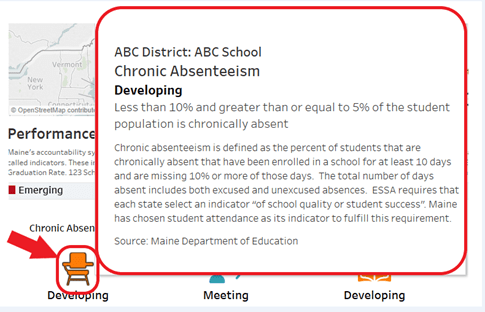
chronicabreportcard

Parents, educators and community members also have the opportunity to examine chronic absenteeism data by student group and to see the progress the school is making in reducing instances of chronic absenteeism school wide.
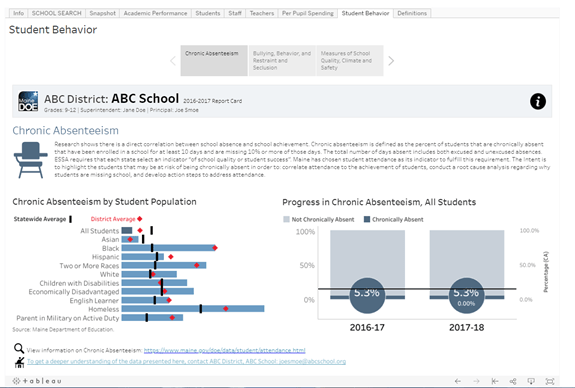
report card 2

Download the Maine DOE’s Chronic Absenteeism Info Graphic as an additional resource.

For further information or questions contact, Interim Director of Learning Systems Janette Kirk at (207) 624-6707 or Janette.Kirk@maine.gov.


Seeking Districts to Participate in Free Pilot of NBC Learn K-12 Product

NBC Learn is collaborating with the Maine Department of Education to offer all districts in Maine the opportunity to participate in a free pilot of their K-12 product.

The pilot will include access to thousands of videos curated for educational purposes, as well as technical and professional learning support. NBC Learn will promote district integration of the tool into a variety of different Learning Management Systems and will offer school leaders support as they align the resources to their local curriculum.

Districts who choose to participate will be asked to name one point of contact. This point of contact should be in a leadership role (curriculum coordinator, library media specialist, technology integrator, principal, teacher leader, etc.) and able to commit to helping other educators in the district or school to purposefully integrate the resources into their teaching and learning practice. That point of contact will also be asked to participate in an introductory webinar and a pilot evaluation facilitated by NBC Learn and the Department, which will include two surveys.

Additional information about NBC Learn and the pilot opportunity can be accessed through the:

Pilot Brochure (PDF)

Pilot Overview (PDF)

In order to ready to fully participate in the pilot from December 2018 through June 2019, districts can sign up for the pilot now. To join the pilot, please sign up here.

For additional information or answers to questions, please contact: Grace Kane, Manager, Partnerships and Sales, NBC Learn at grace.kane@nbcuni.com or Amanda Nguyen, Digital Learning Specialist, Maine Department of Education at Amanda.Nguyen@maine.gov

October is Dyslexia Awareness Month

Maine Department of Education and RSU 5 have begun a teacher-training project for the 2018-2019 school year. Twelve teachers including reading interventionists, special educators, and district special education director, Bonnie Violette will receive extensive Structured Literacy training provided by dyslexia specialists from the Children’s Dyslexia Center in Portland.

Structured literacy is a teacher-led approach characterized by the provision of systematic, explicit instruction of language and reading.  The skills taught are helpful for all students; but they are especially critical for students with language-learning weaknesses, including dyslexia.

The teachers began their training in June with a fifteen-hour seminar and have recently completed an additional fifteen hours of seminar training.  They have just begun to apply new skills and knowledge with their students.  The teachers will receive extensive practicum supervision throughout the year.

Pownal Elementary Teacher
Hillary Massicotte delivers her first Structured Literacy lesson to a fourth-grade student at Pownal Elementary School.

Lisa Whitis, Dyslexia Coordinator for the Maine DOE, recently visited Pownal Elementary School to observe the teachers in action. “The students are loving it, especially the kinesthetic piece, I’ve already begun to see improvement,” shared Hillary Massicotte.

Special Education Director, Bonnie Violette, noted that she has a talented group of dedicated teachers and they are excited to be part of this project.

For further information contact Lisa Whitis,  Dyslexia Coordinator for the Maine DOE at Lisa.Whitis@maine.gov or (207) 624-6643

MEDIA RELEASE: Maine Kids Rock Program Expands to 22 Additional Schools

The Maine Department of Education is pleased to announce that 22 school districts have been awarded $5,000 worth of modern band instruments, per school, as part of an expansion of the Maine Kids Rock Initiative.

“The Maine Kids Rock initiative has been a huge success so far,” said Maine Department of Education Commissioner, Robert G. Hasson, Jr. “We are thrilled to be expanding it by an additional 22 schools in Maine that would not otherwise be able to afford the instruments and specialized training.”

Currently in its second year, the Maine Kids Rock initiative is a program developed between the Maine Department of Education and national nonprofit, Little Kids Rock. Selected schools receive all of the instruments and resources necessary to run modern band programs, and partner teachers will receive extensive, direct coaching through Little Kids Rock’s training course, Modern Band 102, this fall.

To be eligible for participation in this initiative, districts must agree to offer modern band – taught by a certified music teacher – during the 2018-2019 school year. Priority is given to schools who serve 50% or more free or reduced eligible students.

The 22 additional schools join the initiative’s 10 pilot schools, which will continue in the program and receive frequent, targeted professional development. Partner teachers in the second-year cohort will attend a series of virtual professional learning sessions – offered monthly and covering a range of topics from hip-hop to singing in modern band – taught by expert staff from the Little Kids Rock organization. Additionally, all teachers receive free, unlimited access to the newest resources in Little Kids Rock’s online hub, Jam Zone. Next spring, new partner schools will be featured in a public performance at the second annual “Concert at the Capitol.”

The 22 members of this year’s cohort are:

Andover Elementary School (Andover School Department), Dr. Levesque Elementary School (MSAD 33), Easton High School (Easton School District), Glenburn School, Greenville Consolidated School, Hall-Dale High School (RSU 2), Leavitt Area High School (MSAD 52), Lee Elementary School (MSAD 30), Monmouth Middle School, Mattanawcook Junior High School (RSU 67), Miles Lane Elementary School (RSU 25), Molly Ockett Middle School (MSAD 72), Searsport Middle/High School (RSU 20), Sebasticook Valley Middle School (RSU 19), Sherwood Heights (Auburn School Department), Spruce Mountain Middle School (RSU 73), Walker Elementary School (RSU 3), Walton Elementary School (Auburn School Department), Washington Academy, Winslow Elementary School (AOS 92), Winslow Junior High School (AOS 92), and Woodland Consolidated School.

The 10 returning schools are:

Central Community Elementary School (RSU 64), Crescent Park and Woodstock Elementary Schools (RSU 44), East End Community School (Portland Public Schools), Hitchborn Middle School and Penobscot Valley High School (RSU 31), Houlton Middle/High School (RSU 29), Katahdin Elementary, Middle, and High Schools (RSU 50), Medway Middle School (Medway School Department), Meroby and Rumford Elementary Schools (RSU 10), Troy Howard Middle School (RSU 71), and Waterville Senior High School (AOS 92).

Rachel Paling, Maine DOE Director of Communication at rachel.paling@maine.gov

ESSA & Accountability: Why does accountability matter? #success4ME

Every element of our education system, including our expectations for students, how we understand if students are meeting those expectations, and how we are working with and supporting teachers and leaders, work toward the goal of ensuring all students are prepared for success after high school. Accountability is one piece of that system.

Accountability systems are intended to help us focus on what matters most, give us a better understanding of what is working well, and determine where we need to make improvements so we can help all students succeed. Just as state standards and assessments set expectations for what students should know and be able to do, state accountability systems set expectations for school performance helping schools determine next steps in accessing available supports from the state.

Statewide accountability systems set goals for achievement and growth for all schools regardless of race, income and zip code, and provide an opportunity for all stakeholders to understand school and district profile, and performance information.

Maine’s accountability system is now known as Maine’s Model of School Support. Through the implementation of the model,  Maine will identify schools eligible to receive additional supports in January 2019.

What is Maine’s Model of School Support?

Maine has moved towards a more purposeful approach to supporting Maine Schools. Maine’s Model of School Supports utilizes the following indicators:

Elementary/Middle Schools High Schools
Chronic Absenteeism Chronic Absenteeism
Academic Progress English Language Proficiency
English Language Proficiency Academic Achievement
Academic Achievement Graduation Rate

As you can see, the indicators remain a constant across grade spans with the exception of academic progress and graduation rate. Graduation rate only applies to high schools and as such is a high school model indicator. Progress can only be calculated when there are multiple years of data and this is currently only possible between grades 3-8 or Elementary/Middle level, therefore, progress is utilized in Elementary/Middle schools.

Data related to these indicators will be utilized to determine performance levels for each student population. Student populations include: white, Asian, black, two or more races, Hispanic, Native American, Native Hawaiian or Other Pacific Islander, economically disadvantaged, English language learners, migrant, homeless, foster care and students with disabilities (data for bolded student groups is included in the model. Data for non-bolded student groups is used for reporting purposes only).

In order for a school to receive a performance level within the above indicators, there must be a minimum count of 10 students. If there are less than 10 students in a student group, the data is not utilized, is suppressed, and the indicator will not be applicable for that specific student group.

The method by which 2018/2019 determinations are made is a new process to Maine containing many new indicators (listed above). The Department in collaboration with stakeholders, believe the inclusion of a wide variety of indicators will provide a more comprehensive view of school success. Maine uses performance on these indicators to determine schools who would benefit from the provision of school supports. Schools determined eligible to receive supports will receive additional assistance from the state and their districts. Additional assistance and support through the Maine Department of Education will include professional development and learning, regional leadership coaching, and other supports as determined by the tier of support.

Comprehensive Supports and Interventions (CSI) or Tier III supports are determined as a result of all student populations within Title I schools experiencing challenges across all indicators within Maine’s Model of School Supports. This comprehensive support assists in accelerating  improvement schoolwide. Schools will receive supports for a period of three (3) years. These are schools similar to those identified as priority schools in Maine’s previous accountability model.

Targeted Supports and Interventions (TSI) or Tier II Supports – are determined as a result of specific student populations experiencing challenges in a specific indicator consistently for three(3) years.  These schools are similar to schools that were previously identified as Focus schools; however, under ESSA, Maine  now must identify any school with a consistently underperforming subgroup of students. Maine will not be making determinations for schools eligible for Tier II supports until the 2019/20 school year and then annually thereafter as four (4) years of data is required in order to determine three (3) years of consistently underperforming.

Additional Targeted Supports and Interventions (ATSI) or Tier I Supports – are determined as a result of a single student population(s) experiencing challenges across all indicators. These determinations will be made on an annual basis. Support is provided to schools due to a need based on the performance of at least one student group.

Upcoming articles in the DOE Newsroom will focus specifically on each of the five (5) indicators.

Questions regarding the above information can be sent to ESSA.DOE@maine.gov or Janette Kirk via email at janette.kirk@maine.gov or 624-6707.