Reminder: Register now for 2018 Commissioner’s Conference – session highlights available

The 2018 Commissioner’s Conference will be held at the Augusta Civic Center on Wednesday, June 27th and Thursday, June 28, 2018. The Maine DOE has been working closely with Maine School Management Association (MSMA) to ensure that this year’s sessions meet the needs of attendees – see conference highlights below.

Find additional resources and information including pricing, a draft agenda, lodging options, further details about registration, including guest registration, and more on the Maine DOE Commissioner’s Conference webpage.

Register now »

Conference Highlights

Fulfilling the Dream of a Prosperous Maine
Duke Albanese, Commissioner’s Conference Keynote

Fulfilling the Dream of a Prosperous Maine: Getting There Requires a Focus on Education and Effective Leadership for Learning, Citizenship, and Opportunities for All Maine Students”

Finding widespread prosperity has been difficult for our state. Although Maine presents abundant opportunities to thrive and prosper as individuals and communities, pockets of vibrancy have often been limited even during the best of times. To turn the tide and make our state a great place to live and prosper, high quality education is the key. We have the scale and wherewithal to build a world-class early childhood through higher education system focused on equity and enriching learning opportunities for all students. What we need to achieve this is strong, effective, creative, and resourceful leadership. Can Maine do it? Yes. Who will lead?

Duke Albanese will serve as Commissioner Keynote, in addition to conducting a break-out session.

Cracker-Barrel Session
Commissioner Hasson and Maine DOE staff

Come to this informal session and get a chance to talk one-on-one with Commissioner Hasson and Maine DOE staff, including Department leadership. The Department will also have available some insider updates for superintendents.

Certification: What You Need to Know
Maine DOE staff

This session will provide participants with a review of important changes resulting from recent revisions to certification laws; clarification on common misconceptions about certification requirements and processes; an opportunity to discuss communication strategies for certification; and a question and answer segment on the new online system.

Legislative Update
Maine DOE Staff

The Maine Legislature adjourned its Second Regular Session sine die on May 2, 2018. While education bills remain, including LD 1869 –”An Act To Establish the Total Cost of Education and the State and Local Contributions to Education for Fiscal Year 2018-19 and To Provide That Employees of School Management and Leadership Centers Are Eligible To Participate in the Maine Public Employees Retirement System”—which are preserved to be carried over to any special session of the 128th Legislature, others were passed and became law are either in effect now as emergency legislation, or will become law on Wednesday, August 1. This session will include a summary of enacted educated-related legislation, the status of bills preserved by the joint order, and a progress report on the status of rulemaking.

Open Forum: Addressing the Teacher Shortage
Open Forum lead by DOE staff

What can Maine do to address the teacher shortage while strengthening our educator workforce? In this open forum session, we will discuss barriers to teacher retention and recruitment and what is being done across the state to overcome these obstacles. Together we will collaborate on ways that all stakeholders can work together to build our educator workforce and promote the teaching profession.

Put your Collaborative Project on the Regionalization Map
Maine DOE staff

During this session, participants will learn about the EMBRACE II initiatives, including lessons learned; be introduced to the process of forming a regional service center; learn about the upcoming grant opportunity offered by the Fund for the Efficient Delivery of Educational Services (FEDES); brainstorm possible regionalized services and programs; and have an opportunity for questions and answers.

We Have Formed a Regional Service Center: Now What?
Maine DOE staff

During this session, participants will provide input for the Department as to what regional service centers and executive directors need for support; gain an understanding of the monitoring and reporting requirements for a regional service center; receive legislative updates that directly impact regional service centers and their funding; and have an opportunity for questions and answers.

Panel: Preparing Kids for Maine’s Workforce
Maine DOE staff and panel of industry representatives

What are employers looking for? What are students prepared to offer? What can Career and Technical Education (CTE) provide for industry and students? In this session, a panel of industry representatives will share what they look for in an employee. We will discuss and seek ideas for how Maine’s CTE programs can help create more opportunities for students and meet workforce needs.

PreK with Staying Power!
Maine DOE staff

High quality prek has great potential; but research shows that to truly lessen the achievement gap, certain program elements must be present before kindergarten or the gains will “fade out” in the early elementary grades. What are the goals for a prek program in your district? Are you seeing these goals realized in child outcomes over time? Come hear about the prek programs that include the research-based elements and the end-of-prek outcome data that predicts 5th grade reading, writing, and math scores.

Improving K-3 Literacy Achievement by Building Teacher Knowledge
Maine DOE MoMEntum staff and educators from pilot schools

The Department is implementing an early literacy/technology learning pilot project, MoMEntum K-3 Literacy, in schools located regionally across Maine. This initiative provides high-quality professional learning to build teacher knowledge and skills to impact student learning. This session will provide an overview of the initiative; details about the professional learning, including intentional instruction, opportunities for student practice, technology integration, and assessment that informs ongoing instruction; preliminary findings related to student achievement; and lessons learned so far. During this panel discussion, participants will have the chance to hear from and ask questions of those leading the program as well as participating educators and school leaders.

Closing the Achievement Gap with Early Math Education
Maine DOE staff

Two years of assessing current state data shows an increasing gap in the percent of grade 3-5 students statewide who meet or achieve state expectations in mathematics as compared to ELA/literacy. The Maine Department of Education is embarking on a new initiative called the Numeracy4ME K-4 Mathematics Pilot program, in schools located regionally across Maine. This initiative provides high-quality professional learning to build teacher knowledge and skills to impact student learning of mathematics. This session will provide an overview of the initiative, including details about structure of the professional learning, the focus on numeracy concepts, and implications for PK-4 learning and assessment applicable to all schools.

Work Session: 2018/19 School Approval Requirements & Process
Maine DOE staff

This session will provide guidance on the 2018-19 school/district approval requirements and the new more streamlined process in the Department’s NEO system. Superintendents will have the opportunity to begin completing the approval process at this session – bring your laptops.

Open Forum: Performance Evaluation and Professional Growth
Maine DOE staff

This session will provide district leaders an opportunity to share their PEPG triumphs and tribulations. Do you have a strategy that is working well in your district that you would like to share with others? Do you have a need for greater support in certain areas such as observations and feedback? Is your school or district interested in improving the quality of the Student Learning Objectives? Participation, creative strategies, and a willingness to share is encouraged in this session!

Raising the Bar for Technology in Maine Schools
Jim Moulton, Apple Inc.

How do we help our students learn today and prepare them for a rapidly changing world? A driving force behind this change is technology. It affects the way we communicate, the way we work, the way we live day-to-day. It also empowers every individual—and every learner—to create amazing things and make a difference in the world. But first, we need to raise the bar for what’s expected, and what’s possible, for learning with technology.

Substance Abuse Resources
Maine Center for Disease Control

The presentation will provide an overview of Maine Prevention services, specifically substance and tobacco use prevention including electronic nicotine delivery systems/vaping to school leaders. The information provided will be useful for school administrators as they consider policies, practices and education necessary to protect and optimize the health and safety of students. Materials, resources and a list of community prevention providers who can support school prevention efforts will be available at this presentation.

Elevating Concussion Education: How to Address Everyone
Maine Concussion Management Initiative (MCMI), Colby College

As schools prepare for the start of each year, it’s the perfect time to update concussion education. To ensure that head injury is addressed with each population in the district, MCMI has tailored plans to educate all stakeholders. Everyone in your district will benefit from tailored and current concussion information. Attend this session to learn more about how to get involved.

Other possible sessions:

  • Steve Levesque, and Glenn Cummings – Educating the Workforce Panel
  • Adult Education
  • Budget Methodology of State/Local Funds for ESEA
  • ESSA: School Improvement for All
  • Early Math Education
  • Post-secondary enrollment and credentialing options
  • Truancy
  • Trauma

New deadline for changes in documenting medical services in Individualized Educational Plans (IEPs)

On April 14, 2018, the Department issued guidance regarding a change in IEP requirements in Administrative Letter #13. The purpose of the change is to document educationally and medically necessary services on the IEP aligning to Section 65 and Section 28 of the MaineCare Benefits Manual.

On May 1, 2018, the Department issued a priority notice putting in effect a 1-month hold (until June 1, 2018) on the implementation, in order to resolve some questions on IEP document wording. After further review, it has been concluded that an extended delay in implementation is needed.  The Department expects the new procedures and forms to be clarified soon. The Department will announce the new effective date and clarified language as soon as possible.

For more information, contact the Department of Education’s Office of Special Services at (207) 624 -6713.

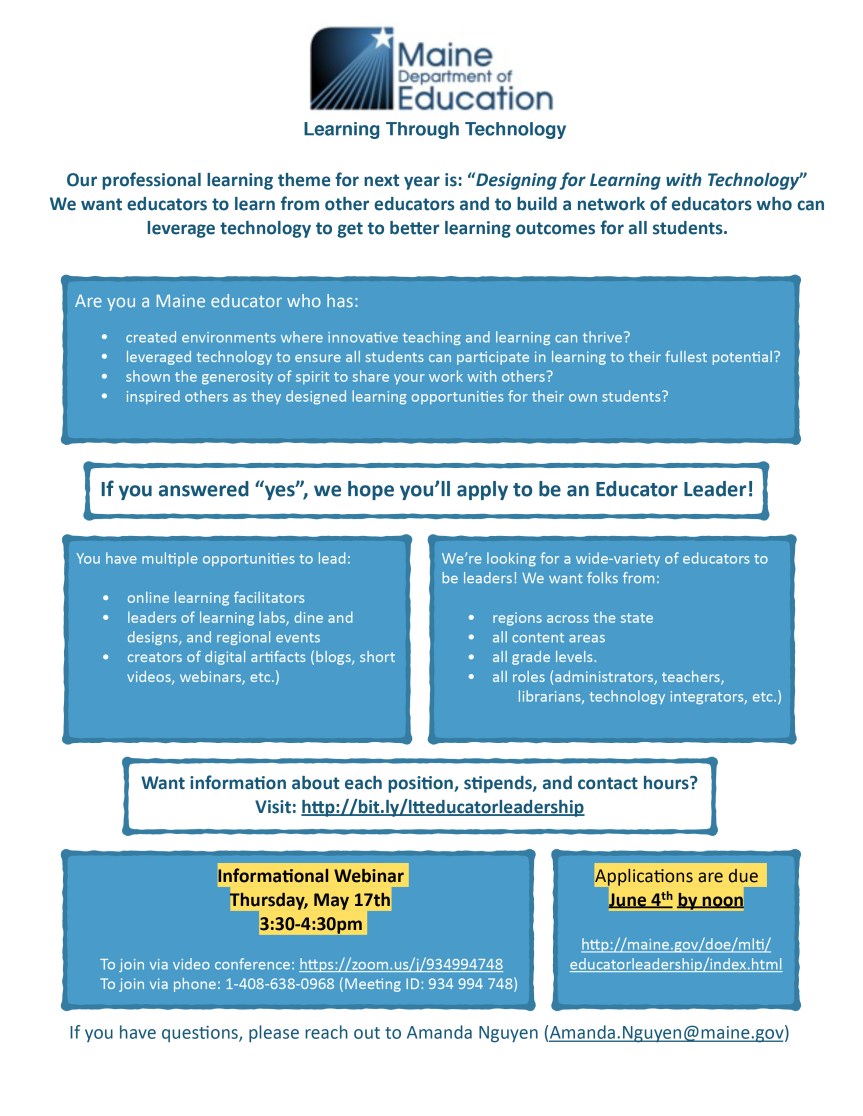
Looking for Educator Leaders who are “Designing for Learning with Technology”

The Learning Through Technology team at the Department of Education is looking for educator leaders! The theme for next year is: “Designing for Learning with Technology.” We want educators to learn from other educators and to build a network of educators who can leverage technology to get to better learning outcomes for all students.

There are a variety of different opportunities to lead: online learning facilitators; leaders of learning labs, dine and designs, and regional events; and creators of digital artifacts (blogs, short videos, webinars, etc.). More information about each position, stipends, and contact hours can be found here: http://maine.gov/doe/mlti/educatorleadership/index.html

Applications are due June 4th by 12:00pm and can be found here: http://maine.gov/doe/mlti/educatorleadership/index.html

A webinar will be available to go over these opportunities and answer any questions folks might have as they complete applications:

Thursday, May 17th, from 3:30-4:30pm

The Department is looking for a wide-variety of educators to be leaders from:

  • regions across the state
  • all different content areas
  • all different grade levels.

We would like representation from each of the different educator roles – for example:

  • administrators
  • teachers
  • librarians
  • technology integrators

The Department would like to hear from educators who have:

  • created environments where innovative teaching and learning can thrive,
  • leveraged technology to make sure all students can participate in the learning to their fullest potential
  • shown the generosity of spirit to share their work with others
  • inspired others as they design learning opportunities for their own students.

Please share this opportunity with other educators!

For further information or questions, please reach out to Amanda.Nguyen@maine.gov

LTT Educator Leader Poster v.5

Computer Science Day: Save the date and invitation to present

The Maine Department of Education, Maine State Library, and Project Login are partnering to host Computer Science Day this summer. The event will be open to the public, applications for presentations are now being accepted.

Date: Monday, August 13th from 9am – 4pm

Location: Maine State House (Hall of Flags), Maine State Library (Atrium), and Various Committee Rooms in the Maine State House

Attendees: Open to the public

Activities: Attendees can join presentations, hear from panelists from multiple industries, and visit booths with hands-on learning opportunities

Topics that will be explored include: What is Computer Science? What is it not? Where do we see it both in Maine and in our everyday lives? What is the skill set our students need to be successful in an evolving workforce that is coming to rely more and more on Computer Science? How can we foster more partnerships, collaboration, and access to resources between educators, non-profits and businesses? What resources exist to help educators integrate computer science into their teaching and learning practice?

Presenters: K-12 schools, Higher Education, Businesses with Employees Engaged in Computer Science Work, Non-Profits, Informal Learning Providers, Companies that have Computer Science Education Products, etc.

If you are interested in presenting at Computer Science Day, please submit the following application by June 4th, 2018!

Application to present: http://bit.ly/csday2018presenters

For more information or questions, contact any of the following event organizers:

Amanda Nguyen, Maine Department of Education, Digital Learning Specialist (Amanda.Nguyen@maine.gov)
Jamie Ritter, Maine State Library, Maine State Librarian, (James.Ritter@maine.gov)
Jason Judd, Educate Maine, Program Director, Project>Login (jason@educatemaine.org)


Maine DOE announces 3rd Annual Read to Ride Summer Reading challenge

Summer vacation is a welcome break from the daily school routine for children and parents alike, but the summer months can be detrimental to students’ learning if young minds are not kept active. Summer learning loss is a well-documented phenomenon, particularly with respect to reading achievement.  Students can lose up to three months of reading progress during the summer if they don’t keep reading.  When combined across a child’s PK-8 school career, this can result in 1-2 years of lost reading progress.

Fortunately, the summer slide can be prevented or greatly reduced when students continue to read on a regular basis. By encouraging children to read from a variety of resources for fun and to explore topics of interest, they continue to practice applying the skills they have learned, build their vocabulary and widen their knowledge of the world.  For students who are not yet reading independently or just beginning to read, reading to and with parents is equally beneficial.

Again this year, the Maine Department of Education is collaborating with the Freemasons of Maine to sponsor the Read to Ride Summer Reading Challenge for students in grades PK-8.  The Maine Freemasons have generously donated 48 bikes with helmets as prizes for the Read to Ride Summer Reading Challenge.  During the first two years of this initiative, thousands of Maine children completed the challenge of reading 500 minutes during the summer vacation.  Maine DOE hopes to see this number grow even higher during the summer of 2018.

Any school with students in the PK-8 grade span may register to participate. Participating schools will collect documentation from students who have completed the challenge. They will hold school level drawings to select two students (one boy and one girl) whose names will be entered into the state level drawing to be held on September 21, 2018.   Schools are encouraged to participate in this challenge, to coordinate it with any other summer reading challenges/programs they offer, and to consider soliciting their own local level prizes for students who complete the challenge.  Details about the Read to Ride Challenge and information to register your school can be found at: http://www.maine.gov/doe/literacy-for-me/summer-literacy.html.

Questions may be directed to Maine DOE’s Early Learning Coordinator, leeann.larsen@maine.gov.

Administrative Letter: Important changes in documenting medical services in Individualized Education Plans (IEPs)

Administrative Letter: 13
Policy Code: BGB
To: Public School Administrators and Special Education Directors
From: Robert G. Hasson, Jr., Ed. D. Commissioner
Date: April 14, 2018
Subject: Important changes in documenting medical services in Individualized Education Plans (IEPs)

The Maine Department of Education has instituted new requirements for Individualized Education Programs (IEPs) beginning May 1, 2018. This guidance is offered in collaboration with the Department of Health and Human Services. The purpose of this change is to clarify the documentation of educationally and medically necessary services on the IEP aligning to Section 65 and Section 28 of the MaineCare Benefits Manual.  These changes will ensure compliance with documentation required for access to MaineCare benefits.

When an IEP Team determines that the nature and severity of a child’s educational needs are significant enough that education in regular classes with the use of supplementary aids and services cannot be achieved satisfactorily (MUSER X.2.B. page 120), the least restrictive environment (LRE) statement must reflect the fact that certain services will be necessary in order for the child to access the curriculum.

Beginning May 1, 2018, the Department requires that newly developed or amended IEPs contain justification for medically and educationally necessary services such as day treatment services, rehabilitation services, nursing services, or other medical services that a child needs in order to receive a free appropriate public education (FAPE). Other educationally and medically necessary services such as speech and language, occupational therapy, physical therapy, social work services, and transportation are already listed in the service grid. The justification will be stated in the least restrictive environment section (LRE) of the IEP (Section 9).

The LRE statement must include information that would justify MaineCare paid educationally necessary medical services. An example of such a statement is the following: “Due to the child’s complex medical needs, the child requires a highly-structured setting with a predictable routine, clear and consistent consequences and integrated therapy for social and emotional needs in a significantly more restrictive day treatment setting”.  Please note that an LRE statement might include additional explanation and that the above example is not intended to necessarily model a complete LRE statement.

Beginning May 1, 2018, schools are requested to write an LRE statement similar to the above example depending on the specific needs of the child.  When the revised IEP form goes into effect on August 1, 2018, it will still be important to develop an appropriate LRE statement but the documentation for MaineCare purposes will be in section 8, “Additional Medical Services for FAPE”.

A draft copy of the revised IEP form can be accessed at the following site:  http://maine.gov/doe/specialed/forms/index.htmlPlease note: this form is only a draft and the revised IEP form will change before implementation on August 1, 2018. 

Further guidance will be included in a revision of the procedural manual available on the Special Services webpage sometime before the August 1 date.  For more information, contact the Department of Education – Office of Special Services at (207) 624 -6713.

PRESS RELEASE: Maine’s reading and mathematics test scores at or above national average on the National Assessment of Educational Progress (NAEP)

Augusta – Maine’s fourth and eighth graders scored at the national average or higher on the recently released 2017 National Assessment of Educational Progress (NAEP) tests of Reading and Mathematics.

NAEP highlights the statewide academic performance for all students, as well as demographic groups including race, ethnicity, gender and socioeconomic status. The test is administered every other year to students in all 50 states, and does not include results for individual students, schools, or classrooms.

Maine’s scores and key information:

  • Maine students scored at the national average or higher, consistent with previous years.
  • Maine students did not show any significant change in performance in either mathematics or reading in grades four and eight when compared to the results in 2015.
  • Reading scores indicate a gender gap at the 4th and 8th grade levels with boys performing lower. The gender achievement gap appears to be increasing as students get older.
  • Math scores did not indicate a gender achievement gap.
Average Scale Scores
NAEP Scores National Public 2017
Assessment Area and Grade 2011 2013 2015 2017
Math Grade 04 244 246 242 240 239
Math Grade 08 289 289 285 284 282
Reading Grade 04 222 225 224 221 221
Reading Grade 08 270 269 268 269 265
 (Scores are rounded to the nearest whole number.)
For a detailed look at the each of the state’s scores including Maine, visit NAEP’s website.

“Maine students face unique challenges today that can have an impact on their learning. While I am pleased that our students are maintaining performance, the Department will continue to focus on effective strategies to improve achievement of mathematics and literacy in all grades,” said Maine Department of Education Commissioner Robert G. Hasson, Jr.

“In addition to the Department’s MoMEntum Literacy Pilot program, we are also embarking on a similar strategy called Numeracy4ME to support schools in their efforts to improve student achievement in math. It is my hope that we can expand these programs as we continue to develop them,” he added.

More information about the MoMEntum and Numeracy for ME pilot programs can be found at the following links:

NAEP scores are only one of many measures of the achievement level of Maine’s students and should not be used in isolation from other data.  The Maine Educational Assessments, such as the eMPowerME, Multi-State Alternate Assessment, and SAT, also provide valuable information about the knowledge and skills of Maine’s students.  Additionally, formative assessments and locally developed academic measurements are essential parts of a school’s instructional program.

The National Assessment of Educational Progress (NAEP) is the largest nationally representative and continuing assessment of what America’s students know and can do in various subject areas.  Since NAEP assessments are administered uniformly using the same sets of test booklets across the nation, NAEP results serve as a common metric for all states and selected urban districts. The assessment stays essentially the same from year to year, with only carefully documented changes. This permits NAEP to provide a clear picture of student academic progress over time with respect to a specific set of learning goals.  As noted above, however, as standards and goals for learning evolve and teachers emphasize new content, and perhaps deemphasize other content, this stability means NAEP may not be able to adequately capture learning with respect to new standards.   NAEP does provide results on subject-matter achievement, instructional experiences, and school environment for populations of students (e.g., all fourth-graders) and groups within those populations (e.g., female students, Hispanic students).


The contents of this paragraph were retrieved from the U.S. Department of Education, National Center of Education Statistics website http://nces.ed.gov/nationsreportcard/about/
Media contact:
Rachel Paling, Director of Communications, Maine Department of Education
Rachel.paling@maine.gov

Outstanding educators sought for Maine talent pool

The Maine Department of Education is accepting recommendations through April 27, 2018 for the 2018 Maine Educator Talent Pool. These distinguished educators may be considered for membership on local and state advisory boards and task forces, as well as be candidates for special recognition through the Department.

The Department is currently seeking elementary educators (grades K-5), relatively new to the profession, with five to 18 years of experience, who show unusual instructional ability; inspire their students, colleagues and community members; have strong leadership potential; and are comparable to the nation’s best educators. Candidates are typically certified classroom teachers holding a bachelor’s degree. Previous recognition is not required. Of special interest are educators who are outstanding but have not received other recognition.

Recommendation forms can be accessed here: Talent Pool Recommendation Form.   Please provide confidential, succinct, compelling, and specific information regarding the candidate on the recommendation form. All questions must be answered, preferably typewritten. Your recommendation packet must include a one-page narrative that addresses how the candidate meets the talent pool criteria, a completed recommendation form, and a resume from his or her personnel file.

School districts are strongly urged to take the time to recommend candidates. If necessary, assign the request to an associate. Please note though, this recommendation must remain confidential and not shared with the individual.

For more information, contact Educator Effectiveness Coordinator Emily Gribben at (207) 624-6748 or Emily.gribben@maine.gov.


Powered By Maine Teach to Lead Summit

Maine Teach to Lead is pleased to announce Powered By Maine Teach to Lead Summit, Monday, April 9th, 8:30-3:30pm at Husson University, in Bangor.

Do you have a vision for your school or district? Do you need time and support to make your vision a reality? Then the Powered By Maine Teach to Lead Summit is for YOU!

This is a FREE event for teachers where you will be able to network with other teachers from across Maine, collaborate with teaching peers to cultivate an idea, and develop an action plan to accomplish your goals.

Join us and make your idea a reality!

Apply today (Applications are due by February 8th at 5pm.)


Learning Through Technology Update

The Learning Through Technology Team at the Maine Department of Education is committed to helping teachers integrate technology into their classrooms in a way that improves student learning outcomes and achievement. We have three new ways to engage with educators this year that are designed to gather input and build capacity.

Professional Learning Survey

We are looking for input from all Maine educators as we develop a schedule of offerings for professional learning during the 2017 – 2018 school year. We want to know which topics are of most interest to you and the format in which you’d like to see the professional learning offered. The survey should take 5 – 10 minutes to complete. We’ll begin reviewing responses on September 18th! Please complete the survey today and share the link with any other educators in Maine that you know!

Link to survey: https://www.surveymonkey.com/r/LTTPL2017

School Visits

We have a new model for school visits. The goal has shifted from looking at MLTI implementation to recognizing the positive efforts of educators who are integrating technology into their learning environments and providing support to schools as they continue to leverage their technology for better student outcomes. Please reach out to Amanda Nguyen, Digital Learning Specialist at the Maine Department of Education (Amanda.Nguyen@maine.gov) if you’d like to schedule a school visit.

Link to school visit information: http://maine.gov/doe/mlti/schoolvisit/index.html

Learning Narratives Blog

We have a new blog that captures the stories of Maine educators who are leveraging technology for learning. Stories come from individual educators and also from our new school visits. The goal is to share models with other schools and educators. If you want to share your story, or recommend educators who we could contact to share their stories, please reach out to Amanda Nguyen, Digital Learning Specialist at the Maine Department of Education (Amanda.Nguyen@maine.gov).

Link to Learning Narratives blog: https://learningnarratives.wordpress.com