MLTI Podcast, Teaching with Tech, Returns for Season Two!

Teaching with Tech is back! The Maine Department of Education (DOE), Learning Through Technology team is excited for the second season of their MLTI (Maine Learning Technology Initiative) Ambassador podcast where they will highlight new faces and voices centered around supporting technology integration across Maine. In the first season of Teaching with Tech, episodes focused on a variety of topics ranging from digital citizenship, artificial intelligence, STEAM-based learning, and gamification in the classroom. The Ambassadors share exciting strategies and tools as well as interviews from the field which showcase how teachers and schools are using innovative educational strategies to provide students with the best experience possible.

The MLTI Ambassador team kicked off season two with an episode titled “What are the Ambassadors Working on?” This episode highlights projects that the team is looking forward to this year as well as gives examples of ways they can support districts, schools, and teachers all over Maine. October will be the first themed month, focusing both episodes around educational technology in the arts. Join the team as they interview educators about how they incorporate technology, tools, and strategies into their classrooms and schools. Be sure to look out for “Community Corner” bonus episodes which cover additional topics outside of the monthly theme. Last season saw bonus episodes dedicated to game-based learning in elementary physical education, the Educate Maine Symposium, and Student Leadership Ambassadors of Maine (SLAM) Clubs.

See a listing of 2023/3024 MLTI Ambassadors here.

Do you have a topic you want to hear on Teaching with Tech or know an educator doing exciting work with technology integration? The MLTI Ambassadors would love to hear from you! To join the conversation, email the team at DOE-LTT@maine.gov. Teaching with Tech is now streaming on Apple PodcastsSpotifyGoogle Podcasts, and YouTube Music.

For more information about the Teaching with Tech podcast or other MLTI Ambassador initiatives, contact the MLTI Ambassador Program Facilitator, Jonathan R. Werner, jonathan.werner@maine.gov

Maine DOE MLTI Ambassador Program Welcomes Five New Distinguished Educators

The Maine Department of Education’s (DOE) Maine Learning Technology Initiative (MLTI) Ambassador program is expanding to include five additional distinguished educators.

MLTI Ambassadors are distinguished educators, on loan from their school for two years, to bring their expertise and experience as a resource and partner with MLTI.

The Ambassador program is a signature program of MLTI 2.0. The full team of ten Ambassadors will deliver professional learning experiences and provide instructional coaching to MLTI-participating schools.

Chris Beckwith
Chris Beckwith

Chris Beckwith

Chris Beckwith comes to the MLTI Team from Reeds Brook Middle School, where he served as a technology integrator. A 30-year veteran with a Masters in Instructional Technology, Chris has taught technology, computer science, science, mathematics and health. Prior to his time in RSU22, Chris worked at the James Doughty School and Ellsworth Middle/High School. He has also run summer camp classes at the Maine School of Mathematics and Science (MSSM) for ten years. He is currently part of the DOE’s CSI program and has participated in both CS Ed Showcases. Chris is passionate about robotics, 3D design, drones, and AR/VR and has shared these topics and others at state and regional conferences. Chris is an avid Star Wars fan and lives in Hampden.

Jeff Ireland
Jeff Ireland

Jeff Ireland

Jeff Ireland comes to the MLTI Team from Oak Hill Middle School in Sabattus, where he served as a 5th/6th grade STEM teacher.  A 27-year veteran with a Master’s degree in Educational Leadership, Jeff worked for 10 years as a late elementary level teacher followed by 10 years as a building assistant principal and principal before returning the classroom to teach fifth grade. He has spent his entire career in the same school system, RSU4 (formerly School Union 44). Jeff is also a Registered Maine Guide and Professional Fly Casting Instructor. He is married to an elementary school teacher, is the proud grandfather of two, and lives in Wayne.

Gwyneth Maguire
Gwyneth Maguire

Gwyneth Maguire

Gwyneth Maguire comes to the MLTI Team from Old Orchard Beach High School, where she served as a library/media specialist and technology integrator.  She holds a Master of Education in Educational Technology from Boston College and a Library Media Endorsement from Central Washington University.  A 25-year veteran, Gwyneth has taught in both public schools, including Cape Elizabeth and MSAD60, as well as Department of Defense Schools. She was previously the ACTEM Conference Co-Chair and continues to serve on the Conference Committee. Gwyneth was called the district’s “MVP” by her superintendent for her ability to connect staff to appropriate tech, produce useful tutorials, and help with systematic organization of tech during COVID. She has worked with adults of all skill levels and backgrounds through positions at the Department of Defense, The Cape Courier, and the Portland Dioceses, as well as EdTech professional learning contractors. Gwyneth lives in Cape Elizabeth.

Donna Netzer
Donna Netzer

Donna Netzer

Donna Netzer comes to the MLTI Team from Princeton Elementary School, where she served as the math teacher for grades 6-8. A 15-year veteran, Donna holds a Masters of Education with focus on Special Populations (Trauma-informed). In her small school, Donna has worn many hats – math instructional coach, trauma coach, local teacher’s association president and running a PK-8 tech club. Princeton Elementary was the school she attended and it is where she has worked for her entire career and she is particularly proud of the national Pegasus Award for Princeton’s work on positive school culture. Donna is well respected in her school and in the Washington county region as someone who makes technology happen through writing grants, organizing training and building carts. She recently participated in the DOE’s CSI program. She lives in Princeton.

AJ Rog
AJ Rog

Aaron “AJ” Rog

Aaron “AJ” Rog comes to the MLTI Team from the Lyman Moore School in Portland, where he serves as Computer Science teacher and technology instructional coach. A 27-year veteran with a Masters of Education in Technology, AJ has spent most of his career working in Portland Schools. In addition to computer science and technology integration, AJ spearheaded an iPad initiative at elementary level.  Prior to teaching in Maine, AJ taught in Las Vegas for 12 years, working in grades 3-5 and later grades 6-8. He has done a lot of computer science training of other educators through CSTA Maine and Project>Login. Outside of school, AJ is a longtime swimming coach and is currently the Head Coach of Seacoast Swim Club in Cumberland. AJ lives in Cumberland with his wife Alexis.

The Maine DOE’s Learning Through Technology Team works hand-in-hand with the MLTI Ambassadors to support the MLTI professional learning plan in addition to the many other components of MLTI. For more information about MLTI 2.0, please contact Project Manager Bethany Billinger (bethany.billinger@maine.gov).  To work with the MLTI Ambassadors, please contact MLTI Ambassador Program Facilitator Jonathan R. Werner (jonathan.werner@maine.gov).


Maine DOE’s Second Annual Computer Science Showcase Features Innovative Student and Educator Projects

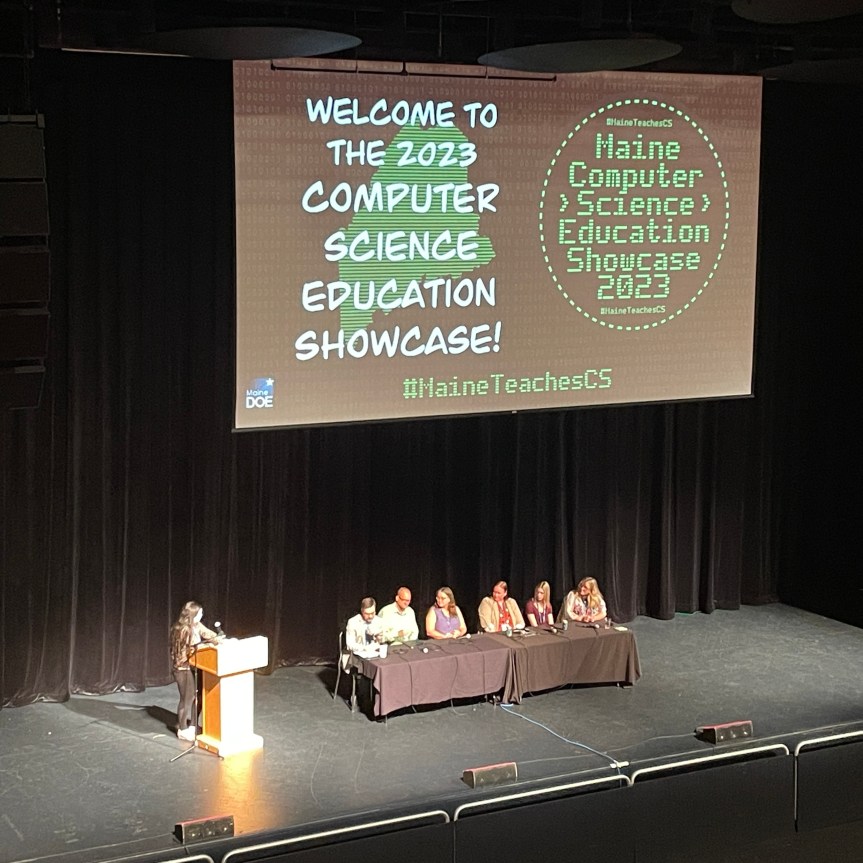
Students and educators from 40 school administrative units (SAUs) across Maine recently participated in the Maine Department of Education’s (DOE) Second Annual Computer Science Education Showcase at the Collins Center at the University of Maine. The Showcase highlighted innovative computer science education programs and projects in schools across Maine, with hands on, interactive exhibits.

Exhibits featured a variety of computer science education projects, including robotics, artificial intelligence (AI), 3D design, coding, augmented reality/virtual reality (AR/VR), data science, cybersecurity, and more. Robotics students participated in a live demonstration on stage where they had to work together to move objects and overcome structural barriers, requiring teamwork and problem solving.

The Showcase also included a panel discussion with educators, a student, industry representatives, and experts highlighting the importance of computer science education, opportunities for students and educators, and where the field is headed.
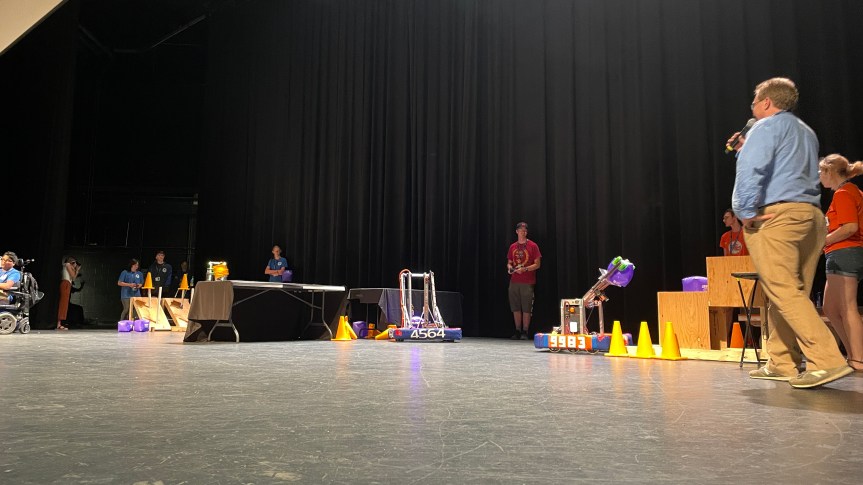
“If you can just simply show them and introduce students to these [computer science] concepts, then it opens up a whole world to them. You can be a kid from Maine and do really amazing things in the computer science field,” said Allison Braley, a teacher from RSU 25.

“These are foundational skills we are talking about, and they are across every sector. These are critical 21st century skills that everyone needs regardless of what pathway you choose in life. Kids can stay in Maine, they don’t have to go to Boston or California for these jobs. Employers are here. It doesn’t matter what background you’re from or what zipcode you’re from, this is for every student,” said Angela Oechslie from Project Login.

“If computing is an elective and only for some, you mostly get those students who set out to do that because they see themselves as who society says should do it. The beauty of looking at computer science from pre-k through 12 is that it can be universal, and you can make those opportunities for anybody to stumble across them—it’s young women, it’s those who are the first generation in their family to go to college, it’s kids in rural areas, it’s kids from underrepresented groups. We can diversify the field and we can make the field richer by giving everyone a chance to say that’s the thing I love,” said Penny Rheingans from UMaine.

“Most of the really difficult problems we need to solve over the next 30 years are going to be solved using computer science,” said Judson McIntosh, an Engineering Manager at Tyler Technologies.
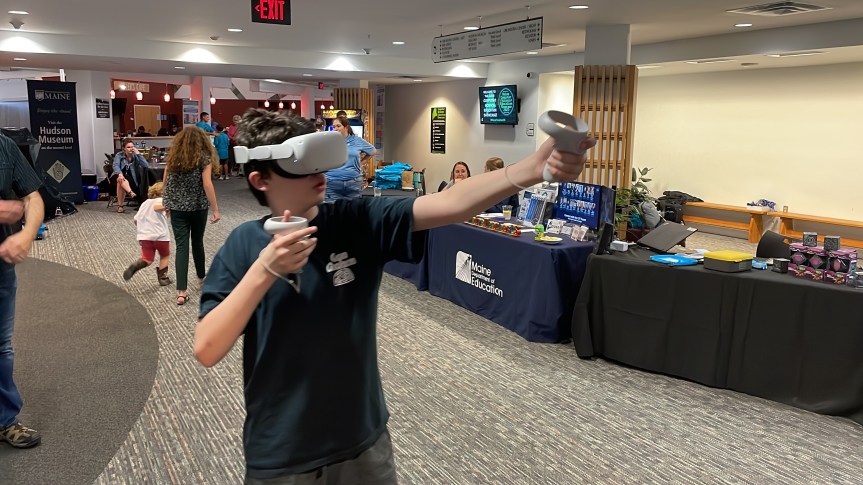
Maine continues to lead on computer science education and is the only state to provide interdisciplinary computer science education to all pre-K through grade 12 students in the state. Earlier this year, more than a thousand students from across the state participated in the Maine DOE’s Maine Learning Technology Initiative (MLTI) Student Conference. Students had access to more than 40 sessions that engaged them in essential computer science skills and knowledge, including animation, AI/machine learning, AR/VR, audio editing, CAD/3D Design, robotics, coding, and video game design. More than a dozen of the sessions were led or co-led by students.

Nearly 100 educators from across the state attended a multi-day institute in July, focused around computer science education. Educators spent two and a half days engaging in sessions and collaborating to integrate computer science into their classrooms and upcoming school year activities. Topics included Robotics & Programming, Coding & Hardware, Augmented & Virtual Reality, and much more. The more than 600 participants at this year’s Maine Educator Summit also had access to multiple workshops and sessions related to computer science and technology skills and integration.
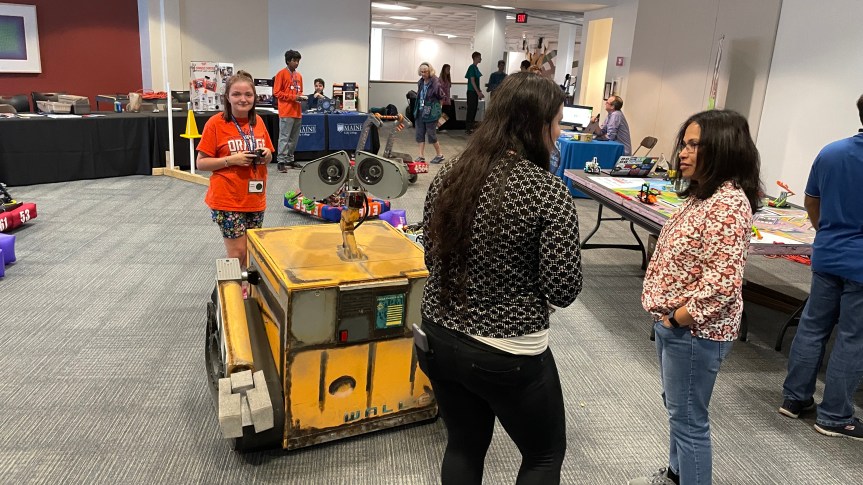
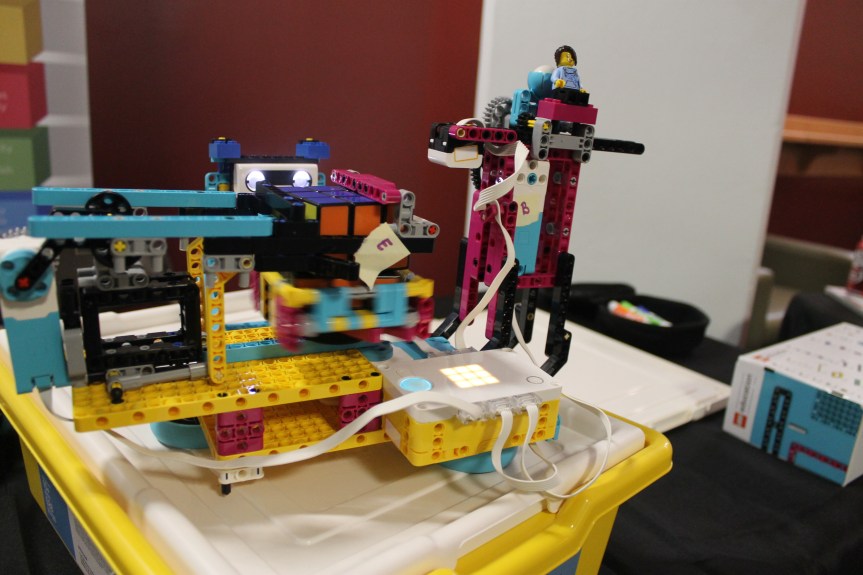
Last year, the Mills administration launched a new Maine DOE initiative to provide every Maine school with a free mobile computer science lab. Schools were able to order one of three mobile lab options: Robotics and Programming, Augmented and Virtual Reality, and Coding and Hardware. Each lab contains computer science equipment valued at $5,000 and is designed to be integrated into any content area and skill level. Additionally, the initiative made available professional learning opportunities for educators tailored to each computer science topic area.
New Super Story Podcast Takes Listeners Inside Schools

A new podcast launched this month to highlight the voices of those who teach in, learn in, work in, and lead public schools in one coastal Maine school community. Five Town CSD and Camden-Rockport Schools Superintendent Maria Libby created Super Story to bring the public into the inner-workings of public schools and help them gain a deeper understanding of the “challenges and triumphs” within public education today.

“My goal in starting the podcast, which has been a dream for nearly 5 years, is most broadly to help change the narrative about public schools,” said Libby. “The podcast shines a light on the human element of education because we have deep, genuine conversations about various aspects of the work. I hope the public is able to connect with and gain greater respect for educators by listening to Super Story.”

The inaugural episode of Super Story featured a conversation with Will Eggena, a Camden Hills Regional High School senior and valedictorian of his class. The two discuss Will’s educational journey, his views on the strengths of his education and where the school community can improve, the future of education, and his advice for others.

You can listen and subscribe to Super Story on Apple and Spotify.

Looking for more education podcasts? Be sure to listen and subscribe to the Maine DOE MLTI Team’s podcast Teaching with Tech which you can access here.

Want us to share your podcast? If you have a podcast at your Maine school or school administrative unit (SAU), please share it with us and we’d be happy to highlight it and increase your audience! Email communications.doe@maine.gov.

MLTI Launches Cyber Performance Grants!

The Maine Department of Education’s Maine Learning through Technology Initiative (MLTI) will release Cyber Performance Grants to help districts bolster network security and safety as defined by CISA’s 2023 recommendations to K12 schools.

Districts can apply for support and assistance with cybersecurity needs to better align themselves with CISA recommendations.   A few examples include:

  • Upgrading Firewalls, Switching, and Access Points
  • Multifactor Authentication Implementation
  • Student Data Privacy Actions
  • Incident Response Plans (Creating/Enhancing)
  • Transitioning to Cloud Services
  • Vulnerability Scanning and or Assessments
  • Cybersecurity Planning and Professional Development
  • Patch Management
  • Phishing/Malware/Ransomware Training
  • Awareness Campaigns
  • Minimizing Public Facing Exposures
  • Data backup upgrades
  • Alignment with CISA’s Cross-Sector Cyber Security Performance Goals (CPG)

The Cybersecurity and Infrastructure Security Agency’s (CISA) report, Protecting Our FuturePartnering to Safeguard K-12 Organizations from Cybersecurity Threats is a required component of the federal Cybersecurity Act of 2022.  The report findings and recommendations to schools can be found within the report and toolkit for schools.

The report begins, “Malicious cyber actors are targeting K–12 education organizations across the country, with potentially catastrophic impacts on students, their families, teachers, and administrators. A new report from the Cybersecurity and Infrastructure Security Agency (CISA) helps schools reduce the risks of a cyber catastrophe.”

CISA’s recommendations include investing in the most impactful security measures and building toward a mature cybersecurity plan, recognizing, and actively addressing resource constraints, and focusing on collaboration and information sharing.

Applications will be reviewed in the order they are received, and awards will be made based on impact, presented needs, and alignment with CISA recommendations.

Important Dates:

Informational sessions:

  • Wednesday, May 24th at 12:30 pm
  • Friday, May 26th at 12:30 pm
  • Tuesday, May 30th at 9:00 am
  • Tuesday, May 30th at 12:30 pm

Applications are due Friday, June 23rd

For more information about MLTI initiatives, go to https://www.maine.gov/doe/Learning/LTT/MLTI/2.0

Have questions? Want more information? Contact James Chasse, Infrastructure Specialist:  james.chasse@maine.gov

Shields Up Maine! Ten Maine School Units Participate in a Cybersecurity Cohort for Maine Schools

The Maine Department of Education (DOE) Maine Learning Through Technology Initiative (MLTI) 2.0 program recently engaged ten Maine school administrative units (SAUs) in a cohort to explore relevant cybersecurity topics. The cohort was comprised of both small and large school SAUs from the northern tip of Maine to the southern coast.  Participating were technology directors and network administrators; the group met biweekly for four months and will culminate with a panel discussion at this year’s annual ACTEM Spring Leadership Conference at the Holiday Inn by the Bay in Portland on May 1st.

“This program has been extremely helpful as we all try and find our way in the new responsibilities that we find necessary to protect our school districts. Most of us are learning as we go in the world of cybersecurity and protecting our school district’s data and networks.” –  Shields Up Maine! participant

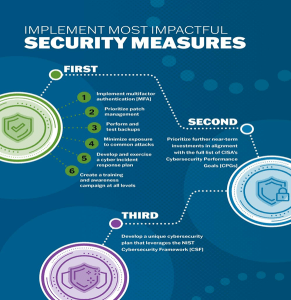
Graphic Source: CISA’s K12 Report to Education
Graphic Source: CISA’s K12 Report to Education (see this graphic larger)

The Shields Up Maine! cohort focused on CISA recommendations for education (see graphic) and covered topics that include the National Cybersecurity Review (NCRS), Cybersecurity and Infrastructure Security K12 Best Practices (CISA’s CSA), Multi-State Information Sharing and Analysis Center (MS -ISAC), the Center for Internet Security (CIS) services, CISA’s- Protecting Our Future Report, Maine School Library Network/Network

Maine (MSLN/NWM) Internet Service Provider (ISP) history and NWM Umbrella Services, Legalities of Information Technology, Maine Government CISO Best Practices, and Incident Response Plan (IRP) Training.

The group vetted various federal resources and services, studying the practicality, affordability, and potential implementation methods of evolving services.

Participating schools in the 2023 cohort include Searsport, Yarmouth, Mount Desert Island, Glenburn, Boothbay Harbor, Fayette, Madawaska, Blue Hill, Standish, and Medomak Valley.

“Shields Up Maine! is a great example of how the DOE has listened to Technology Directors…to connect them with security professionals to better protect Maine schools from cyber-attacks.” Shields Up Maine! participant

For more information about Shields Up Maine! and other infrastructure initiatives, please check out our website. Have questions? Want to learn more? Reach out to MLTI’s Infrastructure Specialist,

Jim Chasses at james.chasse@maine.gov

MLTI Announces the Student Winner of the 2023 T-Shirt Design Competition

Hope Handley
“Very recently, I started testing out digital art and I find it a new approach to projects I have been doing all my life. It’s very trying at times, but trial and error makes it worth the final product. Overall, I love any form of art and hope you can try it out and be creative!”

Introducing Hope Handley, a 9th grader at Grey-New Gloucester High School, whose design was selected as the winner of this year’s MLTI Student Conference T-Shirt Competition.

Hope’s colorized version of this year’s MLTI Student Conference logo

This year’s design focused on the water-focused theme of #DiveRightIn (Dive Right In), so Hope’s lighthouse and sea serpent were particularly eye-catching. This competition was open to all K-12 students in Maine. Hope’s design will be printed on turquoise blue t-shirts for thousands of Maine students and educators participating in the MLTI Student Conference, which will be both virtual (May 18th) and in-person (May 25th).

“Hope viewed photos of people laying out to catch a frisbee and transformed it into our mascot, Pat the Patriot and included ‘Spirit of the Game,’ which is a set of guidelines for Ultimate players.”

Hope and other MLTI students from RSU15 will be among the hundreds of students from more than thirty Maine schools to attend this year’s Student Conference at UMaine. Instructional Technology Integrator Michael Lamoureux had previously had Hope design a logo for the school’s Ultimate Frisbee team. These experiences with art are valuable ones for students as Hope and Mr. Lamoureux worked with the MLTI Team to adjust the design to meet printing requirements.

The MLTI Team will continue to seek out and utilize student artwork. If you are interested in this opportunity in the future, please look at this year’s call for student submissions for more information on eligibility and guidelines. Information about past winners from South Aroostook Community School, Auburn Middle School and Waterville Junior High School is also available.


The MLTI SLAM Showcase Comes to Two Central Maine Elementary Schools in March

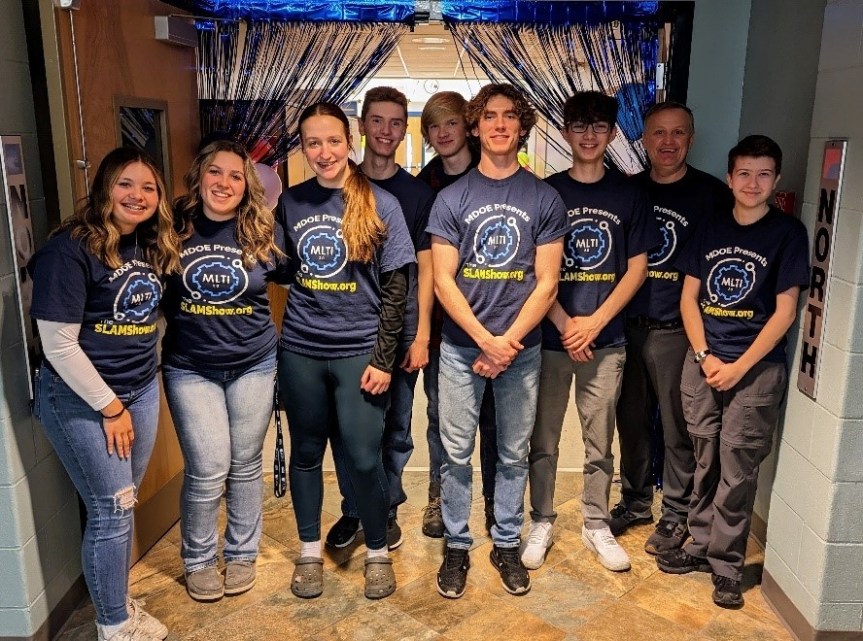
(Pictured: These SLAM Showcase events could not happen without Kern Kelley’s talented students from Nokomis.)

Benton Elementary School’s Lynn Hamlin providing support for students at this year’s third SLAM Showcase.

SLAM (Student Leadership Ambassadors of Maine) ran two successful SLAM Showcase events at two schools, Benton Elementary School (MSAD 49) on March 2nd and Pittston-Randolph Consolidated School (MSAD 11) on March 31st.  The event in Benton, the third SLAM Showcase this school year, was a long time coming.  The event was postponed due to weather in February, but luckily the weather was on this day was manageable. This event happening was particularly exciting for MLTI SLAM Coordinator Kern Kelley and teacher Tonya Therrien, who had planned a similar event in the fall of 2019, but weather and the pandemic delayed a reschedule.  The event in Pittston came through coordination with Patsy Adams, who attended a training at Nokomis this past summer.  When Ms. Adams realized the SLAM Showcase had the capacity for more students, she reached out to nearby River View Community School and invited their students to join in the learning.  Over two hundred students across these three elementary schools were able to participate in the two events.

SLAM Show host Mia interviews MSAD11 students about their favorite parts of the day.

Kern Kelley and his SLAM students from Nokomis along with MLTI Ambassadors spent the day presenting to elementary students and teachers on topics such as 3D design, coding, virtual reality (VR) and graphic design. The students were divided into four groups with each group rotating through the four sessions. All the students who attended were engaged and enthusiastic throughout each 55-minute session. At the end of each session, they were given 5-10 minutes to submit examples of their work, which they were eager to share. Both days concluded with a recording of the SLAM Show with interviews, games, and prizes. Participating students received VR headsets, so they could show their creations from CoSpaces with their families and friends. The school also received a drone following a group photo from the drone.

These two events, following similar events at Central Middle School and Hartford/Sumner Elementary School, proceeds two more scheduled events at Lubec Consolidated School and Van Buren Community School.

Students are interviewed for the SLAM Show that will air on the MLTI Youtube channel the following week

The SLAM show empowers MLTI students to use their devices and technology tools by providing a platform where students can give back and share their innovative work in their schools. The live, in-person SLAM Showcase events have been designed to directly align with MLTI’s vision that all Maine students engage in authentic, relevant, technology-rich, learning experiences that prepare them for a fulfilling future. “It was so much fun to see the students engaged; they were being challenged and being exposed to different technologies, many of them new to the students,” said Benton technology teacher Lynn Hamlin.

Historically, MLTI has been targeted to seventh and eighth grade students, but this year, districts had the option to expand up into nineth grade or down to sixth grade. MSAD49 opted to add sixth graders and became one of several districts who added multiple K-6 elementary schools to the MLTI program. These SLAM Showcase events are an ideal environment for older students, like those from Nokomis, to share their knowledge with younger elementary students.

MLTI Ambassador Joshua Schmidt commented, “I’ve been involved in the MLTI SLAM Showcase events at my own school, and also as a part of MLTI, and the positive energy among teachers and students is my favorite part. Everyone is so excited to learn! I would highly recommend creating a SLAM club at your own school and seeing how this type of event can be an energizing experience for your school and community as well.”
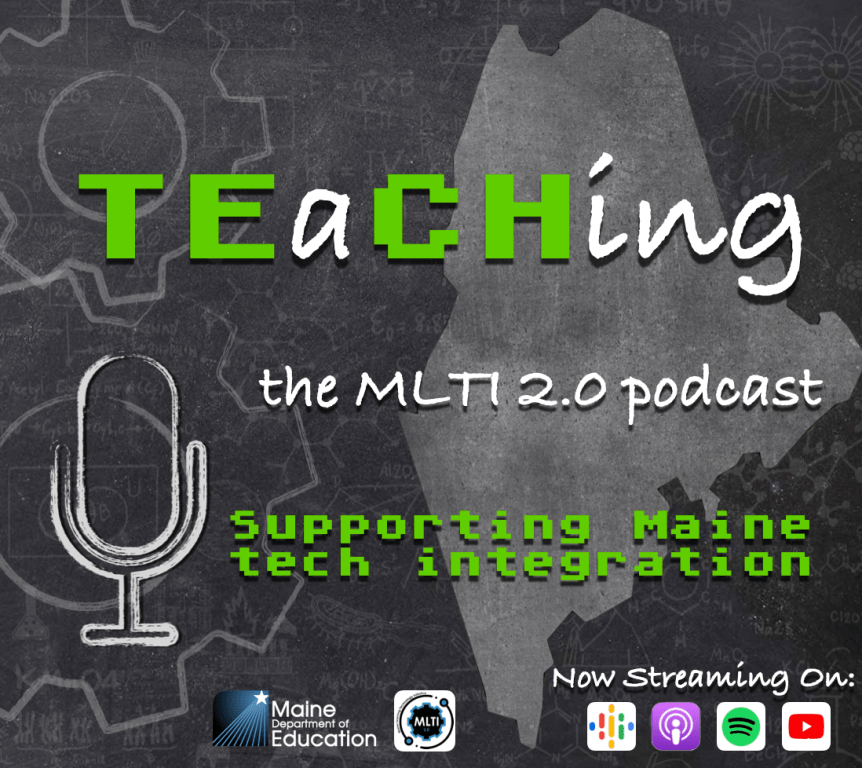
MLTI 2.0 Launches ‘Teaching with Tech’ Podcast

The MLTI 2.0 team has a new podcast called Teaching with Tech. Twice a month, the MLTI Ambassadors create episodes around a specific theme impacting education. Current episodes include gamification in the classroom, STEAM-based learning, and digital citizenship. Not only do the Ambassadors discuss how they view the topics, but they also bring authentic voices from the field to describe their own experiences. The team believes these personal discussions in the podcast make the content accessible for all educators across Maine as well as provide an additional format for educators looking for professional development opportunities.  

In addition to the regularly scheduled episodes around a specific theme, Teaching with Tech offers short Community Corner episodes which contain a variety of topics. These topics could include a relevant or current issue educators face, additional voices from the field, or highlighting educator events that have happened across the state. So far these Community Corner episodes have spotlighted the Educate Maine Symposium and a game-based learning activity in elementary physical education class.  

Plus, don’t miss out on the monthly giveaways which are available to any Maine educator to bring new resources to their classroom or school. This month’s drawing is for a free BreakoutEDU kit! 

The Teaching with Tech podcast is now streaming on Apple Podcasts, Spotify, Google Podcasts, and Youtube Music. If you would be interested in joining the conversation, reach out to the MLTI 2.0 Team at DOE-MLTI2.0@maine.gov with feedback, suggestions for future episodes, or questions on the topics outlined in an episode.  


Media Release: Maine DOE Announces Availability of Maine Learning Through Technology Initiative (MLTI) #TeachWithTech Grants for Schools

The Maine Department of Education (DOE) announced the availability of new Maine Learning Through Technology Initiative (MLTI) #TeachWithTech grants to support school administrative unit (SAU) efforts to meaningfully integrate technology into teaching and learning. The grants provide funding to MLTI educators who want to bring technology into their MLTI schools in a way that is innovative, impactful, and intriguing and will be used to provide supplemental technology to schools.

The supplemental technology available to schools through these grants includes, but is not limited to, 3D printers, laser cutters, video production equipment, specialized cameras, drones, robotics & coding kits, digital microscopes & doc cameras, and audio/podcasting equipment.

“Meaningfully integrating technology into teaching and learning allows teachers to harness the power of technology in a way that deeply engages students, and these tools and resources can be used across content areas and for all grade levels,” said Maine Education Commissioner Pender Makin. “Through these grants, Maine students will be able to access cutting-edge technology tools and build the skills they need to lead and thrive in a high-tech, digital world.”

Maine continues to lead the way with technology learning through innovation and meaningful integration. By focusing on ensuring that students have access to high quality technology-infused learning experiences and incorporating real-world topics and skills, Maine students are better prepared for post-secondary education, their careers, and beyond. From providing ongoing professional learning in technology integration, increasing student leadership opportunities in technology, and providing mobile computer science labs to all Maine public schools, these are just a few of the many ways that Maine is building capacity for and expanding critical access to technology learning for all students.

This grant is designed to offer supplemental technology that is not already provided through the MLTI program; device applications will not be considered. Instead, SAUs are encouraged to think about innovative learning through technology and to submit an application to invest in technology that will create transformative learning experiences for students and supplement the devices already provided. Eligible districts can submit an application for technology supplies and associated professional learning. This will include a plan and narrative that describes and clearly outlines the relationship between the technology and the teaching and learning that it’s being integrated into.

Priority will be given to applicants who:

  • Focus on greatest student impact
  • Serve socioeconomically disadvantaged school districts
  • Prioritize student populations traditionally underrepresented in technology
  • Demonstrate a commitment to pursuing high-quality teaching and learning through technology.

Applications will be reviewed on a rolling basis and in the order in which they are received. Click here to access the application.

For more information about this and other MLTI initiatives, go to https://maine.gov/doe/learning/ltt/mlti/twt

###