The Torch: Civil Rights Team Project Summer Newsletter – How Some Schools Address Bias-Based Language

Administered by the Office of the Maine Attorney General, the mission of the Civil Rights Team Project is to increase the safety of elementary, middle level, and high school students by reducing bias-motivated behaviors and harassment in our schools.

The Civil Rights Team Project recently revamped their newsletter to broaden their reach to Maine schools and community across Maine.

For further information about the Civil Rights Team Project including how to get involved, reach out to Kathryn Caulfield, Project Assistant, kathryn.caulfield@maine.gov or Brandon Baldwin, Project Director, brandon.baldwin@maine.gov or visit the Civil Rights Team Project Website.

Maine DOE Seeks Public Comment on Accountability Waiver & Report Card Provisions

The Maine Department of Education (DOE) is seeking public comment on a request to the U.S. Department of Education (USED) to waive some of the requirements in Maine’s federal accountability system. Maine has administered all required assessments to meet the expectations outlined in ESEA section 1111(b)(2), and as with any transition to a new state-administered assessment, the Department is required to ensure that all accountability system requirements are met.  

Pursuant to Sections 8401 (b) and 8401(d)(2) of the Elementary and Secondary Education Act (ESEA) and Section 421(b) of the General Provisions Act, the Maine DOE is seeking approval from the U.S. Department of Education to: 

  • Waive implementation of Maine’s accountability system and 
  • Waive report card provisions related to certain assessments and accountability in section 1111(h) based on data from the 2021-2022 school year, namely:  
    • Section 1111(h)(1)(C)(i) Accountability system description  
    • Section 1111(h)(1)(C)(iii)(I) other academic indicator results  
    • Section 1111(h)(1)(C)(v) (school quality or student success indicator results).  
    • Section 1111(h)(1)(C)(vi) (progress toward meeting long-terms goals and measurements of interim progress).  

If granted, waiving §8401(b) of the Elementary and Secondary Education Act (ESEA) as amended by the Every Student Succeeds Act (ESSA) of 2015 will continue to advance student achievement as all Maine students continue to receive instruction and participate in a variety of local and state assessment. This ongoing relationship between curriculum, instruction, and assessment, provides the opportunity for schools to continue focusing on student (group) achievement and to identify and support students (groups) who may be experiencing challenges. Identification of schools at this time – before we have completed the standard-setting process – could lead to errors in school identification. Flaws in the identification of schools impacts the credibility of not only Maine’s Model of School Support but the Maine DOE. Maintaining supports for currently identified schools will:  

  • Allow the Maine DOE to provide continuous support to school and classroom leaders during the 2022-2023 school year. Currently identified schools have indicated their preference to remain identified and receive assigned supports.  
  • Ensure the trust developed between the Maine DOE and the Maine SAUs/schools is preserved. 
  • Avoid the identification new schools during a transition of assessments without the ability to develop relevant, realistic, and achievable goals. 

Additionally, granting the waiver request would provide the Maine DOE, in collaboration with SAU leaders, the opportunity to provide extended, meaningful professional learning to districts and schools around the updated state assessment, its purposes, and appropriate applications of the data.  These professional learning opportunities will also serve to expand state assessment literacy and engagement among the field and increase the capacity of educators and administrators to share this information in an accurate and timely way with Maine students, families, and community stakeholders 

As part of the statutory requirements for seeking this waiver, the Maine DOE must solicit and respond to public comment on its waiver request as well as provide evidence of the available comment period.  The public comment period shall begin on June 24 and conclude on July 11, 2022. A copy of the full waiver is available on the ESSA webpage within the Maine DOE website. Public comments on the waiver request may be sent to ESSA.DOE@maine.gov 

Bucksport Students Design Their Own Outdoor Classroom

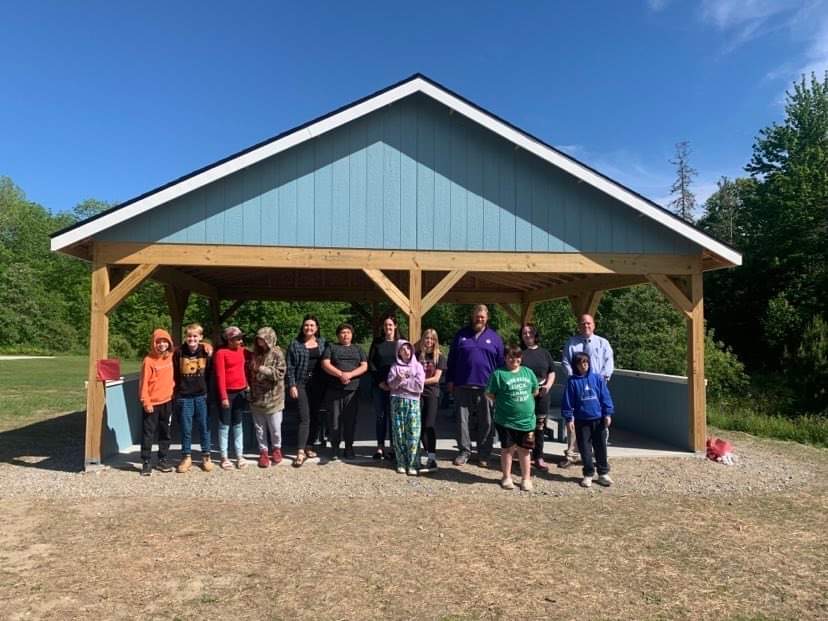
On Wednesday, June 1, the students and teachers at Bucksport Middle School (BMS) celebrated a big achievement. Since August 2021, students have been prototyping, designing, and constructing elements of an outdoor experiential learning environment through team building and design thinking challenges. And now, after almost a year, their new outdoor classroom, which was made possible by a three-year $130,000 federal innovation grant, has been brought to life.

Art and STARS Teacher Hannah Bailey, Science and STARS Teacher Kent Burnham, and Special Education and STARS Teacher Katie True have been working to serve alternative education 6-8th grade students by facilitating as they built this new outdoor classroom. STARS (Students Taking Alternate Routes to Success) is an experiential advisory program that started in the summer of 2021. STARS aims to support students through hands-on learning, including designing and building a home base, while focusing on connecting student interests with community resources and providing extra opportunities to reconnect with each other, with their teachers, and with school.

To start this project, students took a trip to Troy Howard Middle School to check out their outdoor classroom, outdoor kitchen, and garden to gain some inspiration. While the students were there, they drew pictures of Troy Howard’s facilities, to take back as blueprints for the models they were about to make. Next, Hammond Lumber supplied a model of the outdoor classroom, which students used in conjunction with their drawings to create prototypes out of cardboards. Once the prototypes were finished and refined, students met with Orcutt Builders, Hammond Lumber, and the RSU 25 maintenance crew to review and finalize their plans.

As Orcutt Builders got to work on constructing the exterior of the classroom, BMS STARS students got to work designing the interior of their classroom. Their first task was to create chairs that could hold their weight out of cardboard. Next, they started doing skill building to learn how to use their new tools by constructing birdhouses. Once the birdhouses were completed, students learned how to construct tables and chairs from a furniture maker and, using feedback from teachers, began to prototype their own. As Orcutt Builders began to put the exterior of the building up in early October, students learned how to wood burn, creating signage for their soon-to-be hub.

As the classroom began to take shape, students began to assist in its construction, helping to build the knee walls and even painting it the light blue color they had voted on. Then, as Orcutt Builders finished up the construction of the exterior of the classroom, students turned the prototypes of their tables into reality – constructing, sanding, and painting them themselves. In addition to an outdoor classroom aimed to engage increased school attendance and hands-on learning, the students have also built 12 benches and 6 tables for the classroom and are currently in the process of building 12 garden boxes to have outside of the classroom to grow their own flowers and vegetables.

The STARS students say they enjoyed the entire process and are excited for next year. One student shared that she had fun this school year. While she loved getting to put her hands in the wet cement of the classroom and growing closer to her classmates, her favorite part of the classroom is the garden boxes. Another student said his favorite part was getting to meet and interact with different teachers, students, and experts.

The school also plans to construct an applied learning laboratory next to the outdoor classroom, set to open in June 2023. The space will include a 4-season greenhouse, kitchen, makerspace, and aquaponics system, among other features, and is being funded through a $250,000 federal grant through the Maine Department of Education’s Rethinking Responsive Education Ventures program.

Commissioner Makin Releases End of School Year Video Message to Thank and Celebrate Educators

Maine Education Commissioner Pender Makin released a special video message to thank and celebrate educators and school leaders as they wrap up another school year.

“Thanks to the heroic efforts of our state’s educators, staff, school leaders, and school board members, Maine schools continued to turn out their daily miracles through some of the greatest challenges ever faced in public education,” said Makin in the video.

Watch the video here.

Makin detailed the time she got to spend in schools across the state this year, getting to meet with with educators, school staff, and students and experiencing some of the amazing teaching and learning happening in Maine schools.

“Our schools are truly the heartbeat of our communities, teeming with innovation, creativity, joy, resilience, triumph, and unlimited hope,” Makin shared. “I learned something exciting and new at every school I visited this year, and above all I witnessed the very best of what it means to be a changemaker in the lives of our most precious assets, the kids of Maine.”

Makin closed her video message with a note of thanks and wishes for a good summer.

“Thank you for your courage, your persistence, and the love that you’ve given to this most important work,” said Makin.

Job Opening: Continuous School Improvement Leader

The Maine Department of Education’s ESEA Federal Programs Team is seeking an energetic and experienced individual to serve in the role as a Continuous School Improvement Leader. As a member of the ESEA Federal Programs Team, the selected candidate will provide support, research- and evidence-based guidance to a team of leadership coaches serving principals of identified schools; support the formation of school leadership teams with necessary stakeholder representation; support the review and update of the consolidated needs assessment (CNA); guide the utilization of the updated CNA to create a strategic plan to inform areas of focus, support and additional funding; and utilize the continuous improvement cycle to conduct data analysis for intentional decision making in order to provide on-going support . This is a professional service position that directs and coordinates Maine’s Model of School Support as required within Title I under the Elementary & Secondary Education Act of 2015 (ESSA). The position is responsible for the administration, management, and evaluation of  Maine’s Model of School Support as approved under federal Title I statutory regulations. This work will include policy review, input and development as related to Maine’s Model of School Support under federal statutory requirements and adherence to. This is a contracted position.

REPRESENTATIVE TASKS:

  • Approve school strategic plan applications submitted for review/feedback in utilizing awarded funds in a necessary, reasonable, and allowable way;
  • Approve all school leadership coach timecards and travel reimbursement requests;
  • Determine on-going support and resources for School Leadership Coaches, building principals, and School Leadership Teams, based on policy and guidance for Title I School Improvement;
  • Identify agenda items and facilitate monthly meetings with school leadership coaches to develop resources and trainings to support identified schools;
  • Identify specific insight to guide the collaborations in decision making regarding the administration of the Maine’s Model of School Support for identified schools;
  • Determine specific data collection and analysis to identify on-going program refinement and continued improvement;
  • Determine specific policies and procedures directly aligned to Continuous School Improvement research- and evidence-based practices and suggest changes to these policies and/or procedures based on date-driven decision making;
  • Communicate directly and frequently with principals, district staff, and Maine DOE school improvement coaches, as needed, on issues related to the school and the district level support being providing by Maine DOE;
  • Monitor school improvement budget to include review and approval of school improvement project requests and invoices;
  • Review and analyze student achievement data, and use the results to assist principals, leadership teams, and school improvement coaches to improve and develop comprehensive school improvement plans as needed or requested by school leaders and coaches;
  • Provide support, conduct performance reviews, and provide self evaluations for Maine DOE school leadership coaches;
  • Visit identified comprehensive schools to provide technical assistance, collect data regarding program effectiveness, attend leadership team meetings with coach, and meet one-on-one with school leaders, as determined necessary.

KNOWLEDGE, SKILLS AND ABILITIES REQUIRED: These are among the requirements to successfully perform the work assigned

  • Knowledge of current research- and evidence-based best practices and exemplary educational practice in the education of the disadvantaged and the ability to interpret and apply information to current programs;
  • Knowledge of current and emerging federal laws, policies, rules and regulations regarding the Every Student Succeeds Act (ESSA) in particular School Improvement under Title I, including funding, compliance issues and evaluation issues;
  • Knowledge of the State’s assessment and accountability system including Maine’s Model of School Support;
  • Knowledge of continuous quality improvement and systems change concepts, practices, and tools;
  • Ability to assist in managing complex program and federal program budgets;
  • Ability to provide leadership to school leadership coaches and the Tier III identified schools they serve;
  • Ability to communicate clearly and effectively, both in written and oral form;
  • Ability to establish and maintain effective working relationships;
  • Ability to analyze, interpret, articulate, and present technical information, concepts, policies, procedures, and practices;
  • Ability to communicate complex information effectively, orally and in writing, to technical and non-technical audiences.

MINIMUM QUALIFICATIONS:  To qualify, candidates must have a Master’s degree in Educational Leadership or a field related to the position and experience in educational leadership. Preferred candidates will have experience in successfully supporting the administration of federal programs and budgets aligning to the Elementary and Secondary Education Act (ESEA).

APPLICATION:  Please submit a letter of interest, resume, and three current letters of recommendation to Cheryl Lang at cheryl.lang@maine.gov on or before July 1, 2022.


Free Postsecondary College and Career Resource Hub for Maine Parents, Students, and Educators

Earlier this month GEAR UP (Gaining Early Awareness and Readiness for Undergraduate Programs) Maine partnered with SEEDS Training (a world-class Social & Emotional Learning Company) to create an online postsecondary college and career resource hub for Maine students, parents, and educators at no cost.

The hub includes a College Readiness Video Series for High School students, a Parenting Tool Belt for parents, and a Professional Development Series for educators.

The hub can be accessed at seedstraining.com/maineresources.

Highlights of the site include:

The College Readiness Series:

  • 20 Quick hitting videos, full of practical strategies for getting the most out of the college experience.
  • Ideal for graduating seniors and first year college students covering topics such as financial literacy, developing relationships with new teachers, managing time, dealing with anxiety, communication skills and more.

The Parenting Tool Belt – A five-part online training program to help families have more meaningful and productive conversations.

The Professional Development Series:

  • Recorded 60-90 minute sessions that work with your busy schedule.
  • Social & Emotional Learning content that is designed to get results
  • Professional development for you and take-away curriculum that you can use with your team, students
  • and parent community
  • Networking with other pro educators

For more information about this resource, reach out to Kayla Hopkins, GEAR UP Communications Coordinator at kayla@syntiro.org or visit the GEAR UP website.

MOOSE Team Leader Openings

The Maine Department of Education is seeking educational experts to join the Office of Innovation team as MOOSE (Maine Online Opportunities for Sustained Education) Team Leaders. These full-time, fully remote positions will provide leadership in the creation of PK-12, project-based learning progressions for the MOOSE platform. All learning progression topics and the individual modules are highly interdisciplinary.

As the Team Leader, you will be actively involved with your topic team to support the integration of the identified topic area into the modules. You will be responsible for ensuring that the team’s modules adhere to the established module criteria and are created within the specified timeline by scheduling regular meetings, establishing checkpoints, ensuring that the module requirements are met, and guiding the overall success of the team. Module criteria emphasize equity and inclusion, social-emotional and trauma-informed learning, and universal design for learning among other areas of focus.

The day-to-day tasks of this role will vary. In some weeks, you will be more involved in synchronous support, training the creators, helping to conceptualize the learning progression, attending creator meetings outside of typical ‘school hours’, and providing other direct support. Other weeks will focus on more indirect/asynchronous support by answering creator questions, developing training and scaffolding materials for your creators, and providing helpful reminders, support, and referrals, as necessary.

In addition to active consultation and support, as a Team Leader, you will also provide resources, offer targeted professional learning, and other topic-specific support for content creators to ensure that the topic area is represented in the module in an effective and comprehensive manner.

A critical part of this Team Leader role is comfort with technology integrated instruction. Many of our most engaging MOOSE modules center around the effective integration of technology. MOOSE Team Leaders should be comfortable using technology, learning new tools, and supporting innovative uses of technology to create interactive and engaging modules.

These positions can be traditionally contracted (you must be an active educator in the State of Maine) or contracted as a Distinguished Educator. Distinguished Educator positions are set up as an exchange agreement between the Department of Education and your local school district. Through the agreement, the Department pays your local school for the duration of your contract as a Distinguished Educator, allowing your school to temporarily fill your vacant position and continue to pay you your current rate with benefits while you work with the Department of Education. Once the one-year contract is complete, you will be able to return to your position within that district.

If you are interested in learning more about MOOSE and these positions, please visit our website. When you are ready to apply, you can access the application by clicking here. Applications will be reviewed on a rolling basis beginning July 5th and continuing until the positions are filled. Please direct any specific questions about the position or the project to MOOSE Project Manager, Jennifer Page (jennifer.page@maine.gov). 

Get to Know the Maine DOE Team: Meet Jennifer Gleason

Maine DOE team member Jennifer Gleason is being highlighted as part of the Get to Know the Maine DOE Campaign. Learn a little more about Jennifer in the question and answer below.

What are your roles with DOE?

Our team monitors and supports each public school district for compliance with IDEA and MUSER.  We love to provide technical assistance and professional development to special education teachers and administrators.  The team travels to every public school district, charter school, regional program, and CDS site over a four-year period.

What do you like best about your job?

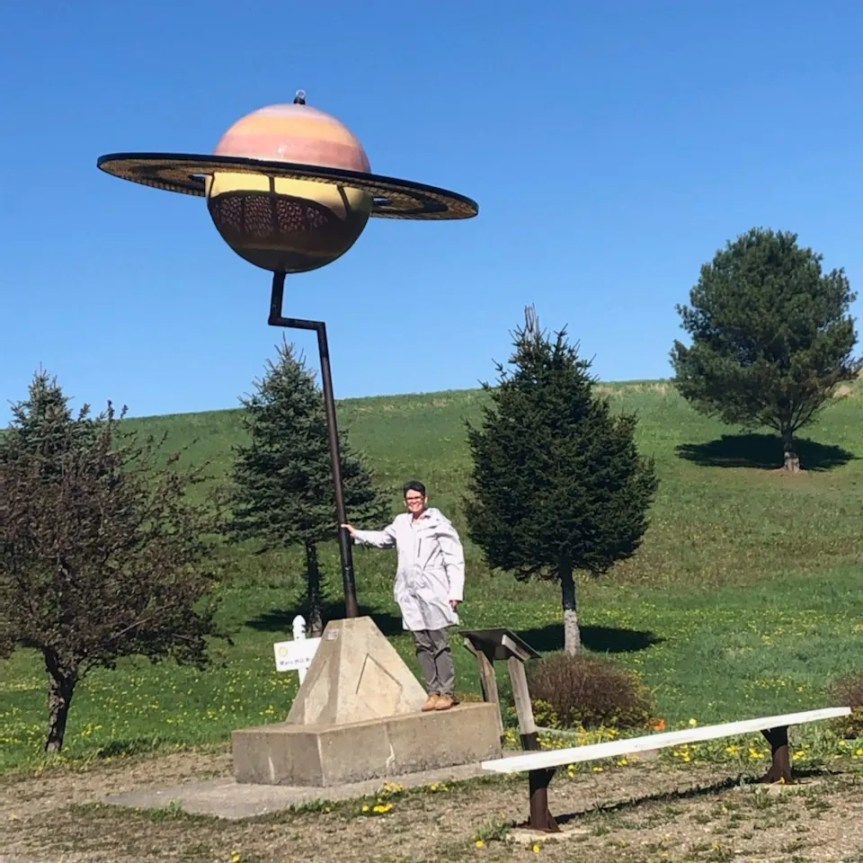
The team is second to none and I get to see every part of Maine.  This picture of me and Saturn is from a recent trip to Presque Isle, where they have a scale-model of the solar system over 40 miles.  I also love visiting schools because I get to help put people at ease when we are coming to do an “audit.” By the time we leave, they understand that we are there to support them and it is a positive experience.  Basically, I love everything about my job.

How or why did you decide on this career?

I went through the process as a teacher and it was such a great learning experience that I wanted to be part of the team.

What do you like to do outside of work for fun?

I love to hike with my pup, spend time with my 2 adult children, garden, read, and float in the pool.

Building a Culture of Innovation at Nokomis High School

“If there is one thing we’ve gotten out of the pandemic, it’s that students don’t want to sit at a desk anymore and have someone talk at them,” said Nokomis High School Principal Mary Nadeau.

Starting last fall, Nadeau challenged her teachers to think outside the box when it comes to their lesson planning. She asked each of the teachers at Nokomis High School to do at least one project-based learning unit per year. Embracing the challenge head-on, many of those educators have not only created and executed interdisciplinary units and project-based lessons that are both outside of the figurative box but also take place, literally, outside of the school building.

“At our principal’s encouragement to think outside the box, a group of educators began thinking more deeply about outdoor education and specifically about utilizing the incredible landscape we have here at Nokomis,” said Nokomis High School English Teacher Anne Dailey. Dailey and her teaching partner revamped their 11th grade American Literature course which has provided the opportunity for about 45 students to have their English 11 experience completely outdoors.

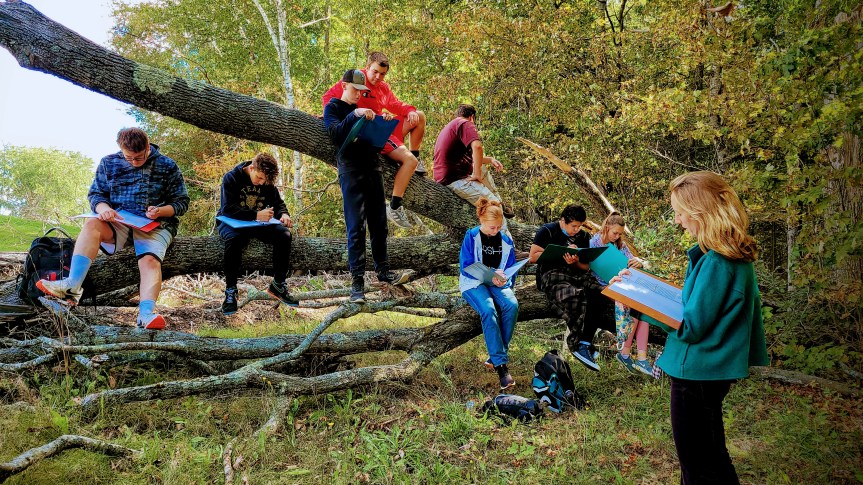
“We read, write, and talk perched on logs or sitting on rocks around the edge of Nokomis pond,” said Dailey. Students are provided with a lot of time for independent reflection and small group work. They are building a month-by-month Almanac that has captured their individual experience of the landscape and their work.

“Only in the depths of the Maine winter did we stay inside, and even then, we took a walk each day,” added Dailey. “I think there was one day where we stood outside the doors for exactly one minute because it was 9° Fahrenheit and there was a serious wind.”

Pictured: Students working outside as part of Dailey’s classes.

It’s not just Dailey that implemented different learning techniques. Nadeau and Nokomis Regional High Instructional Coach and RSU 19 Curriculum Coordinator Kasie Giallombardo shared that 92% of teachers at the high school implemented project-based learning in some form. In Ashley Clark’s chemistry class, she typically gives out worksheets to learn unit conversions, but this year, she changed it up.

Clark believes that “returning to ‘normal’ since COVID has been a struggle for all,” and that making learning more relatable and ‘real’ for students is one way to lessen the struggle. So, instead of lectures and paper handouts in chemistry class, students made hot sauce. “Students used a small batch hot sauce recipe and harvested [their] own peppers from our school garden to make hot sauce. Students were able to use their knowledge of unit conversion to predict the amount of hot sauce we would make in the end and make sure there was enough for all of the students to try,” she said.

For Daniel Leaver, a 9th grade social studies teacher, interdisciplinary project-based learning is nothing new. “This is what I’m passionate about. This is what Nokomis has cultivated in me and a lot of my colleagues,” he said.

Leaver has been including interdisciplinary teaching methods into his curriculum for five years. It started, he says, in 2017, when he was co-teaching with another teacher, Jenine Olson, covering both social studies and English standards with at risk students. The kids loved hands-on learning and wanted to be active, so he invited in a guest speaker who was a grant writer. Students then wrote a grant to build a little library, working with the town, architects, and other experts. This type of learning, he says, was engaging and sparked inquiry because the students knew that they would be applying what the experts were teaching them.

Pictured: 9th grade students in an interdisciplinary unit centered on the evolving nature of communities – students are engaging with a hands-on “tool museum” that folks brought into the school (pre-pandemic).

While each teacher has chosen to implement interdisciplinary and project-based learning differently, they can all agree on one thing: its impact is visible and profound. Leaver says he has never seen students so engaged and interested. “It gets them away from their computers, asking questions, and engaging with people,” he shared.

In response to her outdoors English class, Dailey shared that “the group of students who selected this class are largely students who have felt constricted and uninspired by the ‘typical’ classroom experience, as well as students who simply love the outdoors. Their writing is different – it’s more personal, but it’s also just stronger.” Some of her students bring up small seasonal differences in their writings, differences that would probably be imperceptible from the inside of classroom walls.

“I have been amazed by my students’ ability to apply their knowledge of chemistry to their outside world, ask intriguing and thought-provoking questions about topics in chemistry that they come across in their day to day lives, and be able to further examine how chemistry can impact them in the future,” Clark added. She has really connected with her students this year because of her new teaching style and looks forward to continuing to do so in the future.

Overall, there have been huge shifts in student success rates at Nokomis High School. A far greater percentage of students successfully complete interdisciplinary units, and students have discovered passions and career paths as a result of their work. The students are not the only ones benefitted by this innovation, though.

“As far as my personal learning and process, developing these learning opportunities has led me to better understand performance indicators in other content areas. It has changed the way I interact with my peers. We have maintained a stance that focuses on what is possible. This continues to be a boundary that we push,” Olson shared.

Even so, changing the way their curriculum is taught was not easy for the teachers at Nokomis High School. “At first, [students] struggled to see the benefits that integrated assessments provide,” Olson said. However, once they were taught about what project-based learning is and how it impacts success, the going was easier. Now, students reflect on their learning and have more confidence in their depths of knowledge.

One thing that made the process easier, though, was support. “Our school and administration provide us time and support and resources,” Leaver said. Finding time to have quick meetings and having support from administration made all the difference in the teachers’ ability to implement these innovative techniques.

Pictured: Nokomis Middle and High School teachers doing a “Curriculum Gallery Walk” recently where they shared what teaching and learning looked like, got feedback, and worked together to make goals for next year.

Moving forward, Nokomis plans to expand the interdisciplinary courses they offer, with a whole slew of courses set to be available next year. One class will have a semester long unit called “The Good Life,” which will revolve around happiness. “It’s about being responsive to our kids, and we notice that we have all just lived through collective trauma. Just the pandemic alone, never mind all the craziness in our country,” Leaver said about the unit.

Students in the class will rotate between teachers, spending one month exploring how different cultures interpret happiness, one month exploring how artists and poets have interpreted happiness, and one month studying the biology of happiness. The course is geared toward 11th and 12th graders who are interested in learning about happiness from societal, literary, and scientific perspectives.

This isn’t the only example of a class set to be centered around interdisciplinary studies, either. Olson is working with a math teacher on a combined English/Geometry course called “The Elements of Crafting.” The class will look at different aspects of crafting, including the role of mathematics in craft and literature related to craft. There will also be an upcoming outdoor English/Chemistry class offered.

The teachers at Nokomis High School hope that this method of interdisciplinary and project-based teaching will continue to grow. “I hope that we continue to refine and revise what we have built while continuing to grow our individual and communal practice,” Olson said. Dailey says her ‘dream’ is for there to be a “multi-subject interdisciplinary track that students could select, in which they’d spend a whole day outside engaged in all core subjects, as well as any other subjects that teachers want to integrate.”

While Dailey’s ‘dream’ might sound like a long shot now, it might not be too far off, considering the support from school administration. Nadeau and Giallombardo believe that the way to get there is through a balance of giving teachers lots of support, creating opportunities to connect with other teachers, and finding something in common and creating something together, which Nokomis High School seems to be getting pretty good at.

 

Panelist Opportunities for Maine Science Educators 

The Maine Department of Education is currently recruiting elementary (5th grade) educators and alternate participants (grades 8 and 3rd year of high school) to participate in an upcoming standard setting for the state’s science assessment, Maine (MEA) Science.

Maine educators and the DOE play a crucial role in the development of this assessment for students. No prior experience with standard setting or standard setting methodology is required however, panelists should be a science expert that teaches students who participate in the Maine Science assessment and have a thorough understanding of the assessed Maine Learning Results (MLRs) Next Generation Science Standards (NGSS). Participants must be able to differentiate between student performances at different levels of achievement. Standard setting panels consist of 10 educators per grade band (grade 5, 8, and 3rd year of high school).  Panelists will have the opportunity to discuss and determine application thresholds for Maine.

Current needs include:

  • Grade 5 – 4 Educators
  • Grade 8 – Alternates*
  • 3rd year of High School – Alternates*

*Alternates need to indicate they would be available should a panelist be unable to participate.

The standard setting is scheduled to take place from July 26th – 28th 2022 in Augusta. Travel, accommodations and expenses will be covered with a daily stipend provided to selected panelists.

Please consider applying or sharing the upcoming opportunities with colleagues. The expertise and contributions of Maine educators are a critical element of the continued development cycle for these assessments.

Interested? Complete the panelist registration survey. 

Want more information? Please reach out to Janette Kirk, Chief of Federal Programs at Janette.Kirk@maine.gov.