U.S. Secretary of Education Miguel Cardona announced the 58th class of U.S. Presidential Scholars, recognizing 161 high school seniors for their accomplishments in academics, the arts, and career and technical education fields.
The Maine scholars include (hometown, scholar, school, location):
ME – Bar Harbor – Sirohi G. Kumar, Mount Desert Island High School, Mount Desert, Maine.
ME – West Gardiner – Brett J. Palmer, Gardiner Area High School, Gardiner, Maine.
“Our 2022 Presidential Scholars represent the best of America, and remind us that when empowered by education, there are no limits to what our young people can achieve,” said U.S. Secretary of Education Miguel Cardona. “Today, I join President Biden to celebrate a class of scholars whose pursuit of knowledge, generosity of spirit, and exceptional talents bring our nation tremendous pride. Throughout one of the most trying periods in our nation’s history and amid our recovery from the pandemic, our students have once again demonstrated their strength and that they have so much to contribute to our country. Thanks to them, I know America’s future is bright.”
The White House Commission on Presidential Scholars selects scholars annually based on their academic success, artistic and technical excellence, essays, school evaluations and transcripts, as well as a demonstrated commitment to community service and leadership.
Of the 3.7 million students expected to graduate from high school this year, more than 5,000 candidates qualified for the 2022 awards determined by outstanding performance on the College Board SAT or ACT exams or through nominations made by chief state school officers, other partner recognition organizations and YoungArts, the National Foundation for the Advancement of Artists.
As directed by Presidential Executive Order, the 2022 U.S. Presidential Scholars are comprised of one young man and one young woman from each state, the District of Columbia and Puerto Rico, and U.S. families living abroad, as well as 15 chosen at-large, 20 scholars in the arts and 20 scholars in career and technical education.
Created in 1964, the U.S. Presidential Scholars Program has honored over 7,900 of the nation’s top-performing students. The program was expanded in 1979 to recognize students who demonstrate exceptional talent in the visual, literary and performing arts. In 2015, the program was again extended to recognize students who demonstrate ability and accomplishment in career and technical education fields.
The Presidential Scholars Class of 2022 will be recognized for their outstanding achievement this summer with an online recognition program.
A complete list of 2022 U.S. Presidential Scholars is available at http://www.ed.gov/psp.
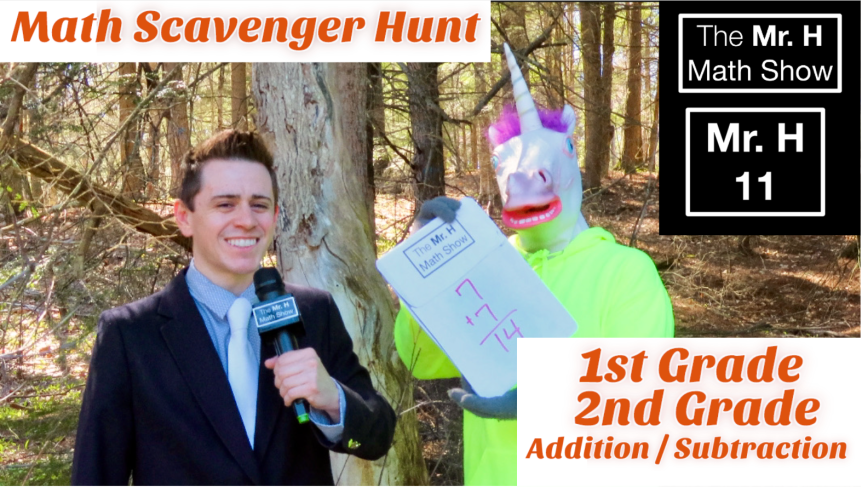
RSU 16 Second Grade Teacher Philip Hodgkins, or Mr. H. as his students call him, has been producing and starring in a weekly gameshow style math show to supplement math lessons for this 2nd grade students.
“During class I’m always hyping something up–birthdays, school assemblies, whatever the next big thing may be,” explains Mr. H. Extending that same level of enthusiasm into a new project, Mr. H uses his exciting game-show style voice, that his students love so much, in a new video series about math, providing an opportunity for his students to engage with math in fun and exciting ways.
“This is a really fun thing to do with the kids and it gives my 2nd graders a chance to show off their math skills,” said Mr. H. The shows are available as an option to his 2nd grade students in class after they have completed their regular math lesson. He explains that the show is a bonus for the students and supplements what they are working on.
With a little help from family members and friends, The Mr. H. Math Show has been uploading a new episode on YouTube every Friday at 7:00 p.m. successfully ever since February break and continues to evolve as the show’s audience expands.
“It’s awesome to see how excited students are to solve the new math questions every week,” said Mr. H. “It’s always great to hear their ideas for future episodes.”
The success of the show has spread to a few other classes at Poland Community School with the Functional Life Skills class and some of the 1st graders and 2nd graders now getting the chance to watch the Mr. H. Math Show too. Mr. H. hopes to expand his audience even further. “I’d love to have math fans watching around the world, tuning in with their families to show off their math skills,” says Mr. H.
In the meantime, he continues to look for ways to add cool new features. Recently he has been looking into adding a musical element to the show with math rap songs.
Check out The Mr. H. Math Show on his YouTube Channel:
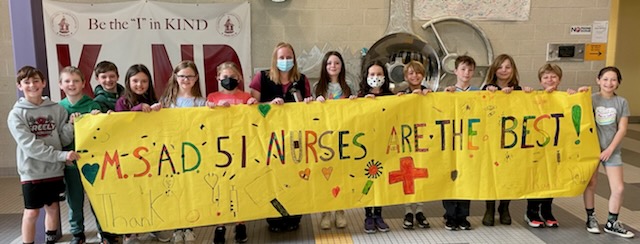
Today is National School Nurse Day, and the Maine Department of Education thanks and celebrates all of Maine’s school nurses.
Maine’s school nurses do essential work providing the daily care and support students depend on. And throughout the pandemic, school nurses have been on the frontlines providing the leadership and care essential to keeping our schools safe, healthy, and open.
The Sea Dogs recently held a special night honoring nurses and Education Commissioner Pender Makin provided a special message to school nurses that you can watch below.
News Center Maine will also air a special conversation with Maine school nurses tonight at 5:30pm and 6pm as part of National School Nurse Day. The special will include shout outs from students across Maine thanking their school nurses.
Happy National School Nurse Day and thank you for everything that you do!
The ESEA Demographics Report is an aggregation of students enrolled on 05/27/2022 for participation in state assessments during the 2022 assessment administration. This report includes student demographic categories for assessment and accountability purposes. The total demographic counts on the certification page only include your District Full Academic Year students. Full Academic Year means that they were enrolled with your district continuously from October 1st to May 27th. This is required reporting for RSUs, CSDs, MSADs, Municipal school units, Maine Indian Education, charter schools, state operated schools, and private schools that accept publicly funded students.
The ESEA Demographics Report will be available for districts to review beginning on May 15th. Districts will be able to certify starting on May 27th with a certify-by date of June 15th.
The Maine Department of Education’s data management team will be holding a webinar where we will be discussing the ESEA Demographics Report and fielding any questions that you may have at 10AM on Tuesday May 17th, 2022. To participate, please utilize the “Join Live” link at the time of the webinar.
In order to view this report, you will need access to NEO – Student Data, if you do not have this access please have your superintendent fill out our online Access Request Form.
If you have any questions, comments or concerns in regards to the ESEA Demographics Report please feel free to contact us at the MEDMS Helpdesk. MEDMS.Helpdesk@Maine.gov or (207) 624-6896.
The University of Maine College of Education and Human Development, in collaboration with the Maine Department of Education, will host the first University of Maine Educators Institute this summer. “Supporting Emotional and Behavioral Well-Being in School Communities: From Surviving to Thriving” will be a virtual event held June 22–23.
This new UMaine Summer University program will feature renowned experts in education and mental health disciplines from Maine and beyond. Participants will engage in interactive workshops as individuals or as part of a school-based team.
The program will feature six strands: Diversity, Equity, Inclusion and Justice; Positive Behavioral Intervention Support (PBIS); Trauma and Resilience; Social-Emotional Learning (SEL); Student-Centered Learning; and Exploring Wabanaki Studies.
“Last fall, we reached out to the state’s teachers and school administrators to ask about their current priorities and needs. Addressing students’ mental, emotional and behavioral health quickly rose to the top,” says Penny Bishop, dean of the College of Education and Human Development. “We’re excited to work with this committed group of educators to tackle these important challenges, to help them plan for the year to come and to collaboratively strengthen our schools and communities.”
Participants have the option of earning three graduate credits or attending for professional development CEUs. More information, including registration options, is online: umaine.edu/summeruniversity/educators-institute.
The University of Maine Educators Institute is one of three opportunities available to educators as part of Summer University. Also in its first year is the University of Maine Climate Change Workshop: “Climate Change Teaching Tools,” July 12–13. Now in its sixth successful year, The Summer Technology Institute: “Cooperation Across Environments and Boundaries” runs Aug. 2–4.
All events are virtual and participants may choose to attend for graduate credit or professional development. Learn more about summer programming for educators at umaine.edu/summeruniversity/summer-workshops.
The University of Maine Climate Change Institute and Summer University will host the first Climate Change Workshop for pre-K–12 educators this summer. “Climate Change Teaching Tools” is designed for educators to learn more about climate change and, in particular, how to bring this important subject area into the classroom in meaningful ways for students.
Participants may choose to attend for graduate credit or professional development CEUs. The two-day online workshop will be held July 12–13. The graduate credit option includes a three-week online course, July 5–22, in addition to workshop attendance.
The event will feature renowned experts in climate change from the UMaine Climate Change Institute, the Gulf of Maine Research Center, the Maine Department of Education and panelists from the Maine Changemakers Network. Keynote speakers will discuss the impacts of climate change to the ocean, land and ice across the globe and here in Maine.
“The age of climate change decision is here, and our actions will define the course of civilization and the health of our planet,” says Paul Mayewski, director and professor of the University of Maine Climate Change Institute.
The Maine Department of Education (DOE) Adult Education team recently brought together 23 educators from adult education programs across Maine at the UMA-Lewiston campus to celebrate their capstone presentations for Teaching Skills that Matter in Adult Education (TSTM). The event was the culmination of a 7-month TSTM training provided by Maine DOE’s Adult Education Team.
Teaching Skills that Matter in Adult Education (TSTM) is a federal initiative of the U.S. Department of Education, Office of Career Technical and Adult Education (OCTAE) that was developed by the American Institutes for Research. The goal of the initiative is to train teachers to integrate the skills that adults need for success in career and life using evidence-based approaches that work across topics that are also important to adults (civics education, digital literacy, financial literacy, health literacy, and workforce preparation).
In 2020, the Maine DOE’s Adult Education Team applied to be part of a cohort of states to be trained in using the TSTM materials. A team of four Maine adult educators, Michael Emery from Augusta Adult and Community Education, Melanie North from MSAD 52 Adult and Community Education, Irina Petranek from Lewiston Adult Education, and Lyn Warne from Eastern Aroostook Adult Education, and Amy Poland, Maine DOE Adult Education PD Coordinator participated in an intensive yearlong training which resulted in a plan to bring the TSTM training to Maine’s adult education programs.
As a result of this effort, Maine’s first cohort of TSTM training kicked off in September 2021 at a 2-day, in-person event that was followed by virtual meetings to support their on-going efforts to teach TSTM in diverse teaching contexts, making math and science connections to TSTM lessons, and integrating TSTM into the existing curriculum. Participants also worked with a coach and coaching group on an ongoing basis from September 2021 through April 2022 meeting regularly to discuss using TSTM in the classroom. They also had two classroom observations, giving them a chance to reflect on their work.
The recently held event served as the wrap up event for Maine’s first TSTM cohort featuring 5 minute presentations from each adult education educator that participated in the training including: Washington County Adult and Community Education, RSU 24 Adult Ed, Mount Desert Island Adult Education, Ellsworth Adult Education, MSAD1 Adult and Community Education, Riverside Adult Education (RSU 22, 26, 34), Franklin County Adult Education, Spruce Mountain Adult and Community Education, Augusta Adult and Community Education, MSAD52 Adult & Community Education, RSU 16 Adult Ed, Lewiston Adult Education, Merrymeeting Adult Education, Portland Adult Education, Windham Raymond Adult Ed, and Marshwood Adult Education.
Christa Galipeau, SAD 1 Adult & Community Education, Presque Isle
Sue Lasselle, RSU 16 Adult Education (Mechanic Falls, Minot, Poland)
Phil Wormuth, RSU 24 Adult Education (Sullivan)
Bryan Brito, MSAD 52 Adult & Community Education, Turner
During each presentation, participants shared their experiences teaching using TSTM lessons in practice, how they adapted the lessons to fit what their learners needs, their lessons learned, and many other useful pieces of information relevant to their peers and the Maine DOE for future success with the TSTM program.
With culture as a common theme, many shared their experiences working both remotely and in-person to teach lessons that were both relevant and accessible to adult learners enrolled in their respective programs and regions.
There were also many shared experiences in working with adult learners which resulted in everything from sharing tips and tricks to turning common frustrations into something positive.
“The tech will get you every time,” said Valerie from Washington County Adult Education program. While her comment got a chuckle and a knowing head nod from most around the room, she turned it into an important lesson for educators about modeling working through a problem (such as a technology issue) in front of students, to show them how to problem-solve in real time – a handy skill for everyone to develop.
Also included in the training was a TSTM toolkit packed with high-quality lessons that are easily adapted for Maine’s varied adult education population (multilingual, adult basic education, high school completion, workforce training, college transitions, etc.). Also integrated into the toolkit are many of the employability skills (soft skills) already taught in Maine which are integrated into academic lessons that highlight relevant topics for adult learners, such as budgeting, reading workplace safety signs, and first amendment rights.
“TSTM pushed me to learn a variety of remote learning tools,” shared Rochelle from Portland Adult Education Program. Rochelle wasn’t the only one to talk about a journey with learning remote learning tools and refreshing their toolbox of digital tools that can help with in-person learning as well. Many of the educators in the room really benefited from their experience using the toolkit provided by TSTM, especially in the wake of the height of the COVID-19 pandemic which changed the way most educators teach.
A booklet created by Maine Snap-Ed (https://www.mainesnap-ed.org/) An example of a community resource used in Maine Adult Education programs
Another common theme among participants was how much more enriching and sustainable their lessons and curriculum became as a result of partnering with local agencies. For many, these connections were critical for things like food stamps and/or education materials, and to supplement their curriculum without having to reinvent something that community partners could come in and present or provide information and/or tools for.
Maine DOE’s Adult Education Team Professional Development Coordinator Amy Poland says, “We are currently planning next year, but we anticipate holding another statewide training similar to this year’s.” She adds that the team is also working on a community of practice which will feature a series of workshops around effective teaching practices using the TSTM Toolkit lessons, and convening a cohort of teachers who will create and curate new materials, and more for their fellow adult education educators across the State.
Are you interested in computer science professional development opportunities for your school? Maine’s 130th legislature, through a bill sponsored by Senator Pouliot, created a pilot grant program to provide funding for high-quality, teacher-developed or teacher-led professional development for PK-12 computer science pedagogy and content.
Priority will be given to applicants that:
Are located in one (or more) of the following counties where no awards have been made in previous application rounds: Sagadahoc, York, Aroostook, Somerset, Washington, Oxford, Waldo, Knox, Lincoln, Franklin, and Kennebec.
Do not currently offer computer science learning opportunities;
Serve socioeconomically disadvantaged school districts;
Prioritize student populations traditionally underrepresented in computer science;
Demonstrate a commitment to pursuing high-quality educator professional development that emphasizes integration of computer science into other course work and curricula or establishes or expands access to courses that offer college credit and other certificates of value, or both; and
Collaborate or partner with other entities, including but not limited to other local education agencies, the business community, nonprofit organizations and private entities.
The application window opens Monday, May 9th, 2022 and closes Friday, May 20th, 2022. Applications will be reviewed in the order in which they are received. All applicants will be notified of their application status within two weeks of the application deadline.
There is no limit to the grant amount awarded per applicant; however, funds will be dispersed equitably across all applications based on county and throughout PK-12.
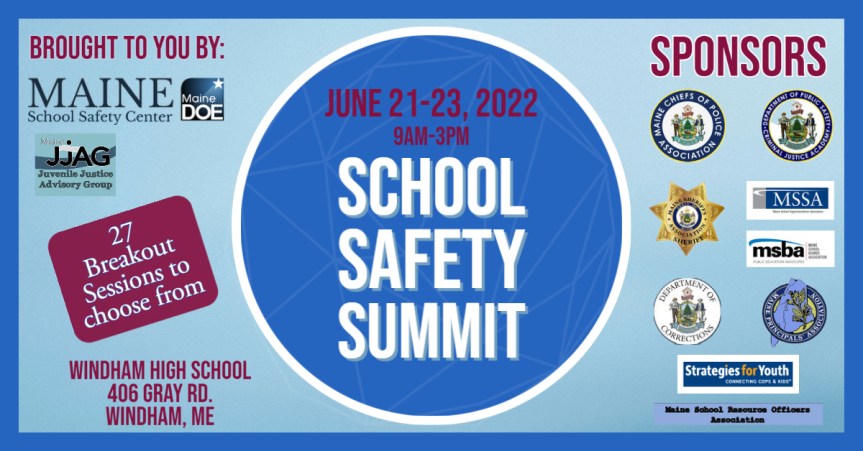
Please join the Maine Department of Education’s (DOE) Maine School Safety Center for the first annual Maine School Safety Summit. Along with state-level partners from across Maine, the Maine School Safety Center and Maine Juvenile Justice Advisory Group (JJAG) are proud to invite you to this high level, diverse training opportunity catered specifically for school and district administrators, school resources officers, juvenile community corrections officers, and law enforcement that work directly with schools, in addition to school support staff such as school counselors, social workers, school nurses, and emergency planning and facilities school/district staff members.
LOCATION
Windham High School
406 Gray Road Windham, ME
DATE & TIME
June 21-23, 2022
9:00 AM – 3:00 PMHighlights include:
Day one and two there will be a two-day course specifically designed for school/district administrators such as principals and superintendents as well as law enforcement administrators on how to work best together as a team for more effective interactions with youth. This specialized training presented by Strategies for Youth will be the first of its kind here in Maine.
Simultaneously, on days one and two, over 16 different presentations will be available for assistant principals, social workers, school counselors, facilities directors, school safety personnel, SROs, JCCOs, law enforcement who respond to schools, school office staff, educational technicians, and any other school staff who work to make their schools a safer place.
Day three will have two tracks. Track one will provide a special session for Transportation Directors and Bus inspectors. Track two will bring all other attendees together to discuss an exciting new way of dealing with youth in crisis entitled, Juvenile Justice Jeopardy, and in the afternoon will be a session entitled Communication in a Diverse World.
Our goal is to create safer schools by offering wraparound total services for Maine students.
Maine DOE Team member Shari Templeton is being highlighted this week as part of the Get to Know the Maine DOE Team Campaign. Learn a little more about Shari in the question and answer below.
What are your roles with DOE?
For the past 8 years I served in the capacity of Science Specialist which kept me in the thick of standards work, science assessment development, providing science professional learning and oversight of several recognition programs for science teachers, students and school initiatives. With the DOE’s recent re-organization to support interdisciplinary learning and a whole student vision, I have transitioned to the role of Interdisciplinary Instruction Specialist and work with a small team to build out resources to support educators in this work.
What do you like best about your job?
Working with teachers and collaborating with state leaders from across the nation.
How or why did you decide on this career?
I started in outdoor education before filling a long-term sub position at a high school in Connecticut. I stayed on at that school while taking courses to complete teacher certification. In 1986 I moved to Maine and continued teaching high school physics, biology and forensic science in the Mid-coast. I loved working with adolescents, igniting or re-igniting that spark in them, sharing my passion for science education while helping them discover their passions. After 31 years in the classroom, I accepted the Science Specialist position at the DOE in hopes of making a greater impact on science education for Maine students in the twilight of my career.
What do you like to do outside of work for fun?
While the days of hiking and packing with my llamas are over, I still enjoy hanging with my last five geriatric llamas. In addition to my camelids, I tend a flock of 30 chickens, work an apiary with 30 bee hives, cuddle with my 5 cats and am sole caretaker for my 96 year old mother. When time allows, I enjoy sea kayaking, golfing, building projects and a good nap.




 Maine DOE Newsroom