Maine’s Military Interstate Children’s Compact Commission (MIC3) State Council will be meeting on November 1st at 1 p.m. by Zoom.
Please contact Sarah Forster at sarah.forster@maine.gov for information about how to connect.

Maine’s Military Interstate Children’s Compact Commission (MIC3) State Council will be meeting on November 1st at 1 p.m. by Zoom.
Please contact Sarah Forster at sarah.forster@maine.gov for information about how to connect.
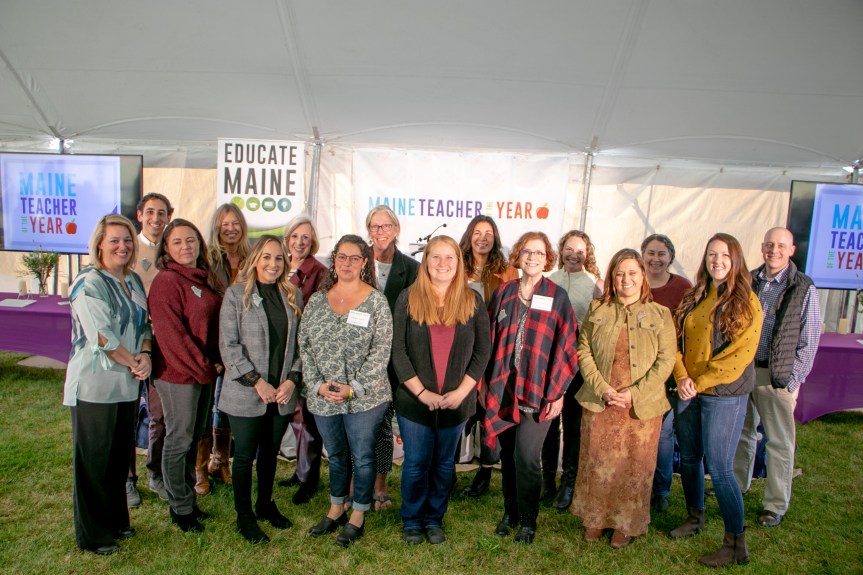
The 2022 County Teachers of the Year and the recently named 2023 Maine Teacher of the Year Matt Bernstein were celebrated recently at the 2022 Teacher of the Year Tailgate Gala. The Gala is an annual celebration of the program honoring the hard work and dedication of these teachers and the teaching profession.
The event was held outdoors under a tent at Geiger, in Lewiston, a long-time supporter of the Maine Teacher of the Year (TOY) Program. A delicious lunch was served by students from the Lewiston Regional Technical Center’s The Green Ladle Food Truck, a part of the Center’s Culinary programing.


Present and legacy State and County Teachers of the Year, along with their families, friends, colleagues, and administrators traveled from across Maine to gather together on a sunny day to celebrate and honor the innovation, dedication, excellence, and hard work of these amazing educators.


Images with the logo ‘Everyone’s Story Includes a Teacher’ is the property of the Arizona Educational Foundation and used with permission.
In addition to an awards ceremony that honored the 2022 County Teachers of the Year, the event featured remarks from Educate Maine Executive Director Jason Judd, 2022 Maine TOY Kelsey Stoyanova, Governor of Maine Janet T. Mills, Education Commissioner Pender Makin, and 2023 TOY Matt Bernstein. Program sponsors were also present, many offering words of appreciation and admiration to the educators in the audience, stressing the importance of education.


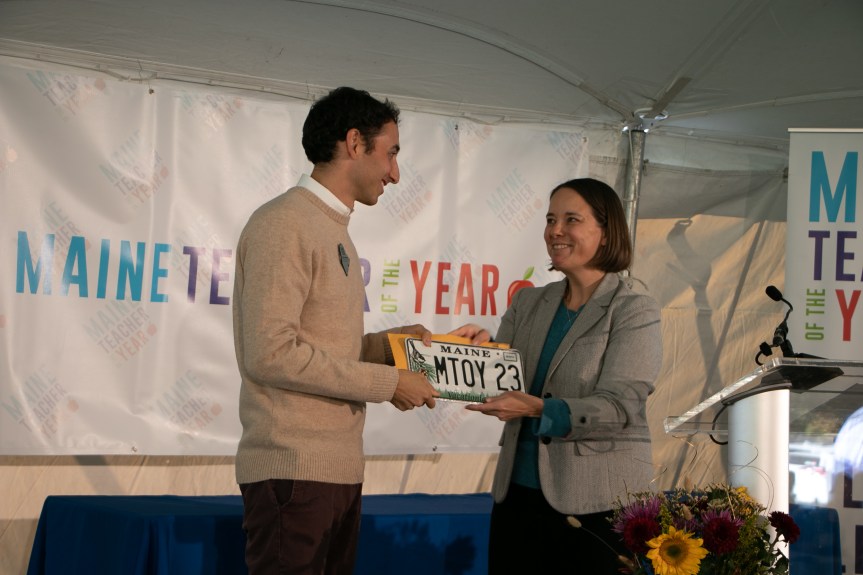
Another annual tradition of the Teacher of the Year Gala is for the Maine Secretary of State to provide a specialty license plate to the Teacher of the Year. We were honored to host Secretary of State Shenna Bellows who presented Bernstein with the license plate this year.
The Maine Department of Education along with its dedicated Maine TOY Program partners Educate Maine, the Maine State Board of Education, and the Maine County and State Teacher of the Year Association would like to extend a sincere dept of gratitude to the program’s funders and sponsors: Bangor Savings Bank, Dead River Company, Geiger, Maine State Lottery, Hannaford, Unum, and the Silvernail Family.
The Maine Teacher of the Year program is administered by Educate Maine, a business-led education advocacy organization, in partnership with the Maine Department of Education, the Maine State Board of Education, and the Maine County and State Teachers and County of the Year Association (MCSTOYA). To learn more about the Maine Teacher of the Year Program visit https://www.mainetoy.org/.
We hope you will join us this November to Shine a Light on youth experiencing homelessness. Use these resources to get involved.
Also, there are many events you can get involved with. Here are some highlights:
November 10: Wear Green Day
Maine DOE Team member Matt Vaughan is being highlighted this week as part of the Get to Know the Maine DOE Team Campaign. Learn a little more about Matt in the question and answer below.
What are your roles with DOE?
As the Resource Administrator for the Department, I am responsible for supporting the Department with human resource needs for our team. I help with hiring and onboarding processes, maintain the organizational chart, assist with keeping performance evaluations timely. I am also a part of the employee recognition planning team. I also prepare the weekly Tuesday Tidbits email, an internal newsletter.
What do you like best about your job?
I truly enjoy supporting our team by helping guide people through processes, as well as working to better the processes to make all of our lives easier in the future.
How or why did you decide on this career?
I have always taken great pride in helping to analyze and build processes to incorporate efficiencies to our everyday responsibilities. I also enjoy the processes relating to employee management like hiring and performance evaluations.

What do you like to do outside of work for fun?
My family is very fast paced and is constantly on the move! I enjoy just about anything sports related – coaching youth sports, bowling, softball, football. I also take advantage of our great State’s four season with camping in the summer, hiking in the fall, and of course ice fishing in the winter, and baseball in the spring.
Augusta Adult and Community Education is pleased to announce their partnership with the City of Augusta Parks & Recreation to offer free child watch services for adult education students. This is a momentous moment for adult education programming as childcare is the leading barrier for many adult education students.
“All students should be able to access their education. Adult education students often face many barriers when returning to school. As the director of this program, it is my goal to eliminate barriers whenever possible. I am excited for this opportunity to partner with our neighbors at Buker Community building and offer free child watch for our adult education students,” said Kayla Sikora, Director of Augusta Adult and Community.
“This partnership with Augusta Adult Education is extremely exciting for our community and the students that August Adult Education serves. We are so fortunate to have the Augusta Adult Education Program in the Buker Community Center and I believe that our partnership is going to continue to grow beyond the child watch program,” said Bruce Chase, Director of Parks & Recreation
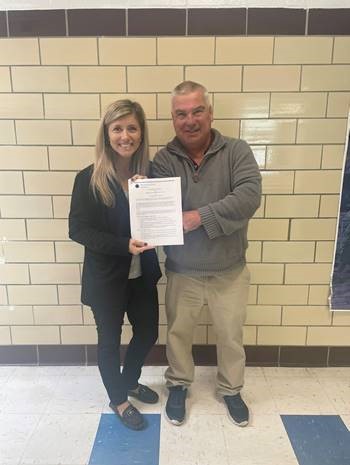
A Memorandum of Understanding was signed into effect on October 25, 2022 between Augusta Adult and Community Education and the City of Augusta Parks & Recreation to offer free child watch for adult education students. Pictured- Kayla Sikora, Director of Augusta Adult Education and Bruce Chase, Director of Parks & Recreation.
In an effort to enhance Maine Native American Studies lessons (MRSA 20-A Sec. 4706), the Secretary of State sponsors an essay contest in which middle and high school students explore at least one aspect of Wabanaki history and then write an essay on their findings.
This program is designed to give students an opportunity to share and showcase what they’ve learned in this fascinating area of study. Essays are reviewed by a panel of judges, who will select a top entry in both the middle and high school categories.
For details visit: maine.gov/sos/kids/programs/nativeamerican. Entries are due November 10.
Library of Congress Teaching with Primary Sources (K-12 grade educators)
Funded by a grant from the Library of Congress Teaching with Primary Sources program, NCHE is proud to announce a 3-part colloquium for teachers focusing on Rural America. These free professional learning opportunities will help teachers develop place-based interdisciplinary units that connect students to their rural communities. Additionally, the Maine Department of Education will be hosting a bi-weekly professional learning community to support educators through these NCHE modules. The PLC will incorporate the work developed by the MDOE interdisciplinary instruction specialists.
The program is designed to:
Educators may complete all or part of the 3-part colloquium.
Register here for these NCHE events. When you register with NCHE, you will receive a follow-up from the Maine DOE to register into our Maine PLC.
Information Sessions with the NCHE will be held on:
For more information, please contact Jaime Beal, Interdisciplinary Instruction Specialist, at jaime.beal@maine.gov.
The Maine Early Learning and Development Standards (MELDS) are the state’s learning standards for children ages three-five. Building from the Infant Toddler MELDS (IT MELDS) and bridging developmental expectations to the Maine Learning Results (MLRs), the MELDS inform all early childhood professionals about the typically developing expectations of young children as well as curriculum and assessment practices.
Over the past few years, the IT MELDS and MLRs have been updated. In order to ensure alignment across the sets of standards, it is time to update the MELDS which were last updated in 2015.
To guide the update process, a steering committee of early childhood professionals from around Maine has been formed and is interested in collecting feedback about the current version of the MELDS. All interested early care and education stakeholders (e.g., childcare providers, parents, teachers, ed techs, administrators) are encouraged to complete this feedback survey no later than November 6, 2022. Input will inform the next steps in the updating process.
In he new year, early care and education stakeholders will be encouraged to consider contributing their expertise to writing teams that will assist with the updating process. The goal is to have the MELDS update completed by July 2023.
If you have any questions, please contact the Department of Education’s Early Childhood Specialist, Nicole.Madore@maine.gov or the Office of Child and Family Services Child Care Services Program Manager, Crystal.Arbour@maine.gov
The Maine Department of Education’s Adult Education Team has funded 8 Strengthening Maine Workforce projects as part of the Maine Jobs and Recovery Program (MJRP).
The federal funding, awarded through a statewide competitive grant process for adult education providers, will enable programs statewide to:
Hub 7 Adult Education – Bridge to Employment
Waldo, Knox, Lincoln and Sagadahoc counties
Total award amount: $378,077
Bridges to healthcare training, hospitality/retail Employment, and manufacturing training will focus on workforce training in collaboration with employers. Existing programs will be expanded, and new programs will be developed and implemented with significant input from area employers. Bridge or gap funding will be provided to eligible students who don’t already meet eligibility requirements through other sources. The bridge to employment for immigrants will focus on the goal of workforce training but will also be directed towards developing and providing English language acquisition services; and improving availability, relevance, and access to English language acquisition courses. A hub-wide training for ESOL/ML conversation partner volunteers will be developed and provided as a means of sustainable capacity building. These services will further aid workforce training and English language acquisition students by providing financial support in areas of transportation, childcare, and training costs not covered under WIOA partner and Department of Health and Human Services financial resources. These will include gas cards, taxi vouchers, on-site childcare, childcare reimbursement, and training scholarships for students while attending adult transitions or college transitions classes, certification programs, or on-the-job training programs. In addition, earn-as-you-learn incentives will be offered to those eligible students who do not qualify for employer or grant-sponsored coverage of their time that would otherwise be spent working to support themselves and their families.
SAD 1 Adult & Community Education – Aroostook Hospitality Workforce Training Program
Aroostook County
Total award amount: $398,408
The goal of the Aroostook Hospitality Workforce Training Program is to develop sustainable and reliable career pathways within the hospitality (lodging and restaurants) industry in Aroostook County that will provide entry level employees, both current and prospective, the opportunity to receive high quality and meaningful training in order to grow and enhance the skills necessary to excel at their job. The focus will be on building skills in customer service, industry specific technology and skills, as well as leadership training opportunities. In addition, education regarding the wide variety of careers available in the hospitality industry as well as an individualized career ladder plan will help participants meet their professional goals.
RSU 25 Adult Education – Healthcare Pathways
Hancock and Washington Counties
Total award amount: $486,080
The project supports expansion and improvement of allied healthcare training across Adult Education Hub 1 in collaboration with regional healthcare partners. This project will allow the expansion of currently established healthcare pathways to address barriers and skills gaps identified in the pilot phase as well as create new healthcare pathways to address industry needs identified during and because of the Covid 19 pandemic.
Expanded healthcare pathways will include hybrid course offerings that address healthcare skills gaps and include stronger and earlier employer connections and offer participants across the Hub an interrelated pathway to certifications, stackable credentials, and engagement with local employers.
New healthcare pathways will include Certified Clinical Medical Assistant curriculum that will include multiple entry points across the Hub.
All pathways supported with these funds will include resources both in and out of the classroom to assist students to address barriers to success in a timely manner.
South Portland – Adult Multilingual Program Expansion
Cumberland County
Total award amount: $260,450
This program will The program will seek to build a culture of success by 1) providing scheduling and transportation that fits with the needs of parents who have children enrolled in school, 2) developing a childcare program for children too young for school, 3) translating materials and using language interpreters as needed to conduct outreach, recruitment and evaluation 4) increasing the relevance of English language acquisition courses by using a culturally aware model that builds towards readiness for workforce participation. address the English language needs of immigrants and asylum-seekers who have little or no English language proficiency.
Westbrook Adult Education – Luke’s Lobster Workplace ESOL
Cumberland County
Total award amount: $199,319
Adult Education will partner with Luke’s Lobster to build an employer-based and contextualized English Language Acquisition program for multilingual learners employed at the Luke’s Lobster production facility in Saco, Maine. Funding for the start-up of the program is being applied for.
Luke’s Lobster employees are in need of English Language Acquisition that fits with their constantly changing schedule and needs. The production schedule varies from day to day depending upon the amount of product coming in from the boats. This will require a flexible program with various training options from onsite training to virtual training, both including various online tools, i.e. EnGen, Zoom. With their ever-changing schedule, transportation and childcare become constant barriers for employees to attend area adult education program’s English Language Acquisition classes. In addition to the waitlists at various programs.
Portland Schools/Portland Adult Education: Extended Language Access Project
Total award amount: $489,850
The Extended Language Access Project will enable Portland Adult Education, the largest adult education provider in Maine, to extend English language learning opportunities to a greater number of students disproportionately impacted by the COVID-19 pandemic through innovatively addressing the waitlist, expanding English instruction, and addressing barriers to participation.
Portland Public Schools/Portland Adult Education: English and Digital Skills Integration
Total award amount: $490,650
The English and Digital Skills Integration programming will increase relevance and accessibility of English language acquisition and workplace preparedness through 1) improving remote instruction, 2) adequate access to loaner devices and hot spots and 3) integrating a multi-pronged approach to digital skills building at all levels of the organization that includes a digital skills lab, targeted workshops and digital skills integration into traditional ESOL classes.
Portland Public Schools/Portland Adult Education: Healthcare Pathways
Total award amount: $500,000
Portland Adult Education’s Healthcare Pathways Program will create English language acquisition and workforce training opportunities in the healthcare industry for individuals disproportionately affected by COVID-19 including people of color, individuals with low-incomes, low English literacy levels, and women who may also be unemployed or underemployed, or currently out of the labor force. Portland Adult Education will work closely with healthcare employers to design and implement programming and connect students to employment opportunities. Portland Adult Education will take a customized approach to meeting students’ education and training needs by offering a range of healthcare focused training opportunities and supports, and ensuring appropriate placement based on English level, professional backgrounds, and career aspirations.
APPLY BEFORE OCTOBER 31, 2022! The PSLF (Public Service Loan Forgiveness) temporary waiver allows eligible borrowers who work for a qualifying employer to apply for PSLF, despite having loans that may not have been previously eligible.
Don’t wait, you’ll need time to complete the PSLF Tool, gather your employment certifications, and submit the application. Visit studentaid.gov and file your waiver TODAY!
For questions reach out to the Finance Authority of Maine at 207-623-3263 or info@famemaine.com.