Cultivating Calm: Pond Cove Elementary School’s K-4 Health and Wellness Program Builds Lifelong Skills

At Pond Cove Elementary School in the Cape Elizabeth School Department, students gain more than just academic knowledge; they’re learning essential tools to support their mental, emotional, and physical well-being. Pond Cove is one of the few elementary schools in Maine with a certified health educator leading a comprehensive Health and Wellness program.

Heather Kennedy, K-4 Health and Wellness teacher at Pond Cove Elementary School, is deeply committed to fostering the whole health of young learners. Kennedy has designed and is implementing a K-4 Health and Wellness curriculum that blends health content, mindfulness, The Regulated Classroom framework, and Yoga 4 Classrooms strategies.

“All students participate in structured or unstructured physical movement as part of every health lesson,” Kennedy explained. “I intentionally designed the Movement on Mats program to help expand students’ whole-body learning, including the practice of self-regulation and stress release.”

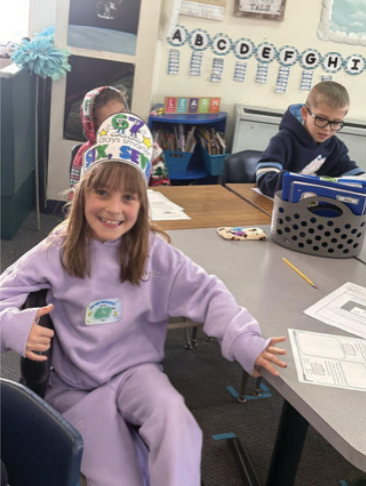
A movement on mats classroom set up.

For younger learners who may not yet have the words to express their stress, movement becomes a powerful tool. Through physical activity, focused breathing, and body control, students build body awareness, emotional resilience, and leadership skills. These activities help them to enter classroom learning with greater focus and engagement.

Kennedy explains that her curriculum “makes it possible for students to practice physical movement in the space constraints of a typical classroom.” Kennedy added that most movement practice takes place right in her health classroom, with desks and wobble stools still in place.

While the physical benefits for students are visible, Kennedy says the most impactful part of her work is what she calls the “hidden work” of co-regulation.

“Within each lesson, I aim to co-create a balanced environment using precise language while modeling behaviors and responses,” she said. “By far, the most beneficial impact of what I do is in the hidden work of co-regulating students’ nervous systems to be in their parasympathetic branch. To foster each learner’s sense of belonging, calm, and safety, I must take the lead by being in a regulated state—no matter how challenging the situation.”

This intentional approach helps students to feel safe, grounded, and ready to learn—skills they can carry far beyond the classroom.

Here is what a few of Kennedy’s students had to say:

“Having Health and Wellness lessons at Pond Cove Elementary School has helped my wellness by teaching me about what would be a ‘once in a while’ choice and what is a ‘healthy, everyday’ choice,” fourth-grade student Levi B. said.

“Being healthy benefits you for your whole life!” fourth-grade student Henry F. said.

“All the areas of health that make up wellness, like physical, mental, emotional, social, environmental, and family, have been put into my brain. All of it together makes it one strong idea of what wellness is. It helps me be more careful with my body, my brain, and my choices,” fourth-grade student Winnie W. said.

“Health is like a really good friend. If you don’t have one, your happiness can go down,” fourth-grade student Chaz S. said.

“Learning about 5-2-1-0 helps me to be my ‘healthy self’ in health and everywhere else!” second-grade student Robin B. said.

“I like 5-2-1-0 because it keeps me healthy and happy!” second-grade student Hazel W-H. said.

Kennedy said she hopes that the Pond Cove’s curriculum is a model that could inspire other districts to bring health education and wellness more fully into their elementary schools.

By embedding movement, mindfulness, and emotional regulation into everyday instruction, Kennedy is helping students to build strong foundations for lifelong health—and demonstrating the powerful role that dedicated health education can play in the early grades.

The Maine Department of Education (DOE) celebrates the work happening at Pond Cove and encourages other districts to explore how a dedicated elementary-level Health and Wellness curriculum can support the whole child.

This story was written in collaboration with Pond Cove Elementary School. To submit a good news story to the Maine DOE, please fill out the good news submission form.

Recognizing National School Bus Safety Week from October 20-24, 2025

From October 20-24, 2025, the Maine Department of Education (DOE) is recognizing National School Bus Safety Week, an annual observance dedicated to promoting the safety and well-being of the millions of students who depend on school transportation safety.

Eighty percent of Maine students ride school buses to school every school day. This important week serves as a powerful reminder of the shared responsibility among drivers, students, parents, caregivers, educators, and communities to ensure that every child’s journey to and from school is safe. Schoolbus safety should be everyone’s priority, every day.

As such, the Maine DOE would like to share the following information from the National Association of State Directors of Pupil Transportation Services (NASDPTS):

This year, we unite under the theme: “Safe Stops. Stronger Communities.” Every stop is a chance to protect lives. When we choose safety, we’re not just preventing crashes; we’re strengthening the very communities we love. Together, we can protect every journey, ensuring safety at every stop!

Every school day, millions of children take their seats on a yellow school bus—the safest way to and from school. Yet, safety doesn’t stop at the bus doors. It requires every driver, every lawmaker, every community member to take responsibility. When red lights flash and the stop-arm is extended, we all have one simple choice: Stop.

NASDPTS reports that drivers illegally pass stopped school buses more than 39 million times each year. Each violation represents more than a statistic—it is a moment when a child’s life is in danger. While we’ve seen progress with a 13% reduction in violations this past year, far too many risks remain on our roadways.

Please find a NASDPTS – National School Bus Safety Week PSA for sharing purposes here.

A Space for Teens, Built by Teens: The Belfast Teen Center

In the middle of downtown Belfast, a new space has opened its doors. It is made for teenagers, by teenagers and is aptly named the Belfast Teen Center. In a time when it has become increasingly difficult for young people to find a safe, welcoming place to hang out, this is a rare and vital resource: a community hub where teens can gather after school.

The idea grew from conversations at Belfast Area High School. Nadejda Stancioff, a school social worker, recalled how a handful of students experiencing homelessness described feeling isolated in their individual experiences. She asked if they would be interested in getting together as a group, and they agreed to that idea. That small gathering quickly helped the teenagers to feel less alone. This group went on to serve as an advisory board for But Still I Am One, a local nonprofit dedicated to empowering young adults who are experiencing homelessness in Waldo County.

The students had plenty of ideas for how to better support youth like themselves, but one issue stood out above the rest: the need for a space to gather. They pointed to a critical gap in their day—the hours between school dismissal and bedtime when many had nowhere to go. Their vision was simple but powerful; they wanted a space within walking distance from school where teenagers could hang out, do homework, charge their phones, and grab a snack or a hot meal. The space would not be limited to teens experiencing homelessness; it would be open to anyone who wanted a place to go.

One of the students in this group pitched the idea as an Extended Learning Opportunities (ELO) project—a center for teenagers that she called, “Freely You.” In this ELO, this student conducted community organizing, event planning, and marketing, culminating in a trial run consisting of a one-night event that she organized and hosted. Her vision quickly gained traction; what began as a student-led ELO grew into a full-fledged community project.

“I think it’s so important that this is a project that grew organically from student efforts. Kids had the ideas, and a few adults got interested and took the idea seriously,” Solomon Heifets, the Belfast ELO Coordinator, said. “Then, a few more adults and a few more students got involved, and it has very quickly snowballed into a true community collaboration.”

Stancioff said she imagines the Belfast Teen Center as a one-stop shop—always staffed by caring adults—where teenagers can find toiletries, food, warm clothes, and other essentials. For Stancioff, the project feels energizing and full of possibility. Her focus is on ensuring that it is sustainable.

Stancioff shared that a lot of the inspiration for the Belfast Teen Center came from The Landing Place in Rockland, a resource hub that also began in response to community need. The Landing Place provides transitional housing for youth from 18 to 25 years old and offers essentials like free clothing and food.

“I’m excited about having a similar space in Belfast; something that can be a true resource hub,” Stancioff said. “For example, when a student needed a backpack, I called the Belfast Teen Center, and they had one right there in their care closet.”

Much of the center’s momentum has come from community support. In the spring of 2025, a group of students, school staff, and local residents began meeting biweekly to form the Teen Center Board, which includes community members like Chris Battaglia, co-owner of Torchlight Media, who offered the use of his downtown studio as the center’s physical home, and Janet Proulx, a member of First Baptist Church in Belfast, who helped to coordinate volunteers from her congregation to provide regular hot meals for visiting teenagers. Other community members, namely Barbara Gage and Neva Allen, offered to operate under the umbrella of But Still I Am One, while working to incorporate the center as an independent 501(c)(3) nonprofit corporation. Sarah Carey, an interior designer, volunteered her time to work with several groups of students to design the center. Once she had gathered all of their input, she ordered and donated furniture based on their suggestions.  


“There are nice people, and it’s safe,” Caleb Curtis-Dufresne, a junior at Belfast Area High School, said about the center.

In Belfast, teenagers have not had a dedicated space of their own since The Game Loft closed in February of 2025. While the Belfast Free Library and Waldo County YMCA remain welcoming, neither space was created specifically for teenagers. At the Belfast Teen Center, two adults are always present to ensure safety and support—but the center itself belongs to the teenagers. They decide how it functions, what activities take place, and how it grows.

The center provides consistent support—warm meals, basic resources, and caring adults who show up—creating a hub where youth feel comfortable and free to be themselves. Edward “Orange” Newcombe, a sophomore at Belfast Area High School, described it as “a place where you can be open, and you can be yourself.”

“It’s important because it’s a place where you can be free from responsibility, and it makes it easy to relax because it’s a dedicated space to just relax,” Ash Richards, a senior in the area, shared about the center.

The Belfast Teen Center’s open house, held on June 10, was well attended by families, students, and community members. Torchlight Media partnered with students to make a short promotional video for the open house. This fall, the center formally opened on Wednesdays from 2-6 p.m., with the goal to expand hours in future years.


Anna Walker, the center’s director, emphasized the importance of listening closely to teenagers’ ideas, as  they plan themed nights like “Pizza and Puzzles” or watercolor painting sessions.

“The goal is to create a place that’s safe, welcoming, and truly designed for teens,” Walker explained. “It’s somewhere they can just show up as they are, have a meal, and know they’re supported.”

Looking ahead, Walker said she envisions a sustainable, youth-led community hub at the heart of Belfast, where every teenager feels resourced, supported, and inspired.

“We want it to be more than just a hangout,” Walker said about the center. “It should be a cozy, creative space where teenagers feel empowered to shape their own experiences, build confidence, and discover new possibilities.”

Over time, Walker and her colleagues hope that the Belfast Teen Center will grow into a permanent downtown home, consistent and innovative, woven into the fabric of the community, ensuring that teens remain a priority in Belfast for generations to come.

The community is invited to stop by the Belfast Teen Center on Wednesdays between 2 and 6 p.m. Anyone interested in connecting with or supporting the center can contact Anna Walker directly at thebelfastteencenter@gmail.com.

Belfast Area High School was an awardee of Maine Jobs and Recovery Plan grants, which started in 2022 and supported 26 programs across Maine, covering 13 counties, as well as the Maine DOE ELO Expansion grant 2.0, which started in 2025. For more information about ELOs, visit the Maine DOE website or contact Maine DOE ELO Coordinator Lana Sawyer at lana.sawyer@maine.gov.

Additionally, every Maine school administrative unit (SAU) has a McKinney-Vento liaison who supports students who are experiencing homelessness. For questions about McKinney-Vento rights and services, please contact Maine DOE McKinney-Vento Specialist Signe Lynch at signe.lynch@maine.gov or find your local liaison using the Maine McKinney-Vento Contact Lookup.

Register Now for the 2025 Fall Alternative Education Association Conference

The Alternative Education Association (AEA) of Maine has announced that its fall conference will be held on Friday, November 14, 2025, at the Marti Stevens Learning Center in Skowhegan from 9 a.m. to 2 p.m., with the theme “Connection!”

The 2025 Fall AEA Conference will showcase inspiring alternative education success stories from around the state. It will also feature engaging breakout learning groups and regional connection meetings. Don’t miss this opportunity to learn, share, and connect with fellow educators committed to student success through alternative pathways.

  • Cost: The 2025 Fall AEA Conference is $75 per person. (Lunch will be provided and is included in the cost.)
  • Date and Time:Friday, November 14, 2025, from 9 a.m. to 2 p.m.
  • Location:Marti Stevens Learning Center (140 Academy Circle, Skowhegan, ME 04976)

Please click here to register.  Registration must be completed by November 6, 2025.

With questions, please contact Tristen Hinkle, AEA President, at thinkle@msad54.org or Tracey Menard, AEA Vice President, at menart@portlandschools.org.

2025 Veterans Day Teacher’s Resource Guide Now Available

As the new school year gets underway and Veterans Day 2025 approaches, the Maine Department of Education (DOE) invites educators and communities to reflect with students on the meaning of this national observance.

The 2025 Veterans Day Teacher’s Resource Guide is now available to download and share. Developed by the U.S. Department of Veterans Affairs (VA) and the Veterans Day National Committee, this guide provides tools to help educators and community leaders teach the history and significance of Veterans Day in ways that are engaging and lasting.

The guide includes:

  • Adaptable lesson plans for all grade levels
  • Historical background on Veterans Day
  • Student activities and project ideas
  • Scholarship information
  • Suggestions for school and community events that honor and thank Veterans

In 2025, the U.S. Army, Marine Corps, and Navy each commemorate 250 years of service to the nation. These milestones are part of the journey toward America’s 250th anniversary on July 4, 2026. Veterans Day offers schools and communities a meaningful opportunity to connect students with this history and to recognize the sacrifices of those who have served.

Download the 2025 Veterans Day Teacher’s Resource Guide here: Veterans Day Teacher’s Resource Guide

To learn more about Veterans Day and how to get involved, please visit the VA Veterans Day website.

Suicide Prevention and Awareness Resources

As Maine schools get into the swing of the 2025-2026 school year, the Maine Department of Education (DOE) and the Maine Department of Health and Human Services Center for Disease Control and Prevention (CDC) would like to share available resources to recognize, address, and support youth mental health.

Data from the 2023 Maine Integrated Youth Health Survey (MIYHS) shows that, among other outcomes, more than one in six Maine high school students reported seriously considering suicide in the past 12 months. Similar data is available for middle school students. A new infographic from MIYHS summarizes this data.  

There are proven strategies that can support youth mental health and prevent suicide. Ensuring that students feel like they matter in their community, have a trusted adult they can talk to, and know that people at their school care about them can decrease the likelihood that a young person considers suicide or experiences other mental health challenges.

The Maine DOE and CDC have resources to support and assist school personnel in connecting with students. The graphics, resources, and materials included below are intended to help spread messages of hope, help, and strength throughout the year. Please consider sharing these materials and resources widely within your school and community networks.

Campaigns and Shareable Graphics

  • The Maine CDC is currently running the Filter Out the Noise youth suicide prevention campaign, designed to help young people recognize and remove negative influences or “noise” from their lives. It offers self-care tips, guidance on recognizing suicide warning signs, and encourages help-seeking behaviors. Visit the campaign website for more information or contact TSUP.DHHS@maine.gov for posters or other shareable videos, graphics, and content for social media from the Filter Out the Noise campaign.
  • The Substance Abuse and Mental Health Services Administration (SAMHSA) released a Suicide Prevention Awareness Month Toolkit with free messaging, downloadable graphics, and videos designed for a variety of audiences including youth. These resources can be used throughout the year.
  • 988 Maine has a variety of resources, and the 988 Lifeline is operational for anyone who calls. Additionally, although the 988 “Press 3” option for a direct line to LGBTQ+ youth support no longer exists, The Trevor Project provides 24/7, year-round, confidential, and free crisis support for LGBTQ+ youth. To access this support, text “Start” to 678-678, call 1-866-488-7386, or click here.


Physical Resources and Materials

  • The Maine Prevention Store is a year-round, one-stop shop for free prevention-related resources. The site provides bookmarks, self-care cards, and other resources specific to suicide prevention and support after a suicide loss.
  • Training for school personnel on Suicide Prevention and Awareness Student Lessons will be available from the Maine DOE and partners later in the school year.
  • NAMI Maine (Maine’s affiliate of the National Alliance on Mental Illness) offers suicide awareness, prevention, intervention, and protocol training for school personnel throughout the year through a contract with the Maine CDC. Visit the NAMI Maine Events Calendar to learn more.

For more information to support suicide prevention and awareness, please contact Mary Caron of the Maine CDC Injury Prevention Program at mary.caron@maine.gov, or Maine DOE Health Education and Health Promotion Consultant Susan Berry at susan.berry@maine.gov, or Maine DOE Climate Culture Resilience Team Coordinator Bear Shea at w.bear.shea@maine.gov.

Maine DOE and Maine Community College System Host Statewide Virtual Showing of Counted Out Film Highlighting Math Literacy and Opportunity

The Maine Department of Education (DOE) and the Maine Community College System (MCCS) are inviting educators, families, and community members to a free statewide virtual showing of the film Counted Out on Tuesday, October 21, 2025, at 7 p.m.

This live virtual event, made possible through the partnership of the Maine DOE and MCCS, is part of a shared commitment to promoting numeracy and equitable, rigorous math pathways across public education in Maine.

Counted Out argues that numeracy and math literacy—the ability to speak the language of math—are critical determinants of social and economic mobility and engagement. This film highlights how access to meaningful math learning experiences can open doors to opportunity, civic participation, and confidence for all learners.

While Counted Out is not about math pathways specifically, its message underscores the central role of math literacy in ensuring students’ future success. This virtual showing offers a chance for educators and community members statewide to join a collective conversation about how to help all Maine students see themselves as capable mathematical thinkers.

Registration is required to participate in the live showing, and the film will begin promptly at 7 p.m. on October 21. Upon registering, participants will receive a unique ticket link by email. Watch the Counted Out trailer and register here.

Celebrating Statewide Engagement

Earlier this fall, in-person screenings and guided dinner discussions were hosted in communities across the state through a collaboration between the Maine DOE, the Maine Math and Science Alliance (MMSA), and the Association of Teachers of Mathematics in Maine (ATOMIM). These regional events brought together educators, administrators, and community members to reflect on the film and share ideas for advancing numeracy in Maine schools.

Participants described Counted Out as “inspiring,” “eye-opening,” and “a reminder that math is for everyone.” Many highlighted the importance of creating classrooms where mathematics feels relevant, engaging, and connected to real life.

One educator wrote, “Creative math classrooms result in creative mathematical thinkers,” while another reflected that, “We need to change the narrative, so every student sees themselves as capable and curious about math.” Others expressed a desire to continue connecting with like-minded educators and exploring new approaches to hands-on, community-based math learning.

Maine DOE Chief Teaching and Learning Officer Beth Lambert praised the collaboration behind the screenings and the enthusiasm of participants statewide.

“The conversations around Counted Out remind us that math is more than numbers—it’s a language of empowerment,” Lambert said. “We’re excited to bring that message to even more Mainers through the upcoming virtual showing.”

Maine Department of Education Expands Access to High-Quality Literacy Professional Development

As part of Governor Janet Mills’ recently launched Maine State Reading Action Plan, the Maine Department of Education (DOE) is excited to announce an opportunity for Maine educators to access evidence-based literacy professional learning modules at a reduced cost.

In the summer of 2024, the Maine DOE provided free access to AIM Institute for Learning & Research’s Steps to Literacy modules. Nearly 650 educators completed more than 20,000 hours of professional learning grounded in the science of reading, covering phonological awareness, phonics, decoding, spelling, language expression, writing, emerging literacy, vocabulary, dyslexia, and supports for multilingual learners.

Building on that success, in 2025, to sustain momentum, the Maine DOE has expanded access to AIM modules and launched Communities of Practice (COP) for school teams. The COPs are designed to deepen professional knowledge and build school-level capacity to implement high-quality, evidence-based literacy instruction.

Recognizing that access to affordable and user-friendly professional learning is critical, the Maine DOE invited professional learning providers offering asynchronous modules that met established criteria to extend reduced-rate access to Maine educators. The Maine DOE has established master agreements with two providers, enabling school administrative units (SAUs) to purchase quality, evidence-based literacy modules at a discounted cost. Details are available here: Maine Department of Education | Professional Literacy Modules.

Reimbursement Opportunity

While any Maine educator may purchase modules at the reduced price, Maine’s Preschool Development Grant (PDG) will reimburse SAUs for modules successfully completed by educators working, or supporting, pre-K through grade 3.

  • Who pays up front: SAUs may purchase modules directly from one of the approved vendors (below).
  • Reimbursement window: Through December 15, 2025, SAUs may submit for reimbursement.
  • What to submit: Invoices should be submitted on SAU letterhead with proof of successful completion for each module.
  • Where to send: Please email invoices and documentation to Renee Reilly, Maine DOE PDG Manager, at renee.a.reilly@maine.gov.

Professional Learning Module Options

AIM Pathways is an interactive digital training platform that delivers evidence-based content in the science of reading. Each Steps to Literacy module follows a “learn, practice, apply” cycle and includes teaching techniques, demonstration videos, and printable resources to help educators integrate new strategies into classroom practice. Learn more about accessing AIM Pathways modules here.

Keys to Literacy offers a comprehensive, research-backed approach to sustainable literacy improvement. Its courses integrate evidence-based instruction with systems, structures, and leadership practices that support equitable and effective learning environments. All modules are designed for asynchronous, on-demand access, allowing educators to engage in professional learning on their own schedules. Learn more about accessing Keys to Literacy modules here.

Through these master agreements, the Maine DOE is ensuring that Maine educators have affordable opportunities to deepen their expertise and strengthen literacy instruction for all students.

For additional information or questions related to module content, please contact Dee Saucier, Maine DOE Inclusive Education Literacy Specialist and Dyslexia Coordinator, at danielle.m.saucier@maine.gov. For inquiries regarding reimbursement, please contact Renee Reilly at renee.a.reilly@maine.gov.

Explore Innovation in Action: Maine DOE Fall Peer-to-Peer Learning Tour Registration Now Open

The Maine Department of Education (DOE) Office of Innovation is pleased to announce that this fall, there will be several opportunities for educators to engage in peer-to-peer learning that highlights innovative educational programming!

Are you an educator interested in exploring immersive learning experiences for your school and students? The Office of Innovation’s Mobile Learning Van is conducting various Learning Tours throughout the school year, and we’d love for you to join us! On each tour, we visit a school that is engaging in innovative learning programs for its students, and we invite educators across the state to see the programs in action and collaborate on all aspects of implementation.

This work stems from $16.9 million in  Rethink K-12 Education Models Funding from the U.S. Department of Education. Maine was one of 11 states to receive that funding in August of 2020 and used it to launch the Rethinking Responsive Education Ventures (RREV) project, a multi-pronged solution with a primary goal of generating innovative remote learning models to provide equitable access to high-quality remote (out-of-the-classroom) learning opportunities for all students. The Office of Innovation is continuing the momentum of this work by offering Learning Tours and fostering peer-to-peer professional learning.

The Learning Tour space is limited to 10 additional Maine educators at each location. If you are interested in joining us on any Learning Tour, please register here or contact Elaine Bartley, Maine DOE Innovative Research and Design Director, at elaine.bartley@maine.gov. You may also contact Elaine with any questions. Additionally, keep an eye on our website for future Learning Tour opportunities!

The current list of tours and events scheduled for the fall of 2025 includes:

St. George Municipal School
October 28, 2025
9 a.m.-2 p.m.

St. George Municipal School was a RREV awardee. Through its innovative pilot, it has created the first pre-K-grade 8 Career and Technical Education (CTE) curriculum in the nation. It also used part of its funding to help build the Grace Innovation Center—the first pre-K-adult CTE center! On October 28, we will get the opportunity to see its new Makerspace building, see the learning in action, and talk to teachers and students.

Kennebunk High School (Alternative Education)
December 2, 2025
9 a.m.-2 p.m.

Kennebunk High School (KHS) was a RREV awardee through its Alternative Education program. During this Learning Tour, we will discuss conducting independent projects with students; tour the Kennebunkport Conservation Trust, where KHS students have helped to create an immersive learning space; and observe an alternative education program in action.

Princeton Elementary School (Technology Education)
December 9, 2025
8:30 a.m.-1:30 p.m.

Princeton Elementary School technology educator Donna Netzer was a recent Maine DOE Maine Learning Technology Initiative (MLTI) ambassador. During this tour, we will observe and discuss technology integration in the math classroom. We will explore showcase products, experience recommended technology tools, and share numerous resources. There will also be an opportunity to stay longer and participate in an after-school tech group that will be working with the technology available in the Maine DOE Mobile Learning Van. Students will explore interviewing and broadcasting skills!

Special Outdoor Learning Day Event at MeANS
October 27, 2025

In addition to our Learning Tours, the Office of Innovation will be co-hosting the upcoming Outdoor Learning Day in collaboration with the Maine Environmental Education Association (MEEA) on October 27, 2025. This event is happening at the Maine Academy of Natural Sciences (MeANS), which was also a RREV awardee. Experienced educators will model lessons for a wide variety of grade levels and subject areas, with time for debrief and discussion after each lesson. Attendees will be able to view outdoor learning infrastructure at MeANS and participate in conversations about funding outdoor learning, safety planning, and behavior management. Use this link to register for the event. We hope to see you there!

NEO Dropout Report Due Soon

The Maine Department of Education (DOE) Dropout Report is due to be certified by superintendents by Wednesday, October 15, 2025, in NEO.

This report is based on federal reporting requirements for students who were enrolled in public education at any point from October 1, 2024, to September 30, 2025, andwho are expected to return but who are not enrolled on October 1, 2025.

“Expected to return” is determined based on the student’s last exit code from the Maine DOE’s State Synergy system. The Dropout Certification Report Instructions outline codes that indicate a student has dropped out on the NEO Dropout Report.

Report Resources

For questions about data reporting, please contact Maine Education Data Management Support (MEDMS) at MEDMS.Support@maine.gov or call 207-624-6896. Reporting guidance, instructions, and webinars about these reports can be found on the MEDMS Support webpage.