Reminder and Updated Guidance for Scheduling / Rescheduling Instructional Days and Requesting Waivers

For those school administrative units (SAUs) that experience unplanned emergency or weather-related school closures, this guidance outlines the process of scheduling or rescheduling school days in order to meet the required number of instructional days, and for requesting Commissioner waivers. The Department encourages SAUs to build extra snow days into their calendar in advance.

As a reminder, the requirement in statute is 175 instructional days for students in grades K-11, and 170 days for high school seniors. An instructional day is defined as a school day during which both students and teachers are present, either in a school or in another setting. A day consists of a minimum of 3 hours, and an average 5 hours of instructional time (time devoted to the teaching-learning process, not including extra-curricular activities, lunchtime, or recess) over any two-week period.

Rescheduling instructional time

Acceptable methods to reschedule classes include the following:

    • Rescheduling or shortening scheduled vacation
    • Postponing the scheduled school closing date
    • Conducting classes on weekends
    • Extending the school day:
      • Under Chapter 125 Section 6.02, subsection C, SAUs may schedule a one-hour extension of the school day for up to 25 days in a school year; 5 one-hour extensions may be counted as an additional school day. It is important for school boards that vote on revised calendars to notify the Commissioner’s office, particularly for SAUs that choose to extend the school day, as this option will alter the attendance counts for the unit.
      • A predetermined early/late release/start day may be extended; the extended time may count as an additional school day provided it equals 5 hours, as outlined above.
      • An extended day should not be greater than one hour more than a regular-length school day.
    • Developing alternative ways to make up school days missed due to weather or emergency closures, as long as they are incorporated into a plan that is approved by the Commissioner.
      • Plans will be considered by the Commissioner upon receipt and review of plan details.
    • Piloting a remote school day. No more than one remote learning pilot day may count currently toward the 175 instructional days required by law. SAUs are encouraged to share remote day experiences with the Department and other SAUs.
        • Districts participating in this pilot complete[d] a short application, attesting to the assurances below:
            • access and equity for all students in implementation of the day;
            • provision of FAPE for students with disabilities;
            • provision of free breakfast and lunch for qualifying students;
            • school board approval, and staff, family and community support:
            • honoring of all other existing legal requirements, including regional school calendar requirements under 20-A M.R.S. 4801 2-A
    • Important information: for schools that choose to pilot a remote day, or to extend the school day in lieu of attending additional days, please be aware that SAUs that participate in federal reimbursement for USDA food funding may be affected, and there is currently no related assistance for SAUs. Although it appears there may be future developments regarding this issue, currently USDA food funding is calculated based on the number of lunches served in the previous year. Therefore, if the SAU has less lunches served due to extending school days rather than going extra days in the 2019-2020 school year, it will result in less federal reimbursement for the meal program in the 2020-2021 school year. In addition, it is important to understand that, currently, implementing a remote school day may conflict with commitments under the USDA food program.For further information about the Child Nutrition Program, contact Walter Beasley, Maine DOE Director of Child Nutrition at (207) 624-6875 or Walter.Beesley@maine.gov.

    Requesting waivers

    In Chapter 125: Basic Approval Standards: Public Schools and School Administrative Units Section 6.01, subsections C (1) and (2), regulations state that the commissioner may waive the minimum school year requirements upon submission of a written request from the school board to the commissioner, and that waivers will be granted after school officials have exhausted all reasonable avenues for making up lost school days, and only in extraordinary circumstances. Waiver requests will be accepted in the Spring, when the danger of cancellations has lessened. There is no need for the school board to send a waiver request to the Commissioner unless the SAU cannot make up enough days to equal the required 175.

    For further information about rescheduling school days or requesting waivers, please view the Department’s updated School Approval Waivers page.

    For further questions or to notify the Department of the intent to file for a waiver please contact Pamela Ford-Taylor, Maine DOE School Enrollment Specialist at (207) 624-6617.
Principals and Health Teachers- Please Complete Your School Health Profiles

The amount of time young people spend in school provides an excellent opportunity to help improve the health status of children and adolescents. The US Centers for Disease Control and Prevention developed the School Health Profiles (SHP) as a tool to measure progress in the implementation of school policies and practices. Principals and Lead Health education Teachers in middle and high schools are given the survey every even year. The last survey was conducted in 2018.

Maine’s efforts in health education and physical education curriculum, aligned to the Maine Learning Results, have led to improvements in several major adolescent risk behaviors. As two examples, school programs have played a part in significantly reducing adolescent smoking and in increasing sexual abstinence. The next challenge will be to reduce use of electronic vapor products.

Maine has had an excellent response rate since the inception of the survey in 1996, and are thankful to all principals and lead health teachers who participate.

The 2020 School Health Profile (SHP) survey will be completed entirely online this year. Your participation and support in completing this year’s survey is greatly appreciated, as it is vital to the improvement of health-related policies and practices in Maine’s schools, and ultimately the health of students.

Maine to Join National #LoveTeaching Campaign February 14 – 21

The Maine Department of Education (DOE), along with the Maine Teacher of the Year (TOY) Program, and Maine State Teacher of the Year Association (MSTOYA), are joining the national #LoveTeaching campaign, a grassroots effort started by teachers in 2015 as an opportunity to celebrate teaching, leading, and learning in a way that unites and invigorates educators and those they inspire all around the world.

Every year, Valentine’s Day marks the beginning of a week-long conversation that aims to illuminate why teachers enter and remain in the field of education, offering a mindset shift from the seemingly singular focus on the challenges of the profession.

Starting on Friday, February 14 and continuing through February 21, 2020 educators across Maine are encouraged to participate by using the #LoveTeaching hashtag on social media to share why they love teaching, either through a story, a moment, a memory, a picture, a quote, or simply explaining why they love teaching in a sentence or phrase. Tag the Maine DOE at @mdoenews on Twitter and at @MaineDepartmentofEducation1 on Facebook so that we can share your teaching inspiration around our state!

As we transition from January into February, we would also like to support MSTOYA in their efforts to keep the momentum of January’s “Invite your Legislator to School” month going, by encouraging teachers who have not done so already, to invite their local legislator to their school.

The goal of “Invite Your Legislator to School Month” is to engage, enlighten, and inform policy makers from our local or state government by providing them with a better understanding of how their decisions affect learners and educators across the state of Maine. It is also a great opportunity to invigorate and inspire them by showing them the wonderful things that are happening in classrooms in Maine.

We know that everyone’s schedules are busy, so please consider scheduling a visit sometime in the near future, or anytime throughout the year that works best for your school and your guest(s). In the words of MSTOYA, “It’s more than a month; it’s a movement.”

Please visit the Maine State Teacher of the Year Association Website to get further guidance and resources that can support you in inviting and scheduling a visit with your local and state legislators.

For further information about the #LoveTeaching campaign, please visit weloveteaching.org and be on the lookout for another announcement from the Maine DOE to kick off the week.


Application Process Open for Student Position on Maine State Board of Education

Student voice is critically important to the Maine State Board of Education, and they are seeking applications for the newest student member to join the Board. Applications are being accepted February 3 – 24, 2020.

The Maine State Board of Education has two nonvoting student members who join the Board as high school juniors and serve for two years, one enrolled in a school in Maine’s First Congressional District; the other enrolled in a school in the Second Congressional District. At all times, the State Board has one high school junior and one senior as members, with staggered appointment.

Applications are currently being accepted from students who attend school in the Second Congressional District (including Androscoggin, Aroostook, Franklin, Hancock, Oxford, Penobscot, Piscataquis, Somerset, Waldo, and Washington counties, and part of Kennebec County) and are currently a high school sophomore.  Application materials are available on the State Board of Education web page. The Board has also mailed application materials to all second congressional district high school principals and guidance counselors. Completed applications should be mailed to:

Mary Becker, Maine State Board of Education
23 State House Station
Augusta, ME 04333-0023

After applications close on February 24, 2020, they will be reviewed according to the process described in Maine Education and School Statutes, Title 20-A, Chapter 5, State Board of Education. Semifinalists will be interviewed in March 2020, after which three finalists will be chosen. The names and application materials of the finalists will be sent to the Governor’s office for final selection. The selected student will be appointed by the Governor and confirmed by the Maine State Senate.

This is an extraordinary opportunity for Maine students to practice civic engagement while serving as both a representative of Maine students and an active education leader in our state.

For further information please visit the Maine State Board of Education web page or contact Mary Becker, Board Assistant at 624-6616 or email at Mary.Becker@maine.gov.

Aquaculture me! Hosts Conference to Connect Research, Education, and Industry

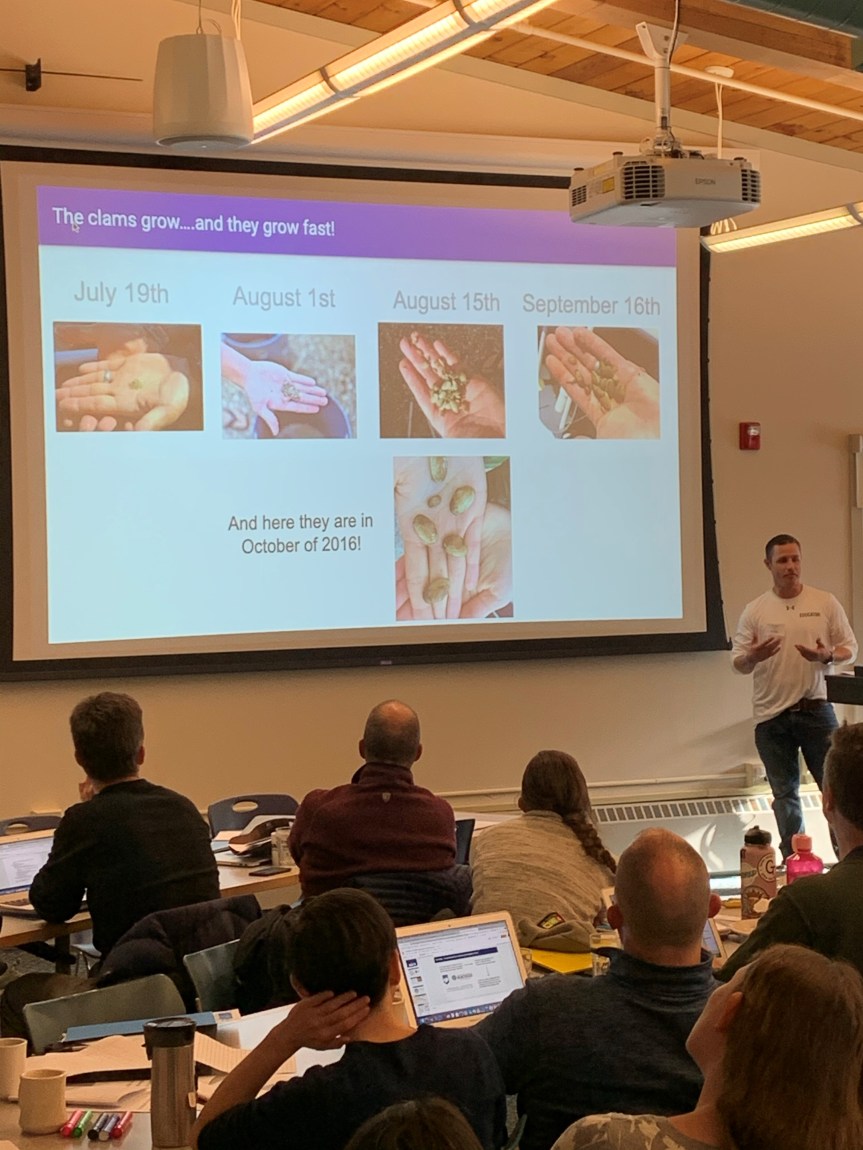
Aquaculture me!, an initiative created by Yarmouth educator, 2016 Cumberland County Teacher of the Year, and Miliken recipient Morgan Cuthbert, to get classroom teachers connected to the science and industry of aquaculture, held a professional development conference at the University of Maine’s Darling Center near Damariscotta last week.

Maine Department of Education Deputy Commissioner Dan Chuhta attended the event on behalf of the Department to give brief remarks and to extend a heartfelt appreciation to Aquaculture me! and educators throughout Maine who work hard to provide Maine students with meaningful educational lessons that incorporate scientific practice about the complex systems that affect our communities and environment through aquaculture education.

The workshop gave participants the opportunity to hear from Maine aquaculture researchers, learn about connecting with the community and the industry, in addition to hearing from Maine educators from Cape Elizabeth, Brunswick, and Yarmouth Schools about successful ways to connect Aquaculture to the classroom.

The conference also gave participants the chance to network with one another and have a round-table discussion about Aquaculture education in Maine.

For more information about Aquaculture me! visit their website.

The conference also gave participants the chance to network with one another and have a round-table discussion about Aquaculture education in Maine.

For more information about Aquaculture me! visit their website.

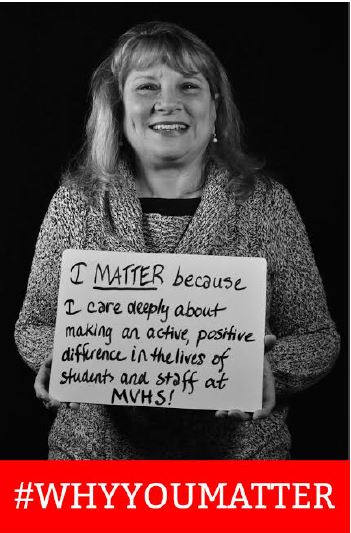
Medomak Valley High School Begins #WhyYouMatter Public Art Campaign

Having attended Alabama’s Chelsea High School’s presentation on their community art project #whyyoumatter at the National Art Education Association Conference in Boston last spring, Medomak Valley High School’s advanced photography teacher, Brooke Holland, and her class have taken on the challenge here in Maine.

The mission of the campaign states, “ #whyyoumatter is a public art campaign that focuses on empowering students while fostering a positive school climate where all people feel supported and valued.”

Holland, with the help of volunteer photography specialist Kyle Santheson, has instructed her advanced photography students in taking black and white photographs of everyone in the school along with their personally written messages of why they matter.

To prepare, staff were given a script with resources to use with their home bases. After viewing inspirational videos about making a difference, students were given time to think about why they matter.

Holland reports, “Within the photo studio, you can hear students and staff helping each other write their statements; whether that is simply articulating their message or giving them the pep talk they need on why they matter.”

These 11X18 posters will affirm and empower our daily interactions and efforts and will, in total, be an impressive display for our district art show this spring. We matter!

This article was submitted by Linda Dolloff Pease, Principal at Medomak Valley High School as part of the Maine Schools Sharing Success Campaign. If you would like to submit a story or share an idea for the campaign email Rachel Paling at rachel.paling@maine.gov.

Manchester Elementary School Holds National Geographic GeoBee

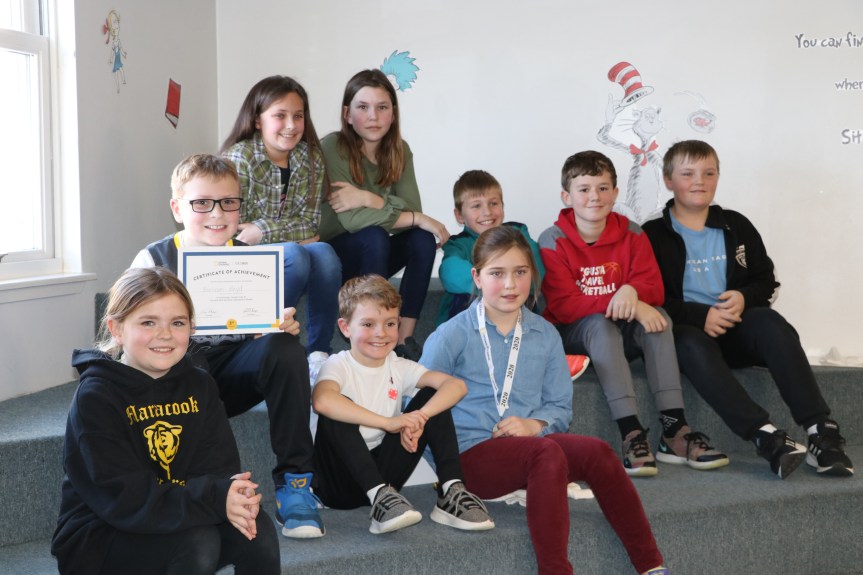
Manchester Elementary School held a final round of its School GeoBee this week. Sponsored by National Geographic, the GeoBee is a geography competition that challenges students in grades 4th through 8th grade to answer questions about geography around the world, everything from culture geography, to economy, science, and physical geography.

The Manchester Elementary School GeoBee was moderated by Maranacook Elementary Gifted and Talented Coordinator Victoria Scott and hosted by Manchester Elementary 4th grade teacher Jenniger Galletta. Parents, teachers, community members, and classmates were all in attendance at the momentous event during which strict rules were outlined for audience members ensuring contestants could concentrate and participate according to national GeoBee standards.

Nine students from 4th and 5th grade participated in the school’s final GeoBee by answering a series of questions provided by National Geographic. Providing their answers both verbally and in some cases in writing, or by circling a location on a map, the competition featured three rounds that eliminated students at the end of each round until one remained.

The schools top three winners were:

  • 1st place: Lydia Garofalo, 4th grade
  • 2nd place: Joshua Herzing, 4th grade
  • 3rd Place: Brennan Boyd, 5th grade

Lydia will go on to take the state qualifying test provided online by National Geographic. If she qualifies, she will go on to the State GeoBee set to be held on March 27th this year. A national championship will be held in May.

Schools across Maine and the United States are also in the midst of participating in this exciting competition by wrapping up their final school GeoBee events this month. Maine Department of Education’s Social Studies Specialist Joe Schmidt is scheduled to moderate at the state competition this spring.

For more information about GeoBee, visit the National Geographic website.

This article was written by Maine DOE staff Rachel Paling in collaboration with Manchester Elementary School as part of the Maine Schools Sharing Success campaign. If you have a story to share or an idea for the campaign, email Rachel at rachel.paling@maine.gov.

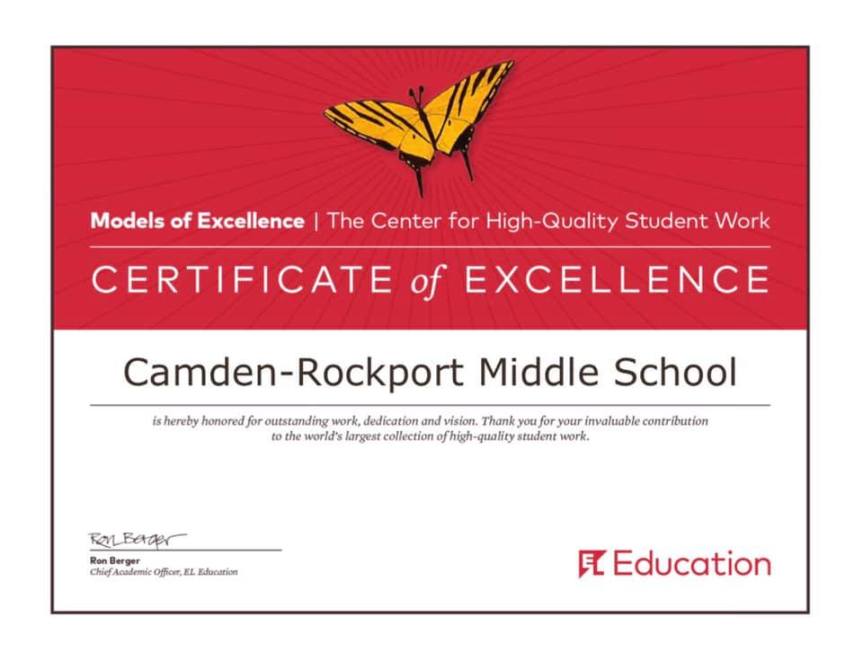
Camden-Rockport Middle School 7th Grade Project Selected as Model of Excellence

The Camden-Rockport Middle School 7th grade Interdisciplinary fall project, “Learning How to See” was selected as a “Model of Excellence” and is featured in the National Model of Excellence database.

Created in collaboration with Harvard Graduate School of Education, Models of Excellence is a open resource featuring exemplary pre-K to 12th-grade student work. Works chosen for this database are recognized for their high level of integrated curriculum development, instruction, assessment and students final product work.

In a press release issued by Five Town CSD / MSAD #28, special congratulations were given to John Dietter, Hilary Flagg, Sam Zwecker, Sarah Whittam, Beth York and Kristen Andersen for their hard work on this project.

The release also said, “Camden-Rockport Middle School is so proud to have their hard work recognized. The school is on a journey to implement meaningful project based learning experiences for students and this is strong affirmation at the national level!”

Camden-Rockport Middle School 7th grade Interdisciplinary fall project, Learning How to See” can be viewed here.

Information for this article was provided in a press release from Five Town CSD / MSAD #28 Executive Assistant to the Superintendent & Communications Director Trina Schroeder.

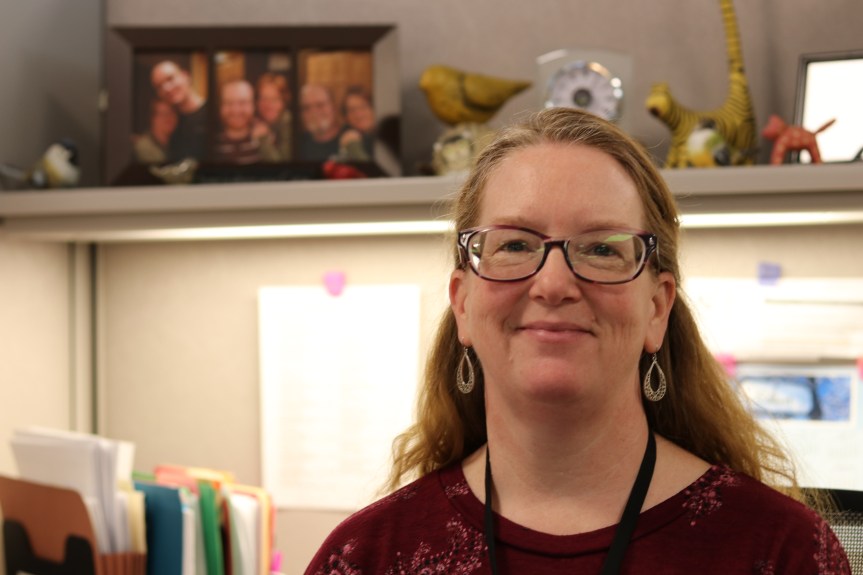
Get to know the DOE Team: Meet Dede Gilbert

Maine DOE team member Dede Gilbert is being highlighted this week as the part of a Get to know the DOE Team campaign. Learn a little more about Dede in the brief question and answer below.

What are your roles with DOE?

I am responsible for many things at the Department including coordinating constituent correspondence, cell and desk phones, travel, building maintenance, access badges, photocopiers, ordering supplies, procurement cards, and providing HR assistance.

What do you like best about your job?

The best thing about my job is that I get to interact with all of the employees of the Department on a pretty regular basis. I enjoy helping them problem solve issues and providing guidance on policy and procedures.  My days are never the same and I appreciate that.

How or why did you decide on this career?

I took business courses in school and a friend (way back in the day) encouraged me to apply to work for the state in a clerical role.  Thirty plus years later I’m still doing the same type of work but at a level with a lot more responsibility and diversity.

What do you like to do outside of work for fun?

Anyone who knows even the slightest bit about me knows I am a crazy cat lady (we currently have 2 kitties at home, Willie and Izzy).  I can be found most days in the breakroom reading a book during lunch and I love to bake.  I recently started crocheting again and just finished a sweater for my cat. Family Sundays are usually spent sharing meals or taking a drive north – (I’d love to retire in Greenville!!)

Model Concussion Policy Revision

Pursuant to Title 20-A MRSA§254(17) , all public schools, and private schools enrolling more than 60% of its students at public expense, are required to adopt and implement a policy on the management of concussive and other head injuries in school activities and athletics that is consistent with the model policy developed by the commissioner.

Since the creation of the mandate for the model concussion policy in 2012, schools across Maine have been instrumental in increasing concussion awareness among students, parents, and staff. The concussion policy is in place for more than just awareness; it should improve the management and care a student receives following an injury. Additionally, injuries can happen during any activity during the school day or outside of school. The location of the injury should not affect the attention and accommodation a student receives. The Department and its partners have revised the model policy to reflect current best practices in concussion management in schools. Over the years there has been a shift in the focus of how a concussion affects a student, specifically with the recognition that children are students first. Therefore, the model policy outlines a graduated school re-entry plan that is individualized and flexible, with input from medical providers, parents, and the school multidisciplinary team.

In order to fully comply with the requirements of the chaptered law, Title 20-A MRSA§254(17) as a result of L.D. 1873, An Act to Direct  the Commissioner of Education to Adopt a Model Policy Regarding Management of Head Injuries in School Activities and Athletics, in the 125th Maine Legislature,  all  additional resources have also been updated. Components that are required by this law are:  model policy, training, student and parental acknowledgment, protocols and forms, immediate removal and evaluation, and medical clearance. The additional requirements,  not part of the model policy, can be accessed through the Department of Education website. Here is a sample of some of the materials:

For more information about this model policy or the additional resources, please contact the School Nurse Consultant Emily Poland at Emily.Poland@maine.gov or (207) 592-0387.