MLTI T-shirt Design Competition Accepting Entries Until February 24th, 2020!

The Maine Learning Technology Initiative (MLTI) is hosting a T-shirt Design Competition again this year. The theme for the T-shirt design is “Celebrating 200 Years in Maine” or “Maine’s Bicentennial”.

A panel of judges will narrow the submissions down to three designs, and then we will ask Maine students and educators to vote for their top choice as they register for the MLTI Student Conference. The winning T-shirt will be printed for the 1000+ attendees of the 17th Annual MLTI Student Conference, which will be held on Thursday, May 21st, 2020 at the University of Maine in Orono. The three students whose designs become the finalists will be given a free registration to the conference.

Eligibility:

  • Any student who attends an elementary, middle, or high school in Maine during the 2019-2020 school year is eligible to enter the competition may enter the competition.
  • Any student or teacher/chaperone who is registering for the MLTI Student Conference may vote on the final design.

Submission Guidelines:

  • Submissions must only have ONE ink color and ONE background color. The inclusion of shading or gradients of colors will lead to disqualification.
  • All submissions must be an original artwork. Any use of any photo, drawing, images or elements created by any other person (other than the MLTI logo) is strictly prohibited and will result in disqualification.
    • Please adhere to the guidelines for the Scholastic Art and Writing Awards regarding copyright and plagiarism: Even if you have permission to use a work or if the work is in the public domain, the work that you submit to this competition must represent a new, original work. Additionally, changing the medium of an original work is not considered transformative. For example, a painting or drawing of a photograph taken from the Internet or a magazine is not considered original and should not be submitted.
  • Each student may only submit one entry AND the entry must be created by ONE student only.
  • The artwork should be sized to 81/2” x 11”.
  • Students may hand-draw or digitally design their artwork.
  • Digitally designed artwork should be 300 dpi, RGB color, and the fonts must be embedded.
  • Submitted artwork must incorporate the phrase “MLTI Student Conference” and the year “2020” or “’20”.
  • Students must incorporate the MLTI logo into their design: downloadable filesor by copying and pasting this link: http://bit.ly/MLTI_logos.
  • The design should reflect this year’s conference theme and should include some reference to “Celebrating 200 Years in Maine” or “Maine’s Bicentennial”.
  • Students are asked to submit an artist statement (less than 200 words) with their design to help bring clarity to their adherence to the theme.
  • Acceptable file types: PDF or JPEG high resolution.
  • Color: T-shirts are one solid color with one color ink, and the student can suggest the color for each.
  • The t-shirt design must fit on the front of the t-shirt.
  • Signed Release: Each student must sign this release and include it in their submission. If the link above doesn’t work, please copy and paste this link: https://www.maine.gov/doe/learning/ltt/conference/tshirt/release

Judging Criteria

  • Guidelines: Work clearly adheres to the submission guidelines (color, size, file type, etc.)
  • Theme: “Celebrating 200 Years in Maine” or “Maine’s Bicentennial”.
  • Principles of Design:Work incorporated the following elements of art: balance, emphasis, movement, pattern, repetition, proportion, rhythm, variety, and unity.

Important Dates

  • Monday, November 4th, 2019 – Competition begins
  • Monday, February 24th, 2020 – T-shirt designs due
  • Monday, March 2nd, 2020 – T-shirt voting begins (with registration)
  • Friday, April 10th, 2020 – T-shirt winner announced

Ready to enter the competition? Submit your entry with this form or copy and paste this link: http://bit.ly/MLTI-2020-tshirt-entry

For more information or answers to questions, please contact MLTI.Project@maine.gov
Revised Proposal Submission Dates: Call for Student and Educator Team Proposals: MLTI Student Conference

The MLTI Student Conference Planning Committee is issuing the call for student and educator team proposals for the 17th Annual MLTI Student Conference, to be held on Thursday, May 21, 2020 at the University of Maine in Orono.

Two important notes:

  1. Proposals are due much earlier this year! This will allow us to have a session list finalized by the time conference registration opens.
  2. Ideally, all proposals will have some form of student leadership incorporated. This could mean students will lead the whole session (with some adult support), students will serve as guides/coaches during the activity portion, or something in between. Students can co-present with teachers or other educators (including from community or business organizations).

Sessions will be one-hour long, must involve some form of creating, making, and doing, and should leave participants excited about what they learned and eager to share their experiences with others.

You can view examples of sessions from the 2019 MLTI Student Conference here.

Here’s the information you need to submit a proposal:

Conference Theme:  Maine’s Bicentennial Celebration

Possible Topics:  Proposals are not limited to the conference theme, and might include topics such as music, spoken word recording, coding, video production, graphic design, or writing and publishing your collection of short stories.

Device Requirements:  The student conference supports all MLTI devices, regardless of platform and encourages “platform-agnostic” sessions.

A Proposal Submission must include:

  1. The name of your school
  2. The title of your session
  3. List of all presenters

Important notes:

  • The $18 registration cost will be waived for up to two presenters. If you choose to have more presenters, you will need to pay the registration fee. Note that the Department has made every effort over the years to keep the cost of the conference low, however, as costs continue to rise, we have increased the registration fee by $3 this year and will raise it by $4 next year.
  • If your proposal is accepted, we ask that you register all presenters in a timely manner. The presenters do not count toward the school limit of 40 students during the registration process.
  1. A description of your session:
    • What skill will participants learn? How will you teach this?
    • What activity will participants engage in – what will they create?
    • What can participants expect to walk away knowing and being able to do?
  2. Materials to share in the conference registration form:
    • Short video advertisement of the session (less than a minute) Please submit Media Release forms for any student in the video.
    • Short description of the session (less than 200 words)
  1. Student leadership information:
    • How will student leaders be incorporated into the session?
    • How will they be empowered to succeed during preparation and during the day of the conference?
  2. Session requirements:
    • Level of expertise needed to participate fully (beginner, intermediate, expert)
    • The maximum number of participants you can accommodate (room sizes vary from 30-200)
    • Space set up requests (auditorium, tables/chairs, projector, speakers, etc.)
  3. Technology requirements:
    • A list of which platforms can be used in the session: (MacBook, iPad, ProBook, ElitePad, Chromebook, other)
    • Software and materials participants must have to participate (be specific)
  4. The name of the educator to be contacted about this proposal, and their email and phone number

Submit Proposals by 5 pm, Monday, January 27th, 2020 to this online form or copy and paste this URL into your browser http://bit.ly/MLTI-2020-session-entry. It is recommended that you type your answers in a separate document and then copy them into the form, so you can be sure to save your work.

Important Dates

  • Monday, November 4th, 2019 – Call for Proposals open and theme announced
  • Monday, January 27th, 2020 – Proposals due
  • Monday, February 10th, 2020 – Sessions selected
  • Friday, February 28th, 2020 – Sessions confirmed by presenters
  • Monday, March 2nd, 2020 – Sessions posted on DOE website
  • March 2nd, 2020: Registration open

Spread the word – if you know of someone doing fantastic work involving technology with making, doing, or storytelling please encourage them to submit a proposal or send an email with suggestions to MLTI.Project@maine.gov!

For more information or answers to questions, please visit the MLTI Student Conference page or contact the MLTI Student Conference Planning Committee at MLTI.Project@maine.gov.

“Harvest of Ideas” Brings Together 600 Washington County Educators for Unique Learning Opportunity

The Washington County Consortium, a non-profit collaborative organization formed by school districts in Washington County to provide regional professional development opportunities, recently held its annual “Harvest of Ideas,” a day-long conference featuring workshops focused on high impact practices, academic and behavioral interventions, relevant resources, and research-based practices.

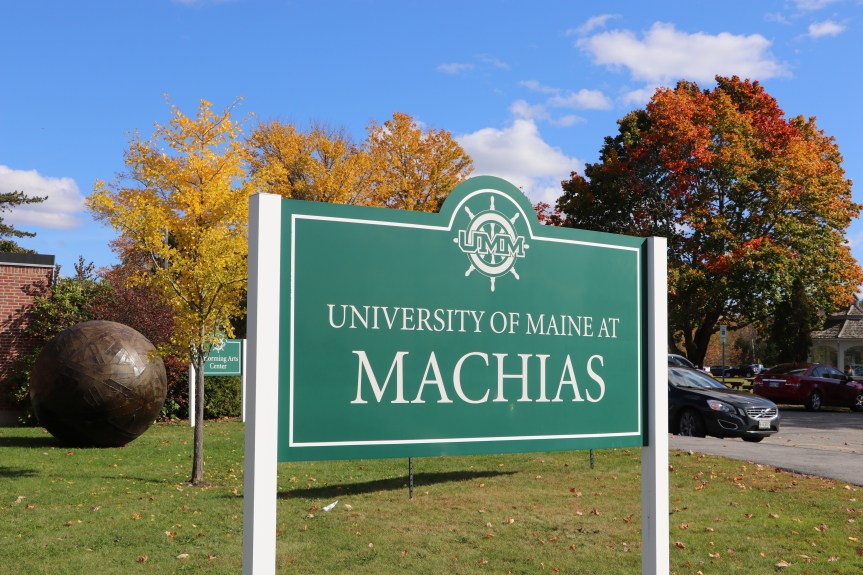
Held at the University of Maine at Machias, the event drew over 600 educators from the Washington County region and offered a wide range of learning opportunities, some of which will be followed up with two additional half-day workshops held throughout the school year, led by conference presenters. Uniquely this year, the conference allowed for 150-minute sessions called learning communities, providing practitioners time and space to think about what the ideas look like in their schools and classrooms, and how and where to start.

Sarah Woog introducing Commissioner Makin who participated via web conferencing to address educators.

Sarah Woog, Executive Director for the Washington County Consortium and the coordinator of conference opened both morning and afternoon auditorium sessions by thanking the many people involved in pulling off such a comprehensive learning opportunity. “Thank you to all who helped put this day together, to the Washington County Leadership Team, the Washington County Consortium Board of Directors, everyone at UMM, from IT to facilities, to the instructors who are sharing in sessions today.” She also gave an important shout out to Culinary Arts Instructor Emily Fitzsimmons from Coastal Washington County Institute of Technology and her students from Machias Memorial High School who provided lunch and snacks that day, in addition to students from Washington Academy, who served as ambassadors for the day.

Representatives from the Maine Department of Education were present, including Emily Gribben who assisted with coordination, Lavinia Rogers who offered a collaborative work session for World Language teachers, and Shari Templeton with an interactive session for science teachers. Maine DOE Coach Darlene Bassett was also present working with Maine educators to host a workshop on Guided Reading. With the help of Woog and Maine DOE representative Mary Herman, Commissioner Makin also joined the conference virtually in two different larger sessions to offer educators her thoughts on teacher voice and its impact on spreading a positive message about education in Maine.

Also featured was a long session about integrating Maine Native American studies into classroom instruction. Geo Neptune, a member of the Passamaquoddy Tribe from Indian Township, hosted the presentation. As an educator, Passamaquoddy activist, and master basket maker, Neptune was able to provide conference participants with valuable and unique first-hand perspective, advice, and tools to aid them in finding resources to teach Native American studies in ways that are contemporary and relevant, while also honoring the long history and culture of Maine’s Native American tribes. As an Educator, Geo has worked not only within Wabanaki communities toward cultural preservation, but statewide within Maine schools to help provide content.

Other sessions focused on a wide variety of pertinent topics including leadership, literacy assessment, engaging students with technology, guided reading, school counseling, Adverse Childhood Experiences, Neurodiversity, and selfcare and mindfulness to name a few. Presenters included several experts in the field including representatives from Maine Principals Association, CAN (Child Abuse and Neglect) Prevention Council of Washington County, University of Maine at Machias, Maine Parent Federation, and TREE (Transforming Rural Experience in Education), in addition to Maine educators from the region speaking to their peers as leading experts in their innovative work in education.

The day was a success on all counts providing educators from the Washington County Region with information and tools to refresh their classroom practices and help with the difficult task of ensuring students in some of the most rural areas of Maine have access to cutting edge curriculum, programming, and resources to help them achieve in today’s world.

“Every year, I just hope to do something that is more meaningful and has a greater impact than the year before,” said Woog. “I am grateful for the numerous people who work with me each year to realize this goal.”

October 31 DATA DEADLINES-

Is YOUR data done?

We are thrilled to share that 74% of our SAUs made the October 31 deadline, and have their student data submitted!  This helps all of us, as it impacts the accuracy and timeliness of the ED 279.

We appreciate that SAUs have been working diligently to ensure the accuracy of their staff data prior to submitting; we are still waiting to receive about 50% of SAU staffing data currently.  Please be sure to check that your staff information is updated in NEO, and call us if we can help!

Also, the truancy, attendance and behavior data for Quarter 1 is due, and the bullying reporting window is now open through November 30th. As we are looking at model policies and identifying what supports and resources we can provide for schools as they work to ensure a safe school climate, this data is helpful for the conversation.

THANK YOU to all of our SAU staff who have worked so hard to ensure the data is submitted.

And remember, if we can help please, contact our helpdesk at medms.helpdesk@maine.gov 
or call 207 624-6896.

School Bus Purchase Program Applications Open November 1

The Maine Department of Education is accepting applications to receive subsidy for new school buses purchased through the School Bus Purchase Program.  The application period is November 1 through November 25, 2019.

The Department will be able to approve about $9 million in school bus allocations that combines new bus requests and the prior year bus term commitment.  Round one applications will be accepted.  This program provides subsidy to school administrative units (SAUs) in order to offset partial cost of new school buses that are used to transport students to and from home and school and school events.  This program is a resource to help SAUs purchase new school buses, retire end of life school buses, and respond to emergency and special bus needs.  Eligible vehicles must meet Code of Maine Regulations Chapter 85 minimum qualifications, with the exception of Section 3.1.

The School Bus Purchase Program instructions and application information are available on the Maine DOE’s NEO website dashboard.  For more information or technical assistance, please contact Pat Hinckley at 624-6886 or email pat.hinckley@maine.gov .

MAARS Workshop and Overview of Approved Changes to Maine’s Model of School Support

Online Registration Portal for 2019 MAARS Workshop, including an overview of key changes to Maine’s Model of School Support (Accountability) is now available.

FocalPoint K12, in conjunction with the Maine Department of Education Assessment Team, will be holding a workshop for the Maine Assessment and Accountability Reporting System (MAARS). Topics during the session include an overview of the MAARS system, information on User Account management, revised Individual Student Reports (ISRs) formats, New Features, and a Q & A session.  Members from Maine’s ESEA Federal Programs team will provide an overview of key changes to Maine’s Model of School Support, as a result of the approval of the amendment submitted to Maine’s ESSA State Plan in December 2018. Each day long session is scheduled from 9 am to 3:30 pm. Lunch will be provided.

Venue and Registration Information

November 19, 2019
Abromson Community Education Center
88 Bedford St
Portland, ME 04101

Click here to register for the November 19, 2019 session.

November 20, 2019
Wells Conference Center
131 Munson Road
University of Maine
Orono, ME 04469

Click here to register for the November 20, 2019 session.

November 21, 2019
University of Maine – Presque Isle
Grand Ballroom – Aroostook Room
181 Main St
Presque Isle, ME 04769

Click here to register for the November 21, 2019 session.

Additionally, the assessment team and our reporting vendor FocalPointK12 will also be providing a MAARS webinar on November 13, 2019, 2:30 in preparation for the November 19 and 20 training sessions.  MAARS Webinar .  The audience for this session is returning and new District Assessment Coordinators (DACs) and Career and Technical Education (CTE) Directors. The updated roles within MAARS will be a critical element to prepare for the upcoming November 19 & 20 MAARS Workshops.

The content of the webinar will include:

  • Role of DACs
  • MAARS Confidential Reports Overview
  • How to add/delete/change MAARS roles and permissions (‘districtadmin’, ‘districtuser’ ‘schooluser’ ‘rosteruser’)

To access the November 13, 2019 webinar please use this link.

Please direct any additional questions regarding registrations to these sessions to Eric Buckhalter at (207) 624-6770 or eric.buckhalter@maine.gov

Public Comment Period for Alternative Science Waiver Application Now Open

The Maine Department of Education (DOE) is seeking 30 days of public comment from October 31 – November 29, 2019, on a waiver application (waiver from §8401(b) of the Elementary and Secondary Education Act (ESEA) as amended by the Every Student Succeeds Act (ESSA) of 2015) to the U.S. Department of Education (USED). The request seeks a waiver from publicly reporting student alternate science test data from the Spring 2020 assessment administration.

The U.S. Department of Education requires state educational agencies, when seeking waivers from statutory or regulatory requirements, solicit public comment on the application, respond to public comments, and provide evidence of the available comment period. A copy of the letter seeking waiver from §8401(b) of the ESEA as amended by ESSA can be downloaded with key elements of the request included below:

Federal program affected by the requested waiver

Section 1111(h) of the ESEA, as amended by the ESSA, requires State and LEA report cards to include information on student achievement on the academic assessments in reading/language arts, mathematics, and science described in section 1111(b)(2) at each level of achievement (as determined by the State under section 1111(b)(1)) for all students.

Maine’s 2020-2021 ESEA Data Dashboard (Report card) will continue to publicly report general state assessment results for mathematics, English language arts, and science and will publicly report alternate assessment results for mathematics and English language arts. Maine is seeking a waiver from public reporting for the alternate science assessment only. Maine will continue to report the alternate science assessment results to parents through individualized student reports (ISRs).

Maine will continue to meet all other reporting requirements. Maine specifically requests a waiver from the public reporting of alternate science assessment performance only.

Sections impacted include:

  • Section 1111(b)(2)(B)(iv)
  • Section 1111(b)(2)(B)(xi) (disaggregation of alt. science data by subgroup)
  • Section 1111(h)(1)(A)
  • Section 1111(h)(2)(iii)

Impact to Student Achievement

There will be no impact to assessing student achievement as all eligible students will continue to participate in the alternate science assessment where applicable. The waiver will permit Maine to not publicly release student alternate science assessment achievement scores. The Maine Department of Education will only report participation rates related to the administration of the alternate assessment in grades 5, 8, and the third-year high school during the 2020 spring administration. Maine is committed to moving towards increased compliance with the assessment peer review for an alternate assessment.  During the 2021 spring assessment administration, Maine will participate in the MSAA on-line Operational alternate assessment.  Standard setting and post equating in the summer of 2021 would allow for reportable student achievement levels and scores that fall.

Monitoring

The Department will actively monitor the delivery of the paper-based assessment through an established monitoring process. Test administration will follow all test administration policies and protocols. Schools will be provided ISRs available for bulk download in order to share student performance with parents/guardians or caretakers.

 Continuity of Services to Students

The vendor for MSAA will provide  Expanded Performance Expectations (EPEs) based on the Next Generation Science Standards for grades 5, 8, and third-year high school.  Teachers will have an opportunity to begin implementing the EPEs during the 2019-2020 school year, in preparation for the on-line Operational Field Test in 2021.

 Public Comment

Maine has solicited public comment regarding a request for a waiver from public reporting. This public comment was announced through the Departments Newsroom, social media accounts and through relevant Listservs. Public comment was solicited between October 31st and November 29th, 2019 for a period of 30 days. A summary of comments and the Department’s response is attached with the waiver request. All comments, in support of or against the waiver request should be submitted to Janette Kirk at Janette.Kirk@maine.gov.

Timeline for Implementation

Date General Science Alternate Science
September 2019 Survey educators regarding science assessment modes
October 2019 Convene RFP Writing Team
November 2019 Develop contract for Science Alternate Assessment paper-based test (2020 administration) with MSAA.
December 2019 Execute Science Alt. Assessment contract with MSAA.
January 2020 Release general Science assessment RFP
Spring 2020 Administer MEA Science assessment Administer paper-based Alt. Science assessment
Summer 2020 Proposed award of general science contract
SY 2020-2021 Item Development
Spring 2021 Field test new general science assessment Implement operational field test of online assessment
Submit waiver for public reporting of science data Submit waiver for public reporting of alt. science data
Summer 2021 Completion of post equating and standard setting
SY 2021-2022 Item Development
Spring 2022 Field Test (year 2) Implementation of operational alt. assessment
Spring 2023 Operational assessment Operational alt. assessment (year 2)

Further information related to this notice can be obtained from Janette Kirk, Chief of Learning Systems at Janette.Kirk@maine.gov.

Get to know the DOE Team: Meet Megan Dichter

Maine DOE team member Megan Dichter is being highlighted this week as the part of a Get to know the DOE Team campaign! Learn a little more about Megan in the brief question and answer below.

What are your roles with DOE?

I am the Workforce Development Coordinator for Adult Education, so I support adult education programs in offering industry recognized credentials and workforce training to adult education participants. I am also the CASAS (the math and reading assessment used by Adult Education programs) state trainer.  Additionally, I have a background in teaching English to non-native speakers and also support adult education programs working with students learning to speak English.

What do you like best about your job?

I enjoy the variety of my work and that it allows me to continue to teach (in the form of training,) and learn daily. And of course, I would be remiss if I didn’t mention the amazing Adult Education team with whom I work.

How or why did you decide on this career?

After college I volunteered with an organization called WorldTeach and spent two years in Thailand teaching at a University. That experience helped shape my career path and I returned to the U.S and enrolled in an M.Ed program- the rest is history.

What do you like to do outside of work for fun?

I am an avid photographer and spend a lot of my free time doing documentary photography. I love the challenge of visual storytelling.

School Civil Rights Teams Across Maine Help Launch First Annual Day of Welcome

On Friday, October 25, civil rights teams from across Maine participated in a Day of Welcome to celebrate and promote the idea that school communities are for everyone and all the parts of their identities protected under the Maine Civil Rights Act: race and skin color, national origin and ancestry, religion, disabilities, gender (including gender identity and expression), and sexual orientation. The event is sponsored by the Maine Office of the Attorney General through the Civil Rights Team Project (CRTP).

“The Day of Welcome is an important opportunity for us to ensure that all Maine students are included and welcomed in Maine schools,” said Attorney General Aaron M. Frey. “Civil Rights Teams play an important role in engaging our school communities in thinking and talking about issues which relate to the Maine Civil Rights Act. The work of these teams is premised on the belief that our communities and our state are stronger when all are welcome. I encourage all Maine students, families, and all members of our school communities to participate in this Day of Welcome and to work with Civil Rights Teams in their schools. I also encourage members of school communities without a Civil Rights Team to reach out to my office to learn how they can help grow this important program.”

The CRTP is a school-based program that supports student civil rights teams, who engage their school communities in thinking and talking about the six protected categories under the Maine Civil Rights Act. Now in its 24th year, it is available to all Maine schools, grades 3 and up, at no cost. There are currently more than 175 schools participating.

As part of the Day of Welcome, all participating teams created an inclusive welcoming message in their schools.

Schools in the news:


New FFA Chapter Officers Trained for School Year

Photo: FFA Officers rise to the challenge of putting creative leadership into practice.  Lane McCrum (right), grade 9, Mars Hill, models unusual headgear intended to promote recycling, with Mars Hill senior Brayden Bradbury on left.

State Officers of the Maine FFA Association (formerly known as “Future Farmers of America”) trained 35 leaders from 7 Aroostook County FFA Chapters on October 18, 2019 at the University of Maine, Presque Isle.

The one-day training, developed by State FFA Officers Graham Berry (President), Camryn Curtis (Vice President), and Ava Cameron (Secretary-Treasurer), with guidance from Maine Department of Education State FFA Advisor, Doug Robertson, was devoted to topics of FFA opportunities, Communication Strategies, and Exemplary Leadership.  FFA student participants came from chapters including Presque Isle Regional Career & Technical Center, Ashland High School, Ashland Middle School, Easton High School, Hodgdon High School, Mars Hill High School, and Washburn High School.

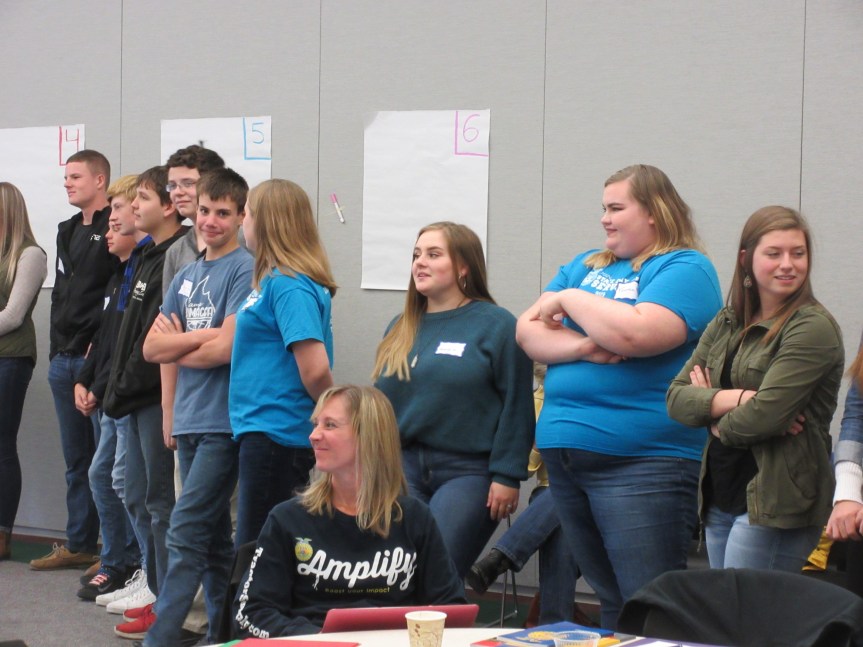
Students race to identify different methods of communicating in order to improve their own FFA chapter member communication.

The purpose of the workshop was to prepare participants to become successful leaders of their own local chapters.  FFA chapters are involved in a variety of activities to provide recognition and enhanced skills to students grades 7-12 enrolled in courses related to agriculture and natural resources. FFA chapters are often very active as well in their local communities in projects ranging from addressing hunger issues to helping elementary students learn more about Maine agriculture. Chapter FFA Officers left the training with many ideas of organizational strategies to undertake at their schools, as well as a number of specific community projects to implement. 

: FFA leaders participate in an activity emphasizing the importance of high quality communication.
FFA leaders participate in an activity emphasizing the importance of high quality communication.

Maine schools with students grades 7-12 enrolled in courses related to agriculture and natural resources, including those with science curricula connected to learning strategies such as school gardens and greenhouses, are eligible for FFA chapter membership—along with associated opportunities related to trainings, competitions, recognition and scholarships—and may address any questions to:  Doug Robertson, Maine FFA State Advisor, (207) 624-6744, doug.robertson@maine.gov