
Get to know the Maine DOE Team: Meet Brandi Cota

Maine DOE team member Brandi Cota is being highlighted this week as the part of a Get to know the DOE Team campaign! Learn a little more about Brandi in the brief question and answer below.

What are your roles with DOE?

I am the Office Specialist for the Maine Learning Technology Initiative. I provide support for the MLTI 1:1 grant program by collecting applications, assisting in the review and approval, also with writing and processing of our contracts. I manage the billing for all of the 200 + schools in the MLTI program which includes invoicing, tracking device inventory, and processing payments. I also assist with event planning, managing the inventory of the leased devices throughout the state, and communicating with technology staff at our schools.

In addition to my work on the MLTI program I provide support for Preschool Development Grant and I am also a part of the Morale Team and the Procurement Resource Group.

What do you like best about your job?

What I enjoy most about my job is to assist in the planning of events like the MLTI student conference. Being apart of events where we are able to see first hand the innovative work that Maine students are doing with technology in our schools. Working on the morale team and spending time planning and participation in fun events with my coworkers is very fulfilling. I also enjoy getting to communicate with teachers and school staff all over the state.

How or why did you decide on this career?

After my time in the Air Force I spent most of my career working in retail management. Even though I enjoyed it I realized I needed a more reliable work schedule as a parent. I switched to the business administration career field when I moved to Maine, and I thought the Department of Education would be a perfect fit.

What do you like to do outside of work for fun?

I spend the majority of my free time with my 10 year old son, close friends and family. I enjoy watching my son play in his games, and this time of year I love watching Packers football. We also like to go to the movies, the beach, attend concerts, and traveling to new places.
Important Reminder and Webinar Assistance: Due Date Approaches for Quarter 1 (Q1) Attendance, Behavior, Bullying, and Truancy Data Review

In order to assist SAUs with their legislatively mandated data reporting, the Maine Department of Education Data Team is offering a free webinar to review the requirements and new features. The webinar is strongly encouraged for those responsible for the compilation and entry of the required data.

The Quarter 1 Reporting and Certification Webinar will be held on Tuesday, October 1st from 10:00 am to 11:00am. (note, this webinar has been rescheduled from Tuesday, September 17) If you did not sign up for the previously scheduled date, please use the Registration URL and the Webinar ID:  562-931-003 to let us know you will be joining us, if you did sign up already, no need to re-register!

The Department of Education offers quarterly windows for districts to review, for accuracy and comprehensiveness, the data that has been entered and reported to us. It is our hope that review of this data on a more regular basis will save district personnel time and work at the end of the year, and that it will provide time for analysis and to make any necessary corrections.

The certification period for Quarter 1 (Q1), which includes attendance, behavior, bullying, and truancy opens October 1st.  Review and certification are required by October 15th. Superintendent certification is required for all quarterly reports.

Attendance-New This Year:

  1. Attendance is now collected in discrete quarters. Please attend the webinar for additional information.
  2. Quarter 1 attendance will be used for the average daily attendance (ADA) reporting requirements for Title V. There will not be a separate Title V ADA collection.
    Why?  Each year the US Department of Education begins the process for determining Title V eligibility for both the State and Federal grants, starting in late November.  Part of that eligibility is asking each state to provide several pieces of data on all their districts, including average daily attendance (ADA).  Without this data, no district would be eligible for the Federal (Small Rural Schools Achievement or SRSA) grant, and districts that are eligible for the State (Rural Low-Income Schools or RLIS) grant would get a reduced allocation, as 30% of the allocation formula is based on ADA from all eligible districts.
  • Attendance data certification can be found here, and guidance on reporting attendance can be found here.
  • Behavior data certification can be found here, and guidance on reporting behavior can be found here.
  • Bullying data certification can be found here and guidance on reporting bullying can be found here.
  • Truancy data certification can be found here, and guidance on reporting truancy can be found here.

If you have difficulties navigating to Synergy or NEO, please call the Helpdesk at 624-6896 or email at medms.helpdesk@maine.gov

All due dates for reports are listed on the MDOE reporting calendar. All quarterly reports are based on the following months:

  • Quarter One (Q1)– As of Oct 1 (to include July, August, Sept) – due Oct 15
  • Quarter Two (Q2) – As of Jan 1 (to include Oct through Dec) – due Jan 15
  • Quarter Three (Q3) – As of April 1 (to include Jan through March) – due April 15
  • Quarter Four (Q4)– As of July 1 (to include Apr through June) – due July 15

LD 577- An Act To Increase Access to Nutritious Foods in Schools by Implementing an After-school Food Program for At-risk Students

LD 577, Public Law 2019, Chapter 428 An Act To Increase Access to Nutritious Foods in Schools by Implementing an After-school Food Program for At-risk Students, will become law on September 19, 2019. We have received questions from district leaders, asking for clarification.

The law states that, beginning in the 2019-20 school year, a school administrative unit with at least one public school in which at least 50% of students qualified for a free or reduced-price lunch during the preceding school year, shall participate in the federal Child and Adult Care Food Program (CACFP). A report listing all districts/schools that meet that 50% or more criteria can be found here.  We have also provided a link for those who wish to read LD 577 in its entirety.  Please note that a school administrative unit that is required to operate a federal Child and Adult Care Food Program may choose not to operate such a program if it determines, by a vote of the governing body of the school administrative unit, and after notice and a public hearing, that operating such a program would be financially or logistically impracticable.  A program, or the public hearing and vote to not host a program, can occur at any point in a school year.

TO ASSIST OUR SCHOOL DISTRICT AND NUTRITION LEADERS

  • Child Nutrition has created a “Frequently Asked Questions” document regarding LD 577, and it is posted on our webpage.
  • A FREE Webinar on the basics of the requirements and program is being offered. Register NOW!

CACFP At Risk 101 Webinar
September 18, 2019 at 1:30-2:30pm
Topics:

    • Briefly discuss LD 577 and requirements
    • CACFP meal pattern
    • Record keeping requirements
    • Filing claims
    • CACFP review process
    • CNPweb agreement

If you have any questions regarding the CACFP At Risk Afterschool Program, please contact the Child Nutrition Office at 624-6843.


Maine Farm to School Network, in Conjunction with the Maine Department of Education, Child Nutrition, Offers Engaging Local Foods Trainings in October  

We are excited to announce that the Maine Farm to School Network has received a $25,000 USDA Farm to School Training Grant to build local food procurement capacity in Maine schools. Designed to increase the availability of local foods in schools, USDA Farm to School grants can help farm to school programs get started or expand existing efforts. “This award will develop the capacity of Maine school food directors to purchase from and support Maine farmers,” comments Stephanie Cesario, Maine Farm to School Network Coordinator. “The funds will support local foods procurement training for food service directors across the state as well as network building,” she added.

The Maine Farm to School Network, in collaboration with other state farm to school advocates, will offer local procurement and network building trainings at the 2019 Maine Farm to School Conference being held at the Kennebec Valley Community College, Alfond Campus in Clinton, ME on October 3-4, 2019. The combined trainings count towards 7.25 contact hours for school nutrition professionals.

Maine schools are ramping up their local food purchasing to support local farms and the local economy, while making school meals fresher and more appealing! The pre-conference local procurement training on October 3rd will join Martine Cherry, USDA Team Lead and Procurement Specialist, and Abbie Nelson, Farm to School Program Director from Vermont Food Education Every Day (VT FEED) and NOFA-VT for a fun, interactive afternoon of digging into local food procurement rules and guidelines so schools can get the local foods they want! This hands-on workshop is designed for school nutrition directors, kitchen managers, business managers, and others responsible for school food purchasing.

This free, 3-hour training will explore topics such as micro purchasing, informal bid process, Buy American provision, purchasing thresholds, values-based buying, and the importance of relationship building with food producers. Participants will learn how to apply strategies to make the most of marketing tools like Maine Harvest of the Month, and reimbursement opportunities like the Local Produce Fund, to either start a local purchasing strategy or take it to the next level.

To register for the training and to learn more about the 2019 Maine Farm to School Conference and Maine’s Farm to School initiatives visit www.mainefarmtoschool.org/conference. A limited number of scholarships are available to support costs associated with attending the local procurement training.

EF-M-13 Private School October Resident Enrollment Counts

This is a reminder that the EF-M-13 Private School October Resident Enrollment Count report is open October 1st.  Private schools that do not have any “publicly funded students” may complete only the EF-M-13 October 1st Resident Enrollment report, but have the option to also enroll their non-publicly funded students in the Synergy State Edition.

Private schools with publicly funded students must report all “publicly funded students” in Synergy State Edition.  Synergy State Edition reporting is necessary in order for the sending school administrative unit to be allocated subsidy for the student. State subsidy to a school administrative unit is often the source of funding that is used to pay the student’s private school tuition.

A “publicly funded student” is defined as a Maine resident student whose educational cost (such as tuition) has been paid for by public funds from a public entity such as the following:

  • Municipal school unit (including those in a School Union)
  • School administrative district
  • Regional School Unit
  • Community school district
  • Education in the Unorganized Territory
  • Maine Indian Education
  • State Funds from a State Agency such as the Maine Department of Education
  • Federal Funds from a State or Federal Agency

The excel form for this report is located on the helpdesk webpage inside the ‘Data reporting Instructions’ tile,  as well as an instructional walkthrough on completing this form.
For questions regarding this report or Synergy/NEO Access, please contact:
Reporting: Trevor Burns – Student Data Coordinator
Email: Trevor.R.Burns@maine.gov                   Phone: (207) 624-6678

Synergy/NEO Access: MEDMS Helpdesk
Email: medms.helpdesk@maine.gov               Phone: (207) 624-6896

Seeking Additional Maine Schools for Social Emotional Learning Pilot Program

The Tobacco and Substance Use Prevention and Control Program with the Maine Center for Disease Control and Prevention (MECDC), in partnership with the Maine Department of Education (Maine DOE), is seeking additional schools that would like to implement the social emotional learning (SEL) program, Second Step, funded by a grant through MECDC.

The MECDC received a portion of the State Opioid Response grant to provide community-based substance use prevention as part of the grant’s larger goal to reduce the prevalence of non-medical use of opioids. The Second Step Curriculum is research-based and available for PreK through 8th grades. Many of the skills within the Maine Learning Results for health education in elementary school align with goals of Second Step, such as nurturing skill building and preventing problematic developmental behaviors that are part of the trajectory towards substance use.

If you are interested in adding Second Step to your school’s curriculum and you are not already part of the MECDC pilot or have not already been contacted by the Maine CDC regarding your application from the last round, please complete this brief 5 minute application survey which will be open for submissions until Friday, October 11, 2019.

Please note: If you applied in the last round and have not heard from the Maine DOE or CDC, please feel free to apply again. We may not have had enough information from you in the last application to proceed.

For more information, contact Megan.Scott@maine.gov at Maine CDC or Emily.Poland@maine.gov at the Department of Education.

K-12 101 Train-the-Educator & SITE ASSESS Trainings

Morning Session – Developing EOPs K-12 101 Training

The REMS TA Center, on behalf of the U.S. Department of Education’s Office of Safe and Healthy Students, is pleased to offer this on-site, 4-hour training that presents important Federal guidance on school emergency management planning. Each school day, our nation’s schools are entrusted to provide a safe and healthy learning environment for approximately 55 million elementary and secondary school students in public and nonpublic schools. In June 2013, the White House released the Guide for Developing High-Quality School Emergency Operations Plans (School Guide), which provides an overview of Federal guidance on school emergency management planning. The School Guide, produced by the U.S. Departments of Education; Justice, led by the Federal Bureau of Investigation; Homeland Security, led by the Federal Emergency Management Agency; and Health and Human Services, incorporates lessons learned from events, like the school shooting in Newtown and the tornadoes in Oklahoma, as well as years of emergency planning work by the Federal government, to present a recommended process, important content elements, and key considerations for school EOP development. In collaboration with their local government and community partners, schools can take steps to plan for these potential emergencies through the creation of a high-quality school EOP. With this K-12 101 training, an expert team will provide an overview of a recommended six-step planning process to create a high-quality school EOP, which includes:

Step 1: Forming a Collaborative Planning Team
Step 2: Understanding the Situation
Step 3: Determining Goals and Objectives
Step 4: Plan Development
Step 5: Plan Preparation, Review, and Approval
Step 6: Plan Implementation and Maintenance

Afternoon Session – SITE ASSESS Mobile App Training

Participants will learn about SITE ASSESS, the REMS TA Center’s first-ever mobile application designed to support education agencies with examining the safety, security,
accessibility, and emergency preparedness of a school building and grounds. This 2-hour training provides information on the importance of site assessments as a school emergency preparedness activity, an overview of the secure mobile app and its features, and shared strategies for using the app to conduct K-12 site assessments collaboratively.

TRAINING DETAILS

When: Friday, September 27, 2019
Time: 8:00 am – 3:00 pm (Registration begins at 7:30 am)
Where: Senator Inn, 284 Western Ave, Augusta, ME 04330
Cost: NO CHARGE

Register for these training sessions online here.   Registration for this event closes on Tuesday, September 24, 2019 at 5:00 pm Eastern Standard Time.

If you have questions or need additional assistance, please contact the REMS TA Center at (855) 781-REMS (7367) or info@remstacenter.org.

Developing Emergency Operations Plans (EOPs) K-12 101 Train-the-Trainer (TtT) Training

The Readiness and Emergency Management for Schools (REMS) Technical Assistance (TA) Center, on behalf of the U.S. Department of Education’s Office of Safe and Healthy Students, is pleased to offer the “Developing Emergency Operations Plans (EOPs) K-12 101 Train-the-Trainer (TtT) Training.” This on-site, 8-hour training presents important Federal guidance on school emergency management planning.

TRAINING DESCRIPTION
Each school day, our nation’s schools are entrusted to provide a safe and healthy learning environment for approximately 55 million elementary and secondary school students in public and nonpublic schools. In June 2013, the Obama Administration released the Guide for Developing High-Quality School Emergency Operations Plans (School Guide) which provides an overview of Federal guidance on school emergency management planning.

The School Guide, produced by the U.S. Departments of Education; Justice, led by the Federal Bureau of Investigation; Homeland Security, led by the Federal Emergency Management Agency; and Health and Human Services, incorporates lessons learned from recent events, like the school shooting in Newtown and the tornadoes in Oklahoma, as well as years of emergency planning work by the Federal government, to present a recommended process, important content elements, and key considerations for school emergency operations plan (EOP) development.

In collaboration with their local government and community partners, schools can take steps to plan for these potential emergencies through the creation of a high-quality school EOP. With this K-12 101 TtT TBR, an expert team will train potential master trainers on the recommended six-step planning process to create a high-quality school EOP, which includes the following:
Step 1: Forming a Collaborative Planning Team
Step 2: Understanding the Situation
Step 3: Determining Goals and Objectives
Step 4: Plan Development
Step 5: Plan Preparation, Review, and Approval
Step 6: Plan Implementation and Maintenance

WHO SHOULD ATTEND?
Potential master trainers from participating schools and districts responsible for training site-based planning teams interested in creating, revising, or enhancing school EOPs; school staff who serve, or will serve, on their school or school district’s EOP planning team; and other interested community stakeholders, including first responders, emergency medical services personnel, law enforcement, and others.

TRAINING DETAILS
When: Thursday, September 26, 2019
Time: 8:00 am – 4:00 pm (Registration begins at 7:30 am)
Where: Senator Inn, 284 Western Ave, Augusta, ME 04330
Cost: NO CHARGE

Register for this training session online here. Registration for this event closes Tuesday, September 24, 2019 at 5:00 pm Eastern Standard Time.

If you have questions or need additional assistance, please contact the REMS TA Center at (855) 781-REMS (7367) or info@remstacenter.org.

Multi-tiered Systems of Support Professional Learning Opportunity for Maine Schools

The Maine Department of Education is pleased to share a year-long professional learning opportunity for Maine schools, designed to help school leadership teams develop and implement Multi-Tiered System of Support (MTSS) frameworks in their schools.

What is MTSS? 

Multi-tiered Systems of Support (MTSS) are comprehensive frameworks designed to address the academic, behavioral, and social-emotional needs of each student in the most inclusive and equitable learning environment.   The MTSS framework is driven by strong leadership, policies and practices, family and community engagement, staff collaboration, and data-informed decision-making. Through the implementation of a MTSS framework, districts and schools increase attendance, elevate student engagement, lessen concern about behavior, improve school climate, and boost academic performance.

OBJECTIVE OF MTSS SERIES:

The professional development sessions in this series will provide educators a common understanding of an integrated MTSS Framework to support both academics and behavior.  This series builds on the success of several Maine schools, and offers ongoing statewide technical assistance. With the support of the presenters, participating school teams will:

  • Become familiar with the essential components of the MTSS framework;
  • Be guided through developing their own MTSS framework;
  • Be provided tools to use within their own school for professional development; and
  • Have a plan to implement their MTSS framework in the 2020-2021 school year.

The school leadership teams attending this series will work between sessions with their school faculty.  This will ensure that school faculty is informed and has a voice in the creation of this framework.  The facilitators will also be checking in with the team between sessions to lend support and to be a resource for the continued development of their MTSS framework.

OVERVIEW OF SESSIONS

Session 1:  October 22nd and October 23rd at Jeff’s Catering in Brewer Maine.
Day One:  LEADERSHIP
– Overview of MTSS
– Roles of Shared Leadership and Shared Responsibility
– Exploring the Why
– Equity and Cultural Shifts
– Role of Data
– Layered Continued Support
– Presentation by Garret Schenck Leadership Team

Day Two:  FOUNDATIONAL SUPPORTS for Academic and Behavior
– Tier 1:  Core Curriculum
– Universal Screener
– Progress Monitoring
– Assessment Reasoning
– Equity for all

Session 2:  Regional Groups- November 2019
DATA, LITERACY AND SUPPORTS
– Data Literacy by Shelly Simpson
– Tier 2 and Tier 3
– Interventions
– Introduction to Individual Learning Plans
– Equity and Data

Session 3:  Regional Groups February 2020
EVIDENCE BASED PRACTICES
– What and When
– Individual Learning Plan update
– Supports in creating a master schedule
– Examination of Professional Development
– Equity and Progress Monitoring
– Assessment Reasoning
– Equity and Time

SESSION 4:  March 2020
FAMILY/COMMUNITY/SCHOOL ENGAGEMENT
– Engagement Strategies
– Implementation
– Creating the process
– Equity within the Framework

SESSION 5:    May 2020
SHARING FRAMEWORK
– Schools share their MTSS Framework

The Maine DOE is committed to working with all Maine schools who wish to improve teaching and learning.  As such, DOE will cover costs for the actual MTSS sessions, texts, and materials that will be used throughout the year. Schools or districts are responsible for travel costs and a fee of $125 per person to help defray expenses for refreshments and lunches for all sessions. For recertification purposes, contact hours will be awarded to MTSS participants.

If interested in joining other schools in creating a Multi-Tiered System of Supports for your school or district, please submit your application  by October 15, 2019.

Maine DOE Launches Culinary Classroom to Support School Meal Programs; EUT to Share Office Space

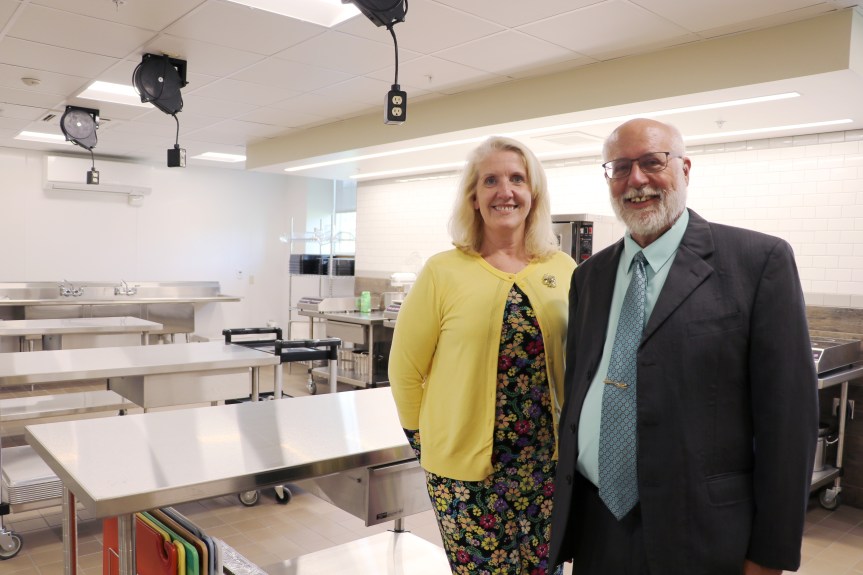
The Maine Department of Education (DOE) recently held an open house to showcase a new culinary classroom based in its Augusta offices. Located just across the river from the Capitol complex, the new space also houses offices for the Child Nutrition Team and the Education in Unorganized Territories (EUT) team as well.

The new kitchen is supplied with industrial stoves, appliances, sinks, counter space, ventilation, and tools that will allow the child nutrition team to host professional learning opportunities for school nutrition staff that are working in schools throughout the state. Pending the final touches on some cameras and tv monitors, the DOE will be planning some upcoming webinars, with tips and information about how to utilize and cook with USDA approved foods in school kitchens, including cooking from scratch, with vegan options, and keeping up with trends in the food service industry, among other topics.

Just down the hall from the kitchen there is ample office space for the staff who work on the Child Nutrition teams including two chefs and several other nutrition specialists. Maine DOE’s Child Nutrition team is a federally funded function of the Department that works to support federal programs that help fight hunger and obesity, by reimbursing organizations such as schools, child care centers, and after-school programs for providing healthy meals to children. They also help run the Summer Food Service Program and oversee several United States Department of Agriculture (USDA) Food and Nutrition Services programs and initiatives that provide healthy food to children.

Child Nutrition Chefs, April Taylor and Michele Bisbee.

While the Child Nutrition Team is working hard to ensure Maine kids have healthy meals, their neighbors, the EUT team, are next door providing State-run administrative services for Maine schools that enroll students from unorganized territories throughout the State, ensuring students who do not have a school near their home have access to elementary and secondary education. The EUT places and supports 900 students from unorganized territories all over the state with tuition, special education services, transportation, and advocacy. They also help run EUT schools, Connor Consolidated School in Connor Township; Edmunds Consolidated School in Edmunds Township; and Kingman Elementary School in Kingman. Maine has 421 (and growing) unorganized territories with students from north to south, inland and islands, mountain areas in the west, and farms areas in the northeast.

In addition to the day-to-day flow of files that pass through the EUT offices during regular business, they also house some unique historical documents with a rich history dating back before the 1920s. Some of which are now on display for visitors to see in their new space, including black and white pictures, hand-drawn floor plans from old school houses, and even some old tuition bills.

The open house drew colleagues and news stations alike and ended with an announcement that the new kitchen space will be dedicated to Child Nutrition Director Walter Beesley who was instrumental in launching the culinary classroom in hopes of providing more hands-on, advanced support to Maine school kitchen staff.

For more information about Maine DOE’s Child Nutrition Team, please visit their website or contact their offices, and for more information about Education in Unorganized Territories, please visit this webpage for contact information.