PRIORITY NOTICE: 2019-2020 NEO Maine Schools and Public School Approval Scheduled to Open May 3

It is that time of year again for each school administrative unit (SAU) to submit annual school reports, including the annual approval report for the unit, certifying progress on the Comprehensive Education Plan. This is in accordance with 20-A M.R.S. Chapter 206 and Maine Department of Education (DOE) Rule Chapter 125, which requires information  to maintain continued approval status for the (SAU) and all schools within it.

Public SAUs and schools complete the annual public school approval process in the NEO information system, verifying required information in the NEO Maine Schools and Public School Approval module.

NEO Maine Schools and Public School Approval Module: FY2020 Changes

Last year, NEO Maine Schools and Public School Approval were integrated into a one-step process, thereby allowing submission of both organizational information and school approval checklist items in one sitting. While this new efficiency was generally well-received, the Department learned that the new process presented some challenges in implementation, particularly for some types of public units that require differentiated formats of school approval. As a result, further improvements to the NEO system have been implemented as outlined below.

  • NEO Public School Approval now delivers targeted school approval certification statements based on school administrative unit type, and has been revised to be more categorical in nature. This means that Superintendents will be responding to fewer questions, and only the questions that apply to the appropriate type of school.
  • In an effort to reduce unnecessary text and make the school approval form more user-friendly, the Department has omitted non-critical citations from certification statements, instead providing a link to a public school approval requirements list with associated citations.
  • The Department had several requests to “re-open” the NEO Public School Approval form to update specific items. While this is not part of the update process, NEO now allows communication between Superintendents and the DOE via the general comment field that appears at the bottom of the NEO Maine Schools and Public School Approval module. Responses entered here, by either the Department or by the Superintendent, will trigger emails regarding outstanding items.
  • Finally, the Department will be able to access some additional coding options, issuing “Waivers” only in situations where exceptions are needed; while an “Approved” option can be selected for items that were initially outstanding but are then brought into compliance.

The Department very much appreciates the effort and feedback that was provided to inform the system improvements over the past year, and hope it continues. An important item to remember, that will not change, is that NEO information may be saved when partially finished to complete at a later time. While completing the approval process, the page should be saved often, as there is a relatively short time-out period.

Maine Schools and Public School Approval NEO Module Directions

We are currently working with a target date of May 3, 2019 for the opening of The NEO Maine Schools and Public School Approval module. The intent of an earlier opening date is to allow time before the current school year ends, and vacations begin, to complete this important task. This change will also support an improved student enrollment upload process in the fall.

The Maine Schools portion is to inform the DOE of school and district contact information, changes in grade spans, and other school-related information. As a preliminary step, the superintendent or chief administrator of the school must first be entered into the NEO Staff Module. Access to NEO staff can be obtained by submitting a NEO Access Request Form to the DOE Data Helpdesk.

To begin: Log in to the NEO information system. Click on Maine Schools. If you do not see this option on your menu, and are a superintendent, technical coordinator, or administrative assistant, please contact the DOE Data Helpdesk.

Filling out the Maine Schools and Public School Approval Module: All fields with the exception of Administrative Office Fax are required. PO Boxes will not be accepted in the “Physical Address” box. Mailing address is needed only if different from Physical address. The Cost Center information references the three-digit code that the business office uses in the public financial system to assign building level costs (may require two codes).

Next, carefully mark all SAU level approval questions with a response, and if the response is “No, or partially No,” a comment must be entered. Additionally, mark to answer the school level approval question for each school listed.

As you move down the module/form, ensure that the SAU- and school-level section question is checked for each section: “Please confirm that the above section has been reviewed…”

At the bottom, date, sign and submit the form.

For questions related to the NEO information system or access, please contact the DOE Data Helpdesk at MEDMS.Helpdesk@maine.gov or 207-624-6896

Please contact Pamela Ford-Taylor, DOE School Enrollment Specialist at 207-624-6617 or Pamela.Ford-Taylor@maine.gov with questions or comments.
PRIORITY NOTICE: 2019-2020 NEO Maine Schools for Private Schools and School Approval Process Scheduled to Open May 3

In accordance with 20-A M.R.S. Chapter 117, the Maine Department of Education (DOE) requires private schools seeking approval status to be approved annually.

Private School Approval Process Updates

As indicated in last year’s guidance (July 12 and  October 2), the 2019-2020 private school approval annual report submission deadline is moving to an earlier date than previous years and will align with the public school approval year (July 1 to June 30). There is also a new target opening date for FY2020 NEO Maine Schools, so that the task of verifying organization information can be completed early. This change will support an improved student enrollment upload process in the fall. The Department urges private schools to submit complete information as early as possible for FY2020, and reach out early to resolve any questions or issues. Any requested funding for publicly funded students will be contingent on the process of basic school approval, following by receipt of the Year-End Report of Private Schools (Form EF-M 240).

All private schools seeking approval status must, in addition to the organizational piece in NEO Maine Schools, enter required staff information into the NEO staff module. The most reported barrier for private schools undergoing basic school approval in FY2019 was related to clearance (CHRC) and certification issues during Department implementation of a new certification system. A significant temporary backlog in certification office processing times, and mismatched or inaccurate NEO staff entry by the private school, were the most common causes of the resulting delays in certification issue resolution. The Department urges private schools to review instructions at https://www.maine.gov/doe/data-reporting/collection/helpdesk/resources/staff-dataentry-guides, and contact the Help Desk with questions regarding the proper way to enter staff information in the NEO information system. The Certification office backlog issue has been rectified.

Private School Approval and NEO

Maine Schools NEO Module 
The NEO Maine Schools form is required by all public and private schools to inform the Maine Department of Education of school and district contact information, changes in grade spans, and other school-related information. As a preliminary step, in order for an organization to be updated in Maine Schools, the superintendent or chief administrator of the school must first be entered into the NEO Staff Module. Access to NEO staff can be obtained by submitting a NEO Access Request Form (Excel) form to the MDOE Data Helpdesk.

Log in to the NEO information system. Click on Maine Schools. If you do not see this option on your menu, and are a superintendent (for private schools, this is the chief administrator of school), technical coordinator, or administrative assistant, please contact the MEDMS Helpdesk at MEDMS.Helpdesk@maine.gov or 207-624-6896.

Filling out the Maine Schools Module: All fields, with the exception of Administrative Office Fax, are required. PO Boxes will not be accepted in the “Physical Address” box. Mailing address is needed only if different from physical address.

At the bottom, check the box to confirm that all information has been reviewed before signing and submitting the form.

Staff NEO Module
For security and privacy purposes, all staff information must be properly entered in the NEO Staff module. The School Approval office utilizes only the NEO public portal Staff Positions search function, together with internal staff violations reporting, to verify that all staff have appropriate certifications and/or clearance. Neither certification nor clearance information should be manually or electronically submitted in any format with school approval materials. This ensures that private information is not being relayed in an unsafe manner.

Private School Annual School Approval Report and Documentation

The annual report is submitted separately from the NEO system, with related documentation, to Maine DOE’s School Enrollment/Approval Specialist, either electronically (email, preferred) or by mail. The NEO requirements need not be completed prior to the submission of the annual report; however, school approval will not be issued until the NEO information is complete and verified.

2019-2020 Approval Reports and requirement checklists are linked below, and also available from the updated Private School Approval web page. If unsure of which form is appropriate for your needs, please contact Pamela Ford-Taylor, School Enrollment/Approval Specialist.

Private School Reporting

School approval includes the requirement that all private schools provide attendance data on their publicly funded students in the Synergy student information system.

Currently, every private school that seeks tuition from a school administrative unit is already entering information into the Synergy student information system for each student for whom they seek public funds. The attendance data entry is comprised of the number of days in the reporting period that the student is enrolled, the number of days they were present, and the number of days of excused absences. This data needs to be updated and reviewed quarterly and certified on June 30th.

Subsidy will as always be dependent on accurate reporting of October 1st enrollment counts. In order for an accurate enrollment count and to ensure that private schools are on track to receive the appropriate tuition allocation, the following guidelines should be closely followed:

  1. In order for attendance data to be submitted, NEO Maine Schools organizational information must have been submitted and approved. If Maine Schools is not submitted, enrollment and attendance cannot be uploaded and EPS cannot be processed;
  2. The first instance of submitting attendance for publicly funded students at private schools, which is due quarterly, must be entered by October 15 and includes the attendance period July 1 through September 30. The next reporting period (to be entered by January 15) will require updated attendance numbers through December, and so on. More details about attendance data submission, and a helpful training manual document, can be found in Student Attendance Reportingand Attendance Manual Entry Guide.
  3. Publicly funded October 1ststudent enrollment data must be entered by October 15; certified by October 31.

Please contact the MEDMS Help Desk at 624-6896, or MEDMS.Helpdesk@maine.gov for assistance with NEO or the student information system. Please contact the DOE Certification Team at cert.DOE@maine.gov for certification system questions. Please contact Paula Gravelle at 624-6792 or Paula.B.Gravelle@maine.gov for questions about tuition. And, for questions about school approval please call Pamela Ford-Taylor at 624-6617, or Pamela.Ford-Taylor@maine.gov.

PRIORITY NOTICE: Updates Regarding ESEA Dashboard, Data Correction, and Federal Accountability under ESSA

This notice provides an update to the original timeline released in the DOE newsroom on March 11, 2019 regarding School Year (SY) 2018/19 data correction requests, the timeline for the release of the ESEA Dashboard, and the implementation of the federal accountability model under ESSA.

Data requests submitted to the Maine DOE by the February 8, 2019 deadline were reviewed, amended if necessary with the updated data sets, and uploaded to the ESEA Dashboard. The original timeline indicated the Data Dashboards would be provided to Superintendents for review on Monday, April 15, 2019.  The Department is currently in the process of conducting Quality Assurance (QA), ensuring the accuracy of presented data sets, and therefore the Dashboards were not available for District and School review on April 15, 2019. Once the QA process has concluded, district and school leaders will be notified and provided two (2) weeks to review the information provided. The ESEA Dashboard will become available prior to the conclusion of SY 2018-19.

As a result of a Maine DOE leadership phone conversation with the US Department of Education (USDE) on December 12, 2018, a subsequent phone call on March 8, 2019, and written feedback provided to the Maine DOE on March 15, 2019 related to Maine’s ESSA amendment, the Maine DOE was directed to resubmit clarifying information on April 8, 2019 to the USDE for review.  USDE has verified receipt of the clarifying information, and the Maine DOE awaits their feedback so that the process can proceed.

During this time of pause, the Maine DOE has secured state funding to support the provision of virtual coaching to schools that the Maine DOE anticipates will be eligible to receive additional support when amendments to Maine’s ESSA State plan are approved.  Participation in the virtual coaching is currently optional, with many eligible schools taking advantage of this support.

Maine DOE has requested an extension, until August 31, 2019, to officially make school identifications, and has requested the period of availability of 1003(a) funds be extended until September 30, 2020. These extensions will allow the Maine DOE to ensure the Department is able to align available federal funds to the identification timeline, therefore ensuring the availability of financial supports to schools.

Please know that the Maine DOE continues to do everything conceivable to ensure Maine has an equitable federal accountability model that honors stakeholder feedback and Maine’s small, rural context.


The Maine DOE is seeking to fill vacancies on the Title I Committee of Practitioners.

Title I of the Every Student Succeeds Act (ESSA) requires each state educational agency that receives Title I funds to create a State Committee of Practitioners to advise the State in carrying out its responsibilities under the Title I program. The purpose of this committee is to review any state rules and regulations relating to Title I, ensuring that they conform to the intent and purposes of Title I.

The majority of members must be representatives from local education agencies and includes representatives from the following categories:

  • Administrators
  • Teachers, including vocational educators
  • Parents*
  • Members of local school boards*
  • Representatives of private school children*
  • Pupil Services Personnel

*areas currently under-represented

Regular meetings of the committee will be conducted on a quarterly basis at the Maine Department of Education Offices in Augusta, with the term of membership commencing August 1st, 2019 and expiring July 31st, 2021.

Those interested in serving on the Title I Committee of Practitioners Committee should contact the Maine DOE Title I Program Coordinator, Monique Sullivan, at monique.sullivan@maine.gov or 207-624-6723 by 5pm on Friday, July 26th, 2019 for further information.

Maine’s Transformational Leaders’ Network Summer Conference Registration ENDS SOON!

Register Now! Closing May 10,2019!

WHO:  YOU if you are a building principal

WHAT:  Maine’s Transformational Leaders’ Network  Summer Conference

WHEN:  Sunday, June 23, 2019 (check in 4:00)– Wednesday, June 26, 2019 (ends 2:00)

WHERE:  The Senator Inn in Augusta (Lodging is available Sunday night for those who need it; there are no formal activities that evening)

The Maine Department of Education invites you, as the leader of a Maine school, to take advantage of a great opportunity to join the Transformational Leaders’ Network (TLN) for a yearlong experience. The Network brings principals together to support school improvement and, most importantly, to promote leadership growth.  The TLN is part of DOE’s commitment to support schools trying to improve. Principals from across Maine have been TLN members for the past five years and have found it extremely helpful in their leadership of school improvement.

“I’ve left the TLN feeling really energized and feeling that I can continue this hard work with my staff, with fresh ideas and fresh focus…”

“When we go to these meetings, it is very positive. There is a lot of support for each other and we are not sitting there saying, ‘Poor us.’ We are looking at the work that is being done by schools and the positive things that are going on in schools and we are using that to help each other, in order to raise the aspirations of kids, but also of teachers, and let them know that we are all in this together.”

DOE will cover the costs for the conference registration, hotel lodging, daily breakfast and lunch (dinners will be on your own), and required texts. Contact hours for the conference and for TLN sessions throughout the year may be used for recertification.

Principals will bring their own school improvement goals to the conference and, in a variety of formats, draw up plans for their leadership work in the coming school year.

What are the objectives of the TLN?   

  • Establish a supportive learning network
  • Develop knowledge of the resources available to you and your staff to assist in successfully transforming teaching and learning
  • Reduce the isolation that you may often feel by connecting you with other leaders engaged in improving their schools
  • Provide a forum for celebrating successes and addressing challenges with your colleagues

What are the objectives of the Summer Conference?

  • You will be guided to develop two workable plans:
  1. Goals and initial actions to improve teaching and learning at your school
  2. Goals and initial actions for your personal leadership growth that will help make the goals of school improvement a reality
  • You will come to know and trust fellow principals as learning colleagues in order to support each other in the hard work of improving your school
  • You will deepen your understanding of how school leadership can contribute to school improvement
  • You will expand your skill set and your strategies as a school leader

What can you expect to come away with after the Summer Conference?

  • Two workable plans that connect your leadership growth to facilitating school improvement in the coming school year
  • First Steps that you can work on over the summer
  • A feeling of support, authenticity, and safety within the TLN that will sustain you and your work over the coming year.

REGISTER BY Friday, May 10, 2019! Space is limited so we ask you to register right away using the following link:

https://forms.gle/MsVvi82drf8UP6yv8

If you have any questions, please feel free to reach out to one of the following individuals who will be working with you at this conference:

Stephen MacDougall                                                Fran Farr

(207) 754-5436                                                         (207) 439-9659

smacdougall831@gmail.com                                  franfarr522@gmail.com


Gordon Donaldson                                                    George Marnik

(207) 667-2382                                                           (207) 461-6047

gadjr11@gmail.com                                                  george.marnik@maine.edu


Sally Mackenzie                                                          Linda Bowe

(207) 798-9619                                                           (207) 322-7256

sarah.v.mackenzie@maine.edu                              lbowe23@gmail.com


Students and Educators Invited to Vote for Winner of MLTI T-shirt Design Competition

Earlier this year, students were invited to submit entries to the 2019 MLTI T-Shirt Design Competition. The winning design will be printed on t-shirts that will be worn by 1,000 middle and high school students during the Maine Learning Technology Initiative (MLTI) 2019 Student Conference. A panel of judges reviewed many entries, identified five finalists, and now invites students and educators to cast their votes for the winning design!

The final designs and ballot (as well as a running tally of votes) will remain available until the end of the day on Tuesday, April 30th. We ask that voters use the honor system and vote only once!

Vote here now!

Additionally, the top 20 student designers were offered free registration to the conference. Congratulations to the following students:

Freeport High School: Leora D., Grace W., Maya D., Reagan D., Jessie M., Corilie G., and Alexander L.

Veazie Community School: Lily C. and Rebekah J.

Saco Middle School: Lucas D.

Southern Aroostook Community School: Rose A., Selena B., Gracie B., Brianna D., Jaelyn F., Collin G., Esther G., Nathan M., and Breanne W.

Registration for the MLTI Student Conference remains open through Friday, May 3rd and is open to all Maine schools to send a group of students.

For answers to questions or more information, please contact:

Amanda Nguyen

Digital Learning Specialist

Amanda.Nguyen@maine.gov

207-624-6656

Husson OT Graduate Student Creates Sensory Path for Students at W.G. Mallett Elementary School in RSU 9

Submitted by Courtney Ross, Occupational Therapy Graduate Student at Husson University.

I recently finished my last clinical fieldwork rotation for my master’s degree, in Mt. Blue School District, RSU 9. I have always thoroughly enjoyed all of my pediatric fieldwork placements especially since my goal is to one day be a certified pediatric occupational therapist, but this one was especially rewarding for me. Prior to going into the school system, I believed that school based OT focused more on daily living skills and basic fine motor components, however I recent found that it is so much more. I was able to learn and implement reflex integration activities, visual processing, and emotional regulation activities, as well as fine motor adaptations and programs, all to increase performance and allow for a student to be successful in the classroom.

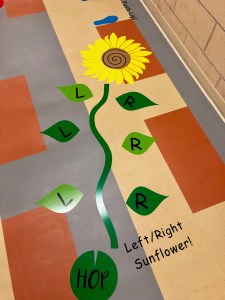
A majority of my time throughout the week was spent at W.G. Mallett Elementary School, in downtown Farmington, which educates pre-k through 2nd grade. About half-way through my time there, my clinical instructor, Christine Libby and I were approached by literacy teacher Vicki Foster, Principal Tracy Williams, and all the Kindergarten teachers about an idea for a sensory path in the hallway. Sensory paths have become very prevalent recently, however they can be extremely pricey – in some cases estimated at $2,500. A price like that can be extremely difficult for schools to afford, especially rural Maine schools. However, I knew that we could do it at a much lower cost using resources of my own and contributions from Principal Tracy Williams. Teachers from the school came up with theme they wanted; a Maine theme. We began the work from there, incorporating how the activities can target specific OT-related tasks, and still seem fun for the students.

Collectively the project took about 30 hours total designing the project on my design program, preparing the materials, and then Christine, my instructor and I installing the path in a 38 foot long hallway, down and back for a total of 76 feet of path. I was able to integrate not only my OT knowledge that I have spent the past 5 years gaining, but also my hobby of crafting and creating things which made this project so rewarding for me. I am so grateful for the support that my supervisor provided throughout this project, giving insight on how certain activities not only target gross motor or sensory input, but also reflexes, because not all students have their primitive reflexes fully integrated which can cause a decrease in school performance and so many other aspects of their education process.

The following explains what the activities in the path target and how overall it can assist a student who is experiencing a period of disregulation within 3-5 minutes:

The design of this path was created to include crossing midline and preparing the visual system via the lazy eight and lobster backwards high fives. It incorporated learning the alphabet, shapes, numbers, and left to right body awareness skills. The vestibular system was engaged through hopping/spinning and the balance beam designed to encourage heel to toe walking. Coordination and motor planning were utilized as well, via the side stepping apples and hopscotch which also has been known to help dyslexia. Wall push ups throughout the path as well as the animal crawling were used for arm and shoulder strengthening, reflex integration skills, as well as deep proprioceptive input for the joints and muscles. The path ends with Yoga poses and belly breathing which are movements to help children re-organize and come back to class with a calm body.

I was able to observe and teach students how to use it during my last week in the school district, and it was amazing how well students responded and engaged to the pathway. My clinical instructor reported it is working really well at W.G. Mallett Elementary School and the students continue to use it every day between their classes or during their OT time throughout the week!

Below are more pictures of the sensory path:


Meet Emily Fitzsimmons, Culinary Arts Instructor at Coastal Washington County Institute of Technology.

Washington County Educator profile submitted by Sarah Woog from the The Washington County Consortium.

Emily is on the left, with a group of her students at a Culinary Arts competition in Portland over February break.

Emily and I had the opportunity over February break to sit down at Helen’s Restaurant in Machias to talk about her work, life, and all things in between. Thank you, Emily, for sharing a meal with me, and for all you do for Washington County students and communities.

Everyone should know Emily Fitzsimmons. Most of you probably already do. I realized this when we met for lunch at Helen’s and she personally greeted almost everyone we came across. And the restaurant was full.

Emily is currently the Culinary Instructor at the Coastal Washington County Institute of Technology, based out of Machias Memorial High School. She grew up in Jonesboro, graduated from Washington Academy, and has cooked in restaurants from Cutler to Jonesboro, beginning when she was 14 years old. She’s catered events all over the County, too, from weddings and baby showers, to professional development sessions throughout the year, and for Harvest of Ideas. Emily was also the food service director at Washington Academy, where she discovered her love for teaching her love, Culinary Arts.

Emily has a degree in Culinary Arts from Eastern Maine Community College and has commuted to Orono the past four years to become a certified culinary instructor. She recently completed her Praxis and her final class, joining the cadre of Washington County educators who have balanced work, family (Emily is married with five kids), long commutes, and longer hours of studying, to gain the knowledge and skills critical to providing opportunities for kids.

Emily talks about her program and students with infectious pride and enthusiasm: “To have a kid want to do what you’re passionate about is so refreshing … and for them to make a batch of cookies, eat, be proud their accomplishment, it’s awesome.” Emily also appreciates how Culinary Arts gives students opportunities to succeed. “It gives them a way to express themselves, to compete on a non-athletic level,” Emily noted.

Emily recently brought a group of students to a culinary competition in Portland, which I had the opportunity to check out. I admired the students’ organizational and time management skills, their precision, and their diligence. It occurred to me these are the habits of mind I had hoped to instill in my math students when I was in the classroom. I think it’s important to acknowledge and celebrate how Emily’s teaching, and vocational programming in general, can support students’ development and teach lessons that can feel so elusive in more traditional settings.

Emily and her work are wonderful examples of the impact vocational programming can have on students and their communities. Her love for her craft is infectious, and you can see her students have caught the bug. She’s also a lot of fun to be around. Just ask anyone at Helen’s.


Employee of the Week: Courtney Baehr

Maine DOE Certification Specialist Courtney Baehr is this week’s Employee of the Week! Learn a little bit more about Courtney in this brief question and answer:

What are your roles with DOE?

I work in the Certification office and ensure that all educators are properly credentialed. My main focus is to review the background checks of all applicants to ensure it falls within state and federal policies. I have performed all jobs in the certification office and continue to assist the office regarding rule changes, implementing policies and procedures, and assisting to create the new credentialing system that will help the field in processing their credentials.

What do you like best about your job?

Knowing that I am protecting students and helping the educators obtain their credentials. The certification process can be confusing at times, and I love to help the educators walk through the process and explain the rules and laws that are involved with obtaining their credentials. I feel like I’ve done my job for the day if I am able to help an educator understand the process and leave them with a better understanding of how the laws work for each endorsement we offer. I always like to hear the “Ah ha!” moment when an educator finally understands the process. It makes it a good day.

How or why did you decide on this career?

I kind of fell into the Department initially when I transferred from Maine Revenue Services in 2008. I started working in Certification as an office associate and worked my way up to my current position. I have a customer service and military background with a Bachelor’s degree in Criminology from USM. Having spent 8 years in the US Coast Guard doing search and rescue and previous to that working in hotels for almost 10 years, my unique background not only helps me in my research performing background checks but also allows me to give the utmost customer service to the field. I’ve stayed in the office for so long because I truly believe in the effectiveness of the office and love that every day there is something new to learn.  As we’ve said for years, “there is never a dull moment in Certification”.

Maine Connections Academy Students Create Student Magazine

Magazine Cover for Maine Connections AcademySubmitted by John Spritz on behalf of Maine Connections Academy (MCA). 

Students who work with Mr. Chris Hoskins (a secondary English teacher) have published the school’s first student-written/student-designed magazine. It’s online of course, it’s called The Connector, and you can see it here.

The Connector has lots of links built into it, where students can access games, puzzles, study tips, movie reviews, and much more. It’s got articles on Maine ski destinations, study prep hints, favorite pets, and a lot more. For a school where students are in all 16 counties, where they see each other only on field trips and at graduation, The Connector is a brilliant way to bring people together and allow them to contribute and engage — online. And the fact that it’s student-built is what makes it all the better.