In an effort to reduce the confusion regarding the National Assessment of Educational Progress (NAEP) achievement levels and the misuse of NAEP data, the National Assessment Governing Board (NAGB) slightly modified the names of the performance levels. In the November 18, 2018 posting on the “Curriculum Matters” blog on Education Week’s, there is an update on the small changes made to the achievement levels for the NAEP.
From this point forward, the NAEP achievement levels will contain the NAEP acronym such as “NAEP basic” and “NAEP proficient”. With the current emphasis on the reporting of student performance in the form of achievement levels, NAGB made this change to reduce the direct comparison of the NAEP levels of proficiency with those used by the individual states.
After each state-level NAEP assessment report is completed, a mapping study is conducted that provides a guide for the examination of state proficiency standards in relation to the NAEP scales. The publication of the “Mapping State Proficiency Standards Onto NAEP Scales” reports are released much later than the Nations Report Card report and the State Snapshot reports since the data and analyses from these reports is required to conduct the mapping study.
For further information about NAEP, contact Regina Lewis, Maine DOE Coordinator of NAEP & International Assessments at Regina.Lewis@maine.gov.
As per the newsroom notice dated September 26, 2018, the implementation of the new IEP form that incorporates Behavioral Health Day Treatment was delayed until January 1, 2019 to allow time to provide answers to questions received from the field.
The Department has compiled the following Frequently Asked Questions, in response to inquiries from the field for clarification regarding the new requirements for Individualized Education Programs (IEP) outlined in Administrative Letter # 17. The new requirements for IEPs outlined in Administrative Letter # 17 are based on a collaboration between the DOE Special Services Team and the Office of MaineCare Services Policy Division to ensure regulatory compliance for both agencies. For further information and guidance, refer to the Maine State Required Forms Procedural Manual.
BHDT- Behavioral Health Day Treatment
BHP- Behavioral Health Professional
DHHS- Department of Health & Human Services
DOE- Department of Education
ITP – Individual Treatment Plan
IEP- Individualized Education Plan
LRE – Least Restrictive Environment
MUSER- Maine Unified Special Education Regulations
OT – Occupational Therapy
PT- Physical Therapy
SAU- School Administrative Unit
SDI- Specially Designed Instruction
What is MDOE’s definition of Day Treatment and Behavioral Health? ‘Day treatment’ and ‘behavioral health’ are not terms that are defined by Maine DOE or DHHS. ‘Behavioral Health Day Treatment’ services are medically necessary services implemented in an integrated manner to allow the child to access his/her special education program. Refer to page 30 of the MaineCare Benefits Manual for Chapter II Section 65: 65.06-13 Children’s Behavioral Health Day Treatment
A covered service is a specific service determined to be medically necessary by qualified staff licensed to make such a determination and subsequently specified in the Individual Treatment Plan (ITP) and for which payment to a provider is permitted under the rules of this section. This qualified staff must assume clinical responsibility for medical necessity and the ITP development. The behavioral health day services described below are covered when (1) provided in an appropriate setting as specified in the ITP, (2) supervised by an appropriate professional as specified in the ITP, (3) performed by a qualified provider, and (4) billed by that provider. Behavioral health day treatment Services must be delivered in conjunction with an educational program in a School as defined in 65.03-4.
Behavioral health day treatment services are structured therapeutic services designed to improve a member’s functioning in daily living and community living. Programs may include a mixture of individual, group, and activities therapy, and also include therapeutic treatment oriented toward developing a child’s emotional and physical capability in area of interpersonal functioning. This may include behavioral strategies and interventions. Services will be provided as prescribed in the ITP. Involvement of the member’s family will occur in treatment planning and provision. Behavioral health day treatment services may be provided in conjunction with a residential treatment program. Services are provided based on time designated in the ITP but may not exceed six (6) hours per day, Monday through Friday, up to five days per week. Medically necessary services must be identified in the ITP.
Does Behavioral Health include Sections 28 and 65? •Behavioral health services are addressed in Sections 28 and 65 and are reflected in the term “Behavioral Health Day Treatment” in related services on section 8 of the IEP. •Do not list section 65 or 28 on the Behavioral health day treatment line. •Only use the term “Behavioral Health Day Treatment” in section 8 related services to document a child that requires services in a day treatment setting. •Refer to the MaineCare Benefits Manual for more information regarding Sections 28 and 65: https://www.maine.gov/sos/cec/rules/10/ch101.htm
Under what conditions would behavioral health day treatment services be documented on the related services grid? •A child requiring behavioral health professional services (determined by the IEP team), regardless of the pay source, should be documented in the behavioral health day treatment section of the related services grid on section 8 of the IEP. •Note that behavioral health professional services are an accommodation, which still need to be documented in section 7 of the IEP (Ed Tech/BHP). Note – There have been no changes to Section 7 “Supplementary Aids, Services, Modifications, and/or Supports”.
If a student becomes no longer eligible for MaineCare funding, does the cost for nursing services or behavioral health day treatment become the fiscal responsibility of the school? •A child requiring behavioral health day treatment or nursing services (determined by the IEP team), regardless of the pay source, should be documented in the related services grid on section 8 of the IEP. •If a child loses a third-party funding source or if the parent refuses/withdraws consent for MaineCare billing for a service necessary for the child to access his/her special education program, yes, the SAU is fiscally responsible for the services.
Should we continue to list social work services, psychological services, nursing services, etc. separately in section 8? •Yes, each required individual related service should continue to be documented separately in section 8. •For further information and guidance, refer to the Maine State Required Forms Procedural Manual.
Can we write a range for BHDT services in section 8, since the actual time for clinical support typically varies day to day for students? •Do not list a range (such as 1-3 hours) of BHDT in section 8. You can indicate that the services will be provided “up to” a maximum amount of time. This does not apply to other services and related services in section 8.
Who is responsible for Specially Designed Instruction (SDI)? The Special Educator is always responsible for SDI, which is documented as a special education service. It is not factored as a related service, in the new behavioral health day treatment section on section 8 of the IEP.
Who is responsible for nursing? If the IEP team determines that nursing services are required in order for the student to receive a FAPE, then the SAU is responsible for providing the services. School nurse services are provided by a qualified school nurse.
Must the nurse providing school nursing services be certified as a school nurse? Yes, the services must be provided by a credentialed school nurse.
If the school nurse, and appropriately trained special education staff and related services staff (OT, PT, Speech) can provide the school health services (G-Tube feeding, positioning, transferring, monitoring for skin integrity, personal care assistance, etc.) should the school list this as nursing services or school health services? •If someone other than a credentialed school nurse provides the service, it should be documented as school health services. •If a credentialed school nurse provides the service, it should be documented as nursing.
If a student only requires intermittent nursing services (as needed monitoring for blood sugar levels, pulse and respiration, personal care assistance, etc.) but the family prefers a full-time nurse be available at all times, is the school required to list the family’s preference and secure a full-time nurse? No, the IEP Team determines the services necessary for the child to access his/her special education program. If there is a lack of consensus, the SAU makes the decision and the parent can challenge that decision through due process procedures.
If the school believes that the school health services could be provided by the school nurse and school staff but the parent has a doctor’s prescription for a full time private nurse, is the school required to secure the full-time nurse? No, the IEP Team determines the services necessary for the child to access his/her special education program. The school must provide a qualified professional to implement the IEP.
If a school has not elected to access MaineCare funding and the parent has contracted with a private nursing agency to provide private nursing within the school, is the school required to list nursing services on the IEP? The issue is not access to MaineCare – it is what is required for the student to receive a FAPE. The IEP must list the services determined by the IEP team as necessary for a FAPE. •Note – There have been no changes to Section 7 “Supplementary Aids, Services, Modifications, and/or Supports”.
What positions can be listed as providers of behavioral health day treatment? •Although behavioral health professionals provide a major portion of day treatment services, the position responsible on the IEP should be documented as “appropriately credentialed personnel”. •Note that behavioral health professional services are an accommodation, which still need to be documented in section 7 of the IEP (Ed Tech/BHP). Related services providers, such as social workers should continue to be listed in the related services block in section 8.
Why list behavioral health day treatment instead of the specific clinical person providing the ITP, counseling and supervision of the BHP? •Behavioral health day treatment integrates a variety of services that create a milieu to provide the services necessary for the child to access his/her special education program. •Continue to list social work services, psychological services, nursing services, and other related services separately in section 8. •In addition, please refer to question 14.
Will the services reflected as behavioral health day treatment impact the calculation of least restrictive environment (LRE)? •No, behavioral health day treatment services are not calculated in the least restrictive environment percentage. •Behavioral health day treatment, as a related service, occurs concurrent to special education services. •Behavioral health day treatment does not reduce specially designed instruction.
Should the BHP accommodation in section 7 match the BHDT related service in section 8? •The BHP accommodation in section 7 and the BHDT related service in section 8 will generally match. •The frequency of BHDT documented in section 8 should reflect the amount of time the child requires BHP support to allow the child access to his/her special education programming. •The frequency of BHDT cannot exceed the school day, or 6 hours. •Some examples of exceptions to the BHP accommodation in section 7 and the BHDT related service in section 8 matching include: when a child requires 2:1 or 3:1 support, after school support, and when working on a transition to a less restrictive environment.
When a health plan is created for a child using evaluation data and reports required to determine eligibility for MaineCare, do the evaluation reports have to be included in the child’s educational record? •If the IEP team orders the evaluation or the parent submits an outside evaluation report and requests the evaluation data to be included in the development of the IEP, yes – include the evaluation report in the child’s educational record. •If the evaluation is not ordered by the IEP Team and the data are not used in the development of the child’s IEP, then the evaluation report does not need to be included in the child’s educational record. (This question applies to special purpose private schools.)
If a child comes into a district with an IEP that says day treatment and the district doesn’t have a day treatment program, what happens? Districts should follow the procedures outlined in MUSER IX (3)(B)(5) for students who transfer and if needed, the IEP team would meet and determine the student’s needs. Then the team would decide on the placement, whether that be an in-district or an out-of-district placement.
Will SAUs need to reconvene to amend all IEPs to reflect the “Behavioral Health Day Treatment” change or can they address this change beginning January 1, 2019; as IEP teams convene. SAU’s should reflect the “behavioral health day treatment” language change beginning January 1, 2019 as IEP team meetings are held; and are not expected to reconvene IEP meetings for all students and make amendments immediately.
Will DHHS pay for services that exceed BHDT listed on the child’s IEP? •DOE does not interpret third-party funding policies and procedures. •Contact Trista Collins regarding MaineCare funding questions. Her contact information is Trista E Collins, State Medicaid Educational Liaison, e-mail: trista.collins@maine.gov, phone 207-624-4094.
For further information please contact the Office of Special Services at 624-6713.
As a reminder, LD 1924 An Act To Improve Information Sharing Relating to Investigations of Educators (Sec. 1. 20-A MRSA §13025) will go into effect on December 3rd 13, 2018.
Academic Achievement – English Language Arts (ELA)
Within Maine’s Model of School Support as part of the Every Student Succeeds Act (ESSA), Maine uses data from Maine’s Education Assessments to define the academic achievement indicator as the number of students scoring at a performance level of 3 (meeting state expectations) or 4 (exceeding state expectations). ESSA requires that each state’s accountability system, in Maine we call it Maine’s Model of School Support, includes academic achievement as measured by performance on the annual state assessments.
Why academic achievement?
Academic Achievement – Mathematics
Maine’s strategic plan aims for students to graduate from high school workplace ready; academic achievement is a cornerstone of the Maine’s Model of School Support. Maine administers the Maine Educational Assessments (MEAs) annually to measure student performance in English Language Arts (ELA) and math.
What does this look like in Maine?
Using the cut-scores that have been established for each of the performance levels of the state assessment, students earn a performance level ranging from 1 to 4.
1 – Well Below State Expectation
2 – Below State Expectations
3 – Meets State Expectations
4 – Exceeds State Expectations
The state has established the ambitious goals for each school to improve academic achievement in ELA and math by 20% for each individual eligible student group using the 2016 assessment as the baseline year. This equates to a 1.4% increase in academic achievement for each student group, in each subject area, on an annual basis.
The school level descriptors for academic achievement are as follows:
Academic Achievement – English Language Arts (ELA)
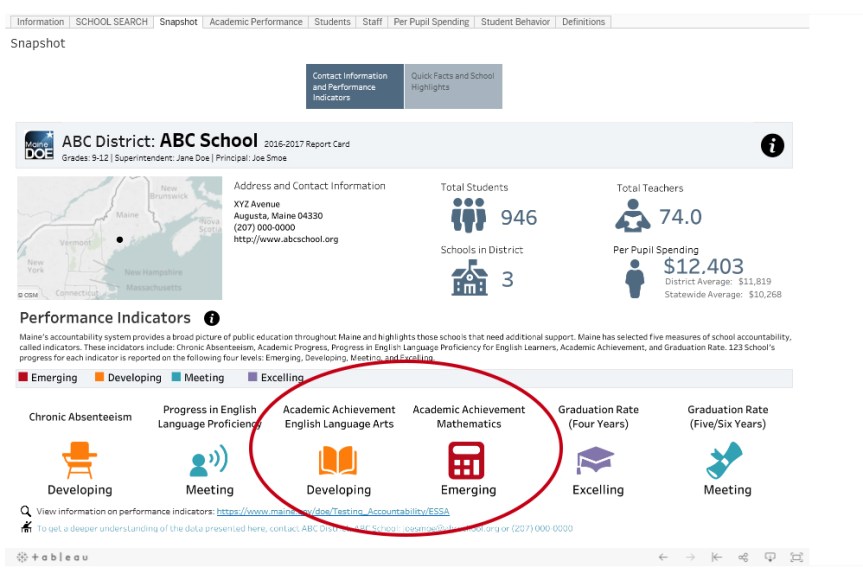
Emerging
Developing
Meeting
Excelling
No eligible student group made their annual target
At least one eligible student group made their annual target
All eligible student groups made their annual target
All eligible student groups exceeded their annual target by at least 10%
Academic Achievement – Mathematics
Emerging
Developing
Meeting
Excelling
No eligible student group made their annual target
At least one eligible student group made their annual target
All eligible student groups made their annual target
All eligible student groups exceeded their annual target by at least 10%
Where eligible student groups (with an “n” size of 10) include: Asian, Black, Hispanic/Latino, Two or More Races, White, Students with Disabilities, Economically Disadvantaged; migrant students, and English Learners.
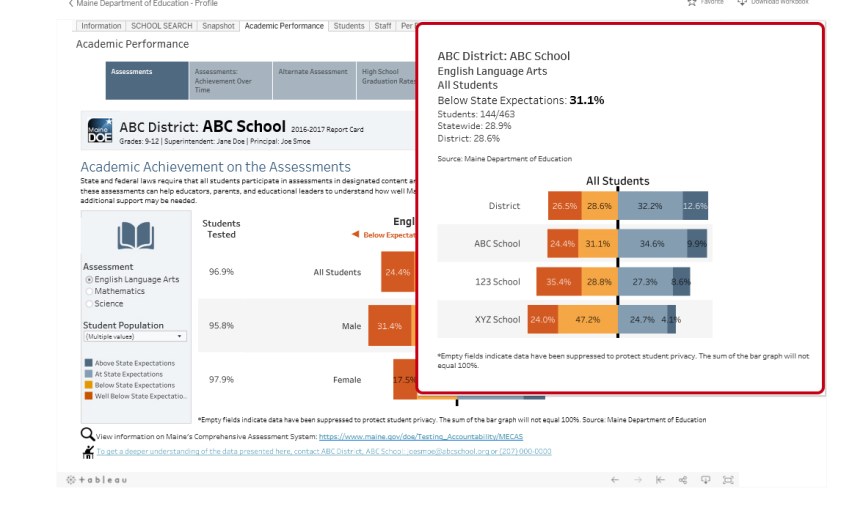
Academic achievement will be presented on the school report card in the following way:
The following are examples of elements the user may select to view:
Performance of specific student populations
National Assessment of Educational Progress
English Leaner performance
Student performance on the Alternate Assessment
Further questions can be directed to Janette Kirk, Acting Director, Office of Learning Systems at Janette.Kirk@maine.gov.
The Maine Department if Education is celebrating the Maine Educators Information System’s (MEIS) one year anniversary. MEIS has officially been in production for one year as of November 14, 2018. Over the course of the past year the following has occurred:
All applications have been processed internally by the Maine DOE in the new system.
The increase in data entry has allowed for data analysis never available prior to having MEIS in place.
All superintendents have online access to educator credentials and violations.
All certification chairpersons can recommend educators for renewal completely online.
All educators can now renew their credentials online.
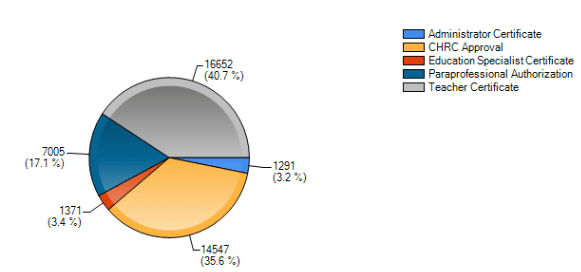
40,866 applications have been processed in the last 365 days! The chart below breaks down the application types:
Next steps for MEIS:
Add an upload button so that educators can upload their supplemental documents outside of the application process and,
Roll out the ability for educators to complete initial applications online.
Stay tuned for these features in the near future.
Important Updates and Reminders for Educators:
All educators who have not yet created an account in the new online certification system are encouraged to do so. By creating an account, educators are ensuring the certification team has the most recent contact information available. Step by step instructions on how to create an account are available on the certification site.
Please ensure applications are complete upon submission with all test scores, transcripts, and other supporting documentation. Submitting incomplete applications or parts of applications at different times will result in significant delays in processing, beyond the typical processing time.
The Department would like anyone who has gotten a fingerprint to call the certification office at 624-6603 two days (or more) after completing your fingerprinting at IdentoGO. Placing this quick call will allow the Department to efficiently process your application.
Conditional certificates will now be issued without securing employment. It is important to note that the conditional certificate is only active for three years and cannot be renewed. For this reason, educators who call to request the conditional must understand that it is a commitment to fulfill deficiencies within a three-year time limit.
In celebration of Educational Support Professionals Day, the Maine Department of Education would like to thank and congratulate the tens of thousands of educational support professionals working in Maine’s public schools.
Educational Support Professionals Day is held the Wednesday during American Education Week each year in November. The day celebrates and honors the significant contributions that school support staff make in public schools every day.
Education support professionals include education technicians, bus drivers, security guards, school nurses, facilities staff, office assistants and more. They drive students to school, clean classrooms and hallways, bandage scraped knees, and prepare and cook meals, among many other things. They are often the first to arrive at school and the last to leave.
We hope that schools state-wide will share in thanking and congratulating education support professionals for everything that they do to support students, schools, and communities throughout Maine.
As a reminder, the Maine Department of Education has scheduled a public hearing on November 15, 2018 as part of the scheduled periodic review of the Maine Learning Results. The Department is seeking public comments regarding the proposed revisions to Rule Chapter 132, revised science and technology and social studies standards.
The public hearing will take place in room 103A of the Burton Cross Building in Augusta. Anyone present may speak at the public hearing, which will be live-streamed. People that wish to speak will be asked to sign in and, preferably, provide two written copies of comments, as well as an electronic copy.
Anyone unable to attend the public hearing may send written comments by 5 pm on December 3, 2018. Written comments may be emailed to sis.doe@maine.gov with the subject “Science Standards Review,” or “Social Studies Standards Review,” or mailed to Maine Department of Education, attn: Beth Lambert, 23 State House Station, Augusta, ME 04333.
Below is a list of relevant links, as well as the hearing information including a link for the live stream:
The Maine Department of Education in collaboration with school districts and schools have verified their 2018 Maine Educational Assessments (MEA) results data within the Maine Assessment and Accountability Reporting System (MAARS). All data in the confidential (login credentials needed), and public sites is now available. Individual Student Reports (ISRs) are also available to districts to download.
This year to support Maine educators, the Department is excited to be able to release items from the math, English language arts (ELA) and science assessments at each grade level in which students in grades 3 – 8 take state assessments. School and district users will also be able to incorporate the released item data in their analysis of student performance. Data regarding district, school and individual student responses to released items are available the confidential MAARS site within Interactive Reports. The actual pdf versions of the released items are available on the maine.onlinehelp.measuredprogress.org/released-items site.
Elements for release include:
The student versions consist of one item booklet per grade, 3-8, that contains each assessed content area (Math, Reading, Writing/Language, Essay).
The associated teacher versions consist of one document per grade, 3-8, that contains each assessed content area and which include:
Items as seen on student version
Standard alignment notation
Answer key
Scoring rubrics where applicable
Scorer training notes and annotations
Exemplary responses where applicable
Sample student responses
Table of released item information
As a reminder to those who registered, the Department will be using these materials during the scheduled workshops to assist educators in navigating MAARS, examining their data, and linking it to instructional practice.
Further questions can be directed to Janette Kirk, Acting Director, Office of Learning Systems at janette.kirk@maine.gov.
The Maine Department of Education has released the 2017-2018 Maine Education Assessment (MEA) results in the content areas of mathematics, English language arts/literacy, and science.
The Department would like to thank schools, districts, and community members for their continued patience while an additional validation was completed after the initial delay in releasing the 2017/2018 results.
“This year the Department has three years of data from the same assessments which will allow for measurement across multiple years,” said Maine Department of Education Commissioner Robert G. Hasson, Jr. “The new trend lines will assist the Department in determining where support is needed to help increase student achievement across the state.”
Superintendent John McDonald of Rockland Public Schools in Regional School Unit (RSU) 13 has been honored with the Maine Department of Education 2018 Commissioner’s Award from Commissioner Robert G. Hasson, Jr.
As part of a celebration and recognition of Maine’s educational leaders during the annual Commissioner’s Conference held in the spring, the Commissioner awards an outstanding Maine superintendent who has gone above and beyond in his or her duties as a leader in their community.
“John is an extraordinary leader. He is very focused on students and the needs of the whole child,” said Commissioner Hasson. “His success in helping to develop school boards by holding workshops that allow them to set achievable goals for students is a testament to his vision for the success of all students.”
John McDonald has held various roles during his multi-year career and service to public education, including teacher, technology and assessment director, school board member, assistant principal, principal, assistant superintendent and now in his current role as Superintendent of RSU 13. He holds Master’s degrees in both educational leadership and elementary education, and Bachelor’s degrees in both anthropology and writing.
“John is a quiet person. He does not promote his own success as an educational leader, but he is truly deserving of this recognition for his many years of service to Maine students,” added Commissioner Hasson.
The 2017 recipient of the Commissioner’s Award was Michael Felton, Superintendent of Schools in neighboring St. George Municipal School Unit.





 Maine DOE Newsroom