PRIORITY NOTICE: Seeking Proposals for Afterschool and Summer Learning Programs

The Maine Department of Education is pleased to announce the release of a request for proposals (RFP) seeking bids from interested parties to implement comprehensive 21st Century Community Learning Centers (21st CCLC) programming in 2022-2023.  It is anticipated that roughly $2M will be available to issue grant awards later this year.

Authorized under Title IV, Part B of the Elementary and Secondary Education Act, as amended by the Every Student Succeeds Act (ESSA) Act of 2015, the 21st CCLC program provides competitive grant funding to support before school, after school, and summer learning programs that focus on improving the academic performance of students in Pre-Kindergarten through grade 12.

The primary purpose of Maine’s 21st CCLC program is to provide funding for school and community partnerships to establish or expand community learning center programs.  These programs provide students in high-need, economically-disadvantaged communities with academic tutoring and enrichment opportunities designed to complement their school-day academic program.  In addition, these programs can provide a broad array of additional support services related to overall student health and well-being.

Local 21st CCLC programs – which can be located in elementary schools, secondary schools or similarly accessible community facilities – provide high quality support services to students during non-school hours.  As such, these programs also support working parents and families by providing safe, supportive learning environments for students at times when school is not in session.

The request for proposal (RFP), which includes information regarding eligibility, program requirements, and more, is available here. An informational webinar for this RFP will be posted to the Department’s application website on January 25, 2022.  It is strongly recommended that interested parties view this presentation, in its entirety, prior to submitting a proposal for 21st CCLC program funding.

Below is the anticipated timeline for the Department’s current 21st CCLC grant competition:

Date Task
January 5, 2022 RFP Released to Public
January 25, 2022 Informational Webinar Posted Online
February 15, 2022 Deadline for Submission of Questions in Response to RFP
March 1, 2022 Interested Parties Submit Letter of Intent to Apply
April 14, 2022 Proposal Deadline
April 2022 Formal Peer Review of Proposals
May 2022 Grant Award Notifications
July 1, 2022 Grant Award Start Date

Please be advised that the dates above are subject to change.  Interested parties must consult the RFP document for the most accurate dates and deadlines regarding this opportunity.

For more information on the 21st Century Community Learning Centers (21st CCLC) Program, contact State Coordinator, Travis Doughty, at travis.w.doughty@maine.gov.

Partner with Other Schools to Create a Remote Plan as Part of RREV Responsive Pilot Accelerator

In an ongoing effort to meet the clear and present needs of the educators across our state, Rethinking Responsive Education Ventures (RREV) in partnership with several School Administrative Units (SAUs) across Maine have created the “Responsive Pilot Accelerator.”

The Responsive Pilot Accelerator is a hyper focused pilot design class that will enable participants to develop a pilot based on a prototype designed by RREV educators. The prototype serves the needs of remote students while maintaining a personal connection with in-school opportunities to participate in extra curriculars or unified arts courses. Its unique online-hybrid features support the individualized needs of students while increasing capacity by using a shared approach to staffing and resources.

Participant who successfully complete the eligibility requirements of the Responsive Pilot Accelerator will leave with:

  • A remote pilot blueprint and;
  • $100K in seed money for staffing, supplies, and administrative expenses.

Awards are available as earlier as January of 2022 for eligible teams.  Please contact Martin Mackey, RREV Director to begin your team’s course as early as Mid-October or Click here to book an appointment directly with the RREV team today.

For additional information, check out our Responsive Pilot Fact Sheet (here) or contact Martin Mackey, RREV Director.

PRIORITY NOTICE: U.S. CDC COVID-19 School Testing Toolkit To Help Communicate with Families

The U.S. Centers for Disease Control and Prevention (CDC) has created a COVID-19 School Testing Toolkit that includes materials that school administrators can use to teach parents, students, and staff about school testing programs and encourage participation. Many of these materials are customizable and can be adapted according to the school’s needs.

Toolkit features:

  • Social media content that communicates the importance of COVID-19 school testing and can be shared on Instagram, Twitter, and Facebook.
  • Informational flyers to promote school COVID-19 testing programs and answer questions about COVID-19 school testing.
  • Posters that highlight the benefits of COVID-19 testing programs in schools and portray in-person learning and activities.
  • Customizable letters and FAQs for teachers, parents, and guardians that address frequently asked questions about school COVID-19 testing programs.

Access the U.S. CDC COVID-19 School Testing Toolkit here!

A link to the COVID-19 School Testing Toolkit can also be found in the Testing Section of the Maine Department of Education (DOE) COVID-19 Toolkit.

PRIORITY NOTICE: Fall Office Hours, Training, & Professional Learning Opportunities NOW Available

The Maine Department of Education (DOE) is providing a comprehensive collection of fall professional learning, training, office hours and other opportunities for Maine’s education field as they prepare for and begin the 2021-2022 school year.

Please find below a listing from the Maine DOE Professional Development & Training Calendar with links to a description, more information, and how to register.

In addition, below the calendar listing you will find ongoing and upcoming cohort learning opportunities, as well as links to curriculum resources that can help educators plan classroom and remote learning opportunities throughout the year.

Professional Learning/Training Opportunities:

Note: the below listing is a copy/paste of our Professional Development & Training Calendar. The calendar gets updated every day, check it out anytime for the most up-to-date listing.

September 1, 2021 – Wednesday

10:00 am – 11:30 am School Based Mental Health Supports Content Hour
1:00 pm – 2:00 pm Child Nutrition Update with Walter
2:30 pm – 3:00 pm Distance Learning Basics: Recruitment, Intake, and Orientation
3:00 pm – 4:00 pm Discover Digital Creativity on International Dot Day

September 2, 2021 – Thursday

11:00 am – 12:00 pm Public Pre-K Return to School Open-Office Hour

September 7, 2021 – Tuesday

1:00 pm – 3:00 pm Primary Source Fall Workshop Series: Part 2: “Freedom & Captivity” Primary Source Set
3:00 pm – 5:00 pm Virtual MAP Growth Basics for Maine Educators (NWEA)

September 8, 2021 – Wednesday

10:00 am – 11:30 am School Based Mental Health Supports Content Hour
3:00 pm – 4:00 pm Special Education Office Hours: Referral to Special Education

September 9, 2021 – Thursday

9:00 am – 10:00 am Federal Emergency Relief Programs Office Hours (ESSER & ARP ESSER applications)
10:00 am – 12:00 pm McKinney-Vento Orientation / Refresher
10:00 am – 11:30 am Finance Training – Coding… Just the Basics
10:00 am – 11:00 am English Learner Data Webinar September 9th at 10am
11:00 am – 12:00 pm Public Pre-K Return to School Open-Office Hour
3:00 pm – 5:00 pm Virtual MAP Growth Basics for Maine Educators (NWEA)
3:30 pm – 4:30 pm HE & PE Teachers Welcome Back To School Resources & Conversation

September 13, 2021 – Monday

3:00 pm – 5:00 pm Essential Reports for Administrators for Maine Educators (NWEA)
3:00 pm – 5:00 pm Essential Reports for Administrators (NWEA)

September 14, 2021 – Tuesday

8:30 am – 12:00 pm NSLP Review Training
1:00 pm – 3:00 pm Verification Training
3:00 pm – 5:00 pm Applying Reports 1: Virtual Connecting MAP Growth Scores to Student Learning for Maine Educators

September 15, 2021 – Wednesday

3:00 pm – 4:00 pm Overview of Alternate Assessment Participation
12:00 pm – 1:00 pm Assessment Lunch & Learn Office Hours

September 16, 2021 – Thursday

10:00 am – 12:00 pm McKinney-Vento Orientation / Refresher
3:00 pm – 5:00 pm Applying Reports 1: Virtual Connecting MAP Growth Scores to Student Learning for Maine Educators

September 17, 2021 – Friday

12:00 AM Digital Worksheets – Asynchronous
8:00 am – 4:00 pm ServSafe Manager Class & Exam
10:00 am – 11:00 am Adult Education: English Language Arts/Literacy Office Hours

September 20, 2021 – Monday

8:30 am – 3:30 pm Fall Mentor Training

September 21, 2021 – Tuesday

9:00 am – 1:00 pm CACFP Basic Training

September 22, 2021 – Wednesday

8:00 am – 12:00 pm Suicide Prevention Curriculum Lessons Training Part 1
3:00 pm – 4:00 pm Special Education Office Hours: Alignment
3:30 pm – 5:30 pm The Math Pact – Mathematics Whole School Agreement (Series A)

September 23, 2021 – Thursday

9:00 am – 10:00 am Federal Emergency Relief Programs Office Hours (ESSER & ARP ESSER applications)
10:00 am – 12:00 pm McKinney-Vento Orientation / Refresher
10:00 am – 11:30 am Finance Training Maine Care Seed
3:00 pm – 4:00 pm Seesaw Skill Scaffolding
3:30 pm – 5:30 pm The Math Pact – Mathematics Whole School Agreement (Series B)
3:30 pm – 4:30 pm The Power of Language: Foundational Strategies for a Safe and Inclusive Learning Environment

September 24, 2021 – Friday

10:00 am – 11:00 am Tech Talk: Digital Marketing in Adult Education
11:30 am – 12:00 pm Special Education Office Hours: Lunch and Learn Q & A

September 27, 2021 – Monday

1:30 pm – 2:30 pm CNPWeb Claims

September 28, 2021 – Tuesday

3:00 pm – 4:00 pm Integrating Computer Science in the PK-12 Classroom

September 29, 2021 – Wednesday

10:00 am – 11:00 am Adult Education ESOL Teachers Office Hours
12:00 pm – 3:30 pm Suicide Prevention Curriculum Lessons Training Part 2
3:30 pm – 7:00 pm Early Mathematics Diagnostic Interview (EMDI) Professional Learning

October 1, 2021 – Friday

12:00 AM Supporting Video Production in the Classroom, Part One

October 2, 2021 – Saturday

8:00 am – 4:00 pm ServSafe Manager Class & Exam

October 4, 2021 – Monday

3:00 pm – 5:00 pm Applying Reports 1: Virtual Connecting MAP Growth Scores to Student Learning for Maine Educators

October 5, 2021 – Tuesday

12:00 AM Strategies for Hybrid Learning – Asynchronous
3:00 pm – 5:00 pm Applying Reports 1: Virtual Connecting MAP Growth Scores to Student Learning for Maine Educators
3:00 PM #PODtober – Podcasts as a Resource
3:30 pm – 4:30 pm MTSS Office Hour

October 6, 2021 – Wednesday

10:00 am – 11:30 am Finance Training – EPS Student Data
3:30 pm – 5:30 pm The Math Pact – Mathematics Whole School Agreement (Series A)

October 7, 2021 – Thursday

9:00 am – 10:00 am Federal Emergency Relief Programs Office Hours (ESSER & ARP ESSER applications)
3:00 pm – 5:00 pm Essential Reports for Administrators for Maine Educators (NWEA)
3:30 pm – 5:30 pm The Math Pact – Mathematics Whole School Agreement (Series B)

October 8, 2021 – Friday

8:00 am – 4:00 pm ServSafe Manager Class & Exam
10:00 am – 11:00 am Tech Talk: TopsPro- Using CASAS Reports for Instruction

October 12, 2021 – Tuesday

1:00 pm – 3:00 pm Primary Source Fall Workshop Series: Part 3: “Maine’s Bicentennial” Primary Source Set
3:00 pm – 5:00 pm Essential Reports for Administrators for Maine Educators (NWEA)
3:00 pm – 4:00 pm Supporting Video Production in the Classroom, Part Two
3:30 pm – 4:30 pm MTSS Office Hour

October 13, 2021 – Wednesday

12:00 pm – 1:00 pm Assessment Lunch & Learn Office Hours
3:00 pm – 4:00 pm Special Education Office Hours: Writing Compliant IEPs

October 14, 2021 – Thursday

3:00 pm – 5:00 pm Applying Reports 1: Virtual Connecting MAP Growth Scores to Student Learning for Maine Educators

October 15, 2021 – Friday

3:00 pm – 5:00 pm Essential Reports for Administrators for Maine Educators (NWEA)

October 18, 2021 – Monday

3:00 pm – 5:00 pm Essential Reports for Administrators (NWEA)

October 19, 2021 – Tuesday

9:00 am – 11:30 am Special Education IEP Training
12:30 pm – 3:00 pm Special Education IEP Training
3:00 pm – 5:00 pm Applying Reports 1: Virtual Connecting MAP Growth Scores to Student Learning for Maine Educators
3:00 pm – 4:00 pm #PODtober – Podcasting in the Classroom
3:30 pm – 4:30 pm MTSS Office Hour

October 20, 2021 – Wednesday

3:30 pm – 5:30 pm The Math Pact – Mathematics Whole School Agreement (Series A)

October 21, 2021 – Thursday

9:00 am – 10:00 am Federal Emergency Relief Programs Office Hours (ESSER & ARP ESSER applications)
10:00 am – 11:30 am Finance Training CTE Student and Staff
3:00 pm – 5:00 pm Applying Reports 2: Student Growth and Goal Setting with MAP Growth
3:00 pm – 4:00 pm What Does Cyber Security Mean to ME?
3:30 pm – 5:30 pm The Math Pact – Mathematics Whole School Agreement (Series B)

October 25, 2021 – Monday

3:00 pm – 5:00 pm Applying Reports 2: Student Growth and Goal Setting with MAP Growth

October 26, 2021 – Tuesday

3:00 pm – 5:00 pm Applying Reports 2: Student Growth and Goal Setting with MAP Growth
3:30 pm – 4:30 pm MTSS Office Hour

October 27, 2021 – Wednesday

3:00 pm – 4:00 pm Special Education Office Hours: Writing Compliant IEPs

October 28, 2021 – Thursday

3:00 pm – 5:00 pm Applying Reports 2: Student Growth and Goal Setting with MAP Growth
3:00 pm – 4:00 pm Tech in the Classroom: It Doesn’t Need to be Scary. 🎃

October 29, 2021 – Friday

10:00 am – 11:00 pm Tech Talk: Excel- After the Export, Part II
11:30 am – 12:00 pm Special Education Office Hours: Lunch and Learn Q & A
3:00 pm – 5:00 pm Applying Reports 2:A1:C131 Student Growth and Goal Setting with MAP Growth

Cohorts and Other Opportunities

  • Maine’s Leadership Development Program (Maine LDP) – Executive leadership training to selected educational leaders across Maine at no cost to the fellows or their sending school administrative units (SAUs). | Learn more here
  • The Transformational Leaders’ Network (TLN) – A two-pronged approach to leadership development that provides school principals an opportunity to deepen their leadership skills while they are leading transformational efforts in their schools. 2 hour virtual monthly sessions and 3 in-person full days over 8 months | Learn more here
  • Learning Moments of Mindfulness: Managing Difficult Situation – In this facilitated, online course, learn about different mindfulness techniques to use both inside and outside the adult education classroom to help you manage difficult situations. Offered October 12 – November 22, 2021 | Register & More Info
  • Rethinking Responsive Education Ventures is gearing up for several fall offerings.  RREV offers customizable PD to PK-12 public and private schools state wide at no cost to your teams. We still have over 9 million dollars to award innovative pilot projects over the next two years.  Please contact: Martin Mackey, RREV director to learn more about how RREV can support your team in developing a culture of innovation in your school or creating  Innovative pilots or check out our website for more info: RREV Website here
  • ThinkerAnalytix – join a team of teachers to work closely with ThinkerAnalytix over the 2021-2022 academic year to receive in-depth training in argument mapping and intellectual empathy- the ability to engage in constructive disagreements over controversial issues with precision and care. Educators are encouraged to register in teams of 2 or 3 with their colleagues. LEARN MORE AND REGISTER HERE
  • EVERFI – join a team of teachers to work closely with EVERFI over the 2021-2022 academic year to receive in-depth training on how to successfully implement EVERFI’s digital resources to build your classroom culture and academic readiness. | LEARN MORE AND REGISTER HERE
  • Webinar: Engaging Your Students with Learning Activities using the Founding Documents of the United States – Join the National Archives Foundation and Dr. Charles Flanagan (Outreach Supervisor – Center for Legislative Archives at the National Archives) on Thursday, September 9 (4:00pm ET) to learn about engaging your students with learning activities using the founding documents of the United States. Free lessons and resources will be shared. The webinar is free, but registration is required by using this link.

Coming Soon:

  • Text Study for K-5 teachers – The Writing Revolution by Judith Hochman and Natalie Wexler. The study will run from October – December – dates to be determined.
  • Understanding the Maine DOL Employment Projections for Career and Development staff/educators – Registration expected to start mid-September.
  • Economic Trends for Career and Development staff/educators – Registration expected to start mid-September.
  • Rethinking Literacy: Sputnik Meets Why Johnny Can’t Read (K-3) – Join Maine DOE Elementary Literacy Specialist Dee Saucier, Maine DOE Science and Engineering Specialist Shari Templeton and other K-3 teachers across the state to learn and work together synchronously and asynchronously. We will read recent research, view short videos and webinars, participate in group discussions and work collaboratively – registration coming fall and early winter.
  • The National Archives – More information about this learning cohort is coming soon. Contact Joe Schmidt (schmidt@maine.gov) with any questions or if you are interested in participating in this learning cohort when more details are made available.
  • The OER Project from The Gates Foundation – More information about the learning cohort coming soon. Contact Joe Schmidt (schmidt@maine.gov) with any questions or if you are interested in participating in this learning cohort when more details are made available.

Curriculum & Other Resources:

  • Maine DOE Webinar Library – recordings of webinars, office hours, and other professional learning categorized by subject.
  • SEL4ME – a free to use, comprehensive, CASEL aligned and trauma informed PreK-12th grade Social Emotional Learning (SEL) curriculum for Maine schools
  • MOOSE (Maine Online Opportunities for Sustained Education) – anytime, anywhere learning options and resources for educators, students, and their families
  • Standards and Instructional Support – The Standards and Instructional Support (SIS) Team collaborates with statewide and national partners to provide professional learning opportunities, resources, and guidance for educators to promote integrated learning experiences and educational practices for the whole child that lead all students to become well-rounded citizens.
  • Digital Learning 101 – A 12-Part Series – Creating a successful remote learning environment requires numerous considerations. In this series, we look at some models and best practices for digital learning. We also draw from both the successes and challenges of the emergency digital learning of the 2019-2020 school year.
  • Rethinking Digital Learning – As we emerge from the cloud of digital learning due to necessity, let’s explore what worked and what didn’t. We’ll share best practices for remote learning as well as dig into innovative ways to rethink how digital learning can be done.
  • Memes, Gifs, and Emojis – A Mini-Series – In this mini-series, we explore innovative ways to use memes, gifs, and emojis to enhance connection in remote and hybrid environments and increase general student engagement. We also look at some best practices to get students excited about digital communication.
  • Green Screen Creation in the Early Elementary Classroom – Green screen technology may seem intimidating at first, but the basics are fairly simple and allow for tremendous creativity.  While having a professional green screen is helpful, teachers have been “hacking” this technology for years with green clothing, green tents, puppets on green sticks, green screen boxes and even green playdough.  Teachers can transport themselves anywhere and students’ imaginative play can go to a new level.
  • Building a Digital Toolbox for Asynchronous Learning at the Elementary Level – This video series has been developed as part of the Maine Department of Education’s efforts to provide guidance and support around the use of digital tools in the 2020-2021 school year. Some of these trainings are tied in with the Department’s MOOSE platform training materials while others are being covered that are specifically not part of the MOOSE digital tools.  The goal is to explore those digital tools that can used effectively for asynchronous learning with a focus on the elementary level.

PRIORITY NOTICE: Toolkit of Resources Available to Promote the Meal Benefit Application

As schools across Maine prepare for the 2021/2022 school year with many changes, including the implementation of free school meals and the challenges of COVID-19, we are aware of the increasing difficulty you face with asking families to fill out the Meal Benefit Application.

Families, schools, communities, and our state can greatly benefit from the data that is gathered from the application, which includes key funding for school resources and additional resources for families in need.

The Maine Department of Education (DOE) has created a Meal Benefit Application Toolkit for schools/districts to help inform and promote the application within your school community:

Meal Benefit Application Toolkit for Schools

We hope that having these resources laid out in this toolkit can ease some of the burden to create your own promotional and informational materials. Here are some of the resources you will find in the toolkit:

  • Social Media Graphics – short informational graphics that can be shared on your district/school social media platforms.
  • Translated Informational Materials – a one-page info sheet that can be printed and distributed to families (translated versions available), info for teachers and school staff, and a letter to families expressing the importance of the Meal Benefit Application.
  • Meal Benefit Application Form Options – links to the original printable application, an online option, and an alternative sample form that can be used to help inform state subsidy calculations.

We recognize and appreciate all your hard work as you prepare for the start of the school year. Please contact Maine DOE for questions and/or additional resources:

  • If there is a specific additional resource you’d like to see in this toolkit, please contact Caroline Bennett (caroline.bennett@maine.gov) and Rachel Paling (rachel.paling@maine.gov).
  • For questions regarding application collection and SSO (Seamless Summer Option), please contact David Hartley (david.hartley@maine.gov).
  • To add your district to the web-based application via Nutrilink (we HIGHLY recommend this to increase accessibility of application), please contact Sarah Platt (sarah.d.platt@maine.gov).

2021/22 Assessment Calendar Now Available

Thank you to the Maine educators who provided responses to the Maine Department of Education (DOE) assessment survey and attended weekly assessment office hours between February and June sharing feedback that was used to inform the construction of the 2021-2022 assessment calendar. The Maine DOE is pleased to share the finalized assessment calendar for school year 2021–2022.

Reminders related to administration of NWEA:

  • Language Usage
    Beginning with the fall 2021 administration, the NWEA language usage assessment will be administered in addition to the math and reading NWEA MAP growth assessments. Students in grades 3–8 and 3rd year of high school (HS) are required to participate in the fall and spring administration of math, reading and language usage.
  • 2nd year of high school students
    School Administrative Units (SAUs) have the option to administer the NWEA assessment to students who are in their 2nd year of high school at no cost to the SAU.
  • Winter Administration
    SAUs have the option to administer the NWEA during the winter assessment window as outlined in the MEA calendar (below). In order to ensure sufficient instructional weeks between assessment administrations, the winter NWEA assessment window is scheduled for January 17–February 10, 2022.

The finalized assessment calendar takes into consideration the following:

  • Advanced Placement (AP)
    According the responses on the assessment survey, Maine educators indicated that it would be beneficial for students to be able to focus on preparing and participating in these assessments.  To accommodate this request, assessment windows for HS math, reading and language usage (NWEA) and science will be conducted during May 16–27,
  • Sufficient Instructional Time
    Maine educators also indicated a preference for assessments to be conducted, where possible, later during the spring. The science and NWEA administrations are scheduled for May 2021.
    Eighty percent (80%) of Maine SAUs indicated they will be utilizing the NWEA assessment during the winter administration window. The spring administration dates are influenced by the winter administration dates to ensure sufficient  instructional weeks between fall -> winter and winter -> spring assessment administration.
  • Staggered Implementation
    The Department did explore a staggered administration of NWEA for grades 3-8 and high school however, this would require the assessment window remain open for both administrations. This would significantly reduce the opportunity for Maine SAUs to use text-to-speech (TTS) outside of the state assessment administration windows (see below).

Other factors influencing the construction of the assessment calendar included:

  • School Vacation
    Assessment is not staggered over spring vacation during April and therefore eliminates potential scheduling challenges and equity of administration prior to and after spring vacation.
  • Availability of Text-to-Speech (TTS)
    Educators were clear in their desire to use TTS outside of the state assessment window. TTS remains unavailable during the identified [reading] assessment windows as outlined below.  SAUs may choose to administer the NWEA assessment locally outside of the identified 4-week windows and apply/utilize the TTS functionality.  The administration of the assessment using TTS is in addition to the state required administration of the assessment

 2021-2022 Assessment Calendar:  

A copy of the assessment calendar is also located on the assessment calendar page within the Maine DOE website.

Content Area  Assessment     State Assessment Administration Window   Grades   
Mathematics, Reading, Science, and Financial Literacy PISA  (selected schools only) September 30-October 29 Age 15
Math, Reading and Language Usage* NWEA

(Required: fall window

(August 15-November 30)

 October 4-29 Grades 3-8, 3rd year HS

(2nd year HS optional)

English Language Proficiency ACCESS & Alt. ACCESS January 10-March 4 K-12/ 1-12 (alternate)
Math, Reading and Language Usage NWEA

(Optional: winter window

December 1-February 28)

 January 17-February 10 Optional: Grades 3-8, 3rd year HS /

2nd year HS)

Mathematics and Reading Grades 4 and 8

Civics and U.S. History Grade 8

NAEP  (selected schools only) January 24-March 4 Grades 4 & 8
Alternate Math & ELA Multi-State Alternate Assessment (MSAA) March 14-April 29 Grades 3-8, 3rd year HS
Alternate Science MSAA Science March 14-April 29 Grades 5, 8, 3rd year HS
Science Maine Science May 2-13 Grades 5 & 8
Maine Science May 16-27 3rd year of HS
Math, Reading and Language Usage*  NWEA

(Required: spring window

March 1-June 15)

May 2-27 Grades 3-8, 3rd year HS

(2nd year HS optional)

Further questions can be directed to Janette Kirk, Chief of Learning Systems.  

Priority Notice: Public Comment Period for Rulemaking Required in Response to P.L. 2019, Ch. 154 Now Open

10-144 CMR, Chapter 261: Immunization Requirements for School Children (DHHS) / 05-071 CMR, Chapter 126: Immunization Requirements for School Children (DOE)

BRIEF SUMMARY: The Department of Health and Human Services – Maine Center for Disease Control and Prevention (DHHS) and the Maine Department of Education (DOE) are jointly proposing these routine technical rule changes to implement P. L. 2019, Ch. 154: An Act to Protect Maine Children and Students from Preventable Disease by Repealing Certain Exemptions from the Laws Governing Immunization Requirements (the “Act”)

The proposed rules can be reviewed, here.

The Act prohibits the rule from including any provision governing medical exemptions and repeals the exemption from required immunization for school students who object, based solely on a sincere religious belief or philosophical reason, effective September 1, 2021, with exemptions for certain students.

Those students who may have declined immunizations based on religious or philosophical objection and are otherwise not eligible for exemptions permitted under Maine’s immunization laws, including those attending elementary or secondary schools for pre-kindergarten instruction, will be subject to current immunization requirements for the certain specified diseases. This rule proposes to require schools to include in their annual report any stricter immunization requirements that may be adopted by ordinance or policy, in addition to the immunization status of all students, including immune students, exempt and non-immunized excluded students.

Additionally, these proposed rule changes include new and revised definitions; add a vaccine schedule for pre-kindergarten students; clarify existing authority and responsibility to dismiss or exclude a child from school when there is a public health threat (20-A MRS § 6301; 22 MRS ch. 250); and clarify superintendent and school authority and responsibility. Finally, changes are proposed to the format of the rule for conformity with Maine CDC rulemaking standards.

As required by law, a public hearing for the proposed rule will be held as a Virtual Public Hearing on July 26, 2021 at 9:00 am, and can be accessed, here.
Meeting ID: 864 0432 7981
Passcode: XeNRq!D2

Comments may be submitted to DOE Legislative Affairs Team member Jaci Holmes, State House Station #23, Augusta, Maine 04333; 207-831-3168 or jaci.holmes@maine.gov `until 5:00 pm August 5, 2021.

PRIORITY NOTICE: Seeking Public Comments for a Tydings Amendment Waiver of FY20 ESEA Funds and FY21 Carryover of Excess Title I, Part A Funds

Pursuant to the authority granted under section 8401(b) of the Elementary and Secondary Education Act (ESEA), the Maine Department of Education (DOE) intends to submit an application for waivers to the U.S. Department of Education (USDOE). As required, the Maine DOE is seeking 15 days of public comment from June 23, 2021 – July 7, 2021, on the request to waive the period of availability for Elementary & Secondary Education Act funds and Title I, Part A carryover limitations.

Requirements from which Maine will be seeking a waiver include:

A Tydings amendment waiver from Section 421(b) of the General Provisions Act to the U.S. Department of Education (USDOE). The Tydings amendment waiver seeks an extension to the availability of Federal Fiscal Year 2019/State Fiscal Year 2020 Elementary and Secondary Education funds. Programs affected by this waiver:

  • Title I, Part A of the ESEA (Improving Basic Programs Operated by LEAs), including the portions of the SEA’s Title I, Part A award used to carry out section 1003 school improvement, section 1003A direct student services, if applicable, and Title I, Part D, Subpart 2
  • Title I, Part B of the ESEA (State Assessment Formula Grants)
  • Title I, Part C of the ESEA (Education of Migratory Children)
  • Title I, Part D, Subpart 1 of the ESEA (Prevention and Intervention Programs for Children and Youth Who Are Neglected, Delinquent, or At Risk)
  • Title II, Part A of the ESEA (Supporting Effective Instruction)
  • Title III, Part A of the ESEA (English Language Acquisition, Language Enhancement, and Academic Achievement)
  • Title IV, Part A of the ESEA (Student Support and Academic Enrichment Grants)
  • Title IV, Part B of the ESEA (21st Century Community Learning Centers)
  • Title V, Part B, Subpart 2 of the ESEA (Rural and Low-Income School Program)
  • McKinney-Vento Education for Homeless Children and Youth Program

A carryover limitation waiver from Section 1127(a) of the Elementary & Secondary Education Act of 1965, as amended for Federal Fiscal Year 2020/State Fiscal Year 2021 Title I, Part A funds. The carryover limitation waiver seeks to waive the requirement that limits the Maine DOE’s ability to grant to its local educational agencies (LEAs) a waiver of the 15 percent Title I, Part A carryover limitation of more than once every three years.

The Maine DOE must solicit and respond to public comment on its waiver request as well as provide evidence of the available comment period. As the Maine DOE moves forward to provide as much flexibility as possible and continued support for expending ESEA federal funds, comments can be submitted to: Jessica Caron at Jessica.s.caron@maine.gov

PRIORITY NOTICE: Investment in Maine’s Career and Technical Education Centers Critical to Economic Recovery, Says Governor Mills

Governor’s Maine Jobs & Recovery Plan proposes $20 million for CTEs to train students and strengthen Maine’s workforce

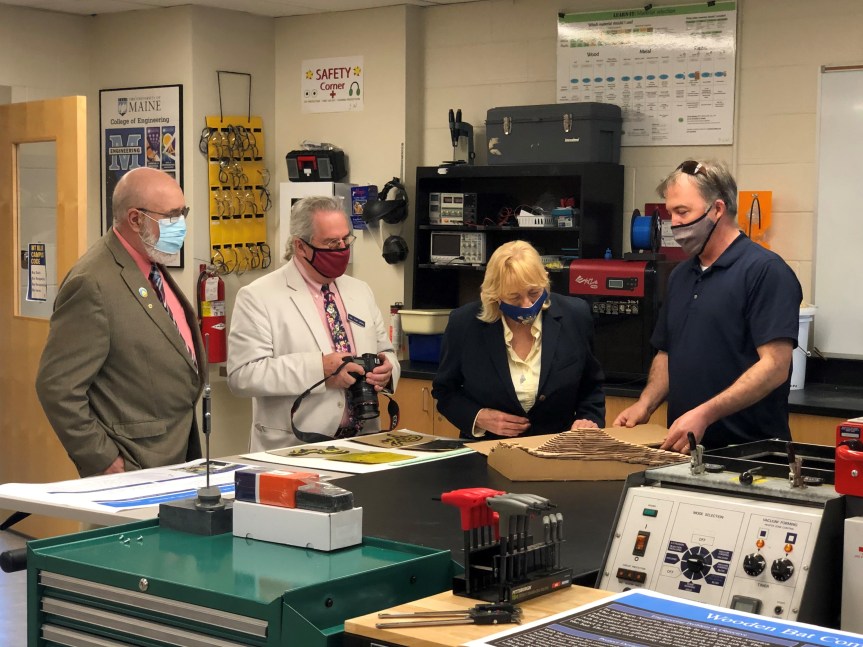
During a tour of Foster Career and Technical Education (CTE) Center in Farmington today, Governor Janet Mills highlighted the importance of Maine CTEs in training skilled workers and spurring economic recovery and long-term growth from the COVID-19 pandemic.

Governor Mills has proposed investing $20 million for program, equipment and facility upgrades for the state’s 27 CTEs as part of the Maine Jobs & Recovery Plan, her proposal to invest more than $1 billion in discretionary Federal relief funds allocated to Maine under the American Rescue Plan Act.

Maine CTEs have not received a significant investment from the State since 1998.

“Jobs in the trades bring with them good skills and good pay, as well as stable, life-long careers, but it’s been decades since we’ve invested in the upgrades our career and technical education centers need to train students to fill those jobs,” said Governor Mills. “Investment in Maine’s CTEs is critical to our economic recovery and long-term growth. With newly available funds, now is the time to make that investment to connect our students with rewarding careers and the businesses that are waiting to hiring them.”

“Governor Mills’ Maine Jobs & Recovery Plan will support the ability of the Foster Career and Technical Education Center, and all 27 CTEs around the state, to help students grow into career-ready adults,” said Melissa Williams, Director of the Foster CTE. “It is critically important that we have the ways and means to support students and create stronger relationships with business and industry partners. Thank you, Governor Mills, for this important investment.”

“Governor Mills’ support for Career and Technical Education Centers will help Maine’s CTEs unleash the potential of Maine’s young people, help fill Maine’s high-growth careers, and create sustained economic growth,” said Dave Keaton, CTE Director of Region Two School of Applied Technology in Houlton and incoming the Executive Director of Maine Administrators of Career and Technical Education (MACTE). “The investment from the Maine Jobs & Recovery Plan is long overdue, and will provide Maine students with exceptional learning opportunities and prepare them for future success as skilled members of Maine’s workforce.”

“Through the Foster CTE Center, I’ve had the opportunity to take business courses, intern at the United Way, and will be graduating with over 40 college credits,” said Mariah Thomas, a senior at Mt. Blue High School. “The support I’ve gotten from my school and programs has given me confidence and clarity in my college and career choices.”

“All my life I wanted to own my own veterinarian clinic, but didn’t know where to start. The courses I’ve taken at Foster CTE Center have given me the direction I needed,” said Allyson Walsh, a senior at Mt. Blue High School. “In the fall I will be attending the University of Maine to major in veterinary medicine and minor in business having already earned 46 college credits, which has given me a head start on my degree.”

“My experience in mechanical and architectural drafting helped spark my interest in engineering through hands-on modeling, design and innovation, which led to a degree in Aerospace and Mechanical Engineering from Rensselaer Polytechnical Institute,” said James Brann, a 2007 graduate of the Foster CTE Center. “Whether students choose to pursue a college degree or enter the workforce directly, time spent at any of Maine’s Career and Technical Education schools is time well spent. Thank you to the educators who inspire our future machinists, engineers, loggers, mechanics, carpenters, electricians and more, and thank you to Governor Mills for recognizing the value of Maine programs like the one here at Foster CTE Center.”

“The relationship between Maine employers and the state’s Career and Technical Education Centers is important for Maine’s economy to ensure our students are learning the skills needed to thrive in skilled trades, health care, biotechnology, and more,” said Heather Johnson, Commissioner of the Maine Department of Economic and Community Development. “The workforce investments of the Maine Jobs & Recovery Plan, which total more than $100 million, will create new economic opportunities for Maine students and employers.”

As Attorney General, Governor Mills used funds she obtained through a settlement with Bath Fitter to create plumbing programs at several CTEs in Maine, including Foster CTE Center. In 2019, as Governor, Governor Mills also proposed a $5 million bond to support equipment upgrades at CTEs. The proposal was rejected by some members of the Legislature at the time despite bipartisan support.

Joining Governor Mills today were Melissa Williams, Director of Foster CTE, Allyson Walsh and Mariah Thomas, Foster CTE Center students, and James Brann, a 2007 graduate of Foster CTE Center.

Maine’s public education system has 27 CTE schools that provide Maine students with training for careers, including in welding, nursing and emergency medicine, computer programming and pre-engineering, electrical, heating and cooling systems, building trades, early childhood education, marine trades, automotive technology, horticulture, hospitality and culinary arts, among others.

Governor Mills has presented the Maine Jobs and Recovery Plan to the Legislature and will travel the state in the coming weeks to discuss it in more detail with the people of Maine.