Exploring the History of Maine Through Robotics

In the fall of 2022, Ann McClellan asked Maxx Pillsbury, a student of the Sphero Bolt coding program at Mt. View Middle School, how he might use the Bolt to tell a story. Both interested in Maine history, Ms. McClellan and Maxx began exploring using the Bolt to tell the story of ten historically significant places in Maine.

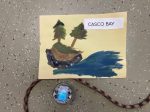
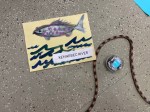
Maxx coded his Bolt to be Samuel de Champlain, an explorer who traveled the coast of Maine. Maxx and Ms. McClellan used a rope to model the nooks and crannies of Maine’s rugged coastline and painted designs on paper to represent characteristics of the area being explored.

Once they planned the layout, Maxx programmed the Bolt. While working, Maxx decided he also wanted the Bolt to narrate the history locations. He wrote a script, chose sounds to enhance the audience’s experience, and found music to play.

You can view a video of the robot moving through the project here:

The final product is impressive and took perseverance and critical thinking to problem solve through challenges that presented themselves throughout the process. For instance, placing the Bolt just right was imperative to its success.

“If the angle was just slightly different when it was set down, then it could mess the whole thing up,” Maxx said.

Ms. McClellan agreed, “Directionals and movement controls were challenging. These had to do with speed, angles, and time. We maintained humor, flexibility, and perseverance, so we got through the programming!”

Maxx is eager to apply what he learned from this project to his other classes. “In my history classes, I will already know some history about early explorers in Maine, and in math class, I can use what I learned about ratios with distance, speed, and time.”

For more information about the Sphero Bolt coding program or other ways to integrate computer science into your curriculum, reach out our computer science specialist, Emma Banks at Emma-Marie.Banks@maine.gov or visit: https://www.maine.gov/doe/learning/ltt/computerscience.


Portland Public Schools Developing Culturally Important School Lunch Menu

The Portland Public Schools Food Service Department, in partnership with local nonprofits and consultants, is working to introduce culturally important menu items to the school lunch options served at the district’s high schools.

This spring, students at Deering, Casco Bay, and Portland high schools are taste-testing food items adapted from traditional Central African cuisine and providing feedback that will help the district decide if the new food items will be incorporated onto the high school lunch menu for next school year. Another goal of the project is to encourage more student engagement and participation in school lunch.

This project is funded by Full Plates, Full Potential, and led by Food Service Director Jane McLucas and local food justice nonprofit Cultivating Community. It is being implemented by several community partners that include FoodCorps, Cumberland County Food Security Council (CCFSC), Good Shepherd Food Bank, and the University of Southern Maine (USM).

“We are Maine’s largest and most diverse school district, and this project is an important – and delicious – way to help us acknowledge and celebrate our diversity,” said Superintendent Xavier Botana. “All our students should have the opportunity to enjoy a wider variety of culturally diverse menu items, which could encourage more students to participate in our nutritious school lunch program. We are very grateful to the wide variety of community partners working with us on this and other projects to ensure food security for all our students.”

This initiative was born from Food Fuels Learning, a network of school and community partners working to build food security in the Portland Public Schools. It is made possible due to the recipe development work done by Khadija Ahmed and Chef Samantha Cowens-Gasbarro with Westbrook Public Schools’ Nutrition Director Mary Emerson.

Ahmed is the owner-operator of Food For All African Mobile Market and the Community Impact Manager for Equity, Diversity and Inclusion (EDI) at Good Shepherd Food Bank. Cowens-Gasbarro is the executive chef for Healthy School Recipes and a school nutrition consultant. These two adapted traditional Central African cuisine into meals that meet federal nutrition guidelines. Replicating the recipes developed in Westbrook, Ahmed and Cowens-Gasbarro are now working with district high school cafeteria staff to test similar recipes in Portland, while also educating staff about the importance of cultural representation in school food.

Food service staff are learning how to cook these new dishes this spring. Every high school student in the district will also have the opportunity to try and provide feedback on potential menu items. This work aims for students to see more familiar dishes offered at school and encourage higher participation in school meals – a proven strategy for increasing food security and reducing stigma around accessing these nutritious foods.

FoodCorps Service Member and Deering High School graduate Mercia Ckaba-Thomas created posters to educate students about the event: “We share a bond through food that creates better connections between cultures, and celebrates the many differences that exist in the Portland community.”

The first taste test took place on March 24. A meal of smashed kidney beans, spiced beef, and cabbage slaw was offered to students, with great success. Taste test coordinators Mercia Ckaba-Thomas (FoodCorps), Zoe Grodsky (CCFSC), Lily Chaleff (Cultivating Community) and Cowens-Gasbarro offered samples and collected feedback from over 250 students with the support of students from USM Professor Jamie Picardy’s “Food, Power, and Social Justice” class and Food Fuels Learning (FFL) high school interns, Anna Behuniak (Portland) and Leaticia Hannah (Deering).

“I would absolutely be more interested in school lunch, especially if this dish was served.” reported one Casco Bay student. Other recipes expected to be tested are chickpeas and chicken over jollof rice and a chicken and spinach stew. A second student taste test is slated for May 19.

In addition to voting and short-form feedback on the day of the taste tests, students are able to sign up to participate in one-hour focus groups. These sessions aim to gather more in-depth insights on cultural representation in school meals and how to better create an inclusive cafeteria environment that is reflective of the diverse student body here in Portland. The three focus groups are coordinated by Kristina Kalolo (CCFSC) along with facilitation training and support for the FFL interns so they can lead their peers in these conversations.

Professor Picardy’s USM students will conduct data analysis of the feedback to help inform the next stages of the project. Youth leadership and youth voice are centered in each step as an important part of the long-term success of this work. Last year, FFL interns conducted a survey on school meals that received feedback from over 800 students. A main takeaway was that there is a strong desire for more culturally representative and culturally important foods in school meals. This project is an extension of the findings that emerged from this student-led research.

Project members Chaleff, Kalolo, and Cowens-Gasbarro recently presented at a Maine Farm to School Network meeting about this work, with the hope that other districts across the state will be inspired and take on similar work to build more equitable and representative school meals. To learn more about how this work unfolds, you can subscribe to the FFL newsletter at foodfuelslearning.org and follow Food Fuels Learning on Facebook.

If the project is successful at the high school level, the district would consider adding culturally important menu items in the middle and elementary school lunch program in the future.

Third Grade Students Send Hygiene Kits to Ukrainian Refugees in Poland

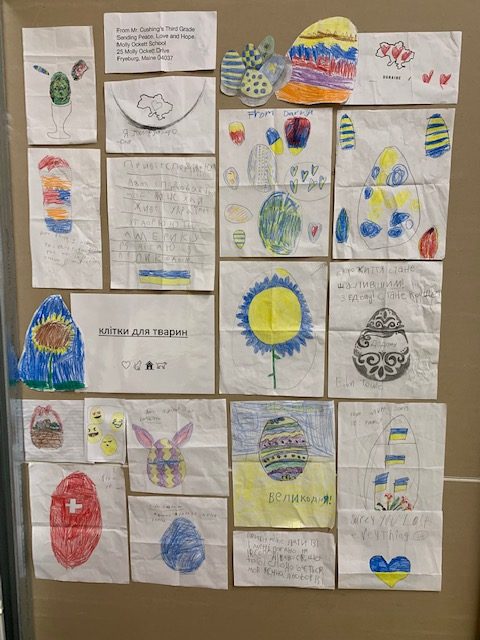
Third grade students from MSAD 72’s Molly Ockett School collected and assembled hygiene kits for Ukrainian refugees in Poland recently as part of a school project. Assisted by their teacher Brian Cushing, the students assembled the kits and sent them with friends who are traveling to volunteer at the World Food Kitchen and can deliver the kits to a nearby Ukrainian Refugee Center in Poland, which is ten miles from Ukrainian border.

“I am so proud of my students and their international outreach,” said Cushing.

Pictured is a collection of student artwork and messages, in Ukrainian that students included with the two suitcases of care kits.

Keeping Up with a Fast Growing Multilingual Learner Population: Merrymeeting’s Story

This article was written by Paul Elisha, Academic Counselor for Merrymeeting Adult Education.

When I first started working as the Academic Counselor at Merrymeeting Adult Education in 2010, our Multilingual Learner (formerly referred to as English Language Learner [ELL] or English Learner [EL]) program consisted of one English Speakers of Other Languages (ESOL) class, one teacher, and about eight students. For the next nine years, our ESOL program fluctuated from 5 to 20 students, one to three teachers, and one to three classes. So in the fall of 2019, when I received a call from Carol Kalajainen of the Midcoast New Mainers Group saying they had about 30 asylum seekers coming to the Brunswick area who were in need of ESOL classes, I panicked inside.

Up until that phone call with Carol, I had never heard of the Midcoast New Mainers Group. I quickly discovered that they are a non-profit, faith-based group of volunteers committed to helping New Mainers get the resources and support they need to reach sustainability and establish a sense of belonging in the local community. They were eager to get the wave of asylum seekers coming to the Brunswick area connected with free English classes as soon as possible. Our first problem, however, was that none of the asylum seekers had reliable transportation to get to our classes in Topsham or Bath. When it became evident that a majority of them were moving into housing on the Brunswick Landing near the Southern Maine Community College (SMCC) Midcoast Campus, we reached out to our partners over there. They graciously provided free classroom space in the University of Maine at Augusta (UMA) Brunswick Center.

We immediately utilized the space at UMA Brunswick to do intakes, advising, CASAS testing, and classes with students. The location was ideal, but within a couple of weeks we found ourselves on the brink of being removed from campus due to one big issue: noise control. The asylum seeking families had no childcare set up, so they were bringing their young toddlers and babies to class. While UMA and SMCC were conducting college classes in the building, little kids were running around playing and yelling to each other in the lobby and moms were consoling screaming babies in the hallways.

Carol and I brainstormed the situation and the Midcoast New Mainers Group stepped in to help these families access childcare at the local Head Start and other daycares in the area. Carol and I remained in constant communication to ensure, to the best of our abilities, that classes were held during times that families had access to childcare.

As an additional resource, we were able to utilize Midcoast Literacy, a non-profit organization in Bath that provides free literacy education. Midcoast Literacy connected all of our new Multilingual Learner students with an English tutor. Arrangements were made for tutors and students to meet on the SMCC Midcoast Campus or at Curtis Memorial Library to ensure that tutoring sessions were within walking distance from where most of the asylum seekers lived.

Just as it seemed we were starting to get our feet under us in being able to serve a Multilingual Learner population three times bigger than what we were used to, COVID-19 hit. With an amazing display of flexibility, patience, and creativity, our ESOL teachers dove into conducting their classes over Zoom. The Midcoast New Mainers Group worked with both Midcoast Literacy and Bowdoin College to provide refurbished computers, laptops or tablets/iPADS to asylum seekers for them to connect with our classes and their Midcoast Literacy tutors online.

Over time, as things gradually opened back up from the pandemic, Kelli Park, one of our ESOL teachers, helped get our Multilingual Learner families outside and connected to the community. She partnered with the Brunswick Topsham Land Trust to hold outdoor potlucks and community gatherings on the Brunswick Landing (conveniently located near where a lot of our Multilingual Learner families live). This has encouraged a lot of our Multilingual Learner students to dive into learning English by immersion as they share conversation, food, music and games with each other.

As more asylum seeking families and refugees from Afghanistan move into the Brunswick area, Merrymeeting Adult Education continues to seek ways that we can grow our ESOL programming. We currently offer 10 different ESOL classes from the Beginner to Advanced levels (three of them are in-person at the UMA Brunswick Center and seven are on Zoom). We hold two in-person Accent classes at our Topsham center for Intermediate and Advanced Multilingual Learner students. Plus, we are running for the first time this April a Multilingual Learner Certified Nursing Assistant (CNA) Preparation Course and Northstar Digital Literacy Course for Intermediate and Advanced Multilingual Learner students interested in becoming a CNA and/or enhancing their computer skills for the workforce.

Now, in addition to having seven ESOL teachers on staff, we have also hired an interpreter, Benedita Kakhuba, who is fluent in English, Portuguese, French, Lingala and Spanish. Benedita and her family are asylum seekers from Angola. Back in the 20-21 school year, she went through our Maine College & Career Access Program to gain acceptance into Southern Maine Community College, where she currently attends part-time. As Benedita takes classes toward a degree in Business Administration, she works for us and for the Immigration Resource Center of Maine as their Housing Assistance Specialist to provide language assistance and cultural brokering services for New Mainers applying for the emergency rental assistance program. Her linguistic skills and passion for helping New Mainers gain opportunities to increase their English language skills has greatly enhanced our ESOL programming.

The Midcoast New Mainers Group continues to support our Multilingual Learner students by coordinating volunteer transportation to and from our Topsham and Bath locations for intakes, academic advising, and CASAS testing appointments. In addition, the Midcoast New Mainers Group has provided funds for our Multilingual Learner students to have their high school diplomas officially translated into English, which is often the first step toward accessing college or specific job opportunities. Plus, they have partnered with a dozen or so businesses in the Brunswick area who are committed to hiring New Mainers as soon as they receive their work permits.

When I received that initial call from Carol Kalajainen back in 2019, I had no idea how we were going to meet the academic needs of a Multilingual Learner population which was three times the size of what we were used to. I did not feel ready. Looking back, I realize that if it wasn’t for the Midcoast New Mainers Group, Midcoast Literacy, UMA Brunswick, SMCC, Curtis Memorial Library, Bowdoin College, Brunswick Topsham Land Trust, the many businesses in our area committed to providing jobs for our Multilingual Learner students, and the flexibility, ingenuity, hard work and passion of the teachers and staff at Merrymeeting Adult Education, we would not be where we are today. I have learned that it is important to tap into every resource our community has to offer when serving our students. I’m incredibly grateful for all of our local partners and community members who have stepped up to help our New Mainers feel welcome and at home here in Brunswick, Maine.

Yarmouth Elementary School Principal Ryan Gleason Named 2023 Maine’s NAESP National Distinguished Principal

The Maine Principals’ Association (MPA) is pleased to announce that Ryan Gleason, Principal at Yarmouth Elementary School in Yarmouth, has been named Maine’s NAESP National Distinguished Principal for 2023.  Mr. Gleason was named Maine’s NAESP National Distinguished Principal at an all-school assembly at Yarmouth Elementary School recently and will be honored by the MPA at their annual Recognition Banquet on April 28, 2022.

According to a release from MPA, Mr. Gleason was chosen because he exudes all the qualities of an exemplary administrator through his efforts to empower students and develop relationships with stakeholders.  His leadership clearly meets the defined mission of Yarmouth Elementary School, “Empowering All Students to Create Fulfilling Lives in a Changing World.”

In announcing Mr. Gleason’s selection as 2023 Maine’s NAESP National Distinguished Principal, MPA Executive Director of the Professional Division, Dr. Holly Blair noted, “Principal Gleason has been chosen for his contributions to the well-being of the entire educational community, creating a positive environment and having the ability to motivate and inspire others.  The interpersonal relationships he has created and his ability to overcome extreme obstacles demonstrates the impeccable leadership that he provides for his students, staff, and community.”

Mr. Gleason graduated from the University of Maine in 1992 and then went on to receive his Assistant Principal Certificate from the University of Southern Maine in 2008.  He then received his Masters in Education in 2014 from St. Joseph’s College in Standish.

He began his educational career as Director of Admissions and teacher at St. Dominic Regional High School.  He then moved into the Assistant Principal role at Durham Community School in 2007 where he stayed until 2014 when he became the Assistant Principal at Falmouth Elementary School.  In 2017, Mr. Gleason became the proud principal of Yarmouth Elementary School where he has been ever since.

Mr. Gleason is a member of the National Association of Elementary School Principals (NAESP) and the Maine Principals’ Association (MPA).

The Maine Principals’ Association is a professional association representing Maine’s K-12 principals, assistant principals, and career and technology center directors.  The Association dates to 1921 and focuses its work on promoting the principalship, supporting principals as educational leaders, and promoting and administering interscholastic activities in grades 9-12.

Messalonskee High School Principal Paula Callan Named 2023 Maine’s NASSP Principal of the Year

The Maine Principals’ Association (MPA) announced recently that Paula Callan, Principal at Messalonskee High School in Oakland, was named Maine’s NASSP (National Association of Secondary School Principals) Principal of the Year for 2023.  Ms. Callan was named at a recent all-school assembly at Messalonski High School, and she will be honored by the MPA at their annual awards banquet on April 28, 2022.

According to a release from MPA, Ms. Callan received the award for her continued commitment, collaboration, and student centered focus and her dedication to creating a welcoming environment at for all students.  According to one Messalonskee student, “Ms. Callan always does the best for students and sees the best in everyone.”

In announcing Ms. Callan’s selection as 2023 Maine’s NASSP Principal of the Year, MPA Executive Director of the Professional Division, Dr. Holly Blair noted, “Principal Callan is an exceptional administrator at the local, state, and national levels.  She clearly advocates for all educators and is completely committed to providing the best educational experience for all.  When I think of someone who holds the title of ‘Principal of the Year’, I cannot think of a better person to represent the State of Maine.”

In addition to being named “Maine’s NASSP Principal of the Year,” in 2015, she was also named, “Maine’s NASSP Assistant Principal of the Year.”  Paula Callan has served on the MPA Board of Directors since 2017 and has been the President of the Association for the past two years.

Ms. Callan received her Bachelor of Science Degree from the University of Maine, Farmington, in 1984 and then graduated in 1993 with a Masters of Education from the University of Maine, Orono.

Ms. Callan started her educational career as a special education teacher at the Farrington and Lincoln Elementary Schools in Augusta after which she was a special education teacher at Cony High School until 1994.   From there she moved into administration when she became the Assistant Headmaster of Lincoln Academy where she stayed for two years.  In 1996, Ms. Callan returned to Cony High School as the Assistant Principal.  After 4 years in this role, she became the Assistant Principal of Morse High School in Bath.  In 2002, Ms. Callan became the Assistant Principal of Messalonskee High School in Oakland until she moved into the role as principal in 2016 where she has remained ever since.

She is a member of the National Association of Secondary School Principals (NASSP) and the Maine Principals’ Association (MPA).

The Maine Principals’ Association is a professional association representing Maine’s K-12 principals, assistant principals, and career and technology center directors.  The Association dates to 1921 and focuses its work on promoting the principalship, supporting principals as educational leaders, and promoting and administering interscholastic activities in grades 9-12.


LRTC Student, Olivia Servidio, Chosen for a Once-in-a-Lifetime Opportunity in Nashville, TN.

Pictured: Pam Abzan the instructor of Lewiston Regional Technical Center’s Medical Science Program, left, stands with her student Olivia Servidio who has been selected for the AspirnautTM Summer Research Internship.

One of Lewiston Regional Technical Center’s very own students, Olivia Servidio, has been chosen for a spot at AspirnautTM Summer Research Internship. This internship is hands-on and a mentored laboratory experience for high school students interested in a career in the fields of science, technology, engineering, or mathematics (STEM).

Participants reside for six weeks on the campus of Vanderbilt University and conduct biomedical research at Vanderbilt University Medical Center in Nashville, TN. Interns are paid a stipend for the time they work in the lab, provided room and board, and given the opportunity to interact with university faculty and administrators.

Students in the past have been involved in research ranging from understanding diabetic kidney disease and breast cancer to designing microfluidic devices with engineers.

Only 20-25 students, from all over the country who apply, are accepted into the program. Students applying need to achieve excellent test scores in science and math and are committed to pursuing a career in the STEM field. The right candidate needs to be curious, resourceful, highly engaged, and resilient.

Olivia Servidio is a bright and driven student and was nominated by her Medical Science teacher, Pam Abzan, to participate in this internship.

RSU 9 Second Graders Win Northeast Toshiba ExploraVision Science Competition

Pictured: Team members Lucinda Perry, Ronnie Yau, and Claire Kiger. 

A team of 2nd graders at the W.G. Mallett School in Farmington was recently named a winner of the Northeast Toshiba ExploraVision Science Competition.

The team, coached by teacher Sue Boyce-Cormier, created the ‘Spider Plant CO2 Collector’. Based on their concerns for the future of the environment and their understanding of how plants can utilize C02, the students invented a device that would potentially attach to the exhaust pipe of cars.

The team will be awarded, virtually, by a Toshiba representative at a school assembly on April 8th and each of them will receive a chrome book. Their design is in the running for the national award as one of just five K-2 teams across the United States. Each winner on the national winning team will be awarded a $10,000 bond.

Additionally, a second team of 2nd graders from Mallett (Della Kangas and Chandler Clark) received Honorable mention, for their invention of ‘The Hive Tracker’.

LRTC 8023 – A Robotics Underdog Story

Pictured: Team LRTC 8023 with their robot. From left to right: Ahmed Hussein, Omar Osman, Jacob Willette, and Chance Tuttle.

April 2nd – 10th is National Robotics Week, a time to focus attention on this interdisciplinary component of computer science. In Maine public schools, robotics comes to life in a variety of ways. From our high school students participating in robotic competitions down to the youngest elementary student programming robots to follow a sequence, robotics is a grassroots effort that we can see in many schools. This recognition, dating back to 2009, has a simple mission – “to inspire students in robotics and STEM-related fields and to share the excitement of robotics with audiences of all ages.”

This second installment highlights the underdog story of LRTC 8023 (Team 8023*) from Lewiston Regional Technology Center. The team formed in 2019 and only had one competition under their belt when FIRST suspended the season. At that first meet in Massachusetts, they walked away the Rookie Inspiration Award and many lessons learned from competing on the field.

LRTC 8023’s two awards in a display case at their school.  Two events, two awards, including an Alliance win, is quite the feat.  The broken piece was sent with love from Team 6324 with the inscription “Ouch!”
LRTC 8023’s two awards in a display case at their school. Two events, two awards, including an Alliance win, is quite the feat. The broken piece was sent with love from Team 6324 with the inscription “Ouch!”

After a year and half without in-person competitions, the team made their return to the carpet for the Pine Tree District’s FIRST Robotics Competition held at Thomas College in Waterville. The twenty-six teams were from Maine, New Hampshire, and Massachusetts, many of them with long established programs and experienced mentors.

The team had been spending months getting their robot ready for their first competition of the 2022 season.  They were, however, underdogs.  They came out of the qualifying matches with a 3-6 record.  They were brought into an Alliance with Orange Chaos (Team 4564) out of Brewer and Morpheus (Team 5813) out of New Hampshire going into the playoffs.  After a spectacular final match with a close point count, LRTC came out victorious.  It was a big lift for the young team mentored by LRTC Trade Works instructor Alan Graves and Lewiston High School Social Studies teacher Kathy County.  As a result, they ranked 21 of 183 in New England district. LRTC 8023 was one of the fourteen Maine teams headed down to the NE District Pease ANG Event this past weekend, where the field was deep and the competition was fierce.  They came in 32nd overall after a 5-7 record during qualifying and did not make the playoffs. “They worked hard, showed up and had what it took to show what a true underdog can do,” LRTC Student Services Support Kelsey Poliquin said.  The town of Lewiston recognized the team’s accomplishments and proclaimed April 5th to be “Robotics Team Day” and invited the team to city hall to be formally recognized.

If you would like to follow LRTC 8023, check out their Facebook page or their Twitter feed.  To learn more about opportunities for Robotics in Maine schools, check out Robotics Institute of Maine (RIM).  For information about computer science in Maine schools, please check out the Maine Department of Education’s Computer Science page.  If you have a robotics success story at your school, email jonathan.m.graham@maine.gov.

* team numbers are given in order of creation, so LRTC 8023 is the 8023rd team to become part of FRC (FIRST Robotics Competition).

The Bucks’ Wrath – From the Classroom to the Playing Field

April 2nd through 10th is National Robotics Week, a time to focus attention on this exciting, interdisciplinary component of computer science. In Maine public schools, robotics comes to life in a variety of ways. From our high school students participating in robotic competitions, down to the youngest elementary student programming robots to follow a sequence, robotics is a grassroots effort that can be found in many schools, some of whom will be spotlighted throughout this week. National Robotics Week, dating back to 2009, has a simple mission – “to inspire students in robotics and STEM-related fields and to share the excitement of robotics with audiences of all ages.”

This first story highlights the perseverance and ingenuity of The Bucks’ Wrath (Team 6329*), from Bucksport High School (BHS). The idea to form a robotics club was born in a first year “Introduction to Engineering” class, co-taught by teachers John Boynton and Mike Gross back in 2017. Being afforded the opportunity to go to a local competition in 2017, and then the FRC World Championship in St. Louis with the financial support of their school, community, and donors, sparked students’ enthusiasm in robotics to grow.  BHS soon added classes about Machining, Engineering, and Computer-Aided Design (CAD), which helped the students develop the knowledge and skills to compete. Donations of a Computer Numerical Control (CNC) router and mill from Bucksport graduate, Andrew Silvernail, and his wife, Shelby, helped grow the team’s capacity. Sadly, that initial group of freshmen, now seniors, only enjoyed one strong showing at a competition before the 2020 season was suspended.

Team members sporting their Penobscot Narrows Bridge themed t-shirts at community presentation.

The 2021 season was also without in-person competitions, but the Infinite Recharge at Home challenges allowed the team, mostly freshmen and sophomores, to demonstrate their skills in a new way.  While working through the challenges of a hybrid school model, the team decided to build a new bot from the ground up.  As Team 6329 shared videos of their progress, they could see other teams using their methods, which motivated the team further.  By the end of the season, their robot ranked in the top 20 in the world and ranked second in its shooting ability.

The 2022 season finally allowed The Bucks’ Wrath to return to the carpet and compete. In addition to their robot’s skills in competition, the team as also recognized with the Entrepreneurship Award, thanks to a business-minded senior who’s marketing and financial efforts set the team up for future success. The Bucks’ Wrath performed strongly after a lengthy layoff from competition, ending the first day as the top qualifying team and performing well through the playoffs on the second day. An unfortunate turn-of-events saw their three-team alliance lose in the finals. True to their character, the team has continued to work and improve as they head to their second event in Durham, New Hampshire.

Fourteen Maine teams headed down to the NE District Pease ANG Event and Bucksport High School was the smallest of the schools sending a team. Again, they performed well in qualifying (coming in 4th) and were picked second overall for an Alliance captained by Orange Chaos (Team 4564) out of Brewer and the Blue Devils (Team 6324) from Salam, New Hampshire. Their Alliance went all to the way to the finals before falling to a formidable Alliance of B.E.R.T. (Team 133) from Bonny Eagle, Infinite Loop (Team 2648) from Messalonskee and captains The Crushers (Team 238) from Manchester, New Hampshire. Despite the loss, The Buck’s Wrath is currently the top ranked Maine team in the NE District at seven overall. The Buck’s Wrath also walked away with the Excellence in Engineering Award as well for the first time since 2018. Coach John Boynton said, “It is a lot of fun representing a small rural school in Maine against the best New England has to offer.”

The Bucks’ Wrath are currently ranked 7th in the NE District after two finalist showings this season.

If you would like to follow The Bucks’ Wrath, check out their Facebook page or their Youtube channel.  To learn more about opportunities for Robotics in Maine schools, check out Robotics Institute of Maine (RIM). For information about computer science in Maine schools, please check out the Maine Department of Education’s Computer Science page. If you have a robotics success story at your school, email jonathan.m.graham@maine.gov.

* team numbers are given in order of creation, so The Buck’s Wrath is the 6329th team to become part of FRC (FIRST Robotics Competition).