Tracy Williamson, music educator at Gorham Middle School, has been selected as 1-of-25 semifinalists for the GRAMMY Association’s Music Educator of the Year. A total of 25 music teachers from 24 cities across 16 states, have been announced as semifinalists, selected from more than 1,989 initial nominations submitted from all 50 states
The Music Educator Award recognizes current educators who have made a significant and lasting contribution to the field of music education and who demonstrate a commitment to the broader cause of maintaining music education in the schools. The recipient will be recognized during GRAMMY Week 2021.
The award is open to current U.S. music teachers, and anyone can nominate a teacher — students, parents, friends, colleagues, community members, school deans, and administrators.
Each year, one recipient is selected from 10 finalists and recognized for their remarkable impact on students’ lives. They will receive a $10,000 honorarium and matching grant for their school’s music program. The nine additional finalists will receive a $1,000 honorarium and matching grants. The remaining fifteen semifinalists will receive a $500 honorarium with matching school grants.
The matching grants provided to the schools are made possible by the generosity and support of the GRAMMY Museum’s Education Champion Ford Motor Company Fund. In addition, the American Choral Directors Association, National Association for Music Education, NAMM Foundation, and National Education Association support this program through outreach to their constituencies.
The finalists will be announced in December, and nominations for the 2022 Music Educator Award are now open. To nominate a music educator, or to find more information, please visit www.grammymusicteacher.com.
Seth Lockman, a graduate of Maine School of Science and Mathematics (MSSM) is part of the team launching “Stardust,” a 20′-tall, 14”-diameter prototype rocket from Loring Commerce Centre in Limestone in late October. The rocket will have a 540-pound liftoff mass and reach 4,000 feet. The purpose of the launch is to show the bio-derived, carbon-neutral rocket fuel in flight, and to demonstrate commercial demand for suborbital launches by carrying commercial payloads. Lockman said one benefit of the non-toxic fuel is that it could be ingested without causing notable harm. Lockman believes Maine could be an affordable alternative to existing suborbital and orbital launch sites for small rockets and noted the growth pipeline company Frost & Sullivan “projects small-satellite launch service revenues will pass $69 billion by 2030.”
Lockman graduated MSSM in 2011 and received a Bachelor’s Degree in Psychology summa cum laude from the University of Maine in 2015.
Lockman said he enjoyed the psychology program because it has “a great focus on statistics, data sampling, and skeptical interpretation of data.” After college, he volunteered at Southworth planetarium at the University of Southern Maine under the tutelage of Edward Gleason, Planetarium Manager. While there, Lockman founded a radio program in collaboration with WMPG in Portland, Maine. The program, Radio Astronomy, now called Scientifically Speaking, brought astronomy to the general public and included field recordings from events, live shows, as well as guest interviews with industry experts. One such interview was with Sascha Deri, Founder and CEO of BluShift Aerospace, Inc. in Brunswick, Maine. That connection led to Lockman’s employment with the company in October of 2018.
This story was submitted by Ryan McDonald, Public Relations Coordinator from Maine School of Science and Mathematics as part of the Maine Schools Sharing Success Campaign. To submit a story or an idea, email it to Rachel at rachel.paling@maine.gov.
A group of Nokomis High School students known as the “Tech Sherpas” have been around the state, nation, and globe presenting to groups of students, teachers, and experts about the technology they are using in school and beyond.
Led by Kern Kelley, a long-time teacher at Nokomis High School and district-wide tech integrator, the Tech Sherpas are all part of Mr. Kelley’s and Mr. Brown’s Broadcasting classes which maintain a school TV station, live stream school events, create video tutorials, and dabblein a host of other cool things like robotics, 3D printing, drones, and more.
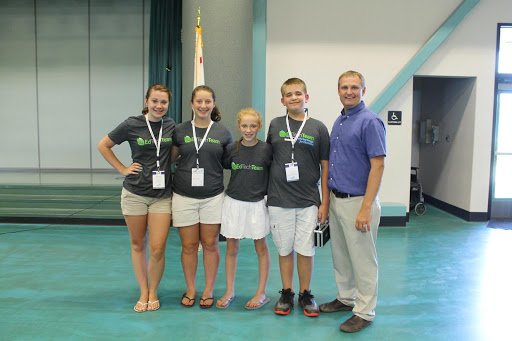
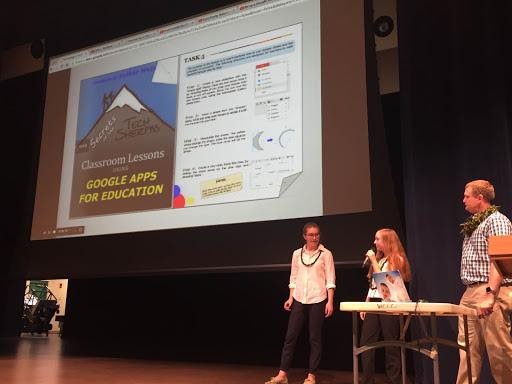
Kern Kelley with student presenters in Porterville, California
A presenter and tech professional development expert himself, Mr. Kelley moonlights as a speaker on a global level, something he has always incorporated with his students and career as an educator. What started out as taking students along to take part in his presentations has evolved into students presenting around the world.
Starting in 2012 on a train ride back from the New York Google Offices at a presentation with Mr. Kelley, the students came up with the idea of taking their skillset on the road more formally and the Tech Sherpas were born. Since then they have grown both in size and knowledge with every passing year and every advance in technology. Pre-COVID-19, the Tech Sherpas had traveled to places like Japan, Ottawa, Hawaii, Pennsylvania, and Chicago presenting to large audiences on topics like Google Slides, Google Meets, Google Classroom, and Flipgrid among others.
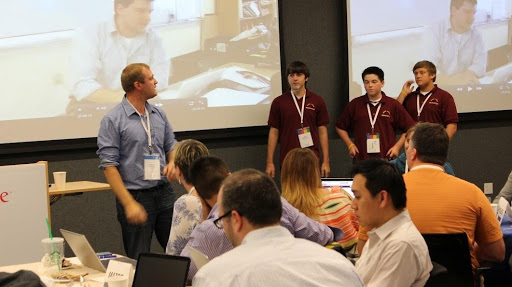
Kern Kelley presenting with Kris Redman Jared Gay and Chandler Cossar at the New York Google Offices in 2012
After the pandemic forced schools to adapt in the way that education is provided, Mr. Kelley and the Tech Sherpas didn’t miss a beat. What was once in-person presentations all over the world has now become a busy job of booking virtual meetings and presentations to keep up with the ever-changing needs of educators, students, people of all walks of life who need to learn, keep up with, and use technology in their everyday lives.
Nokomis High School Senior Rachel Wilcox has been a Tech Sherpa since she set foot in the Nokomis Warrior Broadcasting class her freshman year. Now a senior and finishing her final year of high school during a pandemic, Rachel is the project manager working behind the scenes to coordinate the Tech Sherpas’ virtual presentations.
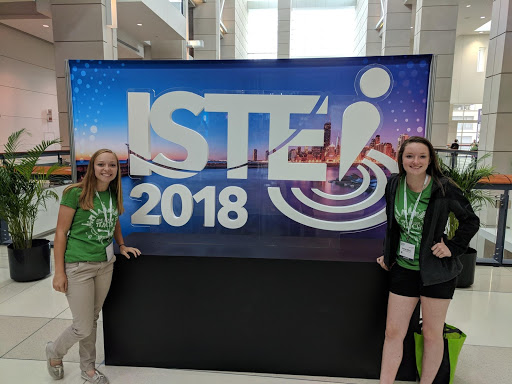
Rachel Wilcox and Britney Bubar presenting at ISTE in Chicago
“I like it,” said Rachel in a virtual interview. “I want to go to college for business management, so this is a good step in that direction,” she added. Rachel is in charge of organizing the Tech Sherpas into groups in terms of their readiness to present with the technology they feel most comfortable teaching others. She also works with outside organizations to schedule the presentations, lines up the students to present, coordinates the practice sessions, and participates in the actual event by doing a pre-event tech check, and helping to host the meeting. During the event, Rachel is usually working with a moderator who watches the meeting chat during the presentation, in addition to the presenters.
One of their most recent endeavors was a student-led presentation at the Virtual End of Summer Fest for the Google Waterloo Engineers. It was an opportunity for Google engineers to see creative uses of their tools by ‘real’ people. The topic was using Google Slides to Create Animations, like this one. The Tech Sherpas worked with EdTechTeam Canada for the event which featured the skills of Tech Sherpa, Kaiden Kelley who also happens to be Mr. Kelley’s son.
Kaiden Kelley presenting to Google Engineers
“When presenting, I’m there to share my skills with the teachers,” Kaiden said of his experiences presenting with the Tech Sherpas. In the event with Google engineers, he shared the skills, tips, and tricks that he learned from using Google Slides on various projects over the years. Be began working with the tool in 2012 and has experienced a myriad of changes and upgrades from Google that he has been able to navigate and use in his everyday work.
A pro at presenting, Kaiden said he doesn’t get nervous anymore during presentations and that the most memorable part of the presentation to Google was seeing everyone “come in” to the virtual meeting from all over the world. The successful presentation has led to further talks with Google Canada about more presentations by the Tech Sherpas.
“We are in a world now that everybody has experienced video conferencing,” said Mr. Kelley. “We will never again live in a world where that has not happened.” Mr. Kelley hopes to give his students as much experience as possible doing video conferencing knowing that when they graduate from high school they will need to be ready with skill sets that allow them to compete for jobs and post-secondary opportunities all over the country, and potentially enabling them to work and learn from right here in Maine.
While Mr. Kelley is excited about the incredible opportunities his students have experienced during the pandemic, he is quick to explain that using video conferencing is not necessarily better education for students, “it is a tool that we can use to keep providing opportunities for kids.”
Austin Taylor and Brittney Bubar presenting at the Hawaii Island TechEd Conference
Other ongoing projects of the team include helping Mr. Kelley on professional learning opportunities for teachers in Maine. One is an opportunity for educators in any part of the State to explore distance learning tools for students and teachers with the help of the United Technologies Center Adult Education and the Tech Sherpas (Learn more about this opportunity here).
Another is a similar “adopt a teacher” project at Nokomis where the students help resident educators with any technology needs they may be having as they navigate hybrid and remote teaching this year. It not only helps boost technology opportunities for students at Nokomis, but also bolsters relationship building, presenting, and teaching skills for the students. Their hope is to expand on these efforts to expand these types of opportunities for students and teachers state-wide
Maine Adult Education programs are working hard through the COVID-19 Pandemic to help students meet their goals. That’s why RSU 16 planned an end of summer graduation ceremony to celebrate the accomplishments of their Adult Education students. In a short, in-person, socially distanced graduation on August 6th the program was able to honor 8 out of 13 of their graduates.
While a group picture is not necessarily easy to accomplish, the staff at RSU 16 made a picture collage to memorialize the event for years to come.
This story was submitted by Jenny Rose, RSU 16 Adult Education Director and McKinney Vento Homeless Liaison as part of the Maine Schools Sharing Success Campaign. To submit a story or an idea please email Rachel rachel.paling@maine.gov.
By Jonathan Simonoff, Visual and Performing Arts Chair for Ashland Community School
The Ashland District School (MSAD 32) music program tried really hard to keep a positive outlook during these difficult times. Instead of thinking “It’s too bad we can’t do this,” we tried to frame it as, “How great is it that we get to do this now?” We looked at our goals for each part of our Pre-K – 12 curriculum and tried to identify ways to still reach these goals in a safe but engaging environment. For some classes those changes were minimal but other parts of the program had a drastic overhaul.
For example, the youngest elementary grades have not changed much but some parts of instruction are being recorded so that vocal and instrumental songs can still be shown to the students. Those classes are also being taught in each grade’s homeroom now.
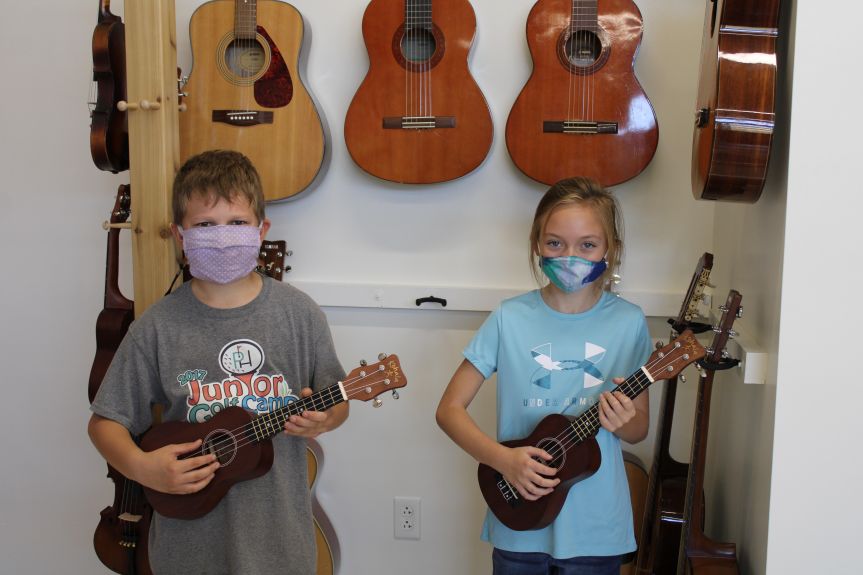
In the past, 4th grade students would use recorders as part of pre-band lessons. This year we are using ukuleles to try to hit upon these concepts. Each student has a ukulele they get to use in class that is sanitized after.
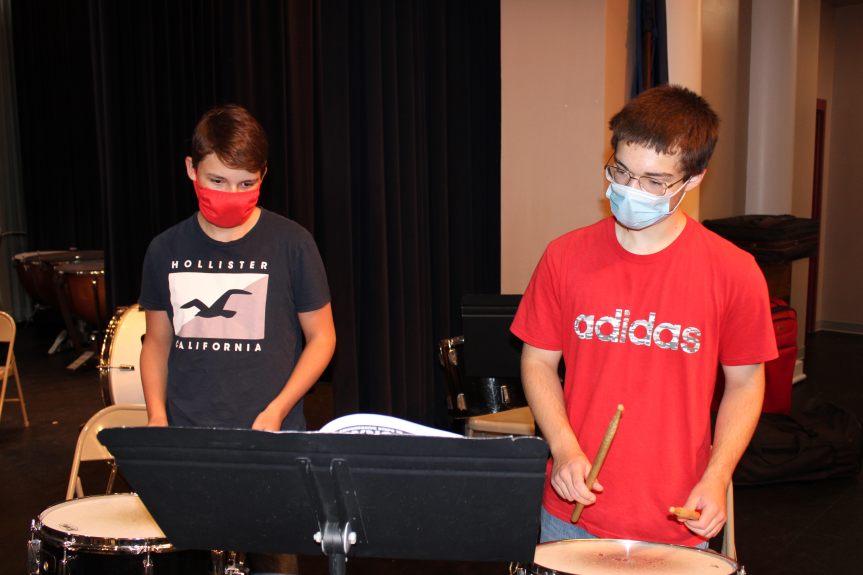
Our beginning band students have also seen a significant change. Since we are not starting any students on traditional band instruments, we have made use of keyboards and drum pads. The class has been put into groups and each student in 5th grade gets a weekly small group lesson on keyboards for note reading skills and drum pads for extra rhythm reinforcement. We are in week 3 of these lessons and so far, every kid is reading and playing very well. I do remind them that they will get a chance to try the band instrument they want but these skills will help them later.
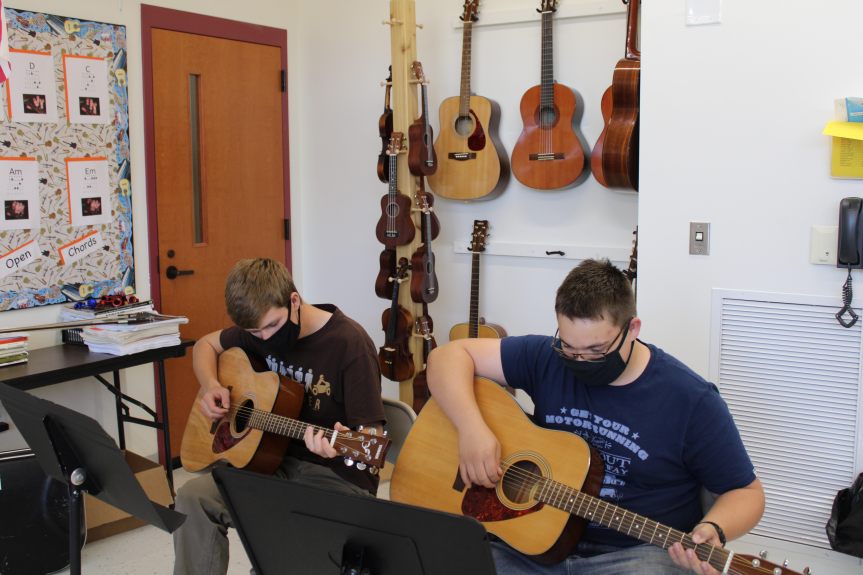
Last year our middle school students usually would have the option of signing up for middle school guitar class or middle school band. This year the guitar class is still an option and the other class they can sign up for is middle school percussion, which focuses on reading and playing rhythms on a variety of traditional and non-traditional percussion instruments.
Perhaps the groups that have changed the most this year are my high school classes. Normally high school students would have the option of taking guitar class or high school band. The guitar class is still running as normal but high school band has changed significantly.
My ed. tech and I have developed an alternating multi-course option for my high school students. We rotate courses every other day and students were able to sign up for one course each day. The courses offered as follows – Piano Class, Percussion Class, Strings Class, Rock Band, Independent Study, or 1 study hall. For example, a student could take piano one day and strings the other day and they follow that schedule for at least a semester before potentially changing their courses.
The classes are pretty self-explanatory. Piano class (a very popular choice) is like a group piano lab. Percussion class has students spending time practicing rhythms and working on drum set techniques. Strings class is teaching students violin. Rock band (another popular choice) has students working with guitar, bass guitar, piano, and drum set to play modern music and independent study allows students to set up and achieve their own musical goals with check-ins with me to track their progress and give advice. For example, I have a few students working on playing the ukulele and using online guides to help them. I also have some students working on creating their own compositions. Study hall is a chance for students catch up on their other academics.
This set up comes with the understanding that students need to be self-motivated and disciplined since some of the time in class they are expected to work independently while myself or my ed. tech are working with other students. It has been very rewarding both for students and teachers to see progress being made and finding new ways to connect with and learn about music.
It also has been a lot of work to set up in terms of making sure we have enough keyboards and violins. We also are writing some of the music out by ear for students (particularly the Rock Band) to perform. But now that we are a month into school, things seem to be moving along nicely and I am very happy with how this year is shaping up!
This story was submitted by Jonathan Simonoff, Visual and Performing Arts Chair for Ashland Community School in collaboration with Jason Anderson, Visual and Performing Arts Specialist for the Maine DOE as part of the Maine Schools Sharing Success Campaign. To submit a story or an idea email it to Rachel at rachel.paling@maine.gov.
Camden-Rockport Middle School: Over the past 20 years, 7th grade students at the Camden-Rockport Middle School have designed hand-crafted tiles to decorate the front entry way of their school during art class. The new school year, however, will take place in a new school building, leaving these tiles, and big piece of the school history, behind.
When Maria Libby, superintendent of MSAD 28 (Appleton, Camden, Hope, Lincolnville and Rockport) and former student at, and principal of, the old middle school building heard that the school was scheduled to be demolished in June, she knew something had to be done to preserve the legacy of the tiles. She says that her “attachment to that place inspired me to document every student tile that had been installed over the past 19 years.” Maria could not let them be destroyed without saving a piece of the history.
While the past 7 years of tiles have been saved for the new school, and will be displayed for the incoming classes of Middle Schoolers at CRMS, 13 years worth of tiles, of history, and of community, were scheduled to be demolished along with the old school building. Maria Libby took matters into her owns hands, and photographed all 1,400 tiles adorning the front entry of the old middle school.
All of the photographed tiles have been uploaded and indexed on the Schooner Tile Project website as a way to preserve the legacy of the school, students, and community. Approximately 1,400 tiles are available to view and download from this site. To find a tile, click on the letter of the artist’s last name in the banner above. View the archived tiles here!
This article was written by Maine DOE Intern Aidan Sachs in collaboration with staff at Five Town CSD MSAD #28 as part of the Maine Schools Sharing Success Campaign. To submit a story or an idea email Rachel at rachel.paling@maine.gov.
Recent COVID-19 community outbreaks in the York County area have inspired Sanford High School Students to create a Public Service Announcement (PSA) this week encouraging their community to, “wear a mask and keep your six”. The creative and well put together video features many students from the high school whose plea is to encourage their community members to adhere to state requirements in an effort to stop the spread of COVID-19 so that they can get back to doing what they love. Check it out!
Heading into the 2020/2021 school year with cautious optimism, Maine’s amazing educators have rolled up their sleeves and worked together to ensure students have access to high quality learning even during a pandemic – and it the outcome is astounding.
Most schools welcomed students back for in-person and remote learning over the past couple weeks. Despite the collective breath holding (across the world), here in Maine it has gone quite well. Administrators, board members, educators, and staff alike have spent the summer working tirelessly to arrange and re-arrange their back-to-school plans this fall to comply with COVID-19 safety requirements and ensure the safety of everyone at school, while at the same time going about the important business of educating their students.
Jake Langlais, Interim Superintendent of Lewiston Public Schools and the Blue Devil, LPS Mascot (Lewiston High School Guidance Department on Twitter)
Numerous news outlets all over the state reported smooth sailing for the first week of school: a goal that was not an easy feat this year. Check out what re-opening looked like in these news articles from around Maine:
Carolyn Nichols, a biology teacher at Morse High School in Bath, was surprised, but happily so, by how well the first day of school went.
“The kids were respectful and took the coronavirus precautions seriously,” she said. “I haven’t slept in a week, but I’m impressed with how well it went.
“It’s a good challenge,” said Sam Regios, the [Presumpscot Elementary School] fifth-grade English language arts teacher, reflecting on the start of the school year as her students worked quietly from behind their masks. “I think it challenges the creativity of teachers and school districts. (I’m) accepting it with open arms.”
“I am not nervous about starting,” the longtime educator [Roxanne Renwick of Peninsula School] said late last week. “I have been blessed with a strong administration and team of colleagues working together to be prepared the best we can.
“We may not have all the solutions for every situation, but we are ready to be flexible and team-oriented to do the best for our students and our community.”
“Long-term substitute teacher Amie Frake was among the educators greeting students — and making sure they were walking in the correct direction, wearing their masks properly and staying 6 feet apart.
“The kids are doing really, really well,” she said. “It’s exciting for them to be here again. It’s been six months since most of them have been here, so it’s good to see them.”
Among those in cohort A are Millie Rauch’s three elementary-age children, who will be starting prekindergarten, first grade and third grade. Her older daughter, Hannah, is in sixth grade at the middle school.
Rauch walked with her three elementary schoolers Tuesday morning.
“We are looking forward to it,” she said. “I think they have taken all the right precautions. The classes are smaller, and they have the right hygiene techniques in place. We were a little nervous, but mostly excited to return.”
During a walk-through at Bonny Eagle High School Tuesday morning, Buxton-based School Administrative District 6 Superintendent Paul Penna said no major issues had come up at the start of the first day for students.
“It’s pretty organized,” Penna said. “We’ve done a lot of ground work. We’ve been doing Zoom meetings with families all summer. We’ve had ongoing … meetings about what our plan is, what it’s going to look like, what you need to tell your kids when you come to school. None of it is really that new, it’s just a matter of doing it.”
“In a meeting earlier this evening with other administrators, I think that I can speak for all of the elementary school principals in saying that it actually went really well,” Mallett Elementary School Principal Tracy Williams said. “Our kids came to school with masks on, they were happy, there was a lot of laughter seeing their friends, teachers were positive and upbeat. We did all of the things that we usually do everyday except with a lot of cleansing and wearing masks and keeping distances apart.”
Nearby, Jenny McGillicuddy was seeing her son, Leopold, 8, off as well. She said she was “feeling really calm” about the coronavirus threat, citing information the school shared with parents on how it would be encouraging social distancing, wearing of masks, and other precautions.
“From what I’ve heard, I feel confident in the Brown School’s ability to keep kids safe,” she said.
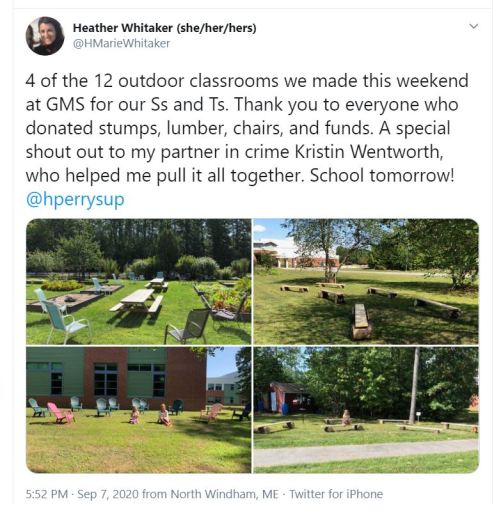
Sometimes it takes a global pandemic to break down the barriers that hold us back from jumping into any situation just to get the job done. From PPE (personal protective equipment) to physical distancing, there is always something to think about to make sure everyone is safe. One solution that many schools have been dabbling with is outside learning: a creative solution that provides students with an environment that is rich with learning opportunities, comfortable, and helps to prevent the spread of COVID-19. Many schools have set up everything from outdoor learning experiences to complete outdoor classrooms.
(Heather Whitaker, 2020 Maine Teacher of the Year/Gorham Middle School Teacher on Twitter)
The articles below detail what this looks like in just a few schools, but many more have worked quickly and efficiently to set up outdoor learning spaces prior to opening. Thank you to the countless community partners all over Maine who’ve stepped up to help make this possible.
A different type of learning is taking place at East Grand School in Danforth, one that doesn’t happen within the confines of a traditional classroom.
In a wooded area behind the school, children run around freely and build forts out of logs and planks. Kids in pre-kindergarten enjoy the fresh air while working on coloring projects. Older students sit around an outdoor fireplace and learn about social studies.
The [Brunswick] school district is partnering with local organizations like Teens to Trails and the New England Mountain Bike Association to help plan, clear, construct and implement open-air classrooms and gathering spaces in an attempt to reduce the risk of spreading COVID-19.
Opening Adams School to face-to-face learning involved much preparation and innovative thinking by faculty and staff. Students were met upon arrival and instructed as to which door to enter to go directly to their classroom. Tented classrooms scattered on campus utilize five Easy-Up tents supplied by the Hatch Fund, which also supplied COVID-responsible physical education games and activities.
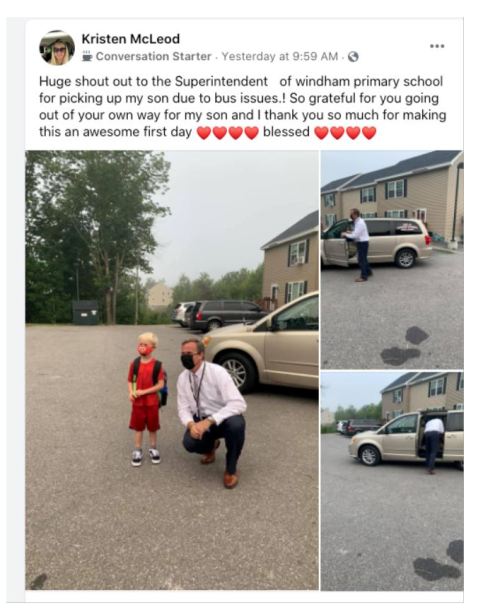
We tell our children to look for the helpers in times of crisis, it’s for their physical and mental safety but as adults, we forget that it’s good for us too. Take RSU 14 Superintendent Chris Howell for example. Due to some unforeseen transportation snags during the first week of school, one of his students couldn’t get there one day, so what did Superintendent Howell do? He picked up that student himself. In a world before COVID-19 this may not have been a viable solution, but right now that doesn’t matter. What matters is that everyone is a team player in the effort to get kids to school and learning and this is just one example of the pure heroism happening by school staff around the state.
(Submitted by Kate Leveille, RSU #14 School Board Member)
Along with school staff and educators, community and state partners are also jumping in to help schools, families, and youth complete hybrid assignments remotely, stay connected even when at home, and provide childcare when needed. These selfless acts also help to solidify the relationships that lead to the strong community and state bonds that we take pride in here in Maine, and that we hope to sustain for generations to come.
The clubs, which have been closed for nearly six months, will operate during school hours this fall as remote learning hubs, paid for with federal coronavirus relief funding. They will offer academic support, technology resources, nutritious meals and safe spaces where members can do schoolwork.
—–
School officials in Portland and South Portland sought the remote learning partnerships with the Boys & Girls Clubs of Southern Maine. Similar agreements are being discussed with the Auburn and Lewiston school systems.
(Portland Public Schools on Twitter)
The Maine Department of Education has also focused efforts toward providing not only guidance on safety protocols, in addition to the latest COVID-19 resources for schools, and a responsive, working Framework for returning to school this year, but there has also been an intensive summer-long effort to launch a library of asynchronous learning modules that are aligned to Maine’s Learning Results through a project called MOOSE (Maine Online Opportunities for Sustained Education) and coming soon will be an additional library of social emotional learning (SEL) modules to supplement SEL curriculums statewide.
A lot of time, dedication, and planning went into ensuring students could go back to school in person and learn remotely this fall. We owe these heroes an enormous dept of gratitude for this important work. While this is only the start of an extraordinary year, we trust our school leaders, our educators, our fearless school staff members to keep students and staff safe while providing quality education to Maine students. Thank them today and every day.
Are you thinking of someone in particular that has gone above and beyond in your school district? Nominate them for an award!
Information for this article was gathered through recent news articles, social media posts, and communications with Maine schools. To be featured in future articles of this nature, email stories, pictures, and ideas to Rachel at rachel.paling@maine.gov.
Five high school seniors in the Portland Public Schools have been named Semifinalists in the 2021 National Merit Scholarship Program. These academically talented students now have the opportunity to compete for about 7,600 National Merit Scholarships worth more than $30 million that will be offered next spring.
The five Semifinalists are Portland High School seniors Liam Foley and Andrew Leonard; Deering High School students Aidan Blum Levine and Matthew Keast; and Casco Bay High School student Oscar McNally.
“Congratulations to these exemplary students!” said Superintendent Xavier Botana. “This is the highest number of National Merit Semifinalists from the Portland Public Schools in more than five years. The credit goes to not only these hardworking students but to their teachers and other supporters, including their parents. I wish them the best as they continue on in this competition.”
These students are among 68 Maine seniors named as Semifinalists in the 2021 contest. There are approximately 16,000 Semifinalists nationwide. Semifinalists were selected from a pool of more than 1.5 million high school juniors that entered the 2021 competition by taking the 2019 Preliminary SAT/National Merit Scholarship Qualifying Test.
Of the 16,000 Semifinalists, about 15,000 are expected to advance to the Finalist level of the competition. To become Finalists, Semifinalists must have an outstanding academic record throughout high school, be involved in school and community activities, show leadership abilities, be endorsed by a high school official, write an essay, and earn SAT or ACT scores that confirm their earlier performance on the qualifying test. Of those Finalists, about half will win a National Merit Scholarship and become National Merit Scholars.
Three types of National Merit Scholarships will be offered in the spring of 2021. The National Merit Scholarship winners will be announced in four nationwide news releases beginning in April and ending in July. These scholarship recipients will join approximately 353,000 other distinguished young people who have earned the Merit Scholar title.
This story was submitted by Tess Nacelewicz Communications Coordinator for Portland Public Schools as part of the Maine Schools Sharing Success Campaign. To submit a story or an idea, email Rachel at rachel.paling@maine.gov.
Imagine being a high school student enrolled in the Health Sciences Program at the Region Two School of Applied Technology knowing you can graduate from high school with the first year of a Bachelor of Science in Nursing Degree from the University of Maine at Fort Kent complete. A new collaboration between the UMFK’s Nursing Program, Region Two School of Applied Technology in Houlton, and UMFK’s Rural U Early College and Concurrent Enrollment Program now makes that opportunity possible for these high school students.
The new program, called Rural U Nursing: Health Sciences Alliance Program brings together the strengths of the programs mentioned above and provides students the opportunity to earn 24 or more university credits, one full academic year of credits that serve as the first year of a Bachelor of Science Degree in Nursing at UMFK. Students completing the program can come into UMFK’s Nursing program as 2nd year students. UMFK’s Nursing program is also available at the University of Maine at Presque Isle adding yet another option after high school for these students.
“We are so pleased to partner with Region Two to bring freshman level college courses to high school students who are interested in pursuing a nursing degree,” states Dr. Erin Soucy, UMFK’s Dean of Undergraduate Nursing. Dave Keaton, Director of the Region II School of Applied Technology adds, “What a tremendous opportunity for our Intro to Medical Professions students and for the workforce in Aroostook County!”
Credits earned in this program will include articulated credit UMFK grants for Maine CNA Certification earned at Region Two, credits from a concurrent enrollment NUR 200 Introduction to Professional Nursing to be taught at Region Two by Health Sciences Instructor Amber Sloat, credits for Anatomy and Physiology I and II classes taught at the Houlton Higher Education Center, and early college and concurrent enrollment classes earned through UMFK’s Rural U program. While this program provides an accelerated pathway to a nursing degree, students will not be charged tuition for any of these credits; thus also providing a more affordable pathway to a BSN degree. Scott Voisine, UMFK’s Dean of Community Education adds, “All early college programs like Rural U give students a chance to experience college learning and earn credits more affordably, but this new collaboration takes it one step further provides a direct onboarding of students into a rigorous and rewarding career pathway at UMFK.”
Rural U Nursing is a direct response to the need to increase the number of nurses in Aroostook County, in Maine, and in the Region. Students will be able to begin the program immediately this fall.
This story was submitted by Dave Keaton, Director of the Region Two School of Applied Technology as part of the Maine Schools Sharing Success Campaign. To submit a story or idea, email it to Rachel at rachel.paling@maine.gov.








 Maine DOE Newsroom