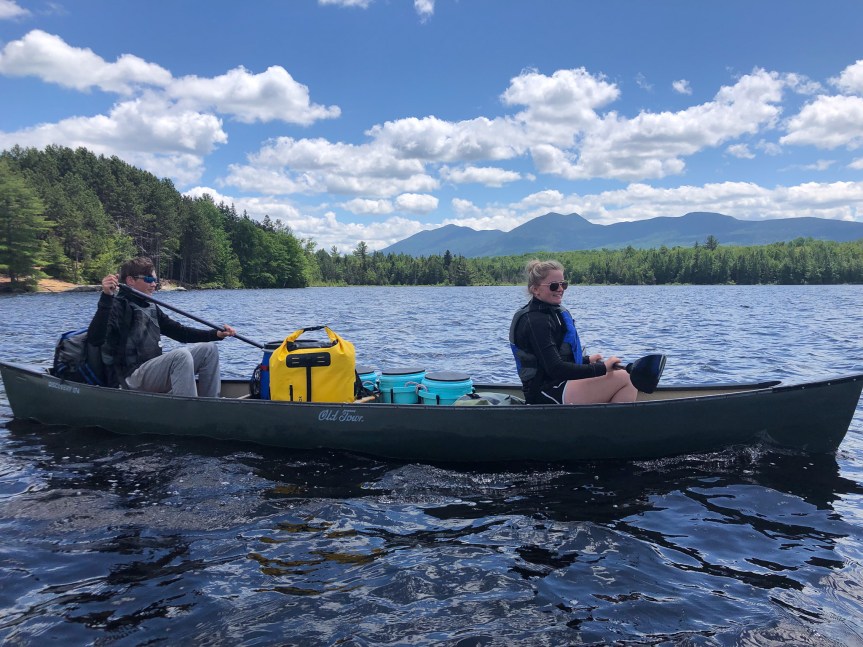
In June, Seven Carrabec High School students joined a Teens to Trails intern and registered Maine Guide Tammy Long on a 30-mile canoe trip along the Northern Forest Canoe Trail on Flagstaff Lake. On this three-day trip, participants navigated the waters via canoe, camped on remote islands, and prepared food over a campfire. Thanks to the Maine Outdoor Learning Initiative, the trip and necessary gear were free for all participants.
The Maine Outdoor Learning Initiative is a program created by the Maine Department of Education (DOE) to engage Maine students with outdoor learning and make outdoor experiences more accessible. The Initiative was inspired by a promise made in Governor Mills’ 2022 State of the State Address to provide students with more opportunities like Carrabec’s canoe trip. The students on the trip were from Long’s Outdoor Leadership Class, taught at Carrabec High School.Long is a registered Maine guide and is extremely enthusiastic about sharing her expertise with students. She is also thankful that she has the skills and knowledge to help them stay safe on trips in remote areas. While Long noted that some of the students had prior canoe experience or had been on a trip with her before, none of them had ever embarked on a three-day, 30-mile paddling trip.
Before embarking on the trip, students were taught extended canoeing skills in an Outdoor Leadership class with Guide Tammy Long. Even for those who did have prior canoeing experience, this trip was challenging.
However, the students accepted the challenge and grew more confident in their canoeing abilities while enjoying the beauty of Flagstaff Lake.
“The highlight for me was when the students stopped holding their phones over their heads ‘looking’ for service and simply relented to the fact that they were unconnected,” remarked Long. “After three days, they couldn’t stop talking about how good it felt.”
Long said she also hopes students will continue to cherish outdoor experiences in our unique state and that they spend more time away from screens.
“I hope to continue being able to take students on extensive canoe trips like this one, and I am very thankful for the grant money provided by the Maine Outdoor Learning Initiative, said Long.
By Ann Dooling, Maine DOE Transformational Leaders’ Network Facilitator and Maine educator/administrator with 34 years of experience working in Maine schools.
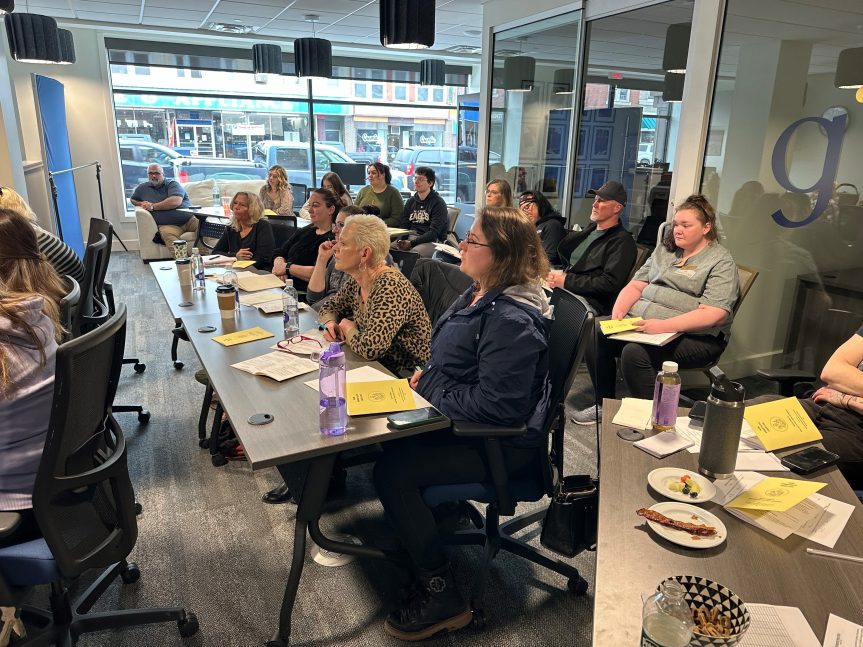
As a principals’ facilitator for the Maine Department of Education’s (DOE) Transformational Leaders’ Network (TLN) in the Western Maine Region, I was recently asked why three dedicated, very busy, hard-working Western Maine principals have made it a priority to participate in the Transformational Leaders’ Network this year, as well as why they always make time to attend the small regional meetings.
The Transformational Leaders’ Network regional meetings are an offshoot of the larger Network. Three principals and I have met at a mutually determined location three times over the course of this school year.
First, let’s explain TLN. The Transformational Leaders’ Network (TLN) is a Maine DOE sponsored statewide community of principals who are engaged in learning about themselves and their leadership. The TLN meets once a month either in person, on Zoom, or in small regional meetings, and is led by a group of facilitators who are all current or former school administrators with backgrounds in Maine’s public education.
I asked Jodi Ellis, Principal of Meroby Elementary and Rumford Elementary in RSU 10; Tabitha Emery, Principal of Stratton Elementary School at Eustis School Department; and Leanne Condon Principal and Superintendent of Andover School Department what keeps them coming back month after month to the TLN meetings.
Leanne Condon
Tabitha Emery
Jodi Ellis
In their own words they shared:
The TLN offers me time to meet with other people who know what it is to be a building leader. It provides an atmosphere in which you feel much less isolated in your job as a school leader and know you have people who can empathize with you and who care about you!
The whole group TLN sessions are set up for the participants in terms of the activities, reading and discussion, along with the fact the books and articles are relevant and timely. Personally, I’ve used several of the checklists and rubrics from our books over this school year to make sure I’m on track with staff relationships and decision making. I’ve also successfully used the protocols, video clips, and articles from our TLN sessions with my staff.
The TLN facilitators are consummate teachers who know how to keep our time together focused, important and fun, which is really helpful as a new principal.
Finally, if you are looking for a supportive network of others who are facing similar struggles, this is the place for you!
I also asked these same three principals why they take the time to always attend our small regional meetings. Again, in their own words:
Honestly, self-care. The time we meet is worth its weight in gold! We talk, collaborate, share ideas, laugh, commiserate, be real, enjoy each other’s company, and feel good overall. During this time, you find yourself sitting at a table with a group of kind, compassionate educators who truly understand what you are talking about and that just feels good.
When we discuss common issues, we each have something to contribute. It is a time for deep conversations and relaxation with fellow educators who understand one another. Our TLN facilitator is as friendly and relaxed as we are, but she is always ready to ask in-depth questions to probe our thinking.
I look forward to these meetings every single time! These women have become a resource for me in my role as a school principal, they offer support, reassurance, and kudos to keep going.
We dream together about what education can be and walk out the door refreshed and ready to take on the next day.
If you are a school principal in the State of Maine, and in this role, believe you could benefit from the educational learning, self-discovery, and the comradery that the TLN offers, please consider joining the Transformational Leaders’ Network this coming 2024-25 school year!
To learn more, visit the Maine DOE Website or reach out to Christina O’Neal, Maine DOE Educator Excellence Coordinator at christina.l.oneal@maine.gov.
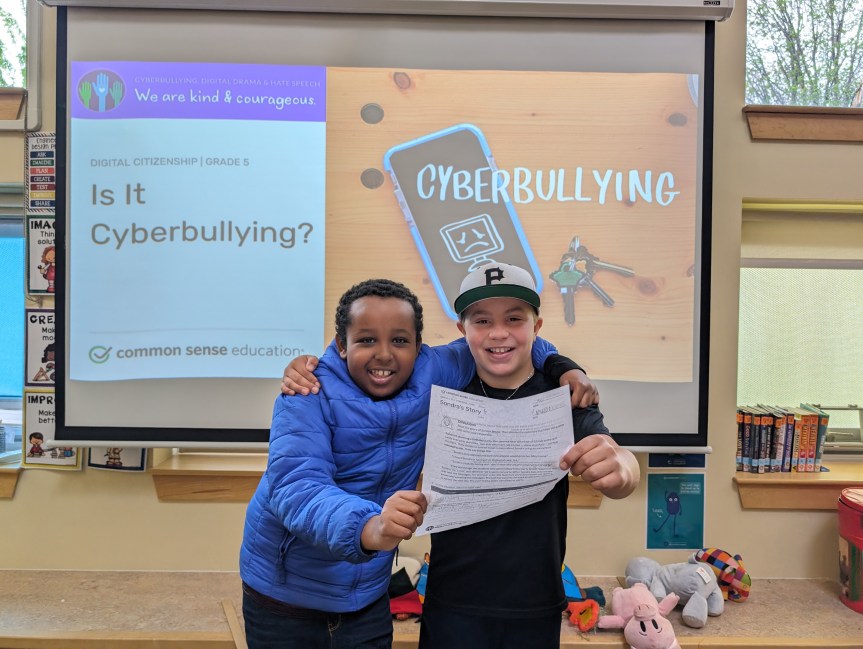
Portland Public Schools has been recognized as a Common Sense District for its work educating students on safe and healthy ways of using technology and integrating technology into the curriculum as a learning tool.
It is no secret that technology has become an integral part of students’ lives and their education. Curriculum makers and educators have been figuring out how to integrate technology innovatively. Maine has been a leader in this integration, with many technology-related initiatives and grants.
“We’re honored to be recognized as a Common Sense District,” said Superintendent Ryan Scallon. “Explicitly teaching students media balance and wellbeing and how to be safe online is a step we are taking to support our ‘Whole Student’ goal in our Strategic Plan.”
The Portland Public Schools have been utilizing Common Sense Education’s research-based digital citizenship resources, working to foster a positive technology culture in the whole community. These resources teach students, educators, and families about internet safety, protecting online reputations, personal privacy, media balance, media literacy, and online relationships. There are lessons for all grade levels, K-12.
Courtney Graffius, District Technology Integration Coordinator, has credited the hard work of librarians and digital literacy as an imperative part of this recognition.
“Our librarians at the elementary level have been the leaders and teachers of these lessons,” Graffius said. “At middle school, it’s been a combination of digital literacy teachers and librarians, and at the high school level, it’s been the librarians taking the lead. This will be a part of the SEL (social-emotional learning) priority for middle school next year and will continue to be part of the work of the librarians at both our elementary and secondary levels. These educators are committed to teaching students essential digital citizenship skills!”
The librarians, digital literacy teachers, other educators, and community of Portland Public Schools are grateful for the support of the Maine Learning and Technology Initiative Ambassadors for helping them become a Common Sense District.
“The Portland Public Schools has demonstrated its commitment to taking a whole-community approach to preparing its students to use the immense power of digital media to explore, create, connect, and learn, while limiting the perils that exist in the online realm, such as plagiarism, loss of privacy, and cyberbullying,” according to Common Sense Education. “The recognition acknowledges the district’s commitment to creating a culture where the whole community is invested in helping kids thrive as digital learners and citizens.” The Portland Public School District received the Digital Citizenship Award on June 14th, 2024, being the second in the state (following Lewiston School District) to receive this recognition. Maine’s devotion to technology integration, including resources to national training programs and handbooks, will hopefully help more students and families navigate the challenging process of using media for good.
Common Sense Education, a national non-profit devoted to educating students and families on technology and its uses, awards school districts as Common Sense Districts when they show commitment to using technology in a safe way that helps enhance students’ education.
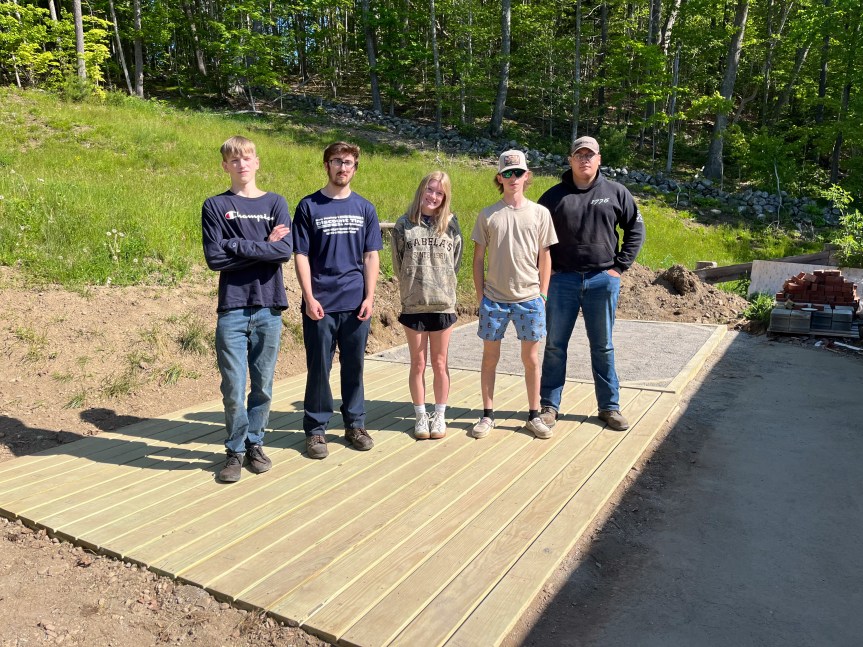
(The Lincoln Academy edLab students who built the greenhouse deck and foundation to support their outdoor learning space.)
The greenhouse will be a part of Lincoln Academy’s Maine Outdoor Learning Initiative program, LA Launch.
Lincoln Academy’s edLab students have been building a greenhouse to support the school’s new LA Launch Program. This free summer program, funded by the Maine Department of Education’s (DOE) Maine Outdoor Learning Initiative, will support rising 9th graders preparing to enter high school.
The Maine Outdoor Learning Initiative is a statewide effort to increase access to engaging, hands-on outdoor experiences and career exploration for middle and high school students throughout the state. The initiative, created by the Maine Department of Education, was born from a promise made during Governor Mills’ 2022 State of the State Address to provide children with more opportunities to get outside and engage with Maine’s natural beauty following the pandemic.
Students in edLab, Lincoln’s alternative education program, took the lead on the construction project with the help of edLab Director Jody Matta and their teachers. As part of the project, edLab teachers and students researched the town of Newcastle zoning process and received guidance from Town Planner Michael Martone. Students prepared and applied for the building permit. With assistance from the facilities department at Lincoln Academy, edLab students wrestled with the many rocks at the site and dug the foundation area. Along with the base for the Maine Garden Products greenhouse, they also built a deck to be used as an outdoor education space.
“It was a great opportunity for us to learn about the process involved in constructing a new building,” said edLab student Ariel Cowan. “It is information that we will be able to use in the future.”
“Our students worked hard on the greenhouse project, and I am proud of their work,” said Matta. “We look forward to utilizing the greenhouse as a learning space in the future.”
As part of the LA Launch program, students will learn about oyster aquaculture at the University of Maine’s Darling Marine Center.
The LA Launch program is designed to support students as they transition to high school and help them connect with Lincoln Academy while they learn more about their community and the importance of connection in a marine ecosystem.
“The greenhouse is a great resource that will allow LA Launch participants to explore and experiment, which will supplement our field trips to meet with community members and learn more about fishing, aquaculture, boatbuilding, and outdoor recreation,” said Lincoln Academy’s Director of Applied Learning Maya Crosby.
Crosby worked with Heather D’Ippolito, Lincoln Academy’s Director of Community Engagement and Development, to build the LA Launch program and apply for the Maine Outdoor Learning Initiative funding. Lincoln Academy was one of more than 60 organizations that received funding through the Maine DOE grant, thanks to an expansion of the program announced by the governor.
The Maine Outdoor Learning Initiative grant covers participants’ transportation and the school is providing lunch. Families interested in enrolling their rising ninth graders in LA Launch should reach out to the program director, Andrew Jonash, at jonash@lincolnacademy.org or visit the Summer at Lincoln Academy page.
Maine Garden Products will deliver the greenhouse in mid-July and place it on the prepared base. The project will be completed by the end of July, before the LA Launch program starts in August.
Schools across Maine have begun to implement more career field exposure and post-grad planning. Professional Development sessions (for students), community integration, and activity fairs have been successful ways to pique students’ interests in different career fields.
At Lisbon Community School, teachers and administrators designed a Community Day to help students reflect on what they’ve learned during the school year, build leadership skills, and learn how to become healthy, collaborative, and productive citizens within their community.
Lisbon Community School teachers have implemented the trend into their curriculum with the help of curriculum team leaders. The school has hosted a Community Day, bringing together students in grades Pre-K through 5thfor the past two school years with great success.
The event brings local professionals ranging from brewers, artists, restaurant owners, town credit union members, fire department workers, emergency medical technicians, doctors, and bakers to the school for one day. Professionals did presentations and demos to educate students on their job and business, and students visited their places of business. Not only is this a great way for students to connect with non-school community members, but exposure to potential career opportunities gives them motivation to continue growing as learners and has inspired them to think about future careers.
It’s safe to say that Community Day has been a success over the past two years. During Community Day, students of all grade levels created individual and group standards of behavior. These group conversations allowed students to reflect on which sills and habits they would like to improve on. Having these conversations with different grade levels in the same space allowed for bonding of students of different grade levels. Teachers also made sure to incorporate the importance of social and emotional wellbeing.
Knowing it will be a while until the next annual Community Day, teachers and students created tangible reminders. Grade 4 students and teachers, led by Angel Tibbetts, created a Kindness Quilt, which hangs in the school for all to see. Additionally, Grade 3 students recorded their PSA of shared values and behaviors for when in the school cafeteria. Community Day serves as a reminder for students that there is so much more going on than what is just in their school and provides role models to inspire students to work hard and achieve their goals. The Lisbon community is grateful for this new tradition and is excited to see how Community Day continues to evolve.
This spring, the Maine Department of Education (DOE) awarded a $400,000 Strengthening Maine’s Workforce Grant to Ignite Presque Isle and SAD 1 Adult & Community Education’s workforce development partnership.
The Maine DOE awarded a total of $4 million in Strengthening Maine’s Workforce Grants between 2022 and 2023. These initiatives are funded through Governor Mills’ Maine Jobs & Recovery Plan.
Ignite PI is an organization committed to innovation and excellence in the Presque Isle area. Through dedicated training and professional development programs, Ignite PI strives to enhance the standards of the hospitality industry and create meaningful career opportunities for individuals in the area. SAD 1 Adult & Community Education provides comprehensive educational programs, ranging from basic education to vocational training, designed for adult students. Together, the two organizations have created a workforce development partnership that provides free hospitality training for workers.
The Strengthening Maine’s Workforce Grant has been imperative to the program’s success. Since the organization’s start in 2022, it has provided more than 4,686 hours of training for Ignite PI employees and 240 hours for non-employees. 135 workers total (94 Ignite PI employees and 41 non-employees) have undergone comprehensive hospitality training. 19 distinct training programs were designed to elevate the skillset of hospitality workers for 15 different local businesses. Not only have job opportunities increased, but the standard of service at multiple establishments has improved due to this training.
“We are thrilled with the progress and positive outcomes of this partnership,” said LeRae Kinney, CEO of Ignite PI. “The training programs have not only improved the capabilities of our employees at Ignite PI but have also contributed significantly to the broader community. This grant has allowed us to offer high-quality education and training free of charge, which is a tremendous asset.”
This program has been incredibly beneficial for businesses in the Presque Isle region. The supervisor of Dean’s Motor Lodge (whose staff attended the B.A.S.I.C.S training) remarked that “the training that my staff received was incredible! By having the opportunity to have face to face conversations and bringing up case scenarios, they were able to better understand the laws.”
The supervisor of Parkhurst Siding Pub (whose staff attended both B.A.S.I.C.S training and ServSafe noted that “It’s certainly nice to be able to hold trainings and elevate our workforce’s knowledge and marketability. These are skills they will keep with them their whole lives. A lot of these are public safety issues at their core so the whole community benefits as well.”
The Strengthening Maine’s Workforce Grant was originally set to end in June 2024; however, it has now been extended to June 2025 due to its success. Ignite PI, SAD 1 Adult & Community Education, and the Maine Department of Education hope that this extension allows for continued support and expansion of hospitality training programs and access to all who want to enhance their skills. The prolonged grand and positive feedback from business owners highlights the region’s ongoing need for skilled hospitality workers.
“The collaboration between Ignite PI and SAD 1 Adult & Community Education demonstrates the power of community partnerships in addressing workforce development needs,” remarked Shara Page, director of SAD 1 Adult & Community Education. “We are excited to continue this journey and look forward to training even more individuals in the coming year.”
To learn more about Ignite PI, SAD 1 Adult & Community Education, and hospitality training programs, please get in touch with LeRae Kinney lkinney@ignitepi.com or Shara Page pages@sad1.org.
The Maine Department of Education (DOE) joins the Alternative Education Association of Maine in congratulating the 2024 Alternative Educators of the Year. The Alternative Education Association of Maine selects the recipients of the Maine Alternative Education Teachers of the Year for their hard work and determination as alternative education teachers in the State of Maine.
Please join us in celebrating the following individuals for their outstanding work with some of Maine’s most at-risk students! Their positive influence on student success is changing lives daily.
John Hawley
John Hawley Teacher, Mt. Ararat High School
John Hawley has been working in alternative education for 6 years. He is described by his colleagues as someone who always advocates for students. Moving them beyond the “at-risk” label, he provides students with opportunities to actively engage in their learning, helping them feel connected to school and each other.
Each day is an opportunity and John Hawley fights for the Alternative Education program at every level, both community and state. All of this excites his students and makes every day another opportunity to learn, all while having the very best of times doing it. Hawley serves as a pillar of the Mt. Ararat Middle School Community, always bringing people together to better serve students both inside and outside his classroom. His goal is to always build the best possible Alternative Education Program for his students.
“My approach is to develop a collaborative team of students working on their grade level project-based curriculum,” said Hawley.
Christine “Cappy” Caprio
Christine “Cappy” Caprio Teacher and Program Coordinator, York High School
Christine Caprio wrote the grant that provided the funding for an alternative education. program at York High School 19 years ago and has led the program to where they serve more than 30 students each year. Through her commitment to the program, she graduates close to 100% of her students within four years. She has implemented a project-based curriculum for York students that emphasizes student ownership and relevance to the curriculum.
She exemplifies a lifelong learner having attained multiple degrees in education. It is very rare to find someone who creates an alternative education and continues teaching in the program for over 15 years. During the covid outbreak in 2020, Ms. Caprio delivered food to her students weekly and forged a connection with them to check on their academic and mental health. She individually taught her students in their driveways to help them pass courses and graduate.
“In my thirty years in education I know of no other educator who has given so much and done so much for her students than Christine Caprio,” said a close colleague of Caprio.
“My work with students is rooted in community and connection; I seek to foster students’ natural curiosity and to challenge and engage them with meaningful, relevant project-based learning curriculum,” said Caprio.
Jacqui Holmes
Jacqui Holmes and Ed Sharood Teachers, Kennebunk High School
Jacqui Holmes and Ed Sharood have shaped and built a vision for expanding the scope and reach of alternative education in Kennebunk. Their innovative programming takes students off of the school campus and into the community where students work in and for local partners. Students who have not found purpose or connection in traditional education are welcomed and challenged in tasks which have tangible real-world impact.
Ed Sharood
Holmes and Sharood, with 8 and 18 years in alternative education, respectively, traveled to the National Alternative Education Association Conference as ambassadors of Maine Alternative Education and advocates of purpose-driven, innovative curricular design. They became the first presenters from Maine in recent memory and drew both accolades and attention for their work.
“These two are simply inspiring,” described one of their colleagues. “They have given so much of themselves to create an environment where each student experiences purpose, challenge, and respect. After talking with Jackie and Ed, I feel like I want to do my own job better.”
“Through a project and community-based curriculum, we strive to create a space where students feel a sense of belonging and are empowered to take ownership of their own education,” said the dynamic duo in a collective statement.
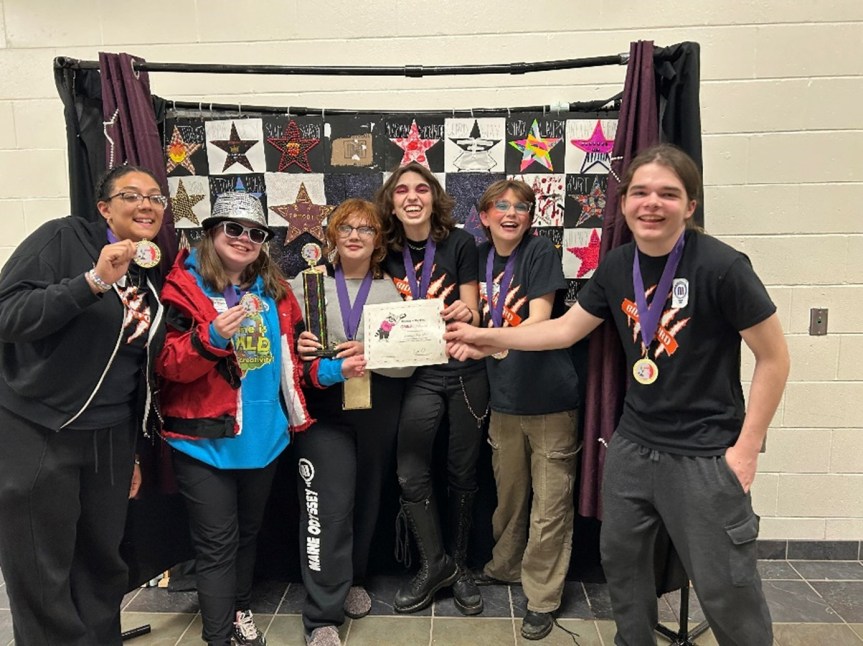
(Pictured: Biddeford High School’s Performance Team, a Maine State Odyssey of the Mind State Champion and World Finalist. Left to Right: Ahlany Martinez, Kyleigh Froehlich, Emily Michael, Layla Keddy, Elliot Aranovitch, and Harvey Giddings.)
Biddeford High and Middle Schools had sweeping success in the recent Odyssey of the Mind State Championship, with six out of the nine teams placing in the State Championship, four teams placing in the top three of their respective divisions, and four teams moving on to the World Finals in Ames, Iowa.
Odyssey of the Mind is a competition series where competitors utilize original problem-solving skills. In practice, teams will be presented with a long-term problem and then present their found solution at a competition. These solutions can be presented in a way that is either verbal or hands-on. Students work in small teams (up to seven) with very limited coach guidance. Some solutions to problems have included building vehicles that travel courses, creating machines to solve impossible tasks, building and ‘crushing’ a tower made of balsa wood, and performing humorous, witty skits. Odyssey of the Mind teaches teamwork, time management, budgeting, public speaking, thinking/troubleshooting skills, and inspiring individual and team growth.
Odyssey of the Mind has competitors ranging from kindergarteners to college students. This recent win isn’t surprising for Biddeford, as they have a long history of success.
“It is so exciting to see Biddeford students working so well collaboratively and excelling at problem-solving to consistently place at the State Tournament and move on to the World Finals every year since 2015,” says Odyssey of the Mind District Coordinator Victoria Salo. “We have had a strong team of coaches this year, which most certainly helps our students prepare for the state competition. Our teams were excited to head to the World Finals.”
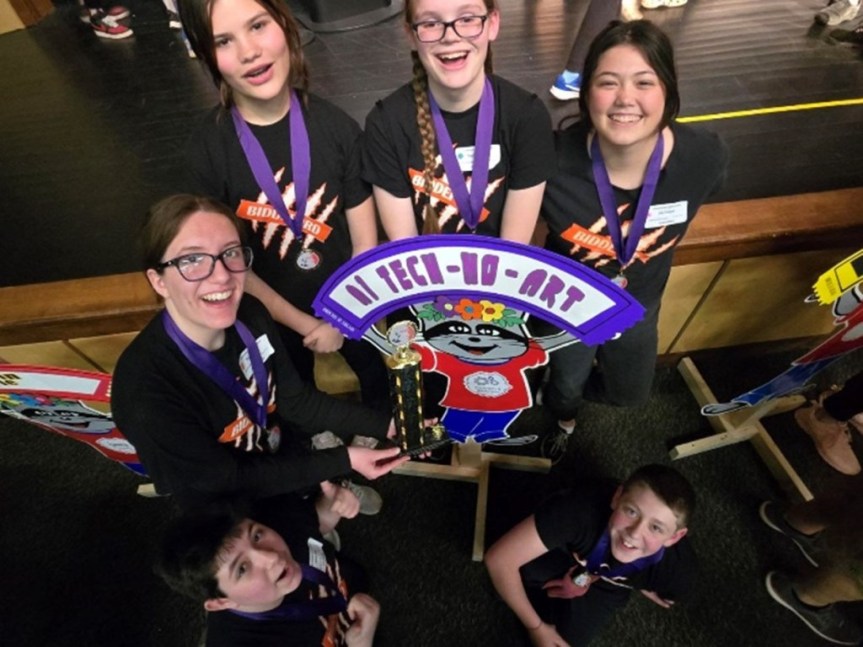
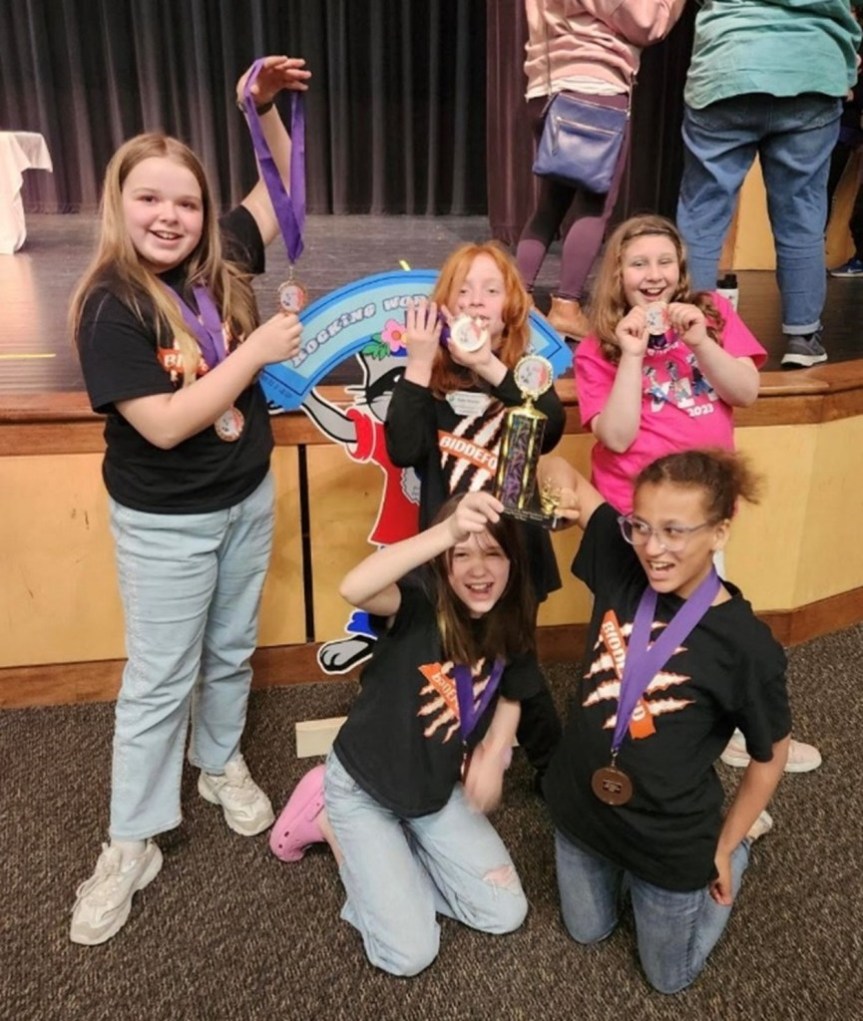
Both the high school Technical and Performance Teams were named State Champions and World Finalists at the tournament. The middle and intermediate school Performance Teams placed second, also qualifying for World Finals. Biddeford teams have now earned the top three places in the State Championship 13 times and advanced to the World Finals 11 times.
Biddeford High School’s Technical Team named Maine State Odyssey of the Mind State Champions and World Finalists. Left to right: James Cote, Emma Cote, Lara Galiardi, Kayla Arsenault, Ella Ireland, and Kyle Perkins.
The Biddeford Primary School even had three of their teams compete against fourteen others. Although they did not receive scores in their competition, they learned how to perform in front of an audience and answer questions from the judges.
Biddeford Middle School’s Performance Team is a Maine State Odyssey of the Mind 2nd place winner and World Finalist. Front row (left to right): Amelia Ireland and Adalina Morrill; Back row (left to right): Maisie Giddings, Baxter Belanger, and Kalina Simard (not pictured: Anja Lunianski).
In the past two years, the Biddeford Odyssey of the Mind program has more than doubled in size. In 2017, Biddeford only had two teams, consisting of 14 students at the high school Division I and III levels. Today, the program has grown to encompass nine teams, consisting of 50 students in Division I, II, and III in all age categories. The teams cumulate many different demographics, such as special education students and top academic performers, and encompass many different interests, such as drama, athletics, and STEM.
Biddeford Middle School’s Performance Team is a Maine State Odyssey of the Mind 2nd place winner and World finalist. Left to right: Cooper Crockett, Bentley Hale (floor), Harrison Buchanan, Wyatt Harper, and Anthony Ramunno.
Odyssey of the Mind has become increasingly popular throughout Maine, with 85 teams from 30 schools, ranging from Limestone to South Berwick, participating in the 2024 season. Turnout at the official state tournament, the Maine Odyssey Spring Fling, was record-high, with 550 students, 120 volunteer coaches, and many families attending. Nine Maine teams qualified for the World Finals, and four of them placed in the top 20.
Maine has been fortunate enough to be one of three teams in the world for a new pilot program, Odyssey Inclusive. OI is an adapted version of a traditional Odyssey of the Mind program, modified for neurodiverse students. The Lamoine Consolidated School OI team, coached by 2023 Hancock County Teacher of the Year Miranda Engstrom, did an amazing job presenting their solution at the State Championships, proving that Odyssey of the Mind is for all.
Jason Wheeler, the Association Director of Maine’s Odyssey of the Mind Program, has been involved with Odyssey since the age of nine. As a student who didn’t consider himself to be academically gifted, Odyssey of the Mind helped him develop a love of learning and problem-solving, as well as an identity beyond the classroom. He has made it his mission to ensure that the program is accessible to everyone in Maine, as being an environment that rewards risk-taking, encourages out-of-the-box experimentation, and reinforces the concept that there are “no bad ideas” is incredibly beneficial. Jason’s favorite part of Odyssey of the Mind is watching students transform into more confident and willing learners.
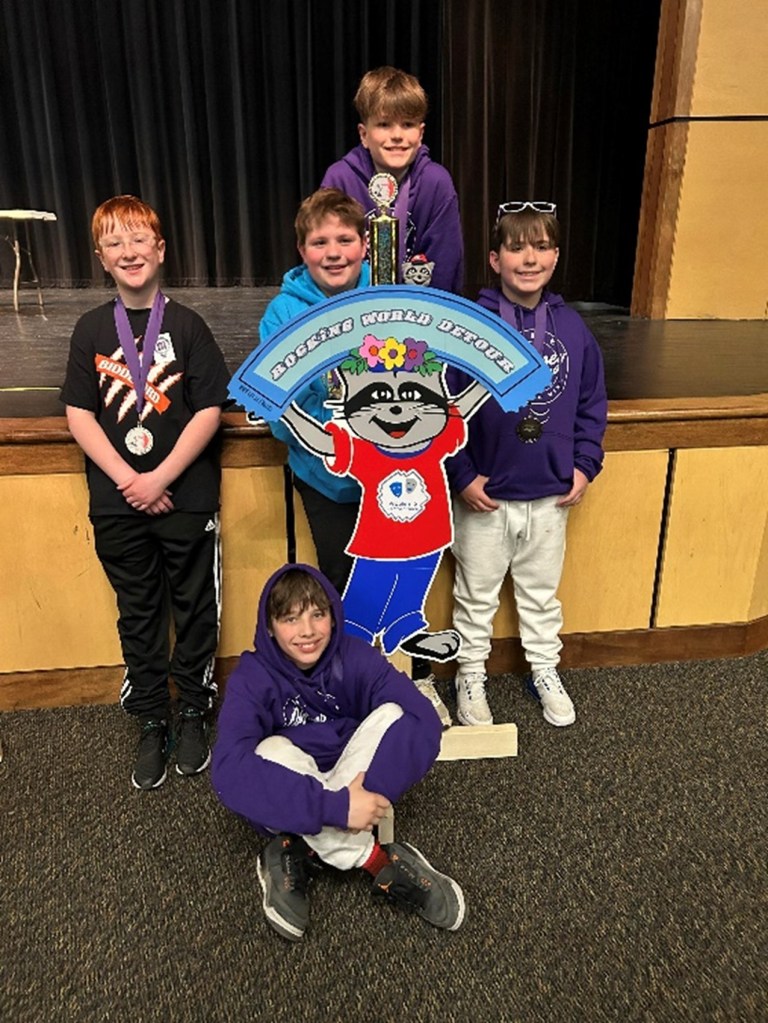
At the State Championship, the Biddeford Performance Team and coaches Victoria Salo and Suzanne Tighe (both teachers in the Biddeford School District) were presented with OMER awards. This award is named After the Odyssey of the Mind’s mascot, the raccoon, and honors all who serve as exemplary role models through their actions and/or words and team members who exhibit exceptional skill and/or talent.
The teams performed exceptionally at the World Competition, with the high school Technical Team placing 7th and the middle school Classics Team placing 35th. Congratulations to Kayla Arsenault, Emma Cote, James Cote, Galiardi, Ella Ireland, Kyle Perkins, and Coach Suzanne Tighe on the Technical Team, and Harrison Buchanan, Cooper Crockett, Bentley Hale, Wyatt Harper, Anthony Ramunno, and Coach Karen Ramunno on the Classics Team. The students’ hard work and dedication paid off, and they are looking forward to their next season.
(Bucksport eighth graders had the opportunity to watch the aurora borealis over the ocean.)
This May, eighth graders from Bucksport Middle School left the screens behind for a weekend of learning and service at Birch Point Beach State Park in Owls Head. Miles Bisher, Bucksport Middle School’s social studies teacher and outdoor club advisor, brought his students out as part of the Teens to Trails’ Life Happens Outside® Challenge, one of the Maine Outdoor Learning Initiative’s 2024 programs.
The Maine Outdoor Learning Initiative is a state-wide effort to increase access to engaging, hands-on outdoor experiences and career exploration for middle and high school students throughout the state. Since its creation in 2022, the program has brought thousands of students on outdoor adventures inspired by educators like Bisher.
“When I was in high school, my outing club advisor took our club on extended camping trips, and those experiences had a profound impact on my life by exposing me to new experiences outside with peers, in settings that would challenge me physically and mentally, and allow me to grow as a person and develop some resiliency and adaptability in the face of adversity. I wanted to offer a similar experience to my 8th graders,” explained Bisher. “Additionally, the prevalence of screen time and phone/social media usage for teens has skyrocketed, while teen time spent outside and synchronous, in-person time with friends has plummeted, and I wanted to show students the innumerable benefits of flipping those two trends.
Teens to Trails Program Manager Samantha Andrews accompanied the group from Bucksport on their trip. Teens to Trails is a nonprofit organization whose mission is “connecting Maine teens to life-changing experiences.” Their Life Happens Outside® Challenge is a weeklong competition for middle school communities. To compete in the challenge, students track every minute spent outside – whether on a dedicated trip like Bisher planned or doing everyday actions like walking the dog or taking out the trash. The challenge takes place May 10-17, and at the end of the week, the eight schools with the most outside minutes logged win $1,000 to apply to future outdoor activities.
“Teens to Trails hears from healthcare experts, parents, and teachers that teenagers feel better on the inside when they spend time outside,” said Executive Director Alicia Heyburn in a recent press release. “We heard so many amazing stories from students and faculty about the positive impact spending a week outdoors can have.”
Bucksport students were a testament to this effort: “I felt like I didn’t need my phone even after we left and felt better and more in the present,” said one student. It made me feel so much better. I felt more energized and like I had time to do things again,” said another. I had some of the best nights of sleep I’ve had in a long time.”
This is Teens to Trails’ first year working with the Maine Outdoor Learning Initiative, and the Challenge is just one of four free programs they are offering students. The initiative, created by the Maine Department of Education, was born from a promise made during Governor Mill’s 2022 State of the State Address to provide children with more opportunities to learn about and explore Maine’s natural beauty and resources after two years of the pandemic.
“Teens to Trails and Bucksport Middle School are grateful to Maine Outdoor Learning Initiative for supporting a student opportunity to enjoy a weekend of coastal camping. The experience also marked the first overnight trip for this great group of middle schoolers,” said Jennifer Hazard
Two students snuggled up for their first night of camping.
Students enjoyed the sunset over Birch Point Beach.
Bucksport students arrive for their camping trip.
Students explore the woods on Owls Head.
One student explores a small cave.
Students explore the woods on Owls Head.
During their trip, Bucksport Middle School students worked together to complete many important projects, such as cleaning up debris on Birch Point Beach State Park’s trails, replacing picnic tables, and burning branches off fallen trees. There were also opportunities for fun, such as exploring Owls Head Lighthouse and hiking Mt. Megunticook. Students were even lucky enough to watch the colors of the Northern Lights reflect over the water. Experts from the Maine Bureau of Parks & Land visited on Saturday evening to teach students about the solar system and constellations and allowed them to see the moon through a high-power telescope.
When asked about their favorite parts of the trip, students most noted their appreciation for being away from technology and, of course, the best part of any camping trip: s’mores.
“The air in the morning with the ocean a bit away and the smores and the energy that came along with it,” one student told Bisher about their favorite part of the trip.
Another noted, “It was probably one of the best camping experiences that someone could experience. I felt like I always had something fun going on, and it was nice talking to people I usually wouldn’t.”
Bucksport middle schoolers can identify the importance of engaging with nature. “Outdoor experiences like this are important for teenagers because they don’t realize how fun or relaxing it is to do these things until they actually do it,” explained one student, “we are constantly on our phones and so disconnected from the real world. Most kids don’t get to have that experience.”
Bisher agrees with the sentiment: “Outdoor education and experiences are not just important but absolutely critical for the holistic development of children and adolescents. Kids need to take risks, be challenged, face and overcome adversity, learn to be adaptable and flexible, disconnect from screens and the online world, and reconnect with the physical world of nature with their friends. Everything is more real and authentic outside, and students need that, now more than ever.”
The Maine Department of Education’s innovative ConCEPT Pilot program has yielded remarkable outcomes, as schools across the state have explored new ways to engage students through questioning protocols and scaffolding conceptual understandings into lessons.
MSAD 54 Teachers
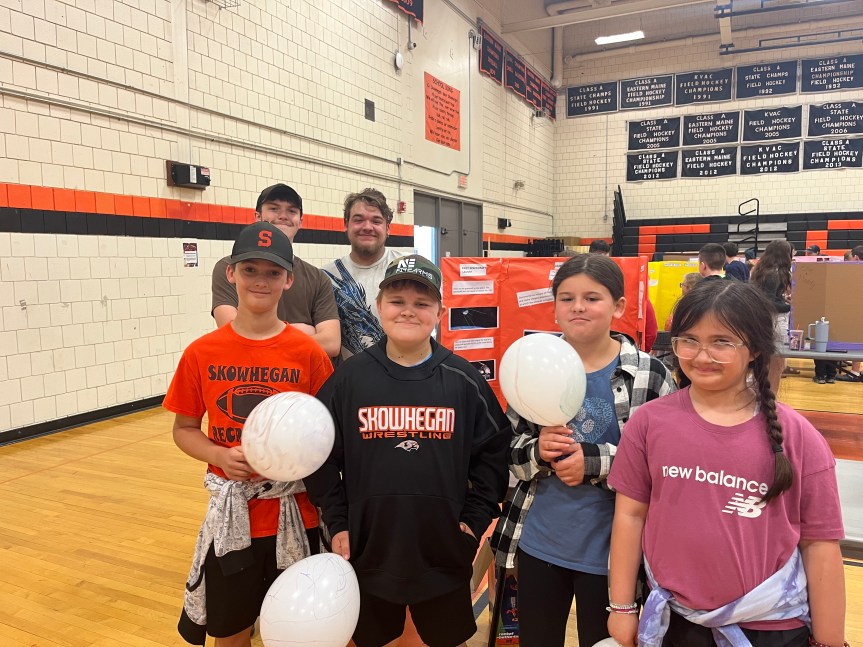
The ConCEPT pilot encouraged schools to view student growth as an ongoing process rather than just a final product. This recognition allowed educators to emphasize the importance of the journey itself, valuing the development of critical thinking, inquiry skills, and curiosity. One standout example of this success is MSAD 54, where Margaret Chase Smith School (MCSS) fifth-grade students’ inquiries about space culminated in a captivating interactive exhibition done by Skowhegan High School students.
At Skowhegan, the project began with a simple yet profound step: listening to the questions of fifth-grade students. These young learners’ curiosity about what lies beyond the horizon led to a series of inquiries that were meticulously explored and answered by high school students. The outcome of this project was a dynamic exhibition where Skowhegan High schoolers conducted mini-demonstrations addressing the MCSS fifth graders’ questions.
Ellie Quinn, a junior at Skowhegan High School, shared her thoughts on the initiative: “This type of learning addresses students’ curiosities and increases both high school and elementary students’ engagement.” Quinn’s sentiment highlights a key success factor of the pilot: fostering a learning environment where students’ natural curiosity drives their educational journey.
Another Skowhegan junior, Aiden McKinna, reflected on the depth of understanding gained through the project. “I picked black holes to learn about as a result of students’ questions. By learning about black holes and presenting it to students, I have a deeper understanding of the material.” McKinna’s experience underscores the dual benefit of the program, enhancing both the knowledge of high school students and the engagement of elementary students.
Kaitlin Dixon, a fifth-grade educator whose students participated in the project, emphasized the authenticity of the learning experience: “By having my fifth graders generate and prioritize the inquiry questions, when the final product came about, students had an authentic interest in learning the answers to their questions.”
This approach ensured that the learning process was driven by genuine curiosity, leading to higher levels of engagement and a more meaningful educational experience.
Bailey Green, MSAD 54 high school science teacher, expressed: “I enjoyed the ConCEPT program because it allowed me the opportunity and flexibility to access my students’ learning in ways that fit their learning modalities. It also encouraged my students to be creative and think critically in their learning!”
The high levels of engagement observed among both the elementary students and the high schoolers who served as their expert guides are evidence of the ConCEPT’s pilot success.
To learn more about ConCEPT and other professional learning opportunities available to Maine educators, visit the Interdisciplinary Instruction page.

![IMG_5289[2283]-2](https://i0.wp.com/mainedoenews.net/wp-content/uploads/2025/03/4ae29-img_52892283-2.jpg?w=271&h=203&ssl=1 "IMG_5289[2283]-2")
![IMG_5259[2282]-2](https://i0.wp.com/mainedoenews.net/wp-content/uploads/2025/03/f2db2-img_52592282-2.jpg?w=153&h=203&ssl=1 "IMG_5259[2282]-2")
![IMG_5296[2285]-2](https://i0.wp.com/mainedoenews.net/wp-content/uploads/2025/03/c3a06-img_52962285-2.jpg?w=271&h=203&ssl=1 "IMG_5296[2285]-2")
![IMG_5302[2284]-2](https://i0.wp.com/mainedoenews.net/wp-content/uploads/2025/03/19636-img_53022284-2.jpg?w=152&h=203&ssl=1 "IMG_5302[2284]-2")