Windsor Elementary School Explores Maine Seaweeds with a Little ‘Kelp’ From Their Friends

Windsor Elementary School educators Kristel Anuszewski and Jana Diket recently collaborated with Maine Sea Grant, Chef Andrew Wilkinson from North Coast Seafoods, and other Maine businesses to bring seaweed to the classroom and cafeteria.

Since the fall of 2023, both educators have been engaged in professional learning and other efforts to bring the sea inland to their community. Why seaweed? Seaweed farming and harvesting is considered to be “regenerative” and “sustainable” as it requires zero input for growth, no chemicals, fertilizers, or pesticides are needed–only providing benefits for the ecosystem and human health. It plays an important role in combating climate change by dampening wave energy and protecting coastal shorelines, absorbing carbon dioxide from the atmosphere, reducing the effects of ocean acidification by raising the PH, and supplying oxygen to ocean waters. Seaweed is also locally sourced, delicious, and one of the most nutrient-dense foods on the planet.

Seaweed farming and wild harvest also help diversify Maine’s marine economy. It’s a great opportunity and source of income for fishermen and others during the winter season, enabling year-round employment opportunities.

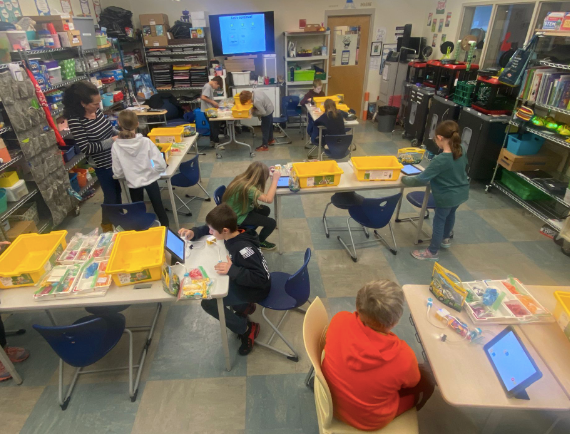
On January 16th, 2024, Windsor Elementary students explored and identified a variety of seaweeds that grow in the Gulf of Maine, and engaged in pressing and other art-related activities. These activities were followed by culinary arts on January 18th with Chef Andrew and his delicious “Seaweed-ish Meat(less)balls,” containing sugar kelp from Maine’s waters. Students also explored a variety of products like seaweed salad and kelp burgers, donated by Atlantic Sea Farms (Biddeford, Maine), as well as a variety of “wild” harvested seaweed products like kelp crunch, seaweed tea, seasonings, generously donated by Maine Coast Sea Vegetables (Hancock, Maine).

Soon after trying the meatballs with Chef Andrew in the morning, Isaiah, an initially skeptical 6th-grader, raised his hand and shared “I didn’t think I would like them, but I really do; may I change my choice for lunch?!”

Although this event primarily engaged 6th, 7th, and 8th graders, all students were offered this option for lunch on January 18th. Windsor School Chefs Missy Parsons and Kara Bailey served up Seaweed-ish Meatballs with pasta and marinara. Chef Ron Adams of Maine Farm and Sea Cooperative, and Chef Mike Flynn, the Director of Student Nutrition Services, Somerville, Maine, stopped in with some Maine marinara with tomatoes sourced from Maine growers– delicious! There was also a special meal option, a kelp burger, served to faculty.

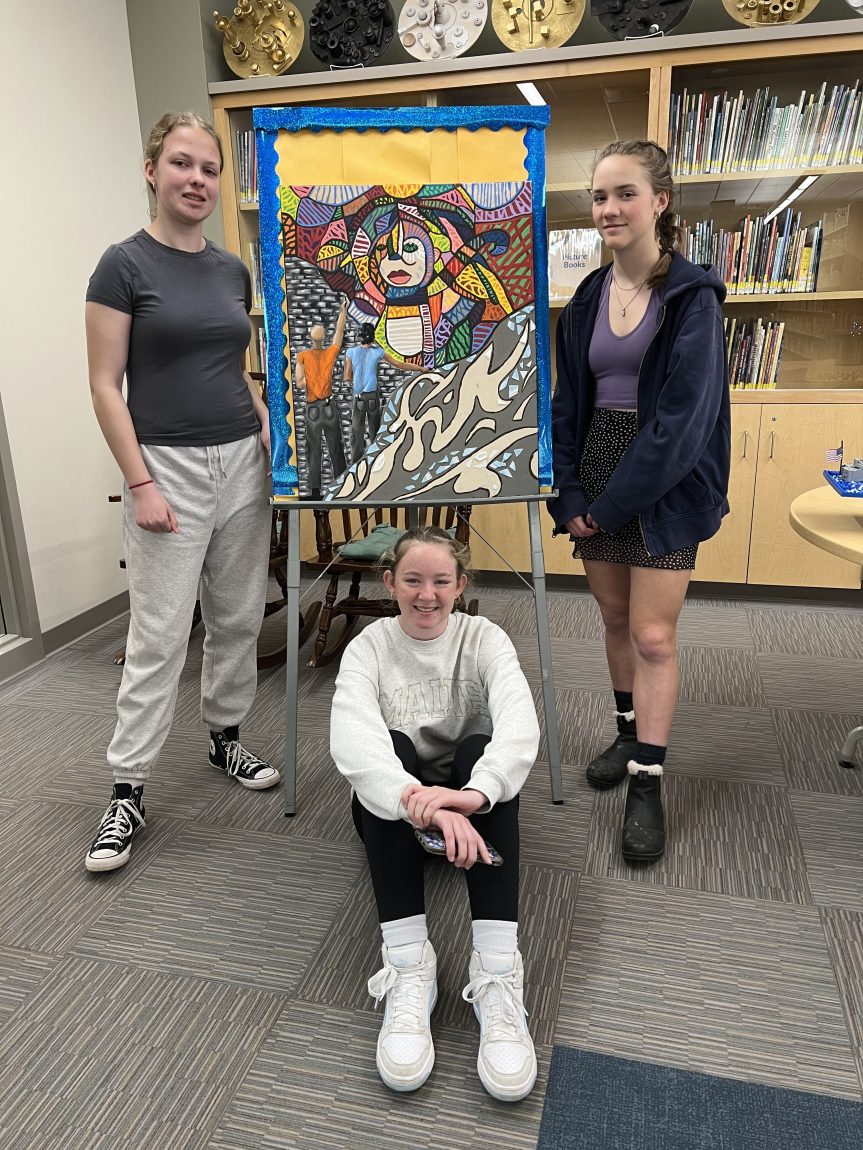
Prior to this collaboration, Anuskewski and Diket introduced their students to seaweed curriculum and activities, and kindergarten through 8th grade students all helped decorate the hallway in preparation for the events. Fish and seaweed adorned the walls, fabric hung from the ceiling with silhouettes of sea-life, creating a magical “seaprise” and experience for all. An intertidal ocean mural with seaweed and other creatures was also on display, built by the 7th and 8th grade students.

Diket plans to continue this work by installing a saltwater tank in her classroom, and both teachers plan on taking students on a field trip to the sea in the spring.

Keri Kaczor, Maine Sea Grant, shared, “It is wonderful to see educators and food service staff at Windsor Elementary collaborate to provide high-quality, hands-on science, art, and nutritional experiences for their students. It’s also a gift to have Maine’s seaweed industry and Chef Andrew generously commit their time, expertise, and products to this effort.”

For more information, please reach out to Kristel (kanuszewski@svrsu.org) or Jana (jdiket@svrsu.org).

This story was submitted by Windsor Elementary School through our Maine DOE Good News Submission form. To submit a story, please fill out the form here.

Photography and Poetry Gallery at Lyseth Elementary School

Walking into the bright atrium of Lyseth Elementary School in Portland, you are met by giant black-and-white photographs of the 20 students in Leigh Quigley’s 4th-grade class. Hanging from the skylight are even more pictures, pictures that students took after learning photography elements like composition, light, and focal point from professional photographer Liz Bieber. Proud adults gather around, taking pictures of student work. As you walk to the end of the atrium, framed images of students and the poetry they wrote, the conclusion to a poetry unit designed to build empathy, understanding, and community within the classroom, hang on the wall in neat rows.

The unit began as a single-focus poetry unit where students were exposed to classic and modern poets and forms and then transferred their learning to create original poetry that captured their voices. After a visit to the Bowdoin Museum of Art, student’s curiosity and excitement transformed the single focus into a multidisciplinary unit that included original photography. Students added knowledge and skills around photography to their poetry knowledge and applied those skills by taking candid and studio pictures of their peers that would accompany their poetry. Once photos were taken and poetry was written, students created frames, chose pictures, and typed their poems, which included different fonts and effects that emphasized certain words and phrases.

4th-grade student Patrick explained his choice of purposely using lowercase letters to “make it different than the others.”

The final products were mounted in the atrium, where they would be a prominent addition and visible to every member of the school community.

“I really like taking pictures and writing poetry,” 4th grade student Grace shared. “The hardest part was figuring out what to write, but I used a poem we read before for inspiration.”

Mrs. Quigley noticed an increase in student engagement but also grew professionally herself. “Working with them every day opened my eyes to new ways of thinking. They provided a fresh take on the subject matter through their unique interpretations.”

This project gave students an opportunity to share their voices, but it also has had ripple effects throughout the school. Lyseth principal Sara Goodall shared that “kids, families, and staff are asking and excited to learn more” and that “less than a week after it opened, Lyseth is exploring a photography club.”

The student voice in their poetry, the choice of which photos to use to illustrate their poetry, the community gathering to celebrate,  and the ripple effects it has caused throughout the school are concrete examples of the school’s core value of “we all belong here at Lyseth.”

This story was a collaboration between the Maine Department of Education’s Interdisciplinary Instruction (II) Team and Lyseth Elementary School. If you are interested in collaborating with the Maine DOE’s II Team to showcase your school’s interdisciplinary instructional work, reach out to Kathy Bertini at kathy.bertini@maine.gov. You can also submit Maine school highlights to Maine DOE’s Good News Submission Form.

Celebrating Women in CTE: Meet Welding Student Emma Koch from Rumford

The Maine Department of Education, in collaboration with Career and Technical Education (CTE) schools throughout Maine, is celebrating CTE month this February by highlighting some of the amazing women who have found their path in life through career and technical education. We hope their stories inspire you the way they have inspired us. (Here are the other stories featured in February: Danica Wooster, Madison Jackson, Amanda Baker.)

Emma Koch is currently in her senior year at Mountain Valley High School in Rumford, Maine, and in her second year at Region 9 School of Applied Technology where she participates in the metal trades program. The two-year program combines the hands-on use of machine tools and equipment with different types of welding and fabrication of metals through lab exercises and a variety of projects.

“Originally I wanted to do lathe work and carving but they only had building construction which wasn’t what I was looking for,” explained Koch. Instead, she took a chance with metal trades to try their lathes and precision machining.

“Going into it, I was hoping to become proficient in machining but soon realized that was not for me, so I shifted to the other end of the shop where the welders were,” said Koch.

After a short time in the booth, she realized she had a natural knack and love for stick arc welding, and that love soon spread to TIG (Tungsten Inert Gas) welding.

“It’s been fun to watch Emma become a welder,” said Region 9 Metal Trades Instructor Curtiss Hallock. “It didn’t take long for her to discover that machining was not for her – she was pretty clear about that by lunchtime of her first day of machining.  It really validated her innate talent as a welder.”

As the only female in her class, Koch explains that the trades have always been largely dominated by men, making them quite an intimidating environment for women to try and be a part of. Looking past all that, Koch explains that she was actually excited to get into welding because her Pepere was a welder, and both her brothers-in-law knew the craft as well. “I was excited to be able to show them up,” she added.


Koch continues to develop her craft and aspires to continue being a high achiever in her program. “Last year, I passed my flat stick welding test, and I am hoping to pass my vertical test this winter,” she said. Passing this test will give her American Welding Society (AWS) certification.

“She raises the bar for everybody in the shop,” added Hallock. “But many of her natural strengths are the ones that can be hard to learn:  focus, determination, and drive.  She’s really good at blocking out distractions.  She stays with a project until it’s done.  She’ll be an outstanding welder if she chooses to pursue that path, but if not those skills will make her successful no matter what she chooses to do.”

As for the future, Koch has yet to figure out exactly what she wants to do but she has a plan to get the process started. “I know I want to go to college,” she said. “I’ll be starting at Central Maine Community College in Auburn next year to play soccer and iron out my future plans.” Koch says she is planning on participating in the upcoming statewide Skills USA competition happening next month in Bangor. This is the first time Region 9 has participated since COVID.

“We are very proud of Emma for being open to trying new experiences which has helped her discover a passion for welding,” said Region 9 Director Brenda Gammon.

When asked what advice she had for current and future CTE students, especially young women, Koch said, “The most important thing is to hold your ground and be open to their advice and help, but don’t let them believe that ‘girly’ stereotype we are given; we are strong, we are powerful, and we can do the trades just as good as anyone.”

Emma and her dad.
Emma and her dad.

Step Inside Hancock County Technical Center

Hancock County Technical Center (HCTC) opened its doors to the Maine Department of Education (DOE) on Valentine’s Day to provide a glimpse of what a day looks like within its walls. Upon arrival, the smell of baked scallops drifted down the hallway from the culinary program at work preparing a special meal for staff. The office was buzzing with the anticipation of another day of learning, with students and staff discussing college plans, transportation routes, and what they are looking forward to as the season changes. HCTC offers programs such as biomedical research, various types of automotive and technical specialties, early childhood education, health careers, hospitality and tourism, law enforcement, and more. Sophomores, juniors, and seniors from all over Hancock County have the opportunity to learn from specialists in their field of interest, with Director Bill Tracy and his dedicated staff there to oversee their endeavors.

Sabrina, a biomedical research support student, explained that she was drawn to the program after a 6th-grade field trip to HCTC opened her eyes to the possibilities available. After a 7th-grade STEM unit utilizing microscopes to investigate onion cells ignited her love for research, she knew that was the path she wanted to go on. HCTC’s biomedical program opened the doors for her to fully explore the field.

As a result of support from her HCTC educators and the Bridge Program, a dual enrollment opportunity that allows students to participate at HCTC while simultaneously taking college credits at their participating high school, Sabrina was accepted to the Aspirinaut High School Summer Internship Program at Vanderbilt University Medical Center in Tennessee. Sabrina is also participating in an ongoing collaboration with Jackson Labs to give her even more exposure to the worlds of scientific and medical research. Sabrina says she has learned a lot from her experience with HCTC and it helped fuel her passion. “This is what I was meant to do,” she said. She also observed from the professionals she interacts with that a career can be more than a job, realizing that, “your work can be your career and be emotionally satisfying.”

Hancock County Technical Center also boasts award-winning educators. Recent Milken Educator Award recipient Meghan Stubbs teaches early childhood education, working with students considering the classroom as their career. An in-house preschool started by Ms. Stubbs provides interactive, hands-on experience for her students while also providing a service to the community. The classroom boasts a full preschool room experience, complete with early childhood level tables and chairs, a “centers” area, and colorful student-created décor.

Her students are quick to point out what makes her an excellent role model and mentor. One of her third-year students, Isabell says, “She has a different way of teaching and gears it toward how we want to learn.”

She said if she could use one word to describe Ms. Stubbs it would be “passionate”. That passion was easy to see as Meghan led a class discussion about ADHD in children and adults.  Meghan led a class discussion on how to identify potential behaviors, as well as strategies for working with all learning types in the classroom. What stood out in this discussion was how open the dialogue was between Meghan and her students, with many sharing personal stories of their own experiences with students with ADHD.  Not only were her students learning the content, but they were able to articulate how that information would be relevant for them in their future classrooms. In Meghan’s classroom, everyone has a voice and is invested in how they can use that voice to impact their own lives and the lives of others.

It doesn’t take long to see what an impact CTE is making in Ellsworth. Instead of learning concepts in the abstract, students at HCTC are doing medical research, teaching children, preparing and serving meals, and so much more. Hancock County Technical Center is an important part of preparing Maine students with the skills needed to turn their passions into careers.

Celebrate #SELday 2024 by Sharing Your School Highlights!

(Pictured: Orono Middle School Students participating in a teacher designed, summer program focused on social-emotional student needs)

Maine schools will celebrate the 4th annual International Social Emotional Learning (SEL) Day celebration on March 8, 2024, and the week leading up to it.

We know that Maine schools are doing amazing things to cultivate the social and emotional learning of all of their students and we want to share that collective success with the nation. With that in mind, this year we are asking you to participate in this national effort by sharing your SEL highlights during the school year and beyond and/or share your school’s 2024 SEL Day activities and initiatives by filling out this form.

Submissions received from this form will help Maine come together as a state to recognize the amazing work of Maine schools at a national level to be included on the SEL4US Leader Board. Together, let’s make Maine a shining example of SEL excellence!

You can also share your #SELdayME2024 highlights during the week of March 8th by posting to your school’s social media and tagging Maine DOE, using #SELday or #SELdayME2024 and tag the Maine DOE at @MaineDepartmentofEducation1 on Facebook and @mainedepted on Instagram.

Check out some of the toolkits and resources for #SEL Day that the Maine DOE shared earlier this month here. For more details on the day or on inclusive ideas, send questions to DOESchoolandStudentSupports@maine.gov.

Maine DOE Podcast Highlights Hands-On Career and Technical Education Experiences

Commissioner Makin Talks with CTE Directors Randy Crockett from Oxford Hills Technical School, Bobby Deetjen from Mid-Coast School of Technology, and Bill Tracy from Hancock County Technical Center

Career and Technical Education (CTE) programs provide Maine students with hands-on experiences in programs like culinary arts, welding, auto, law enforcement, early childhood education, and so much more. On this month’s What Holds Us Together podcast, Maine Education Commissioner Pender Makin talks with three CTE leaders about this engaging learning pathway, Randy Crockett from Oxford Hills Technical School, Bobby Deetjen from Mid-Coast School of Technology, and Bill Tracy from Hancock County Technical Center. They share how CTEs help students build the skills, knowledge, and real-world experiences they need to thrive. Listen here.

“We’re big believers in the hands-on, real-world, interdisciplinary learning that’s happening at Maine’s Career and Technical Education schools. [Students are] learning skills, they’re learning academic content, they’re solving problems and using critical thinking, they’re developing teamwork skills and communication skills—it’s such a robust model of education,” said Education Commissioner Pender Makin on the podcast.

“What happens in our school is pretty magical on a daily basis. We’re dealing with students who are future doctors, engineers, electricians, welders, you name it. These are going to be contributing members of our communities and we get to watch them at 16 and 17 really grow and make decisions that are going to impact our communities as a whole,” said Mid-Coast School of Technology Director Bobby Deetjen.

“It’s nice to be able to offer things that students need and want in the community,” said Hancock County Technical Center Director Bill Tracy. “That model of being able to learn and then immediately apply and practice is something that our students talk a lot about and being able to have that hands-on opportunity.”

“Our spaces are intermingled with the academic areas as well, so a student can walk from engineering and architectural design to their calculus class. It really makes a big difference in terms of access,” said Oxford Hills Technical School Director Randy Crockett, who also talked about the importance of hands-on learning. “That actual application is going to deepen their learning. They have to problem-solve in real time instead of abstract thinking.”

The group also discussed how the CTE model encourages students to take risks and be confident in trying new things.

“We tell our students, if you don’t fail at something that means you are not going to learn to your fullest potential. That’s going to increase engagement right there where students are going to have that kind of opportunity to feel at ease and take a chance,” said Deetjen, who explained that when students are worried about the social pressures around them if they fail, they’ll never take that chance to begin with and CTE programs take that pressure away.

Tracy summed up the power and potential of what CTEs in Maine offer.

“You can walk down the hall and see welding going on, you can see a car being taken apart, you can see [students] looking at electrical systems, and then you can go up and see three-year-olds running around in a classroom, and then you can step over to another classroom where they’re turning cockroaches into cyborgs and learning to control them. Then you walk down the hall and they’re making this amazing meal. What is this world? It’s just an amazing thing,” he said. “That is the world, and we’re just this small-scale piece of what reality is.”

Maine CTE program enrollment surpassed 10,000 students this year, and communities and the State continue to invest in this transformational learning pathway. Maine’s 27 Career and Technical Education regions and centers enroll students in 85 programs. The Mills administration invested $20 million from the Governor’s Jobs Plan to expand CTEs in Maine. In addition to the Jobs Plan funding, the Governor and the Legislature have increased funding for CTEs by more than $10 million.

Extended-Day Enrichment Program Boosts Math Skills and Attendance in Dexter, Maine

(Pictured: Ridge View Community students proudly display their extended-day enrichment projects.)

When Ridge View Community School (RVCS) in Dexter, Maine, utilized Emergency Relief Funds to establish an extended-day enrichment program for students in grades 3-8, they couldn’t anticipate the immediate positive impact it would bring.

“We wanted to offer our students hands-on opportunities to learn about things outside of their regular curriculum, places where, in essence, they could be learning and not even realize it,” said Pre-K Through 2 Instructional Coach Kelly Gay,

One hundred fifty students stayed after school on Monday and Thursday nights to participate in various enrichment programs and tutoring sessions.

“I look forward to the extended day,” Lizzie, a Ridge View fifth grader, explained, “because there are so many fun activities to choose from!”

A Ridge View Community School student holds up a painting of a red mug framed by snowy pine trees on a bright blue landscape while giving the camera a thumbs up.
A Ridge View Community School student displays a painting they created during their extend-day enrichment art class.

Students like Lizzie took part in traditional extracurriculars, like woodworking, baking, and art, spent time outside, practiced robotics, conducted mad science experiments, and had a chance to shake out their energy in dance classes.

Older students visited the Tri-County Technical Center to learn about criminal justice, commercial truck driving, early childhood education, and health occupations. In an effort to include the greater Dexter student community, students from Dexter Regional High School came over to teach lessons from their STEM project as part of their coursework.

Gay remembers how touched she was by the students’ enthusiasm.

“It was so amazing watching the kids leave each night with their finished products and the huge smiles on their faces. The tutoring kids even loved heading to their tutoring sessions as the sessions were engaging and hands-on learning,” she said.

Amongst the creative programming, ensuring student received the tutoring help they needed was still a priority. Students would break off for one-on-one tutoring time with staff throughout the sessions.

“In order to make this plan work, we needed teachers who were willing to either tutor or run an enrichment group. Our staff answered our call for help in amazing ways,” said Gay. In all, 30 educators volunteered for the enrichment programs, and their commitment is evident when you speak to their students.

“I think extended days are so fun because the teachers are so nice, and I learn a lot,” ” said fourth grader Khloe.

According to school data, students who participated in the tutoring and enrichment sessions saw significant gains, especially in math fact fluency and attendance.

“We tracked the attendance of all students at Ridge View Community School as part of our school improvement plan and found that almost all students had a positive impact on their attendance rate. They truly wanted to be there and were sad when the program ended,” said Gay.

A student smiles at the camera while holding baked goods they made during an Extended Day Enrichment program.
A Ridge View Community School student smiling after a successful extended-day enrichment baking session.

Students were not the only ones benefiting from the extended-day enrichment. Gay reported that the program fostered relationships with parents and allowed teachers to design lessons beyond the scope of their regular curriculum, centered around their passions.

“We are proud of our school and our students and are incredibly thankful for the opportunity to provide this for them,” commented Gay. The program was so successful that Ridge View extended it to the 2023-2024 school year, expanding both the tutoring and enrichment programs to the high school.

This learning opportunity was made available through the Coronavirus Response Relief Supplemental Appropriations Act (CRRSA). Visit our office of Federal Response Programming here to learn more about CRRSA.

Did your school use Emergency Relief funds to create engaging student programming like Ridge View? If so, we would love to hear from you. Click here to share your story!

Celebrating Women in CTE: Meet Auto Collision Instructor Danica Wooster

The Maine Department of Education, in collaboration with Career and Technical Education (CTE) schools throughout Maine, is celebrating CTE month this February by highlighting some of the amazing women who have found their path in life through career and technical education. We hope their stories inspire you the way they have inspired us.

Danica Wooster has taught the Auto Collision program at the Mid-Coast School of Technology (MCST) for the last 13 years. The program offers a diverse look into the automotive collision industry, including working with the most up-to-date tools and equipment and learning skills in welding, paint preparation, dent repair, and detailing.

The program she now teaches is the same program that got Wooster started in auto collision when she was in high school.

“I had no idea what I wanted to do. My parents suggested I take the class and the rest is history,” said Wooster. Following high school, she attended WyoTech for Collision/Refinishing, and then started working as a technician in the auto collision industry, eventually earning a business degree and then transitioning to teaching the trade right here in Maine.

“Although I didn’t have a background in education specifically, I feel like I played that role many times in my life – from teaching horseback riding lessons in high school to working side-by-side with entry-level technicians in the shop,” said Wooster. “Both of my parents were also educators, and both were a huge support system for me as I started my career,” she added.

Danica Wooster working with a student
Danica Wooster working with MCST student Bryson Mattox plastic welding a wheel flare (Photo credit: Zoe Richardson, a student in MCST Design Technology program).

Wooster says there are a lot of things she loves about working in CTE but one of her favorites is introducing her trade to the students. “I love seeing a student’s face when all of a sudden something clicks – it’s truly special.”

Being able to teach something she is passionate about while experimenting and learning alongside the students is another huge perk for Wooster. Explaining that many people don’t understand that auto collision repair is an art in and of itself. “It’s making something new again, but every single job is different and handcrafted,” she said.

Danica Wooster working with MCST student Andrew Zuidema refinishing a hood in the paint booth (Photo credit: Zoe Richardson, a student in MCST Design Technology program).

During her time working in CTE, Wooster has had many opportunities to grow professionally as well, by earning a master’s degree and continuing to hone her craft by working in the collision repair field during her summers off from teaching.

“I get to make connections with other people in my trade and in education, and I get to work in a building that has so many other talented CTE teachers,” said Wooster. “It’s all an amazing experience, and I think it’s a very unique part of being a CTE teacher.”

One of the things Wooster is the proudest of is being an advocate for CTE, promoting how important it is for many students and industries but also the incredible opportunities it creates for students.

“Attending CTE when I was in high school had a much different, and often negative, connotation,” said Wooster. “We have come a long way from that.”

“Danica has inspired countless students to pursue non-traditional career pathways,” said Bobby Deetjen, Director of the Mid-Coast School of Technology. “Her students continue to break down barriers and succeed in shops all over Maine.”

Wooster shared her advice for students interested in CTE.

“Working my entire career in a non-traditional field has taught me that the only person I need to prove myself to is myself,” she said. “I’ve heard my fair share of ‘no,’ but I think having a little bit of grit is what makes the difference, what made me keep moving forward. I always encourage my students to have a little ‘grit’…to push through when things get tough and to not be afraid to make mistakes. My entire trade is based on mistakes…and that’s what helps us learn and get better at what we do!”

Eliot Elementary School Civil Rights Team Takes the Great Kindness Challenge

The Civil Rights Team at Eliot Elementary School has been working hard to make their school a better place to be. The Civil Rights Team is made up of 21 grade three students who engage their school community to think and talk about race and skin color, national origin and ancestry, religion, disabilities, gender, and orientation (in an age-appropriate manner).

“Our team works to make our school a safe and accepting place for all of our students,” said Civil Rights Team Advisor Marissa Armitage. The Civil Rights Team Project is a statewide initiative coordinated by the State of Maine Office of the Attorney General.

Grade 3 students have been spreading the message of acceptance and standing up for what’s right. They’ve been thinking about important issues, hosting important conversations, and changing the climate of the school to be more inclusive.

To combat bias-based harassment, the Civil Rights Team recently hosted an assembly for the Great Kindness Challenge, a weeklong national campaign in January where students in schools across the U.S. are challenged to complete as many acts of kindness as possible using a customizable checklist. Armitage says the Civil Rights Team was outstanding at modeling citizenship during their week of kindness this year.

“The Great Kindness Challenge is just one example of [the Civil Rights Team] initiative,” said Armitage. “I’m really proud of the way our students have shown up as leaders. They set the tone for the rest of the school,” she added.

Armitage tells us that the Civil Rights Team has many more plans for schoolwide initiatives throughout the year.

Find more information about The Great Kindness Challenge here.

This story was a collaboration with Eliot Elementary School. To submit a story from your school, fill out our good news submission form.

Fostering the Future – Kicking Off CTE Month at the State House 

(Pictured: Emily Worcester a senior at United Technology Center [UTC] in Bangor.)

The Hall of Flags was abuzz Wednesday morning as representatives from across the state came to Maine’s Career and Technical Education (CTE) Month Kick Off at the State House. Students, instructors, and directors from 15  of Maine’s 27 CTE centers came with everything from canapes to holographic 3D fans, proudly sharing legislators and government officials the advanced skills CTE students are learning.

Biotechnology Tool from Foster Career and Technical Center

When you think of vocational learning, you might picture what Hancock County Technical Center director Bill Tracy describes as “hard trades” such as welding or mechanics. However, the CTE students of today are starting down a wide array of career paths, from graphic design to criminal justice.

“We’re really trying to give kids a broad breadth of what they can do at a CTE enter,” explained Tracy,  “I don’t want them to think it’s just hard trades. Even though the hard trades are really important, there are so many different things they can do.”

Chris Davis, the assistant director of Farmington’s Foster CTE Center, was excited to share what his students are learning in Foster’s biotechnology program.

“They’re learning how to isolate a virus, DNA splicing, and genetic engineering,” he said. “Students working with biotechnology are looking at the biomedical field or forensics. It really increases their ability to work in a lab.”

Many CTE instructors and directors see their work as a building block for Maine’s economy. Matt Peterman of Sanford Regional Technical Center explained, “Maine CTEs are important because we are trying to build the Maine economy, and we’re trying to develop young employees to replace an aging workforce.”

As an extension of this effort, CTE curriculums support their local economies. For example, Oxford Hills Tech School offers a popular hospitality and tourism program, which they are expanding to include outdoor recreation to prepare students to work in the growing ski and ride industry of Oxford County.

Instructor Jeremy Bourque of Somerset Creative Tech Center hopes to see his students prosper and return to Maine. “Our county has a pretty high poverty rate, so we’re pretty proud of the work we’ve done changing these kids’ lives, helping them go to school, find a really good job, and then come back to Somerset County to help the county grow and change,” he said.

Another positive change happening at CTE schools across the country is an uptake in young women working in trades. Maine is no exception regarding this trend. In fact, every instructor and director at the kick off reported an increase in “non-traditional students.”

“We’re trying to break some stereotypes,” Peterman explained. “Traditional roles don’t exist anymore. Anyone can do the job.”

Instructors have seen this trend most notably in welding programs, which continue to be one of the most popular CTE offerings in the state. Jorja Brown, a junior at the Somerset Career and Technical Center, came to the CTE Kick Off to share her experience as a young woman in welding. “I am the best in my class,” she declared, noting that “it’s really cool to experience a very male dominated trade.”

United Technology Center (UTC) senior Emily Worcester was also present, representing young women in mechanics. Worcester is a part of UTC’s small engines program, and loving every second of it. “My experience has been absolutely amazing,” said Worcester. “It’s a chance to expand my knowledge. I could expand my knowledge into a future career, or I could take this knowledge and do my own personal thing. It’s a good choice to have.”

Canapes Made by the Capitol CTE Culinary Team
Canapes made by the Capitol Area Technology Center (CATC) Culinary Team.

Having this kind of hands-on, real-world education is precisely what keeps many CTE students in school. Matthew Hamilton, the Student Services Coordinator at Bath Tech, came to CTE after working as a dean of students. As a dean, Hamilton saw many students who struggled in a traditional school setting. Hamilton shared that those same students now excel in their CTE programs. They are “coming to school early, they’re coming to school on a regular basis, and they’re jazzed up about learning.”

Students like those Hamilton described were the most excited to share their CTE experiences at the kick off. “I was going to drop out in December of my junior year,” remembers Brett Bretton, a senior in the Culinary Program at Capitol Area Technical Center. “But my guidance counselor suggested the culinary program for me, and now, instead of dropping out, I’m going to college for this.”

CTEs aren’t only keeping kids in school but giving them an early advantage for their post-graduate lives. “People think vocation or technology centers are for students that are not college bound, whereas we’re the total opposite. We catapult students so that they can go to college and go to college with a head start,” commented Michael Bouthilette of Biddeford Regional Technology.

Kaylie Trembly of Lewiston Regional Technical Center (LRTC) chose to enter the EMT program after speaking to past graduates. “The people I talked to who went through LRTC are doing really well,” said Trembly, “it helped them determine where they wanted to go.”

CTE programs work with post-secondary institutions across the state, like Southern Maine Community College, University of Maine Farmington, and trade schools like the Aveda Institute. However, these partnerships go beyond traditional higher education, partnering directly with local employers to place students in the field. At Region 9 School of Applied Technology, CNA students split their time between Rumford Hospital and local nursing homes. Meanwhile, in Ellsworth, students can intern with Jackson Laboratories.

“We know we’re small, we’re rural, but I’m definitely passionate about this work,” said Brenda Gammon, the director and superintendent of Region 9, “I’ll do anything I can to give students the best opportunities.”

CTE month continues through February, and it is the perfect time to dig into everything CTE has to offer. Check out a list of Maine’s CTE schools with links for you to explore.