St. George School Second Grade Students Create Poster Campaign for Local Community

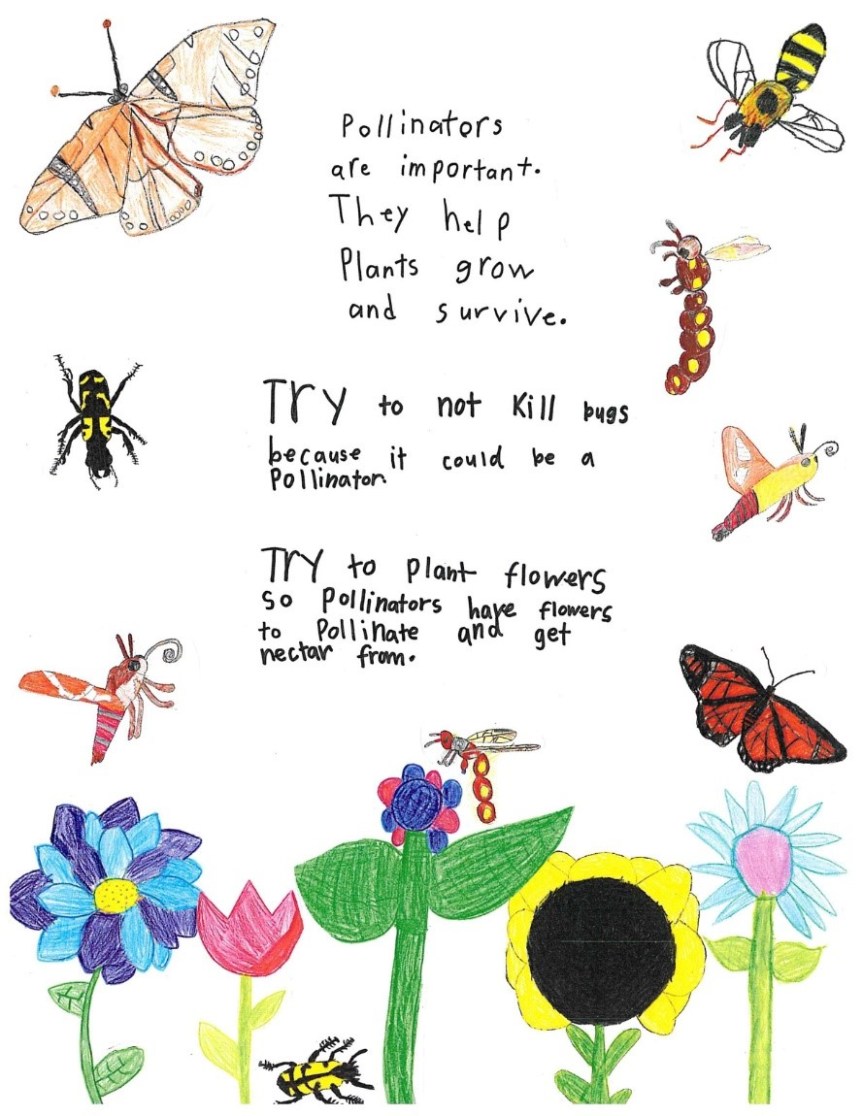
Second-grade students at St. George School in Tenants Harbor spent the spring working on a collaborative research project examining the process of pollination and the need for pollinators to create a healthy environment. The six-week-long project, led by their teacher Alison Babb, 2020 Knox County Teacher of the Year and 2021 Teacher of the Year Finalist, culminated in scientific drawings about various pollinators they had spent time learning about.

Before starting on the drawings, the students practiced their research, reading, and writing skills to create the strongest final product. The students collaborated on reading intricate scientific texts and gathered information on the various plants they were studying. After conducting thorough research on pollinators, the students began creating scientific drawings of the plants. Throughout the drawing process, the students were consistently giving and receiving feedback, enabling them to create the strongest final project possible.

Once completed, the students were not yet satisfied- they wanted to create a poster that would go beyond their classroom for their local communities to both showcase their pollinator drawings and to display some public service messaging regarding pollinators. The second-grade students demonstrated strong collaboration skills and thorough knowledge, and passion for their environments throughout this project.

Readers are encouraged to go to the Jackson Memorial Library in Tenants Harbor and the Camden Public Library to view the posters in person. Knox Village Soup will also be featuring the poster in their late June to early July edition.

Information for this article was provided by St. George School. The article was written by Maine Department of Education Intern Clio Bersani as part of the Maine Schools Sharing Success Campaign. To submit a story or an idea, email it to Rachel at rachel.paling@maine.gov.

Free Digital Learning and Computer Science Summer Professional Learning for Educators!

In addition to the many professional learning opportunities hosted by the Maine Department of Education (DOE) this summer, the Office of Innovation is offering an array of digital learning and computer science professional learning opportunities.

Topics include remote learning, green screen creation, digital worksheets, innovative ways to use memes, gifs, and emojis, and sessions on digital learning for students at different grade levels including elementary, middle, and high school level.

Find details about each of these sessions, in the order that they are offered, in the list below. You can also find them on the Maine DOE Professional Development Calendar, where many other professional learning opportunities and events are also available in a calendar view.

Digital Learning and Computer Science Summer Professional Learning: 

June 2021 

Date/Time: June 29th, 2021, 10am.  

Topic: Rethinking Remote Learning 

Description: As we emerge from the cloud of remote learning due to necessity, let’s explore what worked and what didn’t. We’ll share best practices for remote learning as well as dig into innovative ways to rethink how remote learning can be done. 

Register Here

Contact: For more information contact Emma-Marie Banks emma-marie.banks@maine.gov or Jonathan Graham jonathan.m.graham@maine.gov 

———————————————————————————————————– 

Date/Time: Asynchronous. Available on June 29th, 2021. 

Topic:  Green Screen Creation 

Description: Green screen technology may seem intimidating at first, but the basics are fairly simple and allow for tremendous creativity.  While having a professional green screen is helpful, teachers have been “hacking” this technology for years with green clothing, green tents, puppets on green sticks, green screen boxes and even green playdough.  Teachers can transport themselves anywhere and students’ imaginative play can go to a new level. 

Contact: For more information contact Emma-Marie Banks emma-marie.banks@maine.gov or Jonathan Graham jonathan.m.graham@maine.gov 
July 2021 

Date/Time: July 6th, 2021, 10am. 

Topic: Decoding Coding: Integrating Computer Science in the Elementary Classroom 

Description: Computer science can often feel like “yet another thing” that needs to “fit” in with all of the other learning requirements that teachers need to ensure are covered within a given year, Join this session to learn about strategies and best practices to integrate computer science skills, topics, and core competencies into your elementary classroom. 

Register Here

Contact: For more information contact Emma-Marie Banks emma-marie.banks@maine.gov or Jonathan Graham jonathan.m.graham@maine.gov 

———————————————————————————————————– 

Date/Time: July 13th, 2021, 11am. 

Topic: Memes, Gifs, and Emojis! 

Description: In this session, we will explore innovative ways to use memes, gifs, and emojis to enhance connection in remote and hybrid environments and increase general student engagement. We will also look at some best practices to get students excited about digital communication. 

Register Here

Contact: For more information contact Emma-Marie Banks emma-marie.banks@maine.gov or Jonathan Graham jonathan.m.graham@maine.gov 

———————————————————————————————————– 

Date/Time: July 20th11am. 

Topic: Digital Worksheets 

Description: Teachers can leverage several popular tools (Seesaw, Book Creator, Google Slides, etc.) to create engaging and personalized digital worksheets.  They can work off of pre-existing worksheets or generate their own.  The process of addressing interactivity, including various media, and allowing for multiple ways of demonstrating learning is challenging, but the final products can be transformative. 

Register Here 

Contact: For more information contact Emma-Marie Banks emma-marie.banks@maine.gov or Jonathan Graham jonathan.m.graham@maine.gov 

———————————————————————————————————– 

Date/Time: July 27th, 2021, 10am. 

Topic: Decoding Coding: Integrating Computer Science in the Middle School Classroom 

Description: Computer science can often feel like “yet another thing” that needs to “fit” in with all of the other learning requirements that teachers need to ensure are covered within a given year, Join this session to learn about strategies and best practices to integrate computer science skills, topics, and core competencies into your middle school classroom. 

Register Here

Contact: For more information contact Emma-Marie Banks emma-marie.banks@maine.gov or Jonathan Graham jonathan.m.graham@maine.gov 

August 2021 

Date/Time: Asynchronous. Available on August 10th2021. 

Topic: Book Creator in the Elementary Classroom 

Description: Due to the openness and user-friendly design of Book Creator, it could easily be leveraged in multiple ways.  First, a teacher could use it to create content with rich multimedia elements (pictures, videos, audio, diagrams, etc.).  Second, the teacher could work with the class to create a “class book” filled with content from everyone.  Third, the teacher could create an interactive workbook that students are able to manipulate and add their own answers.  Lastly, students could create digital books with their own content. 

Contact: For more information contact Emma-Marie Banks emma-marie.banks@maine.gov or Jonathan Graham jonathan.m.graham@maine.gov 

———————————————————————————————————– 

Date/Time: August 17th, 2021, 10am. 

Topic: Decoding CodingIntegrating Computer Science in the High School Classroom 

Description: Computer science can often feel like “yet another thing” that needs to “fit” in with all of the other learning requirements that teachers need to ensure are covered within a given year, Join this session to learn about strategies and best practices to integrate computer science skills, topics, and core competencies into your high school classroom. 

Register Here

Contact: For more information contact Emma-Marie Banks emma-marie.banks@maine.gov or Jonathan Graham jonathan.m.graham@maine.gov 

———————————————————————————————————- 

Date/Time: August 24th, 2021, 10am.  

Topic: Strategies for Hybrid Learning 

Description: Join MDOE digital learning specialists for a session on strategies for hybrid learning. As teachers continue to adapt their teaching practices to meet the changing classroom environment, we’ve seen some great strategies to accommodate hybrid learning environments. In this session, we will discuss different models for hybrid learning and dig into some best practices, with a deep dive into strategies.  

Register Here

Contact: For more information contact Emma-Marie Banks emma-marie.banks@maine.gov or Jonathan Graham jonathan.m.graham@maine.gov 

Changes to Maine DOE’s ESEA Program Office Effective July 1, 2021

The Elementary and Secondary Education Act (ESEA) Program Office within the Maine Department of Education (DOE) has recently undergone reorganization that will take effect on July 1, 2021.  The Department’s ESEA Team takes a collaborative approach to the oversight of the various educational programs under the ESEA.  As part of this collaborative approach, individuals within the ESEA Program Office serve as primary school administrative unit (SAU) contacts for different parts of the state.  Each ESEA Program Officer will continue to assist SAUs within each of the nine (9) superintendent regions with work related to ESEA programs.

Please review and note the updated regional ESEA contacts within the Maine DOE.  School administrative units located in each of the following superintendent regions can contact the following individuals for support with their ESEA program work as of July 1, 2021:

Superintendent Region ESEA Program Manager Phone Email
Region 1 – Aroostook Jessica Caron (207) 458-0334 jessica.s.caron@maine.gov
Region 2 – Penquis Travis Doughty (207) 624-6709 travis.w.doughty@maine.gov
Region 3 – Washington Ryan Reed (207) 530-2129 ryan.reed@maine.gov
Region 4 – Hancock Daniel Weeks (207) 624-6749 daniel.r.weeks@maine.gov
Region 5 – Mid Coast Ryan Reed (207) 530-2129 ryan.reed@maine.gov
Region 6 – Western Jackie Godbout (207) 557-3746 jackie.godbout@maine.gov
Region 7 – Cumberland Daniel Weeks (207) 624-6749 daniel.r.weeks@maine.gov
Region 8 – Kennebec Jessica Caron (207) 458-0334 jessica.s.caron@maine.gov
Region 9 – York Travis Doughty (207) 624-6709 travis.w.doughty@maine.gov

For SAUs that (1) may not know which superintendent region they belong to or (2) would simply like to confirm who to contact, please visit the ESEA Program Office’s regional contact map at: https://www.maine.gov/doe/learning/esea/contact.  Individuals can select a particular SAU from the drop-down menu on this page to determine who their ESEA Program Manager is and how to contact them.

For more information on the Department’s ESEA Federal Program Office, please contact ESEA Federal Programs Director, Cheryl Lang, at cheryl.lang@maine.gov or (207) 441-8059.

Governor Mills Signs Bill Focused on Increasing Cash Flow for School Administrative Units

Public Law 2021, Chapter 213, An Act Authorizing an Increase to the Maximum Annual Fund Balance for Public School Districts was signed by Governor Mills on June 15, 2021.  This law will become effective 90 days after the end of the session, and will not impact the fiscal year 2020-21. This legislation updated the law to say:

Notwithstanding any other law, general operating fund balances at the end of a school administrative unit’s fiscal year must be carried forward to meet the unit’s needs in the next year or over a period not to exceed 3 years. Unallocated balances in excess of 5% of the previous fiscal year’s school budget must be used to reduce the state and local share of the total allocation for the purpose of computing state subsidy. School boards may carry forward unallocated balances in excess of 5% of the previous year’s school budget and disburse these funds in the next year or over a period not to exceed 3 years” 

Please note the increase from 3% to 5%.

This law also provides that for fiscal years 2021-22, 2022-23, 2023-24, and 2024-25, the unallocated balances in excess of 9% may be carried over for the same use.

The benefit of this law is that it allows Maine’s SAUs to retain more funds on hand to buffer any unexpected financial needs. While the current statute does provide a mechanism to expand reserve funds in an emergency situation, this increase to the annual fund balance provides Maine’s SAUs the ability to access cash resources without incurring costs of fund borrowing, should an emergency arise.

The Maine Department of Education fully supported this bill, as it helps Maine SAUs effectively address recent or future financial needs.

For more information on Maine’s school funding, please visit:

https://www.maine.gov/doe/funding

Maine Chefs Highlight the Use of Local Ingredients in New Video Campaign  

The Child Nutrition Team at the Maine Department of Education (DOE) has set forth on a campaign to encourage schools to utilize fresh products the state of Maine offers in their school meal programs. The initiative, “Farm and Sea to School” brought in experts of cooking and agriculture to create videos on various recipes that use fresh ingredients grown or caught right here in Maine.  

Rob Dumas from the University of Maine School of Food and Agriculture was featured making several different recipes, including a bean burrito bowl and lentil shepherd’s pie. Dumas is the Food Science Innovation Coordinator at the University of Maine and a certified executive chef with the American Culinary Federation.

Jeff Wolovitz from Heiwa Tofu in Rockport demonstrated how to make a crispy tofu recipe. Mike Flynn, head of School Nutrition at RSU 12, with the assistance of Food Corps service member Maggie Blumenthal made a crunchy baked fish. Annie Watson, co-owner of Sheepscot Valley Farm in Whitefield, made “Mac and Trees”- a healthy spin on a classic meal. Finally, Caitlin Frame from Milkhouse Farm and Creamery in Monmouth created a Waldorf Chicken Salad with a healthy yogurt replacement to the traditional mayonnaise-filled recipe. 

All of the chefs demonstrated how to use fresh ingredients to create healthy and nutritious meals. Throughout their videos, they also teach the audience various cooking skills, including food safety, several knife skills, tricks for keeping your workspace tidy, and many other kitchen hacks.

Information in this article is just a snippet of what these amazing chefs show in their videos. Check out the playlist below for some new recipes and skills to try out! For more information contact Robin Kerber, Maine DOE Farm and Sea to School Coordinator at 207-592-0820 or Robin.Kerber@maine.gov.

July 2021 School Safety and Security Professional Development Offerings

To allow as much flexibility as possible for school staff to take a break from the incredibly difficult school year, yet still have the opportunity to continue to learn about school safety and security, the Maine Department of Education (DOE) Maine School Safety Center (MSSC) has assembled a relaxed, go at your own pace, and self-select menu of short professional development sessions (30-45 minutes each)!

The Readiness and Emergency Management for Schools Technical Assistance Center (REMS TA) has archived several school safety asynchronous sessions.  Participants can register through REMS, complete any or all sessions listed below in any order, and can then  complete a brief MSSC survey on each completed session.  Once the survey is completed, a one-contact hour certificate will be made available to participants for each session completed.

Following is the link to, description of, and survey for each session:

Developing Emergency Operations Plans (EOPs) K-12 101

A high-quality school EOP is adequate, feasible, acceptable, complete, and compliant with state and local requirements. To ensure that EOPs meet these criteria, school planning teams must work collaboratively to determine EOP goals and objectives. That is why the planning process is so important. Although processes should be adapted based on the unique characteristics of the school, school district and situation, teams can use this session to learn about all aspects of plan development, assessment, review, implementation, and maintenance.

Learn more and take the course

Survey and certificate link

School EOPs In-Depth: Developing a Bereavement and Loss Annex

This session has been designed to help you understand the importance of including plans for responding to bereavement and loss in a high-quality school emergency operations plan (EOP) and common manifestations among children related to bereavement and loss. When you are finished with this session, you will be able to assemble the appropriate team for developing the bereavement and loss plan; identify and incorporate responses to bereavement and loss into appropriate annexes; identify and consider the role of developmental factors in early elementary, school-aged children, and adolescents in creating your plan that includes establishment of a crisis response team, as well as appropriate policies and procedures; and conduct stakeholder training related to bereavement and loss.

Learn more and take the course

Survey and certificate link

School EOPs In-Depth: Developing a COOP Annex

This session has been designed to help you learn about the Continuity of Operations (COOP) Functional Annex, or “COOP Annex.” When you are finished with this session, you will be able to define and explain the purpose of the COOP Annex; identify the types of circumstances that lead to COOP Annex activation; develop a COOP Annex as aligned with steps 3 and 4 of the recommended six-step planning process; and understand how to revise and implement COOP planning as aligned with steps 5 and 6 of the recommended six-step planning process.

Learn more and take the course

Survey and certificate link

School EOPs In-Depth: Developing a Food Contamination Annex

This session has been designed to help you learn how to incorporate food safety planning into a school Emergency Operations Plan (EOP). When you’ve completed this session, you will be able to explain the purpose of the Food Contamination Annex; assemble the appropriate team for developing the annex; develop the annex to include procedures for addressing food contamination and food recall; conduct staff training and exercises related to the annex; and use data and techniques (e.g., after action reports) to revise and maintain the annex.

Learn more and take the course

Survey and certificate link

School EOPs In-Depth: Planning for Infectious Diseases

This session has been designed to help you learn how to incorporate infectious disease planning into a school Emergency Operations Plan (EOP). When you are finished with this course, you will be able to define and explain the purpose of the Infectious Disease Annex; identify the types of circumstances that lead to Infectious Disease Annex activation; explain the functions and recommended contents of an Infectious Disease Annex; explain the integration of infectious disease planning with relevant functional annexes; and understand how to revise and implement infectious disease planning, as aligned with steps 5 and 6 of the recommended six-step planning process.

Learn more and take the course

Survey and certificate link

School EOPs In-Depth: Planning for Large Events

This session has been designed to help you define large events and the special vulnerabilities they pose to schools, understand planning considerations unique to large events, update the other annexes in your Emergency Operations Plan (EOP) to account for large events, conduct staff and stakeholder training and exercises related to large events, and use data and techniques (e.g., after action reports) to revise and maintain your EOP.

Learn more and take the course

Survey and certificate link

For further questions, please contact the Maine School Safety Center.

VISTA Member Joins Maine DOE for Food Security Project

Rebekah Sousa has joined the Maine Department of Education (DOE) Office of School and Student Supports to build awareness, capacity, and resources related to food justice for Maine students.  She is a Volunteer in Service to America (VISTA) member of Americorps, serving a one year term.  Americorps was established in 1964 to help communities combat poverty.  Rebekah’s position is one of 25 state-wide VISTA positions that are focused on ending hunger in Maine by 2030.

Rebekah will be creating a needs assessment to identify schools and communities that may need more support reaching families in need, working with the Maine School Safety Center (MSSC) to communicate the relationship between food security and school security, and applying for grants to create programming and support resources to ameliorate food insecurity for students and their families.  The end goal is for all children to have regular access to enough nutritious food for growth, learning, and development, contributing to a safe, active, and healthy life.

Rebekah is an Air Force Veteran and mother of 6.  She holds a master’s degree in public health and has worked largely in the healthcare setting and in preventative medicine.  Very recently, she worked as an Ed Tech at her village school and discovered how rewarding it is to work with the future generation.  Rebekah hopes to return to the classroom when she finishes her teaching certificate, but in the meantime, she will pursue another passion project: feeding the hungry.

Rebekah grew up in a food insecure home and fondly remembers helping out in the kitchen at school in exchange for meals.  The memories of empty cupboards in her single-parent childhood home are not as rosy.

Rebekah aims to strengthen services, reduce barriers, and make resources more easily available for the students who are currently receiving free/reduced meals. She also longs to reach the students who are living on the cusp of poverty and might not qualify, but would greatly benefit physically, mentally, and emotionally from nutritional support.  The short and long-term consequences of food insecurity are too great to ignore; no one should have to live with hunger or uncertainty where their next meal is coming from.  To this end, she welcomes all collaboration and insight from the educators and support staff with “boots on the ground” doing the front-line work every day.

Rebekah joins Caroline Bennett, a VISTA member serving on Maine DOE’s Child Nutrition Team. Caroline is halfway through her year of service with the Department on promoting the federal meal benefit program and other initiatives that provide Maine children with healthy meals through school.

Please contact Rebekah at Rebekah.sousa@maine.gov or (207) 816-1440.

Sub-Grant Application to Support Homeless/Housing Insecure Students Now Available to SAUs

The McKinney-Vento subgrant application for 2021 is now open! This funding will support School Administrative Units (SAUs) in developing, implementing, continuing, and expanding programs that facilitate the school success of children and youth experiencing homelessness or housing instability. This funding is provided under the McKinney-Vento Education for Homeless Children and Youth (EHCY) program. The application can be found here.

Applications must be submitted to the State of Maine Division of Procurement Services, via email, to Proposals@maine.gov. The Department is not using the new Grants4ME system for these applications. Please see the link for more information about the submission process.

All Maine SAUs as defined by 20-A M.R.S. §1(26) are eligible to submit bids in response to this Request for Proposals. Multiple SAUs may join together to submit a collaborative proposal, but such proposals must be submitted by a lead SAU that agrees to act as the fiscal agent for the project.

In the interest of assuring that these funds reach as many of Maine’s homeless students as possible, the Department will give priority consideration to applicants (single SAUs or collaboratives) that have identified an average of 50 or more homeless students in the past two school years (2019-2020, 2020-2021).

SAUs that currently have a McKinney-Vento subgrant (with an active date beyond September 1, 2021) cannot apply for additional subgrant funds.

For more information about the McKinney-Vento subgrant application, please contact Amelia Lyons at 207-557-1787, or amelia.lyons@maine.gov.

PRIORITY NOTICE: Seeking Public Comments for a Tydings Amendment Waiver of FY20 ESEA Funds and FY21 Carryover of Excess Title I, Part A Funds

Pursuant to the authority granted under section 8401(b) of the Elementary and Secondary Education Act (ESEA), the Maine Department of Education (DOE) intends to submit an application for waivers to the U.S. Department of Education (USDOE). As required, the Maine DOE is seeking 15 days of public comment from June 23, 2021 – July 7, 2021, on the request to waive the period of availability for Elementary & Secondary Education Act funds and Title I, Part A carryover limitations.

Requirements from which Maine will be seeking a waiver include:

A Tydings amendment waiver from Section 421(b) of the General Provisions Act to the U.S. Department of Education (USDOE). The Tydings amendment waiver seeks an extension to the availability of Federal Fiscal Year 2019/State Fiscal Year 2020 Elementary and Secondary Education funds. Programs affected by this waiver:

  • Title I, Part A of the ESEA (Improving Basic Programs Operated by LEAs), including the portions of the SEA’s Title I, Part A award used to carry out section 1003 school improvement, section 1003A direct student services, if applicable, and Title I, Part D, Subpart 2
  • Title I, Part B of the ESEA (State Assessment Formula Grants)
  • Title I, Part C of the ESEA (Education of Migratory Children)
  • Title I, Part D, Subpart 1 of the ESEA (Prevention and Intervention Programs for Children and Youth Who Are Neglected, Delinquent, or At Risk)
  • Title II, Part A of the ESEA (Supporting Effective Instruction)
  • Title III, Part A of the ESEA (English Language Acquisition, Language Enhancement, and Academic Achievement)
  • Title IV, Part A of the ESEA (Student Support and Academic Enrichment Grants)
  • Title IV, Part B of the ESEA (21st Century Community Learning Centers)
  • Title V, Part B, Subpart 2 of the ESEA (Rural and Low-Income School Program)
  • McKinney-Vento Education for Homeless Children and Youth Program

A carryover limitation waiver from Section 1127(a) of the Elementary & Secondary Education Act of 1965, as amended for Federal Fiscal Year 2020/State Fiscal Year 2021 Title I, Part A funds. The carryover limitation waiver seeks to waive the requirement that limits the Maine DOE’s ability to grant to its local educational agencies (LEAs) a waiver of the 15 percent Title I, Part A carryover limitation of more than once every three years.

The Maine DOE must solicit and respond to public comment on its waiver request as well as provide evidence of the available comment period. As the Maine DOE moves forward to provide as much flexibility as possible and continued support for expending ESEA federal funds, comments can be submitted to: Jessica Caron at Jessica.s.caron@maine.gov

MaineCare Seed Adjustments to be Made, Request for Review of Q3’21 Reports by July 15, 2021

The recovery of Q3’21 MaineCare Seed will occur in the July 2021 subsidy payment. The Maine Department Of Education (DOE) is asking School Administrative Units (SAUs) to review their reports by July 15, 2021 to ensure accurate adjustments to subsidy. SAU staff must review, and submit disputes, or student by student claims on both the public and private MaineCare reports for Q3’21 by July 15, 2021.

To access the MaineCare Seed reports, please follow the instructions below.

  1. Log into NEO using the link below

https://neo.maine.gov/DOE/neo/Dashboard

  1. Click on the Student Data tab
  2. Click on the Student Report tab
  3. Select MaineCare in the Reporting Area drop-down
  4. Choose the quarterly Seed report and the report type (private/public)
  5. Click view report button
  6. Export Button

    Once the report appears on the screen, choose the export button.

You may export the reports to Excel, but please be aware that there may be multiple worksheet tabs within the workbook. Save the file to your computer.

To dispute a claim:

If you disagree that a particular student or time period should not be on the report, please send an email with the following information for each State Student ID to stephanie.clark@maine.gov.

  • State Student ID
  • The reason that you disagree
  • Identify the type of report: public or private
  • Quarter in which the claims are located
  • Service provided dates (From and To)
  • Total amount of Seed being disputed

Summer services:

Students must be enrolled for the time period they are receiving educational services. This means that students that are receiving extended school year services in district, or extended school year services in an out of district placement, must have a primary enrollment for that time period. This will ensure that Maine DOE has the most accurate enrollment data to determine SAU responsibility for MaineCare Seed.

If you have difficulty logging into NEO:

Anyone who currently has Special Education Director permissions to the Special Education module will automatically have permissions to access MaineCare reports.

As in the past, if a new staff member needs permission to access this module, a request from the Superintendent to the Maine DOE helpdesk will be necessary. The helpdesk contact information is medms.helpdesk@maine.gov or 207-624-6896.

Please contact stephanie.clark@maine.gov for more information or technical assistance related to MaineCare Seed.