Are you opening a new Pre-K program or expanding an existing program in FY22? – Maine Department of Education will provide funding for FY22 for new or expanded Pre-K programs!
If your SAU is opening or expanding a Pre-K program in the 2021-2022 school year, you are eligible to receive funding on your FY22 ED279 for children you enroll in these new or expanding Pre-K programs in 2021. This means you will receive the funding for enrollment in the same year that you enroll the Pre-K children, without a year delay.
Beginning in FY19, the Essential Programs and Services (EPS) funding formula added an allocation for Pre-K programs’ estimate student count. The Pre-K program estimate count allocation is intended to provide funding for Pre-K programming in advance of actual student enrollment, helping to offset the upfront costs associated with expanding or starting Pre-K programs. This Pre-K program allocation was first authorized into law on July 1, 2018 to begin in FY19 and continue indefinitely.
If you are expanding and would like to receive an FY22 estimate Pre-K allocation, please notify the Maine DOE by completing the FY22 Estimate Pre-K Count Data Form before October 30, 2020. There are 3 questions to be answered:
Choose your SAU from a list
Do you have an existing Pre-K program (FY21)? – Yes/No
Provide your SAU’s Pre-K Estimated Increase Count (new slots available in new or expanding program)
SAUs completing the form must also complete the Pre-K Program Application with DOE’s Early Childhood Team by April 30, 2021 and obtain program approval.
The FY22 Estimate Pre-K Count Data Collection form is meant to capture the FY22 estimate for new and expanding Pre-K program enrollment. The estimate student count data, in addition to the current (FY21) enrollment in an existing Pre-K program, will be used to provide funding on the FY22 ED279. SAUs’ Pre-K total enrollment number, as reported and verified October 1, 2021, should match the combined existing and estimated increase total that was used to calculate funds in the ED279. After October 1, 2021 an audit adjustment, based on actual enrollment reported in NEO on October 1, 2021, will be made to the Pre-K allocation assigned on the FY22 ED279. Please note that this may increase or decrease funding.
This information has been provided by the Maine Department of Agriculture, Conservation, & Forestry.
IAQ and IPM strategies for Microbial Pests
October is bringing predictably cooler temperatures, which means we’ll all be spending more time indoors. Indoor air quality (IAQ) is well known to affect human health and academic performance, but the pandemic has brought renewed attention. Now is a good time to take a second look at both ventilation systems and cleaning/disinfecting protocols to make sure all processes are working optimally and that staff have completed the necessary training.
Ventilation and Filtration
Our understanding of coronavirus has evolved in the past ten months, and we now know that people can become infected merely by sharing air, especially in close quarters. While wearing masks, installing barriers, reducing occupancy, and holding classrooms outdoors are good strategies, schools are also implementing additional ventilation and air filtration processes to reduce risk of disease transmission while also improving overall indoor air quality. Ventilation and filtration of indoor air may be at least as important, if not more so, than surface disinfection for reducing the risk of COVID-19 transmission1,2. And, with increased use of cleaning and disinfectant products, it is especially important to ensure that indoor spaces are adequately ventilated.
The simplest way to increase ventilation is to open screened windows and doors for cross-ventilation of indoor spaces, if doing so does not compromise safety or interfere with normal operation of ventilation systems. This is less ideal as temperatures drop, but may offer a temporary way to improve IAQ (and reduce risk of coronavirus transmission) in buses and some classrooms.
Environmental engineers also recommend increasing settings on mechanical ventilation systems to six to nine fresh air exchanges per hour, if possible. When more people are in a space, the air exchange rate should be at the higher settings. The American Society of Heating, Refrigeration and Air Conditioning Engineers (ASHRAE) provides detailed checklists and comprehensive guidance on ventilation and filtration to help schools slow transmission of viruses and improve indoor air quality via HVAC systems in ‘Reopening of Schools and Universities’. Consult with your HVAC specialist before making any changes to operation of your HVAC system.
Selecting the right cleaning and disinfecting products and using them correctly is critical to the health and safety of the people in your care—including your own staff. Some products may pose unnecessary health risks, may be ineffective against coronavirus, and/or are not permitted for use in Maine schools. Avoid learning after the purchase, that the sales rep was misinformed about Maine’s regulations or was making false claims.
Before purchasing any products, obtain and read both the product label and Safety Data Sheet (SDS) and verify that the products under consideration are permitted for use and will be appropriate for the intended purpose. For disinfectants and sanitizers, the product label has instructions on how and where to use the product, what PPE may be required, the required contact time, and more. You must read and follow the label! Disinfectant labels are legal documents that clearly state, “It is a violation of Federal law to use this product in a manner inconsistent with its labeling.” The SDS has additional chemical safety information but lacks the critical information found only on the product label. Obtain the product label from your distributor or contact the Maine Board of Pesticides Control.
Because many disinfecting and sanitizing products share similar trade names, refer to the product’s unique identifier—the EPA Registration Number (EPA Reg. No.) found on the label. Keep a copy of both the product’s label and the SDS in your school’s pest activity logbook, along with a written record of were, why, how and by whom, these sanitizing or disinfectant pesticides are used in your schools.
Using Electrostatic or Other Powered Sprayers? Governor Mills issued Executive Order 7 FY20/21, temporarily suspending some pesticide applicator licensing requirements, thus permitting the unlicensed use of powered sprayers for routine disinfection by qualified staff. To qualify for this temporary exemption personnel must complete School Disinfectant Applicator Training and the associated on-line exam to receive a certificate.
Non-school employees, including contracted cleaning services and bus drivers are not included in this license exemption and must have a full Commercial Pesticide Applicator’s license for powered disinfectant application. All other pesticide applications on school properties, powered or not, also require a Commercial Pesticide Applicators license. Contact the Maine Board of Pesticides Control for more information.
All School IPM Coordinators must complete the Initial Training Module and the Comprehensive IPM Training one time.
The next Comprehensive IPM Training will be offered via webinar Friday October 30, 8:00-11:00 AM. REGISTER NOW. Note: This webinar will be recorded and available for on-demand viewing later.
Initial IPM Training, provides an overview of Maine’s School IPM requirements (always available on-demand).
After completion of these two trainings, you must also earn one hour of IPM continuing education/year. Credit can be earned by viewing webinars, presentations and videos related to school IPM such as the webinars listed below.
Additional Training Opportunities
October 20, 2020, 1:00-2:30 PM ET. Cleaning up after Rodent Infestations. Register Now.
October 22, 2020, 1:00-2:30 PM ET. New Tools to Assess and Address IAQ Health and Safety. Register Now.
A group of Nokomis High School students known as the “Tech Sherpas” have been around the state, nation, and globe presenting to groups of students, teachers, and experts about the technology they are using in school and beyond.
Led by Kern Kelley, a long-time teacher at Nokomis High School and district-wide tech integrator, the Tech Sherpas are all part of Mr. Kelley’s and Mr. Brown’s Broadcasting classes which maintain a school TV station, live stream school events, create video tutorials, and dabblein a host of other cool things like robotics, 3D printing, drones, and more.
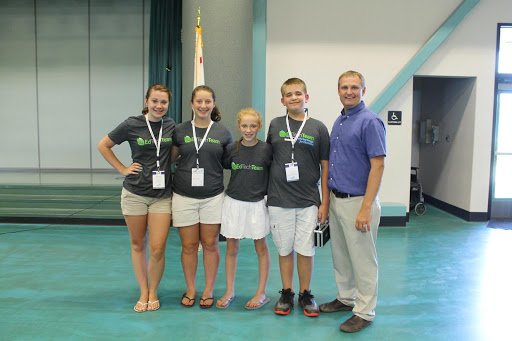
Kern Kelley with student presenters in Porterville, California
A presenter and tech professional development expert himself, Mr. Kelley moonlights as a speaker on a global level, something he has always incorporated with his students and career as an educator. What started out as taking students along to take part in his presentations has evolved into students presenting around the world.
Starting in 2012 on a train ride back from the New York Google Offices at a presentation with Mr. Kelley, the students came up with the idea of taking their skillset on the road more formally and the Tech Sherpas were born. Since then they have grown both in size and knowledge with every passing year and every advance in technology. Pre-COVID-19, the Tech Sherpas had traveled to places like Japan, Ottawa, Hawaii, Pennsylvania, and Chicago presenting to large audiences on topics like Google Slides, Google Meets, Google Classroom, and Flipgrid among others.
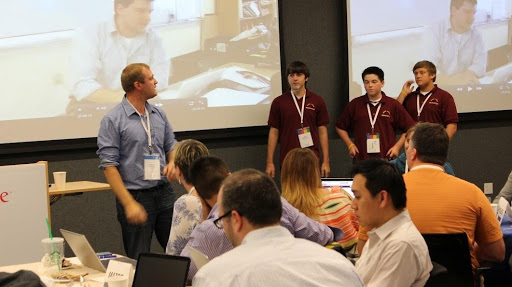
Kern Kelley presenting with Kris Redman Jared Gay and Chandler Cossar at the New York Google Offices in 2012
After the pandemic forced schools to adapt in the way that education is provided, Mr. Kelley and the Tech Sherpas didn’t miss a beat. What was once in-person presentations all over the world has now become a busy job of booking virtual meetings and presentations to keep up with the ever-changing needs of educators, students, people of all walks of life who need to learn, keep up with, and use technology in their everyday lives.
Nokomis High School Senior Rachel Wilcox has been a Tech Sherpa since she set foot in the Nokomis Warrior Broadcasting class her freshman year. Now a senior and finishing her final year of high school during a pandemic, Rachel is the project manager working behind the scenes to coordinate the Tech Sherpas’ virtual presentations.
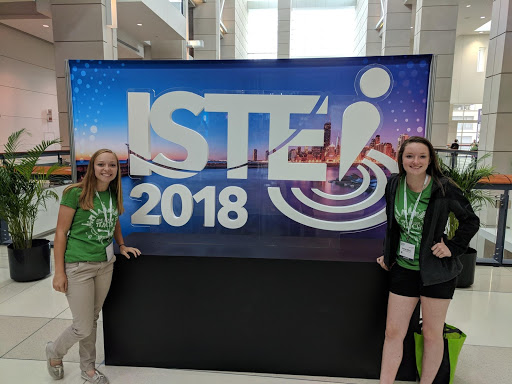
Rachel Wilcox and Britney Bubar presenting at ISTE in Chicago
“I like it,” said Rachel in a virtual interview. “I want to go to college for business management, so this is a good step in that direction,” she added. Rachel is in charge of organizing the Tech Sherpas into groups in terms of their readiness to present with the technology they feel most comfortable teaching others. She also works with outside organizations to schedule the presentations, lines up the students to present, coordinates the practice sessions, and participates in the actual event by doing a pre-event tech check, and helping to host the meeting. During the event, Rachel is usually working with a moderator who watches the meeting chat during the presentation, in addition to the presenters.
One of their most recent endeavors was a student-led presentation at the Virtual End of Summer Fest for the Google Waterloo Engineers. It was an opportunity for Google engineers to see creative uses of their tools by ‘real’ people. The topic was using Google Slides to Create Animations, like this one. The Tech Sherpas worked with EdTechTeam Canada for the event which featured the skills of Tech Sherpa, Kaiden Kelley who also happens to be Mr. Kelley’s son.
Kaiden Kelley presenting to Google Engineers
“When presenting, I’m there to share my skills with the teachers,” Kaiden said of his experiences presenting with the Tech Sherpas. In the event with Google engineers, he shared the skills, tips, and tricks that he learned from using Google Slides on various projects over the years. Be began working with the tool in 2012 and has experienced a myriad of changes and upgrades from Google that he has been able to navigate and use in his everyday work.
A pro at presenting, Kaiden said he doesn’t get nervous anymore during presentations and that the most memorable part of the presentation to Google was seeing everyone “come in” to the virtual meeting from all over the world. The successful presentation has led to further talks with Google Canada about more presentations by the Tech Sherpas.
“We are in a world now that everybody has experienced video conferencing,” said Mr. Kelley. “We will never again live in a world where that has not happened.” Mr. Kelley hopes to give his students as much experience as possible doing video conferencing knowing that when they graduate from high school they will need to be ready with skill sets that allow them to compete for jobs and post-secondary opportunities all over the country, and potentially enabling them to work and learn from right here in Maine.
While Mr. Kelley is excited about the incredible opportunities his students have experienced during the pandemic, he is quick to explain that using video conferencing is not necessarily better education for students, “it is a tool that we can use to keep providing opportunities for kids.”
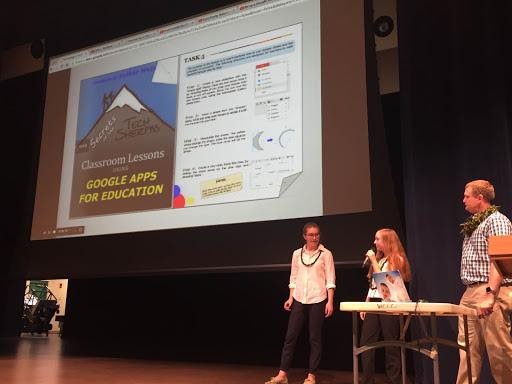
Austin Taylor and Brittney Bubar presenting at the Hawaii Island TechEd Conference
Other ongoing projects of the team include helping Mr. Kelley on professional learning opportunities for teachers in Maine. One is an opportunity for educators in any part of the State to explore distance learning tools for students and teachers with the help of the United Technologies Center Adult Education and the Tech Sherpas (Learn more about this opportunity here).
Another is a similar “adopt a teacher” project at Nokomis where the students help resident educators with any technology needs they may be having as they navigate hybrid and remote teaching this year. It not only helps boost technology opportunities for students at Nokomis, but also bolsters relationship building, presenting, and teaching skills for the students. Their hope is to expand on these efforts to expand these types of opportunities for students and teachers state-wide
Maine DOE Team member Karen Kusiak is being highlighted this week as part of the Get to Know the Maine DOE Team Campaign. Learn a little more about Karen in this question and answer.
What are your roles with DOE?
During, before, and after the Legislative session I support the policy team with analyses of bills that relate to education. I follow hearings, testimony, amendments, work sessions, voting in the chambers of the Legislature, and the Governor’s actions on bills. In all seasons, I organize responses for, or respond to, formal inquiries about education that are submitted to the Governor’s Office or that come from members of the Legislature. During pandemic times, I have been working on a team to review and coordinate school districts’ applications for federal relief through ESSER and through the second round of funding in the state’s Coronavirus Relief Fund.
What do you like best about your job?
I learn something new about at least one federal or state law, rule, policy, practice – or a nuance of law, rule, policy, or practice – practically every day.
How or why did you decide on this career?
Education found me over 40 years ago; I didn’t think I wanted to be a teacher. However, after I stumbled into a Title One aide position (before Maine used the term “Ed Tech”) I quickly became a certified teacher (via alternate route) then special educator, special education administrator, and teacher educator who prepared future teachers to be critically aware of practices and policies that marginalized some students or undermined public schools and the practice of education. I was and continue to be particularly dismayed about neoliberal education policies of the last decade or more, and worked to change them. I’m delighted today to be part of a team that is focusing on education equity from inside government.
What do you like to do outside of work for fun?
I enjoy independent cinema, cooking, travel (when I can…), reading, time with my two daughter who moved “away,” and keeping up with the news. This summer and fall I have made a point to find new places to put my kayak in the water and new Maine Trails to walk. Before the pandemic, I enjoyed rowing Cornish pilot gigs in Belfast Harbor.
Amanda Peterson, the Business Leadership Instructor at United Technologies Center (UTC) in Bangor has been named the 2020 Maine Career and Technical Education (CTE) Teacher of the Year by the Maine Administrators of Career and Technical Education (MACTE). Mrs. P, as her students call her, was honored by Maine Department of Education (DOE) Commissioner Pender Makin and Maine Community College System President David Daigler at the annual MACTE conference which was held virtually on October 8th.
(Pictured: Amanda Peterson poses for photos with her family members after being honored.)
“This is a period in our history where educators of exceptional character are extra important,” said Commissioner Makin in her remarks honoring Peterson. “Students all crave stability and hope, a reason to believe in their own future. Having your teacher demonstrate clearly and consistently that they care and believe in you is priceless.”
Known for her ability to blend an extraordinary set of abilities in an effort to cater to each and every student, Mrs. P thoughtfully taps into each student’s uniqueness, talents, and dreams by celebrating and them and helping them to confidently grow into their best selves. She transforms individuals often filled with self-doubt and uncertainty, to individuals who demonstrate self-confidence and direction.
During his remarks, MCCS President Daigler spoke about Mrs. P’s efforts to develop a robust CTE Business program for UTC that helps students earn college credit. “Currently Ms. Peterson offers 12 EMCC Business courses and additional courses from 2 other Maine higher education institutions, bringing her total course offerings to 14 college courses or 42 college credits. Delivering a demanding college level curriculum to high school students is challenging. Having over 90% complete with A’s and B’s based on locked 3rd party and college summative assessments is phenomenal. This level of learning, with students widely becoming able to reach and function in Bloom’s Quadrant D, occurs because of her dedication, belief system, and understanding of experiential education.”
Maine Administrators of Career and Technical Education (MACTE) administers the Career and Technical Education (CTE) Teacher of the Year Award, which recognizes teachers who are providing outstanding career and technical education programs for youth and/or adults in their respective fields and communities.
Peterson has a Master’s of Science in Education and a Bachelor’s of Science in Business from Husson University and an Associate Degree in Business Administration from Thomas College. She has 25+ years working in a family small business, (farming, restaurants, general stores), in addition several years in industrial education experience, instructing, banking, IT support, finance, and small business ownership. Peterson is a certified Maine CTE instructor in Business Education, Information Technology and Cooperative Industrial Training.
The National Association of State Boards of Education (NASBE) today announced that Maine State Board of Education Chairman Wilson G. Hess is one of three national recipients of NASBE’s 2020 Distinguished Service Award. This national award honors current and former state board members who have made exceptional contributions to education. It is given to three outstanding leaders each year and is the highest award NASBE can bestow on a state board of education member.
Wilson G. Hess is chairman of the Maine State Board of Education. A member of the board’s Legislative Action Committee, he excels in building relationships with local, regional, and state legislators. Hess has been particularly instrumental in ushering in policies on higher education, career and technical education, school construction, and expanded internet access.
“He is a tireless educator who does not sit on the sidelines,” said board colleague Fern Desjardins, who nominated Hess. “Wilson was in constant contact with the Department of Education and other legislators this year on CTE matters and expanding broadband access to rural communities. Both initiatives received boosts in funding as a result of his efforts.”
Another board member, John Bird, notes of Wilson: “He enables me to be more effective [as a board member]. He understands the politics of education and the framework of education in Maine. He attends to details while focusing on a broader vision to make something better happen.”
Hess worked over 40 years in higher education, including more than 20 years as college president in private and two- and four-year public institutions. As president of the University of Maine at Fort Kent, Wilson instituted a series of successful online degrees and the state’s largest dual enrollment early college program. He is involved in several advisory councils, boards, and committees in higher education and countless other business, entrepreneurial, economic, and development initiatives. An active member of NASBE, Hess has served on the editorial advisory board since 2016.
“The 2020 Distinguished Service Award winners represent the very best in citizen leadership in America,” said NASBE President and CEO Robert Hull. “State boards of education remain a steadfast bastion of nonpartisan discourse and policymaking at its very best, and this year’s distinguished service awardees represent all that is good about that process. Strong proponents of stakeholder engagement, strategic planning, and a firm focus on equity are but a few of their stellar traits. Hats off to our 2020 Distinguished Service Awardees!”
Other award recipients were Dr. John Kelly, vice chair and previous chair of the Mississippi State Board of Education and Maria Gutierrez, the longest-serving member of the Guam Education Board.
The 2020 Distinguished Service Awards will be presented October 21 at NASBE’s virtual annual conference. Learn more about the conference.
NASBE serves as the only membership organization for state boards of education. A nonpartisan, nonprofit organization, NASBE elevates state board members’ voices in national and state policymaking, facilitates the exchange of informed ideas, and supports members in advancing equity and excellence in public education for students of all races, genders, and circumstances.
Maine Department of Education Commissioner Pender Makin and Deputy Commissioner Dan Chuhta will host a virtual briefing for legislators on Thursday, October 15, 2020 from 11 am – 12 pm.
Maine school leaders have successfully welcomed back students from Kittery to Madawaska while facing multiple challenges during the COVID-19 pandemic. Teachers and school staff are working tirelessly to provide education and support services to children statewide. Commissioner Makin will provide an update on the ongoing work occurring in schools, recent initiatives that the department has undertaken as part of our continued provision of resources and support for students and educators, and answer questions.
The update will occur for one hour and can be viewed live via YouTube.
Created in partnership with the U.S. Department of Education’s Office of Safe and Supportive Schools (OSSS), the Resilience Strategies for Educators: Techniques for Self-Care and Peer Support (RSE) Train-the-Educator (TtE) Virtual Training by Request (VTBR) is a virtual learning opportunity for caregivers in schools and school districts to better understand, and teach others, resilience strategies following emergency events.
This class kicks off the Maine Department of Education (DOE) Maine School Safety Center’s 2020-2021 training series. MSSC will be hosting a different class every month for the next 5 months:
Resilience Strategies for Educators: Techniques for Self-Care and Peer Support Train-the-Educator
The Maine Environmental Education Association (MEEA) is pleased to be offering mini-grants to Maine educators and schools to support outdoor learning during the 2020/21 school year. Teachers and schools from across Maine who need support to build and expand their classes outdoors are encouraged to apply.
Eligibility Criteria: All Maine Public (Pre-K -12) teachers and schools are invited to apply but preference will be given to schools with a high need (determined using most recent Maine DOE % Eligible Free & Reduced Lunch data)
Applicants can submit a request for up to $1,500
Other Important Information for your consideration before applying:
Only one grant made per school
We have limited funding we aim to distribute funds across the state
All funds must be spent by April 15, 2021
Reporting must be completed by April 30, 2021
How can this funding be used to advance outdoor learning in your school?
Application Due: October 19th 11:59 pm. Please note: You need to complete and submit the grant application using this google form. This document helps you see all the questions ahead of time so you can prepare your answers before you submit them in the google online form. More info here.
Other Resources to Support You!:
The Maine Environmental Education Association is also part of the Nature Based Education Consortium (NBEC) where we work with organizations, schools and educators across the state to build policy and structures to advance outdoor learning for ALL Maine youth. At NBEC we have built an outdoor learning online portal that has training videos, funding opportunities and resources to help you implement outdoor learning and to assist you in making the case for expanded outdoor and environmental learning in your school. https://www.nbeconsortium.com/outdoor-learning-schools
Maine DOE and DHHS Release Dashboard of COVID-19 Cases in Maine Schools
AUGUSTA — Today, the Maine Department of Education (DOE), in collaboration with the Department of Health and Human Services (DHHS) and Maine Center for Disease Control and Prevention (CDC), released an online dashboard of COVID-19 cases in Maine schools, complementing the information provided by schools to help parents, students, and staff make informed decisions about their health and safety.
The dashboard lists pre-K through Grade 12 public and private schools that have one or more COVID-19 cases among Maine residents, including those that have had an outbreak of COVID-19 that remains open, within the last 30 days. Cases are included if the infected individual lives in Maine and is associated with the school (as either a staff member or student) and was physically present on campus, including participating in group school activities such as sports. The number of cases is suppressed to protect privacy in any school with fewer than 5 cases.
The Departments will update this dashboard, which is posted on the DOE website, every Tuesday and Thursday.
In the last 30 days, four pre-K through 12 schools have had COVID-19 outbreaks: Sanford High School, Massabesic Middle School in East Waterboro, Community Regional Charter School in Cornville and Skowhegan, and Coastal Ridge Elementary School in York. During the same period, 55 other schools had at least one case of COVID-19, including out-of-state schools with Maine residents. Including both confirmed and probable cases, 112 cases have been associated with schools to date this school year.
The rate of COVID-19 in schools in line with the overall prevalence of COVID-19 in Maine. With 223,813 students and staff in Maine schools, the number of cases represents a case rate of 5.0 per 10,000 over the past 30 days. The rate for the entire state over the same period was 6.7 per 10,000. The demographics of people in schools differ from that of the state, accounting for some of this difference.
Maine CDC works with DOE to respond to cases of COVID-19 associated with schools, including contact tracing, as outlined under a standard operating procedure. Additionally, DHHS has deployed on-site testing at Sanford High School and Massabesic Middle School in partnership with the schools’ administrative units. The Mills Administration has worked with schools on procedures to prevent and limit school-based spread of the coronavirus. It issued guidance in July through the Framework for Reopening Schools and Returning to In-Person Instruction that has been periodically updated. It has also provided technical assistance and up to $329 million in Coronavirus Relief Funds to support implementation of health and safety protocols during the pandemic.
This new dashboard is part of the Mills Administration’s approach to COVID-19, which is to provide information, support, and policies to balance safety with re-opening Maine’s economy and schools.






 Maine DOE Newsroom