Get to know the Maine DOE Team: Meet Nena Cunningham

Maine DOE team member Nena Cunningham is being highlighted this week as the part of a Get to know the DOE Team campaign! Learn a little more about Nena in the brief question and answer below.

What are your roles with DOE?

My role as the Head Start State Collaboration Director is to assure state agencies and policies align to support our Head Start and Early Head Start programs throughout the state.  I am also leading the department’s efforts to create a Parent, Family and Community Engagement Framework to support districts as they work with families in their schools and communities.

What do you like best about your job?

The best part of my job is that no two days are the same!  I get to meet and work with people from across Maine, New England and across the country, and share my passion for Head Start!

How or why did you decide on this career?

I have worked in local Head Start programs my entire adult career.  When this position opened up, it seemed to be a natural fit!  Working with vulnerable young children and their families has been my focus throughout my educational journey.  Watching infants, toddlers and their families grow is my absolute favorite part of my career!

What do you like to do outside of work for fun?

Outside of work, I love to spend time with my family and friends.  My husband and I have two (not so small anymore) boys who keep us on our toes!  I enjoy spending time “upta” camp and just being outdoors!

Maine Adult Education System Receives Champion of Education and Workforce Development Award

Gail Senese, Maine DOE Director of Adult Education, Lisa MacDonald Cooper, MDF Program Director, Education & Workforce, Shirley Wright, Executive Director of MAEA, and Suzanne Nowinski, President of MAEA.

At the 2019 Annual Meeting and Awards Luncheon hosted by the Maine Development Foundation (MDF), Maine’s Adult Education System, comprised of over 70 local Adult Education Programs, the Maine Department of Education’s Office of Adult Education, and the Maine Adult Education Association (MAEA), was one of six award recipients.

As part of the award presentation, MDF described the Maine Adult Education System in the following way:

Local adult education programs throughout Maine provide a range of instructional services to help adults develop the skills for further education opportunities, job training, and better employment, and to realize their full potential as productive workers, family members, and citizens. Adults seeking to further their education or advance their careers can enroll in adult education courses in literacy and adult basic education, high school completion, English language acquisition courses, Maine College Transitions, and career preparation and enrichment. Instruction is aligned with adult learners’ goals and focuses on supporting their efforts to meet the College and Career Readiness Standards. The Maine Adult Education System partners with Maine CareerCenters, local employers, higher education, and community agencies to maximize the education and training opportunities for its adult learners. And, most importantly, it embodies the very spirit of lifelong learning, which enriches individual lives and whole communities.

Accepting the award on behalf of adult education programming statewide were Gail Senese, Maine DOE Director of Adult Education, Suzanne Nowinski, President of MAEA, and Shirley Wright, Executive Director of MAEA.

GailonStage
Gail Senese, Maine DOE Director of Adult Education.

“This means so much to all of us,” said Dr. Gail Senese in an acceptance speech she gave on behalf of the Maine Adult Education System. “We see ourselves as part the economic development chain in this State, preparing people to be good workers, and good community members, and good neighbors. We thank you so much for this recognition, for not only the people who work in this field but for the people who deserve to be served.”

Guidance on Enrollment, Attendance and Education of Children Age Six and Younger

There have been questions about the laws and rules that govern the enrollment, attendance, and education of our youngest learners, as schools consider recent legislation, and the expanding number and size of public preschools programs.

During the 129th Legislature, LD 150 and LD 151 both addressed the age of compulsory attendance.

LD 151 lowered the compulsory age for attendance in school to age 6.  This includes children who are accessing private or home instruction options.  In addition, there is clarification that children five years of age who are enrolled in a public or publicly-funded educational setting are required to attend, unless a parent/guardian has formally withdrawn them from school. All student attendance data should be reported and monitored for chronic absenteeism and truancy.  For further guidance regarding truancy, please see our website.  We encourage districts to consider their policies and protocols for supporting student attendance, and for reporting concerns to, and engaging with, partner agencies as needed.

This clarification is also a reminder that students, regardless of age, cannot be removed or unenrolled from a school that is receiving public funds without the due process afforded to those students and families in 20-A M.R.S. § 1001(8-A and 9). In addition, school administrative units may not unilaterally determine that a child attend on a modified schedule (e.g. abbreviated school day, reduced school week).  Parents/guardians must be involved in, and agree to, this decision and understand thoroughly the reasons for the request.

There are additional considerations for preschool students who have been identified as eligible to receive special education or English language acquisition services.

In accordance with Federal and State law, a child may not be excluded from enrollment in a public preschool program based solely on the presence of a disability or English language acquisition needs.  Enrolled children who are referred to Child Development Services (CDS), based on program concerns regarding the child’s development or behavior, must be considered a child with a disability and afforded the same rights as his/her K-12 peers until the child’s Individualized Education Program (IEP) team makes determinations.

The parents/guardians of all public preschool students must be administered the Maine DOE Language Use Survey, and if the student has a primary/home language other than English, an English language proficiency screener must be administered. If a student is identified as an English learner, English language acquisition services must be provided. A student cannot be denied access to public preschool on the basis of language acquisition needs.

We are committed to providing ongoing resources and support to educators, and to fostering partnerships with other educators and service providers. We encourage all to reach out to our staff and to watch for upcoming professional development opportunities on building an inclusive classroom, using trauma-informed practices, and integrating social-emotional learning into curriculum.

  • For resources and support with public preschool programs, please contact Nicole Madore, Early Childhood Specialist at 624-6677 or Nicole.madore@maine.gov
  • For CDS questions and support, contact Kris Michaud, State Early Childhood Special Education Technical Advisor at 592-1406 or kristopher.michaud@maine.gov with questions or comments about the guidance.
  • For questions and support regarding general attendance or truancy, please contact Gayle Erdheim at 207-624-6637 or gayle.erdheim@maine.gov, or refer to our webpage.
  • For questions and support regarding students who are English learners, contact April Perkins, Director of ESOL/Bilingual Programs & Title III, at 624-7726 or april.perkins@maine.gov.

Maine DOE Convenes Local Educators to Review Career and Educational Development Standards

The Maine Department of Education hosted a group of local educators for a series of work sessions that will take place last month to review the Career and Educational Development (CED) standards.

The review is part of an established fourteen step review that rotates through the eight content areas of Chapter 132 (doc) over a 5 year period, during which educators from across the state consider and revise standards to reflect the rigorous expectations and provide guidance to schools.

The career and education development standards are divided into three subgroups of knowledge and skills (Learning About Self-Knowledge and Interpersonal Relationships; Learning About Exploring Education, Career, and Life Roles; and Learning to Make Decisions, Plan and Create Opportunities, and Make Meaningful Contributions). Within each of these subgroups are performance indicators and descriptors that describe what students should know and be able to do across four grade bands (K-2, 3-5, 6-8, 9-Diploma). The career and education development standards also include an introduction and a note regarding embedding career and education development instruction.

As part of the ongoing review process for content standards, revised standards for social studies and science have been adopted.  In addition, writing teams for the career education and development, English, and math standards are drafting revisions that will be finalized by the end of September.

The Department of Education will then initiate the rulemaking process for Chapter 132 for final review and adoption of the revised career education and development, English, and math standards. This fall, the Maine DOE will begin a review of the health education and physical education, visual and performing arts, and world language standards. For more information about the standards or the standards review process, check out our web page.

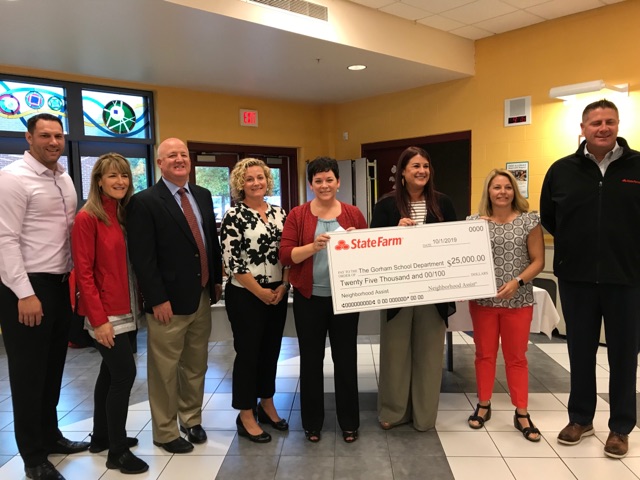
BackPack Team at Gorham School District Receives $25,000 Neighborhood Assist Grant

Gorham School District was one of 40 recipients nationwide to receive a $25,000 Neighborhood Assist Grant. They received the award for the efforts with their BackPack Program and School Garden, an initiative that provides food for students and families experiencing food insecurity in the community.

This past June, State Farm accepted 2,000 applications for their Neighborhood Assist grant program.  Submissions represented causes from throughout the country which focused on education, safety, and community development initiatives.  A review committee narrowed down the submissions to the top 200 finalists which were posted online and voted on by the public.  The 40 causes with the most votes each won a $25,000 grant.

Gorham’s BackPack Team Administers weekend food and snack bags to students, offering a school food pantry at the high school, and by growing a school garden which provides fresh produce to the local food pantry during the growing season. The BackPack Program sends food home every weekend with students who would otherwise not have enough food to last through the weekend. Learn more here.

School Administrators holding shopping bags of food.

Reminder of Initial Audit Requirement Due November 1

We would like to remind business managers, and those with fiscal reporting responsibilities for SAUs, that the statements of assurance and the Maine Education Financial Systems (MEFS) Financial reconciliations are due by November 1st, as required by Title 20-A MRSA §6051 (4).

The statement of assurance should include:

  • Written determination of whether or not proper budgetary controls are in place
  • A written determination of whether or not the annual financial data submitted to the department is correct, including submission of an audited reconciliation of the annual financial data prepared and certified by the auditor;
  • A written determination as to whether the school administrative unit has complied with applicable provisions of the Essential Programs and Services Funding Act.

Any adjustments identified by these reconciliations should be submitted to Maine Education Financial System by November 30th.

For more information or assistance, please contact Stephanie Clark, Fiscal Compliance Associate, School Finance & Operations for the Department of Education at 207-624-6807 or Stephanie.Clark@maine.gov.

Enrollment up at Maine’s Community Colleges

The Maine Community College System announced last week that preliminary enrollment figures show a 6.3 percent increase in enrolled students this fall compared to the same time last year.

The increase is in sharp contrast to a nationwide trend of declining enrollments at two-year public colleges over the last several years. The strong showing is due in part to a number of new initiatives at the colleges aimed at attracting and retaining more students. The system also did not raise tuition for this academic year, maintaining the lowest tuition and fees in New England.

As of September 23, the system-wide headcount is up 6.3 percent (an additional 966 students) from the same date a year ago. All seven colleges report increases, the largest of which are at Eastern Maine Community College, up 10.4 percent with 2,141 students enrolled compared to 1,939 last year at this time, and at Southern Maine Community College up 8.2 percent, with 6,078 students enrolled compared to 5,618 a year ago.

At the same time, the system is also seeing a surge of participation in its short-term job training programs which are not included in the fall headcount enrollment numbers.

In the last year, the number of trainees who completed short-term training programs funded by the MCCS Maine Quality Centers (MQC) program has almost doubled to 1,602, up from 897 in the previous year. MQC works with Maine employers to provide customized training that is free to trainees and is focused on strengthening the skills of the Maine workforce.

“We’re seeing significant growth both in our programs that lead to one-year certificates and two-year degrees and in short-term training,” MCCS President David Daigler told the system’s Board of Trustees at a meeting Wednesday in Bangor. “Demand from both employers and individuals looking to gain the skills needed to compete in this new economy is exploding and stretching our ability to respond.”

The high demand for both degree programs and short-term training at Maine’s community colleges is particularly noteworthy given the state’s record low unemployment, aging demographics and widespread workforce shortages. Community college enrollment has historically been tied to the economy, going up during periods of high unemployment and declining when jobs are plentiful.

Fall enrollment increases have been driven in part by initiatives at campuses across the state. Among the new efforts are: doubling the number of visits to some high schools, replacing group orientations with one-on-one orientation sessions; reaching prospective students through texting instead of email; adding new high-demand programs including plumbing, HVAC and esports; and giving students new online tools to communicate with others to increase peer-to-peer connections.

Enrollment numbers for fall 2019 will be finalized in mid-October.

See the full release with graphics on the MCCS website.

CORRECTION: Data Reporting Deadlines That Impact Subsidy Calculations (ED279)

The initial post on 9/26/2019 indicated that the Student Data and Staff Data Certifications would both be due by October 15, 2019; we apologize for this error and have corrected the due dates below to October 31st for both certified reports.  The Student Data certification period begins on October 15, 2019 and ends on October 31, 2019.  The Staff Data certification period begins after July 1, 2019 and also ends on October 31, 2019.

Please ensure that any revisions to the data collections are completed by October 31, 2019 so that the School Finance & Operations Teams have time to ensure that the collections are accurate prior to the start of the EPS FY 21 subsidy calculations in November.

The table below details data that has a direct impact on the calculation of an SAU’s subsidy. SAU’s can use the table to quickly assess what action they must take and by what deadline. The table also includes the follow up actions SAUs can expect from Maine Department of Education. The information in the table provides deadlines for reporting data errors, asking specific data questions, and when data revisions must be submitted to Maine DOE to be included in the SAU’s FY 21 EPS Funding Calculation. Please contact us with any questions!

Data Point SAU Reporting Period SAU Action Needed Maine DOE Action
NEO Staff Data – Specifically but not limited to EPS positions – Teachers, Guidance, Librarians, Health, Education Technicians, Library Ed Techs, Clerical, School Administration  July 1, 2019 -October 31, 2019 Enter/Update Staff Data in the NEO Staff Module.

Superintendent must certify the data is accurate
Revision and certification/ recertification until 10/31/19

Data questions can be emailed to medms.helpdesk@maine.gov

Close Staff data entry 10/31/19

DOE staff begins data quality checks/data scrubbing 10/15/19 to 10/31/19

DOE contacts SAU staff as necessary to resolve inconsistencies and/or errors

Synergy Student Information System –

10/1/19  enrollment (Public Schools) including- attending students, resident students, superintendent transfer students, equivalent instruction (home school) students taking a course(s) in the district, economic disadvantaged students, English learners, special education students

October 1 – October 31, 2019 10/01/19-10/15/19

-Enter/Update Student Data in Synergy

– Review data for accuracy and completeness in the October 1st Student Enrollment Count report in the NEO Student Data moduleTop of Form

Bottom of Form

10/15/19 – 10/31/19

-Superintendent must certify the data is accurate

-Revision and certification/ recertification until 10/31/19

Data questions can be emailed to medms.helpdesk@maine.gov

Close Student data entry 10/31/19

DOE staff begins data quality checks/data scrubbing by 10/15/19 to 10/31/19

DOE contacts SAU staff as necessary to resolve inconsistencies and/or errors

Financial Data – FY19 August 23, 2019 Upload to the Maine Education Financial System (MEFS)

FY19 – 7/1/18 to 6/30/19 Actual Expenditures

FY19 7/1/18 to 6/30/19 Actual Revenues

FY19 Balance Sheet Transactions

Maine DOE staff reviews financial data submissions

DOE contacts SAU staff as necessary to resolve inconsistencies and/or errors

Financial Data – FY20 August 2, 2019 Upload to the Maine Education Financial System (MEFS)

FY20 Revenue Budget

FY20 Expenditure Budget

Budget Approvals – Email Budget Meeting Referendum results including budget expenditure and revenue articles to Denise Towers.

More detail guidance on can be found at: https://www.maine.gov/
doe/funding/accounting/guidance

ED279 Public Posting February 1, 2020 Post public report, Preliminary ED279 – prior to February 1, 2020.
ED279 Review March 3, 2020 or 30 days after the public posting of ED279 SAU superintendent and staff review the Preliminary ED279

Direct questions and notification of errors to the Maine DOE School Finance Team by 3/3/2020. Tyler BackusPaula Gravelle or Ida Batista

 Professional Learning Opportunity: Lenses on Learning- Leadership for Elementary Mathematics (3-Part Series)

Who is invited?   This professional learning opportunity is specifically designed for a team from K-8 schools consisting of:

  • 1 principal/mathematics coordinator
  • 1 classroom teacher/mathematics coach

Why participate?

  • Strengthen your instructional leadership and supervision practices in mathematics
  • Strengthen your pedagogical and content knowledge in mathematics
  • Explore what it means to develop a stance of inquiry and ongoing learning about mathematics education
  • Examine what it means to engage students in active learning
  • Consider ways to develop a shared school vision of rigorous, accessible, and equitable mathematics teaching and learning
  • Compare assessment practices and ways to use assessment to improve student learning
  • Take away ideas and materials to use in your school and classrooms

What is our key goal? To provide you with experiences, information, and resources to guide you in key areas of school practice, leadership, and instructional strategies that have an impact on students’ mathematical learning.

What is our approach to professional development?

  • Do the math: Use video and hands-on explorations delve into key elementary mathematics concepts using multiple approaches, including manipulatives and visual representations.
  • Connect to research: Discuss readings that connect each topic to research and take away powerful research-based approaches, tools, and resources to use in your school and classrooms.
  • Collaborate: Work together and share ideas with other K-8 teams.
  • Leading change: Set goals and generate a plan for ongoing mathematics improvement for your school and classrooms.

Cost:  $180.00 per team for all 3 sessions (includes continental breakfast, lunch, books, and materials for participants).

Contact hours: 24 hours

Registration: 8:00 am, Session 8:30 am – 3:30 pm

Locations: Dates (Must attend all): Registration Links:
Keeley’s Banquet Center, Portland 11/5/19; 1/7/20; 3/24/20 Register for Portland Event
University of Maine, Farmington 11/6/19; 1/8/20; 3/25/20 Register for Farmington Event
Northeastland Hotel, Presque Isle 11/19/19; 1/21/20; 3/17/20 Register for Presque Isle Event
Jeff’s Catering, Brewer 11/20/19; 1/22/20; 3/18/20 Register for Brewer Event

Space is Limited!  Apply by October 18, 2019

Questions? Contact: Michele Mailhot, Mathematics Specialist: 624-6829, michele.mailhot@maine.gov  or Jen Robitaille, Elementary Mathematics Specialist: 624-6673, jennifer.r.robitaille@maine.gov

Maine DOE Update – September 26, 2019

From the Maine Department of Education


Reporting Items

Data Reporting Deadlines That Impact Subsidy Calculations (ED279)

The table below details data that has a direct impact on the calculation of an SAU’s subsidy. SAU’s can use the table to quickly assess what action they must take and by what deadline. The table also includes the follow up actions SAUs can expect from Maine Department of Education. The information in the table provides deadlines for reporting data errors, asking specific data questions, and when data revisions must be submitted to Maine DOE to be included in the SAU’s FY 21 EPS Funding Calculation. | More

Webinar to Assist with Staff Data Certification

To assist those who are responsible for the important task of reporting, validating and/or certifying staff data to the Department of Education, the DOE Data Team will be holding a webinar on Tuesday October 16th.| More

Important Notice: October 1st Student Enrollment Reporting Opens Soon

The October 1st Student Enrollment report will be opening on October 1, 2019 for review, and will be able to be certified by districts starting on October 15, 2019. The certification must be completed no later than October 31, 2019. | More

| Visit the DC&R Reporting Calendar |


News & Updates

Future Teachers Academy: Free Event for High School Students Interested in Exploring the Field of Education

Future Teachers Academy, an event for students who are interested in exploring the field of education, is being hosted by Thomas College and will be held on November 8th from 8:30 am to 1:30 pm on their campus at 180 West River Road in Waterville. | More

Maine Department of Education Provides Complimentary 2019-2020 Law Books to Superintendents

The Maine DOE acquired enough copies of the Maine Education and School Statutes 2019-2020 Edition law book from the publisher, Swan Island Press, to distribute one, at no charge, to each superintendent of schools in Maine. | More

Three Maine Schools Receive National Blue Ribbon School Honors

The U.S. Department of Education today announced three Maine schools as National Blue Ribbon Schools for 2019. The recognition is based on a school’s overall academic performance or progress in closing achievement gaps among student subgroups. | More

Get to know the DOE Team: Meet Dan Chuhta

Maine DOE team member Dan Chuhta is being highlighted this week as the part of a Get to know the DOE Team campaign! Learn a little more about Dan | More


Maine Schools Sharing Success Stories

| Submit your Maine School Success Story |


Professional Development & Training Opportunities

Free Emergency Management Training Sessions Available This Week Only

With this K-12 101 training, an expert team will provide an overview of a recommended six-step planning process to create a high-quality school EOP | More

| Visit the Professional Development Calendar |


Latest DOE Career/Project Opportunities