Students Engaged in STEM Challenges at Blue Hill Consolidated School’s Summer Program

Submitted by Dawn McLaughlin, ESEA Coordinator & Curriculum Coordinator at School Union 93.

For two weeks, twenty students of Blue Hill Consolidated School have been participating in a Title 1A Summer School, taught by Ms. Bradford and Ms. Longley. Summer School is being held at George Stevens Academy, with students ranging from grades K-8. Morning early sessions focus on Reading and ELA, and later morning is focusing on Math and STEM. Much of the student work is hands-on, and students are highly engaged.

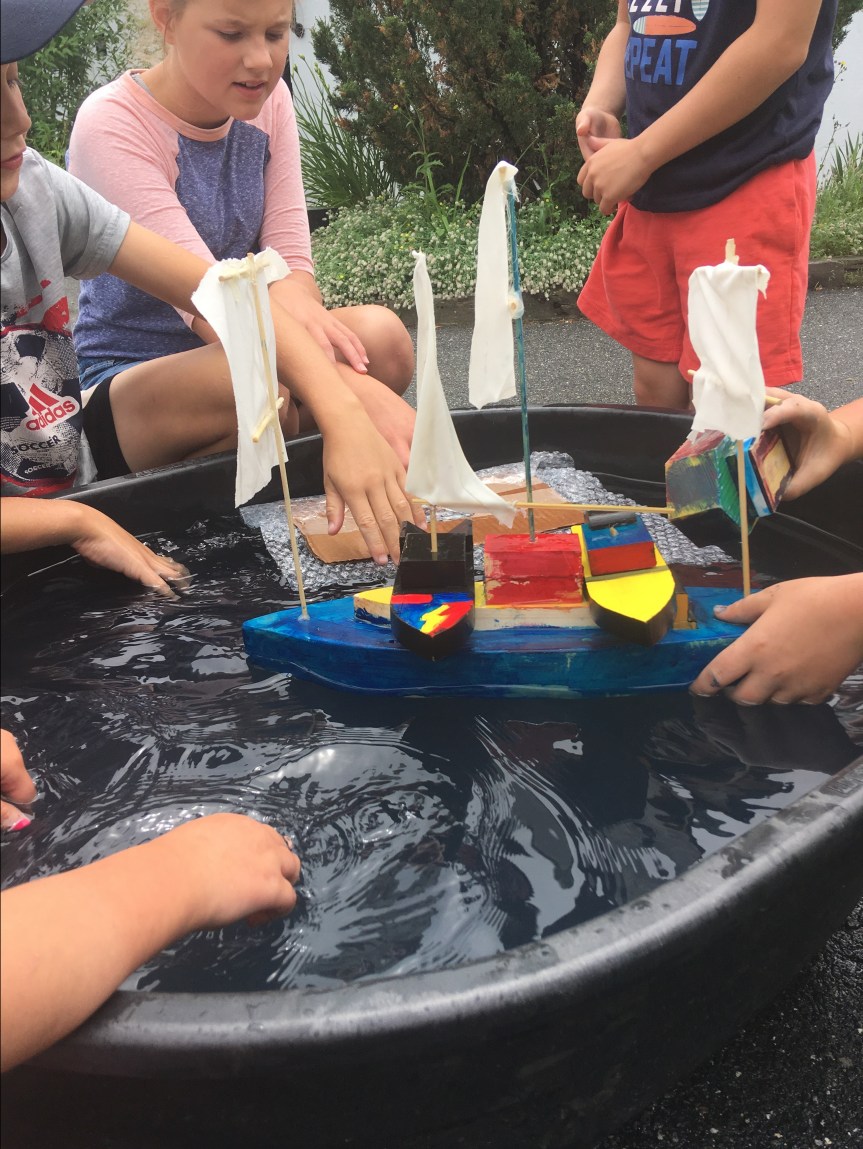
Much of the read aloud fiction is tied in with the STEM challenges. Last week’s theme was Water Week. Students read boat themed books like Who Sank the Boat? by Pamela Allen and Toy Boat by Randall de Seve. Students created their own boats out of reusable materials and pieces of wood. Younger students added plastic animals one at a time to see how many animals their boat could hold. Older students used keels and sails to balance their boats thinking about ideas like center of gravity and weight.

Next Think Tank Scheduled for September 30!

In the ongoing effort to engage with all stakeholders, the Department of Education will hold its next Think Tank at the Schoodic Institute in Winter Harbor on September 30.  Participants can choose  from four topics, and can attend morning or afternoon sessions only on one topic, or attend both sessions and discuss two topics! Topics include special education, defining school success, educator excellence (recruiting and retaining) and MLTI.  Lunch will be provided, and the think tank is FREE, however we do ask for participants to register, for planning purposes.  Please see the Registration Link for more information and to register. We look forward to hearing from you!

Get to Know the DOE Team – Meet Barbara McGowen

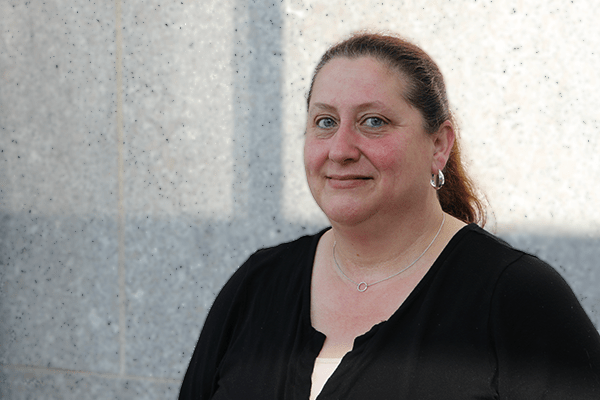
Maine DOE Fiscal Coordinator Barbara McGowen is being highlighted this week as the part of a Get to know the DOE Team campaign! Learn a little more about Barbara in the brief question and answer below.

What are your roles with DOE?

I am the Fiscal Coordinator for the Office of Special Services.  My team provides oversight of fiscal activities for the OSS teams, including, the State Agency Client Program, Due Process, Special Projects, IDEA and the Office of Special Services Grants and Contracts Program.  My team provides technical assistance and support to Maine administrators, working collaboratively with them to achieve federal and state fiscal compliance.

What do you like best about your job?

I love being able to play even a small role in supporting the education of Maine’s children.  My team works hard in tandem with SAUs to strengthen understanding of federal programs to create an environment of certainty and comfort.  I am blessed to be working with an incredible group of dedicated people who work tirelessly to make a difference in education.

How or why did you decide on this career?

My education and training background is in financial management.  I began my career in banking, eventually transitioning to work for a non-profit organization focused on creating opportunities for disenfranchised peoples.  I enjoyed the mission of the non-profit and the people I worked with.  When a position opened at the Department of Education it was at that moment in time when I was ready to let go of the endless search for funding and work to future retirement.  I am incredibly pleased to say that I have found a new mission supporting Maine’s educators, administrators and students.

What do you like to do outside of work for fun?

Outside of work I enjoy spending time with family.  Family get-togethers, picnics, celebrations, traveling, camping, you name it and I am there.

WCC Educator Profile: Mike and Jeanne Beal

The Washington County Consortium, Washington County Educator Profile submitted by Sarah WoogExecutive Director of the Washington County Consortium.

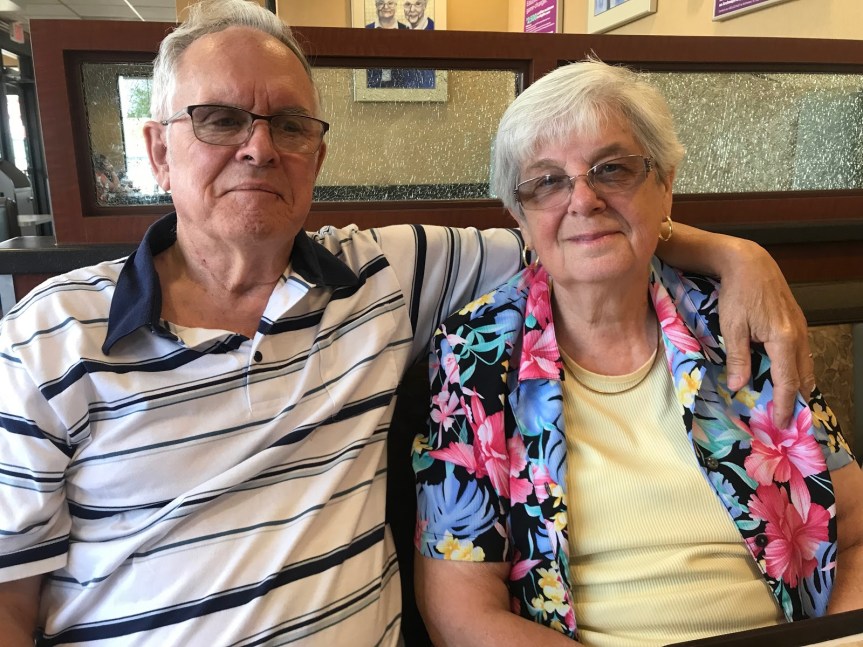
Meet Mike and Jeanne Beal, retired educators who, combined, have served students and communities in Washington County for almost a century (96 years and counting)

When I met Mike Beal, the first question I asked him was “Do you know you’ve inspired Ron Ramsay (Superintendent, MSAD 37)?” Mike replied, “Do you know he inspired me?” Mr. Beal was Mr. Ramsay’s teacher, Principal, and coach at S.S. Nash School in Addison back in the sixties. What Mr. Beal was expressing in his retort was a guiding principle I discovered defined his long and illustrious career in education: allow the children to inspire you.

Ron Ramsay, and Lorna Greene, Principal at D.W.Merritt School, both recommended I profile Mike. Lorna shared in an email “His wife is delightful as well, she has also been a teacher, a school volunteer and a loyal supporter of children, SAD #37 schools, and education. You may want to interview them as a couple. They certainly are cherished and admired educators in our area. I hope this helps.” It did. I was excited Jeanne joined us for our conversation at the Bluebird Ranch Restaurant in Machias, and together they painted a beautiful picture of their lives as educators and with poignant reminders of why we do what we do.

Mike and Jeanne started their careers in education in the early sixties. They met in high school and married in 1960 while they were in college. Mike went to Jonesport High School and Jeanne went to high school on Beals Island when there was still a high school on the island. There was no bridge linking Beals Island and Jonesport then. They both graduated from the University of Maine at Machias (UMM). Jeanne took longer to graduate because she took every other year off to earn money to pay for college, while Mike had a basketball scholarship (he’s in the Hall of Fame at UMM), and finished in four years.  Their early days together is a Downeast love story. They fell in love young, discovered a shared a passion (education), and worked hard to piece together a life in service to others. 

They served, and they inspired. Mike’s impact is best expressed in the email Ron Ramsay sent to me in preparation for my interview with Mr. Beal. Mr. Ramsay shared:

    Looking back on my years as a student at the S.S. Nash School I have nothing but great memories of my times with Mr. Beal. He coached and mentored us all day, every day. When we had recesses we spent our time playing basketball and baseball while learning through his example how to be a good, honest, caring human being. Mr. Beal always played, directed the game, coached, encouraged, and just simply made it fun. Everyone wanted to participate and everyone learned from their experiences. Mr. Beal was enthusiastic and it inspired all of us to do their best. Everyone had great respect for Mr. Beal at all levels of his teaching, coaching and administrative career. You as a student wanted to perform well because you didn’t want to disappoint him. He cared deeply about all of his students. Mr. Beal’s contributions to our schools are legendary. His contributions to the individual students that he has taught and coached are beyond measure. I feel blessed that he was my teacher, coach and Principal and that he coached me in Elementary school and in High School and that he coached both of my boys during their elementary years. Mr. Beal has positively impacted generations of children.

Mr. Ramsay’s description of Mr. Beal agreed with how Mr. Beal saw his years in education. Mike emphasized his constant engagement with children when he was a teacher and administrator. He saw all interactions as opportunities for impact, and as moments of inspiration. As an administrator, he met every bus at the beginning of the day. He used trauma-informed practices before we in education talked about “trauma-informed practices.” Meeting students first thing allowed him to reach out to a tired student, or see that a student was having a hard time before it translated to disruptive or disengaged behavior. He was always out during recess, and admitted to occasional snowball fights. But even in this admission, I saw what Ron had described when he said he learned from Mike how to be “a good, honest, caring human being.” During the snowball fights, projectiles weren’t thrown at short distances, and didn’t hit faces. He modeled good, honest, caring fun. 

Mike’s wife, Jeanne, has been a caring educator all of her life too. She was Ron Ramsay’s first grade teacher. He shared, “She gave me the greatest gift of all… she taught me how to read.” Jeanne taught generations of youngsters to read.  After she retired, she went back to be an Ed Tech in Special Education to teach struggling students how to read. She was proud to share that the students she worked with were always readers by the end of their time together. She continues to support reading in schools and volunteers to read to Kindergarteners weekly. Jeanne’s love of teaching is not only academic. She treasured, too, the relationships she had with children as an educator. Jeanne remarked, “Children have to have someone to look up to. Love what you’re doing and children. You (as educators) are the guardian or parent many of them do not have.”

I wanted to profile Mike and Jeanne Beal because, going into the new school year, I was eager to celebrate educators who would inspire us. They certainly have inspired me and I am confident their years of service and lessons in love can provide inspiration for us all. I am grateful for the time I spent with them. But I think the message we can glean from their lives in service, and the message they celebrate, is that we should find inspiration in the children with whom we share time. We can learn from them how to be more effective and fulfilled educators. Our own development is integrally woven into our time and engagement with our students. Actually, Mr. Beal said it best: “Every kid is different and you have to be different to get to every kid.”

Downeast School Teachers and Staff Distribute Books to Children via Bicycle Library

Submitted by Kathy Harris-Smedberg, Assistant Superintendent of Schools, Bangor School Department.
Summer Reading Brought directly to you! The Downeast School Book Bike will be delivering summer reading books in our community on Wednesday mornings between 10:00 - 11:00 am from July 3rd - August 21st.

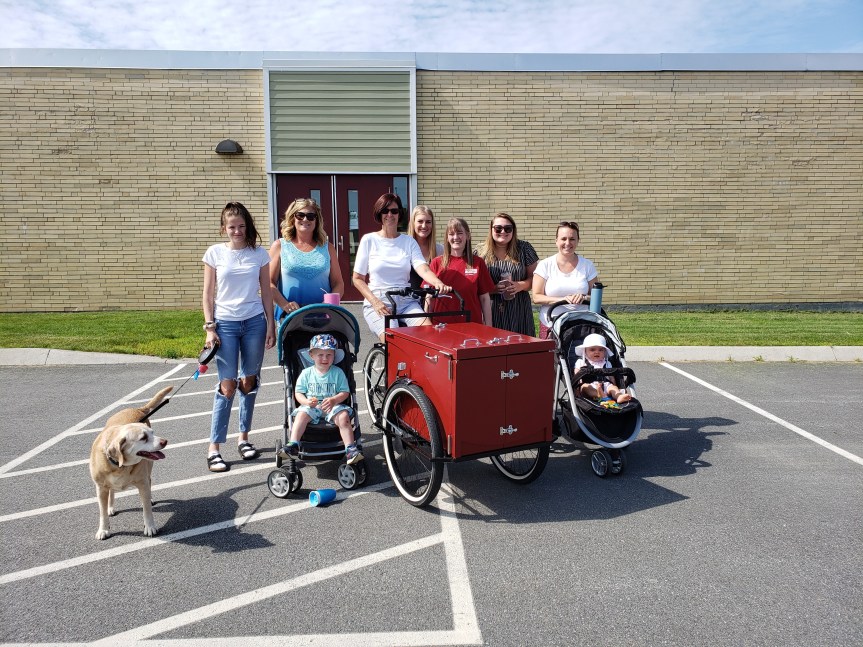
Downeast School teachers and staff are volunteering their summer time to distribute books to the children of Downeast School via the bicycle library.

Pictured: Stephanie Seccareccia, kindergarten teacher; Kim McNutt, librarian; Tina Hinkley, secretary; Ashely Enright, grade 2 teacher; and Melissa Metivier, speech pathologist alongside community members.

These dedicated faculty and staff make four stops in the neighborhood, passing out books, helpful reading strategies parents/guardians can do at home with their children, and information about school and learning. The Bangor School Department strongly believes in the value of reading and strives to find a variety of ways to ensure that children are never without a book.

Maine Officially Adopts English Language Development Standards

Each of the eight content areas taught in Maine schools has its own set of standards, collectively known as the Maine Learning Results. Since 1997, the Maine Learning Results have provided a framework from which educators can build their curriculum, instruction, and assessments. Alongside these content standards, students learning English have been supported with a cohesive set of English language development (ELD) standards, aligned to the academic content they are learning.

This year Maine participated in the US Department of Education’s assessment peer review process for the English language proficiency assessment, through which the need for officially adopted ELD standards was emphasized. Therefore, the Maine Department of Education is officially adopting the WIDA ELD Standards as the foundation for language instruction for students who are English learners (ELs).

In use in Maine since 2007, the WIDA ELD Standards are an essential tool for student learning. WIDA is a non-profit educational consortium with 40 members, including the Maine Department of Education. In addition to the WIDA ELD Standards, WIDA provides Maine educators with a suite of high-quality instructional and assessment tools for students who are ELs, as well as professional learning for educators.

The five ELD standards support all Maine educators to engage students who are ELs in the academic language needed to access the Maine Learning Results. Both the Maine Learning Results and the WIDA ELD Standards were developed through extensive educator collaboration and have been regularly reviewed and updated to reflect the changing demands of college and career readiness.

  • Standard 1: Social and Instructional Language- communicate for social and instructional purposes within a school setting
  • Standard 2: Language of Language Arts- communicate information, ideas, and concepts necessary for academic success in the content area of language arts
  • Standard 3: Language of Mathematics- communicate information, ideas, and concepts necessary for academic success in the content area of mathematics
  • Standard 4: Language of Science- communicate information, ideas, and concepts necessary for academic success in the content area of science
  • Standard 5: Language of Social Studies- communicate information, ideas, and concepts necessary for academic success in the content area of social studies

For more information about the WIDA ELD Standards, or for support in implementing them effectively in your district, please contact April Perkins, Director of ESOL/Bilingual Programs & Title III, at april.perkins@maine.gov or (207)624-6627. For information about English language proficiency assessments please contact Sue Nay, ACCESS Assessment Coordinator at Sue.Nay@maine.gov or (207) 624-6774.

Preparing to Educate Students who Are English Learners- Reviewing Lau Plans

As schools prepare for the 2019-2020 academic year, the Maine Department of Education would like to offer its support to help educators proactively plan effective programs for students who are English learners (ELs). Each year many new families arrive to Maine over the summer, or transfer from one Maine district to another. When school enrollment begins in the fall, districts may enroll a student who is an EL for the first time or may experience an increase in the number of students who are ELs as compared to last school year. The following suggestions and resources can help educators prepare to identify and serve students who are ELs and engage their families and communities.

The first step in preparing to serve students who are ELs is to have an up-to-date, board-approved Lau Plan, which is essentially the district’s road map, detailing how it meets federal and state policies for English learners. “Lau” refers to a 1974 US Supreme Court decision, Lau v. Nichols, that confirmed the rights of English learners to meaningfully access their education. In other words, Lau v. Nichols established that students who are English learners must be provided with English language acquisition support to enable them to meet the same challenging academic standards that other students are expected to meet. All districts are required to have a Lau Plan as part of the school approval process. To help districts create a thorough, well-crafted Lau Plan, the Maine Department of Education provides the Lau Plan Template and Guidance.

Staffing an effective program for students who are ELs is another key step. However, it is often difficult for districts to predict the coming school year’s count and the intensity of each student’s needs in order to plan staffing accordingly. Staffing must be responsive to student needs; the level of services that students are provided should not be determined by current staffing. Because of this, districts may find themselves in need of more teachers than anticipated. In such cases, the Maine Department of Education offers to share job postings with English for Speakers of Other Languages(ESOL) educators and to connect districts with qualified consultants in the region, whom districts may then screen and hire through their standard processes.

It is recommended to designate a staff member to manage the process for identifying students who are ELs, including administration of English language proficiency screening assessments. Also, having an existing staff member become (660) ESOL-endorsed is a proactive way to ensure readiness, should any students who are ELs enroll unexpectedly.

For information regarding Maine’s requirements for providing services to students who are ELs, please see the resource and policy guide, Serving Maine’s English Learners. For further assistance, please contact April Perkins, Director of ESOL/Bilingual Programs & Title III, at april.perkins@maine.gov.

RECOGNIZING GREAT EDUCATORS: Department of Education Talent Pool!

The Maine Department of Education believes that a great way to ensure a robust educator workforce is to develop and engage a network of outstanding educators as exemplars and leaders for our state.  By promoting the excellence that exists in classrooms and schools across Maine, we hope to increase the trust and respect given to educators, and encourage and support others in an outstanding career working with Maine’s students.

We are seeking recommendations for our Maine Department of Education Talent Pool.  This opportunity is for the unsung heroes who are making a difference for students, and likely will continue to expand that impact far beyond their classrooms or schools. The Department of Education hopes to connect these current educational luminaries to one another, to decision making at the department, and to other practitioners in the field. By tapping into their professional expertise and insights, and encouraging educator to educator collaboration and sharing, Maine’s learners will continue to thrive!  Those who are recommended can determine their capacity and interest in engagement, there is no expectation beyond being an outstanding educator.

Please help us in the creation of our Talent Pool, and with our continued efforts to support and celebrate the amazing work being done in classrooms across Maine every day! Recommendations will be accepted on a rolling basis, however we would like to start the school year with strong cohort in place, and encourage school and district leaders to begin the recommendation process as soon as possible.

For more information, please check out the recommendation form, or reach out to Emily Gribben at Emily.gribben@maine.gov or (207)624-6748.


PRIORITY NOTICE: Conceptual Conversation Around the Performance Evaluation and Professional Growth Systems (PEPG)     

Since 2012, educators across the State of Maine have worked collaboratively to create locally developed, effective models for professional growth. Since that time, plans have been revised and refined to reflect the requirements of Chapter 180 and school or district goals. In response to changes to Chapter 180 made during the 129th legislative session, The Maine Department of Education invites interested stakeholders to attend a conceptual conversation related to educator effectiveness on August 5, 2019 from 3pm-5pm at the Burton Cross Building (Room 103A and 103B) in Augusta.  The conceptual conversations will provide an opportunity to explore hallmarks of educator effectiveness in the current rule Chapter 180.   

PL 2019, Chapter 27, removed the mandate that student learning and growth be used as a measure in summative effectiveness ratings effective on September 1, 2021.  In accordance with the Maine Revised Statutes, Title 20-A, sections 13704 and 13706, the Department of Education is required to amend the department’s rule Chapter 180: Performance Evaluation and Professional Growth Systems, to implement the provisions of the law, and submit the provisionally adopted rule to the Legislature.   

The department intends to take the following steps in order to submit the provisionally adopted rule to the Legislature by January 10, 2020, as required.   

  1. On August 5, 2019 stakeholders are invited to attend a conceptual conversation which will be facilitated by Maine Department of Education’s Educator Effectiveness Specialist Emily Gribben and Legislative Liaison Jaci Holmes; the Commissioner and other Maine DOE members may join the conversations as their schedules allow. This conversation will be guided by the following discussion prompt: 

Prompt: What are the critical components of educational practice that lead to educator’s overall effectiveness?  

2.  Taking into consideration the insights gained from conceptual discussions and the requirements under Chaptered Law 27, the Maine DOE staff will write a proposed rule Chapter 180 and begin again the Maine Administrative Procedures Act (A.P.A.) major substantive rule process pursuant to 5 MRS §8052 (public notice of filing, public hearing, open public comment period).The Maine DOE is working diligently to honor the hard work that has been done by steering committees and all educators to implement PEPG systems that foster improved teaching and learning.   

3.  Once the proposed rule has been filed, the public will be notified of the scheduled public hearing and comment period.  This will be an opportunity to provide written and oral comments regarding the proposed rule.  

4.  The department will review all comments and respond accordingly.  Updates to rule will then be filed for legal review before being submitted to the legislature by January 10, 2020.   

For more information on the conceptual conversations for Chapter 180 and Educator Effectiveness, contact Emily Gribben at Emily.gribben@maine.gov.   


Seeking Innovative Educational Leaders to Join Maine’s Leadership Development Program

The Maine Department of Education is thrilled to announce that the facilitator candidates for Maine’s Leadership Development Program (Maine LDP) have been selected. The selected facilitator candidates represent the following regions of the state: Washington, Kennebec, Penobscot, Cumberland, Androscoggin, and York counties.  The Department is looking forward to highlighting the selected facilitator candidates in August.  Maine’s LDP is an initiative designed to build and strengthen instructional leadership skills among Maine’s educational leaders at the school, district, and state levels. In our ongoing efforts to support and foster the educational expertise in Maine, educators who aspire to do the same are invited to take advantage of this high impact opportunity!

In recent weeks, the Department has been contacted by educational leaders interested in participating in the Maine LDP, but not able to commit to serving as future facilitators. In response to this feedback, the Department has made available  a limited number of seats for Maine leaders join the cohort. If you are interested in participating in Maine’s LDP and are able to make the one-year commitment, this is your chance to join this exciting professional learning opportunity. Maine’s LDP brings together the Maine DOE’s successful Transformational Leaders’ Network with NISL’s nationally recognized Executive Development Program (EDP).

Maine’s LDP is delivered through a blended learning model and includes study, inquiry, and hands-on activities with practical applications that meet the rigorous expectations for today’s educational leaders. Completion of the program can contribute to credit hours for participants pursuing an advanced degree, or contact hours for re-certification purposes.

Benefits for Maine Schools

  • Prepares educational leaders to lead for excellence and equity
  • Increases student achievement, fosters a culture of high expectations
  • Enhances teacher recruitment, retention, and quality

Program Curriculum

  • Nationally researched, evidenced-based, and locally delivered in a cohort model
  • Improves the practice of leadership, transforms instruction and student achievement in schools
  • Consists of 12 two-day units, delivered in 12 to 15 months
  • Bridged with online coursework, readings and job-embedded application of key concepts

Characteristics of Ideal Candidates

  • A belief in and commitment to improving instruction and increasing student achievement
  • Experience (five years) in a leadership role at the school, district, and/or state level and background as a classroom teacher. Ideal candidates include, but are not limited to, principals, assistant principals, instructional coaches, deans, Title I directors, department leaders, ESEA coordinators, special education directors, English Learner directors, assistant superintendents, instruction and curriculum directors, and superintendents.
  • Excellent communications skills; able to effectively facilitate professional development for peers
  • Demonstrated skills in mentoring and coaching
  • Experience as a successful practitioner—able to translate concepts to actions, theory to practice, and programs to craft
  • Able to participate in the entire NISL program and attend all required sessions
  • Likely to live and work in Maine for the next five years

The Department encourages experienced educational leaders to consider applying to join the initial cohort of participants for Maine’s LDP. The deadline for participant candidates is August 5, 2019. Please visit http://www.maine.gov/doe/educators/maineldp for more information and email nisledp.doe@maine.gov  with any questions. Interviews will be scheduled upon review of submitted applications.