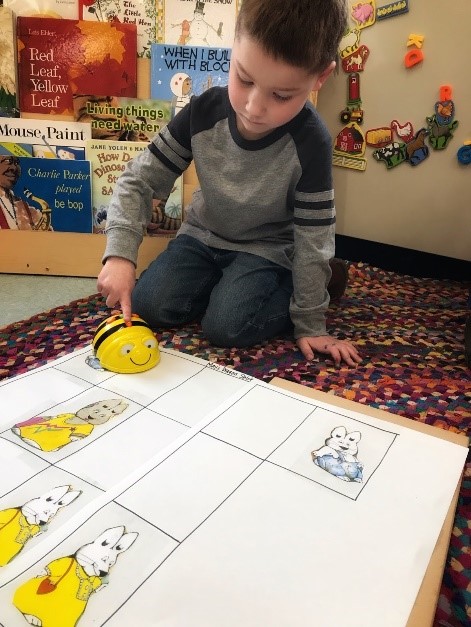
April 2nd – 10th is National Robotics Week, a time to focus attention on this exciting, interdisciplinary component of computer science. In Maine public schools, robotics comes to life in a variety of ways. From our high school students participating in robotic competitions, down to the youngest elementary student programming robots to follow a sequence, robotics is a grassroots effort that can be found in many schools, some of whom will be spotlighted throughout this week. National Robotics Week, dating back to 2009, has a simple mission – “to inspire students in robotics and STEM-related fields and to share the excitement of robotics with audiences of all ages.”
There are as many types of robots as there are holidays on the calendar and creative teachers have found a variety of ways to incorporate them into their classrooms. Among the most popular robots in middle and elementary schools are the Edison, Botley, and Wonder Workshop’s trio of Dot, Dash, and Cue. These robots each have their own unique appeal and functionality. When selecting which robot(s) to introduce to the classroom, an educator considers both its purpose and its potential. Introducing middle level students to robotics can seem daunting, especially if the educator is new to robotics themselves.
Many Maine educators have found creative ways to roll out a robot to students that gives everyone an opportunity to learn. Often it is part of a special event, perhaps even during National Robotics Week! A simple task can allow for collaboration and creative thinking as students troubleshoot through challenges with the robot. For the educator, it allows them to observe this process and the inevitable student engagement that follows. Consider these two examples from two Maine schools.
At Lincolnville Elementary School, teacher, Val Bemis, had her students design track layouts for Ozobots. Since it was October, students used Halloween themes to their track designs such as a haunted house or a trick-or-treating route. Students used “a lot of problem solving, persistence and patience in getting the robots to their final destinations,” Bemis said. “The students enjoyed it and had some celebrations when things went as planned or close to it!” Once students successfully coded their robots to their goal they were rewarded with a “sweet reward.” This project was an extension of the 10 levels of online coding challenges in ShapeTracer 2 from Ozoblockly.com.
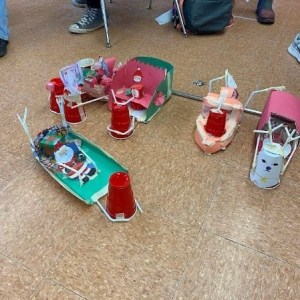
Another example of a thematic rollout comes from Hodgdon Middle School in southern Aroostook County. In the days leading up to the December break, students engaged in an engineering design challenge under the direction of science teacher, Sara McQuarrie. The students were tasked with creating a sleigh for Santa Claus that was pulled around by a Sphero robot (under a plastic cup). Sara provided each team with “Engineering Elves” and supplies. The constructed sleighs had to meet different criteria such as have enough room for Santa’s toys. Students learned how to calculate speed so they could predict who’s sleigh would be the fastest. They then tested out their predictions in several heats. Students enjoyed brainstorming why one sleigh was faster than another and critiquing their own designs. Finally, they ran their sleighs through a maze, which allowed them to test their coding skills with the Sphero. The activity was one of several choices that students had in the days prior to the winter break.
To learn more about opportunities for Robotics in Maine schools, check out Robotics Institute of Maine (RIM). For information about computer science in Maine schools, please check out the Maine Department of Education’s Computer Science page. If you have a robotics success story at your school, email jonathan.m.graham@maine.gov.

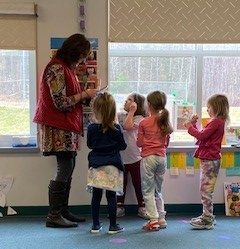
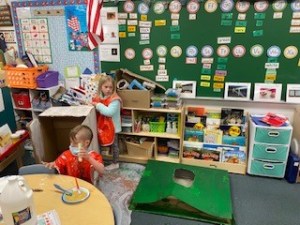 The Week of the Young Child provides an opportunity to shine a light on the importance of early learning and to focus attention on the needs of young children, their teachers, families, and communities.
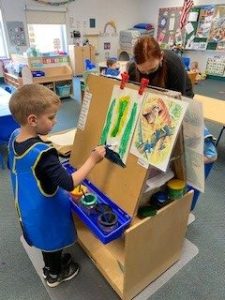 Pre-K and Kindergarten classrooms in the Oxford Hills School System utilize whole student, interdisciplinary instructional programs that the Maine DOE, in collaboration with Maine educators, have adapted for Maine using work originally developed by the Boston Public School System. Both instructional programs are content rich (aligned to Maine’s learning standards) and are designed around opportunity for structured play.
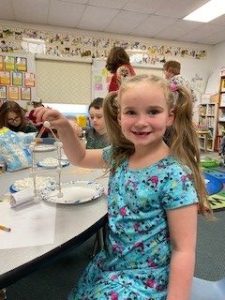 Oxford Elementary Principal, Tiffany Karnes, shared, “It is such a joy to go into a Kindergarten or Pre-K classroom and hear the conversations students are having with each other as they engage in their center work. Whether it is in the dramatic play area or the block area, students are using their imaginations and incorporating the vocabulary they have learned. They are building wolf dens when they are learning about animal habitats or dressing up as characters from a book that they have heard during read-aloud and acting out their story. The level of oral language and increase in vocabulary that we are seeing far exceeds anything we have seen in the past.
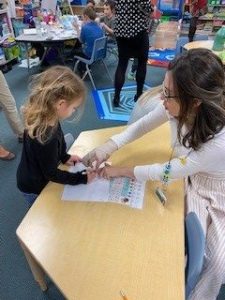 For more information about the Maine Department of Education’s early learning efforts, including Pre-K for ME and K for ME, contact Lee Anne Larsen, Early Learning Team Coordinator at